
THE OUTLAWS
OF
THE AIR
BY
GEORGE GRIFFITH
AUTHOR OF
"THE ANGEL OF THE REVOLUTION'S "OLGA ROMANOFF; OR, THE SYREN OF THE SKIES" ETC. ETC.
WITH ILLUSTRATIONS BY E. S. HOPE
To reduce total file size and download time this version of The Outlaws of the Air is a single HTML file with illustrations reduced considerably in size. The FF CD-ROM includes larger versions of all pictures and separate files for each chapter.
|
THE OUTLAWS OF THE AIR BY GEORGE GRIFFITH
WITH ILLUSTRATIONS BY E. S. HOPE |
|
CONTENTS.

CHAP.
PROLOGUE.
IN THE CAMP OF ISHMAEL.
A FEW minutes before one A.M. on Sunday, the 1st of July 1894, a man was walking with quick if somewhat irregular strides, as some men do walk when deeply absorbed in thought, up the Caledonian Road from King's Cross Station. By his dress he might either have belonged to the aristocracy of the craftsman class, or he might have been one of the poorer members of that class which is popularly considered to be above it.
But, whatever doubt there might have been as to his station in life, there could have been none as to the character of the face on which his slightly back-tilted black felt hat allowed the light of the gas-lamps to fall, as he walked with his thumbs in his waistcoat pockets, and his head thrown back just a shade from the perpendicular. It was a dark, clear-cut, clean-shaven face, with bright blue eyes, contrasting strongly with the black straight brows above them; a slightly aquiline nose, with thin, sensitive nostrils; short upper lip, firm, resolute mouth, square chin, and strong though not heavy lower jaw.
A single glance would have been enough to show that it was the face of a man in whom strong convictions were united with the will and the courage to translate them into action, no matter what difficulties or dangers might lie in the path marked out for him by what he considered to be his duty.
In stature, he was over the average, and but for a slight stoop of the shoulders which gave a suggestion of the student, borne out by the broad, square forehead and two little perpendicular lines between the eyes, he would have stood very nearly six feet in the low-heeled walking shoes which he wore.
To the casual glance of the passer-by, there was nothing to differentiate him from any other young fellow of his apparent age and station; and, therefore, it was quite out of the question that the policeman who was beginning his night's work by flashing his bull's-eye into the doorways, and trying door handles and shop shutters, should bestow more than a passing glance, quite devoid of interest, upon him as he strode by. He was sober and respectable, and seemingly making his way quietly home after a decently spent Saturday evening.
There was nothing to tell the guardian of the peace that the most dangerous man in Europe was passing within a few feet of him, or that if only he could have arrested him on some valid pretext that would have enabled him to lock him up for the rest of the night, and then handed him over to the Criminal Investigation Department at New Scotland Yard, - the officers of which had been hunting for just such a man as he for the last twelve months, he would have prevented the commission of a crime which, within twenty-four hours, was to plunge a whole nation into panic and mourning, and send a thrill of horror through Europe.
But he would have done far more than this, for by laying Max Renault, electrician and anarchist, by the heels just that moment, he would have ensured the discovery of documentary evidence which would have procured his extradition to France, and subsequent proceedings which would have saved the world from a reign of terror and an epoch of carnage and destruction in comparison with which the worst that society had so far learned to fear from anarchy would prove to be the merest trifle.
But how was that most unimaginative and matter-of-fact of mortals, a British policeman, to know that in his waistcoat pocket he carried a foreign telegram, which, properly interpreted, conveyed the intelligence that Caserio Santo was on his way to Lyons, to await there the order, in obedience to which he would with one stroke of his knife send a shudder through the civilised world; or how was he to divine that in the brain behind that open, honest-looking brow there were thoughts working which ere long might set the world in a blaze?
In St. Petersburg, or even in Paris, such a man would have been shadowed, his every movement would have been watched, all his comings and goings noticed, and at any moment - such a one as this, for instance - he might have been pounced upon and searched as a suspicious person; and assuredly, if he had been, the toils of the law would have closed about him in such fashion that little but a miracle could have set him free again.
But here in London, the asylum of anarchy, and the focus of the most dangerous forces in the world, he went on his way unquestioned and unsuspected, for, although the police were morally certain that such a man existed, they had no idea as to his personality, no notion that this smart, good-looking young fellow, whose name had never been heard in connection even with such anarchist clubs as were known to have their quarters in London, and much less, therefore, with any of the crimes that had been laid to the charge of anarchy, was in reality even a greater criminal than Vaillant or Henry, or even the infamous Ravachol himself
These were only the blind if willing tools, the instruments of political murder, the visible hands that obeyed the unseen brain, those who did the work and paid the penalty. But Max Renault was the brain itself, the intellect which conceived the plans for the execution of which the meaner and cheaper disciples of the sanguinary brotherhood of the knife and the bomb died on the scaffold, or wore out their lives in penal prisons or the mines of Siberia.
In a word, he was the moving spirit and directing intellect of what was soon to become the most dreaded body of men and women in the world, but which was now only known to the initiated as "Autonomie Group Number 7."
But the stroke which, if his true character bad been known, would have cut short his career, whether by rope or axe, would have done more than paralyse the brain which had plotted half the crimes that had been committed in the name of anarchy during the previous five years, and others in which the red hand had never been seen. It would have stopped his career at the most important moment of his life, and prevented him acting as the connecting link between two sets of circumstances which, though naturally of the utmost antagonism to each other, would, when united in such a personality as his, produce an explosion which might shake the world.
A few hundred yards past the top of the hill, Max turned sharply to the left, walked along a side street, turned to the right at the end of this, and went into another. Three minutes' quick walking brought him to the side door of a house which had a small timber yard on one side of it, and on the other a deserted beer-house, which had lost its licence, and remained unoccupied because the premises were fit for no other kind of business.
The house itself had a low shop front, with the lower half of its windows painted a dull green, and on the upper part was an arc of white letters making the legend: "Social Club and Eclectic Institute." A lamp over the shop door bore the same inscription in white letters on blue glass, but the lamp was out now, for it was one of the rules of the club that all members should leave the premises not later than twelve o'clock at night on week-days and half-past eleven on Sundays.
This rule, however, seemed only to apply to a certain section of the members. After Max had opened the side door with his latch-key, and ascended the stairs at the end of the passage, with a familiarity that enabled him to dispense with a light in the absolute darkness, he knocked at the door of an upstairs room which he found without the slightest hesitation. It was opened, and he found himself in the presence of four men and three women sitting round a table on which were the remains of what had evidently been a substantial and even luxurious supper.
Renault's action on entering the room was one which more than bore out what has been said of his character and the desperate work that he was engaged in. He acknowledged with a brief, curt nod the salutations of the company, then, putting his back against the door, he pulled his right hand out of his trouser pocket, and said, in a quiet, almost well-bred voice, which had just the faintest trace of foreign accent-
"Victor Berthauld, sit still!
There was a small slender-barrelled, six-chambered Colt in his hand, and the muzzle was pointed at a little lean, wiry, black-muzzled, close-cropped Frenchman, who had begun to wriggle uneasily in his seat the moment Max had made his appearance. His black eyes rolling in their deep sockets took one frightened glance from face to face, and then he said, in a voice to which he in vain tried to impart a tone of bravado-
"Well, Comrade Renault, what do you want with me, and what is that revolver drawn for?"
"Don't `comrade' me, you little rat," said Max, with a short, savage laugh. "Tell me who tried to warn the Paris police that Carnot's life was in danger. Tell me who would have had Santo arrested at Marseilles if his telegram had only got into the hands it was intended for.
"Tell me who means to repeat the message to-morrow morning to Paris and Lyons, and who means to have this place raided by the English police at an inconvenient hour within the next week, on the ground of unlawful gambling being permitted here. Tell me that, you dirty hound, and then I'll tell you, if you don't know, what we usually do with traitors."
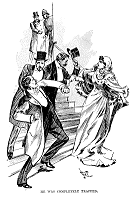
Berthauld sat for a moment speechless with fear. Then, with an imprecation on his lips, he leapt to his feet. Not a hand was moved to restrain him, but as he rose to his full height, Renault's arm straightened out, there was a crack and a flash, and a little puff of plaster reduced to dust leapt out of the angle of the wall behind him; but before the bullet struck the wall, it had passed through his forehead and out at the back of his head, his body shrank together and collapsed in a huddled heap in his chair, and Max, putting his pistol back into his pocket, said, just as quietly as before-
"It's a curious thing that even among eight of us we must have a traitor. I hope there aren't any more about. Take that thing down to the cellar, and then let us get to business; I've something important to tell you."
So saying, he walked round the table to a vacant armchair that stood at the end opposite the door, threw himself back in it, took out a cigar and lit it, and, with the same unshaken hand that a moment before had taken a fellow-creature's life, poured out a tumblerful of champagne from a bottle that stood half empty beside him.
Meanwhile, two of the men had risen from their seats. One of them tied a red handkerchief tightly round the dead man's skull, to stop what little bleeding there was from the two clean-cut wounds, and then the two picked him up, and, without a word, carried him out of the room.
"I hope I haven't shocked you by such a rough-and-ready administration of justice," said Max, half turning in his chair and addressing a girl who sat next to him on his right hand.
"No," said the girl. "It was obviously necessary. If half you charged him with is true, he ought to have been crucified, let alone shot. I can't think what such vermin are made for."
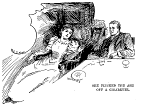 And as she spoke, she flicked the ash off a cigarette that she held between her fingers, put it between as dainty a pair of lips as ever were made for kissing, and sent a delicate little blue wreathing cloud up to mingle with the haze that filled the upper part of the room.
"And now, What is this interesting something that you have got to tell us, Monsieur Max?"
"All in good time, Ma'm'selle. I must ask you to wait until Casano and Rolland have come back; but meanwhile I will whet your curiosity by telling you I am thinking seriously of exiling myself for a couple of years or so."
As he said this he looked keenly from under his half lowered eyelashes into the girl's eyes, as if expecting, or, perhaps, only half hoping for, some sign of emotion.
Two dark-fringed lids lifted suddenly for an instant, and then dropped again, and in that instant two liquid deep grey eyes, which before now he had seen grow almost black with passion, looked at him inquiringly. And that was all.
"That is news indeed," she said. "It must be something very important that takes Monsieur Max away from the scene of action at such a critical time as this."
"Yes," said Renault coldly, and with an almost imperceptible contraction of the brows, "it is important; so important, in fact, that I don't think I am exaggerating when I say that if I had not come back to-night, instead of to-morrow, and had given that fellow twelve hours more grace, the fate of the whole world would have been changed."
"What! the fate of the world?" said she half incredulously, while the others ceased their conversation and turned to listen to this strange passage of words.
"Yes," said Max, slightly raising his tone till it had a note of triumph in it, and at the same time bringing his hand down on hers, which was resting on the arm of her chair. The quick blood came to her cheeks and a flash of anger to her eyes, and she made an effort to withdraw it, but he held it fast, and, before she could speak, went on-
"Yes, Lea, if the venture that I am going to undertake turns out a success, I shall hold the fate of human society in my hand, just as I hold this pretty little hand of yours, only in a somewhat rougher grip, and then-"
"And then, Monsieur Max," interrupted the girl, snatching her hand away as the pressure of his relaxed for a moment. "I suppose you will have what you have not got now, the right to take what you want by the universal law of might."
"Yes," he said, with another laugh, a somewhat more pleasant one this time. "And as I have the power; so will I use it, whether in love or war. Are you agreed?"
Lea looked at him steadily for a moment, and then, with a swift flush overspreading as fair a face as ever man's eyes rested upon with love and longing, said in a low voice that had just a perceptible tremor in it-
"Yes, I suppose might is right after all, in love as well as war and nineteenth century society. He who can take can have; but, if you please, we will wait until you can take."
"Agreed!" he said. "That's a bargain. And now we'll get to business. Have you found Comrade Berthauld a quiet resting-place?" he continued, addressing the two men, who had just returned to the room.
"Yes," said Casano in his pleasant Italian tenor. "Ve haf gifen him a bath. I don't sink zere vill be very mooch left of him or his clothes by ze morning."
"Very well," said Max, taking some papers out of the breast pocket of his jacket. "Now, sit down and listen."
They obeyed in silence, Casano first bolting the door.
"First," said Max, looking up from his papers and giving a quick glance at the expectant faces round the table, "Comrade Caserio Santo of the Cette Group has been chosen by lot to execute the sentence passed by this group on the 6th of February on Sadi Carnot in return for the lives which he refused to spare. Santo will be at Lyons soon after daybreak. If that rat Berthauld had got out of this room alive, Santo would have been arrested, and Carnot would have escaped. I have the proofs of his treachery here, if you wish to see them. As it is, is it agreed that I shall direct him to offer our congratulations to M. le President on his visit to Lyons?"
He stopped and looked round the table again. The others nodded in silence, but Lea looked up with something like softness in her eyes, and said-
"What a pity! Poor Carnot is an excellent fellow in his bourgeois way, isn't he? Quite a model husband and father, incorruptible in politics, and all that sort of thing. Wouldn't some one else do as well, say, Casimir-Perier or Dupuy? Incorruptible politicians are not so plentiful in France just now."
"The better the man the better the effect," said Max drily. "It is just as easy to strike high as a little lower. There are plenty of politicians in France, but only one President."
"Ja! dass is so," said a bright-faced, square-headed little German sitting opposite to Lea. "Strike high and hit hart. Dat is de vay to make dese sheepsheads open deir moufs and stare ven dey reads de papers on Monday. Let Carnot go first, and den - veil, den someone else. Dere are plenty of dem to spare."
A laugh followed this speech of Franz Hartog, who may as well be introduced here as elsewhere as the cleverest engineer in Europe, and an anarchist heart and soul-if he had a soul, which some of his nearest acquaintances were very much inclined to doubt.
"Very well," said Lea; "I withdraw my objection, if, indeed, I ever had one."
The veto of one member, by the rules of the Group, would have been fatal to the execution of the proposal. As Lea withdrew hers, she flicked some more ash off the end of her cigarette, and with it virtually fell the man whose death all Europe would be mourning within forty-eight hours.
"Then that is settled," said Max. " I will wire to Lyons the first thing in the morning. Now, Hartog, have you anything to tell us about this gunboat of yours?"
"Ja, dot is all arranged. Her keel vill be laid on de slips next mont. I have designed de engines mineself, and de speed contracted for by de firm mit de Russian Government vill be thirty-five knots, and you can bet dat my engines vill make her do it. She vill make her private trial, mit all her coal and arms and ammunition on board according to de contract, mitin eighteen monzs from now, and you can depend upon me to be on board her at de time, mit a suitable majority of de firemens and crew to do vat ve vants snit her.
"You can be sure, too, dat de oders vill have got someting inside dem dat vill not make dem mooch good if ve have to have a small scrimmage after all to get possession of de boat. Den ve vill rendezvous at de proper place, and den dere vill be some vild time on de Atlantic and de Cape routes ver dey bring de specie and de diamonds.
"Ja, you believe me, Monsieur Max and comrades, Franz Hartog vill make you de masters ov de sea, and you shall laugh at all de fleets of Europe ven dey try to catch you. Dat vill be anarchy vot vill be worth calling somdings. Ja, it is a great scheme, and ve shall do it, you believe me."
The little German stopped and looked round the table, rubbing his hands, and amidst the murmurs of approval that followed his speech, Max nodded laughingly to him and said-
"Yes, my friend, you are quite right. That, is a great scheme, and if you can capture that little greyhound for us when she is built and armed, you will have done more for anarchy, and driven a bigger nail into the coffin of the tyranny of commercialism, than ever any man did yet. And now I am going to tell you of a greater scheme than that."
"Greater as dot!" exclaimed the German, his steely blue eyes glittering through his spectacles with excitement. "How can any scheme be greater as dot?"
"Listen and you shall hear," said Max, "and I won't take very many words to tell you."
"Some years ago now, when I was little more than a lad, and before I came to believe that there is no remedy for the present state of affairs except force and terrorism, I joined a society of amiable idiots who meet at each other's houses in different parts of London, and who call themselves the Brotherhood of the Better Life.
"I have kept up my membership, partly because it amused and interested me, and partly because I had a sort of idea that some day something might come of it. For a long time they have had a scheme on foot to emigrate to some out-of-the-way part of the world, and start one of those social colonies which of course always come to grief in some way or another, as the Freeland one has just done; but, up to a few weeks ago, they never had a chance of making a start, for lack of money.
"Then, about a month ago, we had a regular romance, and something occurred that I would never have credited if it hadn't happened under my own eyes. Nearly six months ago, one of our members who pretended to be a craftsman - but who was really nothing of the sort, for he was what they call a gentleman from head to foot-disappeared.
"For five months we heard nothing of him, and then, one night, after a lecture by a sort of latter-day prophet of ours, a very clever but misguided fellow called Edward Adams, a stranger came out from the audience and asked to be allowed to say a few words.
"Of course, we allowed him to, and then he started out and told us that he was the father of the young fellow who disappeared from amongst us, that his son was dead, and that on his death-bed he had converted his father to his own social views; and not only this, but he had made him promise to give what would have been his inheritance to the society to carry out the scheme of the social colony. Then he told us that he had come to fulfil this promise, and, if we would allow him, to take part in the venture himself.
"Well, we consented, on condition that he accepted the Constitution which we had been, as I always thought, playing at drawing up, and this he agreed to do, and then staggered us by saying how much he was prepared to devote to the carrying out of the scheme. We expected a few hundreds at most, perhaps just enough to give us a start with what we could get together of ourselves, so you can imagine what we felt like - and I in particular - when the figure came out at over a hundred thousand pounds."
"Ein hundert tousand pound!" cried Hartog, unable to restrain his enthusiasm. "Vy, I could build nearly tree ships of tirty-five knots mit so mooch! Can you get hold of it, Monsieur Max?"
"I'm not going to get hold of that, friend Franz, but of something a good deal more important than money. It turned out that our fairy godfather was no other than Frederick Austen, the head of the big engineering firm of Austen and Son, of Queen Victoria Street and Woolwich. The death of his son has made it impossible for an Austen to succeed him in the business, and that, combined with his change of social views, has decided him to give up the business altogether.
"Of course, I needn't tell you that we accepted him and his money with thanks. But there was something stranger to come yet. Last night, at a meeting of the committee, of which I have the honour to be a member, he confided to us a secret which, as he said, would enable the colony not only to hold its own against any who might wish to interfere with it in case it prospered, but which will enable the colonists to enforce an object-lesson in peace, goodwill on earth, and all that sort of thing, on the first nations that go to war with each other, after they are in a position to wield the power that it will give them.
"Then" - and here Max Renault leant forward on the table and instinctively lowered his voice while the others leant forward also to catch what was coming- "he told us that just before his last illness his son had completed a series of experiments which enabled him to say with truth that the problem of aerial navigation had at last been solved, and that he had solved it.
"He told the secret to his father, and he at once placed all the resources of his business at his disposal, and, comrades, believe me or believe me not, as you like, but I tell you that less than twenty-four hours ago I saw in action a working model of a flying ship which Frederick Austen is going to build with my assistance in the Brotherhood's New Utopia."
A murmur half of amazement and half of incredulity ran from lip to lip as Renault uttered these momentous words, and Lea suddenly straightened herself up in her chair, stretched her shapely arms upward, and then, folding her hands behind her head, looked at Max with undisguised admiration in her eyes, and said, with a ring of exultation in her voice-
"Ah, now I understand you, after wondering all this time what your parable was going to lead up to. Excellent, Monsieur Max, excellent! You have not been playing the anarchist wolf in the socialist sheepskin for nothing. You will emigrate with these good folks to their New Utopia, wherever they may find it, absorb such ideas as may be useful, appoint yourself aerial engineer to that excellent converted capitalist, and then-"
"Yes, and then," said Max, with a significant movement of his hand towards the pocket that contained his revolver, "when the Cruiser of the Air is built and equipped, and I have satisfied myself of her working power, she will be found missing some fine morning, and so shall I.
"I'm not going to exile myself with a lot of people like that for nothing, I can tell you. If I'm the man I take myself for, within three years from now that air-ship shall carry the red flag through the clouds, and terrorise the whole earth from east to west and pole to pole.
"And now," he continued, rising to his feet, under the stimulus of his own words, "if you've any more champagne, fill up. I've a toast for you. For another year or two you must carry on the work without me, or stop it altogether, as seems best to you; and meanwhile you, Hartog, shall get your thirty-five knot sea-devil afloat and to business till you've levied ocean tolls enough to give us funds to build an aerial fleet on the model of the ship that I'll bring you, and then we'll have no more hole-and-corner assassinations and no more pettifogging bomb-throwing. We'll declare war - war to the knife - on the world that we hate, and that hates and fears us, and then-"
"Here's your glass, my Lord of the Air that is to be," said Lea, rising and handing him a full tumbler of champagne with a gesture of deference that was not altogether assumed. "And so let us have your toast."
"You shall have it, short and sweet," said Max, taking the glass and lifting it above his head. "Here's life to those we love, and death to those we hate - Vive L'Anarchie and the Outlaws of the Air!"
"Mein Gott, but dat is a great scheme! He vill set de vorld on fire if he only comes properly to bass," said Franz Hartog, as he drained his glass at a gulp, and then stood gazing at Max Renault with a look that was almost one of worship in his little twinkling eyes.
CHAPTER 1.
UTOPIA IN THE SOUTH.
ON the 21st of November 1898, the Calypso, a team yacht, rigged as a three-masted schooner, and measuring between four and five hundred tons, met with a rather serious accident to her engines in one of those brief but deadly hurricanes which are known to navigators of the South Seas as " southerly busters."
They are the white squalls of the South, and woe betide the unhappy ship that they strike unawares. Over the smooth, sunlit waters there drifts with paralysing rapidity a mass of hissing, seething billows, churned into foam and then beaten down again by the terrific force of the wind that is roaring above then. Often there is not a breath or a puff of air felt by the ship until the squall strikes her, and then the blow falls like the united stroke of a hundred battering-rams.
If the ship is stripped and ready for the blow, she heels over till the water spurts in through the lee scupper holes and half the deck is awash. If there is a rag of sail on stay or yard, there is a bang like the report of a duck-gun, and,
if yon have quick eyes, you may see it flying away to leeward like a bit of tissue paper before the gale, and if it has not yielded with sufficient readiness to the shock of the storm, a sprung topmast or a snapped yard will pay the penalty of resistance.
Meanwhile, what was a few minutes ago a smoothly-shining sea, scarcely ruffled by a ripple, is now a white, boiling mass of swiftly rising billows, amidst which the straining, struggling vessel fights for her life like some stricken animal.
It had been thus with the Calypso. A stout new forestaysail that had been hoisted in the hope of getting her head before the squall had been struck square, and had resisted just a moment too long, at the cost of a sprung foretopmast. Then, an effort to bring her round with the screw had resulted in the disaster that practically crippled her.
A big sea came rolling up astern, her nose went down and her stern went up, her propeller whirling in the air, and, before the engine could be stopped, there came a grinding, thrashing noise in the engine-room, and, a moment later, the yacht was drifting helplessly away before the storm with a broken crankshaft.
When this happened, the Calypso was on a voyage from New Zealand to the Marquesas Islands, between four and five hundred miles to the north-east of Auckland. The screw had been hoisted out of the water and a spare foretopmast fitted; but only five days after this had been done she was caught in a heavy gale from the south-westward, and got so badly knocked about that when every spare spar on board had been used in refitting her, she could only carry sail enough to take her at four or five knots an hour before a good topsail breeze.
The result of this double misfortune was, that a month later she was still on the southern verge of the tropics, beating about in light, baffling winds, unable to make her way into the region of the south-east trades.
The Calypso was owned and sailed by Sir Harry Milton, Of Seaton Abbey, Northumberland, landowner and ironmaster, who rather less than three years before had come of age and entered upon his inheritance of broad acres, mines, and ironworks, which yielded him an income not far short of thirty thousand a year, and in addition to these a comfortable nest-egg of nearly half a million in hard cash and good securities.
For the last year and a half, he had been seeing the world in the pleasantest of all fashions - cruising about from port to port, and ocean to ocean, in his yacht, in company with his sister Violet, a pretty, healthy, high-bred brunette between eighteen and nineteen.
Sir Harry himself was a good specimen of the typical English gentleman, standing about five feet ten in his deck shoes, well built, broad-shouldered, ruddy-skinned, and clear-eyed, with features that were frank and pleasing in their open manliness, rather than strictly handsome, and yet saved from mediocrity by that undefinable, yet unmistakable, stamp of good breeding which distinguishes, as was once wittily if somewhat cynically said, the man who has a grandfather from the man who only had progenitors.
Apart from the officers and crew of the Calypso, there was only one member of the yacht's company who needs introduction in special terms. This was Herbert Wyndham, second lieutenant of Her Majesty's gunboat Sandfly, an old
schoolfellow and bosom friend of Sir Harry's, and just now on a year's invalid leave in consequence of a nasty bullet wound received in storming a stronghold of a West African slaver chieftain, at the head of his blue-jackets. Sir Harry had picked him up at Cape Town, when he was beginning to get about again after the fever that had followed on his wound, and, with his sister's assistance, he succeeded without much difficulty in persuading him to spend the rest of his
leave on a cruise to the South Seas in the Calypso.
In person, Lieutenant Wyndham was a well set-up, clean-limbed young fellow of twenty-six, with a good-humoured face and bright hazel eyes, which looked alertly out from under a square, strong forehead that matched the firm chin, which, according to the modern fashion of naval officers, was clothed with a close-clipped, neatly-trimmed beard a shade or so lighter than the close, curly chestnut hair that formed not the least of his personal attractions.
k As week after week passed, and neither land nor sail appeared in sight from the decks of the half-crippled yacht, Sir Harry began to feel a little natural anxiety for the ultimate safety of his beautiful craft and of those near and dear to him on board her. Another such a squall or a gale as she had already suffered from would almost infallibly wreck her in her present state, and both he and his sailing-master would have been glad to reach even the shelter of a coral lagoon, within which she could take refuge until she could be thoroughly overhauled in a fashion that was not possible out in the open sea.
But most things have an end,- even calms in the South Pacific,- and by Christmas Eve the Calypso had at last crept out of the zone of calms and had begun to feel the first fitful puffs of the trade winds. Then, about an hour before sunrise on Christmas morning, the unexpected, but none the less welcome, cry of "Land, ho!" brought everyone, from Sir Harry himself to his sister's maid, or the "Lady-in-Waiting," as Lieutenant Wyndham was wont to call her, tumbling out of their berths and up on deck.
No one who has not seen the sun rise over an island in the South Pacific can form any adequate idea of the scene that greeted the eyes of the crew of the Calypso, as the light broadened and brightened to the eastward in front of them. The island paradises of the South Sea are like no other part of the earth. Their beauty is entirely their own. No word-painting can ever do full justice to it, and the reader must therefore fain be content with the purely geographical description, which will follow in its proper place, of the island that was seen rising out of the smooth sapphire sea to the poop-deck of the Calypso on Christmas morning, 1898
In less than half an hour after the welcome hail had run along the deck, Sir Harry and the sailing-master were eagerly scanning the land, now about ten miles distant, through their glasses.
"What do you make it, Mr. Topline?" asked Sir Harry, after a good long stare at the mysterious land, taking his binoculars from his eyes and looking at the old salt with a puzzled expression.
"I can't say, Sir Harry. I've never seen the island before, and I don't believe it's down in the chart. You see, we've got clean out of the track of the trading vessels and mail steamers, and this part of the South Sea is even now very little known. I'd no idea there was land within three hundred miles of us," replied the sailing-master.
"No, it's not on the chart, for I was following Mr. Martin yesterday when he was pricking off the course, and there was nothing near us. Confound the wind! There it
goes to a dead calm again. Hullo, what the deuce is that?"
As he spoke, Sir Harry jumped, glass in hand, on to the rail that ran round the flush deck of the yacht, climbed half a dozen rounds into the main shrouds, and again levelled his glasses in the direction of the island. A moment later he sang out to the sailing-master-
"Topline, what do you say to a steam launch coming off from your unknown island?"
"A steam launch! Well, I'll be kicked if it isn't!" said the other, mounting the opposite rail and focusing the approaching craft. It must be the steam tender of some man-o'-war surveying the island or getting fruit and water, only she's got no funnel, and I don't- Why, she's going twenty knots an hour through the water if she's going a yard! She's no man-o'-war tender, not she!"
All eyes on board the Calypso were now turned on the strange craft, which, by this time, had cleared the reef and was coming speeding towards them over the smooth, windless sea, at a pace which proved that, whatever her motive power
was, it lacked nothing on the score of efficiency. In less than half an hour, she was describing a wide curve round the stern of the yacht, preparatory to running up alongside.
It was at once evident that the sailing-master had been quite wrong in his first guess that she was the steam tender of a man-of-war. She was a ten or twelve tonner, long, narrow, and low-lying, white painted, with a bright gold stripe from stem to stern, and covered, fore and aft, with a snowy-white curtained awning, bordered with a fringe of brilliant colours. In fact, as far as appearances went, she might have been spirited from the Upper Thames on a Henley Regatta day to the distant and lonely region of the South Sea, out of which were now rising the high bluffs and green slopes of the unknown island whence she had come.
As she came up alongside the Calypso, a youth of about eighteen, who was standing at the wheel amidships, hailed the yacht in English, and wished the new-comers "A Merry Christmas!" in a tone which left not the slightest doubt as
to his nationality. Sir Harry returned the greeting as heartily as it was given, wondering not a little, like the rest of his shipmates, not only at the presence of such a dainty little craft in such out-of-the-way waters, but also at the strange
contrast between the manner and language of the youth who had hailed him, and his entirely uncivilised appearance - uncivilised, that is to say, from the standpoint of modern fashion.
His bearing and speech were those of a well-educated and cultured young gentleman at the latter end of the nineteenth century, but his dress was more like that of a Phoenician mariner of a thousand years ago. His long brown hair fell in curls on his broad shoulders and clustered thickly about his smooth forehead, held back from his bronzed, handsome face by a narrow fillet of metal that looked like
polished aluminium.
His dress consisted of a long over-tunic of soft grey woollen cloth, bordered with cunningly-worked embroidery blue silk, open at the neck, where it showed a white linen close-fitting under vest, and confined at the waist by a red silk sash, wound two or three times round, and hanging in heavily fringed ends over his left hip. A pair of soft yellow leather moccasins, beautifully worked in many-coloured beads and bead embroidery, covered his feet, and came half way up the calves of his bare, muscular legs.
"What craft is that, and where do you hail from?" asked Sir Harry, some dim notion of pirates associating itself in his mind with the somewhat fantastic attire of the youth at the helm.
"This is the electric launch Mermaid, and yonder island is Utopia," he replied. "We came out to see if we could be of any assistance to you. You seem to have had rather a bad time of it somewhere, by the look of your spars."
On hearing this queer, though kindly expressed reply, Sir Harry began to think that the Calypso must have drifted out of the realms of reality and into the regions of romance, for the only Utopia he had ever heard of had been Sir Thomas
More's Nowhere. But good manners forbade any expression of surprise or incredulity, and so he answered laughingly-
"I had no idea that a Utopia existed on earth in these degenerate days, but I am delighted to learn that I am wrong, and I'm also much obliged to you for coming out to us. We've disabled our engines and got our spars badly knocked about. But won't you come on board and let us introduce ourselves?"
"Thank you, if you'll throw me a rope, I will. Never mind the gangway ladder. Here, Tom, take the wheel, and don't let those girls run away with you."
"That's just what he'd like us to do," came in the laughing tones of a girl's voice from under the forward awning as the young fellow caught the rope and swung himself lightly over the Calypso's rail.
"I didn't know you bad ladies on board," said Sir Harry, meeting him at the gangway and holding out his hand; "if I had known, I would not have hailed you so unceremoniously."
"There are no ladies in Utopia, and the Utopians dislike ceremony very much, so it's just as well you didn't," replied the youth, with a laugh, as he took Sir Harry's hand.
"But surely that was a young lady's voice I heard just now, and a very sweet one too, if I heard aright."
"Well, it was a girl's voice, certainly. There are three of them on board the Mermaid, but they wouldn't like to be called young ladies. There are only women and girls in Utopia. We left the ladies behind in England."
He checked himself rather abruptly as his eyes met Violet's gazing in frankly undisguised astonishment at him. Then, with a slight flush on his cheeks, he went on-
" But pardon me, I had better introduce myself instead of talking about our manners and customs, which I daresay you will learn before long. I am Frank Markham, skipper of the Mermaid, and her crew is at present composed of Tom
Harris, Ralf Smith, Lucy Summers, Annie Hilton, and Dora Merton, the girl who made a very true remark about Master Tom as I came on board."
As young Markham said this, he went to the side and sang out-
"Come now, Mermaids, show yourselves! I want to introduce you to our visitors. By the way, you have not told me your names yet," he continued, turning to Sir Harry.
"My name is Harry Milton; I am owner and skipper of the Calypso. This is my sister Violet, this is Lieutenant Wyndham, of Her Majesty's ship Sandfly, and this is Mr. Topline, my sailing-master."
As Sir Harry made the introductions in turn, the curtains which ran round the fore-deck of the launch were drawn aside, disclosing three pretty long-haired girls, picturesquely, if somewhat lightly, attired in gay tunics and cloaks and
long moccasins, profusely ornamented with many-coloured silken embroidery, fringes, and curiously worked clasps and armlets of lustrous white and yellow metal. Instinctively every man who was looking over the bulwarks of the Calypso raised his hat or his cap as the three girls, half gravely, half shyly, returned the salutes from the deck of the yacht.
"And now, what can we do for you?" asked Markham when this little ceremony was over. "I suppose you want to get into port and refit as soon as possible?"
"That's just what I do want to do very badly," replied Sir Harry. "But where am I to find a port and a dockyard in this part of the Pacific?"
"Both are within less than half a dozen miles of us, and the Mermaid shall tow you in in an hour if you will first oblige me with five minutes' conversation in private."
"Certainly; come into my cabin," said Sir Harry, leading the way to the companion.
In less than ten minutes they returned, Sir Harry looking just a trifle mystified, and without loss of time a light hawser was got out and made fast to the Mermaid, and the two vessels began to move smoothly towards the white reef
in the distance, fringing the hitherto unknown island of Utopia.
CHAPTER II.
GOING INTO PORT.
IT took a little over an hour for the Mermaid to tow the Calypso from where she had lain becalmed, into the lagoon of Utopia. As the yacht approached the island, it rapidly became manifest that, whether chance or design had guided the Utopians in the selection of their far-away home, they had had the good fortune to choose a spot that well deserved to be called beautiful, even in that part of the world where land and sea and sky seem to conspire to wear their brightest and most beautiful aspects.
Between these two headlands lay a wide, irregular bay, fronted by the broad expanse of brilliant emerald-green water and backed by verdant slopes which, clothed with all the wonderful vegetation of the southern tropics, rose and
fell, valley behind valley and hill behind hill, until they merged in the distance with the heights of the volcano and its attendant chains.
"That is Mount Plato," said Markham, who at Sir Harry's invitation had remained on board the yacht to act as cicerone to the visitors to Utopia. "We call it that
because under its shadow we hope to found our New Republic."
"But isn't the Republic founded yet?" asked Violet. "If you'll allow me to say so, I should have thought it was not only founded, but had reached a considerable height of prosperity."
"Yes," chimed in Wyndham, with a movement of his hand towards the Mermaid. "If twenty-knot electric launches are not a sign of a fairly prosperous civilisation, I can hardly see what would be."
"Twenty knots!" laughed Markham. "Why, the Mermaid can run thirty when we're in a hurry, and we've got a three-thousand tonner on the slips now in the dockyard that we are building on a new principle, and which we expect to
make forty."
"Whew!" whistled Wyndham, lifting his eyebrows in undisguised astonishment. "Forty knots? If you can build vessels like that, you Utopians ought to be millionaires to a man. Why, there isn't a European Government that wouldn't willingly give you half a million apiece for as many of them as you could turn out.
"Our own Admiralty is perhaps the most thick-headed institution of its kind under the sun; but I believe even it would give me a good deal for the secret of a ship like that, if you would let me take it home with me."
Instead of replying directly, Markham looked at Sir Harry, who at once took the hint, and said, with a shake of his head-
"No, Wyndham, I'm afraid there's no chance of that, or anything of the kind. In fact," he said, "I may as well tell you, and you gentlemen also," he continued, with a glance at the sailing-master and his chief mate, "that I have accepted
the invitation to put into Utopia on the sole condition on which it was given, and I have pledged my word of honour for myself and everyone on board the yacht that no attempt will be made to learn anything that is not freely told to us, and even that if we learn anything by accident, we will behave both here and at home as though we
had never known it.
"You see, we have not the slightest right to pry into the secrets or discoveries of our hosts, and I'm sure you will agree with me that in giving such a pledge I was making the least return I could for the kindness and assistance that I'm sure we shall receive on shore."
"Oh, quite so, quite so!" said the lieutenant. "Of course I was only joking. A man would deserve to be shot who did a caddish thing like that. Still, just now, you know, a forty-knot ship properly armed would be simply invaluable, not only to an individual nation like ourselves, but to the civilised world at large. You know what I mean."
"Ah, yes!" replied Sir Harry, his face becoming grave in an instant. "You mean, to chase that brute with the red flag and hunt him down to wherever his lair is. Yes, a ship that could do that would be cheap at a couple of millions, and I believe Europe would subscribe the money to buy it in a week, even if the Governments couldn't find it. I'd give ten thousand myself with pleasure."
"Pardon me," said Markham, turning round from the rail where he had been standing, pointing out the different features of the island to Violet, while Sir Harry was speaking. "But that sounds almost like a modern edition of one of the old pirate stories. Surely you don't mean to say that there are any pirates nowadays, either with black or red flags?"
"I am sorry to say that there is at least one," said Sir Harry; "and he can do more damage an a month than all the old pirates put together could have done in a year."
"What a villainous shame!" said Markham, looking for the moment graver and sterner than they would have thought possible. "That will be news for them ashore if you care to tell them the story. In fact, I'm afraid we shall put a considerable tax on your generosity in that way, for we haven't had any news from the outer world for quite twelve months now.
"Lovely, indeed!" said Violet, who, during the conversation, had been looking about her with all her eyes, as though she could never get enough of the beauty of the scene. "I've heard and read all sorts of stories about the Pacific Islands, but I couldn't have believed that anything earthly could have been so beautiful as this."
And truly the scene that was visible from the bridge of the Calypso on which they were now standing was worthy of the enthusiasm of her words. Every colour that nature uses in painting her incomparable landscapes was here, either
blended or contrasted to produce the most exquisite effects.
On land were mingled a hundred tints of green and gold, from the sombre hues of the banyan leaves to the golden ears of the patches of corn that were ripening on the upper hill slopes; trees and shrubs of every shape and height succeeded each other, from the lowly bananas to the towering palms and the splendid pines that crowned the higher summits of the mountain ranges; and, high above all, the bare, blue-grey cone of the volcano rose to crown a picture which no words could adequately describe.
But when, to the medley of hill and vale, mountain rock and ravine, presented
by the island itself, were added the snowy white of the billows breaking on the long reef - which, save for one narrow opening, stretched from point to point across the bay - the emerald-green of the lagoon inside it, and, outside, the deep
blue of the open ocean reflecting the sapphire of the cloudless sky, the picture became almost unearthly in its strange and varied loveliness.
The roar of the tumbling billows upon the reef sounded louder and louder in the ears of the Calypso's company as the Mermaid and her charge ran in towards the opening.
"I think I had better take your wheel now," said Markham to Sir Harry when they were within about five hundred yards of the reef. "This is rather a ticklish piece of steering for anyone who doesn't know the currents."
"I should think so," said Wyndham, looking ahead, as Markham went and took the wheel from the sailor who was steering. "I know I wouldn't care about the job of bringing a torpedo-boat in here in the dark. Why, there doesn't seem to be much more than sixty feet of clear water to get through. If this place were properly defended, it could be held against all the navies of Europe as long as they chose
to stop here."
"Yes," laughed Sir Harry; "especially with one or two forty-knot cruisers dodging about outside and making a judicious distribution of torpedoes. What do you think, Topline?"
"I think, Sir Harry," growled the old salt, "that I'll believe in forty-knot cruisers when I sees 'em. If a speed like that's possible, why can't all the Governments of Europe, with all their money, build a cruiser that'll catch that craft, whatever she is, that's been playing up old Scratch among the Atlantic liners, according to the news we got at Sydney?"
"Because they don't know how," said Markham, without turning his head, "and because there are some secrets that money won't buy."
As he spoke, he gave the yacht's wheel a turn and swung her about four points to port, in imitation of a similar manoeuvre of the Mermaid, which was apparently running dead on to the reef. Within fifty yards of the white water the Mermaid shot across into the seething foam, doubled sharply, and ran to starboard at right angles to the yacht. This brought a strain upon the hawser, and as it came up dripping out of the water and tightened, Wyndham could not repress an exclamation of surprise.
"That's queer towing; what on earth is she doing that for?"
"You'll see in a moment," said Markham, giving a spin to the wheel and swinging the yacht round after the launch. By the tenseness of the rope, it was evident that the Mermaid was pulling very hard upon it. The Calypso came round,
and then her stern swung with a rush into the swirling white water that was boiling about the narrow entrance.
Then, while the party on the bridge watched with barely concealed anxiety the breakers which every moment brought nearer, until they were roaring only a stone's throw away, the line slackened slightly, and just as the sailing-master, unable to contain himself any longer, sang out, "She'll be on the reef in a minute! Tell the launch to tow harder, man; can't you see she's going?" the foaming, tossing mass
of breakers suddenly seemed to slide away ahead, and a minute later the Calypso had drifted through the opening stern first, and was floating motionless on the smooth, glittering water of the lagoon, with the Mermaid lying a few yards ahead of her.
"There's a twelve-knot current coming round the corner of that reef," said Markham, leaving the wheel and turning to the sailing-master. "You could no more tow a disabled ship through there than you could tow her over the reef itself. The only way to get the yacht in was to let her drift in - with a proper check on her, of course."
"I beg your pardon, young gentlemen," said Topline, 1ooking just a bit crestfallen. "I was wrong, and you were right. You know the place, and I don't; and I'll be hanged if I could have got her in myself."
The Mermaid now got under way again, and began to tow the Calypso across the lagoon towards the high bluffs at the southern arm of the bay. The bright, smooth water of the bay was already dotted by dozens of pretty little craft, canoes with outriggers, some double-hulled catamarans with great white sails that swept them along at a famous pace, others, canoes of the shape seen on the Canadian lakes and rivers, and others again just such craft as you may see any summer's day on the Thames between Putney and Richmond, large, roomy row-boats, slim outriggers, and broad, flat centre-boards, with their wide spread of snowy
canvas.
All came racing away with the land breeze from the head of the bay, where half a dozen jetties ran out into the water, and where, behind the snowy coral beach, the verdant shore was dotted with white houses, peeping out from shady groves of lime and orange trees and spreading tree-ferns, above which the stately palms lifted their gently-waving crests a hundred feet into the air.
The Calypso was soon surrounded by the light-heeled craft, and many a greeting of welcome was waved to the newcomers by their gaily-dressed crews, and, thus escorted, the yacht was towed to the bluffs. It looked as though the
Mermaid was going to run her nose up against the huge frowning wall of rock that rose hundreds of feet above her, but within a couple of hundred yards of their base Markham went to the wheel again.
The launch swerved to port, and as he sent the Calypso after her, those on her bridge saw the wall of rock open into a vast arch, the apex of which was over two hundred feet from the water. They glided through this for a distance of
about fifty yards, and then the half light of the tunnel gave place to the bright sunlight again, and they found themselves floating in a perfectly land-locked oval basin about a mile long by about three-quarters of a mile broad, and closed in on all sides by perpendicular cliffs rising sheer from the water to heights varying from eighty to a hundred and fifty feet.
"Here we are at last!" said Markham. "This is the dockyard of Utopia, and in a couple of hours your yacht shall be on the slips in the dry dock. Meanwhile, if you
will come on board the Mermaid with me, we will go ashore."
CHAPTER III.
OLD FRIENDS AND NEW.
AS the Mermaid came alongside in obedience to a hail from Markham, the gangway steps were lowered, and Violet, Sir Harry, Lieutenant Wyndham, and the young Utopian went on board the launch, leaving the sailing-master to see the Calypso into dock.
Under the forward awning the introductions were repeated in more formal fashion, and as Violet shook hands with the Utopian girls, which she did with mingled feelings of slightly strained propriety and irrepressible admiration, she said, with a laugh-
"I see that in Utopia, at any rate, the vexed question of rational dress has been satisfactorily settled."
She spoke almost in an undertone, but her brother caught her words, and exclaimed, with more enthusiasm than discretion--
"Settled? I should think so! It's a perfect triumph of art and convenience over Mrs. Grundy and conventionalism. I hope you will take some patterns home with you, Violet."
His sister stole a sidelong glance, not at him, it must be confessed, but at Lieutenant Wyndham, and said, with just the faintest possible flush on her pretty cheeks-
"Oh, of course, it would be delightful, but- I am afraid you are forgetting the difference in climate. Miss Dora, here, for instance, looks entirely irresistible in Utopia at Christmas, but for her own sake, I should be very sorry to see her shivering in the Park in the severity of the British June."
"I should think so," said Dora also, with the faintest suspicion of a blush and a smile, that made Sir Harry wonder why he had never seen as pretty a girl as this in England. "Why, quite apart from the shivers, which would be uncomfortable enough, the people would think that I was one of the girls out of 'Utopia Limited,' trying a new sort of advertisement, and then, I suppose, some one would call a policeman, and give me in charge for outraging public decency."
"Very probably," chimed in Wyndham drily; "and the first to do it would be one of the women who go to a dance or a theatre, well--"
"Thanks, Lieutenant Wyndham," almost snapped Violet, this time blushing in real earnest. "You seem to forget the last time that you and Harry took me to the theatre. Suppose we change the subject. 1 ought to have known better than raise such a purely feminine question in the presence of unregenerate males. No, don't apologise; I deserve what I got. If you say another word, I won't speak to you for the rest of the day."
Anywhere else a certain amount of awkwardness might have followed this little scene, but Dora promptly came to the rescue by saying very demurely--
"Well, it's only about three years since we left England, and I have not forgotten the weather yet. I don't think there can be any more comparison between your dress and ours than between the British climate and this one. At any rate, I can promise that when you have succeeded in reforming your climate, we girls of Utopia will form a mission and go and try and reform your dress."
By the time the laugh that followed this sally had died away, the Mermaid had run alongside a jetty which ran out from a platform of rock at the head of the basin, and was made fast.
"Why, bless my soul! surely that can't be Mr. Austen-- and yet I'll be hanged if it isn't either him or his double! How do you do, sir? Who on earth would have dreamed of finding you in Utopia?"
By the time he had uttered the last words of his somewhat disjointed exclamation, Sir Harry had cleared the gangway between the Mermaid and the jetty with a couple of strides, and was shaking hands with a man of spare figure
and medium height, with a keen, intellectual, clean-shaven face and close-cropped grey hair, who was standing on the jetty, forming a somewhat commonplace contrast in his easy, fitting brown holland Norfolk jacket and trousers and grey solar topee to the picturesquely-clad little group about him.
"And equally who in Utopia would have dreamed of having the pleasure of wishing a merry Christmas in the Southern tropics to Sir Harry Milton and his charming
sister?" said the old gentleman, returning the Baronet's grip with equal heartiness, and then letting go his hand to hold his own out to Violet, whom Lieutenant Wyndham had just handed ashore.
"For such pleasure as there is in that, Mr. Austen, you must thank a combination of good and bad fortune, which has brought us out of the matter-of-fact world that we sailed from into-- well, into some realm of romance which really doesn't seem as though it were on the surface of the same planet," said Violet in response to his greeting.
"This has really been a morning of wonders for us, and, finding you here after your mysterious disappearance from London, is certainly the greatest wonder of all. I can tell you I feel even more than the usual feminine curiosity to know how it has all come about. For my own part, I feel something like Alice in Wonderland, only the Wonderland is a very much nicer one."
"And all the wonders shall be explained in due course as far as I can explain them, I can assure you," said Mr. Austen; "but our first duty is to make you feel a little bit at home in Wonderland, so you must come and be introduced to some of
its inhabitants. Me you know already, and you seem to have made friends with the Mermaids too. This is Edward Adams, who would be first President of Utopia if we had any Government or politics, which I thank Heaven we have not. He is the man who conceived the ideal of which Utopia is the realisation."
As he said this, he presented her, with a gesture which included her brother in the introduction, to a tall, well-built, grave-faced man of about thirty-five, with crisp, curling brown hair and a blond close-clipped beard and drooping moustache,
which was not quite thick enough to conceal the gravely pleasant smile with which he bade them welcome to Utopia.
"And this is Max Renault, our chief engineer and electrician, to whose genius the existence of the Mermaid is due," continued Mr. Austen, presenting the man whose acquaintance the reader has already made under such different circumstances. Like Adams, he was dressed in the Utopian costume; but distinguished and even handsome as he looked in it, Violet somehow found herself unable to return his readily offered hand-clasp as heartily as she had returned those of Adams and Mr. Austen. The man seemed to her to have a reserved or rather a concealed power about him, which, to her woman's swift intuition, seemed to strike her with a vague sense of deceit. When Lieutenant Wyndham was presented to him, after being introduced to Mr. Austen, he looked at him keenly for a moment, and then said--
"I'm afraid I can't claim the pleasure of your previous acquaintance, Mr. Renault, but somehow your face seems familiar to me."
"It is quite possible that it is sufficiently commonplace for you to mistake me for some one else," replied Renault, with a smiling politeness that contrasted but ill with the vision of recollection that flitted before his mind's eye as he shook Wyndham's hand.
"And now," said Mr. Austen, when the introductions had been completed, "if you like, we'll have a turn round the dockyard while they are getting your yacht on the slips, and then we can go on board the Mermaid again and run round to the settlement, and get some lunch and find you quarters."
During the inspection of the dockyard, which occupied the next hour or two, both Sir Harry and Lieutenant Wyndham were amazed to see how much had been done in the three years that they were told the Utopians had spent upon the island.
There were three basins, partly natural and partly artificial, which had been fitted with sluice-gates moved by hydraulic power, the largest of which, the one the Calypso was being put into, would have taken a vessel twice her size, while the other two would amply have accommodated a craft of three hundred tons.
On the opposite side of the main basin, on a rocky plateau about thirty feet above the water, there were two blast furnaces of the newest design in full operation, and water-power engines, actuated by penstocks and turbines under a five hundred-foot head of water, were running a plant of machinery capable of performing all the processes of steel ship-building, and were also operating a powerful
installation for the extraction of aluminium from earths and clay by what seemed to be a highly improved and very economical process of electrolysis.
From the interior of a large oblong wooden shed, that stood on a plain of rock sloping at an angle of about fifteen degrees down to the water's edge, came the sound of hammering, drilling, and rolling, which told the lieutenant's practised ear that some vessel, probably the three thousand ton forty-knot cruiser of which Markham had spoken, was being constructed within it.
He would dearly have liked to have been admitted within the enclosure, to see what manner of naval marvel it concealed, but good manners and his recollection of the pledge Sir Harry had given compelled him to possess his soul with patience and hope for a future invitation. None was given, however; for Mr. Austen, on passing the shed, merely nodded towards it, and said--
"We are trying an experiment in ship-building in there. Perhaps Markham may have told you of it, but as it isn't in a fit state for criticism yet, and as we're not quite sure about its ultimate success, I'm afraid I can't ask you to go and look
at it."
After that, of course, nothing could be said on the subject by any of the visitors. By the time they had seen what they were shown at the dockyard, the Calypso was safely shored up in the dry dock, and the hydraulic pumps were
throwing the water in tons into the outer basin; and then, after Sir Harry had told the sailing-master not to allow any of the crew to leave her until he received word from him, the party went on board the Mermaid again, and were soon speeding across the green waters of the lagoon to the settlement.
Then more introductions were gone through, everyone according a simply-worded and yet hearty welcome to the voyagers, and then Mr. Austen, insisting on the privilege on the ground of old acquaintance, carried off Violet, Sir Harry, and Lieutenant Wyndham to his house to lunch. Adams and Renault excused themselves from joining the party, saying that they would have plenty to talk about at first without them, but promised to come and smoke a pipe on the verandah after lunch, and hear all the news from the outer world.
During the meal, the host did nearly all the talking in satisfying the curiosity of his guests as to the origin of Utopia, and the reason for his own presence in the colony. He told them, in a simple, circumstantial narrative, how the death of his son had led him to become a member of the "Brotherhood of the Better Life," and of the change in his social views, together with his determination to retire from the business that had brought him into commercial relations which ended in friendship with Sir Harry's father, and devote the whole of his fortune, amounting to over half a million, to the practical development of the scheme which he had heard Edward Adams propound at one of the meetings; how they had bought a steamer, loaded her with everything that could be of use in the new colony, from a spade to the elaborate machinery they had seen working at the dockyard, and had brought out the first party of five hundred colonists to this island, which had been discovered twenty years before by one of the members of the Brotherhood, named Ambrose Miller, an old salt who had been captain of a South Sea whaler.
Then he went on to tell how the colonists prospered exceedingly during their first year in their island paradise, how they had escaped the fate of all similar ventures by rigorously excluding everything that savoured of politics and political economy from the primitive and purely domestic system which alone existed on the island, and how at the end of a year they had sent the steamer back to England with invitations to the best of their friends and kindred to come and join them, at any rate for a year's visit on trial; and, lastly, how, at the end of that year, every man, woman, and child of the six hundred souls who had accepted the invitation elected to renounce for ever the world that they had left, and become citizens of Utopia.
"So far," said Mr. Austen, bringing his story to an end, "the experiment has been a distinct and undeniable success, and that, I think, is chiefly due to the fact that we have only tried to make ourselves comfortable, and have not played the
fool with constitutions or theories of government. We are simply a collection of about two hundred families, each perfectly independent of all the others, and only acting with them where common interest prompts them. As a matter of fact, we get on very well together, and the one law that we have all solemnly agreed to effectually prevents any unpleasantness arising from personal ill-nature."
"For pity's sake, tell us what it is - we want a law like that so badly in London!" broke in Violet, in a tone of eloquent mock entreaty.
"With pleasure," smiled Mr. Austen in reply, "though I'm afraid English society is too hopelessly complicated to allow of its application. It is simply this: If any Utopian of responsible years meddles with the personal or domestic concerns of any other in word or deed, he or she is to be at once turned out of the colony, and banished for a year to a small islet about four miles off the eastern coast. A second offence would mean being set adrift in a boat with a month's provisions outside the reef, and being forbidden to return on pain of death."
"Capital!" exclaimed Sir Harry. "What havoc a law like that would make with some of our most cherished institutions. Has it ever been put in force?"
"No," said Mr. Austen, smiling, and slowly shaking his bead; "and I don't think it ever will be. We are too busy in Utopia to be busybodies. But here are Adams and
Renault, and you must get your news ready."
"And especially the news of this mysterious nineteenth-century pirate with no name and a red flag that Markham has been telling us about," said Renault, stepping in from the verandah as he spoke.
CHAPTER IV.
THE STORY OF THE RED PIRATE.
LIEUTENANT WYNDHAM is the freshest of the party as far as news is concerned," said Sir Harry, when they had settled themselves in their easy lean-back chairs on the verandah, and had lighted their pipes, charged with fragrant Utopian-grown tobacco; "and, added to that, there's just a chance he may let some naval state
secret out in the course of his yarn, and that will make it all the more interesting."
"I don't know any naval state secrets," laughed Wyndham, in reply, "and therefore I can't tell any. The British Admiralty doesn't communicate its official secrets to lieutenants of British gun-boats. Of course, if you happen to be an officer in the German Navy with a handle to your name, and the favour of the Kaiser behind you, it is a very different matter. However, that's not the story.
"The story itself," he continued, settling himself in his chair and blowing a long contemplative whiff of smoke up towards the verandah roof, with all the air of a man who knows how not to spoil an interesting story by an undue plunge in medias res, "is something so strange and unheard-of, that when the news was first published from some unknown source of information in the Pall Malt Gazette, it was received with about as much incredulity as you'll remember the Pall Mall's story about the retirement of Mr. Gladstone was, but I'm sorry to say it proved every bit as true as the other.
"To begin at the beginning. You remember that about five years ago the British Admiralty, in some queer freak of common sense and patriotism, gave orders for the construction of a flotilla of forty-two torpedo-boat destroyers, and bargained for a speed of twenty-seven knots.
"The first of these boats was the Havock, and the second was the Hornet, both built by Yarrow. The Havock did a trifle over twenty-seven knots, and the Hornet a bit over twenty-eight. This put the Russian Government on their mettle, and, as it is considered good business and correct
commercial patriotism for loyal British firms to sell the deadliest possible weapons to our likeliest enemy, there was no objection to the builders of the Havock and the Hornet undertaking to build a twenty-nine knot boat for the Tsar.
"Then, no sooner had the order been given, than Thornycroft of Chiswick, who, by the way, has said that if the money was forthcoming, he could build a boat that would do forty knots, went one better, and, in June '94, turned out the Daring, which astounded everybody by doing twenty-nine and a quarter knots over the measured mile at Maplin. This, of course, woke Yarrow's people up like a shot, and they turned out the Tsar's boat, and rushed her over the measured mile three times running in a shade under two minutes, and that of course meant a speed of nearly thirty-one knots an hour.
"We all thought the limit had been reached, at any rate for some time, but six months later, that is to say, towards the middle of '90, Thornycroft turned out the still celebrated Ariel, which knocked all the other records into a cocked hat by running the mile twice each way in less than a minute and fifty seconds. The average speed worked out at thirty-three knots an hour, and common consent seemed to take this as the maximum.
"The Ariel remained unbeaten until the Pall Mall Gazette startled the world in the beginning of April last by publishing the news that Schichau, the crack torpedo-boat builder of the Continent, had built a destroyer for the Tsar, with a guaranteed speed of thirty-six knots an hour, engined on quite a new principle by a German engineering genius called Franz Hartog, and that she had gone out for a trial run on the Baltic, and had just vanished into space, taking Hartog among others with her.
"All sorts of speculations of course began to fly about as soon as it became impossible to keep the affair secret, and the Pall Mall's story was confirmed by the German press. Some people said that she must have run full tilt into a rock or a sandbank, and gone down with all hands; some said that they had tried to over-drive her and had blown her up, and this certainly seemed the most feasible explanation. Some again said that she must have been stolen by the Nihilists, but this was laughed at as impossible.
"For all that, however, it turned out to be very much nearer the truth than any of the other guesses. Four nights after she disappeared, the lieutenant in command of a Danish torpedo-boat coming through the Sound from Copenhagen to Kronborg went ashore as soon as he got into port, and stated that a grey-painted boat about the size of the missing destroyer, that's to say, about two hundred feet long, had passed him during the night at a tremendous speed, with no flame or sparks coming from her funnels.
"He said that his own boat was travelling over twenty knots at the time, and yet the unknown vessel ran away from it as though he had been standing still. This, combined with the fact that she showed no lights, certainly made it look as though she had really been the runaway. The lieutenant's story leaked out, and of course the papers jumped at it, and then they seemed to plunge into a contest of invention to see which could get the wildest and most ridiculous answer to the problem: What had become of the lost destroyer?
"I don't know whether any of you remember it, but there was a highly imaginative book published, I think, in the early part of '94, the author of which put a most curious combination of buccaneer and sentimentalist on board an equally curious cruiser worked by gas engines, which stopped at the most critical moment for want of oil, and brought her piratical raidings on the Atlantic to a timely but ignominious end.
"Well, the general belief was that those who had stolen the lost destroyer had done so with the intention of emulating this gentleman's exploits in a really practical fashion, for I ought to have told you that the boat, with that excess
of technical detail which the Germans sometimes indulge in, had been sent to sea for her trial fully equipped in fuel, stores, arms, and ammunition, just exactly as though she'd been going straight into a fight.
"Affairs were rather strained just then between Russia and England, in consequence of the old row about Korea, and there was a rumour that the Russian Government had requested this to be done in case of emergencies.
"A little over a month passed, and nothing more was heard of her. The rumours were beginning to die away and give place to fresh sensations, when, like a thunderbolt out of a clear sky, came the news that the Alberta, one of the
new fast Canadian line from Halifax to Liverpool had been stopped in mid-Atlantic by a long, wicked-looking grey-painted vessel, with a turtle-back deck for'ard, three funnels and one mast, and flying a plain blood-red flag from a flagstaff astern, and plundered of every ounce of specie, and all the portable valuables that she carried. The Alberta brought the news herself, and so there was no doubt about its truth. Not a bad morning's work, I must confess, even for a quite up-to-date pirate," added Wyndham, noticing with some curiosity a faint flush that deepened the bronze of Renault's cheek as he spoke.
"I suppose an outrage like that produced a tremendous excitement as soon as the news was known?" said Adams, who had been following the story with the most intense interest.
"The American liner New York had been stopped in mid-Atlantic, just as the Alberta had been, and while the usual looting was going on, an American gun-boat, the Albany, appeared on the scene, and the New York signalled for assistance. The pirates that had boarded her opened fire with their magazine carbines, and cleared the decks; then they got into their launch as fast as the Lord would let them, and ran for the Destroyer, which, by the way, really turned out to be the proper name of the pirate.
"They were no sooner on board than they opened fire with half a dozen quick-firing guns and a lot of machine guns, and riddled the New York like a sieve; then they sent a torpedo into her, and blew her up just as the gun-boat
came within range. She opened fire right away, but she might just as well have shot at an express train a couple of miles away, for the pirate spun round on his heel, clapped on full speed, and went away, as one of the officers of the Albany put it, like a locomotive on the loose.
"The gunboat saved about half of the New York's people, and brought them into Plymouth. Then the row began in good earnest. The pirate had outraged the British lion, and, as it were, fired point-blank in the face of the American Eagle. In less than a week British and American cruisers, gun-boats, and torpedo-destroyers were swarming on the Atlantic looking for him.
"Of course, the Ariel was foremost in the hunt, and as luck would have it, she, in company with the cruiser Medea and the Firefly, the best of the Yarrow boats, was the first to sight him. This was about 150 miles north-west of the Azores, and, would you believe it, there was a North German liner, the Lahn, just on the point of sinking less than a mile away from him.
"He was only about five miles ahead of our boats, and so the Ariel and the Firefly cracked on all steam and went at him like a couple of greyhounds just slipped from the leash. The brute actually bad the cheek to wait for them until they were almost in range.
"Just as the Ariel fired the first shot with her forward quick-firing twelve-pounder, he slewed round, slipped like a streak of greased lightning through the water for about five hundred yards, stopped, and returned the shot. The Ariel's shell dropped about six hundred yards astern of him, and his burst squarely between her and the Firefly. Then he rushed away again on a wide curve trending round to the old Medea, who might as well have been motionless as doing the sixteen knots that was all they could grind out of her.
"The fellow tore through the water - incredible as you may think it - at a speed that must have been very nearly forty knots an hour. In fact, Charlie told me they could see nothing but a cloud of spray, with the boat's nose in front of it and her red flag showing through the after part of it. Do what they could, they couldn't stop him getting the Medea between them and him.
"This forced them to separate. As they did so, the Medea opened fire and blazed away like a floating volcano, but it wasn't a bit of good, they no sooner got the range than they lost it again, the brute was moving at such a frightful speed. He ran up to within a mile of her, stopped dead, spun round on his heel, fired his two stern torpedoes at her, and away he went again, sending the spray flying thirty feet into the air on each side of him.
"One torpedo missed, but I'm sorry to say the other took the old Medea under the quarter, and literally blew her stern off. The Firefly stood by to give what assistance she could, and the Ariel took up the chase again, with every ounce of steam her boilers would stand. From what Charlie said, she
might just as well have tried to chase the Flying Dutchman.
"She stuck to it the whole afternoon, and in six hours travelled over two hundred miles to the north-west - but all that her crew ever saw was that cloud of foam away ahead of them, always getting smaller and smaller; and at last night and a fog came on together, and it faded away into the darkness and the mist, and they lost sight of it.
"That," said the lieutenant, knocking the ashes out of his second pipe, "is the last that I heard at first hand of the pirate with the red flag, for the day after Charlie told me the story, I was ordered out to the West Coast. That was nearly nine months ago, and, from the accounts we saw in the Australian papers, which you will be able to read at your leisure, he is still at large, looting a liner every now and then, as the fancy takes him, and laughing at every attempt to catch him."
"Then, if no one else can catch him, we will!" said Mr. Austen, almost passionately, rising from his chair with a flush of anger on his thin cheeks. "It is an outrage on humanity and civilisation that such things should be! I'm afraid we must give him three months' more licence, but, after that, we'll hunt him down and sink him, if we have to chase him round the world to do it! Renault, we must
have the Nautilus afloat in three weeks!"
CHAPTER V.
ANARCHY AFTER DINNER.
A BRIEF and somewhat uncomfortable silence followed Mr. Austen's outburst of righteous indignation. Adams looked at him with an expression of surprise not unmingled with regret, and a dark flush and a most unmistakable scowl passed over Renault's swarthy features. Only for an instant, however, did he suffer his feelings to betray themselves. Even before Mr, Austen had time to notice it, the scowl had passed, and he turned to him and said in a tone that seemed intended to convey more meaning than the words he used-
"Three weeks? I'm afraid it will hardly be possible to have the Nautilus ready for sea by that time, and, of course, you can't refer to anything but her."
"Oh, no, of course not," replied Mr. Austen hastily, and, as Wyndham thought, rather confusedly. "Of course I referred to her, and," he continued, turning to Adams, as if for corroboration of what he said, "I certainly should have thought that she was sufficiently far advanced for us to have had her ready for sea within a month from now, and then, allowing two months for the voyage and the search for this miscreant, we surely ought to be able to run him down within three months."
"I really don't see why we shouldn't, Renault," said Adams in reply to this. "And I don't see why I shouldn't tell you gentlemen," he went on, turning to Sir Harry and Wyndham, "now that Mr. Austen has partly let the cat out of the bag, that the naval experiment which was mentioned down at the dockyard is a new type of sea-going warship which we are constructing, not, I can assure you, for offensive purposes, but purely for defence, should it ever be necessary, and for swift transit in the meantime.
"She is a sort of combined submarine ram and torpedo-boat, designed and engined on a new principle by our friend Max here. She is not submarine in the sense that she will be able to plunge entirely under the water, but if she turns out a success, and ever goes into action, there will be nothing of her to be seen but a small oval platform carrying her machine guns and the conning-tower.
" Everything else will be from ten to twenty feet under water, and therefore beyond the reach of shot, and even if the platform got knocked to pieces, she could still get away, for the engineers and crew will not be dependent on ventilation for fresh air, and she can be steered by compass, though, of course, not by sight, from the interior of the hull ten feet below the surface of the water. But when I say that we expect her speed to be quite forty knots an hour, you will see that there will not be very much chance of her getting knocked about."
"Forty knots an hour?" exclaimed Wyndham, sitting bolt upright in his chair and bringing his hand down on his knee with a sounding slap. "Why, if I only had command of any boat that really would do forty knots an hour, I'd stake my life on running the Destroyer and her red flag off the sea within ten days of the time I got fairly on to the Atlantic; and, with a cruiser such as you have just described, I'd fight the fleets of the world, and sink them ship by ship, if there was any necessity for me to do so. Thank Heaven, she doesn't belong to any of the possible enemies of England!"
"There's no telling," said Max, laughing, but not, it struck Wyndham, in a very pleasant fashion. "You know, although we have not published any declaration of independence or any theatricals of that sort, we Utopians owe no allegiance to any of the Governments of the world, and I suppose we should resent interference from the British Foreign Office just as readily and as forcibly as if it came from any other quarter."
"Very possible," retorted Wyndham, a trifle nettled, more at the tone than the words; "but that, if you will pardon my saying so, is hardly the question at present. Of course, I have not the slightest right even to suggest, much less to dictate in any way, to you gentlemen who have given us hospitality and are helping us out of a very considerable hole. But if you will allow me to express my candid opinion, as a man whose business it is to know something about such things as these, I should like to say that, granted that this wonderful cruiser of yours does what you expect her to do, you alone of all the people of the earth will have in your hands the means of tackling this enemy of Society - part of whose story I have been able to tell you - on equal terms, or even at some advantage; and if that is so, surely it will be your duty to Society"-
"Stop there for a moment, please," interrupted Adams a trifle warmly. "To Humanity perhaps - to Society, as you call it, no. We owe no duty to Society, and we will pay none. Society made use of us and our labour as it suited its convenience, caring less for us personally than it did for its horses, and when it had no further use for us, would have left us to starve in the gutter or the garret as the Fates Might have willed it.
"That is why we are here; that is why Utopia exists. If the Brotherhood of Man which is preached about in your churches and prattled about in your parliaments were a fact instead of the mockery that it is, we should never have come out here to the ends of the world to seek the possibility of living a healthy human life without the necessity of being somebody's slave or somebody's tyrant."
"Look here," said Sir Harry, "we've something a lot better to do than fire syllogisms at each other while we've got Utopia to explore and the Calypso to look after. Wouldn't it be more to the purpose if, instead of talking here, you were to place your professional skill and experience at the service of these gentlemen in getting the Nautilus ready for sea?"
"Of course it would, if they'll only accept them," replied the lieutenant, getting up with an air of relief, as though he had had quite enough of polemics. "I'm theirs to command if they think I can be of any use."
"Of course you will," said Adams, rising with the rest of the party. "Frankly, we didn't intend to tell you anything about the existence of the Nautilus, for fear our intentions might have been misunderstood; but what you have told us
about this pirate and his doings makes it quite a different matter. We shall be glad of all the help we can get. Will you come down to the dockyard now and have a look at the Nautilus?"
Both the lieutenant and Sir Harry jumped at the invitation to see the mysterious craft from which such great things were hoped, but on the way down to the jetty, where the launch was waiting for them, Violet was captured by Dora Merton and another "Mermaid," and carried off, by no means unwillingly, to afternoon tea and to chat on more congenial subjects than ship-building and machinery.
When the male portion of the party once more landed at the dockyard, and had gained admission to the shed, which before had been closed to them, they found themselves alongside the hull of a vessel which Wyndham's practised eye saw at a glance formed a very considerable advance on the ideas in vogue in the naval arsenals of Europe and America. A long, narrow hull, shaped as nearly as possible on the model of a mackerel's body, carried, supported by a sharply oval structure on the back, a larger and still more elongated oval platform, with a low, heavily armoured conning-tower situated at the forward end.
Three four-bladed propellers projected from the stern and quarters, one in the line of the keel, and the others from the quarters, diverging slightly outwards from the middle line.
"Now," said Renault, after the two visitors bad taken a bird's-eye view of the whole exterior, "if you'll allow me, I'll act as showman and explain her points to you. This hull is 250 feet long, 30 feet deep, and 25 feet wide in its largest dimensions, which you see are not amidships, but rather towards the head.
"It is made of mild steel throughout, with the exception of the ram, which is faced with Harveyised nickel steel hard enough to pierce or tear ordinary iron or steel plates as if they were no tougher than brown paper. When you get inside, you'll see that, in addition to her twenty-four water-tight compartments, she's very much strengthened towards the bow, so as to give her the greatest possible
resisting power when she is striking her blow.
"These slides that you see cover the apertures for the underwater torpedo tubes. There are eight of them, two forward, two aft, and two in each broadside. The gun deck there is the only part of her that will be visible when she's in deep water fighting trim. It stands ten feet above the hull, so that when the bull is entirely submerged - as it will be - there will only be a freeboard of about seven feet; and
as the deck itself is only forty feet long by fifteen in its greatest breadth, there won't be much to shoot at."
"No," said Wyndham; "she'll be a very ugly customer in anything like smooth water; but I don't see how you are going to fight your guns in anything like a sea, for the deck would be swept fore and aft by almost every wave."
"So it would," said Renault, "and we should let it be. The guns will all be mounted on disappearing carriages, and, as you will see when you get on deck, - where we may as well go right away now, - can be brought completely under cover, so that in heavy weather the craft would simply be a torpedo ram, with nothing to shoot at but the bare platform and the conning-tower."
So saying, he led the way up a ladder on to the deck, which Wyndham found already fitted ready for the reception of what when mounted would be a formidable armament of quick-firing cannon and machine guns, all of which, when in position, would, as Renault explained, be capable of being lowered out of sight and under shelter by means of the disappearing carriages working through sections of the deck, covered with steel slides.
"We haven't got our guns yet," said Adams, in reply to a query from Sir Harry. "They, and the torpedo armament, are being made at Elswick, but we expect them to be ready by the time we get the Nautilus home to receive them."
"Oh, then you are going to take her home?" said Wyndham.
"Yes," replied Adams, "I think so. We were intending to have them brought out in the steamer that you see lying on the opposite side of the basin," he continued, pointing to a trim-looking craft of about two thousand tons; "but in view of the urgency of this business, and the high speed that we hope the Nautilus will show, I think there will be a great saving, especially in time, if we take the ship to her guns, instead of bringing them out here to her. Don't you think so, Mr. Austen?"
"Oh, by all means! It'll mean a saving of quite two months, if not more, and we haven't a day to lose while that scoundrel is at large. As soon as ever we can get her into the water and put her through her paces, we must start for England, and get her to work as soon as possible."
"Bravo!" said Wyndham; "and when she goes, may I go with her, if I only go as cabin-boy or stoker's mate."
"You certainly won't go as the latter," said Renault, "simply because our engines don't want stoking."
"What!" exclaimed the lieutenant. "Then they are not steam engines? No, of course. What a fool I am! I ought to have seen that you have no funnels. What are
they - gas, electric or what?"
"Neither," said Renault, moving towards an open slide, from which a companion-way led down into the interior of the vessel. "But come along, you shall see them for yourself."
CHAPTER VI.
A VISION IN THE SKY.
THE engine-room of the Nautilus was situated in the after-section of the hull, about halfway between the stern and the midships line of the vessel. It was a long, narrow compartment, forty feet long by fifteen broad, and divided into three longitudinal sections, each of which contained what looked to Wyndham like a vertical engine of the quadruple-expansion type. A second glance, however, convinced him that they must be something essentially different, for there were no steampipes and no indications of the presence of either boilers or furnaces. As far as could be seen, steam was not the motive power at all. To set this question at rest, the lieutenant turned to Max and said-
"This is certainly no steam-engine. But where do you generate your motive power?"
"The day of steam is already past for the engineer who stands at the high-water mark of his craft," replied Max, with just a suspicion of superiority in his tone. "This is a gas-motor, not worked by ignition of inflammable gas as in the old-fashioned engines, but by the deflagration of a solid salt by means of the electric spark.
"You see this steel box at the side of the high-pressure cylinder. That is the explosion chamber. From there the products of the explosion pass through the cylinders in turn, doing their maximum of work in each, and in that chamber at the end they are collected and condensed, and then, with the addition of other chemicals, they can be used to manufacture new supplies of what I may call our motor-fuel."
"Why, that's precious like the old idea of perpetual motion!" exclaimed Wyndham, looking almost incredulously at the engineer. "You get your energy from your chemical at one end of the engine, and at the other you collect it again and use it over and over almost indefinitely, I suppose."
"Not quite indefinitely," chimed in Mr. Austen. "You see, we can't use all the products of combustion for recombination, and we have to add new materials each time. Still, I think we effect a net saving of about fifty per cent.; that is, we can use our fuel one and a half times over, and as our engines give ninety-five per cent. of the explosive energy in actual work, you will understand that we shall be
able to travel enormous distances with a very small expenditure of fuel- that is, of course, in comparison with a steamer's expenditure of coal or petroleum."
"Oh, quite so," said the lieutenant; "it will make a perfect revolution in marine engineering if it ever gets known, as I suppose it must do some day."
"Unless Max and I die with the secret of the explosive in our possession," replied Mr. Austen, with a meaning smile, which warned Wyndham not to ask the question that was on his lips. So, instead of doing that, he said-
"Of course, I have neither the right nor the desire to pry into secrets that don't concern me, and so I will just say that this motor-fuel of yours would be worth a good many pounds a ton for driving torpedo-boats and high-speed cruisers; but I suppose there is no harm in my asking the amount of horse-power you expect to get out of these three engines?"
"None at all," said Renault. "You see they are of rather peculiar construction, and the cylinders are a good deal stronger than the ordinary steam-cylinder. That is because they have to bear a very much greater pressure. Each of the engines is calculated to work up to a maximum efficiency of fifteen thousand horse-power."
"Fifteen thousand each!" exclaimed Wyndham. "Forty-five thousand gross! Why, it seems incredible that such a tremendous power should be locked up in such a small
space as this."
"Nevertheless it is true," replied Renault. "You see that is the difference between waste and economy. I needn't tell you how much power you would get from the
modern steam-engine if you could only make ninety-five per cent. of the thermo-dynamic energy of the coal effective."
"This is a very marvellous craft. of yours," said Sir Harry to the three Utopians generally; "but what I find more marvellous even than the vessel itself, is the fact of finding her here in Utopia, where one would naturally expect to find
nothing but the arts of peace in vogue."
He spoke in a half joking tone, but Adams, who answered him, did so much more seriously.
"Yes," he said, "that is so; but it is just because we believe in the arts of peace, and mean them to flourish here, that we are creating the means of protecting ourselves."
"But, my dear sir," exclaimed Wyndham, looking at him with an incredulous smile, "what on earth have you got to protect yourselves against? Really, I can't see that you stand in much danger of being attacked by anyone in an out-of-the-way part of the world like this."
"In the first place," replied Adams, "Utopia is beautiful, and will some day be very rich. You know, as well as I do, the fatal attraction that beauty and wealth have for those Powers which indulge in a mission for protecting just such out-of-the-way parts of the world as this. Then, again, now that the Panama Canal is at last completed, a few months will see the establishment of the Southampton and Panama route from England to New Zealand and Australia.
"Utopia is not known now, except to us and you, but then it will be almost in the track of the Panama and Auckland steamers, and will practically command the route. Now, when you have seen a little more of this island, you will agree with me that, with a very little trouble and expense, it could be converted into a perfect ocean fortress, absolutely impregnable to any assault from the sea, and, at the same time, containing accommodation enough to shelter, and even to refit, a very considerable fleet. In short, it might easily be made the Malta of the South Seas."
"So it might, of course, and a magnificent position it would be, too!" exclaimed Wyndham. "Why, it would command all the east to west routes to Australasia, and a
strong squadron stationed here in time of war would practically command the South Pacific."
"Just so," replied Adams; "and that is just what we don't want. We were here first, and we propose to stop here. We have no more desire to be protected than we
have to be annexed. As Mr. Austen has told you this afternoon, we have no politics at home and no policy abroad, and we don't want any.
"Hence, if a French or German, yes, or even a British warship were to turn up here some fine morning, and send a boat ashore to discover the island, and hoist the Tricolour, the black, white, and red, or the Union Jack, on the bluffs yonder, we should say 'no,' and we want to have the power of saying 'no' in such a way as would overcome any objections that might be raised to the refusal."
"But you are Englishmen yourselves," said Wyndham, his patriotism a trifle nettled by the dry, uncompromising tone in which the last few sentences were spoken. "Surely you don't mean to say that, if a British cruiser on the Pacific
station were to put in here, and the captain came ashore to hoist the Union Jack in the name of the Queen, you would offer forcible resistance?"
"Most decidedly we should," replied Adams, almost sternly. "We should entertain him hospitably, supply him with anything that he wanted and we could give him, and
then we should politely ask him to go about his business, and leave us to ours. This is no part of the British or any other Empire, and it isn't going to be, if we can help it."
"But suppose," objected Sir Harry, "that he did what would be his plain duty to do, under the circumstances, and took possession of the island by force? You could hardly expect him to recognise you as an independent State. I haven't the slightest desire to speak offensively, you know, and I'm simply asking for information. He would be infringing no national rights, and if the possession of the island were necessary to the protection of a line of British connections with the British colonies, it would be his duty to take it, if only to prevent it falling into hostile hands."
"He might not be infringing national rights," said Adams warmly, " but he would be infringing personal rights, and that we should not allow him to do. Of course, I am aware it may sound to you rather like idle boasting, but I can assure you that if he didn't take the twenty-four hours' notice to quit, that we should give him, neither he nor his cruiser would ever be heard of again."
"Possibly so," said Wyndham, "if that terrible Nautilus of yours does what you expect her to do, and had all her armament on board; because I am quite aware that she could sink any warship that floats inside half an hour. But how if the cruiser turned up before she is ready for work, or while she was absent, how then?"
"It would still be done," said Adams, in a tone that warned Wyndham that the controversy had gone as far as his courtesy could permit it to go under the circumstances. "But you must pardon me if I beg you not to ask how we should do it."
This, of course, brought the conversation to a sudden stop, so far as that topic was concerned; and, as it happened, just at that moment the Mermaid ran in alongside the jetty, and Violet- her trim, conventional European costume looking quaintly conspicuous in the midst of a little group of picturesquely clad Utopian damsels- came down to welcome them ashore.
"Harry," she said, as her brother and Wyndham stepped on to the jetty, "this is quite a fairyland, and I think I shall stop here. 'Dora here has promised to take me for a sister, and-"
"I wish to goodness she would!" blurted out Sir Harry, with an unexpected abruptness that brought a sudden startled look into Miss Dora's soft brown eyes, and a bright flush to her pretty cheeks; "because, in that case, you know- "
"Oh, don't talk nonsense, you silly fellow!" interrupted Violet, in time to save him from further and possibly fatal indiscretion. "Of course I didn't mean that. Surely, you can't be presumptuous enough to think that one of the princesses of this enchanted realm is going to look with favour upon such a commonplace person as yourself. I always thought you were a modest sort of creature, but I suppose the air of this paradise has intoxicated you."
"As it apparently has you, my dear Violet," retorted Sir Harry, "or else you wouldn't talk such arrant nonsense."
"We came to tell you that dinner is ready," said Dora, in such a primly demure tone that the conversation ended in a general laugh, and after that they set out for the settlement, abjuring dangerous topics for the rest of the way.
A good deal later on in the evening, about half-past ten or eleven, Sir Harry and the lieutenant, after a long chat with Adams and Mr. Austen, who had seen them home to the door of the bungalow which had been placed at their service, started out for a stroll up towards the hills, instead of going to bed, so that they might indulge in a quiet smoke together and an uninterrupted chat over the strange adventures that had befallen them, and the still stranger things which they had seen and learned since sunrise.
The night was so deliciously cool, the landscape was softened down to such an alluring dimness by the dusk of the tropic night, and the scent of the fruits and flowers had such an inviting charm, that they wandered on, smoking and chatting, without any thought of how time was passing, until the path which they had been following opened out on a clearing that formed the summit of a low spur of the foothills branching out from the chain running from Mount Plato to the northern bluffs.
There they stopped, and threw themselves down on the short, soft turf, to admire in leisurely fashion the beauties of the dimly starlit picture of sea and land, mountain, vale, and plain that lay spread out before them.
"Yes, truly," said Wyndham, "it is a lovely land, and much to be desired, even if it is somewhat of a land of mystery. I can't say that I blame friend Adams for wanting to keep it out of the hands of empire-makers and land-grabbers with patriotic designs, even if they happen to be British. Hullo, what's that? Look, Milton, look!- over yonder, above that line of hills!"
The last words were uttered in a half-whispered tone of intense astonishment and almost of awe, and, as he spoke them, Wyndham grasped Sir Harry by the arm, and pointed to where the ridge of the opposite line of hills, about two miles away, was sharply defined against the starlit sky. Sir Harry's eyes followed the direction of his finger, and soon saw a sight that made him catch his breath and hold it in
dumb amazement.
With straining eyes, and without a word spoken between them, they watched the strange, swiftly-moving thing. Suddenly it doubled on its track. It had been moving
towards the sea, and now it turned in a wide, graceful sweep. It followed the curve of the mountain, crossed the valley, as it seemed, in a single majestic leap, and then turned again and swept down out of the dusky distance, so close to where
they were lying that they could hear a soft whirring, whistling sound as it clove the air. It passed within three hundred yards of them, turned again, and then, making a magnificent upward curve, soared over the ridge of hills, and vanished into space beyond them.
"Great heavens!" almost gasped Wyndham. "I was right in calling this a land of mystery, and Adams was right when he said that they could hold the island against all comers. Good God! they might terrorise the whole world, if they liked. That was an air-ship. The great problem is solved at last!
"Look here, Milton, if they find out that we've seen that thing, they'll never let us out of this island alive, good fellows and all as they seem, so we'd better keep our mouths shut until we can see what's to be done. Poor old England! She
won't be mistress of the seas much longer, if a colony of irresponsible Socialists can raise a fleet of ships like that thing."
"I'm afraid not," said Sir Harry in a tone of unwonted seriousness. "I wonder how the deuce they got hold of a secret that all the world has been hunting after for centuries. Let's go home and sleep on it, for, as the Russians say, the morning is wiser than the evening."
But, as may well be imagined, there was very little sleep that night for either Sir Harry or the lieutenant. They were abroad again before sunrise the next morning, and at once fell to discussing the startling and terrible discovery which, as it were, had been forced upon them during their stroll the previous evening.
After a long and earnest conversation, in which the question was viewed in all its aspects, Wyndham ended up by saying-
11 I'll tell you, Sir Harry, what I'm going to do, with your permission. I'm going to stop here until the Nautilus is ready for sea, and keep my eyes open in the meanwhile on things in general, and Mr. Max Renault in particular. I've
seen that fellow somewhere before, and not under very creditable circumstances, but for the life of me I can't tell where it was. It was some time before I had that touch of fever in Africa, and I suppose that's wiped it out. However, that doesn't matter now. If the Calypso sails before the Nautilus, and you go straight home to England, as I suppose you will, you shall take a letter from me to the Admiralty, containing my resignation of my commission."
"What!" exclaimed Sir Harry; "surely you don't mean that?"
"Yes, I do," said Wyndham ; "my mind is quite made up on that point. I must have a free hand in what I am going to do. I am going to join the Utopians, if they'll
have me, and accept the berth they offered me on board the Nautilus. I couldn't do that if I remained in the navy. There's no reason why I shouldn't be, at any rate, navigating lieutenant of her, then I'll take her borne, get her armament on board, and hunt these piratical Anarchists off the face of the sea to begin with.
"By that time, I shall hope to be sufficiently deserving of the confidence of my fellow Utopians to be let into the secret of the air-ship, and then"-
"Hush!" whispered Sir Harry; "you are talking too loud. I believe I heard something move behind those bushes."
"Good morning, gentlemen! You are early abroad. I hope it isn't because you have slept badly. I presume you haven't breakfasted yet."
It was Renault who spoke. Turning round the corner of a clump of acacias, about twenty yards in. front of them, he sauntered towards them, his hands in his pockets and a cigar between his teeth. Whether he had heard Wyndham's words or not it was impossible to guess; so far as any outward sign went, he had not. His manner was as frank and cordial as possible, and his greeting betrayed not the slightest sign of suspicion.
"I was just going down to the lagoon for a swim," he continued, "and I daresay you are looking for the same thing, so if you like to come with me, I'll show you where the male Utopians take their morning dip. This way; the girls' bathing-place is on the other side of that bluff."
So saying, he led the way round an abrupt turn in the pathway down towards the shore, followed by Sir Harry and Wyndham, who accepted his invitation as the best and readiest thing to do under the circumstances.
CHAPTER VII.
A PICNIC ON MOUNT PLATO.
A WEEK had passed since the conversation just narrated, and during that time the repairing and refitting of the Calypso had made good progress, and the work on the Nautilus had been prosecuted with such enthusiastic vigour- relays of those who were destined to be her crew literally working day and night at their tasks- that there was every prospect of its being possible to launch her within another fortnight.
In addition to this, the visitors to Utopia had been made so completely at home by the members of the colony, and had so rapidly and so insensibly got on terms of the closest friendship with them, that they already began to look forward with undisguised regret to the time when circumstances would make it necessary for them to say good-bye. Guests and hosts mingled in the most unreserved intercourse, and
the more the former saw of the latter and their delightfully simple and natural institutions and mode of life, the more firmly they became convinced that they had by no means done an unwise thing in forsaking the complications and multifarious worries of what is, more in courtesy than in truth, called civilisation, for a life which seemed to give all the good that the world had to offer, with none of the discount of over or under-living taken oft.
Nothing more had been seen of the mysterious air-ship, and, of course, Sir Harry and the lieutenant had kept their own counsel strictly. Night after night they had taken their stroll from their bungalow, which lay nearly a mile from the centre of the settlement up towards the foot-hills, but their expectations, if they had any, were disappointed. Wherever the wonderful cruiser of the air was, she was carefully hidden from sight, and as not the slightest restraint was put upon their movements about the island, they were forced to conclude that those who were in the secret had every confidence in the security of the hiding-place.
Day after day came and went all too swiftly for the liking of the visitors, in a round of busy work and healthy, innocent enjoyment. By the time the week had passed, such good progress had been made with the work, that, in accordance with the custom of Utopia, it was decided to spend New Year's Day, 1899, as a general holiday.
The dockyard was closed for twenty-four hours; Markham and half a dozen of his friends undertook to provide for the entertainment of the crew of the yacht, under the ordering eye of Mr. Topline; and Adams and Mr. Austen, acting on a suggestion which originated with Dora, who appeared to have, in one sense, quite carried out her promise of making Violet a sister for the period of her visit, organised a picnic of exploration to the slopes of Mount Plato.
There were about a score of sturdy Shetland ponies and as many sleek, well-fed donkeys on the island, which were both useful and properly-respected members of the community, and half a dozen of each of them were pressed into the service of the expedition to carry the eatables and drinkables, and to be ready, if necessary, for the use of any of the ladies- as Wyndham and Sir Harry felt bound to persist in calling them, in defiance of Utopian custom- in case, as was not very likely, they were overtaken by fatigue on the way.
Sir Harry and the lieutenant had come out with the intention of climbing the cone of Mount Plato as the principal object of the day's excursion, and as this would take nearly the whole day, allowing for dinner and the necessary siesta after it, a separate party was formed for the expedition, consisting of the visitors, Dora Merton, Lucy Summers, and Adams, who had volunteered to act as guide and general cicerone. A panniered donkey carried the wherewithal for dinner in the crater, and a pony was laden with a small tent and the necessary fittings to provide shelter in case the mountain was visited by one of the sudden storms which
sometimes swept across its upper heights.
It was not very long before the party, small as it was, split up into three divisions, which made their way in somewhat extended order along the steep, narrow hill-paths which led to the summits. Adams and Lucy, for reasons best known to themselves, formed the first of these, and Sir Harry and Dora the last.
It may also be recorded that there was an interval of nearly a hundred yards between each division, an arrangement which seemed perfectly satisfactory to everybody, though, if the truth must be told, Adams would fain have changed places with Sir Harry, for, in the depths of his serious, practical soul, there lurked a not very well-based hope that some day this brown-eyed beauty, who so far had
contented herself with setting hearts aflame with the carelessness of a delightful unconsciousness, might accept the homage of the man whom everyone tacitly accepted as the moving spirit and virtual leader of the Utopians.
Interesting as the conversation en route undoubtedly was to the young baronet, it would have been even more so had it been possible for him to have asked Dora point-blank, as he would dearly have liked to have done, whether or not she
knew of the existence of the air-ship, and, if yes, how much she knew or
would tell about it.
He could hardly bring himself to believe that this lovely, innocent, light-hearted girl- for in just such terms did his thought describe her to him during that momentous walk- could be burdened with the possession of a secret on which the peace and security of the world might well one day depend; and yet that such actually was the case he was destined to learn before many minutes had passed. A sharp turn in the path brought them suddenly in view of a second truncated cone, about five hundred feet lower than that of Mount Plato, and lying, as nearly as he could guess, some two miles to the eastward of it, separated from it by a valley so deep as to give it the appearance of a distinct mountain.
"I didn't know Utopia boasted two volcanoes," he said, stopping and looking round over the magnificent panorama which now lay at their feet. "What do you call that second one yonder?"
"That," said Dora, glancing half shyly up at him with a quick flush. that seemed in curious contrast with the simplicity of the question he had asked,- that is what I believe they call a secondary crater to Mount Plato, and- well, I'm afraid that's all I am at liberty to tell you about it. If I invent a suitable name for it, and call it, for present purposes, Mount Mystery, you will understand me, won't you?"
"Of course I shall," replied Sir Harry, flushing in his turn, and slightly inclining his head as though in apology; "and I hope that you will understand that I trenched upon the forbidden ground quite unintentionally."
"There can be no question of that," she said, with a smile, that awoke in him an unreasoning, and yet not altogether unnatural, desire to embrace the principles of the Utopians on the spot, if he could only embrace her with them, and abjure home, country, and capitalism thenceforth and for ever, for the sake of the only pair of bright eyes that had ever taught him what the magic and mystery of sex really meant.
They were walking on again now, for somehow Sir Harry had no desire that his sister and Wyndham should overtake them too closely, and by way of shifting the conversation from dangerous ground, he said, after a little interval of silence-
"Do you know, Miss Dora, I am rapidly coming to the belief that you Utopians have really chosen the better part of life, by leaving the world and all its bothers, and coming out to this paradise of yours to live, as I suppose men and
women really were intended to live and would have lived, if the curse of Eden had never been laid upon them."
" Of course we have," she replied, in a tone which showed that, to her at least, there could be no question about it. "I believe the curse of Eden, in its modern form, at any rate, is simply the spirit of greediness and vain-glory which makes
every man want to have more and be something grander than his neighbour. Of course, Nature did not make all men and women equal. We are not by any means equal here even. Naturally, some of us are cleverer, stronger, or more-more-
"Beautiful, for instance."
There was no mistaking the look that accompanied Sir Harry's completion of her speech, and she didn't pretend to do so. She looked him frankly in the eyes, and only a deepening of the colour on her pretty cheeks told him that she had taken his interruption as literally as he had intended it to be taken.
"Yes, Sir Harry, more beautiful, if you like to put it so. It would be absurd to expect it, and that is why we haven't attempted to bring any of the silly theories of what they call Socialism in England, out here with us. We simply believe it to be possible for people to live healthy, natural lives, and develop themselves physically and mentally as far as their powers go, without troubling their heads about all the foolish complications of society, with its different ranks and degrees of wealth and poverty.
"Still, I must say I am rather surprised at you, finding our life here better than the one at home. I always thought that for a man like yourself, rich, titled, young, and- well, yes- good-looking- there's your compliment back for you - the social life of England made earth as nearly a paradise as possible."
"Not always," replied Sir Harry, laughing outright at the direct frankness of her unconventional speech. "Of course, fellows like myself have a very good time of it - better, I daresay, than most of us deserve; but still I must say that I have found something in Utopia that I not only never found anywhere else, but never even thought of before. I can't exactly say what it is, because it's so strange to me,
and yet it seems something better than anything that either money or position could buy at home."
"Perhaps it's just a healthy atmosphere, social as well as physical," she suggested. "You know we can breathe freely here; and we live, we don't play at it, or pretend to be something else than we really are, as I used to think people did when I lived in England."
"I daresay that's it," replied Sir Harry, looking at her with admiring conviction as he spoke, "only you put it more concretely than I thought it. I verily believe you will end by persuading us all to become Utopians before the Calypso is ready for sea again. As for Violet, you seem to have put her quite out of conceit with the old order of things already. I shouldn't be at all surprised to see her turn out, some fine morning, in that delightfully picturesque
costume of yours."
"Ah, wouldn't she look nice in it?" said Dora, with an added sparkle in her eyes at the very thought of such a conversion. "That's all that's wanted to make her quite the prettiest girl on the island."
"Save one," retorted Sir Harry; "but then, of course, you speak unselfishly."
"I'm afraid you've brought at least one of the bad habits of fashionable society with you," replied Dora demurely, but yet flushing rosy red again, not altogether with displeasure. "But suppose we walk a little faster. There is Mr. Adams beckoning to us. They're waiting to show you the way into the crater."
It will not be difficult to surmise, from the tone of this conversation that the young lord of Seaton Abbey was in a fair way of meeting his fate in the far-away spot to which the Fates and his disabled yacht had brought him. What the course of his future fortune might have been, if what, on his part at least, was something more than a chance flirtation had been allowed to pursue its course in peace, can
never be known, for only a few hours after they were walking, laughing and chatting thus, up the mountain side, there fell, like a bolt from the blue, a swift and sudden calamity upon the little community of Utopia, which woke it with awful suddenness and violence from its dream of paradise on earth.
The party dined together in the crater of Mount Plato, and then, as before, separated into pairs which seemed to prefer the amusement of independent exploration. Shortly before five, Adams hailed Sir Harry, and said that it was high time for them to set about returning to the plateau, if they didn't want to be left behind. Sir Harry agreed, and promptly sent forth a lusty "Halloo!" which echoed round the walls of the crater, as a signal to Wyndham and Violet to join them.
There was no answer. They hallooed again, this time in chorus, and only the echoes replied. Then on consultation, they learnt that none of them had seen the missing pair all the afternoon. Fearing that they might have strayed away and got lost, they made a rapid exploration of the crater, and then, not finding them there, went out on to the mountain side, and continued their search, Adams and Sir Harry still hallooing as they went.
They searched for an hour without success, and then, when the four met once more at the entrance to the crater, as the sun was beginning to sink behind the opposite western wall, Adams said, "It's no use. They must have gone back to the others for some reason, and yet - I can't understand why they should have done so. Why, what's the matter, Sir Harry? Are you ill?"
"Look! look!" cried Sir Harry, whose ruddy, bronzed face had suddenly turned to an almost ashen colour. He grasped him by the arm as he spoke, and turned him half
round, pointing with his other hand to the secondary cone which Dora had rightly named the Mount Mystery. Instantly all eyes were fixed in a silent stare of amazement and horror on the round ragged hole that marked the smaller crater.
Out of the black depths, they saw, soaring swiftly and vertically upwards, the strange shape of the mysterious airship which Sir Harry and the lieutenant had seen crossing the hills a week before. They thought they made out something white moving to and fro on its deck. It seemed to sway violently about for a moment or two, and then pitch headlong out of sight into the black gulf beneath. The next moment the air-ship leapt several hundred feet up into the air, and then, in a long, sweeping, upward curve, darted away out over the sea to the north-westward.
CHAPTER VIII.
A DOUBLE TRAGEDY.
IN breathless silence, a silence in which wonder, fear, and horror were blended, the four spectators on the crater of Mount Plato watched the rapidly-played-out drama in the air that could scarcely fail to prove a tragedy which should cast a gloom over the lives, not only of the visitors to Utopia, but also over those of everyone on the island.
Adams was the first to recover his self-command. Like the others, he had followed the swiftly-moving air-ship on her seaward course until she became a speck in the distance. Then he turned to Sir Harry and said in a tone that he vainly tried to keep steady-
"Our secret is out-and lost, I'm afraid! I can't understand it yet, but we can talk about that afterwards. There has been foul play over yonder, and something terrible has happened, I am sure. Come along, we'll go over to the other crater. It's no use wasting time talking. Come along- I'll show you the way! You girls had better go back and tell the others, and ask them to send up what help they can.
We shall probably want it. You will know where to find us afterwards."
Dora and Lucy saw at once that this was the thing to do, and they were just starting back to the party on the plateau when Lucy stopped, and without a word ran back into the crater. Hardly four minutes had passed before the others heard a clatter of hoofs, and saw her come tearing at full gallop up the steep path that led out of the crater, seated astride the back of the Shetland pony after the fashion of the ladies of Mexico. She waved her hand to them as she swerved past, and then went away at headlong speed down, the mountain path towards the plateau.
A narrow, barely-defined path led down the eastern side of Mount Plato into the valley which separated it from the smaller mountain, and along this the three walked rapidly, Adams leading, Sir Harry in the middle, and Dora being at the rear. As soon as they had cleared the rougher ground of the crater, they broke into a trot, which soon brought them to the ascent leading up to the gap, which was now plainly visible in the wall of the second crater. Here their speed was reduced to a walk again, and, as they were climbing the steep ascent, Sir Harry told Adams how the secret of the existence of the air-ship had been accidentally revealed to him and Wyndham a week before.
"I'm afraid that may do something towards explaining the mystery," said Adams in reply. "I wish to Heaven you had told me about it at once, and then we might have taken some precautions."
"What do you mean?" asked Sir Harry. "I can't explain now," said Adams; "and even if I could, I don't suppose it would do much good. Whatever harm is done is done. Here we are. That is where the air-ship was built, and where it ought to have been in hiding since you came. None of us, as far as I know, knew anything about
the trip that she took on the night you speak of. She has only just been completed, after numberless experiments, in her present form, and her trial trip was not to have taken place until you had left the island. That means treachery on someone's part."
"And that someone is your engineer, Renault," said Sir Harry between his teeth, as he followed Adams down the steep zigzag path that led to the interior of the crater.
Half-way, Dora, who was still bringing up the rear, stopped, and, pointing with one hand, said-
"Look yonder, just by the clearing! Don't you see something white up in the trees there, where that big palm is, just by the crater wall?"
They stopped and looked, and there, sure enough, in the rapidly fading light, they made out a patch of something white showing against the dark green of the foliage.
"Come along, for God's sake!" almost gasped Sir Harry. "Heaven only knows what that white thing may be."
And before the words were well out of his mouth, Adams had sprung forward and plunged into a hidden path that ran along the floor of the crater under the trees. Sir Harry and Dora followed hard on his heels, and a few minutes' run brought them out into a little oval clearing, in the midst of which stood a palisading of palm trunks, interlaced with wattles and creepers to a height of about twenty feet.
A door leading into it stood open, and as Adams ran through this, he paused for a moment, uttered a half stifled cry, and then ran on, followed by the others. In the centre of the enclosure stood a raised platform, some two hundred feet long by a hundred broad, flanked on one side by a row of huts, which evidently served as workshops. The platform was vacant save for a light frame-work of scaffolding which
ran across its greater length, and the body of a man which lay beside it, face downwards, with the arms spread out.
One glance was enough to tell them that it was that of the lieutenant. Adams and Sir Harry leapt on to the platform at the same moment and raised him very gently
from the planks. His limbs were limp and inert, and as they lifted him, his head fell forward on his breast.
"This looks like murder," said Adams, as they raised him. "Good heavens!- to think that we must have had a murder even in Utopia. Look there under his shoulder-blade. He's been stabbed in the back!"
"Yes," said Sir Harry thickly. "It must have been that, but perhaps he's not quite dead yet. Poor Bertie! I'm afraid that scoundrel overheard us after all, and this is the result."
"Run and get some water, Dora, quick!" cried Adams. "Have a look in the storeroom and see if there is any brandy or anything of the sort there. Look sharp, there's a good girl!"
They had just finished bandaging the wound when Dora appeared, with the bottle in one hand and a water-jug in the other. Sir Harry half emptied the brandy into the water and bathed Wyndham's cold, pallid face with it. To his unspeakable relief, his eyes half opened, and a faint sigh escaped from his lips.
In a moment, Dora had poured some brandy on her handkerchief and squeezed a few drops into his mouth. His eyes opened wider, and another sigh, this time stronger,
carne, accompanied by a slight convulsive movement of his chest. Then Sir Harry raised him to a half-sitting position, kneeling beside him, and letting his body rest against his knees.
He opened his eyes fully, and looked about him with the dazed expression of a man waking from an evil dream. A faint inarticulate sound carne from his lips as Adams held the jug to them. He drank a little almost mechanically, and as he swallowed it, a faint shudder ran through his body. He looked at them with reason dawning in his eyes, and with a painful effort whispered-
"Where's Violet- and the air-ship- Renault?" and then his head fell back against Sir Harry's arm and he fainted.
The two men looked at each other blankly for a moment, and Dora, suddenly clasping her hands together, exclaimed in a low, broken voice-
"Oh, poor Violet! I see it now- I see what happened! Renault must have taken her up in the air-ship with him, and she threw herself out. It was her white dress that we saw falling, and that must be her up in the trees. Carry him to the living-shed and put him in one of the berths. I'll nurse him till the others come, and you go and see if you can find poor Violet. It was an awful fall, but perhaps it hasn't killed her."
It took them nearly twenty minutes to hack and push their way through the thick undergrowth that lay between the enclosure and the tall palm by the wall of the crater which Dora had pointed out. When they got under it, a single glance upwards showed them that Dora's guess had been right. Lying on the broad, umbrella-like expanse of the great radiating leaves of the palm crest, more than a hundred feet from the ground, lay in a huddled heap a form which could be no other than Violet's.
The palm trunk leant outwards at a considerable angle from the crater wall, and Adams, slinging the bag of spikes (which, with other necessities for tree-climbing, he had thoughtfully provided himself with) round his neck, and fastening one end of a long rope round his waist, took out a spike and drove it into the sloping side of the trunk as high as he could reach. Then, telling Sir Harry to keep the rope clear, he swarmed up, got his foot upon it, and drove another one in about five feet above it. Then he mounted on to this one and drove in another, and so on up the tree.
Sir Harry stood below and watched him in the dusk with straining eyes, scarcely daring to breathe in his anxiety lest the swaying of the trunk, which perceptibly increased as he got higher and higher, should dislodge Violet from the top and destroy their last hope by flinging her to the ground. Adams' last spike only carried him to within about ten feet of the top. Sir Harry could just see him stop, and saw in an instant what was the matter.
"Can't you get any higher?" he shouted. "Shall I get some more spikes and bring them up to you?"
"No," said Adams, "there is no need for that. I can almost reach the top. Can you climb?"
"Yes. I can climb up there, at any rate."
"Very well, then, come up. Does the rope reach to the ground?"
"Yes, and plenty to spare."
"All right, then; come along, and be careful."
Before the words were out of his mouth, Sir Harry had got his foot on the first spike, and was climbing quickly, but cautiously, up the trunk. When he reached the last, Adams, putting his arms and legs round the trunk, swarmed up until he got a hold of the root of one of the leaves.
"Now," he said, "get your foot on to the last spike, hold tight, and let me get my foot on your shoulder."
Sir Harry did as he was bidden with a steadiness that spoke volumes for his muscles and his nerves, and in another minute Adams had crawled up through the leaves and on to the crest of the tree. Sir Harry waited for a moment in agonised suspense, until he heard him say-
"She's here, insensible and badly injured, I'm afraid, but I don't believe she's dead. At any rate, we'll have her down in a few minutes. You stop there and get ready to take her."
Then he hauled up the rope, passed the other end round her body, and made it fast in a loop under her arms. Then slowly, and with infinite care, he raised her from where she was lying, and worked her towards the side, where her brother was waiting to take hold of her. The great leaves of the palm swayed horribly, and Sir Harry expected every moment to see them both go crashing through to the ground, a hundred feet below. But Adams knew what he was about, and the expected never came.
He managed to get himself firmly planted in the crown of the tree, with his legs wedged between the leaves, and then, holding the slack of the rope in his teeth, he gradually pushed the body of the unconscious girl forward and downwards until her brother got his one free arm round her waist. Then, bracing himself in his seat, he took the rope in one hand, steadying her with the other, and said-
"Now, if you've got her, slide down to the next spike. I'll keep her weight on the rope. Don't be afraid of her falling."
"All right," said Sir Harry. "Lower away."
And then with a rustle Violet disappeared through the leaves. Tearing his clothes and his skin against the rough rind of the tree, Sir Harry slid and climbed with his burden down from spike to spike, Adams always keeping the rope sufficiently taut to relieve him of the greater part of her weight, until at length, bleeding and breathless, he passed the last spike, and laid her on the ground.
"It's all right, Adams," he shouted in a hoarse, gasping voice. "Thank God she is safe so far, if she is only alive!"
"Good!" replied Adams, at once lowering himself out of the top. "I'll be down in a minute, and then we'll carry her to the shed."
By the time they got Violet back to the shed and laid in one of the berths, Lucy had returned on her pony from the camping-ground, with the news that Mr. Austen, with Mark Edwards, a young physician who had joined the colony with the second party of emigrants, and Dr. Roberts, the surgeon of the Calypso, a bluff, good-natured man of considerable talent and more experience, whom it has not been necessary to introduce to the reader before, were coming after her on ponies, and that her own mother and Dora's would also be there before long, to take charge of either of the missing guests if any nursing was necessary.
Lucy was, of course, terribly shocked to learn the nature and the extent of the misfortunes that had brought the day's enjoyment to such a terrible end, but, with the same promptness that she had displayed in going for help, she settled down at once to help Dora in doing what could be done for Violet before the doctors came, while Sir Harry and Adams looked after the wounded lieutenant. In less than half an hour later, the anxiously awaited assistance came, and Doctor Roberts at once took charge of Violet, who was still alive, although all efforts to restore her to
consciousness had failed, while Doctor Edwards attended to the lieutenant.
Some twenty minutes afterwards, the doctor came out of the hut, looking very serious, and asked Mrs. Merton to go again with him for a few moments. Then, leaving her with Violet, he went to Sir Harry, who greeted him with-
"Well, Roberts, is there any hope for her? Tell me the worst at once, because it can't be worse than what I have been dreading for her."
"My dear fellow," said the doctor, putting his arm through his and leading him away from the others, "I'm not going to attempt to disguise from you the fact that the poor girl is very badly injured. Of course I've not been able to make a very complete examination yet, and I can't until I have the necessary instruments from the ship, but as far as I have been able to go, I have found that the right leg
is broken both above and below the knee, the collar-bone is broken, and the right shoulder badly dislocated. So far, there is nothing in that that a strong young girl couldn't get better from, but I'm sadly afraid that there's serious injury
to the spine as well, and concussion of the brain on the top of that."
The doctor felt the muscles of Sir Harry's arm quiver as he spoke, but as he didn't speak for a moment, he went on-
"So far, I don't know whether or not there are any internal injuries, but of course there may be. She has evidently had an awful fall, and only being caught in the top of that palm tree saved her from being smashed out of all human shape. As it is, we can only be thankful that she is alive, and do our best to pull her through."
"And what about Wyndham?" asked Sir Harry.
"Oh, he'll do, I think. That wound's nothing to the one he had in Africa. If the knife had gone under instead of over the rib that it struck, it would have touched the heart and finished him. As it is, there is nothing to stop him being about again in three months, especially in a magnificent climate like this.
"I don't think we shall have either of them moved from here, at any rate for the present. This mountain air is splendid, and the valley is perfectly sheltered. Couldn't have a more perfect place for a sanatorium, so we must turn a couple of these huts into hospitals for the time being, and Edwards and I will take turns in constant attendance as long as it's necessary. You can rest assured that everything that can be done will be done."
No one left the crater of Mount Orient that night. Messengers had been despatched by Mr. Austen to the settlement and the yacht, to bring up everything that was necessary, from the doctor's instruments to provisions and tents for those for whom there would be no room in the huts. Fires were lighted, and the electric lights by which the constructors of the air-ship had worked by night were turned on. Like the other machinery used in building, the dynamos were driven by water power, so the current was always ready for use.
It was a little before midnight, when Wyndham had dropped off to sleep, and Violet still remained invisible by the doctor's orders, that Sir Harry, Mr. Austen, and Adams were taking a turn in the clearing before going to bed, and Sir Harry was speaking quietly, but in a voice that bespoke a resolution of no small moment.
"I have seen enough to-day and to-night," he said, "to convince me that in allying myself with you, if you will have me, I shall be doing the best thing that I can do, not only for myself and poor Violet, if she survives what she has to go through, but also for the world at large. I didn't tell you before, but I may tell you now, that when Wyndham and I first discovered that you possessed an air-ship, he decided to throw up his commission in the British Navy, and offer his services to you as navigating lieutenant of the Nautilus.
"If you can see your way to making him that when he gets well, I think you will do well, for I know that he is a very skilful sailor, as well as being as brave as a lion, and that he is really thought a great deal of by the authorities at home, especially after that last affair of his on the West Coast."
"Yes," said Mr. Austen, "I am quite sure of that; and I can tell you that he won't even need to ask for the command of the Nautilus if he is willing to take it."
"I am glad to hear it," continued Sir Harry. "Now, as regards myself, of course you know I am one of those somewhat useless creatures called gentlemen of fortune, and so I have been trained to nothing useful, and know nothing useful. But I have one thing that's useful, and that's money. Happily I have plenty of that, and with your help I'm ready to devote every penny that I have got to the work of hunting down that scoundrel Renault, and punishing him for what he has done to-day.
"If you call teach me to do anything else, you'll find me willing to learn, but that I'm ready to do now. I can raise half a million, if necessary, as soon as I get back to England, and another million after that if it is wanted to build cruisers and air-ships and find the best material and talent for the work that money can buy. You can think over what I have said to-night, and give me your answer in the morning."
"There's no need for that," said Adams. "If you like to join your fortunes with ours, either for good or until your object is accomplished, there is no one in Utopia who will not welcome you; and as for the help that you offer us in repairing our loss, that, too, we will accept in the same spirit in which it is made; so that is a bargain between us, either as friends for the time being or comrades for good."
"Lieutenant Wyndham has just woke up. He is much better, and wants to speak to Sir Harry at once," said Dora, who had joined them unperceived while they were talking.
Sir Harry went at once, and found his friend sitting in his berth propped up by pillows.
"How's Violet?" he asked, almost in a whisper.
Sir Harry shook his head.
"I don't know yet, old man," he said. "Roberts won't let me see her yet, but he tells me there is no immediate danger. What do you want me for? You mustn't talk too much, you know."
"I know," replied Wyndham. "But I've just remembered where I saw that fellow Renault, and I want to tell you before I forget again. It was nearly four years ago, when I was on leave in London. The police had raided an anarchist club somewhere up near the Caledonian Road, and a friend of mine, a barrister, was retained to prosecute the fellows who were caught. Renault was one of them, but he called himself Louis Rolland then.
"They found him with explosives in the house, just the things that the anarchists use in making their bombs, and they also found correspondence which made it plain enough to my mind that he and the others had something to do with the murder of President Carnot. The case was as plain as daylight against them, but they had a very smart man for them, and because it couldn't be actually proved that they were using the explosives to manufacture bombs, the whole lot got off.
"Take my word for it, Renault's an anarchist, pure and simple, and he has stolen the air-ship to go and join those fellows in the Destroyer. The Lord only knows what will happen if he succeeds."
"And Heaven only can prevent it," added Sir Harry, "for no earthly power can."
CHAPTER IX.
A SOLILOQUY IN MID-AIR.
MONARCH of all I survey.' Ah! I wonder what poor old Cowper would have made Robinson Crusoe say if he could have imagined him in such a position as this. 'Free as air' is not the word for it, for the air isn't free, because I am its master. No, riding on the wings of the wind- that is more like it, and yet even that doesn't do, for my wings are my own by right of- well, we'll say conquest, though I suppose respectable society would find another name for it, and the wind - the tamed, subjugated wind - only holds them up like the passive, conquered slave that I have made it
"No, there are no words to describe it. It is too glorious, too transcendent for words, this conquest of the air really achieved at last, the realisation of all the dreams of flight from the days of Daedalus until now. Look, look, my eyes, for you have never beheld such a scene as this before, nor have the eyes of any mortal man before me - moi, Max-Renault, veritable roi des airs! For what is mere commonplace ballooning to this when you know that your balloon is but the slave, the plaything, of every breath of air that blows, a mere helpless straw floating about without will hither and thither in the currents of the ocean of atmosphere?
"Bah! what is that compared with this? A touch on one lever or another, and I fly to right or left, dive to the surface of the sea or soar beyond the clouds, just as my turn of fancy may suggest. And look at those islands down yonder, those snow-ringed gems of emerald set on the sapphire shield of the sea - look how they rise in front of me and go dropping away behind me, and how those few fleecy clouds that I could leap over with a single bound come flying towards me as if to greet their new comrade of the air!
"Ah! a hundred miles an hour, with another twenty or thirty in hand for a pinch, and an ocean of which I am the only navigator stretching above me and below me, in front and behind and on either hand, wider than the wide world itself, open and free, and all mine, mine alone among all the sons of men. I, the Magellan, the Columbus of the new world, the realm of air that I have conquered; I, to whom land and sea and air are open; to whom the most secret places of the world, where no human foot has trodden, must be open as the daylight; whose gaze, if I but will it, may explore even the unseen solitudes of the poles; I, who can outsoar the vultures and outrace the storm.
"Glorious! glorious! and yet, alas! not quite so glorious as it might have been. Ah, ma belle Violette, why were you such a misguided little fool as to go and break that pretty neck of yours on those pitiless rocks, instead of being sensible, and coming to share this empire of the air with me - with me who loved you, for the time being at any rate, better than anarchy itself, or even Lea, the proud and fair, herself - fairest of the Daughters of Destruction?
"Peste! what a fool the girl was to lose her life, and a share of the empire of the world, for a silly superstition called honour, and because she thought she loved someone else, as I suppose she did. And that lieutenant, qui le diable l'emporte - as he possibly has done by this time.
"I think I struck home, for he went over like a stuck sheep,- better, in fact, for he never gave a kick,- and he deserved it, for if it hadn't been for him, I could have worked that beautiful scheme of mine out to the end, and shouldn't have been forced to come away in a hurry like this, without a bomb or a gun or an ounce of ammunition on board, except a rifle and a couple of revolvers, and a few hundred
cartridges.
"I wonder what evil twist of fate brought him to Utopia, just him - one man out of the few dozens that were in the police-court that day and saw me in the dock from which British justice so kindly released me. He must have remembered sooner or later, and then I suppose he would have denounced me as an anarchist and member of Autonomie Group No. 7, and then - malediction! - he might have spoiled everything, for those virtuous socialists might have believed him, and requested me to leave -without the air-ship - or, anyhow, they'd have watched me so that I couldn't have got her.
"No, I think I was right to take Fortune by the forelock when I did. At any rate, I have got the ship, and that's the main thing, and as soon as I can get her armed, with the able assistance of Franz and the others, I'll go back to Utopia and make a wilderness of it. I wish I'd had a chance of killing old Austen before I left. I wonder whether he has told the secret to Adams or anyone else; but if he hasn't, he's bound to do so now, and I'll have to wipe the lot out before they can build another air-ship.
"I don't expect they'll get the Nautilus launched for some time if that battery that I connected with the fuel reservoir only works properly. I think the clock work was all right, and would make the connection at the proper time. If it does, it will blow half of her into the basin, and not leave much of the other half together. Pity I bad to do the work in the dark, but if I'd showed a light, some prying fool would have been sure to see it, and then- phew! they'd have hung me like a dog, and I suppose in one sense I should have deserved it!
"Ah, well, I must look for the best, and be thankful I got away as I did. What a scare there must have been in Utopia last night. By the way, what shall I call my pretty cruiser of the air? They were going to call her the Volante, but I think I must have something a bit more appropriate than that.
"Yes, that will do; I'll call her the Vengeur, since she is to be the first instrument of my revenge upon the accursed society that guillotined my French father for strangling a thief of a lawyer who had ruined him, and drove my English
mother to - bah! there is no use in troubling about that now. The day of vengeance will soon come now, and when it comes, sacre! what fun there will be when Franz has made me some guns and some of those pretty little projectiles that
he used to talk about " Imagine my beautiful Vengeur being sighted some fine
morning circling over Trafalgar Square, or the Place de la Concorde, or Broadway, or the Nevski Prospekt. Ah! I can fancy how the crowds will collect under me, how the people would rush out of the houses and the shops, crawling about, like the earth-worms that they are, and pointing up at me, and wondering what I am going to do.
"And then think of the fun of a little aerial artillery practice at their expense! The bombs bursting in the middle of the crowds and scattering them, mostly in pieces, in every direction! Think how they'll run shrieking and raising their arms aloft for mercy, until they are knocked over, just as helpless as a flock of sheep would be in front of a machine gun.
"But there will be better fun than that at Westminster and over the Chamber of Deputies on the Quai d'Orsay. Think of the effects of a nicely planted projectile through the windows of what those English call their Gilded Chamber! A charge of gun-cotton will make a nice mixture with the contents of the Woolsack, and the fragments of M. le President flying about the Chamber of Deputies will be a sight
for all the oppressed of the earth to laugh at.
"And it is possible now, all possible! The Queen of England in Windsor Castle, or the Tsar surrounded by all his slavish millions, will be no safer from me than the man who is walking along the street. What will the trifling, though meritorious, work of Vaillant and Henri, of Ravachol and Santo, be to what I shall do, flinging my thunderbolts from my aerial throne? Yes, it is splendid, this realisation of the long-dreamt-of ideal of human flight! Splendid, splendid!"
Thus mused Max Renault, now no longer a mere conspirator against society, lurking in slums and by-streets, and passing under false guises among his fellow men, but master of an engine of destruction which, if the remainder of his
plans only succeeded as his first venture had done, would enable him to bid defiance to the world from the unattainable altitudes of the air; and, more than that, to hurl death and destruction, to which no effective reply could be made,
wherever his fancy bade him strike his blows.
Somewhat bombastic as his soliloquy would no doubt have sounded had there been other ears than his own to listen to it, yet, when stripped of the rhetoric with which his French blood endowed it, it was nothing but sober fact. He had boasted of nothing that he could not accomplish. For the time being he was master of the air, and therefore an enemy that the mightiest State on earth would have good reason to
fear, since he alone of all its enemies would strike straight at its heart, paralyse its directing will, and reduce its organisation to chaos in a few days or weeks of terrorism, as the case might be.
The craft that was bearing him through the air at a speed of a hundred miles an hour, two thousand feet above the sunlit bosom of the broad Pacific, was a very elongated cigar-shaped cylinder constructed of papier mache, rolled and compressed to the hardness of steel. It was a hundred and fifty feet long from point to point, with a diameter of twenty-five feet, one-third of the distance from its forward point, and from thence tapering away astern to four feet.
Five horizontal helices, or six-bladed screws, ranging from twenty to ten feet in diameter, worked on five short strong vertical masts above the hull, and three propellers, each seven feet in diameter, revolved on shafts, one projecting from each quarter and one from the stern in the middle line of the vessel. Through the cross-diameter of the hull ran four hollow shafts of aluminium steel, and each of these carried a somewhat wing-shaped aeroplane of lattice-work, the slats of which could be opened and shut like those of a venetian blind.
The upper part of the hull was fitted with long windows of toughened glass, covered with external blinds, to moderate the light in the interior or to keep off the too intense heat of the sun when necessary. In the sides and bow there were
other windows which, on emergency, could be protected by slides of aluminium steel, which gave an uninterrupted view ahead and on either side of the air-ship.
Forward of the foremost mast was a conning-tower of oval shape, seven feet by five, and projecting three feet above the hull. This contained the steering-wheel, the lever which controlled the slats of the air-planes, and the switches which
regulated the speed of the engines, together with a compass, barometer, and a speed-gauge, which indicated at the same time the velocity of the ship and the pressure of the wind on her air-planes.
It was in this conning-tower that Renault was sitting, with windows on every side of him, commanding an uninterrupted view in every direction, as he indulged, as men are wont to do when they are as absolutely alone as he was, in his soliloquy on the prospects that were visible from the extraordinary situation in which he found himself. He had locked the steering wheel and the levers, and the air-ship
was speeding along through the uninterrupted ocean of air independently of his attention, needing no further control until it should be necessary to increase her elevation in order to rise out of sight from the sea or to pass over mountains on land.
It was a couple of hours after sunrise, on the 2nd of January. He had been in the air for a little more than twelve hours, and in that time had traversed over a thousand miles on his way from the Pacific to the Atlantic, across the Isthmus of Panama, towards which he was now steering. He had brought away provisions that would last him for a month, and there was sufficient supply of motor-fuel on board the air-ship to carry him a distance of twenty thousand miles, or nearly double the distance that he expected to travel before getting into communication with his friends in the Destroyer.
Always flying at the uniform rate of a hundred miles an hour, the Vengeur passed north-eastward over the Pacific, across the Isthmus of Panama, at an elevation of six thousand feet, sped unseen over the West Indian archipelago, and
then, swinging slightly to the northward, ran up the Atlantic, until, on the morning of the fifth day, Renault saw the harbour and city of New York through the breaks in the sunlit ocean of rolling, billowy clouds which lay between earth and sea in the serene and cloudless atmosphere in which the Vengeur was floating.
CHAPTER X.
ON THE SCENE OF ACTION.
IN reaching New York in command of the airship, Renault had carried out the first and most important part of his scheme, but from this point his plans were necessarily rather vague.
Before he could do anything definite, it was absolutely necessary that he should put himself into communication with Franz Hartog, on whom he would now be obliged to look as his right band in carrying out the designs on the peace and safety of society at large which had been shaping themselves in his brain for the past three years.
He had accomplished the first and greatest achievement of the war which had already been definitely declared against the established Powers of the world. He had assisted Mr. Austen to work out and put into material form the ideas which his son had conceived, but which he had been destined never to see realised. He had improved upon these, and he bad assisted in the working out of every detail with an
anxious care which the Utopians had taken as pure zeal for the welfare of the colony.
With his own hands he had worked at the building of the air-ship and the construction of her engines and equipment, and then, when everything was complete, he had made the bold and successful stroke which had deprived those who had trusted in him of the fruit of their joint labours, and placed him in possession of the
only machine in existence that was capable of navigating the air.
This was much, very much, but more had to be done before the Vengeur could become the irresistible engine of destruction that he intended her to be. He knew that, skilful and far in advance of his age as he was himself in mechanical genius, he was but as a child in comparison with the eccentric little German, who was all brain and no heart, and who, before his departure to Utopia, had furnished him with the plans and designs which had enabled him to pose before his late fellow-colonists as a mechanical inventor of the first order.
He knew that to Franz Hartog, and to him alone, he would have to look for the guns and projectiles which would form the offensive armament of the Vengeur. Without his aid she was merely an aerial pleasure cruiser; with it she could be transformed into a war-ship of such terrible power, that neither fleets nor fortresses could offer her any resistance worth the mentioning.
Beyond all question Hartog was absolutely necessary to him. So, too, would be a crew of at least eight men to work the ship and man the guns in time of action if the Vengeur was to be brought up to the highest possible point of efficiency. There was no doubt about this; but with the conviction of this necessity came an uncomfortable doubt about the possibility of trusting to anyone save himself - yes, even to Franz Hartog, faithful and all as he believed him to be.
As commander of the Vengeur, he would occupy an absolutely unique position, a position never before paralleled in the history of the world. He would be above and beyond the reach of all human laws, the wielder of such a power as
the earth had never trembled at before, a power which would offer the most dazzling and perhaps irresistible temptation to the usurper who might aspire to reign in his stead.
The buccaneers and pirates of past ages had, with more or less success, held control over their lawless crews, partly by force of personal influence, but chiefly because in their case failure meant capture, and capture meant either death
on the high seas or a dance on nothing at Execution Dock. Hence, as a rule, the rank and file had preferred to trust themselves to the guidance of the master spirit, lest worse might befall them; but there would be no fear of this sort
before the eyes of the crew of the Vengeur.
To be in possession of the only air-ship in existence meant at once the impossibility of failure and the certainty of escape. There could be no pursuit, and so no capture. The most inaccessible parts of the world would be open to them, and they could take their choice of refuges in a thousand places where no man could follow them.
To command a crew and to keep them disciplined and faithful under such circumstances would mean the exercise of qualities which he might or might not be proved to possess when the hour of trial came. To possess them meant the command of an empire such as no man had ever ruled over before; to be found wanting would mean death by assassination and the ignominious failure of all his splendid and far-reaching plans. That was the alternative, and in the long hours of leisure that the flight of the almost automatic Vengeur had afforded him, he had deliberately
faced the contingencies in theory and made himself ready to meet them in practice.
And now all there was to be done was to pick up the Destroyer, in whatever part of the ocean she might be cruising, accompany her to the secret stronghold which by this time her crew must have discovered, and there elaborate
the plans for future action. There was only one course which made it at all possible to arrive at this result, and that course he took.
"This is Saturday morning," he said to himself, "and therefore the very day of all days in the week that I ought to be here, except perhaps Wednesday. Most of the big boats will be leaving New York for England to-day, and if Hartog is still playing the same game, I ought to stand a good chance of falling in with him if I pick up one of the big ones as she passes Sandy Hook and follow her across.
"It'll be rather slow work for a craft like this, but still I can amuse myself running about a bit and seeing if there's any other game in sight. I don't suppose concealment matters very much now, and I may as well go down and see what there is to be seen."
With the suspensory fans revolving at half speed, and the midship propeller working just fast enough to give steering way to the vessel, Max dropped her gently through the clouds, and in half an hour was hanging close under them, and about fifteen hundred feet over New York Harbour. Every part of the Vengeur was painted a dull, neutral grey, and he felt pretty well satisfied that at that altitude it would be quite impossible for any one on land or water to make him out against the grey background of the clouds.
The wharves of Hoboken, Jersey City, and Brooklyn were already busy in preparation for the departure of the out-bound liners, and Renault, with a pair of powerful fieldglasses, watched them carefully for the first signs of the big ships putting to sea. The morning, though cloudy, was a good one for seeing, and he could easily make out the distinguishing funnels of the different liners as they lay
alongside their wharves.
He saw the red funnels with black tops and two black lines under them of a big Cunarder; the black funnels with the horizontal white stripe of a ship of the American line; the plain yellow funnels of a North German Lloyd boat over on the Hoboken side; and the black-topped yellow funnels of a huge White Star liner on the New York side.
All these had the Blue Peter flying, showing that they were ready to put to sea as soon as the tide suited. Nine o'clock came, after he had waited nearly an hour and a half, and then one by one they began to cast off and work out into the stream. They steamed away slowly at first, but with ever-increasing speed, past the Battery, between Brooklyn and the Statue of Liberty, through the Narrows, and so on round Sandy Hook. Huge as they were, they looked little more than toy steamboats floating on the surface of a lake at the altitude from which Renault watched them.
Gradually one of them, a great three-funnelled White Star liner, began to draw ahead of the other, fast as they were now going.
"Ah, I suppose that's the White Star boat Gigantic that they were building when I left England to beat the Campania and Lucania," said Renault, as he put the Vengeur after them, keeping her close up under the clouds. It doesn't matter which the others are, she's my game for the present. I can't go very far wrong in keeping her in sight, but I daresay they will keep pretty much together for the rest of the day. They are travelling very fast, considering the great, lumbering, floating hotels that they are.
"Hullo, what the deuce are those things out there? A couple of cruisers, as sure as I'm lord of the air! Yes, and a brace of torpedo-boats in attendance on each of them. That means a convoy. Bravo, Franz! You must have made it pretty hot for them on the Atlantic to make anything like that necessary, and it also means that you're expected, so I suppose we shall see some fun before we get across.
"Oh that I only had my guns and ammunition on board, and then I wouldn't mind if they had a fleet waiting for you!"
Renault had drawn his conclusions correctly. The terrorism exercised by the anarchists afloat on the Atlantic bad reached such a pitch that the American and British Governments had been compelled to enter into an agreement, in virtue of which an American squadron of fast cruisers and torpedo-boats convoyed each flotilla of liners from New York to a midway station on the Atlantic, where they were met by a similar British squadron, which convoyed the liners into English waters. In addition to this precaution, all the liners had themselves been converted into cruisers and fitted with quick-firing and machine guns, so as to be able to take care of themselves in an emergency.
As soon as they were picked up by the liners, the cruisers stationed themselves one on each side of the line which they formed at a distance of about four miles. Two of the torpedoboats ran out a couple of miles ahead as scouts, and the other
two brought up the rear about the same distance astern, and so, apparently secure from any attack save by an overwhelming force, which, under the circumstances, could not possibly be brought against them, the flotilla proceeded on its way.
There was only one weak point in the arrangement, and that was due to the inevitable rivalry of the competing lines. The Blue Ribbon of the Atlantic was still as jealously coveted and as eagerly striven for as ever, pirate or no
pirate. The Gigantic- for such the White Star liner really was- had been built to cross the ocean in five days, and she was expected to do it, so she took up the running, and gradually forged ahead.
When the second morning dawned, Renault, looking down from the clouds, saw her over fifteen miles ahead of the other liners, and about ten miles ahead of the foremost cruiser, with the two torpedo-boats some four miles off either quarter. Behind the cruiser came the Cunarder, and far away astern he could just make out the smoke of the Lloyd and American liners and the two torpedo-boats that were
bringing up the rear of the long procession. Another twenty-four hours' run would bring the White Star boat within touch of the British squadron, and two or three hours after her the others would come up.
Every now and then other liners, with here and there a cruiser and a torpedo-boat or two, were met coming in the other direction. In fact, as Renault said to himself, the Atlantic looked more as though half the nations of Europe were at war rather than an ocean highway in time of perfect international peace.
The second night came down dark and misty, but on a moderately smooth sea, and Renault, showing no lights, ran down to within eight hundred feet of the mast-heads of the Gigantic. She was now nearly twenty miles ahead of the rest of the flotilla. He could make her out easily by the lights that were gleaming from her decks and portholes, and he recognised that if Franz was on the war-path on the
Atlantic track, and had any designs upon her, as he probably would have, seeing that she was the fastest, biggest, and richest prize of the lot, he would have to act before morning, for by daybreak the British squadron would probably be in sight, and he would also have to run the gauntlet of the more numerous convoys and other warships that might possibly be cruising in the more crowded waters of
the Eastern Atlantic.
Considering the force that was within such a short distance, Max, in spite of his anxiety to fall in with his comrades, half hoped that they would keep out of the way. Perhaps they were not on that part of the Atlantic at all. They might be on the African coast in the track of the Cape steamers, or down South waiting for some of the South American liners bound to Colon or Monte Video, or even away in the Indian Ocean playing havoc among the East-bound steamers.
Thus, turning over the chances in his mind, he kept in touch of the Gigantic until close on midnight. The two torpedo-boats were now about eight miles astern of her and the cruiser five miles behind them. Suddenly a beam of light shot up out of the ocean astern, then vanished, and was repeated again three times in quick succession. Renault didn't understand it, but those on board the Gigantic recognised it as a danger signal which meant "stop and close
up."
"Ah, that means something," said Perrault, "I'll go back and see what it's all about."
He had taken what sleep he needed during the day, so that he could spend the night on watch in the conning-tower, for he felt sure that if anything happened, it would be under cover of the darkness. He swung the Vengeur round, and, quickening her up to sixty miles an hour, darted back towards the cruiser which had shown the signal. Less than fifteen minutes brought him over the war-ship, which was now flashing her electric lays rapidly in all directions over the water. He stopped and watched for a few minutes, circling slowly overhead, and soon their light revealed a strange spectacle to him.
The two torpedo-boats, evidently badly rammed, were fast settling down, and the cruiser was rushing up to them at full speed, still flashing her search-lights ahead and to both sides of her. Just as she came up with them, one of the long beams fell upon a grey, low-lying, swiftly-moving object in the dark water to the south-east. Instantly a storm of thunder and flame burst from her decks, and a
tempest of projectiles swept over the waves in the direction of the fast-flying assailant that had done her work so silently and with such terrible effect.
CHAPTER XI.
THE "DESTROYER" AT WORK.
IT was of course impossible for Renault to see whether or not the broadside fired from the cruiser had taken any effect on the flying Destroyer, given that the assailant who had so mysteriously disabled the two torpedo-boats was, as was most probable, the now famous pirate craft. Moving, as she would do, at a speed of some twelve hundred yards a minute, the searchlights had no sooner picked her up than they lost her again, and as the night, although calm and cold, was now rather thick, the electric rays had only a short range, and a very few moments would take her beyond their radius.
For nearly half an hour he watched with interest that fast intensified into anxiety as nothing further happened. The Gigantic had slowed down, and he could see from the moving lights on her deck that she was getting her own guns ready for action. The cruiser, after picking up the crews of the sinking torpedo-boats, had overtaken her and exchanged signals with her, and the other members of the flotilla were rapidly coming up astern.
Still cursing the lack of weapons which made him a helpless spectator of the drama which had already become a tragedy, he was just beginning to fear that the war-ship's broadside had blown the Destroyer out of the water, when he
saw a quick pale flash to the northward, followed by the outburst of a sphere of brilliant flame on the cruiser's deck. By the momentary blaze of light he saw human forms hurled in all directions prone on her upper deck. Then came, almost immediately afterwards, the short, sharp bang of the explosion. Then long streams of flame burst out from her side and the roar of a second broadside mounted to
his ears. Hardly had it died away than another pale flash gleamed out from the northward, fully a thousand yards from where the first had shown, and a moment later a second shell burst on the cruiser's deck, this time square between
her funnels.
"Bravo, friend Franz!" cried Max in his conning-tower; "they haven't hit you yet, and you've hit them twice. That's something like shooting! There goes another broadside. Missed him again, of course. Who could hit a thing they can't see and which doesn't stop in the same place two seconds together? Fancy the little Destroyer tackling a big cruiser and a couple of torpedo-boats like that. It's just the sort of daring that commands success.
"Ha! there's the other fellow coming into action. They'll try to head him off between them, I suppose. I wonder what the other two torpedo-boats are up to. Ah,
there they are, running out to the northward full speed, with the flames showing a yard above their funnels. Good to shoot at, that, I should think; and Franz hasn't shown a light or a spark of flame yet except from his guns.
"Ah, there he is again! That second cruiser's searchlight just got him for an instant. Cæsar, what a speed he's going at! Forty knots if it's a yard. Another broadside - blaze away, mes amis, you're only firing into the sea. Hullo, what's that? One of the torpedo-boats gone. He's rammed her, I suppose. Only one lot of flames now. Bang - there goes the other one. Blown her clean out of the water.
"I wonder what those shells of Franz's are. He doesn't need to strike twice with them, anyhow. I'd give something for a handy gun and a few of them up here. Wouldn't I give those two cruisers fits, firing down on their deck without their being able to send a shot back! Yes, that'll be something like business when we can do that. I wonder what he's up to now. Vanished again. He's picked his night well with this haze; those searchlights don't show anything half a mile off; and that gun of his carries a good two miles.
"Ha! there he is again, south of them now. He's sailed half round them while they've been wondering where he was. That was a nasty one for cruiser number two. Smashed up her forward funnel, as far as I can see. That'll knock a knot or two off her speed. I'll be hanged if I don't think he'll smash the pair of them up before daylight.
"There goes a torpedo home at last," cried Max in a tone of savage exultation, as a dull roar came up from the surface of the water, and the few remaining lights of the first cruiser swerved slowly to one side, and then one by one disappeared.
That was all he saw, but it meant a tragedy in which five hundred gallant fellows lost their lives in the space of a few minutes, most of them drowned like rats in a trap, as the great ship went down nearly broken in two by the explosion of the terrible missile which had come out of the darkness to strike its irresistible blow.
The second cruiser was now near enough to see the catastrophe that had overwhelmed her unhappy consort. Her searchlights were instantly concentrated in a broad fan of light which overspread the area of swirling eddies sprinkled with life-buoys, hen-coops, overturned boats, and odds and ends of flotsam and scores of struggling forms of men making a last struggle for life.
In two minutes her boats were in the water and pulling hard on their errand of mercy. But here they had reckoned without the pitiless ferocity of their invisible assailant. This was just the opportunity that the pirates had counted on to enable them to complete their triumph in the strangely unequal battle in which speed, cunning, and dexterity had so hopelessly outmatched a force apparently so vastly superior.
No sooner did the searchlights betray the position of the second cruiser, than shell after shell came up out of the darkness, never twice from the same point of the compass, and burst in her upper works, shattering her projectors, and spreading death and ruin about her decks. So rapidly did they come, and so widely distant were the points of fire, that it seemed as though the pirates numbered three or four instead of only one vessel. Before the work of rescue was nearly accomplished, the cruiser had been put into total darkness, and was unable to show a single ray of light that would have enabled her crew to guard against the last deadly assault that was now inevitable.
Rashly enough, the American liner began to use her projector, in the hope of picking up the pirate and making it possible to pour the united fire of the five vessels on her, but, the moment the electric ray gleamed out, a shell, fired almost at right angles to the beam, pierced her thin plates and exploded, as ill-luck would have it, in her engine-room, and burst the steam-pipe of her starboard engine. A moment later a hail of six-ounce shot from a machine gun crumpled
up her projector, and the other boats, taking the hint, abstained from showing their lights.
It was hard, but it was necessary. Armed and all as they were, it was quite impossible for the liners to fight under the circumstances. The captain of each of them was responsible for more than a thousand lives, and the unseen enemy had by this time conclusively proved that he could sink them one by one without giving them a chance to retaliate. All they could do was to wait, and hope that the
morning would bring help that would compel the retreat of the pirate before he had accomplished the work of plunder that would begin as soon as the last cruiser was disposed of.
To run for it was out of the question. The first one that attempted that would be crippled before she had steamed a mile. What was the good of twenty-five knots against thirty-five or perhaps forty?
As soon as she had administered her warning to the American boat, the Destroyer took a wide circuit round the now almost disabled cruiser, which she was able to locate by the light of the lanterns that she was obliged to show for the guidance of her boats, and then, stealing up to within half a mile of her on the opposite side, turned round, backed slowly up for another hundred yards or so, and deliberately discharged her two stern torpedoes at her.
The aim was carefully taken, and both the missiles took effect, one under the quarter and the other under the side. The roar of the combined explosions told those in the boats and on board the liners that the last fatal blow had been
struck, and that the four big ships, with all the lives and treasure on board of them, now lay practically at the mercy of the pirates.
"Splendidly fought, mon brave Franz!" exclaimed Max, as the sorely-stricken war-ship literally doubled up and went down like a mass of iron plunged into the water. "That ends the fighting part of the business, I should think. Now I fancy I can do something for you. A little timely bravado will make those four liners deliver themselves into our hands as tamely as though they hadn't a gun on board."
Five minutes after he had said this to himself, the officers and crew of the Gigantic - all the passengers had of course been sent below long ago - were almost paralysed with amazement, not altogether unmixed with fear, by the
apparition of a huge floating shape which suddenly dropped from the clouds and darkness over their heads and flashed a blinding, dazzling ray of light down on her deck. It moved to and fro for a moment or two, and then stopped over the bridge on which the bewildered captain was standing, staring upwards, in the midst of a group of his equally bewildered officers.
"Steam to the northward, and signal to your consorts to do the same at ten knots. Quick, or I'll sink you where you lie. Do as I tell, and every life shall be spared, and when we've done with you, you shall go in peace."
"Who in Heaven's name are you, and what do you want with us?" almost gasped the captain.
"This is the aerial cruiser Vengeur," replied Max, "consort to the vessel which has just disposed of your cruisers and torpedo-boats. What we want is your specie and any odd valuables your passengers can spare, and the sooner you give them up, the sooner you can go on your journey.
"Now which is it - surrender or fight?"
"Fight?" exclaimed the captain of the Gigantic, in a tone in which wonder and disgust were about equally blended; "how can we fight? Make the course north, Mr. Thomson," he continued to his chief officer. "It's no good. We must think of the lives of the passengers first. That fellow could blow us to bits at his ease, and we couldn't touch him with a shot. A whole fleet couldn't fight an airship, and that's one, there's no doubt about it. It's horrible, but there's nothing else to do. We're helpless. Put the helm over."
"I'm glad to see you take such a sensible view of the situation, captain," said Renault, as he saw the great liner swing round to the northward in obedience to his order. "You have saved a needless slaughter that I should have regretted very much. Can you signal to the others to follow you, as I asked you to do?"
"No," shortly replied the captain, "I can't; and if I could, they mightn't obey me."
"Very well," said Max; "then I'll go and tell them what to do myself. Keep due north, and mind, if you fire a gun or attempt to make a signal, I'll blow you out of the water."
While this conversation was going on, the Destroyer had prudently kept out of sight. Franz Hartog, who was in command of her, startled as he at first was by the sudden and unexpected appearance of the air-ship, was not long in coming to the conclusion, from what he saw, that she could only be the long-expected craft which Max had promised to bring from Utopia nearly four years before. Why he had
taken no part in the battle until now he could not understand, but he was quite content to wait for an explanation, and that he very soon got. He exhibited a flash light for an instant, and Max, divining his intention, swooped down to where he was lying, a couple of miles astern of the Gigantic.
"Destroyer, ahoy!" he sang out, as the Vengeur sank gently down to the surface of the water alongside the dim grey shape of the pirate craft. "Is Franz Hartog on board?"
"Ja, mein lieber Max, he is here," replied a familiar voice. "And is dot you at last mit der air-ship? I alvays said you vould come some time, but you haf been der teufel's own time coming, and vy der donnerwetter didn't you help us to smash up dem cruisers, ven you haf a beautiful air-ship like dot? - and, mein Gott, she's a beauty, vot I can see of her!"
"Because I couldn't, Franz," laughed Max in reply. "I haven't a gun or a shell on board. I had to come away in a hurry with this thing, or I shouldn't have got her at all. I've nothing better than a rifle and a revolver with me, and they wouldn't be much good, but those fellows don't know that, so I've told the big one to steer off due north at ten knots, and not fire a shot or make a signal, or I'll blow him to bits. He believed me, and he's doing as I told him. Now I'm going to tell the others the same thing. Can you spare me a few shells, just to convince them with in case they don't see the force of the argument?"
"Ja, mein friendt, you can haf as many as you like," replied the little German, delighted at the idea of Renault's ruse.
Max brought the Vengeur down lower still, until a sliding door in her hull amidships was level with the bridge of the Destroyer, and through this a couple of dozen twelve-pounder percussion shells were rapidly passed to him.
A few moments later the crews of the three liners were thrown into a condition bordering on panic by the astounding vision of the air-ship coming towards them, with her single brilliant ray of light projected almost vertically downwards.
The first on whose decks it fell was the Cunarder Horania, a big boat built on the model of the Lucania and Campania, but with triple screws and a speed of twenty-four knots, or rather more than half a knot less than that of her huge rival, the Gigantic. The same orders were given to her as had been given to the White Star boat, and perforce obeyed under similar compulsion.
Then the Vengeur visited in turn the American and North German boats, and within twenty minutes the four captured liners were on their way northward at ten knots, the highest speed that the crippled American boat could make, with the Vengeur flying to and fro in a zigzag course over their mastheads, and the Destroyer bringing up the rear, about half a mile astern. No lights were permitted, and, of course, none were shown by the captors.
It was now a few minutes after one in the morning, and therefore, as the sun would not rise till ten minutes past eight, they had seven hours' steaming before daylight, enough to carry them well northward of the winter tracks of all the
transatlantic lines, excepting that of Halifax to Liverpool. Twenty miles south of this track the flotilla was halted, and the American boat was ordered to tranship her specie and valuables to the North German liner Bremen, the smallest
of the four, but a fast, handy boat, which the pirates had decided to take as their transport for the time being.
The Destroyer put a dozen men, armed to the teeth, on board the American boat, to watch the transhipment of the specie and to collect the money and valuables which the passengers were compelled to surrender. The fate of the New York was still too fresh in their memories for anyone to dream of resistance. The transfer was rapidly and quietly effected, and then the half-disabled boat was dismissed to make the best of her way to port. The other three were then ordered to resume the northward course at the highest speed of which the Bremen was capable - that is to say, about twenty-two and a half knots.
Morning at length broke, grey and dull and cold, over a sea on which not a sail or a smoke-cloud was visible. By mid-day on the 6th they had reached a region which is totally unfrequented from the beginning of winter to the end, and which is only traversed even in summer by the Greenland whalers and a few adventurous yachts.
Here the liners were halted and ordered to bank their fires, so that as little smoke as possible might show from their funnels. The specie and everything that was worth taking was transhipped from the Gigantic and the Morania to the Bremen, and the passengers and officers of the North German boat were divided between the Cunarder and the White Star liner, and these two, after their guns had been rendered useless, and their ammunition taken out of them, were allowed to depart in peace, which they promptly did at full speed to the eastward.
Thus was accomplished, as the newspapers put it, when the amazing story was made public, the greatest, the most daring, and the most successful act of piracy ever perpetrated on the high seas.
While in Europe and America the exploits of the Destroyer and the Vengeur were being anxiously discussed, the chief actors in the ocean tragedy were securing their enormous booty, and laughing over the discomfiture of their plundered foes.
In a deep rock-bound creek on the north-west coast of Africa, between Cape Bojador and Cape Garnett, protected seaward by reefs and shoals, and landward by the illimitable wastes of burning sand, which none but a few wandering Arabs ever thought it worth while to cross, lay the Destroyer and the Vengeur with their treasure-laden prize.
The sailors and firemen and engineers of the Bremen had been compelled, under pain of immediate shooting, to work the vessel to within two hundred miles of the coast. Then they bad been given her boats, with sails, provisions, weapons, and ammunition, and £150 a man for their services, and told to make the best of their way to the Canaries. This had been done just before nightfall, and the next morning there was not a trace of the pirates or their prize to be seen.
The inlet was one of a dozen equally well-chosen refuges which Hartog had picked out in different parts of the Atlantic, and he had so far followed the traditions of his predecessors in piracy, that in every one of them he had concealed treasure to a very large amount. He had been very careful never to visit the same hiding-place twice in succession, so that, in case of his being seen entering one of them, and information being given to the war-ships on the look-out for him, it would be no use for them to go and lie in wait for him there.
In half a dozen secret depots on each side of the Atlantic he had laid up stores of ammunition and the condensed petroleum fuel, treated according to a secret process known only to himself, which was burned in the smokeless furnaces of the Destroyer, and the positions of these had been so skilfully chosen that he was never more than a couple of thousand miles from a refuge that was at once a hiding-place and a depot.
As the Destroyer could steam four thousand miles at full speed, and over seven thousand at half speed, without refilling her fuel bunkers, his capture was to all intents and purposes an impossibility, unless a collapse of the machinery
or some very improbable accident put him at the mercy of his enemies.
Heartless and soulless as the little engineer was with regard to all other subjects, he was something more than an enthusiast where machinery was concerned. He was wont to say that his heart only beat properly while his engines were working. He loved them with an affection surpassing the love of man for man, or even for woman, and it is probable that if he had been confronted with a really perfect machine, he would have fallen down and worshipped it as the best possible substitute for the Deity, in whose existence he did not believe.
To attempt to describe his raptures when Max, on their trip to the inlet, took him for his first flight above the clouds in the Vengeur, would be to attempt the impossible. He himself totally failed to give it utterance. The new sensation of skimming hither and thither at will through the yielding air, of soaring or sinking as the fancy took them, and of travelling at a speed that reduced even the forty knots of the Destroyer to the merest crawl, filled him with emotion, which for the time being struck him dumb with sheer rapture.
He went from end to end of the craft, examining everything, stroking and caressing the framework of the vessel and the metal of her engines as though they had been the sentient frame of some adored human mystery, muttering incoherently to himself, and every now and then breaking out into exclamations of irrepressible delight.
He was all eagerness to get the Vengeur into commission, as he put it; and before even the brief voyage was ended, he had designed an armament for her which, if it did anything like what he promised for it, would render her terrible to her enemies beyond Renault's wildest dreams of destruction.
"I tell you, friendt Max," he said, as they were sitting together in the air-ship's saloon, a thousand feet above the inlet, on the evening of their arrival, "dat ven I haf done mit dis craft she vill be a holy terror to all der vorld, both
on land and sea, and ven ve haf built a score or so like her, as ve vill do pretty soon, you shall do vat you like mit der earth and der fulness thereof.
"And now, I suppose, you vant to hear vat ve and der comrades haf been doing all dese times you haf been avay. Ve vill haf some more drinks and smokes, and den I vill tell you about it."
CHAPTER XII.
ANARCHY UP TO DATE.
IN de first place," said Franz, settling himself to his narrative after he had lit a long black cigar, through the smoke of which his little eyes twinkled almost merrily at Max, "you must understand dat after dat unpleasant affair vich dat scoundrel Berthauld must haf brought on us before you found him out and stopped his
tongue, de Group broke up for de time being.
"Ve thought it vas safer to do dat and go back to de old plan of individual action until it vas time to do someting big, as ve haf done. Lea Cassilis settled down quietly to her artistic dressmaking business in London, till she got a chance to go to New York, and vent, partly for de dollars, and partly to begin a little scheme dat I vill tell you more about afterwards. Sophie Vronsky and Marie Rolland stopped in London mit Marie's husband, and I vent back to Elbing to make out my engagement mit Schichau.
"Dere were several delays before ve could get properly to work on de Tsar's boat, and de consequence vas dat she vas not launched until nearly two years later. Improvements in engines and guns kept cropping up, de English kept on building faster and faster boats, and as de strict contract vas dat she should beat everyding dat floated, ve had to keep on doing thugs over again, even after ve had got dem finished.
"Dis vas goot for me, because it gave me more time to get fellows into de works dat I could depend on, and ven she at last vent on her trial trip, I had dirty of dem on board her, stokers, firemen, engineers, and sailors. As dere vas only forty on board altogether, and as ve had took care to get de cook who prepared de luncheon dat de svells had on board between de runs on our side, dere vas not very
much difficulty in settling mit dose who tought dat de boat should go back to Elbing ven ve vanted to take her someveres else.
"As goot luck vould haf it, one of de Baltic fogs came down like vet blankets, so dat you could not see from de nose of de boat to de stern. Dot vas our opportunity, so ve took it; and some of de highest officials of Schichau's yard
and de two Russian officers vat had come to watch the trial met mit some serious accidents with completely prevented dem from swimming home."
"Ah," said Max quietly, "I was afraid you would have to do something of that sort. Had you much of a row?"
"No," replied Hartog, with an expressive gesture. "Dere vas no row at all. Ve got dem all into de yard-room, shut dem up dere, put a strong guard ofer dem, and wen ve had run far enough out to sea drough de fog, ve vent in and fetched zem out won by won, tied deir hands behind deir backs, fixed a pig of iron ballast to deir feet, and dropped dem oferboard.
"Ve tought dat vas de most convenient way of disposing of dem. If ve had shot dem, somevon might haf heard de shots, and if ve had cut deir throats, it would haf made an unpleasant mess dat ve did not want in our nice new ship.
"Ven ve had sent dem to de fishes, ve ran quietly along to de westward until nightfall, and den ve cracked on all speed and made a rush for de Sound. Ve had won or two narrow shaves of being found out, but ve got drough all right, and den ve ran up de Nord Sea and round Scotland. Den, wen ve were well out of de way, ve drilled ourselves and practised mit de guns and torpedoes, and made our plans and
vent on de varpath.
"De Alberta, about vich de lieutenant told you, vas our first prize. Ve got more dan von hundred and fifty tousand pound in cash from her, and mit dat ve set up in business. Ve found dis nice little hiding-place, vere ve planted fifty tousand of de money as a sort of reserve fund. Den ve ran across de Atlantic, and I landed Leo Marcel, my first officer, who is a very smart young fellow and quite a
gentleman to look at ven he is properly dressed. In fact, I suppose he vould be a gentleman now if he had not quarrelled mit his rich uncle in Lyons in such a vay dat de old man never recovered, and Leo had to leave France suddenly for de goot of his health.
"Vell, I land Leo mit plenty of money, and he goes to New York, meets Lea, and gives her ten tousand pounds. Mit dat she goes first to London to make arrangements mit Rolland and some oders dat you know, and den she takes Sophie Vronsky mit her as lady companion and goes and cuts de teufel's own dash in Paris as de youthful vidow of a deceased Yankee vat made large piles in pork.
"Meanvile, Leo, who speaks Spanish so perfect as I speak English, gifs himself out as de agent of de Paraguayan Government, and buys a smart steam yacht as a despatch-boat; loads her up mit de best sort of ammunition he can buy, torpedoes and different sorts of stores and explosives vich I have told him about, and puts to sea in her, so dat ve can meet by arrangement vere nobody vill see us, and dere
I captures his ship, and ve drop his crew overboard and bring de stores and dings over here.
"On de vay ve catches de Norham Castle, von of de Cape boats, and clean her out. She vas coming home mit gold and diamonds, and dot catch vas vort more as two hundred tousand pound to us. Den off goes Leo again in his yacht, dis time to Europe, and after he has given de diamonds to Lea and Rolland to put into circulation, he organises agencies of comrades in London, Paris, and Brussels, Liverpool, Southampton, and Newcastle - all as most respectable people in de shipping business and export trade.
"Of course dese gentlemen are alvays ready to supply us mit anyting ve vant in de vay of stores or fighting material, and tell no tales about it. Dey find dat much better dan de old style of anarchy. Dey haf plenty of money, and are quite respectable, and know dat dey are doing efer so much more harm to our enemies dan dey could do in de old-fashioned style."
"But if you've got that yacht, what did you want to take possession of the Bremenfor? I should have thought a great big lump of a ship like that would be more in the way than anything else."
"Don't you see dat dis is a business in vich ve can have no accidents. If ve build dose ships anyvere on shore, it is just possible dat de place may be found by some of de good people dat are looking for us so carefully, and if dat vas so,
ve should not be able to take our vorks avay mit us, to say noding of perhaps letting some air-ship, almost finished, fall into de hands of de enemy. Do you see dat?"
"See it?" cried Max, rubbing his hands together with delight. "I should think I do! That's another stroke of genius to your credit, Franz. You are going to make the Bremena floating workshop, and put the air-ships together aboard of her. Bravo, that's a capital idea!"
"Ja, de idea is goot," replied the engineer complacently, "and I have tought him out very carefully. You see de Bremen is ofer five hundred feet long, and dat is plenty big enough to build air-ships, two hundred feet long, on. Ve can take her down south and keep her alvays in fine veather, so dat de vork can be done on deck.
"Dose in charge of her can alvays be on de look-out for ships, and move her off venever anyting heaves in sight. In dis vay, you see, ve shall be able to dodge all de ships of all de navies for ever, and no von vill ever be able to guess how de teufel ve get our air-ships built. I tink dat vill be a much better plan dan having dese hiding-places on shore."
"Yes, much better," said Max; "but, all the same, I think it would be wise, as soon as we have got the Vengeur armed, to go to Utopia and make a clean sweep of the colony. We shan't be safe if any of them get away, because, you know,
it is quite certain that Austen and Adams will take Milton into their confidence now about the air-ship, and as Milton has any amount of money, it will be just as easy for them to build another Vengeur as for us; in fact, it will be easier, because they'll simply have to give their orders and pay the money.
"There's no telling how soon Milton may get away in his yacht or the other steamer, and be off to England, most likely with Austen on board; and once let them do that, and the next thing we shall see will be an aerial privateer out on the Atlantic, looking for the Destroyer - and precious warm she'd make it for you, too, I can tell you. Now, how long will it take, do you think, to get the guns made and the Vengeur properly supplied with ammunition?"
Hartog was silent for a few moments, as if he were making a calculation, then he looked up and said-
"You can haf shells and gun-cotton, and melinite, and blasting gelatine, and a nice business-like explosive of my own, vich I have tought of christening anarchite, by vay of a little choke, as soon as ever you like; but de guns cannot possibly be made and brought out to be fitted in less dan tree monts."
"H'm!" said Max, after a pause. "That would be a lot too late. The secret would be out long before then. Look here!" he went on, jumping suddenly out of his chair and beginning to walk up and down the saloon; "how long would it take you to get the Destroyer from here to Utopia?"
"Ah!" said Hartog slowly. "Dat is rader a large order, as de Yankees say. From vat you haf told me, Utopia cannot be very much less as ten tousand miles from here
by sea, veder ve go round de Horn or round de Cape and by Australia. Ve cannot steam at full speed, because ve cannot carry fuel enough. Ve could not make more dan tventy or tventy-five knots, say six hundred miles a day mit fine veather, and it vould take us quite sixteen or eightteen days to get dere. Dat vould burn up nearly all our fuel, and den how should ve get back? It vould be a nice ting to be chased by a cruiser just ven our fuel vas giving out, vouldn't it?"
"Then why not take the Bremenwith you with a reserve supply of fuel? You could steam her down as far as the Horn, load up from her again, and go ahead to Utopia, leaving her to follow on, couldn't you?"
"Ja, dat might be done if ve had men enough to vork her, vich ve haven't," replied Franz, with a shake of his head. "Ve should vant at least fifty more, and I can tell you goot loyal anarchists who are able to vork a steamboat are not very easy to find. It is de teufel's own pity dat dis island is so far away."
"Yes, confound it!" said Max, looking rather blank at this unexpected difficulty. "What the deuce are we to do? Of course, it will never do to run the Destroyer short of fuel, and you can't take the Bremen round the Horn without a lot of men, I can quite see that, and getting men only means more delay -delay which might ruin the whole thing."
"Dere is only von ting to do," said Hartog, leaning back in his chair and crossing his stumpy little legs. "And dat is vot ve must do."
"Well, what is that?" asked Max impatiently.
"It is dis," said Hartog deliberately. "I expect Leo back from Europe in de Pilgrim -a nice innocent name dot for an Anarchist gentleman's yacht, isn't it? - to-morrow, mit odds and ends and some chemicals dat I vant to prepare my fuel. Now, de Pilgrim should haf mit her four nice little Maxim guns dat vill do dere eight hundred shots a minute, and give people fits at tree tousand yards.
"Dey only veigh two or tree hundredveight each, so you can carry dem easy. Ve vill fit dem on board de Vengeur, den ve vill get plenty of empty bottles from de Bremento make into hand-bombs for melinite and anarchite, and a new patent fire-mixture dat I have invented, and den ve can put half a dozen of our best men from de Destroyer on board here mit us and take a little trip right avay to Utopia and clear de place out. Ve can be ready to start in tree days, and ve can get dere in five days, and as you have been five or six days avay now, you vill be back again inside de fortnight. And dot vill be quick enough, for you told me dat dey could not get de yacht ready in less dan tree weeks. Now, I think ve had better go down and have a look trough de Destroyer and de Bremen, and see if ve can find anyting useful for de Vengeur."
CHAPTER XIII.
TO UTOPIA.
THE examination resulted in the selection of two light Maxim guns from the armament of the Destroyer, and a three-barrelled Nordenfeldt, carrying twelve-ounce shells, from the Bremen, and these were fitted on board the Vengeur provisionally and in case any accident should happen.
The shells of the Nordenfeldt had been charged with Hartog's secret explosive, to which, in his grimly jesting way, he had given the suggestive name of anarchite.
He reckoned that, given an elevation of two thousand feet, the Nordenfeldt, which was mounted aft, while the Maxims were pointed downwards through the foremost
ports in the hull of the air-ship, would have an effective range of quite two miles, while at this distance and elevation the Vengeur would be almost invisible, and absolutely beyond the effective range of any gun mounted on land
or sea.
Aerial artillery, in spite of its being necessarily very much lighter than that employed either on land or sea, possessed two enormous advantages. The first was in
facility of aim and relative steadiness of the object fired at; the second lay in the fact that the aerial gunner had the attraction of gravitation in his favour, while his opponents had it against them.
The projectile of a gun fired at a great angle from land or sea is subject to a downward pull which constantly diminishes its velocity, and at last converts its path into a downward curve. On the other hand, a projectile fired, say, from a height of two thousand feet, with a muzzle-velocity of fifteen hundred feet a second, is accelerated every foot it travels, and strikes its mark with a velocity which is increased in proportion to the acuteness of the angle at which it is fired. At two miles range and two thousand feet elevation the Vengeur's projectiles would strike with the enormous velocity of some five thousand feet per second.
So, too, with the heavier shells that would be dropped vertically. In accordance with the well-known law of moving bodies, they would travel sixteen feet in the first second of their fall, forty-eight in the next, eighty in the next, and so on, increasing in velocity every second they were in the air, less, of course, the retardation produced by the resistance of the atmosphere.
In addition to the guns and their ammunition, the airship was also furnished with fifty ten-inch conical shells, half of which were charged with melinite and the other half with blasting gelatine and compressed oxygen in separate compartments, and two hundred quart champagne bottles charged with anarchite and Hartog's fire-mixture, a horrible compound which, in addition to burning with unquenchable energy on the bursting of the shell, spread dense suffocating and poisonous fumes over a radius of several yards from the focus of the explosion.
As might be expected, there was the keenest competition among the Destroyer's men for berths aboard the airship, and so Max, to whom the engineer had naturally taken his old subordinate position, save where the tactics of the Destroyer were concerned, had them put through a stiff competition in gun drill under his own eye, and chose those who acquitted themselves with the greatest smartness. One of them, a young fellow of three-and-twenty, named Raoul
Taxil, who had been second engineer of the Destroyer, he made engineer and chief officer of the Vengeur, and, after he had fully explained the working
of the air-ship's machinery to him, he took his new crew for a cruise into the air over the desert, to work them into their places.
When a height of three thousand feet had been reached, Max told Taxil to switch the two side engines on to the helices and run the midship screw at thirty miles an hour. From their present elevation they commanded an enormous range of vision, which was still further increased as a light haze, which was lying over the coast to the north, lifted and dispersed under the increasing heat of the sun.
Standing in the conning-tower, Max and Hartog swept the sea and the coastline with their glasses, and at last Max turned to his companion and said-
"There she is, I think, down yonder- look, that long trail of smoke to the northward close in by the land."
It was, indeed, the Pilgrim, some five miles from the shore, running along at about eighteen knots an hour, with a considerable volume of smoke coming from the funnel.
When she came up, and her fittings and crew had been inspected, Hartog had a tete-a-tete with Renault, for the purpose of determining future plans.
"Well, friend Franz, what do you suggest?" said Renault by way of an opening.
"Vell, mein friendt, I haf been doing some tinking, and so far as I can see, de best dat ve can do is dis. In de first place, everyting is ready to leave de inlet insides of an hour; secondly, as de Pilgrim has brought out between fifty and sixty recruits, good smart fellows all of dem, mechanics and engineers and some sailors, I tink dat, if ve send Marcel home again mit as small a crew as possible, to get de machines and tings made for de air-ships dat I haf gifen him de plans and
drawings for, ve can find men enough now to man de Bremen and take her round de Horn. It vill take us quite a month to get to Utopia, but dat ve cannot help. Ven ve get dere, you can clear dose peoples out."
"Supposing always that they're there still."
"It is not unlikely dat dey vill be dere. Dey know dat you had no weapons and no ammunition. Dey vill believe dat you vill go somevere and get dem made, and dey
know dat vill take some tree or four monts. Now it vould take dem longer dan dat to build and arm anoter air-ship for demselves, and I don't tink dey vill leave before dey have made one, alvays supposing dat you have successfully destroyed de Nautilus.
"But, at any rate, I suppose you must haf damaged her very much, and she vill take a long time to repair. You may be sure dat dey vill not go avay mit only de yacht and deir oder steamer, because dey know it vould be perfectly easy for us to lie in vait for dem up near de entrance to de Panama Canal and sink dem bof before dey could say deir prayers. Besides, I do not tink dey vould have room to take de whole lot in de two ships, and you can bet dey vould not leave any behind if dey are such civilised, merciful sort of people as you say dey are. Now, vat do you tink of dat for a scheme?"
Max, who had been thinking hard while Hartog was talking, saw that under the circumstances there was really no other plan that they could pursue that promised anything like the same safety and reasonable hope of destroying the colony of Utopia, so after a few moments' silence he said-
"No, I don't see anything else for it. That's the best thing to be done, Franz, and we'll do it. Just send Taxil here, and I'll tell him how to lay the Vengeur on board the Bremen. Then you go and see everything ready to get out."
"Goot! I tought you vould find dat de best scheme."
So saying, he left the saloon, and then Taxil came in to receive Max's instructions.
So perfectly did he carry them out, and so thoroughly had Franz made all the arrangements, that within half an hour the air-ship was lying in her place on the
Bremen's deck, properly shored up on dog-leg supports, and yet free to rise at any moment into the air. Her two Maxims had been replaced at the forward ports, and a light quick-firing pneumatic shell-gun, which the Pilgrim had
brought out, was mounted aft, so that she was perfectly ready to co-operate with the Destroyer in case any fighting had to be done.
Twelve men had been left to work the Destroyer, and this, with the recruits, left nearly eighty free to work the big liner. The Bremen had coals enough in her bunkers to run some ten thousand miles at half speed. This, of course, was not enough to take her to Utopia, especially as she might have to do some hard steaming on the way, but this gave them very little anxiety. There was plenty of coal on the sea to be had for the taking. Nothing would be easier than to run down a liner or a cargo boat, or even half a dozen of them, on the route, empty them of coal, and turn them adrift, and this, as a matter of fact, was done no less
than four times between the African coast and Cape Horn.
Before eight o'clock everything was ready. The Pilgrim went out first and ran away to the northward, then the Destroyer stole out to see that the coast was quite clear, and came back to tow the Bremen through the narrow entrance. By nine o'clock they were well clear of the land, and, with no lights showing, they steamed away in company to the south-west.
Beyond the holding up and plundering of two South American liners and a couple of big ocean tramps, the voyage out was marked by no incident worthy of record, and, on the morning of the fifth of February, the look-outs reported Mount Plato rising out of the unfrequented sea dead ahead to the north-west.
The Bremen was therefore ordered to go dead slow for the land, and the air-ship rose from her deck to make a reconnaissance of the island, while the Destroyer ran ahead to patrol the outside of the reef. The Britannia had, of course, been taken to pieces and stowed away in the liner's 'tween decks, as it was not intended to make use of her for the present, except for experimental purposes.
The Vengeur had not floated for long over the familiar landscape of the island of Utopia before Max felt certain that his main fears had been realised. The most searching scrutiny of his glasses failed to reveal a single sign of life.
The settlement was there with its outlying houses, but no smoke rose from the chimneys of those in which the cooking for the colony was done. He soared over Mount Plato and Mount Orient and found the craters deserted.
Then, cursing the promptness and skill with which the colonists must have formed and executed their plans after his departure, he ran the air-ship over the dockyard, only to find the same silence and the same signs of desertion there.
Worse than all, the shed in which the Nautilus had been built lay in ruins, the slips were empty, and, with a savage oath breaking from his lips, he was forced to the conclusion that his attempt to destroy her had failed, that the colonists
had finished her and taken her away to some unknown destination, and that, therefore, the hitherto incomparable Destroyer was now no longer the mistress of the seas.
CHAPTER XIV.
HOMEWARD BOUND.
IT will now be necessary, in order to preserve the continuity of the narrative, to go back to the evening of the disaster which caused such a dark and sudden cloud to fall upon the hitherto unclouded brightness of life in Utopia.
Before daybreak on the morning following the discovery of Lieutenant Wyndham lying wounded on the platform in the crater of Mount Orient, and the rescue of Violet from her perilous position on the top of the palm tree, young Markham came galloping up to the crater on pony-back, and had an interview with Adams and Mr. Austen, who were roused for the purpose from the brief slumber into which they had fallen after the distress and excitement of the previous night. So serious was the news that he brought, that they were not long in seeing that he was perfectly
justified in taking the step that he had done.
Bewildered as he had been by an apparition which, as he well knew, meant the disclosure of Utopia's most jealously guarded secret, he had not been long in coming to the conclusion that it could only be explained on the supposition
of treason and desertion. Then, instantly, his thoughts had reverted to the Nautilus. If there had been anyone on the island capable of disclosing the secret of the air-ship and stealing her from the colony, was it not also reasonable to suppose that such a traitor would also try to deprive the colonists of the formidable sea-weapon which had so nearly approached completion.
It had taken all his own ingenuity and the authority of Mr. Topline to restrain or in any way satisfy the wondering curiosity of the Calypso's men with regard to the apparition of the air-ship. But this was of insignificant importance in comparison with the undefined, but very certain, fears that he entertained with regard to the safety of the Nautilus. Consequently, he put the Mermaid's head about, and astonished the sailors still further by rushing her back to the entrance to the lagoon in front of the settlement at a good thirty knots an hour.
It was dark by the time he got back to the dockyard, so, after giving the Calypso's men in charge of the sailing-master, he took the crew of the launch ashore, lighted the electric lamps, and set to work to make an examination, first of the hull of the Nautilus, and then of the dockyard itself.
For between three and four hours they searched in vain, and then, just as they were about to give up the search and leave the interior of the vessel, Markham's quick ear had caught a sound like the ticking of a clock, faint but regular, in the inmost recesses of the after part of the craft. He saw at once that this was a sound that boded danger, for there was nothing in connection with the work of building that could explain it, so they set to work again with redoubled energy, and not a little anxiety, and at last discovered, close hidden under one of the motor-fuel magazines, a battery and a little clockwork mechanism arranged like that
of an alarum clock, which, as after examination' proved, would five minutes later have completed the circuit and sent a spark through the magazine, and produced an explosion which would have blown the after part of the Nautilus to fragments.
This was of course proof positive of treachery as ruthless as it had been cunning and secret, and gave ample confirmation of Markham's timely apprehensions. The battery was immediately disconnected, and then, leaving two of his companions to explore every other recess of the ship into which a human being could crawl, Markham took the rest, and, after enlisting the assistance of Mr. Topline and the
Calypso's men, proceeded to make a thorough and systematic examination of the whole dockyard.
This precaution, very necessary after what had been found in the hull of the Nautilus, occupied the searchers well through the night, but resulted in no further discovery, and from this fact it was rightly concluded that the traitor
or traitors had had no time to plan or execute any further damage. As soon as he was satisfied of this, Markham, without waiting for daylight, had ridden up to Mount Orient and told his story to Adams and Mr. Austen, so that they might lose no time in taking any precautions that they might think necessary. The first thing to be done was to hold a sort of council of war, and to this Sir Harry was invited, in consideration of the offer he had made the evening before to devote his life and his fortune to avenging the misery and suffering that Renault had brought upon his
sister and himself.
Naturally the first question that arose was whether Renault had acted entirely alone, or whether he had had any accomplices on the island. As soon as the lieutenant woke, which he did soon after sunrise, very weak, but in the full possession of his faculties, he was able to answer this question in the negative so far as the carrying off of the airship was concerned.
He told them that on the previous afternoon he and Violet, when wandering alone, for reasons best known to themselves, in the valley between the two craters, had been unexpectedly accosted by Renault, who appeared to be in his pleasantest and politest mood, and he had led the conversation round to the Nautilus and the lieutenant's offer to take her to sea.
Then he had told them that he had had a conversation on the subject with Adams and Mr. Austen, and that they had agreed with him that, as the lieutenant had virtually decided to throw in his lot with the Utopians in their campaign against
the Destroyer, there was no reason why a much greater secret than that of the existence of the Nautilus should be any longer withheld from him.
Wyndham had seen instantly what he was driving at, and when Renault at length, without giving any sign that he knew of their knowledge of the air-ship's existence, told him point blank that there was such a craft on the island, and offered to show it to them, there and then, in the crater of Mount Orient, his anxiety to see the wonderful ship at close quarters had got the better of his prudence, and he had accepted the offer without a thought of any ulterior design
on Renault's part.
They had found the air-ship resting on her platform in the crater, and Renault bad taken them on board, showed them the machinery, and explained the working. Then they had gone on deck, Renault having promised to run the ship round the inside of the crater, to give them an idea of the ease with which she could be managed. Just as they were waiting for her to rise from the platform, the lieutenant had felt the stab of Renault's dagger in his back; then came a violent lurch, the air-ship's deck rose beneath his feet, and he was hurled to the ground, and remembered nothing more till he opened his eyes and found Adams and Sir Harry leaning over him.
Later on in the day, when the whole colony had become aware of the loss that Utopia had sustained through Renault's daring and all too successful crime, a regular council of war was held in Lieutenant Wyndham's room.
As the Utopians were too sensible to believe that the more talk there is on a problem the more likelihood there is of arriving at a satisfactory solution, the council consisted only of Mr. Austen, Adams, Ambrose Miller, the veteran mariner who had piloted the colonists to Utopia, Sir Harry, and, of course, the wounded lieutenant, who had sufficiently recovered from the exhaustion consequent on his wound to be able to listen a good deal and talk a little.
As all had thought the question well out beforehand, and as no one had any desire save to find out the best course to pursue, there was very little talking done, and the most of it was done by Adams, who now, as on all important crises in
the fortunes of Utopia, acted as the colonists' spokesman.
"I am afraid there is only one thing to be done," he said, in response to Mr. Austen's request that he should state his view of the case first. "I am afraid it will seem a very extreme view of the case, and, of course, if anyone can suggest another way out of the difficulty that offers the same chance of safety, I shall be most happy to agree with them.
"So far as I can see, however, this treachery of Renault's has placed everybody in Utopia in a very serious position indeed.
"The discovery that Markham made in the Nautilus clearly proves that he intended to destroy the only vessel that could compete with the Destroyer. I am afraid there can be no doubt now but that Renault was an anarchist in disguise, and that he came out with us solely for the purpose of getting hold of the secret that Mr. Austen gave us, and also, as events have proved, of stealing the air-ship
when it was completed.
"No doubt he recognised Lieutenant Wyndham, and saw that he might be exposed at any moment, and that, to my mind, is why he took the air-ship for a trial trip that
night that the lieutenant and Sir Harry saw her over the hills, and also why he laid his plans hurriedly, and got away with the air-ship, instead of waiting, as I daresay he would have done, to try and corrupt enough members of the colony to help him to steal the Nautilus as well.
"With the personal violence and the dastardly crime that he was guilty of against Miss Milton and Lieutenant Wyndham, I do not think we have any concern at present-"
"No," said Sir Henry grimly. "We'll see about that later on when the day of reckoning comes; but we'll have to get on something like equal terms with the scoundrel before that."
"Yes," continued Adams. "So we can put that aside for the present. Now, obviously, Renault, having got possession of the air-ship, must do one of two things. Either he must content himself with the mischief that he can do after he has got her armed, and run the risk of our building another vessel swifter and more powerful than the one he has stolen, or else he will get her armed, come back here,
and exterminate the colony in order to prevent our doing so. To my mind, there is no choice between the two courses. He will certainly come back, and that as soon as he possibly can, therefore the only thing that we can do is to get out of Utopia before he returns."
When Adams ceased, there was silence for two or three minutes. He had suggested the one course that held out any reasonable chance of safety, but it was also a course that meant the abandonment of the colony and all the bright hopes that had grown up round the venture, which had been overwhelmed with such sudden and unexpected disaster.
They knew that the Utopians had got to love their island paradise so dearly that it would be a terrible wrench for them to leave it, perhaps for ever, at a few days' notice; and so it was in a sadly serious tone that Mr. Austen took up the parable, and said-
"Yes, I'm afraid there's nothing for it but that. The man who could do what Renault did yesterday is capable of any crime, and I feel certain that he would not scruple even to come back and slaughter every man, woman, and child in Utopia, in order to make sure that he alone possessed the secret of the air-ship's motive power.
"Our duty, both to ourselves and the world, is now perfectly plain. Whatever sacrifice to our personal feelings, we must leave Utopia at the earliest possible moment. We must finish the work on the Nautilus, and get her home to England to receive her equipment. That done, she must take the water in search of the Destroyer, and not rest until she has found her and sent her to the bottom. Meanwhile - we must have at least a dozen air-ships."
"Make it a score at least," put in Sir Harry, with a short laugh. "If they cost £40,000 a-piece, I'll see that the money's found for them."
"Very well," continued Mr. Austen, looking round at him with a smile. "A score let it be, and I can promise you that they shall be both faster and more powerful for destruction than the Volante, as we were going to have called her.
"But by the time we have built these,- and with the utmost expedition they will take at least six months to complete, even if we build them simultaneously,- we must expect that Renault and his accomplices, with an equal, if not greater, command of money, will have been able to build a fleet possibly as strong as this, and therefore, I am afraid, we shall have to prepare ourselves not only to hunt the
anarchists out of the world, but to literally fight such battles as have never been fought before.
"In short, I am afraid we must take it that, within the scope of the air-ship's powers, and as soon as she has been properly armed, Renault is virtual master of the world. It seems an extravagant term to use, and yet it must be granted that he is so; and we shall have to fight him for that mastery, and take it away from him, or be destroyed in the attempt. There is nothing else for it, so far as I can see."
"No, there is nothing else; we must go," said Adams and Ambrose Miller, almost in a breath.
The result of this brief conference was that, that evening the colonists of Utopia assembled to the number of about a thousand souls on the beach beside the landing-stages, and heard from Adams's lips the gist of what had already been
said in private. Everyone, of reasoning years, was compelled to admit that, mournful as such a step undoubtedly was, there was nothing for it but to forsake their beautiful southern home.
As long as Max Renault remained at liberty and in command of the air-ship, there was no chance of safety for anyone in Utopia, and therefore they must abandon it.
Some day, perhaps, when the peace of the world should be restored, they might return and continue the work that had been so rudely interrupted; but for the present they must forsake it.
But when Adams had done speaking, Sir Harry jumped upon the block of coral upon which he had been standing, and, in a few well-chosen, hearty words, claimed the opportunity of making a return for the hospitality he and the company of the Calypso had received in Utopia, by placing a little seaside town in Yorkshire, which he owned from the foundation to the chimney-pots, at the disposal of all who chose to go and live there as his guests until they found opportunities of settling down again into English homes of their own.
The invitation was accepted in the same spirit in which it was given, and with the next sunrise the Utopians set to work, with heavy hearts, but a settled conviction that they were doing the best possible for themselves and their children, to make all preparations for leaving the island at the earliest possible date.
Of course, the work on the Nautilus was pushed on with the utmost speed. Everyone who could give any assistance was set to work, and relays of workers wrought night and day on her and the Calypso with such hearty goodwill that
on the tenth day of the new year the Calypso was floated out of the dry dock, and, in the presence of all the assembled colonists, Miss Dora put her dainty fingers on the electric button connected with certain mechanism which, set in
motion, sent the Nautilus gliding down the well-greased ways of the slips, and despatched her with a graceful plunge into the waters of the basin.
By noon the following day everything was ready for the exodus, and the colonists embarked on the three vessels that were to take them back to England. The Irene, the two-thousand-ton transport steamer which had originally brought
them out, and the Calypso, which had also been fitted up as a transport, were to go by way of the Panama Canal, the Irene carrying the Mermaid as a tender. Ambrose Miller went in command of this portion of the expedition, and the Nautilus, in charge of Adams and Mr. Austen, and carrying Violet and the lieutenant, Sir Harry, Doctor Roberts, and Mrs. Merton and Dora, who had undertaken the care of Violet between them, was to go round the Horn in order to avoid the undesirable notice she would be bound to receive going through the Canal.
Though neither knew it, she actually passed the Destroyer, outward bound for Utopia, within ten miles of her, between the island of Trinidad and the coast of South America.
Travelling at an average speed of forty knots an hour, the Nautilus covered the fifteen thousand odd miles between Utopia and the Straits of Dover in the miraculous time of seventeen days. So far the voyage was eventless. The strange, low-lying craft, mastless save for a single signal pole, had crossed the world almost unobserved. The lieutenant's wound had healed, and he was so much stronger that he took a regular watch every day in the conning-tower, to familiarise himself with the working of the vessel; while Violet, though, of course, still almost helpless, had improved wonderfully in both health and general spirits.
They were running quietly and swiftly along through comparatively smooth grey sea, almost due east of the Admiralty Pier, at a distance of about eight miles, in the early night of the 27th, when the first interruption occurred. Without warning the long white blinding ray of a war-ship's searchlight flashed out of the gloom towards the land.
It fell for an instant on the platform of the swiftly-moving Nautilus, then came the short, flat-toned bang of a blank cartridge, conveying an unmistakable information to stop. The lieutenant happened to be in the conning-tower with Adams at that moment. Adams, who was at the wheel, looked at him inquiringly and said-
"What does that mean?"
Wyndham was silent for a moment, and then said very seriously-
"It may mean one of two things, and either of them is bad enough. Either these scoundrels in the Destroyer have been terrorising the Channel, or England is at war. However, I'll soon let them know who we are."
So saying, he put his hand on a switch, the forward searchlight of the Nautilus gleamed up from the water, and flashed the private signal, intimating that the strange craft was in charge of an officer of the fleet.
CHAPTER XV.
NEWS OF WAR.
AS the answering signal was flashed from the war-ship's searchlight, the Nautilus slowed down to ten knots and swung round to port, describing a three-quarter curve which brought her alongside a large, grey-painted armoured cruiser, which, with her attendant brace of torpedo-boats, was cruising under easy steam about six miles from the land.
As the Nautilus, with nothing of her showing above the water except her platform and conning-tower, and an expanse of plated turtle-back deck fore and aft of it, and with no funnels, and, consequently, no smoke or steam issuing from any part of her, ran up alongside the cruiser, all who were on the deck of the British vessel crowded to the bulwarks and portholes, and up into the rigging, to get a closer view of the strange craft.
The captain himself was at the gangway as she came alongside, looking with no less curious eyes than anyone else at this strange visitor, which seemed the nearest approach to an actual submarine vessel that he had ever heard of. By the time the gangway steps had been reached, Wyndham had come on deck dressed in his uniform as a lieutenant of the fleet, and returned the salute with which Her Majesty's cloth was immediately recognised.
"What craft is that, and where do you come from?" asked the commander of the cruiser. "And how long have you been in commission? I never heard of a thing like that in the Navy. Who are you?"
"Well, sir, I'm Herbert Wyndham, late lieutenant of the Sandfly, gunboat on the West African coast, invalided on sick-leave, picked up by a friend's yacht, and landed on an unknown island, where I found the craft that I am now temporarily in command of. If you'll allow me to come on board, I'll explain myself more fully."
"Certainly. Come on board by all means, Mr. Wyndham," replied the captain. "According to what you say, you ought to have some adventures to tell."
"Yes," said Wyndham, who by this time had got on to the gangway ladder, and was mounting slowly, with the assistance of one of his own crew. "You must excuse my
coming rather slowly, for I was wounded again less than a month ago, and am rather shaky still."
"Why on earth didn't you say so, man?" exclaimed the captain, as a couple of bluejackets ran down the ladder in obedience to a sign from him. "I could have sent a chair down for you if I had known that."
"Oh, I'm not quite bad enough for that, thanks," said Wyndham, as he accepted an arm from one of the bluejackets, and so arrived safely on the cruiser's deck. From
the gangway he was at once taken straight down to the captain's cabin, and there told him all that it was necessary for him to know of the origin and mission of the
Nautilus.
"And now," he said, in concluding his story, " we are going to run up to Elswick and get our armament on board. It was ordered months ago, and will no doubt be ready for us by the time we get there. When we've got it all on board, and I'm a little stronger, we are going out to hunt that blackguard of an anarchist down. In fact, I'm going to resign my commission in the navy on purpose to do it."
"I don't think you can do that," said the captain of the cruiser seriously. " At least, from what I have heard of you, I feel pretty certain you won't attempt to do so under present circumstances."
"Indeed?" asked Wyndham, lifting his eyebrows. "And why not? I hope I wasn't right in guessing, as I almost did when you fired the shot to tell us to heave to, that England's at war."
"Yes, I'm sorry to say we are," replied the captain; "and, between you and me, I am still more sorry to say we're not prepared for it."
"Oh," said Wyndham, "is that really so? I haven't heard anything about that. Who are we fighting?"
"Russia, at present," replied the captain. "And I'm afraid we shall be at loggerheads with France, too, before very long.
"I suppose you're a good way behindhand with the news now, but you'll remember that, after the compromise that ended the war between China and Japan by granting
the Japanese, amongst other concessions, the suzerainty of Corea and the control of the Corean ports, we found it necessary to reoccupy Port Hamilton, in order to keep a check on the Russian naval developments in the East.
"Well, for the last year we've been quarrelling about that with Russia, who was very much sold because Lord Salisbury put his foot down and absolutely refused to give her an ice-free port in Corea when the Chino-Japanese quarrel was settled, and matters came to a crisis about a month ago, when the Russians attempted to occupy Port Lazaraff by force, and our China Squadron stopped them, also by force.
"They fired on us first, and there was a regular pitched battle, in which the Russians were soundly thrashed. Of course, that could only mean war, and so war it is. France is holding her hand for the present, in spite of the arrangement that most people think there is between her and Russia. The moment she draws the sword, Germany, Austria, and Italy will join us; and, for my own part, I fancy that she's just waiting, for the present, to see how the cat jumps between us and Russia.
"We've had no actual fighting here yet, but, of course, every one is on the qui vive. The Russian Baltic Fleet will be shut up in the ice until April, and the moment the Black Sea Fleet attempts to force the Dardanelles, Turkey is to join us, and there'll be a general row.
"Meanwhile, we are keeping one eye on Russia, and the other on France; the Mediterranean Squadron is being strengthened every day as fast as we can get the ships into commission, which is precious slowly, I can assure you, thanks to the normal torpidity of the Admiralty; but still, we are holding our own very fairly, and if we only have Russia to tackle, I think we shall be able to confine the war
to the sea, and give her a good hammering when the ice breaks up and we get properly to work. By the way, I wish we had a dozen or so craft like that Nautilus of yours. Couldn't we get that one into commission, and have some
more built, don't you think?"
Wyndham was silent for a moment, and then, with a shake of his head, he replied- "I don't feel altogether sure of that. Of course, as there's war, it will be impossible for me to resign my commission, as I intended to do for private as well as public reasons, and, therefore, if I am ordered on service, when I am fit for it, I shall go; but, you see, the Nautilus is private property.
"She's been built outside British jurisdiction, by people who own no allegiance to Britain or any other country, and, more than that, she's driven by a motor-power of the composition of which I haven't the faintest notion. In fact, I've given my word of honour not even to ask what it is; and if you had fifty ships like her, they'd be very little use to you if you had to drive them by steam-engines in the
ordinary way.
"I suppose you thought we were some new-fashioned sort of Russian torpedo ram trying to sneak through and do what damage we could in the narrow waters. Of course, we're nothing like that; but still, I ought to tell you that I am really only a sort of guest on board her, and those who actually do own her may have plans of their own that I should be sorry to interfere with."
"H'm!" said the captain. "That makes it a little awkward, doesn't it? Could I see one of these gentlemen, do you think? Perhaps we might be able to come to some
arrangement, though, of course, you understand I have no power to treat on behalf of the Government; still, I have some interest at the Admiralty, and I daresay that a report from me might be favourably considered, especially as their lordships seem to be a little bit alarmed by the row that was kicked up when the declaration of war actually came, and they weren't able to put three-quarters of the ships into
commission."
"If you'll send down and ask Mr. Austen to come on board," said Wyndham, "I think he'll be the best man for you to talk to. He is- well, practically the designer of the Nautilus, and I have no doubt his word would go a long way
if he chose to give it."
The captain at once rang for an orderly, and sent him down to the Nautilus with an invitation to Mr. Austen to come on board the cruiser. The invitation was accepted, and within five minutes he was seated at the captain's table. Then a somewhat lengthy conversation ensued; the end of which was that Mr. Austen consented to a report, embodying a description of the Nautilus, being laid before the Admiralty, with a proposal that a dozen such vessels might be built at the expense of the country for the purposes of home defence, on condition that they should be furnished with motor fuel by Mr. Austen and his friends, who were to
have sole control of the engine-rooms, and that no attempt was to be made to discover what the motor fuel was.
The ships might be commanded by British officers, and used as they thought best, but only for the duration of the war; after that they were to be given up to the Utopians, to be used according to their discretion. These conditions were taken down by the captain of the cruiser, to be embodied in his despatch, and then he was invited on board the Nautilus and shown over her without reserve. To say that he was amazed at what he saw would hardly be doing justice to his feelings by the time he had seen everything that was shown to him.
"For offensive or defensive purposes," he said, when he at length returned to her saloon, and had been introduced to the rest of her company, "I would rather command a craft like this, properly equipped, than the biggest battleship in the
British Navy."
"Yes, I should think you would," said Wyndham, with a laugh. "I know more about her capabilities than you have been able to learn in such a short visit, and I can tell you I should be very sorry for you if you were in command of the Royal Sovereign or the Majestic, say, and I bad the Nautilus, and it was my business to send you to the bottom. You wouldn't have a chance against me. You might, perhaps, knock the platform into bits; but the next moment the ram
would be into you, and you'd go down like a stone."
"Yes," replied the captain, with a perceptible shudder, "I suppose we should. Forty-four knots an hour, did you say you could make? Honestly, you know, that seems to me almost impossible. Why, even that scoundrel who has been terrorising the Atlantic wouldn't be in it in a race with you at that rate, and rumour says he can do nearly forty."
"Nevertheless, it's a fact," replied Wyndham. "We've just travelled over fifteen thousand miles in seventeen days and a half, and if you work that out, you'll find that it comes to about forty knots an hour on the average, and if it was only
daylight, you should see for yourself. Hullo, what's that?"
As he spoke; there came the dull boom of a gun out to sea, followed by a rattle of sharper reports. The captain of the cruiser jumped up from his seat at once and made towards the door of the saloon, followed by Wyndham, Sir Harry, Mr. Austen, and Adams.
When they reached the platform they saw searchlight beams darting out from a score of points at once, and signals were being flashed inland from the outer waters of the Straits. The captain of the cruiser, after one glance round, ran up on to the deck of his own vessel and had a hurried consultation with his first, officer; then he came to the gangway and called out-
"Now, then, Wyndham, there's a chance for your Nautilus. A couple of strange crafts, steaming like the very deuce, are running up under the French land to the north-west. They'll probably run inside the limit so we can't chase them, though our fellows are after them. You can do as you like. Suppose you overhaul them and see what you can make of them. They've got about a twenty-mile start of you now. Do you feel inclined to tackle them?"
"Oh, I'm agreeable, of course," said Wyndham. "What do you say, gentlemen?" he continued, turning to Adams and Mr. Austen.
They glanced at each other and nodded.
"Yes," said Adams; "I don't see why you shouldn't, as long as there isn't any unprovoked bloodshed."
"Oh, of course not," said Wyndham. "I don't suppose you want me to sink them, do you, Captain Andrews?"
"Well, no, not unless they absolutely refuse to give an account of themselves, and in that case, of course - well, you can just use your own discretion."
"I see," said Wyndham in reply. "We won't hurt them unless we are obliged to. What course shall we steer?"
"You can make it nor'-west by north from where you lie till you make the French land. By that time you'll see the flames from their funnels, I expect, and then, of course, it will only be a question of heels."
"All right. Good-bye. Keep those torpedo-boats of yours out of the way," said Wyndham, "because if we hit anything it'll get hurt. Good-bye, I'll bring you news back in an hour or so, or else you'll hear something startling in the morning."
The captain waved good-bye from the deck as Wyndham went forward into the conning-tower, accompanied by Adams, who was going to take the wheel for him, while Mr. Austen and Sir Harry disappeared down the after companion-way. Those on board the cruiser heard the companion-slide and the door of the conning-tower shut with a smart snap. Then they heard the muffled tinkling of an electric bell, and the
Nautilus moved slowly away from the cruiser's side. As soon as she was clear of her and her consorts, there was a sound as of rapidly churned-up water, a mass of boiling foam rose astern of the Nautilus, two clouds of spray leapt up
ahead of her, and the next moment she had vanished into the darkness on her errand of investigation.
CHAPTER XVI.
THE "NAUTILUS" GOES INTO ACTION.
AS the Nautilus gathered way, the lieutenant had the pumps set to work and filled her water compartments until the hull was entirely submerged, and nothing but the platform and about half of its supporting structure remained above the surface. The two wings of spray which she had thrown up when she started now subsided. The night was calm, though cold, and the water rushed away on either side of the swiftly-moving platform in long, dark, smooth swirls, without a trace of foam either fore or aft.
This was accomplished by means of a device which, in designing the Nautilus, Mr. Austen had made use of for the first time in naval architecture. Far forward in the hull, just behind the ram, the plates were pierced with scores of tiny holes arranged along the top and sides of a cylinder, and through these, fine jets of oil were forced, and these, rising to the surface or spreading themselves along the upper sides of the hull, both diminished the skin-friction and prevented the water breaking into foam forward of the platform.
A double advantage was derived from this arrangement. The reduction of skin-friction meant a considerable increase in speed, and the absence of any "bone in her teeth," to use a nautical term, enabled her, as the present expedition clearly proved, to approach close to another craft at night without giving any warning of her presence. Had she been running thus submerged when coming through the Straits,
the probability is that she would have got through without anyone being a whit the wiser; but this manoeuvre was only intended to be resorted to when in action.
The apparatus for supplying pure oxygen and keeping the air in her interior perfectly fresh was capable of performing its work continuously for twenty-four hours. There were no furnaces or boilers to heat the air or vitiate it with smoke and noxious fumes, and not even Violet, lying on the couch in her cabin fifteen feet below the surface of the water, suffered the slightest inconvenience as the wonderful vessel bore her at a speed of nearly forty-five knots an hour through the depths. In fact, so absolute was the confidence in the strength and capabilities of the Nautilus with which her voyage had inspired those on board her, that Violet had point-blank refused to be put on shore at Dover, for fear her brother should have felt bound to accompany her, and so would have missed the excitement of the chase. As for any harm coming to them, the idea never even suggested itself.
Within half an hour from the start, the plumes of flame from the triple funnels of the two strange craft were distinctly seen from the conning-tower to the north-west under the looming shadow of the French land. Slightly altering the course of the Nautilus to the northward, Wyndham now steered direct for the points of light. The hostile torpedo-boats, if such they were, were evidently bound on some
important mission, for it was obvious that they were steaming for all they were worth.
Another half-hour brought the Nautilus close enough to them for Wyndham to see that they were two large torpedo-boats of the class known in the French navy as torpilleurs de haute mere, and that they were travelling at a speed of over thirty knots an hour. This gave him an advantage of from twelve to fourteen knots, and so the distance between them rapidly decreased. When the chase had lasted for a little over an hour and a half, he was within five or six hundred
yards of them and dead astern. They still kept on under the land and within the three-mile limit of the French shore which no British vessel could pass for any hostile purpose without a breach of neutrality.
"I'll be hanged if I can make out what those fellows are up to," said Wyndham to Adams when he had reduced speed so as to keep his distance from the torpedo-boats. "They're evidently on some special errand or other, or else they wouldn't be going at such a speed. British they are not, or they wouldn't be over here. If they were French, and merely running from one port to another in the ordinary way, there would be no reason for all this hurry, because we are not at war with France, and they have just as much right to steam through the Straits as our ships have.
"On the other hand, if they are Russians, how did they get here? They can only have come from a French port or from the Mediterranean; and yet, if they have come from the Mediterranean, they must have coaled either at sea or at a French port, or they wouldn't have enough coal on board at this time to be steaming at that speed. We can't ram them on mere suspicion of being Russians, so I suppose there is nothing for it but just to follow them up for the present.
"There are the lights of Dunkirk on the quarter, so in half an hour we shall be outside French waters, then perhaps we shall see what their game really is. Fortunately, it is all on our way to the Tyne."
"It looks to me," said Adams, "as though they were either carrying some secret despatches to a fleet in the North Sea, or else they're on a raiding expedition somewhere. I don't really see that we can do anything else but watch them."
"No," replied the lieutenant, "I don't see that we can; but still, I am satisfied that there is some pretty dark game afoot or afloat. They don't seem to turn to the north, either. If they mean a rush across to the English coast after sneaking through the Straits in neutral waters, they'll make it pretty soon. I'd give something to know what they really are up to."
For two hours more they ran along in the rear of the two boats, without seeing anything that gave them any clue to their character or the object of their cruise. This brought them, as nearly as the lieutenant could calculate, off the mouth of the Scheldt.
A few minutes later, they sighted the lightship marking the entrance to the river, and almost at the same instant, the two torpedo-boats made a rapid turn and ran out to the eastward in slightly diverging directions. Then the sparks and flames that had been shooting from their funnels disappeared, their speed decreased, and the lieutenant had to turn the Nautilus inland to keep out of sight as he slowed her down.
"Oh, that's it, is it?" he said, as he saw the manoeuvre of the two boats. "Whatever they are, they have come to watch the entrance to the Scheldt. Now the question is, what are they watching for? Either for something coming in or something going out. It can't very well be anything coming out, unless it's a passenger steamer, and they wouldn't take all this trouble for that."
"Do you think it likely," said Adams, haphazarding a guess, "that Britain has made any secret arrangement with Belgium to garrison Antwerp, as I have often heard she would try to do in case of a war, and-"
"By Jove, I believe you've hit it!" exclaimed Wyndham. "The trouble with France may really be much nearer breaking out than Captain Andrews knew, and it's just possible that such an arrangement has been made, and that our people might be running two or three transports across by night, so as to steal a march on the Frenchmen.
"It would be rather a risky move; but, anyhow, we shall soon see if it is so, for these fellows certainly look as though they had got wind of something of the sort, and mean to patrol the outside of the river mouth to waylay a troopship and shove a torpedo into her, and then get back again into French waters as if they'd never done anything. If that's so, it's a very good job that we followed them, and
I think we shall be able to spoil their little game very effectually.
"We'll just run round behind them and get out to sea in front of them. Yes; they're evidently looking for something coming in, or they wouldn't be running out at quarter speed like that."
The Nautilus now made a wide curve round the landward side of the boats, and then, keeping well out of sight, put on speed and ran away to sea. When she got out ahead of the boats, Wyndham noticed that they showed no lights visible from a vessel bow on to them, and from this he rightly concluded that his surmise was correct, and that they were lying in wait for something coming from seaward. Nor was it very long before he and Adams made out a huge black mass looming dimly against the dark background of sea and sky to eastward. It was showing neither masthead nor side-lights, so evidently its mission was also a secret.
"That's the craft they're looking for," said Wyndham, after a long stare through his night-glasses. "I shouldn't be surprised if that's one of the big P.&0. boats being used as a trooper. Those fellows haven't sighted her yet, I think,
for they're a good dozen miles behind us. We'll run along and tell that chap what there is ahead of him. Hullo, there's another behind him," he continued, as a second black mass loomed up astern of the first one.
In a quarter of an hour, the Nautilus was alongside of the leading steamer, and Wyndham, throwing open the door of the conning-tower, hailed the deck and rapidly explained the situation to the officer who answered his hail. Adams's
conjecture proved perfectly correct. War with France was considered to be imminent and liable to break out at any moment. A secret engagement which had long been in force between the Belgian and British Governments was being taken advantage of to put ten thousand British troops into Antwerp, and three big steamers were making a rush for the Scheldt that night.
Secret intelligence of this must have been conveyed by spies to France, and the two torpedo-boats had been sent out to intercept and sink the troopers, if possible, without any one being aware of their fate. It was a desperate move, and in flat defiance of the law of nations; but in practice there could be no doubt that the troops were being conveyed to a neutral country for hostile purposes, and this would go far towards justifying the action of France, provided always that it was successful.
If unsuccessful, the moral effect would be so bad that the Government would probably repudiate all responsibility for the action of the two boats. Wyndham's trained mind saw all this at a glance, and his course of action was immediately
taken. He warned the second and the third troopships of their danger, and as the three slowed down and went at quarter speed to the northward, he headed the Nautilus in for the land again, saying to Adams as he did so-
"There's nothing else for it. We must send those two fellows to the bottom without mercy. They are there to commit a breach of the law of nations and to sacrifice thousands of lives without even the sanction of regular warfare. The Destroyer herself has really done nothing worse than that. What do you think?"
"I am afraid I must agree with you," replied Adams gravely. "It seems a terrible thing to do, certainly, but it would be infinitely more dreadful to see them sink those steamers with all the thousands on board them."
"Yes," said Wyndham. " And if the Frenchmen once catch sight of them, they'll send one, at any rate, of them to the bottom, for we can only attend to one torpedo-boat at a time; so we'd better get the business over as soon as possible."
The low platform of the Nautilus now began to glide faster and faster over the water, and Wyndham kept her on a curving course towards the land, until the two French boats- for such they really were, and bent on the very errand that Adams had guessed- were in line broadside on, and the nearer one was about a mile away. Wyndham signalled for full speed to the engine-room, and the Nautilus
rushed forward towards the unsuspecting enemy.
Not until she was close upon her was she detected by those on board the first torpedo-boat, and then it was too late. The submerged ram went at her with a speed of an express train. The steel spur pierced her thin plates like tissue paper, and then the bulk of the Nautilus, hurled with frightful impetus upon her, crushed the flimsily-built hull like an eggshell, and the platform passed over the wreck.
For a moment they saw forms of men with agonised faces crawling about it, and then the Nautilus swept on, leaving the fragments to sink in the sea. Four minutes later the ram struck the second one square amidships, cut her in two as cleanly as a gigantic chisel might have done, and as the two halves dropped away on either side, Wyndham swung his terrible craft round, signalled for quarter speed, and ran back to pick up those of the crews who were still struggling and swimming for their lives.
Out of eighty men they only succeeded in saving twenty-four, and these they took back to the leading troopship as prisoners of war. They confessed that they had heard of the movements of the troopships from spies in England, and had come out to sink them. But whether they had done this by the order, or even with the sanction, of the French Government, they flatly refused to tell.
The result of this, the first warlike action of the Nautilus, proved to be of immense importance. When France woke up the next morning, there were ten thousand British troops in Antwerp. The French press stormed in its usual hysterical fashion, but war was not declared. For the time being, at any rate, the rapid and well-planned move was checkmate in the game that the two Governments were
playing.
Of course, all sorts of rumours were soon flying about concerning the exploit of the Nautilus, but officially nothing was said on either side. The ram went on her way to Elswick and shipped her guns, torpedo armament, and ammunition, and underwent a thorough overhauling at the hands of Armstrong's most experienced engineers.
Sir Harry, Adams, and Mr. Austen at once applied themselves to the task of getting the various parts of the twenty air-ships into the hands of the different firms who were to construct them, and orders were given at Elswick for the building of another ram on the lines of the Nautilus, while that redoubtable craft was taken round to Southampton, in readiness to sally forth into the Atlantic on receipt of the first news by ship or cable of the appearance of the Destroyer on the high seas, or to act as torpedo-boat destroyer and
scout in case of an outbreak of hostilities with France, and any attempt on the southern coast.
In this way a month and then two months passed, and still they waited in vain for any sign of the pirate who a few weeks before had been the terror of the Atlantic. She had disappeared as utterly as though a shot from one of the big guns of a battle-ship had blown her out of the water. Liners went to and fro unmolested, and even the air-ship that had given such terrible evidence of its powers had evinced no further sign of its existence.
A series of crushing naval defeats in Eastern waters had shown Russia the folly of measuring her strength afloat with the Power that was still the mistress of the seas. France, isolated by the alliance of Britain, Belgium, Germany, Austria, and Italy, still withheld her hand, chiefly in consequence of the wisdom and strength of the President of the Republic, who had set his face like flint against war save in defence of territory; and so the combatants waited until the breaking up of the ice in the Baltic or the forcing of the Dardanelles should enable Russia to make an effort to retrieve in the West the disasters she had sustained in the East.
CHAPTER XVII.
A VISIT TO PARIS.
WHILE these events were taking place in England, the crews of the Destroyer and the Bremen were enjoying what they no doubt considered
a well-earned holiday amidst the tropical beauties of Utopia. Renault and Hartog
had decided, for the present at any rate, to take possession of the island and the dock yard, keeping a sharp look out for unwelcome visitors, and to take advantage of their leisure to fit out the Bremen as a floating workshop for the construction of the air-ships, as soon as the necessary materials could be obtained from their agents in America, England, and Europe.
They knew that they would be free from interruption, at any rate for a period of some weeks, it might even be months, since it would be absurd for an expedition to be sent out to attack them in the island, unless it could be supported by at least two or three air-ships, and these Max knew from experience could not possibly be built and made ready for flight in less than four months from the time that work was commenced on them. He knew that Sir Harry and his friends would push on the construction of their vessels with the utmost possible speed; and he also saw clearly that, if there was going to be a fight for the empire of the air, the side
that got its fleet on the wing first would have an immense advantage over the other.
So convinced was he of the paramount necessity of expedition that, after he had been a fortnight in Utopia, and had seen Hartog get everything into working order, he determined to run the risk of a journey to America and Europe, in order to personally visit his agents, and push on the construction of the various parts of the air-ships to the utmost possible speed.
It was not, however, only reasons of policy which impelled him to this decision, for Max Renault was a man who possessed all the strong passions usually associated with his masterful type of character, and of these, next to the ruling passion which had made him the implacable enemy of all organised society, the strongest was his love for the beautiful girl in whom he had recognised a soul kindred to his own, which, while admitting his superior strength as a leader and an organiser of the forces of anarchy, had tacitly asserted an authority of its own over him, an authority which she knew he was willing to bow to the moment that she gave him the permission she had hitherto coldly and consistently withheld, because in the nature of the case it must involve the surrender of herself to him.
His attempt to carry off Violet in the air-ship from Utopia had really only been the result of a passing fancy, strengthened by a savage desire to inflict an irreparable injury upon her and her brother, and the friend who was perhaps her lover, simply because they were members of the class that he hated with the whole strength and bitterness of his perverted nature. Had the attempt been successful, if Violet had been cast in a less heroic mould, and had not chosen the peril of almost certain death to the slavery which he would have imposed upon her, he would probably have amused himself with her as long as the fancy lasted, and then killed her in cold blood to remove an obstacle to the execution of his plans.
But with regard to Lea Cassilis, his feelings were very different. He really loved her with the love that such a man as he only gives once and to one woman, no matter how many others might claim or win the admiration of the passing moment. And now his thoughts had gone back to the challenge that she had given and he had accepted in the little upstairs room in the back street off the Caledonian Road more than four years before.
She had tacitly admitted that if the projects of that memorable night were realised, it would be for him to take and keep that which he chose should be his -and did she not well know what that would be? Now the power to carry out those projects was finally his. He was no longer the nameless anarchist lurking in the obscurity of city slums and planning murders and outrages in the dark. He was the acknowledged and unquestioned leader of a band of desperate men who had declared open war upon the world, and had so far proved themselves invincible.
Then they were poor; now they were wealthy, and their wealth, skilfully used, would enable them to turn the resources of civilisation against itself. They could spend money like water, and every pound would buy as much for them as it would for anyone else. There was no fear of their spending too much. The wealth of the world's commerce was theirs to draw upon as they needed. There was no answer but submission to the demands which came from the unassailable vantage-ground of the air.
Would Lea still hold to her part of the implied bargain between them? Would she think that he had accomplished enough of his part to claim the performance of hers, or would she tell him to wait until the now inevitable struggle for the empire of the air bad been fought and won, and society lay helpless before the most formidable and implacable enemies that it had ever had?
It was to receive an answer to these questions and others that were shaping themselves in his heart and setting his cool, evenly-flowing blood aflame, that, after a two months' voyage, during which he had visited every agent in America and England, and with his own eyes seen and inspected the progress of the work on the materials of the air-ships, that he set the Vengeur's head towards Paris, and dropped her to the earth one dark night in the forest of Fontainebleau.
He had brought with him Raoul Taxil and six men whom he had chosen with the greatest care. Taxil had now so completely convinced him of his personal devotion, that he did not feel the slightest scruple in leaving him in charge of the air-ship. But even had his estimate been wrong, he knew that treachery was impossible, if only because everyone on board the Vengeurwas convinced it would not pay.
He was the only one who was able to prepare the motor fuel which worked the Vengeur's engines. Not even Franz had been admitted to the secret. In fact, Max had told him point blank that he would put a bullet through the head of him or any one else that he even suspected of trying to share the secret with him.
When he left the air-ship, after having given Taxil full instructions as to evading observation, and the keeping of the rendezvous he had appointed, he was so far disguised that even those who knew him most intimately would have had some difficulty in recognising him.
A liberal use of hydrogen peroxide had bleached his hair from glossy black to the bright bronze tint which had been so popular among beauties, professional and otherwise, a few years before. His dark eyebrows had been lightened by the same means, and a neatly trimmed moustache and imperial to match had been skilfully affixed to his clean-shaven lip and chin.
With a light valise in his hand, he made his way into the town of Fontainebleau, and caught a train there which landed him in Paris shortly before midnight. He slept in a small hotel near Lyons station, and occupied the following forenoon in fitting himself out with clothes which would be less conspicuous in Paris than the quaint, ill-fitting odds and ends that lie had been obliged to borrow from his men.
Before doing this, however, he had despatched a telegram addressed to Madame Cora Dail, 5 Rue Vernet, Champs Elysées, and the consequence of this was that when at four o'clock that afternoon he sent up a card inscribed "Francois
Laroche," and having an almost imperceptible pencil-mark in the top left-hand corner, to the first floor, the concierge informed him that he was expected, and touched a bell which brought a smart English footman to conduct him to Madame's presence.
As the portière of the luxuriously furnished boudoir fell behind him, a slight and still almost girlish figure rose with a nearly inaudible rustle of soft draperies from a low couch in a delightful little curtained alcove formed by a deep
window looking out on to the broad tree-lined avenue.
"Welcome, Monsieur Max," said a well-remembered voice, and as he took the little, cool, soft hand that was placed in his, he looked up, and their eyes met. It was Lea, but Lea glorified; and the sight of her beauty dazzled him for the moment, and seemed to deprive his usually ready and deliberate tongue. The four years which had transformed the girl of eighteen into the woman of twenty-two had
touched nothing of her girlish freshness, but they had added to it a reposeful dignity that he had never seen in the pretty little dressmaker, with whom he had fallen in love in London.
And over and above this there was the glamour that wealth, which only emphasises the coarseness of the common human material, enables innate refinement to glorify itself with. Madame Cora Dail, the alleged widow of the millionaire slayer of hogs in Chicago, was a very different person from Lea Cassilis, the clever and precocious girl member of the Autonomie Group No. 7, and this Renault saw at a
glance before she had uttered her second sentence in greeting to him.
"You are somewhat changed, I see," she went on, meeting his glance with a steadiness that warned him, with something like a pang of jealousy, that he was not now the only man who looked at her with unconcealed love and admiration in his eyes. "I suppose the change was necessary, but honestly I can't say that it is altogether an improvement. That moustache and imperial- may I ask whether they are a natural growth, or only assumed for the occasion?"
There was a slight suspicion of mockery both in her tone and her words that irritated him not a little, and seemed to tell him that he was likely to find the distance between them as great as ever, but he kept himself well in hand, and replied in similar tones-
" Unfortunately, the change which has the misfortune to fail to please your ladyship was necessary, but, happily for me, it is not permanent. The moustache and imperial were purchased with the hair-dye, and have only been in position since last night. A pretty fair growth for the time, aren't they? But, to turn to a more interesting subject, permit me to offer my compliments in exchange for your welcome. To use the old simile of the butterfly and the chrysalis-"
"Thanks, Monsieur Max, we will take it as spoken," she interrupted, with a half-curtsey and a smile that dazzled him afresh. "I was in hope that you had brought some more interesting conversation with you than that. Let me assure you that since I have been the widow of an American millionaire, with half Paris at my feet, my ears have been so sated with pretty sayings that I could almost thank anyone who would be absolutely rude to me.
"But come," she went on, with a sudden, and to Max very pleasant change in her manner. "I suppose we have something better to talk about than this. Ah, there is the coffee. 1 have given instructions that I am not at home to the President himself, if he should do me the honour to make an afternoon call; and so, for the next two hours at least, we can entertain each other with all the news that we
have to exchange. For instance, I am literally dying to hear all about your life on that wonderful island of Utopia, where-"
"Utopia?" he interrupted. "How did you know that was its name?"
"Why, from Leo Marcel, of course. When I heard that he had got back from Africa, as he did just when all Europe was ringing with your aerial exploits over the Atlantic, I sent him a telegram asking him to come over to Paris and tell me all he could about you- I mean about your adventures and the air-ship. Ah, that reminds me, tell me first, have you brought her with you to France?"
"I am more than delighted by the knowledge that you thought me worthy of so much interest," replied Max, obeying the gesture which invited him to seat himself on the dainty silk-covered sociable on which she was reclining. "Yes, I have brought her. Last night she landed me in the forest of Fontainebleau, and by this time she should be safely hidden in some snug little ravine in the Pyrenees."
"In the Pyrenees!" exclaimed Lea; "that is a very long way off, isn't it? Are you not afraid of your lieutenant or your crew running off with your priceless craft, and going into the general destruction business on their own account?"
"Not in the slightest," laughed Max, with a shake of his head. "I can trust them, because they know that they can do nothing without me. I am the only one who knows how the Vengeuris driven, and when they had used up the motive power that there is on board, they would have to get out and walk, for they couldn't make her fly another yard to save them from the guillotine. As for the distance, you
forget that aerial travelling is not exactly like going by train or steamboat. The Pyrenees are only a three hours' flight from Paris, and if I had her here now, you should dine in London this evening if you wished to do so."
"Marvellous!" she replied, looking at him this time with a real interest in her eyes. "But, of course, I had forgotten for the moment what Marcel told me about your speed. And now tell me, when may I expect a trip to the clouds in this wonderful cruiser that owns you as her master?"
"She will be back in the same spot at Fontainebleau at ten o'clock to-morrow night," said Max; "and then, if you think you can safely trust yourself with me, she shall take you, not only to the clouds, but beyond them, to the heights
where the sun shines all day and the stars all night, and then she shall carry you to any spot of the world you may choose to see. If you would like to be the first woman who has ever set eyes upon the North Pole or the South, you shall see it, for the earth has no obstacles that the Vengeur cannot laugh at.
"I tell you, Lea, that the conquest of the air means more than you have ever dreamed of; and if you will come with me to-morrow night, I will show you the wonders and glories of a kingdom such as no man ever ruled over before, and which is only waiting for the fairest woman on earth to come and be its queen."
CHAPTER XVIII.
TRAPPED.
N0 woman, and least of all women, Lea Cassilis, could have mistaken the meaning either of the words or of the low, passion-thrilled tone in which they were spoken. She looked at him as he sat there, leaning slightly towards her, and possessing an unlikeness to himself that was almost grotesque. And as she looked, she thought of the scene in the little club-room, when she had snatched her hand away from under his, and told him that it would be time enough to ask when he had the power to take.
Since then many things had happened. She had reigned for a season as the belle of Paris, spending money as she pleased with both hands, worming her way into intrigues which laid bare before her eyes the inner workings of the vast machine that is called Society. Before her radiant beauty and lavishly-spent wealth, all doors had flown open. She had mingled with the great ones of the earth; she had
learned their secrets and won their homage; and she had seen that the management of nations was carried on by means of just the same petty trickery and sordid selfishness as she had witnessed in the conduct of the business of the fashionable dressmaker who had once been her mistress.
The further she had seen into society, the less she liked anything save that gay, brilliant, idle aspect of it which was already beginning to bore her. Since she had come to Paris, fortunes, titles, and vast estates had been laid one after another at her feet, only to be rejected with a smiling, tolerant disdain that had made some of the wits of Paris remark that la belle Americaine would be contented with nothing less than a crown.
Perhaps, after all, it was a crown that she was waiting for; and, if so, the hour and the man had come, and the crown would be hers for the taking, if she would but put out her hand for it. True, it would be no tiara of gold and jewels, such as the queens of the earth wore, yet it would be such that the proudest of them might well envy her its possession. It would be the diadem of an empire without frontiers, of a realm that included the whole earth, and from whose throne she could hurl her lightnings alike upon palace and prison, striking down the mightiest and the meanest with a more than royal impartiality, and all this would be hers if only-
"Monsieur Max," she said, with a new light in her eyes, and a brighter flush on her cheeks, when her thoughts had run thus far, "I know what you mean. You are thinking of what we said at the club that night. Well, I have been thinking of it too. I remember what I said and what you said, as distinctly, perhaps, as you do. Tell me now truly, for the sake of our common hatred of society, have you literally and actually the power to do what you said you would do then, and therefore to take what you- well, what you led me then to believe that you wanted?"
"I have," said Max, laying his hand on hers just as he had done that night; "I have the power and I have the will, and yet-"
"And yet what?" she asked, dropping her eyes for a moment before the steady gaze of his passion-lit eyes.
"Yet, though I have the will, there is something else that prevents me permitting it to put the power into action- something that makes me, virtual master of the world though I shall be in a few weeks from now, yet not master of myself."
"And that is-?"
His grip tightened upon her hand as he answered-
"There is no need for me to tell you what you know already, Lea. A man does not love a woman like you and remain his own master long, and it is just because I love
you that I cannot use the power which would force you to choose between surrender and destruction. If I loved you less than I do, it would be easy for me to wait my opportunity and carry you off in the Vengeur-"
"As you tried to carry off Violet Milton, eh?" interrupted Lea, looking into his eyes with a cold, searching glance, and speaking in the even tones of the merest commonplace.
Such an unexpected facer would have disconcerted ninety-nine men out of a hundred, but Max Renault was the hundredth.
Inwardly, the shock of Lea's words seemed to him to drive every drop of blood out of his heart; but, outwardly; his iron nerves gave no sign of discomfiture. Like a flash, he saw that Lea's keen, subtle wit had, with the single question, purposely created what might be the crisis of his life.
On his answer to it would depend her answer to the supreme question that he had put to her by implication in his last speech. His splendid nerves responded instantly to the call. Without the quiver of an eyelid, or a quaver in his voice, he replied-
"Ah! so you have heard of that little romance, have you? and that means that you have made the acquaintance of some of the Utopians or their visitors. May I ask who?"
If she had obeyed her first impulse, she would have struck him across the face, and ordered him out of the room, at whatever risk to herself. But the mood passed as quickly as it came. A glance at the strong, stern face and the steady eyes before her told her that in this stronger nature than her own she had met her master, and, as she was a woman, she liked him none the less for it.
As the sudden anger passed out of her heart, it was replaced by something that had never been there before, and her voice had just the least perceptible tremor in it as she answered his question.
"Sir Harry Milton brought his sister over to Paris nearly two months ago, to put her under the care of Roulier, the great nerve specialist, and I met him while he was here. You didn't kill her, you know, when you threw her out of the air-ship- or, I forget, did she throw herself out?"
"Oh, she threw herself out," replied Max, with a note of astonishment in his voice. "But you amaze me by telling me she didn't die. Why, she pitched herself out headlong when the air-ship was over a hundred feet from the ground - nearly two hundred, in fact. The girl must have as many lives as a cat."
"And suppose she hadn't thrown herself out, what then?" asked Lea, with a quite indescribable inflection of her voice.
"What then? May I smoke?" said Max, taking out his cigarette-case.
Lea nodded, not having a word ready to reply with. He struck a match, lit his cigarette, and went on, in a voice that could not have been more imperturbable if he had been discussing the day's prices on the Bourse-
"Well, then, I suppose I should have acted as any other man who was also a good anarchist would have done under the circumstances. You see, under those same circumstances, Miss Milton would have had the disadvantage of being at the same time a really decent-looking girl and the daughter of a race which every good anarchist is, by the very principles of his being, impelled to reduce to the last
extremity of degradation, and so-"
"And so," said Lea, leaning forward, her lovely face all aglow with what was now genuine, uncontrollable admiration for the masterful spirit of the man who, without a perceptible effort, had thus put her desperately meant home-thrust aside "and so there isn't the slightest need for you to say any more about it.
"Max, I've met my master, and, like any other woman who is a woman, I'm glad of it. There's my hand. Take it or leave it, as seems good to you. When the Vengeur comes back to Fontainebleau, you will only have to renew your
invitation, and I will take that trip to the clouds and beyond them,- as your guest, remember,- and you shall show me all these kingdoms of the air and the world and the glories thereof, and after that- well, we shall see. Now, does that content you?"
Max made no reply in words, simply because no words occurred to him which to his mind were capable of doing justice to the situation. He rose to his feet, picked Lea up bodily in his arms, pressed one long, lingering kiss on her willingly surrendered lips, and then put her down again. Then, seating himself beside her, he put his arm round her waist, drew her head down on to his breast, and said quietly- "It is so! If ever mortal man had reason to be content, then I am content. I have offered you what no man was ever yet able to offer to woman, and you have accepted it. May the Fates cover all my plans with confusion if ever, for a moment even, you have reason to regret the choice that you have taken!"
And then he bent his head down and kissed her again, and after that she raised her head and looked him in the eyes, and said in a low, steady tone-
"Even so. You have given to me what never was given to woman before, and I have given you in return all that a woman can give; and if either of us fails in justice to the other, may that other be able and willing to exact the last penalty of vengeance that human hate could wish for! And now let us talk."
The hint was obvious, and Renault took it, and so for nearly an hour this strangely-betrothed man and woman sat and talked just as any other man and woman in all Paris might have talked, saving only for the subject of their conversation. Each told the other in quiet, matter-of-fact narrative what his or her experiences had been since the last time they had met, and then they went on to discuss the prospect that now lay before the ruthless apostles of the propaganda by force.
They discussed the fate of nations as though they had been the joint arbiters of destiny, and they decided whether monarchs and statesmen should live or die as best suited their purposes; whether the war that had been declared between Britain and Russia should be allowed to go on, or whether either State should be paralysed by blows which they alone could strike at its head; and whether those who now held the guiding reins of the world should be allowed to hold them a little longer, or whether, by striking them down, one after the other, in swift succession, the States of Europe should be thrown headlong into the demoralisation of leaderless anarchy. As the little clock in the boudoir chimed six, Lea rose and said-
"Now, for the present, or till to-morrow morning, au revoir. As I told you, I have a card for the President's reception to-night at eight, and you may be sure that I shall not fail to do what is necessary. By to-morrow I shall have made the necessary arrangements for our journey, and you will find me at the Lyons station at eight o'clock, by which time those whom it may concern will understand that I am
somewhere else. Happily, rich American widows in Paris are expected now and then to be guilty of some eccentricity, and this will do for one of them. And so, mon maître bien-aimé, à demain, au revoir!"
When the train left Paris for the south at a quarter past eight the following evening, Max and Lea were seated in a first class coupe, and by ten o'clock they bad reached the little open space in the forest in which Lea for the first time saw the, to her, strange shape of the Vengeur, as the air-ship, prompt to the minute of the rendezvous, dropped slowly through the darkness on to the soft brown turf.
Five minutes later, they were on board, and Lea saw the tree-tops swiftly sinking down beneath her as the Vengeur soared up again into her element. The night was dark and cloudy, but through the clouds the pale glimmer of half a
moon could every now and then be seen. As soon as the Vengeur was well clear of the trees, Max took Lea with him into the conning-tower, and, inclining the slats of the airplanes, he sent a signal for full speed to the engine-room. Then, slipping his arm round Lea's waist, partly perhaps with the object of keeping her steady during the air-ship's upward flight, he said-
"Now watch with all your eyes!"
The next moment the Vengeur leapt forward and upward; the cloven air sang and whistled past her, and the black curtain of cloud seemed to fall bodily towards the earth. For a moment the grey billows rolled noiselessly about them, and then, in wondering admiration too intense for words, Lea saw a vast, limitless sea of snowy cloud-fleeces spread out beneath her, and above she saw the unclouded vault of heaven gemmed by myriads of stars, amidst which the golden crescent of the moon floated stainless and serene, her white light casting a huge shadow of the swiftly-flying Vengeur on the snowy cloud-sea beneath them.
There was no sleep for Lea that night. In vain Max tried to persuade her to go to her cabin as the larger hours of the morning approached. Intoxicated with the strange beauties of the scene and the bewildering novelty of her first aerial voyage, she insisted on remaining with him in the conning-tower until the beauties of the moonlit night were eclipsed by the glories of the sunrise over the sea of clouds, which still lay outspread beneath them as far as their eyes could reach.
Then, when weariness at last overcame her, she went to her cabin, to sleep and dream of all the marvels she had seen, and Max, after sending for Taxil to take command, went to his, to dream other dreams no less entrancing. About two o'clock in the afternoon, Lea met Max again in the saloon, and, after their greeting, said- "Well, where has this wonderful voyage brought us to by this time?"
He pulled back the slide from one of the side windows and pointed through a great rift in the clouds that lay a thousand feet below them. Her eyes followed the direction of his finger as he pointed downwards, and she saw beneath the clouds another cloud of grey-blue smoke, through which a thousand roofs and spires were dimly showing.
"There's London," he said. "To-night we will dine at the Metropole, and then run up to the Criterion and see a comedy, of course adapted from the French, which I think will amuse you. There's a burlesque anarchist in it, not at all a bad character from the capitalist point of view. The interesting part about it is that in the last act it almost becomes a tragedy."
Not many hours later, Lea remembered these lightly-spoken words, in the midst of the first real agony of terror which she had ever passed through. The Vengeur was brought to ground in the midst of a dense bank of fog which lay along the Essex shore of the estuary of the Thames, a little to the north of Southend-on-Sea, and Max and Lea landed, with one of the crew to carry their two
valises and to act as messenger between them and the airship if necessary.
Taxil had, of course, received minute instructions as to keeping in touch with them; and as they took their way towards the station, the Vengeur rose in the air again and vanished in the fog.
That evening, as Max had promised, they dined at the Metropole, and afterwards went to the Criterion Theatre to see the comedy and the burlesque anarchist.
Of all the theatres in London, that was the worst one they could have chosen to visit on that particular night, for, as the Fates would have it, while they sat in their stalls, one of the side boxes in the second tier was taken possession of
by two gentlemen, who were no others than Sir Harry Milton and Lieutenant Wyndham.
In such a place it was impossible that Lea's brilliant and uncommon beauty should not attract almost universal attention. Sir Harry recognised her at once, and then began to look curiously at her companion. Of course, he pointed him out to Wyndham, and then the two opera-glasses came earnestly into play. Max's disguise was quite good enough to deceive even an intimate acquaintance passing him casually
in the street, but it could not stand the searching examination that be was subjected to for the next two hours.
Feature by feature, gesture by gesture, he was identified without having an idea of what was going on. For, the moment their suspicions were aroused, Sir Harry and
Wyndham kept themselves and their friends well in the background of the box. At length, when the performance was over, conjecture had so far become certainty that they had determined to take the risks and act.
Just before the curtain came down, they left their box and stationed themselves among the well-dressed idlers who were already lounging about the entrance to the theatre. As the occupants of the stalls and dress circle and boxes came slowly up the steps which led from the theatre, they watched each rank narrowly, until Lea at last appeared, leaning on Max's arm. This was Sir Harry's cue. He walked forward, and, raising his hat to Lea, said-
"Good evening, Mrs. Dail. Who would have dreamed of seeing you in London? What has London to offer so superior to the delights of Paris?"
Before she could reply, Wyndham stepped quickly up from the other side. With one swift movement of his left band he snatched the moustache and beard from Max's face, and, taking him by the collar with his right, said in a loud, clear voice-
"Good evening, Mr. Max Renault, anarchist and murderer. Who would have thought of seeing you here to-night?"
Max, taken utterly off his guard, tried to wrench himself free and force his way through the excited crowd which Wyndham's startling words had instantly brought about them, but it was no good- the surprise had been too carefully planned, and he was completely trapped. When the crowd divided again, it was to allow two policemen to go out holding the famous anarchist securely handcuffed between them.
CHAPTER XIX.
A SCENE AT BOW STREET.
THE arrest of Max Renault occurred at a few minutes past eleven, and before midnight the news - embellished, of course, by the wildest rumours and exaggerations - had spread far and wide over London, and had been flashed over the wires, not only to the provinces, but to the Continent and America as well.
Some accounts said that he had been arrested in the act of throwing a bomb on to the stage, and that it was only on his examination at the police court that the real importance of the capture had been discovered. Others, again, said that the now famous air-ship herself had descended in Hyde Park, and had been captured with all hands on board; while yet a third rumour said that she was still at large, and
had gone to attack Windsor Castle out of revenge for her captain's arrest. The true facts were, however, as they were set forth at the end of the last chapter. Renault offered no resistance, and did not even utter a word of protest as soon as he saw that he was fairly in the toils. All he said was confined to a couple of sentences addressed to Sir Harry, and that was-
"I am not going to deny my identity; I only wish to say that Mrs. Dail had, of course, not the slightest idea of it. I hope that, as a gentleman, you will see that she suffers as little inconvenience as possible."
Sir Harry bowed in reply, and at once offered his arm to Lea, who took it, and, after one brief, frightened glance at Max between the two policemen, she went out with him, saying as she did so-
"What an awful thing!- and, would you believe it, Sir Harry, I have almost been silly enough to allow that man to persuade me to marry him. What an escape! Ugh! it
makes me cold all over to think of it. Please get me a cab. I'm staying at the Metropole; my maid will be there waiting for me, and I shall get back to Paris first thing in the morning.
"No, please don't trouble to come with me. Really I would rather not. I shall be quite safe, and - well, you see, I left the hotel with one gentleman, as he called himself, and it would hardly do to go back at this time of night with another, would it? Those hotel people do talk so. Thanks; this will do nicely. Good-night, and a thousand thanks for your kindness!"
She waved her hand to him from the cab, in farewell, and he called another, and drove off to Bow Street to join Wyndham and his two friends. Lea drove to the Metropole, had her valise and Max's brought down, paid her bill, called another cab, and drove off at once to Charing Cross.
As she gave the direction, a man who bad been lounging about the hotel entrance turned away and sauntered up the Avenue towards the station. He was the man who had left the Vengeur with them to act as means of communication between them and the air-ship if necessary.
When Lea had dismissed her cab at Charing Cross, she took a ticket for Cannon Street, and the man, following close after, took one for the same place, and got into the same carriage with her. She managed to find an empty first-class compartment, and by the time the train reached Cannon Street, she had given her companion an account of what had happened, and a lengthy and minute message to Taxil. At Cannon Street they parted. Pierre, the sailor, disappeared on foot in the direction of Cheapside, and Lea got into a cab and drove to Aldersgate Street station.
There she watched the cabman out of sight, took a ticket for Farringdon Street, and then, leaving the station, got into another cab and told the man to drive her to an address in Westbourne Terrace, where, three-quarters of an hour later, she was telling the story of Max's arrest to Rolland and his wife.
The next morning there was hardly anything on the newspaper placards but the great black letters which announced the event of which all England was already
talking; the unexpected and almost grotesquely easy capture of the famous anarchist and captain of the still more famous air-ship, which, as all the world knew, had
destroyed, single-handed, three powerful cruisers and the same number of torpedo-boats.
When Max was brought before Sir John Bridge at Bow Street at ten o'clock the next morning, not only was the court packed to suffocation, but Bow Street itself was filled with an anxious, excited crowd, bent on getting a glimpse of those who had played the chief part in the capture of the prisoner. As Sir Harry and his friends drove up, the crowd parted, and cheered them as they went through. Outside
reporters took snap-shots at them as they entered the court, and rushed off to have them reproduced to embellish the sensational narratives of their adventures in Utopia and on the Atlantic, which the nimble fingers of hundred of compositors were already setting up to form a sequel to the police court proceedings.
The proceedings themselves were of the simplest possible character, but they were none the less interesting on that account. When Max was brought into the dock, he stood leaning on the rails in front, between the two stolid, stalwart policemen who guarded him, with an unconcern that could not have been more absolute if he had been a spectator watching the most trivial of cases. He politely but firmly refused all offers of legal aid, and with equal politeness disregarded the magistrate's warning that anything he said might be used against him at the assizes if he were sent for trial.
First, Lieutenant Wyndham, then Sir Harry, then the officers of the liners appeared in succession in the witness-box and told what they knew of the accused, his crimes and his extraordinary exploits. The quietly-told, circumstantial narratives were spoken in the midst of a breathless silence, which was broken for the first time when Sir Harry described Max's attempt to carry off his sister in the air-ship, and then all eyes were turned for a moment on to the accused, and
a low murmur of irrepressible indignation ran like a fierce growl through the crowded court.
Max simply lifted his eyebrows a little, and, with an almost imperceptible shrug of his shoulders, turned to Sir Harry and waited for him to go on with his story. He followed every word of the evidence against him with the minutest attention, and as soon as the case for the prosecution was finished, he said very quietly-
"Is it permitted for me to say anything now?"
"If you have anything to say," replied Sir John, "or if you have any reason to give why I should not commit you for trial, as I at present intend to do, I am of course bound to hear you; but I must again warn you, as you have refused the protection of any legal adviser, that anything you may have to say is, under the circumstances, more likely to do you harm than good.
"You are accused of the most terrible crimes, and, so far as this court is concerned, the evidence against you is more than sufficient, seeing that you have already admitted your identity. It is my duty to advise you to say nothing now,
but to take steps to engage proper legal assistance, and then follow your counsel's advice implicitly."
"I am obliged to you for your advice, sir," said Max in a low, even tone, which seemed strangely loud in the breathless stillness of the court, "but at the same time I am quite prepared to take the risk of disregarding it. I care as little
for your laws as I do for the assistance of a highly respectable lawyer; who would only want hiring to defend even such a criminal and enemy of society as I have no doubt these good people here think me.
"We are at war, I and the society you represent. The last turn of the game has been in your favour. I and my people spared the lives of these gentlemen who have given evidence against me - evidence which I suppose is quite enough to hang me if you only have the power to do it. That shows how unwise it is to be too merciful in warfare.
"Still, I must compliment them, if not upon their gratitude, at least upon their moderation and their accuracy. I have listened carefully to everything they've said, and I have the pleasure of saying that it is all true. And now, sir, you have given me well-meant advice; permit me to give you some in return. You say you intend to commit me for trial. That means, I suppose, that I shall be locked up in your cells till I make my next appearance at the Old Bailey. There the form of trial will be gone through, and I shall be condemned to death in the usual
way.
"You will not hang me, because you can't, but you will try to do so at your peril. I am stronger than the law, and if the law tries to injure me, it will get the worst of it. I am alone here, but there is a power behind me which can and will exact such a penalty, even for the temporary inconvenience which you may put me to, that the wisest thing you could do would be to take steps to ensure my liberation
and safety. You have heard something of what that power can do. It will do nothing till sentence of death has been passed upon me. I need say no more, and, therefore, sir, if you wish to send me for trial, do so."
As he finished his audacious speech, Max stared straight at the magistrate, and, without moving a muscle of his countenance, waited for his reply. It came, curt and sharp.
"You have outraged the laws of society and this country, and those laws will be vindicated without regard to any possible risk: You have been allowed to speak, and you have made a very foolish speech, in spite of its bravado, which in all human probability has finally sealed your fate. You are committed to take your trial at the assizes which will be opened on Monday next, on the double charge of piracy and murder on the high seas. Let the prisoner be removed."
Then the tension which had held the crowd silent broke, and as Max was marched from the dock between the two policemen, there was a rustle and a movement of feet and a low, hoarse murmur, through which angry exclamations broke, as everyone thronged forward to get the last glimpse of him as he disappeared through the prisoners' door. Then, as it closed behind him, the court slowly emptied of all save those whose duty kept them there. No one had any interest for the other cases that were coming on. There was only one topic for the public of London that day, and no one cared to talk or hear or read of anything else.
In less than an hour the newspaper offices were pouring out special editions containing fuller and fuller reports, until every word that had been spoken during the proceedings was set forth with the most minute accuracy. It was upon this that Max had counted when he made his speech to the magistrate. It was by no means so foolish as Sir John Bridge had honestly thought it to be.
Max knew that every word would be printed by the newspapers, and he deliberately used them for the purpose of conveying his instructions to Taxil and the crew of the Vengeur. Those instructions were simply that the Vengeur was to keep out of the way, and nothing was to be done until sentence of death had been passed upon him. Then, by some means, which he trusted to them to devise, he was to be rescued, and after that, or if the attempt failed, vengeance was to be taken for his arrest, or death, as the case might be.
TO THE GOVERNMENT OF ENGLAND You are hereby warned that if Max Renault, at present in prison awaiting your so-called trial for murder and piracy, is condemned to death, the sentence will be executed upon you and your property. If it is carried out on him, the vengeance exacted will be taken first on your Queen and Royal Family, and then upon the members of your Houses of Parliament your judges and your lawyers, and after them upon yourselves generally. If Max Renault is placed alone and free on the gallery of the north tower of the Crystal Palace at midnight on Saturday, London will be spared; if not, what is written here will be done at the proper time.
CHAPTER XX.
SENTENCE OF DEATH.
THE impression produced on the collective mind of London by this audaciously worded poster may be safely left to the imagination of the reader. How in some quarters it excited derision and in others panic; how the timorous heard the news of it with dread, and how the secret enemies of society read it with a smile on their lips and potential murder in their hearts; how the penny newspapers published leading articles, ranging in tone from the alarmist speculations of the Daily News to the easy, if wholly insincere, banter of the Daily Telegraph; and how the halfpenny papers vied with each other in a contest of imagination and mendacity which stopped at nothing, from the publication of entirely fictitious correspondence with non-existent anarchists, to an interview with the captain of
the air-ship and author of the placard.
The five days that elapsed between the proceedings at Bow Street and the trial of Max Renault for his life at the Old Bailey passed amidst ever-growing excitement and ever-spreading uneasiness, but the red placard had been the last sign made by the anarchists.
The demand for the release of Alex had, of course, been ignored - as his friends apparently expected it would be, since, as far as was known, they had not even come to the appointed place. Naturally, too, the newspapers informed them that this would be the case. Neither on land nor in the air had a trace of the Vengeur been seen, though millions of eyes were looking anxiously for her.
Max himself preserved an aspect of absolute indifference to the fate that appeared so certain. He declined all legal aid in the preparation for his defence, if he had any, and communicated with no one outside the walls of Holloway. Lea had reappeared in Paris two days after his arrest; and then, hearing that an outcry was being made against the English police for allowing her to go out of the country
unquestioned, she at once returned to London, put up at the Metropole, and communicated with Scotland Yard, saying that if she could be of any service to the prosecution, she was ready to give what evidence she could.
This had led to an interview with one of the heads of the Criminal Investigation Department, in which she managed to befog and mislead the official so utterly that, on his report, it was decided not to call her, it being, doubtless rightly, considered that there was more than enough evidence to hang Renault several times over, had that been possible or desirable.
As for any connection between him and the wealthy and fascinating idol of half Paris which could be construed to her disadvantage, such an idea had never seemed to enter the heads of the authorities at all, and so Lea went back to the Rue Vernet before the trial, to receive the condolences of her large circle of acquaintances on the unpleasantness of the experience that she had passed through, an unpleasantness which some said was amply compensated for by what Paris considered to be the piquant novelty of the adventure.
The trial at the Old Bailey, although it naturally excited an interest that was literally world-wide, was in itself almost devoid of sensational incident. As a matter of fact, there was no question to try, since the prisoner had already admitted that the fatal evidence against him was true. When he was asked whether he pleaded "Guilty" or "Not guilty," he replied in a low, clear tone-
"Not guilty."
"Then are we to understand," said the judge, "that you do not adhere to the statement you made before the magistrate, and that you have evidence to call in your own defence?"
"I have no evidence to offer," replied Max, "and what I said in the police court I am prepared to say here."
"But that contradicts your plea of `Not guilty,'" exclaimed the judge. "The same witnesses that appeared against you before the magistrate will be called here to-day, and will give the same evidence. In the police court you voluntarily admitted that that evidence was true, and yet you have just pleaded `Not guilty.'
"I can hardly think that a man of very considerable intelligence, as you appear to be, standing in the presence of a Court that is about to try him for his life, could find it possible to indulge in a mere play upon words. It is greatly to be regretted that you did not employ counsel, as I understand you could well afford to do, and, even if not, counsel would have been provided by the Crown. At any rate, you would have been spared the commission of an absurdity which, under the present circumstances, is something more than painful."
"My lord," replied Max, in a tone that took all respect out of the form of address, "I plead `Not guilty' because I am charged with what you call murder and piracy, and to that plea I shall adhere. I and my comrades have as much right to make war, if we can, upon this country as this country has to make war on Russia. I care nothing for the sophistry which calls it war in the case of the nation and murder or piracy in the case of the individual. The men and passengers who fell into my hands, I treated honourably. Their lives were in my hand, and I let them go. If I had killed them when I had them defenceless, I should have felt bound to
plead guilty to the charge of murder - supposing it could have been brought against me."
Great and all as was the horror with which Renault's crimes had inspired the whole of civilised humanity, there was yet something in the spectacle of this solitary man, confronting the sternest, though the most impartial, tribunal in the world, disdaining all outside aid, and literally pronouncing his own condemnation beforehand rather than condescend to take advantage of a quibble or an untruth, which produced a marked impression on everyone in the crowded court.
The most stolid of the jurymen could not resist the suggestion of romance with which the whole situation was so pregnant, and even the judge's voice when he next spoke had something less in it of that tone of scornful toleration which is usually used from the Bench to those who are unable or unwilling to purchase the assistance of a professional advocate.
"It is no part of my duty to discuss such a question as that with you. I am here to interpret and enforce the laws of England as they stand, and, according to those laws, the offences for which you are about to be tried are capital offences, and there is an end of it. As a matter of form I will accept your plea of `Not guilty,' and therefore the trial will proceed. Mr. Maudesley, I believe you open for the
Crown."
As the leading counsel for the prosecution rose to his feet, amidst a faint rustle of garments and a low, half-repressed murmur of anticipation, Max made an expressive gesture with his hands, and said in a slightly higher tone than he had used before-
"One word more, if you please, my lord. After what I said in the police court, and after what you have just said here, this trial can only be a formality which will be very nearly a farce. I am in no humour to assist at an entertainment for these people here."
As he said this, he jerked his thumb contemptuously towards those parts of the court which were packed with fashionably dressed men and women, who had used the most strenuous endeavours to get places for the grim drama that they expected to see.
"Nor," he continued, with an added note of contempt in his voice, "do I wish to be bored with the ready-made sentiment of this learned gentleman, whom I could have hired to defend me if I had chosen. To save time and trouble, therefore, I will anticipate the foregone conclusion, and withdraw my plea of `Not guilty.'
"I did everything that your witnesses would swear I did. I am guilty of what you call murder and piracy, and what I call war. Now, my lord, I hope I have simplified your task; but before you pass sentence of death, as I presume you will now proceed to do, let me repeat the warning-"
"Silence, sir!" exclaimed the judge in quick, stern tones which made the words ring like pistol-shots through the crowded court. "You have been permitted to trifle with the law, whose dignity I am here to uphold, because you are undefended by counsel, and English justice condemns no man, however vile a criminal he may be, unheard, but I shall not permit you to insult it by the threats which you call warnings.
"You have pleaded guilty to a series of crimes and outrages which have caused the sacrifice of hundreds of lives. Your own life is therefore forfeit to the law, and the law will take its due, no matter what the consequences may be. Even if it were in the power of you and your followers to lay London in ruins before sunrise to-morrow, it would still be my duty to do that which I am about to do, and I shall do it.
"Gentlemen," he continued, turning to the jury. "You have heard the prisoner withdraw his plea of `Not guilty,' and, with a bravado and callousness utterly shocking and disgusting alike to our sense of propriety and our feelings of humanity, glory in the commission of crimes which excel all similar crimes, perpetrated by the abandoned wretches among whom he seems proud to number himself. Under such circumstances, happily unparalleled in an English court of justice, there can, I conclude, be no doubt as to your verdict. Do you find the prisoner, on his own confession, guilty or not guilty of the crimes of murder and piracy on the high seas with which he stands charged in the indictment?"
For a moment there was silence so intense that the throng in the court could hear their own hearts beating and their own breath going and coming. The foreman of the jury glanced inquiringly at his colleagues. Every head was bowed in unanimous assent, and then he rose to his feet and said, in a voice that he did his best to keep steady under the excitement of the moment-
"We find him guilty, my lord."
"Prisoner at the bar!" said the judge, turning to Max and taking up the fatal square of black cloth in his right band, "you have been found guilty, on your own confession, of the crimes of murder and piracy on the high seas. It is my duty to ask you now whether you have any reason to give why sentence of death should not be passed upon you."
Max leant his folded arms on the rail of the dock, and, after one quick, searching glance, first at the jury and then at the throng that packed the court, looked the judge full in the face, and said, with a sneer that he made no attempt to disguise-
"Since that will also be sentence of death on those who are my enemies, I have neither reason nor objection. Say on, my lord!"
Then he stood and, still with unshrinking eyes and smiling lips, watched the judge put on the black cap and heard him say the solemn words which, unless some miracle should be interposed to save him, consigned him to a shameful death and a felon's grave.
"-- and may the Lord have mercy on your soul!"
The last of the fatal words had scarcely died away in the hush that had fallen on the now breathless throng, when Max suddenly straightened himself up, and, before the warders could stop him, cried in a loud, clearly-ringing voice-
"That is the death sentence of London! That for your law and your justice. Fichtre!" And with that he snapped his fingers in the faces of judge and jury, and the next moment was hurried from the dock by the two warders.
CHAPTER XXI.
A CALM BEFORE A STORM.
ACCORDING to the merciful practice of the English criminal law, three Sundays are allowed to elapse between the passing of sentence of death and its execution, the execution as a rule taking place on the Tuesday following the third Sunday. Sentence had been passed on Max Renault on Monday the 5th of April, and therefore, as the newspapers speedily informed the general public and the thousands of anarchists, scattered all over the Continent and America, who had gloated over
his exploits with fiendish delight, and had already given him the first place in their evil hierarchy, the execution was fixed for Tuesday the 27th.
"This gave an interval of about five weeks from his arrest, which, added to the two months which had passed since the arrival of the Nautilus in British waters, made a period of over three months during which every effort had been strained both by the anarchists and the Utopians to push on the construction of their respective aerial fleets, which another month or so would now probably see equipped and afloat.
Sir Harry and his friends naturally had one great advantage in being able to have their ships laid down, built, and equipped out of hand without any fear of interference by the authorities, while the anarchists were forced to have the sections of theirs made by various and widely-separated firms, and then had to take them away to be put together on the floating dockyard into which they had transformed the Bremen. On the other hand, this advantage was, if anything, more than neutralised by the fact that their enemies were already in possession of the only air-ship capable of taking the offensive at any moment, and that, too, in a style that would far eclipse her former depredations.
The immediate consequence of Max's visit to America and Europe had been the completion, under the specified time, of the armament which Hartog had designed for the Vengeur, and while the whole world was wondering what had become of her, she was lying snugly hidden on an uninhabited islet in the Faroe group, taking on board her guns and ammunition from the Pilgrim. When she took the air
again, she carried four pneumatic shell-guns capable of throwing projectiles charged with five pounds weight of either anarchite or fire-mixture, to a distance varying from two to five miles, according to her elevation.
These were mounted two ahead and two astern, and on each broadside she carried two automatic guns of the Maxim pattern, but of very light construction and small calibre, from each of which could be projected, every minute they were in action, seven hundred conical nickel-coated bullets, which would kill at a range of from four to five thousand yards. In addition to these she carried five hundred specially prepared projectiles made of papier-mache, and charged with fire-mixture, for use in her vertical bomb-tubes.
As her net lifting power was nearly two tons over and above the weight of the hull, machinery, and guns, she was able to carry a quantity of ammunition sufficient to do an enormous amount of damage, considering the very advantageous conditions under which it would be discharged - conditions which would allow every projectile to be sent home to its mark with the most deliberate aim.
As soon as the Pilgrim had performed this part of her work, she set out for Liverpool, where the anarchist agents had instructions to send the parts of the air-ships and their equipments as they were completed, and there, under the noses of the authorities, the harmless-looking cases were shipped as hardware and machinery for the port of Montevideo, and carried away, as soon as a cargo was completed, to the island of Trinidad, off the coast of Brazil, where she was
met by the Bremen and the Destroyer.
Meanwhile, a series of conferences were being held between Sir Harry and his Utopian friends, and a syndicate that had been formed to develop and keep in the country a new machine for navigating the air. This air-ship had been designed by Mr. Hiram Maxim, the inventor of the automatic gun which, in its deadly fashion, had sung the praises of his inventive skill in so many parts of the world.
The aeroplane, as Mr. Maxim had appropriately named this engine of warfare, was to all intents and purposes a huge kite with auxiliary wings, supporting a car in which an engine, driven by steam and burning vaporised gasoline fuel, operated two huge propellers projecting from the stern.
These forced the inclined aeroplane and wings against the air, the upthrust of which lifted the machine from the ground after a short run corresponding to that of a bird taking flight from the earth.
But the flying machine was plainly no match for the airship proper. In fact, some time before, Mr. Maxim had said that if ever an air-ship could be made that could raise itself vertically from the ground and keep itself suspended motionless
in the air at any desired elevation within reason, it would be an immeasurably superior engine of warfare to his own aeroplane.
Now that there could be no longer any doubt that such an airship had been built, Mr. Maxim, with the impersonal unselfishness of the true scientist, promptly admitted the fact, and set himself to work to design an air-ship that would beat the Vengeur. This was the common ground upon which he and Sir Harry and his friends met, and the result was, that they put their resources and their knowledge
together, and formed a corporation under the title of the Aerial Navigation Syndicate.
The advantage of their alliance with Mr. Maxim very soon became apparent to Sir Harry and his friends. His unrivalled inventive skill, and the immense experience he had gained in the long course of experiments that he had made in connection with the construction of his aeroplane, at once bore fruit in improved designs for the new airships. Not only were they to be made larger and more powerful, but several improvements were to be made both in their internal construction and the materials used, which were expected to greatly increase their strength and carrying power, and would so enable them to carry a more powerful armament and a greater quantity of ammunition.
A fleet of twenty-four of these air-ships had been laid down in ten different manufactories scattered over the British Isles, and all the firms engaged in the work had been obliged to give a pledge, under heavy penalties, not to disclose any particulars connected with the work, or to allow the workmen engaged on one part to know what was being done in another department. Added to this, the firms that were building the hulls knew nothing about the machinery; and even the various parts of the engines, the propellers, and the lifting fans were made by different engineering firms under orders given in different names.
As a matter of fact, two or three of these firms were actually employed at the same time in making portions either of the air-ships or their machinery for both the anarchists and the Syndicate; but, as the most elaborate precautions were taken on both sides to keep all reliable information out of the newspapers, and as the prices paid by both were so high, the various manufacturers found the keeping of the secrets far too profitable to run any risks of the momentous work on which they were engaged becoming known to anyone save themselves and their employers.
The object of this policy of secrecy was, in the first place, to obviate as far as possible the danger of discovery by anarchist spies, which would in all probability lead to the destruction by the Vengeur of any dockyard or manufactory that was found to be making any part of the Syndicate's ships. Added to this, the Syndicate had ulterior motives in view, which carried its plans far beyond the extermination of the anarchists as a fighting force.
The British Government had refused to avail itself of Mr. Austen's offer to place the designs of the Nautilus at its disposal unless the secret of the motor-fuel were also given up to them. This was, of course, impossible, and so the Nautilus and her sister ship, the Aries, which was being constructed as rapidly as possible at Elswick, were to remain, for the time being at any rate, the only examples of that type of war-ship in existence.
An immense amount of popular indignation was naturally aroused by the publication of the news that the Government had virtually retired from the building of any aerial craft which could hope to engage the Vengeur on equal terms.
Questions were asked in Parliament and answered in the usual - terms of official reticence and ambiguity. The Syndicate kept its own counsel rigidly, and the interviewers who besieged its members were sent empty away one after the other, until they gradually got tired, and relieved their disappointment by spreading reports that the Syndicate had nothing to tell because it had nothing to do.
It was reported on wholly erroneous grounds, or rather on no grounds at all, that all efforts to transform the aeroplanes into air-ships such as the Vengeur were believed to have ended in failure, and this sent public opinion round the other way, until it praised the Government and the War Office for refusing to spend the money that was so urgently needed for strengthening the army and the fleet upon experiments in an entirely new fighting arm, which, for all anyone knew for certain, might. never be brought to perfection. The members of the Syndicate, far from denying these reports, rather encouraged them, as their work depended in no way upon popular favour or support, and anything that tended to increase the mystery in which they were shrouding their plans was so much added defence against the very probable attacks of their enemies in the anarchist camp.
As for the Vengeur and the Destroyer, as day after day and week after week went by,, and nothing was heard of either of them, it began to be believed either that some unknown misfortune had overwhelmed them, or that the
capture and now certain fate of their leader had so disorganised them that; like a body without a head, they bad become incapable, for the time being, of definite action.
Even the Utopians were themselves deceived by the quietude of affairs since the arrest of Renault. They felt certain that he was not the man to disclose the secret of the motor-fuel to any of his followers, for to do so would be to surrender the one claim he had to supremacy among a band of men whose especial boast it was that they owned no law but that of their own individual wills. From this they argued to the conclusion that the Vengeur had exhausted her supply of fuel, and that, while the only man who could and would replenish it was lying waiting for death in
Newgate, the air-ship, as useless as a steamer without coal, was hidden in some out-of-the-way place, impotent for any further mischief.
But while the public was diverting its attention from the doings of the anarchists to the war with Russia, which the rapid breaking up of the ice in the Baltic would in a few days bring from the East to the West, and while the members of the Syndicate were permitting themselves to be lulled into a false sense of security, the enemy had been hard at work with equal secrecy and equal energy. Lea
Cassilis, from her house in Paris, had been in constant communication with the anarchist groups, both in England and all over the Continent, perfecting the preparations for the simultaneous striking of a number of blows at the social
organisation on the day fixed for Renault's execution.
Spies had also been ceaselessly at work, ferreting out as far as was possible the designs of Sir Harry and his friends with regard to the building of the new aerial fleet, for Lea had learned from Max that Mr. Austen at least, and probably
Adams as well, knew the all-important secret of the motive power, and would therefore be certain to build other airships to replace the stolen one.
Their comings and goings were watched, and their footsteps dogged day and night by anarchist spies, and, in spite of all the precautions that they took, their lives were in danger, and might have been taken a dozen times over, had not Lea, still firmly convinced that some means would be found to rescue Max, and believing that his vengeance would only be satisfied by killing them himself, expressly
forbidden their death, at any rate until it was known whether or not Max would be able to take his vengeance for himself.
So successful, however, were her spies in their efforts to find out what the Syndicate was really doing, that on the night of the Sunday before the Tuesday fixed for Max's execution, four explosions occurred almost simultaneously in four of the works where parts of their air-ships were being constructed. One happened in London on the banks of the Thames, another at Sheffield, another at Birmingham,
and another on the Clyde.
How they were carried out was, of course, a mystery, and remained one; but so well were they planned and executed that essential parts of no fewer than eight of the twenty-four air-ships were utterly ruined, and the building of the complete fleet was thus delayed for quite three months longer. The next morning, the "Anarchist Terror," as the newspapers had come to call it, was more widespread
than ever. The explosions were taken as a direct renewal of the warning that had been given by Max himself and in the red poster.
Popular excitement rose to fever heat in a few hours; the news from the seat of war was once more at a discount, and the anarchists and their threats and possible doings once more occupied the first places in the columns of the newspapers and the excited imagination of the public. It was confidently reported, and almost universally believed, that the Vengeur had passed from town to town during the night and bombarded the works, which had been destroyed from the clouds; and then the man in the street began to ask his neighbour, with anxiety by no means unmingled with fear, what would happen to London itself if, after all, the anarchists were able to carry out their threats against it?
CHAPTER XXII.
AT THE LAST MOMENT.
AS soon as day dawned over London, on Monday the 26th of April, the policemen
and that portion of the inhabitants who happened, whether by reason of business or
pleasure, to be abroad, were astonished and not a little disquieted to find hundreds of red placards posted in all the conspicuous parts of the city and its surroundings, bearing the simply ominous inscription:-
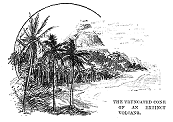 They were approaching it from the west, and before they reached it, the sun had risen above the horizon, and against the flood of light that blazed along the eastern horizon they saw, standing out clear and sharp, the truncated cone of an extinct volcano, which raised itself in lonely grandeur between four and five thousand feet above the sea. From the middle slopes to north and south two curving ranges of hills, sparsely timbered at their summits, but with their sides clothed with ever denser and more luxuriant vegetation, ran out to the south-east and north-west, gradually decreasing in height until they terminated abruptly in cliff's
of naked rock which rose eight or nine hundred feet sheer up from the water.
They were approaching it from the west, and before they reached it, the sun had risen above the horizon, and against the flood of light that blazed along the eastern horizon they saw, standing out clear and sharp, the truncated cone of an extinct volcano, which raised itself in lonely grandeur between four and five thousand feet above the sea. From the middle slopes to north and south two curving ranges of hills, sparsely timbered at their summits, but with their sides clothed with ever denser and more luxuriant vegetation, ran out to the south-east and north-west, gradually decreasing in height until they terminated abruptly in cliff's
of naked rock which rose eight or nine hundred feet sheer up from the water.
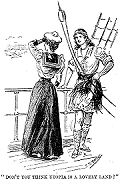 "But here we are at the entrance to the lagoon. What do you think of it? Don't you think our Utopia is a lovely land?"
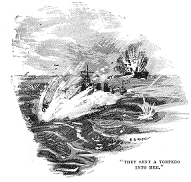 "Sensation? I should think it did," said Wyndham, with a short laugh. "The newspapers raised a howl that you might have heard almost here. Politics and divorce were discounted to nothing in the way of interest, while broadsides of questions were fired into the First Lord of the Admiralty. Standing Orders were suspended to discuss the pirate, and even the Admiralty itself began to wake up and rub its eyes, and wonder what the deuce it was all about, when, five days later, a much more terrible story was brought to Plymouth.
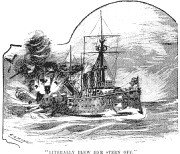 "My cousin, Charlie Curzon, who was on board the Ariel, and who told me the story, said the excitement for the next half hour or so was something indescribable. The two boats dashed at him to head him off, the Ariel doing all her thirty-three knots and the Firefly a good thirty-two, but they were just too late.
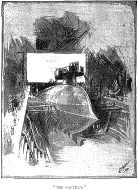
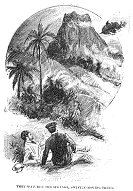 Something was moving swiftly along the ridge of hills, about five hundred feet from its summit. The night was too dark and the distance was too, great for them to make it out very distinctly, but, as it swept along, apparently at an almost incredible speed, they could see the stars behind it blotted out and reappear.
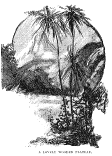 A start was made just as the cone of Mount Plato was beginning to glow in the first beams of the rising sun, and the spot selected for the camping-ground- a lovely, wooded plateau 2,000 feet above the sea and some seven miles from the settlement- was reached in less than a couple of hours. Here they sat down to a second breakfast, in which some choice champagne from the stores of the Calypso played a pleasantly conspicuous part, and then the party split up
automatically into groups in accordance with individual choices and varying projects.
A start was made just as the cone of Mount Plato was beginning to glow in the first beams of the rising sun, and the spot selected for the camping-ground- a lovely, wooded plateau 2,000 feet above the sea and some seven miles from the settlement- was reached in less than a couple of hours. Here they sat down to a second breakfast, in which some choice champagne from the stores of the Calypso played a pleasantly conspicuous part, and then the party split up
automatically into groups in accordance with individual choices and varying projects.
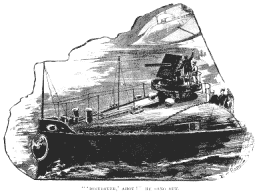
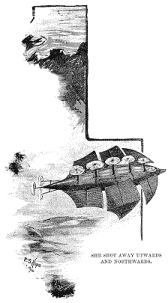 All this occupied the rest of the day and well into the night,
and just before sunrise the next day Hartog suggested that they should take a flight to the northward, to see if there were any signs of the Pilgrim. The
desert was just changing from brown to grey under the growing light, when the Vengeur soared vertically upwards to a height of five hundred feet, and then, with one engined driving the helices, and the other two the propellers, she shot away upwards and northwards at sixty miles an hour.
All this occupied the rest of the day and well into the night,
and just before sunrise the next day Hartog suggested that they should take a flight to the northward, to see if there were any signs of the Pilgrim. The
desert was just changing from brown to grey under the growing light, when the Vengeur soared vertically upwards to a height of five hundred feet, and then, with one engined driving the helices, and the other two the propellers, she shot away upwards and northwards at sixty miles an hour.
 It will be remembered that he was entrusted with the amusement of the Calypso's crew during the holiday, and in the discharge of this duty he had taken several of them for a run round the reef in the Mermaid, after entertaining them for the greater part of the day, in order that those of them who wished might get a good general view of the island that they were so soon to leave. During this trip, and while the Mermaid was at the eastern extremity of the reef, and over twenty miles from the landing-stages, he had seen the air-ship rise from the crater of Mount Orient and leave the island.
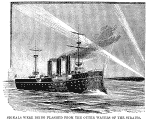
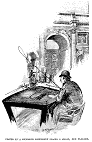 Soon after nightfall that evening, Taxil dropped the Vengeur to the ground in a lonely glade in the centre of Epping Forest, and found Pierre waiting for him there by appointment, with a bundle of newspapers under his arm. That was Tuesday evening. On Thursday morning London woke up to find posted in a hundred different places - on the walls of the Law Courts, the Government offices, the base of Nelson's Column in Trafalgar Square, the Bank of England, the gates of Buckingham Palace, the Marble Arch, and even the terrace of the House of Commons - a small, red placard about eighteen inches square, of which the following is a copy:-
AND THE
PEOPLE OF LONDON.
Signed, for the Anarchist Central Executive,
RAOUL TAXIL
In command of the air-ship Vengeur.
 Adams and Mr. Austen still retained in their own exclusive keeping the secret of the composition of the motor-fuel to be used in the engines, and the last of the Articles of Association was to the effect that no attempt was to be made to trespass upon this forbidden ground. The Syndicate possessed a capital of three millions, and, as the event proved, no capital ever before subscribed for any object made such enormous profits as this did, though how they were to be made remained a matter of pure conjecture, until the world rubbed its eyes and wondered why it had never thought of such a scheme before.
| BEWARE! AND TAKE WARNING WHILE THERE IS YET TIME WE WILL HAVE LIFE FOR LIFE AND BLOOD FOR BLOOD |
| -THE ANARCHIST EXECUTIVE. |
But not only was the placard posted on the walls of public and other conspicuous buildings. In the form of a leaflet it was scattered in thousands about the streets and even on the house-tops. In vain did the police attempt to collect these after they had torn the placards down. They were picked up by the early-comers into the streets and passed eagerly from hand to hand; then the evening papers, published soon after seven in the morning, got hold of them and reproduced them in their boldest and blackest type, so that by mid-day the scare was complete.
Then came the irrepressible monger of sensation, and he, having no facts to go upon, promptly elaborated from his inner consciousness letters from non-existent correspondents, describing how, in the watches of the night, they had seen- at any rate with the eye of imagination- a vague and ghostly form corresponding to the published descriptions of the air-ship, floating to and fro over London, and scattering a red rain of leaflets far and wide over the streets and house-tops.
That day, important news which had come to hand, telling of the break-up of the ice in the Baltic and the mobilisation of the Russian fleet, was crowded into obscure corners to make room for romantic descriptions of aerial exploits on the part of the Vengeur, which no human eye had ever seen her perform, and with equally imaginary narrations dealing with the manner in which the real inspirer of all this panic, and the veritable hero of the moment, was passing the last few hours that were left to him on earth.
What he ate and drank, the books he read, the number of hours he had slept each night, and the very words with which he was supposed to have refused the ministrations of the chaplain; his behaviour towards the warders, and even his demeanour when alone, were all set forth with a well-simulated accuracy which spoke volumes for the imaginative capacity of those who had corrected the dearth of reliable facts out of the plenitude of their own inventiveness.
To all this was added a touch of realism which, in the eyes of the multitude at any rate, endowed it with unimpeachable veracity. Line-sketches were given of the condemned cell, showing the arch-anarchist seated at the wooden table with his face buried in his manacled hands, while two stern-faced warders kept watch and ward on either side of him.
Later editions followed this up with plans of Dead Man's Passage, the yard of Newgate, and the open shed under which stood the gallows ready to receive their victim. Then, when the sensation worked up by the newspapers had reached its height, rumours began to fly about from lip to lip to the effect that the air-ship, which was now a fearful reality in the popular mind, had been seen here and there and everywhere, swooping down through the clouds and hovering over affrighted towns and villages, flying at full speed through the air on some unknown errand of slaughter and destruction, and even hovering over Osborne House, with intent to bury the Queen and her household in its ruins.
Everybody appeared to feel confident that some extraordinary attempt at rescue would be made, and the wildest theories were advanced in anticipation of it. It was even suggested that for once the French method should be adopted, that the hour of execution should be altered, and that Renault should be taken unexpectedly from his cell and hanged out of hand without warning.
The Home Secretary was actually asked a question in Parliament as to whether, in view of the exceptional circumstances, he did not think it advisable that something of this sort should be done; but the questioner was met with a cold rebuff; and informed that the Government declined to be intimidated by the vague threats that were being circulated, and that the law would take its course in the ordinary way, and at the appointed time - namely, eight o'clock on the following morning - an intimation with which the anarchists were promptly made acquainted through the medium of the evening papers.
Meanwhile, Sir Harry, Mr. Austen, Adams, and Lieutenant Wyndham had come to the conclusion that, for the sake of the momentous projects which they, as active members of the Aerial Navigation Syndicate, had in view, it would be better for them to scatter as widely over the British Islands as they could, so that, in case the Vengeur was really capable of taking reprisals for the execution of Renault, and confined her operations, as, for the time being, she would be obliged to do, to London, no chance shell should make the carrying out of their plans impossible.
In consequence of this decision, they had all left London on the Saturday and Sunday by different trains for various parts of the kingdom, with the intention of keeping constantly on the move, either on land or sea, until the hour of execution had actually passed, and it was known what form, if any, the vengeance of the anarchists was to take. In this way they were able to put the anarchist spies, for the time being, completely off their track, and, it is probable, to this course of action some of them, at any rate, owed their lives.
It is hardly necessary, perhaps, to mention that very good care was taken to send Dora Merton, her mother, and all their friends into places where they would be safe, at least for the present, from the attacks of their enemies. Some had gone to remote villages in Wales and Scotland, some were scattered among English watering-places, and some had been sent to the Isle of Man and the Channel Islands; and as all had, of course, renounced the picturesque Utopian costume on their arrival in England, they found no difficulty in losing themselves among the inhabitants of the places in which they took refuge.
By nightfall on Monday, the whole of London was in a state of feverish and irrepressible anxiety and apprehension. The terror of the unknown hung over everyone, from the mansions of Mayfair to the slums of Whitechapel. No one talked of anything but the approaching doom of the arch-anarchist and the vengeance that had been threatened by his still invisible allies. An epidemic of unreasoning fear had seized upon the whole people, from those who wandered about the streets arguing and gossiping with each other and buying up every new special edition that the newspaper offices kept pouring out full of repetitions of what had gone before, to the Cabinet Council that was sitting in Downing Street discussing the telegrams that were constantly arriving from the various points of the Empire threatened by Russian attack.
Many believed that London would be bombarded from the air during the night, and this belief was strengthened by a fire which broke out among some warehouses on the Rotherhithe bank of the river, but which had, in fact, nothing whatever to do with the work of any incendiary. Of course, it was taken for granted that the anarchists had set them on fire, and thousands of people wandered about the streets all night, wondering where the next conflagration was going to break out, or when the fire bombs would begin to descend from the sky.
The whole strength of the Fire Brigade and of the police force was kept on duty until the morning, but nothing happened, and the grey dawn of a cloudy April morning broke over London, showing its buildings still uninjured, and without bringing any news or warning of aggressive action on the part of the anarchists.
By five o'clock, the anxious watchers in the street began to move with one accord from all points towards what was now the common centre of interest- the dark, smoke-grimed prison of Newgate; and by six, Ludgate Hill, Old Bailey, Newgate Street, Holborn, and the southern end of Giltspur Street, were packed with an excited throng of anxious, pale-faced people, waiting, some to see the hauling up of the black flag, and others, who could not see it, to hear the shout of relief and the cheer of triumph that would hail its appearance as the sign that the master spirit of the Anarchists had ceased to exist.
All round the prison and its approaches, strong cordons of police were drawn up to keep the crowd in the roadways, and to prevent it getting on to the pavement or too near to the doors of Newgate, while hundreds of other policemen in plain clothes mingled with the crowd, keeping a sharp look-out for anarchists who might have come armed with hand bombs to take a mad and indiscriminate vengeance for the death of their chief. Half a dozen squadrons of lancers and dragoons were also kept in readiness, but out of sight, at the Horse Guards, in case any rioting or outrages on the part of the anarchists, who were believed to be in strong force in London, should make it necessary to clear the streets, and all the public buildings were guarded by double sentries and extra policemen.
Amidst the general excitement, the man who was the cause of it all was, outwardly at least, the calmest man in London. Certainly, no one in the whole metropolis had slept more soundly than Max Renault had done when the warders woke him at half-past five. He dressed himself leisurely, and with his usual care, in his own clothes, which, in accordance with the usual custom, had been returned to him after his sentence. At six, his breakfast was brought to him, and he ate as hearty a meal as though he had been going out hunting, instead of to the gallows, and when it was over, he washed it down with half a pint of champagne, in which he drank "success to Anarchy and destruction to Society."
Of any attempt that might be made for his rescue, or any revenge that might be taken for his death, he said not a word. There was no bravado in his manner or boasting in his speech; he was simply cool and collected, polite to everybody, and apparently anxious to give as little trouble as possible. When the chaplain entered the condemned cell to make one last effort to bring him into a frame of mind befitting the terrible position in which he stood, he shook hands with him, and said, in the easiest manner imaginable-
"My dear sir, I'm afraid you're giving yourself quite unnecessary trouble on my behalf. I know you're doing it from a sense of duty, and if I were not so averse to listening to wasted words, I would hear you with pleasure, if not with profit; but, you see, I have no creed but anarchy, and no faith save in the ultimate triumph of its principles, and so I must really decline to waste the short time that appears to be left to me in unprofitable conversation."
"I can neither force you to listen, nor would I if I could," said the chaplain gravely and almost sternly. "To a man standing as you do on the brink of eternity, argument is worse than useless, and I will not tempt you to further mockery. Is there anything that I can do for you - I mean in the worldly sense? Have you any message to leave or any property to dispose of? If you have, you may command me."
"Thank you," replied Renault, smiling, as he could sometimes smile, with a rare sweetness. "The only message I have to give has been given, and my property belongs of right to my comrades in arms, to be used in the work to which we are devoted. And now, if you wish to do me a real service, get me one of this morning's papers, and let me read quietly until the time comes."
The good chaplain was far too familiar with the behaviour of men in Renault's position not to be able to see that his callousness was genuine, and in no measure assumed. He saw, too, that to make any attempt to perform the last offices of the Church for him would only be to give him opportunity for scoffing, which might, if he were provoked too far, degenerate into blasphemy; so he left the cell and went to the governor's room, where he got a copy of the Standard, which he sent to the condemned cell by a warder.
Max took it, and soon became absorbed, as he might well be, in its contents. The editorial page opened with a leading article, a column and a half long, on his career and the justly merited fate that awaited him; and on the next page there were three columns concerning the anarchists and their doings in all parts of the world; and after them came the war news, the chief item of which was to the effect that Kronstadt and the Russian Baltic ports were now free from ice, and that the mobilisation of the Russian fleet would be complete in a day or two. All this, however, was of no importance, in Max's eyes, in comparison with one brief paragraph in the summary of news which ran as follows:-
"As stated in our late edition last night, the Home Secretary has declined to entertain the suggestion that the convict Renault, now under sentence of death should be executed at some unknown date and hour, in order to obviate any possible attempt at rescue. Such a rescue is rightly considered to be absolutely impossible, and the execution, which is fixed for eight o'clock this morning, will have taken place before these lines are in the hands of the majority of our readers."
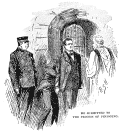 Max continued apparently absorbed in the perusal of the paper until a quarter to eight, not even seeming to hear the muffled note of the bell of St. Sepulchre as it tolled his own death-knell. When the governor and the chaplain entered the cell with the executioner, he looked up, laid the paper down, and rose to his feet with a slight bow. The governor briefly informed him the purpose they had come for, and without a word he submitted to the process of pinioning.
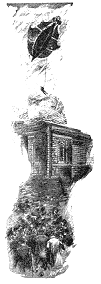 As soon as this was completed, the door of the cell was thrown open, and the usual procession was formed, the governor leading the way and the chaplain bringing
up the rear, reading the burial service of the English Church. So they went from
the cell, down Dead Man's Passage, and out into the yard. On the threshold, Max
paused for just an instant, giving a glance up into the sky, in which the clouds
hung low, and then one look at the open shed under which the rope was already dangling from the black-painted beam.
As soon as this was completed, the door of the cell was thrown open, and the usual procession was formed, the governor leading the way and the chaplain bringing
up the rear, reading the burial service of the English Church. So they went from
the cell, down Dead Man's Passage, and out into the yard. On the threshold, Max
paused for just an instant, giving a glance up into the sky, in which the clouds
hung low, and then one look at the open shed under which the rope was already dangling from the black-painted beam.
So far he had not opened his lips, but when a fourth of the way between the passage and the scaffold had been traversed, he stopped suddenly, drew a deep breath, and then a long, piercing, screaming cry came from his lips, and rang out high above the murmur of the excited throng outside the prison walls. The next instant, the murmur of the crowd was changed into a roar of amazement, which grew shriller and shriller, until it became one mighty, long-drawn yell of fear.
Before the cry Max had raised had died away, a huge grey shape dropped swiftly and vertically from the clouds, and passed from the view of the crowd behind the walls of Newgate Yard. Then came the sound of a rapid fusillade of small-arms, and then the air-ship soared up again, with the still-pinioned body of Max dangling in a lasso from one of the ports in the hull. Before the Vengeur had reached
the clouds, it had been hauled in. Then she stopped, just under the clouds, and the vast crowd, knowing intuitively what was to come, began to surge to and fro with wild yells and hoarse shouts of terror, for the rescue had been achieved after all, and the moment of revenge had come.
CHAPTER XXIII.
REVENGE!
BRAVO, Raoul! that was the neatest thing you ever did in your life, mon brave, and you'll live to be pretty old before you do anything smarter! Tonnerre! How that canaille yelled when they saw me go up instead of the black flag. I can be as good a friend as I can an enemy, and you shall never want a friend now as long as I'm alive."
The scene over which the Vengeur floated was even now terrible enough to have shaken the nerves of any but an anarchist or a professional soldier. The vast throngs packed into the streets about Newgate were swaying to and fro in great masses, struggling to force their way out, and, after the manner of crowds possessed by panic, doing everything to frustrate their own object.
For fully ten minutes the Vengeur circled slowly round over the agonised thousands, as though her captain and crew were enjoying in anticipation the horrors that they were about to add to the frightful scene beneath them. Then Max stopped her a couple of hundred feet over the cross of St. Paul's, with her bow pointing westward, and called down one of the tubes-
"Ready with the forward guns - one on the end and one on the middle of the street. Let go!"
There was a sharp, hissing sound as the pent-up air in the breech-chambers forced the projectiles out. Then two bright masses of flame blazed out, followed by the mingled roar of the explosions and the crash of glass as the neighbouring shop windows were blown in.
Two great ragged gaps were torn in the densely packed masses amidst which the shells fell, as though the earth had burst open beneath their feet, and bodies of men and women were hurled up into the air, mingled with limbs and torn fragments of other bodies, and fell back upon the heads of those who thronged the pavements. Then, in the midst of such a cry of agony and terror as had never reached human ears before, Max took up another tube, and said-
"Ready with the port stern gun! Send a shell into that lot where the four streets meet!"
Again the hissing sound came, and the shell burst in the midst of the throng that was packed into the junction of Cheapside and Newgate Street, with the same hideous effects.
"Starboard bow gun - a couple of shells in the crowd by the church there. Port bow, another under the bridge! Port stern, send a shell at that big building with the pillars in front of it - that's what they call their Royal Exchange - a bourgeois swindling den!"
His orders were obeyed almost as soon as they were given, and, as each shell struck and burst, the scene of wholesale murder became more and more hideous, for the fearful effects of the projectiles seemed to strike the helpless throngs with paralysis, and all they could do was to sway to and fro, and scream and moan with terror, as though they intuitively knew that they were at the mercy of an enemy
from whom there was no escape.
Some made wild rushes into the shops and houses, and as soon as he saw this, Max ordered the guns to play upon them, loaded with fire-shell, and a few minutes later unquenchable fires were blazing furiously in a score of houses and shops all round the area of slaughter and destruction. Then, like the incarnation of an evil spirit brooding above the scene of indescribable horror, the Vengeur passed slowly over the streets dropping bombs charged with fire-mixture as she went, and when she had completed the circuit, a ring of flame and smoke encircled the black frowning walls of the prison in which everyone had believed by this time Max Renault would have been hanging by the neck.
"I think that will do for this part of London," he said to himself, as the Vengeur once more floated over the cross of St. Paul's; "and as we have a good many visits to pay to-day, we may as well be off. Ah, yes! that's a happy
thought. It's nearly nine o'clock, and the City men will be just coming up from the county to begin their day's swindling. We'll smash up the railway stations first, and begin with Cannon Street. I've owed the South-Eastern a personal grudge for some time."
He took up the mouthpiece of a tube and called into it-
"Stern guns there, train on that railway station with the rounded roof. Starboard gun, load with anarchite and fire into the station and at the trains on the bridge. Port gun, load with fire-shell and train on the hotel in front. Let go when you're ready - six shells each."
Then he took up another tube and gave the order, "Starboard bow gun, blow up that bridge at the bottom of the street. Port bow gun, load with fire-shell and set those two railway stations on fire. Ludgate Hill hasn't been fit for anything but burning for a good many years now," he added to himself, with a low, malicious laugh.
By the time his orders had been obeyed, Cannon Street Hotel was ablaze in half a dozen places, the station was half wrecked, and the wrecks of a couple of trains were lying scattered over the bridge. The bridge across Ludgate Hill had been blown to pieces, and Ludgate Hill and St. Paul's stations were both on fire. He now turned the Vengeur's prow eastward and brought her to a standstill again over the Bank of England. Then the pitiless order went down the tube-
"Ready with the bomb tubes!- that's the Bank of England. I don't think they'll do much business to-day. Let go half a dozen pills for the Old Lady of Threadneedle Street to digest, if she can. Ah, that's a sort of run on the
Bank they haven't had since the Old Lady started in business! Money will be a trifle tight to-day, I fancy, in the City."
He kept the Vengeur moving very slowly as the bombs were dropped, so that they might fall in different places. As they crashed down through the roof and burst, jets of flame and smoke rose through the holes they made, showing how terribly they had done their work, and in a few minutes the interior of the treasure-house of England was blazing like a furnace.
Then Max steered the Vengeur at easy speed towards Westminster, still keeping his elevation of three thousand feet, and sending an occasional shell from his guns at random over London to north and south, in sheer wantonness of destruction, for the mere sake of keeping up the panic he had created.
As the Vengeur passed up the river, Max caught sight of the square red-turreted building which he recognised as New Scotland Yard.
"Ah!" he said, looking down at it through his glasses, "I mustn't forget that. I'll let the national windmill alone for the present, for I may be able to catch some of the hereditary legislators and misrepresentatives of the sovereign people in it a bit later on; but our friends of the police and the Criminal Investigation Department will probably be at home, and pretty busy too, so I'll just stop a minute and leave my card."
So saying, he stopped the air-ship high above the great square building, and then half a dozen fire-bombs descended on its roof in quick succession. They crashed through it as though it had been made of glass, and presently tongues of
flame and wreaths of smoke began shooting and creeping out of the windows. As soon as he saw this, he ran half a mile to the southward, and sent a dozen anarchite shells through the windows to help on the conflagration that his fire-bombs had started.
"That'll do for you, my friends, I think. Scotland Yard was always a pretty warm
corner, but I don't thick it was ever quite as hot as it is now. There are a good many fellows in there who'll never hunt down any more poor devils of anarchists and hand them over to the tender mercies of M. de Paris. Now, where shall we pay the next call? Ah, of course, I have it. It would never do to forget that. We'll go and
scare the rooks out of the legal dovecots.
"Those sleek-looking scoundrels, they're the cause of half the injustice and the oppression that has made anarchy what it is, and me what I am. Here goes for the Temple and what the canting hypocrites are pleased to call the Royal Courts of Justice. I hope the Courts are sitting. I'll go and serve a notice of ejectment on them, and decline to stay execution, as they say in their pompous jargon."
With that he sent the Vengeur across the Embankment and the Strand, and placed her over the Law Courts. Then bomb after bomb crashed in quick succession through different parts of the gabled roof of the great building, until it was on fire in a dozen places at once, and there was such a stampede and haste to get out as the law's delay had never known before.
That afternoon and evening neither flag was hoisted nor light kindled on the Clock Tower of Westminster, for the universal panic had now spread to all ranks of society, and neither Lords nor Commons felt inclined to run the risk of a sitting in a building whose conspicuous position and character marked it out for almost certain destruction at the hands of the enemy of mankind who, for the time being,
held London at his mercy.
Max waited in vain for the signal that Parliament was sitting, still keeping up the terrorism by circling hither and thither high over the vast wilderness of houses, and dropping a bomb or sending a shell here and there as the fancy took him, or any tempting object presented itself. He kept this up until about six o'clock, and then, as his ammunition was beginning to run rather low, he decided to
put the finishing touches to his horrible work, and then get away and join Hartog again.
Going to work with almost diabolical deliberation, he first ran up and down over the river and destroyed the floating fire-engines. Then, hovering over Westminster, he sent bomb after bomb through the roofs of the Houses of Parliament, the Government Offices, the Horse Guards, the Admiralty, and Whitehall. For a moment
the thought of destroying Westminster Abbey as well crossed his mind, but a glance at the venerable pile brought back to his well-stored mind all its ancient and splendid traditions, and instead of giving the order, he said to himself-
"No, I won't do that. It would do no good, and it would take a thousand years to repair the damage. I'll let the old church alone. Who knows but some day we may preach the new Gospel of Man in it. Sacre diable, how the abodes of red tape are burning! It seems to make splendid fuel. I wonder what there is in that fire-mixture of Hartog's? It burns as if it came from the lake of Tophet itself. Fine bonfires those for anarchy to light its pipe at! Ah, they're lighting the street-lamps out yonder to the north. It's time to go and pay the gasworks a visit. I think I've provided London with quite light enough for to-night. It's a waste to burn gas under the circumstances."
Then the Vengeur ran across to Vauxhall, and a few moments later the shells began bursting among the gasholders, tearing great ragged holes in them, and as the gas came rushing out, fire-bombs were dropped to ignite it, and huge tongues of roaring flame shot up into the air, until one after another the gasometers burst like huge shells. Then came the turn of the Old Kent Road works, and the southern
half of London shook to its foundation as the enormous quantities of gas stored up in the holders took fire and then blew up, hurling fragments of iron plate, bricks and coal, and fragments of bodies far and wide over the surrounding streets.
Max turned his attention to the smaller ones first, and sent a shell through the roof of each of them in rapid succession. Then he poised the air-ship exactly above the giant, and dropped first a solid piece of iron weighing about ten pounds on to its roof, and then sent a fire-bomb immediately after this. The piece of iron bored a clean hole, and as the gas came rushing up out of this, the fire-bomb fell
and ignited it.
The next instant a long stream of intensely brilliant flame, almost like the ray of a searchlight, leapt up into the darkening sky hundreds of feet above the gas-holder. Then the volumes of gas escaping from the others caught fire in the air, with which, of course, they made a highly explosive mixture, and exploded with a concussion, the force of which was felt even by the Vengeur, floating nearly three thousand feet above. The great reservoir soon began to subside; its enormous weight driving the gas out with terrific force, sending the long tongue of flame far up into the sky, and casting a parting gleam on the hull and aeroplanes of the
Vengeur as she soared away to the westward.
"Ah!" said Max, as he looked back out of the conning-tower at the dark gulf of London, still lighted up by huge patches of flame covered by enormous canopies of rolling smoke; "the next time you try to hang an anarchist, perhaps you will think twice about it. I hope that will teach you that the centre of power has shifted. The rule of nations is at an end, for I can paralyse those who rule them with a single stroke. What I have done to London to-day it would have taken a besieging army weeks to do. The rule of the world has shifted from the earth to the air, and
woe betide the earth as long as I rule the air! How mad Franz will be when he finds he has missed all this fun!"
So saying, he sent a signal for full speed to the engine-room, and in a few minutes the conflagrations of London were only little points of light on the horizon.
CHAPTER XXIV.
A REIGN OF TERROR.
THE excitement produced by the terrible events of Death Tuesday, as the fatal day of the anarchists' revenge had been promptly and permanently named, was completely indescribable. Not only England but the Continent - indeed, it might almost be said the whole civilised world - was convulsed by it.
Nothing like this had ever happened in the history of the world before. The ocean terrorism maintained by the Destroyer on the Atlantic was as nothing to it. From under the very shadow of the scaffold, in the centre of the most populous city in the world, a notorious criminal had been snatched from the grasp of justice by means so unheard-of and marvellous, that only the awful reality of what had followed made it impossible to doubt the fact that it had occurred.
This man, arraigned at the bar of English justice to answer for the most terrible of crimes, had calmly admitted them, and then, snapping his fingers at the majesty of the law, he had threatened to take a tremendous vengeance even for the indignity of having sentence of death passed upon him - and he had kept his monstrous threat to the letter.
There could be no doubt about that. The blackened and smoking ruins of the most important buildings in London, of the very seat of Government itself, the darkened and wreck-strewn streets, the thousands of human bodies, torn and mangled almost beyond recognition, and the mutilated remains of men, women, and children who had perished in the burning houses or been crushed to death by the panic-stricken throngs in the streets - all these were evidence, too fearfully unmistakable, of the fact that the enemy of society had, for the tune being at least, armed himself with a power superior to anything that the forces of law and order could
bring against him.
In what had been to him merely the pastime of a spring day, this one man, with half a dozen followers, had done what it would have taken the leagued armies and fleets of the Continent weeks of the most appalling strife and bloodshed to do. He had bombarded London, and the amount of damage he had done had been limited only by his inclination or the failure of his ammunition. What had happened to London might happen to Paris the next day, to Berlin the next, to St. Petersburg the next, and so on. It was only a question of time and ammunition. From the monarch in his
palace to the peasant in his cottage, no one was safe, and no one had the remotest idea where the next blow would fall.
To say that a reign of terror, a condition of almost universal panic, had been established at one stroke by the anarchists, would be simply to state the bare facts of the case. Men were afraid to meet anywhere in large numbers, lest, as in London, destruction swift and inevitable should be hurled upon them from the sky.
The Parliaments of the world met in scanty numbers, and in fear and trembling. They passed their resolutions hurriedly, and separated as soon as possible, for politics had suddenly become invested with an actual personal danger, and as politicians and heroes are seldom made of the same stuff, legislators mostly preferred the safer obscurity of their own homes to the perilous prominence of their official positions.
Suppose the British Houses of Parliament had been sitting when the Vengeur made her attack on the Palace of Westminster, how many members of either House would have escaped death or mutilation? What was there to prevent a
similar assault to be made at any moment on any other of the Parliament Houses of the world, from the Chamber of Deputies in Paris to the House of Representatives in
Washington? There was nothing, and so it came to pass that the parliamentary Governments of the world were half paralysed by the terrorism of anarchy in its most frightful form.
But, although this was primarily due to the assault of the air-ship on London, it was not wholly caused by it. While Renault had been at work in the air, Lea had been no less active on land. Through her agency, all the anarchist groups in the world had been prepared beforehand for the startling events of Death Tuesday, and they had unanimously resolved to celebrate the rescue of the man they now looked up to as their leader and chief, in spite of their rigidly individualistic principles, in a fashion worthy of themselves and their horrible creed.
The result had been that there was hardly a great centre of population in the civilised world that had not been the scene of some explosion, assassination, or other outrage.
Within a week, the war party in France was in the ascendant, and before another week had passed, France had joined hands with Russia, and declared war on Britain, as the harbourer of anarchists, and the enemy of the peace of Europe. By this time, too, the Baltic was clear of ice, and the Russian northern fleet was only waiting for the cooperation of the French Channel squadron to force the British blockade of the Sound, and carry the war to the shores of Britain.
Such was the general position of affairs on the 12th of May, when a meeting of the directors of the Aerial Navigation Syndicate took place at the offices of the Maxim-Nordenfeldt Company in Victoria Street, Westminster. Mr. Maxim himself was in the chair, and others present were Mr. Austen, Sir Harry, Edward Adams, and Lieutenant Wyndham. The proceedings had opened with a terse comprehensive view of the position of the Syndicate by the chairman, and, in concluding this, he said-
Now, gentlemen, from what I have said and you already know, I think you will agree with me that it won't be very long now before the old order of things is completely done away with, and all the fighting of the future, if there is to be any, will have to be done either by semi-submarine craft of the type of the Nautilus and the Aries, or else by means of air-ships.
"That scoundrel Renault has proved that against a properly managed air-ship, carrying guns and a fair amount of ammunition, there is practically no defence. Now, he and ourselves are the only people in the world who possess these ships. We don't know how many he's got by this time, because he hasn't given any sign of his existence since his attack on London. But, however many or few he has, we know how he'll use them.
"We have two, the Volante and the War-Hawk, ready to take the air to-morrow. I fancy they're swifter and more powerful as fighting machines than his, and I don't know that any of us will have any reason to wish any alteration in the original plan, that they should be devoted to hunting this scoundrel down, and, if possible, destroying him. It is also agreed, I think, that the Volante shall be commanded by Mr. Adams, and the War-Hawk by Mr. Austen, and that each of these gentlemen will choose their own officers and crew."
A general nod of assent went round the table as Mr. Maxim paused for a moment, and then he went on-
"With regard to the rest of the fleet, I am happy to say we have so far repaired the damage caused by those rascals with their bombs, that we shall have twenty more ships ready for work in a fortnight from now, and this will bring us face to face with a question, if possible, more important than anarchist-hunting, and that is our attitude with regard to the war.
"As you no doubt know, we have received some very tempting offers for the use of our ships, not only from the British Government, but from France and Russia as well. But I think you'll agree with me that the services in warfare of such an engine of destruction as our air-ships will undoubtedly be, are not to be measured by a few thousand pounds a month that a Government would pay for the hire of them."
"Most assuredly!" said Mr. Austen, as the chairman paused as if awaiting a reply. " I think, at any rate, speaking for myself and my immediate friends, that the very worst policy would be to place the air-ships at the disposal of any Government. To do so would be to give them the means of tyrannising over other Powers, and subjecting them to an almost irresistible temptation to embark upon a career of indiscriminate conquest, which might end in enslaving the liberties of the world.
"For my own part, I don't believe that any government, whether despotic or democratic, is sufficiently civilised to be entrusted with such a power as that. The world is not ready for aerial navigation yet, and I have never ceased to regret, since Renault stole the air-ship from Utopia, that I did not keep my son's secret and let it die with me."
"You'd have been something more than mortal if you had done that, Mr. Austen," said Mr. Maxim drily. "Besides, you know, if your air-ships hadn't been built, my aeroplanes would have been nearly as dangerous to the peace of the world; and, as it was then just a matter of business with me, I should have sold them or hired them out to anyone who'd have paid for them, and left them to fight it out amongst themselves, just as they do with the Maxim gun."
"But as a matter of business," chimed in Sir Harry, "and humanity as well, I certainly think that our original plan will be by far the best so far as the war is concerned. What do you think, Mr. Adams?"
"Oh, undoubtedly," replied Adams. "Once we have driven the anarchists from the air and given that blackguard, Renault, his deserts, I hope we shall carry it out as quickly as possible; but I am certainly of opinion that we ought to use every effort to hunt Renault and his accomplices down first. We really have nothing to do with the quarrel with France and Russia, and it is of very little moment to us which is in the right or the wrong.
"My voice will certainly be for hunting the anarchists down first with every ship that we can get afloat, and then carrying out the original plan on the basis of which this Syndicate was formed."
"And that is my view, too," said Sir Harry, as Adams ceased speaking. "On both public and private grounds, I think we are bound to put a stop to the terrorism which this Renault, unfortunately, has it in his power to exercise. I think that if England, France, and Russia are foolish enough to go to war about matters which they could settle in a few hours with a little common sense and fair play, we may as well leave them to fight it out for the present.
"But even if the whole of Europe were at war, it would be of less importance than exterminating Renault and his accomplices, because it stands to reason that if we give them time to build a large fleet of air-ships, they will simply take advantage of the war to increase its horrors a hundredfold and spread their terrorism round the whole world, and, in that case, civilisation will simply come to an end, and the anarchists will soon gain command of the world- and a very nice prospect that would be."
"Very well, then," said the chairman. "We will consider that as settled, and so this will be the last meeting of the Syndicate for the present. We have done our talking and our thinking, and now we shall go to work. You gentlemen will go on active service, and I shall remain here to superintend building operations and business in general. I hope our next meeting will be to arrange terms of peace, and put international matters on a little more satisfactory basis than they are now. I think that is everything, isn't it?"
"No," said Mr. Austen, taking a sealed envelope from his breast pocket. "There is one thing more. Mr. Adams and I start to-morrow upon what may be a very perilous undertaking. All warfare is uncertain, and this warfare will probably be the most uncertain of all; and therefore, Mr. Maxim, we have decided to leave with you the formula for the preparation of the motor-fuel, so that you may have it prepared in proper quantities, and, of course, with due regard for secrecy, for the supply of the fleet.
"All we shall ask in return will be your word of honour that you will learn the formula by heart, and at once destroy this paper, that you will never disclose it to anyone, and that you will supply none of the fuel on any conditions to anyone outside the Syndicate."
"You have my word on all these points, I can assure you," replied the chairman, as he took the priceless envelope. "If ever I let it out, you are at liberty to blow me to smithereens with one of my own guns."
After this, a few more minor details of business were arranged, and the meeting broke up. That evening the members of the Aerial Navigation Syndicate dined together at the Hotel Victoria, in company with several old friends from Utopia, and not the least hearty of their toasts was that in which they drank "Success to the cruise of the Volante and the War-Hawk."
CHAPTER XXV.
THE "WAR-HAWK'S" FIRST FLIGHT.
THE most elaborate precautions had been taken by the Syndicate to prevent the Anarchists and their spies from doing anything to hinder the blinding of the Volante and the War-Hawk, the first two vessels of their fleet that
were to take the air, and also to keep secret the manner and place of their building.
As has already been said, the various parts of the ships and their engines and armament had been made by different firms, and these, when completed, were despatched by rail to two different points. The Syndicate had acquired, privately of course, and in names unknown to the world, Lundy Island, off the coast of Devon, and one of the Farne Islands, off the coast of Northumberland, for the purpose of putting the vessels together and equipping them under circumstances which made it possible to keep all strangers and possible traitors away from the spot.
Thus everything that was necessary for the building and equipment of the Volante had been conveyed by rail to Bristol, and there shipped on board the Irene and taken to Lundy Island, while the materials of the War-Hawk had been sent by rail to North Shields, and conveyed thence by another steamer to the Farne Island. No one was allowed on either of the steamers save those who had been members of the colony of Utopia, and were personally known to the directors; while on the islands the strictest possible watch was kept in order to make sure that no strangers or suspicious persons landed upon them.
All the building operations had been carried out on both vessels simultaneously, and the day after the last meeting of the Syndicate, Edward Adams and Mr. Austen, with their chosen lieutenants, went, the one west and the other north, to see everything in order, and, as it were, put their respective ships into commission. Adams took with him Tom Harris and Ralf Smith - late of the Mermaid - as lieutenant and engineer, and Dr. Edwards as surgeon. His crew he would find waiting for him on board the Irene, or else on the island.
The War-Hawk, with whose fortunes the reader will be more particularly concerned, was in a certain sense Sir Harry Milton's own ship, although, at his particular request, Mr. Austen had consented to take command of her. He had spent nearly a hundred thousand pounds out of his own pocket on her, and had spared no expense to make her the most perfect and the most powerful aerial cruiser in existence, and therefore the most certain instrument of his vengeance on the man who had wronged him so wantonly and so deeply.
From point to point the elongated cylinder which formed the War-Hawk's hull measured two hundred and twenty feet, with an amidships diameter of thirty-five feet. Her triple engines were capable of exerting nine thousand horsepower, six thousand of which could be concentrated on her six lifting fans, which, under these conditions, were capable of lifting a dead weight of four tons, in addition to the hull and engines.
The engines and gearing were so constructed that while either three or six thousand horse-power could be applied to the lifting fans, leaving three thousand for the driving propellers, the whole nine thousand could be concentrated on the latter, and then the aeroplanes, driven forward at a speed of more than three miles a minute, would more than support the whole weight of the vessel and her cargo.
For armament she carried two pneumatic shell-guns forward, and two aft, which had been specially designed for the vessels of the Syndicate by Mr. Maxim and Mr. Austen, and which would throw a shell carrying twenty pounds weight of high explosives to a distance of seven miles when fired from an elevation of two thousand feet. On each broadside were four machine guns of the Maxim type, effective at a range of three miles, and with a firing capacity of seven hundred and fifty shots a minute. She was also fitted with six vertical bomb-tubes, each furnished with a releasing apparatus which automatically despatched the projectile the moment that the tube was exactly vertical to the object aimed at.
Sir Harry had had two objects in view in making the War-Hawk, as he hoped he had made her, the most formidable engine of destruction in existence. First and foremost, of course, was his settled purpose of hunting Max Renault from the world, and taking due vengeance on him for the crimes that be had committed, but hardly second to this came the fact that he had determined to confide the safety of all
that was dearest to him on earth to the speed and strength of the splendid craft upon which he had lavished money without stint.
Violet, who had of course been brought away from France as soon as it was known that there was any danger of war being declared, was now quite convalescent, although the great nerve specialist under whose care she bad been in Paris had been unable to hold out any hope that, without the intervention of a miracle, she would ever be able to walk again. As Dr. Roberts had feared, the injury to her spine had proved to be the most serious of all.
Her vigorous constitution had triumphed over all her other injuries, severe as they had been. Her general health, and even her spirits were fast coming back to her, but her lower limbs were almost useless, and so she was a prisoner to the
invalid chair in which it was only too probable she was condemned to pass the remainder of her waking life.
As soon as she had learned that her brother was building the War-Hawk, and intended to take the air himself in pursuit of Renault, she had begged and pleaded so hard to be taken with him, that at last, acting on Dr. Roberts's advice, he had yielded.
"Don't you see, my dear fellow," the late surgeon of the Calypso had said to him, when he expressed his surprise at his advice, "that, after all, this air-ship of yours will probably be the safest place she can be in? You'll always be
on the look-out for the enemy. You will know where he is, or, at any rate, where he is not, and if you meet him, you'll only attack him under favourable circumstances; but if you leave your sister on land, you will never know when some of these blackguardly anarchist spies might find her out and kill her just out of pure spite, or when Renault himself might find out where she was, and blow up the building she was living in out of revenge for his former failure.
"Added to that, in these nervous complaints the all-important thing is to guard against mental worry. If you leave her at home and go careering through the air yourself, she will be in a constant state of anxiety about you,- sleepless nights and all that sort of thing,- and instead of getting stronger and better, she'll simply get weaker and worse out of sheer anxiety for you. Take my advice, and take her with you, and take me, too, to look after her. You know I can make myself useful in other ways than as a sawbones."
After this, there was nothing for it but to let Violet have her way and make one of the company of the War-Hawk. But this decision speedily opened another question, which was settled in a way that gave Sir Harry not a little secret
satisfaction.
It was quite impossible that, in her helpless condition, Violet could go on board the War-Hawk without one of her own sex as attendant and companion, and for this office Dora Merton volunteered in such decisive terms that she speedily overcame what little opposition she met with. Thus it came to pass that when the air-ship lay on the island on the evening of the 14th of May, ready to take her first flight into the air, her company consisted of Mr. Austen and Sir
Harry as joint commanders, Frank Markham as chief engineer, and a crew of eight Utopians, who had been specially trained to the work, Dr. Roberts as ship's surgeon
and general utility man, as he described himself, Violet Milton and Dora Merton-whom Violet had ever increasingly strong reasons for regarding as a sister, in fact as well as in fancy, as every day of their intercourse went by.
The central portion of the War-Hawk's hull had been flattened so as to form a promenade deck about seventy-five feet long by twenty broad, and on this Sir Harry, Mr. Austen, the doctor, and Dora were standing round Violet's chair, waiting for the sinking disc of the sun to disappear over the hills of Northumbria, and so give the signal for the voyage to begin.
A few moments later, Mr. Austen went to the rail which surrounded the deck, and, leaning over, said to those who were standing about the ship on the land-
"Is everything clear?"
"Yes," came the reply; "all clear."
"Very well, then," said Mr. Austen, going to the top of the companion-way which led down to the engine-room. "Are you ready with the lifting fans, Markham? You can
go ahead when you like. I'm going to take the wheel in the conning-tower now."
"All ready," came the reply, in Markham's voice, from the engine-room; and then came the click of a lever, the blades of the lifting fans sprang out horizontally from the masts, and began to spin round with ever-increasing speed, and a sound that gradually rose from a soft whirr to a shrill whistle.
"It doesn't look as though these wheels just turning round in the air like that could lift this great ship and everything on board from the earth, does it? " said Violet, leaning back in her chair and looking up at the revolving fans.
"The air is a solid, if you only hit it hard enough," said the doctor, quoting from an American authority on aeronautics. "Wait till these fans hit it hard enough, and we shall rise like a fish in the water, or more properly, perhaps,
a bird on the wing."
The whistle of the fans, revolving with ever-increasing rapidity as Markham brought more and more of the engine-power to bear upon them, now rose almost to a scream. A hurricane of wind seemed to beat down upon the steep, sloping awning over the deck for a moment, and then they felt the deck lift and sway beneath their feet. They looked over the side, and saw that the land was sinking away from beneath them, then a bell sounded in the engine-room, and the propellers began to revolve. A gentle breeze seemed to sweep along the deck, and the island slipped away behind them.
"Look, we are off at last!" cried Dora, clapping her hands in sheer delight. "There's the sea below us now, and the islands- look at them, they are like so many little dots on the water already. What a speed we must be going at, and fancy, we are flying, actually flying! Isn't it glorious? no more obstacles for us now, either on sea or land, no hills to climb, no rough seas to go pitching over or plunging under. We can fly over everything."
"There's no doubt about that," said Sir Harry, "and I suppose this is actually the first time on record that an angel has flown without wings."
"Bravo, Harry!" laughed Violet, looking up at Dora's now rosy face. "That's very nice."
While this conversation bad been going on, the War-Hawk had swung round and was running at about forty miles an hour to the south-westward. Before Violet could make any retort to Dora's last piece of banter, Sir Harry, who had been sweeping the clear seaward horizon with his field-glasses, leant forward suddenly, as though something had caught his attention. He looked hard through the glasses
for a moment, and then, taking them from his eyes, said-
"Violet, you must go below at once. Come along, I'll carry you. Miss Dora, will you get one of the boys to bring the chair down?"
And before they had time to ask any questions, he had picked his sister up in his arms and was carrying her below to her cabin, followed by Dora. He laid her upon her couch, kissed her, and ran up on deck again without a word. Then, calling the crew up and telling them to prepare the ship for action, he went into the conning-tower and said to Mr. Austen-
"There are three air-ships coming up yonder from the southward. We have only just left the island in the nick of time."
CHAPTER XXVI.
A FLYING FIGHT.
MR. AUSTEN followed the direction of Sir Harry's finger with his field-glasses, after locking the steering-wheel for the moment.
"I'm afraid there is no doubt about it," he said, putting the glass down and releasing the wheel again. "As you say, there are three of them, and they are coming up very fast. Of course they cannot be anything but a portion of the Anarchist fleet."
"That's quite certain," said Sir Harry. "Simply because they can't be ours. Evidently their spies have managed to find out where we were building the War-Hawk, and those three ships have been sent to smash her up before she could get into the air. If they'd been half in hour sooner, they'd leave blown us and the War-Hawk into little pieces- and with Violet and Dora on board too! Phew! It gives one the shivers to think of it. However, thank God, we are all right now. The question is, what shall we do- fight, or run away?"
"Run away, by all means," replied Mr. Austen, with a grim sort of smile and a meaning twinkle in his eye. "I don't know whether it has ever struck you, but the fact is, that in aerial warfare to run away will not only be to fight, but to fight under the most favourable circumstances. The first, and in fact the only axiom in aerial tactics will be: Get your enemy behind you and below you. Then smash him up."
"I see, I see. Of course it will be!" exclaimed Sir Harry. "An air-ship flying at a hundred miles an hour cannot use her bow guns with any effect, while her stern
guns will be even more effective than if she was stationary. What a fool I was not to think of that before! Well, then, we shall have a trial of heels first, and then a little gun practice at long range, I suppose?"
"Just so," said Mr. Austen. "Always supposing that those fellows are foolish enough to follow us. Now, as I have had more practice than you have, I'll stop here and manage the ship, and you go aft and fight the two stern guns. You can tell me through the speaking tube what you want in the way of speed or elevation."
"Yes, that's the plan," said Sir Harry, turning to leave the conning-tower. "They've got the awning down and everything snug by this time, so we're ready for full speed whenever you life."
"Very good," said Mr. Austen, sending a signal to the engine-room as he spoke. "We'll go up to four thousand feet first. As soon as your range-finder tells you that they are within five miles, you can open fire. Don't be afraid of the ammunition. Our gunners want practice, and we can get plenty more at Lundy. If we can get those fellows to follow us, we'll work round there and join forces with the Volante."
"All right," said Sir Harry. "I won't spare the shells, I can tell you. I only hope that blackguard Renault is on board one of them, and that I get a shell squarely into her."
So saying, he closed the door of the conning-tower and descended into the hull of the ship, which was now rising rapidly into the upper strata of the air. He paid a visit first to his sister's cabin, and briefly explained the position of affairs to her and Dora, assuring them that there was no danger,- as there really was not, as long as they could keep the enemy behind them,- and then he went into the after
gun-room, where he found the crews standing by the two long guns, which had already been loaded.
The three anarchist vessels were now about six miles astern, and nearly two thousand feet below the War-Hawk. Of course at that distance they were mere specks floating in the ocean of atmosphere, and to hit them with a point-blank
aim was quite out of the question. Still, as the War-Hawk was only moving at a speed of about sixty miles an hour, while they were travelling nearly a hundred, the distance rapidly decreased, and every moment they became more and more distinct.
"What are you loaded with, Martin?" said Sir Harry to the captain of the starboard gun.
"Twenty pound melinite in both guns," was the reply.
"I'm afraid that won't do for these fellows," said Sir Harry. "But still you can try the range with them. I think they've sighted us, for they are evidently rising. Take the two outside ones and try your luck."
The two gun captains took a careful sight through the range-finders mounted on the breeches of the guns, and then came a long and a sharp whistling hiss, as the air pent up in the breech chambers under the pressure of a hundred atmospheres rushed out, driving the projectiles before it. Sir Harry, with his glasses, had no difficulty in following the two shells, flying as they did in a line with the flight of the War-Hawk, until they vanished into the distance. No result
visible to the naked eye followed, but as he took his glasses down from his eyes, he said-
"Bravo! Capital shots both of them. You got the direction excellently, and I don't think they can have been fifty yards out, either of them. Now we'll try a couple of gelatine time-shells."
These were shells containing blasting gelatine and a tube filled with liquid oxygen. As the guns were being loaded again, Sir Harry said-
"What do your range-finders say now?"
"Coming down to nine thousand yards and fifteen hundred feet elevation."
"Then set the shells for six seconds, and let go as soon as you are ready."
Almost as soon as the words were out of his mouth, the compressed air hissed through the barrels again, and Sir Harry began counting.
"One-two-three-four-five-six. Ah, there they go! Elevation perfect, but about a hundred yards astern of them. Still, it has shaken them up considerably. Ah, I thought so! they're scattering."
The moment after the two transient specks of light had appeared in the distance against the now darkening background of the sky, telling of the bursting of the two shells, the two outer anarchist vessels swerved sharply to right and left, and, still mounting upwards and travelling at the utmost speed of which they were capable, swung round in two wide curves, as though they were striving to head the War-Hawk off.
Watching them closely through his glasses, Sir Harry allowed them to come within three miles of the War-Hawk's quarters, and then asked Mr. Austen to quicken up until the War-Hawk was relatively stationary to them. At the same time he had the two bow guns swung round until they bore on the anarchist vessels on either side.
"Now," he said to the crews as soon as the guns were in position. "Your range is three miles. Time your shells for that, and blaze away. Ah, they've opened fire too! Well, they won't do much harm at this speed, I think."
His last exclamation was called forth by the bursting of a couple of shells about a mile on either side of the War-Hawk, and some three hundred feet below her. What Mr. Austen had said was borne out to the letter. The four vessels were now moving at a speed of a hundred and twenty miles an hour through the air, and therefore the wind was rushing past them with a force half as great again as that of a hurricane. Consequently, as the anarchist gunners very soon found, it was impossible to take any effective aim with guns into the muzzles of which the air was being forced at this enormous pressure.
But with the War-Hawk's artillery the conditions were reversed. Her guns being trained aft at a very acute angle, the wind swept harmlessly past their muzzles, and her projectiles, hurled forward with an initial velocity of three
thousand feet a second, sped undisturbed on their way. Her gunners now settled down steadily to their work, and every shell burst nearer than the one before it to one or other of the anarchist vessels. At length one from the starboard forward gun burst fairly under the air-planes of the nearest of them.
"Bravo! " cried Sir Harry, who had watched the explosion through his glasses. "That's crippled him at last."
And so it had done; for, like a bird with a broken wing, the stricken ship stopped, turned over, and vanished in the distance as the others sped onwards. By this time they were travelling over the Cheviot Hills in a south-westerly direction. Those on board the War-Hawk, looking back into the gloom behind and beneath them, saw a brilliant spout of flame burst up out of the midst of the dark heather-clad hills far away in the distance astern.
"That was an anarchist air-ship loaded with explosives falling on to the earth from a height of about three thousand feet," replied Sir Harry gravely. "That is what it means to be crippled in an aerial engagement. Horrible, isn't it?"
"Horrible! " cried Dora, with a shudder. "There is no word that would describe it. It seems too awful even to think about. Is that what would happen to us if they hit us?"
"Most probably," he said, still more gravely. "And that is why we are keeping them behind us. Ha! there goes another. Well aimed, Martin. That appears to have shaken him considerably. It burst right under his stern, didn't it?"
"Yes, and crippled his propellers, I think," said the captain of the starboard after gun, flushing with pleasure at the result of his shot. "She is dropping out of sight fast, and there's the other one turning round to go and help her, I
suppose."
"So she is," cried Sir Harry. "Now, Miss Dora, you go back to Violet and tell her we have had it all our own way so far. Don't I only wish old Wyndham was here. I think this sort of fighting would open his eyes considerably."
"You are not the only one on board who wishes that; Sir Harry," said Dora, with a laugh, as she walked towards the companion-way that led up from the gun-room - which was placed in the lowest part of the hull so that the guns could be fired clear of the air-planes and the propellers.
As the third of the anarchist air-ships had gone back to her crippled consort, who was now beyond range, Sir Harry also left the gun-room, and went to discuss the situation with Mr. Austen in the conning-tower.
"We've done very well," said the engineer; "very well indeed, considering this is the first bit of gunnery practice our gunners have had. I hope that one we sent down didn't fall on a town or a village. We can't be very far from some of the towns on the North Tyne. Good heavens! Why, an explosion like that would be enough to lay a whole town in ruins. I'm afraid this aerial warfare is going to be something much more horrible than the old-fashioned sort, and goodness knows that's bad enough."
"I'm afraid so," replied Sir Harry; "but I don't think that fellow fell anywhere but on the moors, and he wouldn't do much harm there except to himself. I'd give something to know that that blackguard Renault had been on board of her. But what do you think we had better do now? Shall we go back and see what those fellows are up to? There is a good moon getting up now, and we shall have plenty of light to see what they are doing."
"Yes," replied Mr. Austen, "I think we may as well. I'll tell Markham to go up another thousand feet, and then we'll try if we can get over them. Just see that there are no lights showing anywhere about the ship when you go back to the gun-room, will you? We mustn't let them see us coming if we can help it. Tell me when you want to use the guns again. We'll go back at sixty miles, and then you'll be able to pick them up easily."
As Sir Harry left the conning-tower, the blades of the lifting fans sprang out from the masts and began to revolve faster and faster as the speed of the air-ship decreased. At the same time, Mr. Austen inclined the planes, and the War-Hawk, swinging round, mounted on an upward curve in an easterly direction.
As she did so, a scene of strange and almost indescribable beauty opened out under the wondering eyes of Dora and Violet, as they sat at the window of their cabin, quite oblivious for the time being of any danger, and wholly absorbed in amazed admiration of the marvels of their first aerial voyage. They were far above the clouds now, and the great bank of cumulus to the westward, which had looked so
dark from the earth, was now a fairyland of snow and opal, stretching away into the infinite distance in endless ranges of hills of the most fantastic outline, bathed in the mingled silver of the moonlight and the crimson afterglow of the sun
that had set behind them.
To the eastward there were only a few isolated masses of cloud floating like islands of snow in the ocean of air, and below these, thousands of feet beneath them, lay the dark outline of the land and the shimmer of the moonlight on the
water beyond it. As the War-Hawk swept round, two little grey patches close together appeared far below and in front of them. One was the crippled air-ship and the other her consort, lying about fifty yards away from her.
CHAPTER XXVII.
AN ESCAPE AND A CAPTURE.
WHAT are we to do with those fellows?" said Sir Harry to Mr. Austen, as the War-Hawk slowed up and hung suspended in the air some fifteen hundred feet above the two Anarchist air-ships. "It doesn't seem quite the thing to blow them to pieces in cold blood, and yet-"
"My dear sir," replied Mr. Austen almost sharply, "please remember whom we're fighting. These people are not honourable adversaries; they are only vermin, and as vermin we must destroy them. There, look at that! do yon think any human being with a soul to call his own would do a thing like that- leave his consort helpless under his enemies' guns! Wilson, Vincent, get your guns to bear on that scoundrel and see if you can't wing him before he gets out of range."
The latter part of Mr. Austen's speech went down the speaking-tube communicating with the forward part of the gun-room, and almost instantly the bang of the two mingled reports sounded through the ship, and the two shells went screaming after the uninjured air-ship, which had literally sprung away from the side of her helpless consort the instant that the War-Hawk had been discovered hovering over them.
Unfortunately, the order had been given a moment too late, and the shells passed astern of the rapidly moving vessel and struck the earth far below, expending their energy harmlessly on the heather. Before the guns could be recharged, the anarchist craft, with her planes inclined downwards, had passed like a flash underneath a light bank of clouds and vanished.
"That's my fault," said Sir Harry bluntly. "I don't think I understand this kind of warfare yet. Kill or be killed seem the only alternatives. That fellow may do untold mischief before we can catch him again."
"Exactly," said Mr. Austen drily. "But it was my mistake as well as yours. We ought to have fired on them both the moment we came to rest. However, we won't let
that one escape."
"Not if I can help it," added Sir Harry. "I'd like to take the beggar prisoner and hang the crew in due form; but while we were doing that, I suppose that other fellow would come back and blow us to pieces."
"Stop a minute- I don't see why we shouldn't if we only take proper precautions," interrupted Mr. Austen. "I think that other fellow has had quite enough of fighting for the present, and this one is absolutely helpless; if he hadn't been, he'd have followed the other. As far as I can see, he's only able to use his lifting fans to stop himself falling on to the earth. We'll leave him there, and see what has become of the other. Full speed ahead, please, Markham. Now," he continued, as he put the speaking-tube back on its hook, "we'll try what the War-Hawk can do in the way of speed."
As he spoke, the blades of the lifting fans fell down beside the masts and were caught in the clips which held them in position. The wind began to whistle, and then to sing, and then to scream past the masts and stays as the air-ship gathered way, and, with the whole nine thousand horse-power of her engines concentrated on the propellers, went rushing through the cloven atmosphere at a speed of three miles a minute, or a hundred and eighty miles an hour. Keeping her air-planes slightly inclined, Mr. Austere sent her on an upward path to the eastward, the direction which the anarchist craft had taken.
"We won't give him any chance to get above us," he said to Sir Harry; "and if we can get over him and in front of him, we may get a chance of another shot at him. Yes, there he is. Look! You can just see his outline in the moonlight against the background of that moor down yonder."
Sir Harry looked downwards, and saw what looked like a grey shadow in the bright moonlight hanging between them and the land. He brought his glasses up to his eyes for a moment, and then said-
"Yes; and what's more, we have the heels of him. We are overhauling him hand over fist."
"So we are," said Mr. Austen, "thanks to the lavishness of your expenditure on the War-Hawk, I think I can congratulate you on having the fastest air-ship afloat, and of course that means the most formidable one. I should say he was making about thirty miles an hour less than we are, and of course, if he means to run for it, he is doing his best."
"Well," laughed Sir Harry," I'm thankful my money has been of some good at any rate, for I am exasperatingly conscious of the fact that I haven't distinguished myself very much since we got afloat."
"All in good time, my dear sir," said Mr. Austen good-humouredly. "Remember this is your first aerial voyage, to say nothing of your first battle in the air, and, added to that, you must remember that I've studied aerial navigation and tactics in theory for more years than you have thought about them for months. I don't suppose it will be very long before you'll be able to take the War-Hawk into action
without my assistance, and make her the terror to her enemies that she ought to be."
"Well, however that may be, I am lucky in having some one who can teach me," laughed Sir Harry in reply. "And I've certainly learned the most valuable lesson of all to-night, for I know now that I know nothing at all about it. So, for the present at least, you will please consider yourself in supreme command. You take entire charge of the ship, and tell me what to do, and I'll do it."
"Very well; that's practical, to say the very least of it," said Mr. Austen, looking at him approvingly out of his keen grey eyes. "And now, if you'll just take a look round and see that the guns are all ready and the men in their places, and
then come back here, I'll give you your first lesson in aerial navigation. Meanwhile, we shall have overtaken that fellow, I think, and then perhaps we shall see some fun."
Sir Harry, feeling a little out of sorts with himself, but still satisfied that he had taken the most sensible course in reducing himself for the time being to the condition of a pupil, made his round of inspection, and by the time he got back to the conning-tower, he found, as Mr. Austen had said, that they had already overtaken the fugitive, which was now floating, a grey speck, nearly two thousand feet below them.
"We'll get a little farther ahead," said Mr. Austen, "and then we can open fire on him with the stern guns. But I don't want to do that yet, because we must be passing over the borders of Northumberland and Durham now, and that's crowded with towns, so if we did happen to send him to the earth, we might kill hundreds of people below in doing it. We'll wait till we get out to sea, and then it won't
matter.
"Eh? What? Hang the fellow! he knows his business a great deal better than those others did. Do you see that crowd of lights down there? Well, that's Newcastle and
Gateshead, and those yonder to the eastward are the towns along the Tyne to South Shields and Tynemouth. There he goes- he's dropping down towards them. He knows we
daren't fire at him, because, if we miss him, our shells will strike in the town, and if we hit him, he'll just drop like a huge bomb-shell into Newcastle and lay half the town in ruins. Confound him! what are we to do?"
"And look!" almost shouted Sir Harry, grasping him by the arm and pointing downwards to where myriads of lights indicated the position of Newcastle and Gateshead. "He's bombarding the towns himself out of pure spite and revenge
for our having destroyed his two consorts!"
It was only too true. Although the anarchist air-ship apparently lay at the mercy of the War-Hawk, in reality she commanded the situation. True, she offered a comparatively easy mark to her guns, but then, if a shell struck her anywhere but in the magazine, she would be crippled, and drop like a stone, with all her cargo of explosives, upon the town; while every shot that missed her - and in the deceptive half-light of the moon the aim was anything but a certain one - would strike some part of the town below, and do just as much damage as her own shells.
" What the deuce are we to do?" exclaimed Mr. Austen angrily, as he saw the anarchist's shells bursting, apparently in half a dozen parts of the town at once. "Who on earth would have thought of the brute trying a move like that? There, see, he is dropping fire-shells now into the shipping. Great heavens! look how it's blazing! That must be awful stuff those shells are loaded with. Oh, this won't do at all! There is only one thing to be done. We must go down and get about a couple of miles away from him, and then fire horizontally at him over the town."
"And expose ourselves to his shells while we are doing it," interjected Sir Harry. "I'm afraid that would hardly be prudent, would it?"
"No, no; you're right--that won't do," said Mr. Austen. "If we lose our elevation, we give away our advantage, and we can't get him within range of our guns without bringing ourselves within range of his, and the worst of it is that the first shell that hits settles the matter. Confound the clouds! Look at them coming up there from the sea, and a sea-mist, too, by all that's unfortunate! Was there ever such a miserable climate as this? Ah, there he goes!- I thought so. That's what the blackguard's been waiting for. We've lost him!"
Before the last word had left his lips, the anarchist airship had executed a daring but perfectly successful manoeuvre.
A dense bank of cloud had drifted rapidly in from the sea, followed by the rolling masses of a veritable sea-mist, which swept up like a vast cloud of white smoke, mingling with the darker smoke of the fires and the explosions and the thousands of chimneys of the two towns.
Through this he dropped suddenly like a stone towards the earth, and, once enveloped in it, he set his propellers to work at their utmost speed, and went skimming away out to sea at fully a hundred and fifty miles an hour, only
a few hundred feet above the housetops, leaving a dozen fires blazing furiously behind him in the town and on the river.
"Outwitted after all! And just as we had him at our mercy, if it hadn't been for the town!" exclaimed Mr. Austen. "And yet, what could we have done?"
"Nothing," said Sir Harry. "There was no help for it. We couldn't have fired on him while he was between us and all those thousands of helpless people down yonder. I suppose it's no use chasing him any farther?"
"Oh no, not the slightest," said Mr. Austen angrily. "He's given us the slip completely this time. A needle in a haystack is nothing to an air-ship flying a hundred and fifty miles through a fog. Confound the weather!- and he was no fool either who was in command of that ship."
"Suppose it was Renault himself," said Sir Harry. "By heavens! if I thought that, I'd have blown her up if it had wrecked half Newcastle! Why the deuce didn't that strike me before?"
"Well, we can't do anything now," said Mr. Austen. "Whether it was Renault or not, he has outwitted us this time, and there is an end of it. Still, the War-Hawk hasn't done very badly for her first two or three hours in the air. We've destroyed one of the enemy and crippled another - And that reminds me, we may as well go back and see what has happened to that other one."
"And if we can only collar the crew, we may find out whether Renault was in command of the expedition," said Sir Harry. "I shall never forgive myself if I hear that he was on board that brute that escaped."
Mr. Austen had carefully noted the course steered by compass in pursuit of the third air-ship, as well as the time occupied, consequently he was able to run the War-Hawk back from Newcastle almost to the very spot where the disabled anarchist had been left. Then, from a height of four thousand feet, her two searchlights were brought into play ahead and astern, and before long one of them fell on the object of their search, still hanging almost motionless in mid-air, supported by her rapidly revolving fans.
Her three propellers had been so shattered and twisted, and her stern had been so much damaged by the explosion of the shell, that it was impossible for her to move a yard horizontally by her own power, and hence she was drifting to the westward at the rate of about twelve miles an hour before the breeze that had brought the unlucky mist, under cover of which her consort had escaped.
The War-Hawk with her two searchlights had, of course, been sighted by the anarchists before she sighted them. It is hardly necessary to say that she was as absolutely at her mercy as a balloon would have been-more so, in fact; for an uninjured balloon would probably have, by this time, outsoared the War-Hawk and sought safety in the upper regions of the air. As it was, all the available force of her partially injured engines just sufficed to keep her afloat, and that was all.
The War-Hawk's head-light flashed straight down upon her, and, half-blinded by the rays, her crew looked up, and saw the two forward guns with their muzzles depressed and converging upon them. Then they looked down at the dark earth lying below them, as it were, at the bottom of a gulf more than three thousand feet deep. A shot that crippled their lifting fans would send them headlong to death and
destruction. A shell bursting in the hull of their ship would explode their magazine and scatter them and their craft in fragments through the air. It was no wonder that, under the circumstances, the courage which was equal to the destruction of defenceless towns or the blowing up of ocean liners swiftly degenerated into panic. There was one chance left, and that was surrender, and they took it. A white flag fluttered from a flagstaff astern.
"Ah!" said Mr. Austen as soon as he made it out. "They seem to think discretion is the better part of valour."
" Which means," said Sir Harry, "that they prefer hanging to being blown to bits. Of course we can't give them any other terms."
"Certainly not," said Mr. Austen. "Still, I would much rather hand them over to the proper authorities, if we can do so safely, than kill them ourselves in cold blood. And, besides, the moral effect would be very much greater. We'll go down and see what they have to say. I don't think they'll try any treachery with these two guns trained on them. It wouldn't pay."
Then he sent a message to the engine-room, and the War-Hawk sank slowly down, still keeping her guns trained on the anarchists, until only a hundred yards separated the two vessels.
"Will you do the shouting, please? Your lungs are a good deal better than mine."
"Oh yes, with pleasure," replied Sir Harry. "Though it's the first time I've been on speaking terms with these gentry."
So saying, he threw open a slide in the forward part of the conning-tower, and sang out, as though he had been hailing a ship from the deck of his yacht-
"Air-ship, ahoy! Who are you, and does that white flag mean surrender?"
A little thick-set man, standing on the hull and holding on to the after-mast with one hand, made an expressive gesture with the other, and replied in a high, shrill voice and a strong German accent-
"Dis is der air-ship Vengeur, and ve are vat you call anarchists. Ja, ve surrender! By tam, dere is noding else to do!"
CHAPTER XXVIII.
PRISONERS OF WAR.
THE irony of fate!" exclaimed Mr. Austen, as the reply floated up out of the depths. "To think that our first prize of war should be the poor old Volante, as we meant to call her - the ship that we all spent so much thought and labour over in Utopia, and which I so fondly fancied was going to enable us to compel all the nations of the world to keep the peace- and here we meet her in our first battle!"
"Yes, queer enough certainly," laughed Sir Harry somewhat bitterly. "That's just how the Fates seem to delight in making fools of us." Then he turned to the open slide and sang out again in reply to the anarchists' hail, "I suppose you know that surrender means being taken to Newcastle and handed over to the police?"
"Dat is vat I suppose it does mean," came the answer. "It's not likely you are going to be kind enough to gif us a free passage to some safe blace, and set us at liberty. Ve know dat you can blow us into blazes and little bits if you like, and so ve vould rader go and see de police."
If Sir Harry had been a good deal closer than he was, he would have heard Franz Hartog- whom the reader will already have recognised in the commander of the crippled air-ship - mutter to himself in conclusion, "Dere is some chance to get avay from de police, but, by de beard of Gambrinus, dere is none to get avay from dose guns!"
"All right," replied Sir Harry. "How many men have you got on board?"
"Dere are eight besides mineself"
"Send them all up on deck, and look sharp about it," said Sir Harry. "Now, Mr. Austen," he continued, "it won't do to give those chaps any chance of treachery, and if you'll leave this business to me, I think I have a plan that will make it impossible."
"With pleasure," said Mr. Austen. "You do just as you think best, and I'll keep an eye on them from here in case they do attempt any tricks."
"Thanks. Then will you bring the War-Hawk right over her, and lower her to about thirty feet above her?"
So saying, he left the conning-tower, called the crew together, leaving a man stationed at each of the forward guns, and briefly explained what he was going to do. Two long rope-ladders were then dropped through two slides in the lower part of the gun-room of the War-Hawk, which sank slowly down until their ends touched the deck of the Vengeur, so that they hung clear between her after lifting fan and the one in front of it. The two forward guns were now useless, so Sir Harry called the men from them, and told them to load two of the vertical bomb-tubes. Then he went to one of the slides and called down to the Vengeur, whose crew were now standing by the masts on the narrow deck.
"Are you all on deck?"
"Ja, ve are all here, except de man at der engines. Do you vant us to come up de ladder?"
"Yes, but only one by one. If you're the captain, come up first by the starboard ladder. No nonsense, mind! Our bomb-tubes are loaded, and the moment I even think you are up to any tricks, I'll blow you to pieces. Up you come, now!"
There was no choice save between obedience and destruction, and so Franz turned to his men and said-
"You hear dat, boys? De game is up for de present, so don't try any tricks. Ve may be able to fool de police, but ve can't argue mit dose bombs, so behave yourselves."
Then, growling Teutonic oaths under his breath, he clambered slowly up the ladder, Markham, of course, putting a little extra power into the lifting fans to counteract the extra weight. The moment that he got up to the slide, he was seized and unceremoniously dragged through. Then he was tied hand and foot, and meanwhile one of the War-Hawk's men climbed down the other ladder and took his
place on the Vengeur's deck. The moment he got there, he whipped a couple of revolvers out of his belt and covered the anarchists. Then Sir Harry called out again-
"Now then, next man, up you come!"
The second anarchist at once commenced the ascent to captivity. As he went up, another "War-Hawk" went down, and so the two crews exchanged places, until five of the anarchists,including Hartog, were lying bound in the gun-room, and five of the War-Hawk's men were on board the Vengeur. These speedily tied up the remainder of her crew, and then took charge of her engines. Then a rope was passed down from the stern of the War-Hawk and made fast to the Vengeur's bow, and when all was ready, Sir Harry went back to the conning-tower.
"Very neatly done indeed, Sir Harry," said Mr. Austen. "This will be a very pleasant little surprise to the good people in Newcastle. By the way, have you learned whether or not Renault was on board any of the ships?"
"No, I haven't," laughed Sir Harry. "I tried to get it out of that little brute of a German, who- would you believe it?- is Franz Hartog, the man who stole the Russian torpedo-boat, and turned her into the Destroyer, but he cursed me by
all his gods, and told me to find out for myself. Still, I believe he was on that one that escaped, because when I indulged in a little politic romance, and told him we had blown her to pieces, he let out a gasp of genuine disgust which there was no mistaking."
"And so he's Franz Hartog, is he?" said Mr. Austen, lifting his eyebrows. "Then, if that's so, whether Renault has got away or not, we can congratulate ourselves on having made the next important capture to him. I expect by this time Herr Franz is pretty sorry that he didn't stick to sea piracy instead of taking to the air."
"Yes," laughed Sir Harry. "He is about the most disgusted man I ever saw."
"All right for towing now, Mr. Austen," came a message from the engine-room, as Sir Harry ceased speaking.
"Very well," he replied down the tube. "Go slowly at first, and quicken up gradually. Don't bring too much strain on the rope at once."
Then the War-Hawk's propellers began to revolve, and she moved away to the eastward, with her captive in tow, at an increasing speed that gradually quickened up to fifty miles an hour. A little over an hour's towing brought the lights of Newcastle once more beneath them.
A long blur of darkness to the north-east marked the position of Jesmond Dene and Armstrong Park. Sir Harry knew the topography of Newcastle perfectly, and under his guidance the two air-ships crossed the town unseen, above the clouds of smoke that were rising from the conflagrations, and dropped like shadows on to the open space between the clump of trees and the old watch-tower overlooking the now deserted valley of Armstrong Park.
It was now after ten o'clock at night, but the fire brigades were still working hard in extinguishing the fires which had been started by the anarchist fire-shells, and nearly the whole population was out in the streets in a state of
excitement, bordering on panic, waiting for the air-ship to reappear in the skies and complete her work by bringing the doom of central London upon Newcastle.
As Sir Harry was personally acquainted both with the Mayor and Captain Nicholls, the chief of police, he thought it would be better for him to go personally to explain the strange occurrences which had brought them with their prisoners to the town. As soon, therefore, as the air-ships touched ground, he landed and went to the gate-lodge, where a brief explanation and a sovereign quickly secured his
exit.
Crossing "Sir William's Bridge," he was lucky enough to be overtaken by an unoccupied cab, and in this he drove straight to the police station in Pilgrim Street, where he found the Mayor in consultation with the Chief Constable,
discussing plans for obtaining protection for the town in case the panic in the streets should degenerate into riot. His card secured his immediate admission to the chief's private room, for his connection with the Aerial Navigation Syndicate was well known, and in addition to this, his personal influence in the county, and his acquaintance with the Mayor, made him doubly welcome at such a moment.
"Good evening, Sir Harry!" said the Mayor, rising from his seat when he entered, and holding out his hand. "We were talking about you only a moment ago. I suppose you know we are in terrible trouble? The anarchists have been bombarding the town from one of their air-ships. When is your Syndicate going to get its fleet afloat and hunt these scoundrels from the air? And where have you come from, by the way? Have you dropped from the clouds?"
"That is just exactly what I have done," laughed Sir Harry, as he shook hands with him and the chief of police. "I have just come down in one of those very ships; and, what's more, I've brought an anarchist ship with me, and all her crew prisoners of war; so all you have got to do is to send out the prison van to Armstrong Park, and bring them home and lock them up."
The Mayor and Captain Nicholls stared at him for a moment in blank astonishment. He had told his startling tidings in as matter-of-fact a voice as if he had been asking them to dinner, and it took some time for them to grasp the full meaning of what he said. Then the Mayor found his voice again, and exclaimed-
"What! You have captured the air-ship and brought the scoundrels on board her prisoners into Armstrong Park? I thought the age of miracles was past, but
if you've done that, it isn't, and the thanks of the two towns will be yours, for you have done them the greatest service that anyone could do them. As you can see
for yourself, the scoundrels have set Newcastle and Gateshead on fire in about a dozen places, besides wrecking twenty or thirty buildings with their shells."
"Stop a moment," said Sir Harry, "I haven't fully explained myself yet. I am sorry to say we have not captured the particular airship that did the damage. You'll scarcely believe me, but she has got clear away, although we were floating
over her at the very time she was firing on the town. We did not fire on her, because, you see, if we had done so, every shot that missed her would have struck you; while, if we had hit her, she would have come down, with about a ton of explosives on board, and levelled half Newcastle with the ground."
"I see! I see!" said the Mayor. "Of course you couldn't. But which air-ship is it that you've captured?"
" There were three of them," replied Sir Harry. "They came to attack us this evening on one of the Farne Islands, on which we built the ship I have come in, but we just managed to give them the slip. We have destroyed one, captured another, and, as I say, the one that fired on you has escaped. But I'll tell you something else we've done. We've caught Franz Hartog, that brute of a German engineer who stole the torpedo-destroyer from Elbing, and committed all those horrors on the Atlantic. So you'll have quite a distinguished prisoner, you see."
"That's glorious news, isn't it?" exclaimed the Mayor, turning to the chief of police. "I needn't say I hope you'll hold him tight when you get him."
"There's no fear of that," was the reply. "If walls and doors will hold them, they won't slip through my fingers, I can tell you. But now, Sir Harry, I suppose you want them fetched at once?" continued the captain. "So, with your Worship's permission, I'll get out the van, and have a guard of mounted men ready to go with it."
In a quarter of an hour the chief returned to say that the van was ready, and that the Mayor's carriage was waiting to take him and Sir Harry to the Park. The two vehicles rattled away up Pilgrim Street towards Jesmond Road, with their escort trotting on either side of them, to part the crowd that filled the great thoroughfare, and within an hour Franz Hartog and the crew of the Vengeur were safely stowed away in the compartments of the prison van, and on their way back to the cells.
The news of the capture spread like wildfire through the towns, and was immediately telegraphed all over the country, to be reproduced, with unexpected effects, as events proved, in all the morning papers.
The good people of Newcastle would fain have lionised Sir Harry, and made a public spectacle of his marvellous craft; but, as the War-Hawk was already overdue at Lundy, he declined even the Mayor's invitation to sleep at his house,
and, as soon as he had seen the anarchists safely within the grim, black walls of the gaol in Carliol Square, be returned to the Park, and the War-Hawk, with the Vengeur still in tow, rose into the air, amidst a mighty roar of cheers from the thousands who had gathered on the great viaduct and about the Park gates to catch a glimpse of the now famous vessel. She flashed farewell with her searchlights, and sped away up into the clouds en route for Lundy Island.
CHAPTER XXIX.
MAX TO THE RESCUE.
Of course the newspapers published voluminous accounts, necessarily imaginative, of the aerial combats between the War-Hawk and the anarchist vessels, and more reliable, if no less highly coloured narratives of her coming with her prisoners of war to Newcastle. Once more Sir Harry's portrait appeared in all the illustrated periodicals, together with alleged pictures of his wonderful vessel, which represented her under a variety of forms, from that of a flying torpedo-boat to that of a gigantic bird with screw propellers instead of a tail.
Once more the whole nation was talking about nothing but the anarchists, and the Syndicate, and the hostile fleets of air-ships, which the popular imagination multiplied until they were numerous enough to have shaken the heavens and devastated the earth in their conflicts.
All this was perfectly natural, and indeed inevitable, and yet, as events speedily proved, it was the very worst thing that could possibly have happened. Three days passed without any of the air-ships belonging to either side having made
a sign of their existence. The Vengeur had been taken to Lundy Island,
and placed for repairs on the slips on which the Volante had been put together, after which both the Volante and the War-Hawk had vanished to destinations unknown to any but the directors of the Syndicate.
Then, on the early morning of the fourth day after Hartog and his shipmates had been placed in durance vile, Newcastle woke up to find itself placarded, just as London had been, with the ominous red posters, which demanded the immediate and unconditional release of the prisoners, under pain of aerial bombardment.
The message from the enemy was brief and to the point. By ten o'clock Hartog and his companions were to be put on board a steam launch and taken ten miles out to sea, where they would be picked up by an air-ship. If a white flag was not hoisted over the police station to show that this had been done, the bombardment would begin at half-past ten.
There was no doubt this time as to whether the threats would be fulfilled or not. The experience of London conclusively showed what the fate of Newcastle would be if the order was disobeyed. The feeling of relief that had been enjoyed since the capture of the Vengeur instantly gave place to panic again.
The Mayor at once telegraphed to the offices of the Syndicate and to the Home Office, imploring assistance and the protection of the aerial fleet which was believed to be in existence. Of course, the Government could do nothing- it had no engine of warfare at its disposal that could cope for an instant with the anarchist air-ships; and Mr. Maxim telegraphed back in the name of the Syndicate, saying that
the only two available vessels were beyond the reach of communications, and reminding the authorities that, having taken no precautions to ensure secrecy, they could only expect the anarchists would be informed of what had happened by the newspapers, and would naturally do as they had done.
With this cold comfort Newcastle was obliged to be content. The authorities were confronted with what was in sober truth a very terrible dilemma. On the one hand,
there was the dignity of the law to be vindicated; and on the other, there was a practically impossible penalty to be paid for doing so. To yield meant to confess before all the world that the forces of anarchy were superior to those of civilisation and order, and so, to all intents and purposes, held the world for the time being at their mercy; while to resist meant to consign one of the wealthiest and most populous towns of the kingdom to destruction and carnage horrible beyond all description.
What had happened a few nights before, terrible and all as it had been, would be as nothing to what was now threatened, for the placard distinctly stated that the town would be bombarded by a fleet of twenty air-ships, that they would destroy friend with foe, and that if Hartog and his companions died, their tomb would be the ruins of Newcastle and Gateshead.
What was to be done? At half-past eight, the Mayor, in an agony of perplexity, telegraphed to the Home Office for precise instructions. He said that the prisoners had been before the magistrates two days previously, had been formally committed for trial, and were now lying in the town gaol awaiting the assizes. In an hour the reply came back, to the effect that the law was to take its course at all hazards. The moment this decision became known, the population of the two towns revolted en masse, and turned out into the streets, vowing that the prisoners should be released if they pulled the gaol down with their own hands to do it.
The psychological moment had arrived, and the habit of respect for the law suddenly succumbed to the irresistible terror which affected everyone in precisely the same way. All had lives and homes to lose, most had families and property as well. The rich man feared for his mansion just as the artisan feared for his cottage. Rich and poor were, for the moment, united in the presence of an impending fate, which would make no distinctions of class or fortune.
The elementary idea upon which all law is founded- the preservation of life, peace, and property- was suddenly inverted. To obey the law meant to lose everything that the law was supposed to safeguard. In other words, a power stronger than the law had sprung into existence and annulled it at a stroke.
There was no time for demonstrations or speech-making or discussion. The Watch Committee of the Town Council had been sitting since seven o'clock. The streets were full of angry and excited multitudes, animated by a single purpose, and the town authorities were speedily made aware of what that purpose was.
Considering the terrible and unparalleled position in which he was placed, the Mayor acted with wonderful coolness and discretion. Staunch respecter of the law as he was, he clearly saw, as the moment for making a final decision grew rapidly nearer, that to obey the law was to defeat it. Half a dozen troops of lancers and as many companies of infantry, with the whole police force, had so far sufficed to
keep the crowd clear of the police station and the gaol; but he knew that the moment the first shell fell from the sky, it would be the signal for panic, universal and ungovernable, in the midst of which the military and civil forces would be helpless, even if, by some miracle, they were not infected by it.
Therefore, after a brief discussion with his colleagues, he telegraphed back to the Home Office to say that the town was practically in revolt, and that, unless the Government could furnish him with the means of protecting life and property and upholding the authority of the law, he would be compelled to take the responsibility of releasing the prisoners.
This message was despatched at a quarter to ten, but the Mayor had determined not to obey the summons of the anarchists until the very last moment- until, in fact, their air-ships appeared in the sky in fulfilment of their threat.
All but official telegraphic communication between Newcastle and London bad been stopped. In five minutes the message was being read off to the Home Secretary. In ten more two other messages were being flashed back to Newcastle.
One was to the colonel commanding the troops in the town, ordering him to bring the prisoners by special train to London at all hazards, and directing him to acquaint the Mayor with his instructions. The other was to the senior captain of the coast defence squadron stationed in the Tyne, ordering him to close the river until the prisoners were on their way to London.
By a quarter-past ten the town was practically under martial law. The Mayor bowed to circumstances, ended the sitting of the Town Council, and retired to his private room to await the issue of events he could not longer control. The colonel in command of the troops made his way with a strong guard to the gaol, and requested the governor to have the prisoners at once removed to the station, where a special train was already being made up.
The excitement of the populace had now risen to the pitch of frenzy, but the knowledge that the magazine rifles of the infantry and the carbines of the cavalry were loaded with ball cartridge, prevented any actual outbreak for the time being. Just as the half-hour sounded from the tower of St. Nicholas, the gates of the gaol opened, and the prison van came out from the deep archway under the first entrance
tower.
The same moment a mighty roar of terror went up from the throats of the hundreds of thousands of people filling the Manors, Erick Street, Croft Street, and all the approaches to Carliol Square, save Worswick Street and the space in front of the gaol gateway, which were kept clear by the police and the soldiers, and thousands of hands were pointed upwards to the sky. From a score of points all round the town the dreaded air-ships were rapidly approaching.
They stopped at a height of about fifteen hundred feet, plainly in view of everyone against the clear sky. One of them, flying a plain blood-red flag from her flagstaff astern, swept down swiftly in the direction of the gaol, and stopped five hundred feet from the ground and about seven hundred yards in a straight line from the gates where the guard was drawn up round the prison van. The moment she came to a standstill, the colonel raised his sword and ordered his men to fire on her.
The rifles went up with mechanical precision, but before a trigger could be pulled, three streams of fire spouted from the air-ship's broadside, and a storm of Maxim bullets was poured into the broad open space in front of the gaol.
Horses and men went down under it in huddled heaps to the ground. The colonel was almost the first man to fall, and before the withering hail had been raining down for five minutes, there was neither man nor horse left alive within fifty yards of the prison van.
The crowds that had been watching for its departure surged back, screaming with terror, and treading its weaker members under foot in its mad rush for shelter from the bullets of the terrible machine guns. At the same moment, the other air-ships opened a converging fire of shells from twenty points upon the devoted town and the crowds who thronged the streets.
Instantly the prisoners were forgotten, and all control was at an end. Buildings were collapsing in every direction under the frightful energy of the explosives rained upon them, and hurricanes of bullets were sweeping along the streets. In the midst of the indescribable panic which now reigned supreme, the air-ship with the red flag ran forward and dropped to within fifty feet of the ground close by the
prison van. She was the Revanche, Renault's new flagship, and the same craft which had so narrowly escaped destruction by the War-Hawk four days before.
Her fore and aft guns sent shell after shell down the Manors and into the ends of Worswick Street and Erick Street, until she floated over a solitude cumbered with ruins and strewn with hundreds of corpses. Then a rope ladder dropped to the ground from one of her ports, a couple of men descended, went to the van, and took the keys from the corpse of a policeman lying by the step, rapidly opened the doors, and brought the handcuffed prisoners out.
They were all there, Hartog and the eight men who had been so ignominiously captured on board the Vengeur. Their handcuffs were speedily unlocked, and as soon as his hands were free, Franz ran towards the air-ship, crying-
"Ach, mein lieber Max! I knew you vould come for us. I fought you vere not de man to run avay and leave your friendt in trouble. How did you know dat ve vere in de van?"
!I guessed it, my friend," replied Max, who was leaning out of one of the port-holes laughing at the comical figure presented by the little German in his unwonted excitement. "My glasses showed me the soldiers round it, and I felt pretty sure that they wouldn't honour anyone but you with a military escort."
"Ah, ja! and vere is dat escort now?" chuckled Franz, looking round with an evil grin at the mangled and riddled corpses of the unhappy redcoats. "I vonder ven dese fools vill learn dat dey can only fight air-ships mit air-ships?"
"Well, you ought to be able to teach them," laughed Max in reply. "How the deuce did you let yourselves get taken prisoners like a lot of tame pigeons?"
"Mein friendt, if you had had one of dose shells bursting among your propellers and blowing holes in your stern like ve had, I don't tink you vould have been able to run avay quite as fast as you did," snapped Franz, and the retort was so smartly turned that Max himself could not help joining in the laugh that it raised against him.
"I fought and ran away so as I could fight another day," he said, when the laugh had died away. "And it's a precious good job for you that I did. But come along, we can't stop here talking all day. Up you come, all of you! We are missing half the fun. Stand by, there, to put more power on to the fans," he continued, turning towards the interior of the ship, and as the released prisoners climbed one by one up the ladder, the lifting fans revolved faster and faster, and as soon as the last had got on board, the Revanche rose slowly into the air, her propellers spun round until she was moving at a speed of sixty miles an hour, and the added weight, supported by the air-planes, was no longer felt.
As soon as he was on a level with the other ships, Max visited them one after the other, until he had distributed the late crew of the Vengeur among eight of them. Meanwhile the bombardment had been kept up by the whole fleet with pitiless vigour.
When he had transferred the last of the Vengeur's men, he said to Franz, whom he had kept on board the Revanche with him-
"I think that's lesson enough for them for the present. The next time we ask them to oblige us, perhaps they will be a little more civil about it. We've got a better use for our ammunition than this. François, hoist the signal to cease firing, and then the one for the fleet to collect."
"Vat for is dat?" asked Franz, with a look of undisguised disappointment. "Vat better use could you have for your ammunition dan burning dose rats out down dere? Mein Gott, see vat blazes! Dere von't be half de town left by evening. I don't see how you can find a finer game dan dis."
"Can't I?" laughed Max. "You wait till we get on the other side of the North Sea, and you'll see. I had news last night that the French and Russian fleets are going to break the British blockade of the Sound to-night, and I don't see why we shouldn't have a share of the fun. You see, they'll be battering each other to pieces on the water, and as we love one of them just about as much as the other, we'll just get above them and-"
"And make a tree-cornered fight of it, and smash dem all up mit a fine and generous impartiality!" interrupted Franz, bringing his hands together with a sounding clap. "Friendt Max, you are a genius! Dat vill be someting like sport.
Dis is no better as burning haystacks beside it. Let us go at vonce, in case dey begin before ve come."
CHAPTER XXX.
THE BATTLE OF THE SOUND.
AS it was extremely unlikely that the Russian fleet would attempt to break the blockade of the Sound until it had the advantage of the darkness, Max decided to economise his motor-fuel, and keep a speed of only fifty miles an hour across the German ocean. It was, therefore, close on eleven o'clock at night when the fleet arrived over what was to be the scene of action.
It was a dark, moonless, and somewhat cloudy night, but, as the ships sank through the clouds, their crews could distinctly make out the two irregular shores of the Sound, with their twinkling lights and the illuminated clusters which mark the position of the towns along them. To the north of Kronborg, in the triangular opening between Hogenaes on the Swedish and Gilleleie on the Danish shore, was massed the main body of the British fleet.
Although Germany and Denmark had not yet declared war, their Governments had intimated to Russia that any attempt to violate the neutrality of the Sound, or to force the passages between the southern islands of Denmark, would be considered as an act of war. The southern approaches to the exits from the Baltic were, therefore, patrolled by a powerful German fleet, with Kiel and the Holstein Canal as its base; while the Danish fleet, supported by the land fortifications, barred the way to the Sound, and the Grön Sound, which forms the channel between the
islands of Falster and Zealand, and the entrance to the Great Belt.
Thus the Russian fleet, strong as it was, would have been hopelessly outnumbered but for two facts. A French squadron of eight battle-ships, sixteen cruisers, and thirty-five torpedo-boats had forced the passage of the Straits of Dover four days previously, under cover of a general attack on the English Channel ports, and had placed the British blockading squadron between two fires, just as the Russians
would be if they once steamed into the Sound.
This was the first fact, and was by this time known to all Europe. The second fact had been kept a profound secret, confined to the Tsar and half a dozen of his most trusted engineers, who commanded a body of a hundred picked volunteers, sworn to secrecy, and chosen exclusively from the noblest families of Russia. For over five years the Russian engineering staff had been steadily experimenting in the directions of a solution of the problem of aerostation, and about six months before the outbreak of the war their efforts had been crowned with success, and a fleet of navigable aerostats had been secretly constructed far away from public observation, on one of the Tsar's private estates in the wilderness of the Urals.
The inactivity on the part of the Russian fleet in the Baltic, which had excited so much surprise, was in reality due to the necessity of waiting until the aerostats could cooperate with the battle-ships in forcing the passage of the Sound. No fewer than a hundred of these new engines of war had been built by the Russian Government, and fifty of them were to take part in the struggle for the command of the narrow sea, a battle which, as the event proved, was destined to be entirely unparalleled in the history of naval warfare.
Max had given the captains of his fleet strict and ample instructions as to their course of action, and of these the first was to keep carefully out of sight until night fell, and not to fire a shot on any account until they received a signal from him. A few minutes before eleven, Max and Hartog were in the conning-tower of the Revanche, floating about three thousand feet above the island of Moen, intently watching sea and land with their glasses through the white rifts in the clouds which now lay some five or six hundred feet below them.
They had already seen the French, German, Danish, and British fleets, and formed a pretty correct idea of the general plan of the action, and now they were waiting, like those on sea and land, but with very different feelings, for the appearance of the Russian fleet, whose arrival would give the signal for the work of death and destruction to begin. All of a sudden Hartog gave a loud grunt of astonishment,
and very nearly dropped his glasses. Max, who was accustomed to these exclamations of his, took no notice until he caught him by the arm, and, pointing down to a rift
in the clouds to the northward, said in a voice husky with excitement-
"Look, mine friendt, look down dere, and tell me vhat you tink of dat for a nice trick to blay on dose unsuspecting sailors and soldiers vat are vaiting to plow each oder to pieces mit all de resources of Christianity and civilisation. By tam! I believe dose tings belong to de Russians, and if dey do, dere will be de teufel's own delight down dere before de sun rises."
Max looked down, and to his amazement saw three great elongated, cigar-shaped bodies drifting rapidly through the air to northward over the waters of the Sound.
"Aerostats, by all that's wonderful!" he ejaculated. "And pretty lively ones, too, at that. Those fellows aren't moving much less than fifty miles an hour, and what wind there is is against them. Yes, I remember now, Lea told me only the other day that she had heard rumours that the Tsar's engineers had succeeded in building some of those things in some out-of-the-way place, and hoped to be able to use them in the war. Well, if they do belong to the Tsar, and he has a good few of them about, I hardly think there'll be much need for our assistance for some time yet. They'll smash one another up pretty completely without us."
"And den," chuckled Hartog, rubbing his hands in anticipation of a perfect carnival of bloodshed,- "den, wen dey are all smashed, ve can sail in and go for de remains, and den tackle de war-balloons and bust dem up as vell. Mein Gott, dat will be glorious fun!"
"I don't see why we should smash up the war-balloons, at any rate just yet," said Max quietly. "Just think of the damage they are able to do to those who are our enemies just as well as theirs. Of course I don't suppose they'd be any match for us, for we could fly two or three feet to their one, but for land and sea warfare they'll be better than anything the British or Germans have got. I think we'd better see what damage they can do before we interfere with them. It all helps on the good work of anarchy, you know. The more horrible war becomes, the sooner the peoples of the earth will get disgusted with the rulers and politicians who
are always dragging them into it. Let them do what destruction they can manage, and then we'll go in and finish."
"Max," said Hartog, in a tone of sententious mock reproof, "I am afraidt you haf very bloodtirsty tastes. I tink it would be a fery great slaughter dat would satisfy you."
"Yes," said Max, with a savage laugh, "a very big one; but look, there goes the main fleet! The first three we saw were only scouts, I suppose. I don't think it will be long now before the fun begins."
The rift in the clouds had widened now, and through it they saw a long line of the strange-looking shapes, curved in the form of a crescent, drift swiftly to the north, where the unsuspecting fleets and fortresses were waiting for a very
different and far less formidable enemy.
"I hope our fellows won't take it into their heads to fire at those aerostats," continued Max. "That would spoil all the fun. I wish those clouds were a bit thicker, and I'd take the risk of signalling them."
"Yy not hoist a vite flag instead of de red one," suggested Hartog, "and den fly along past dem? Dey will understand dat after your oder instructions."
"Yes, that's not a bad idea," said Max. "We'll try that."
Ten minutes later the Revanche bad ascended a few hundred feet and passed along the long line of air-ships which extended north and south. At the southern end, towards Fehmern Island, at the entrance to Kiel Bay, one of the ships stationed there ran alongside her. When they were within hail, a slide was drawn back in her conning-tower, and her captain called to Max and asked him if he had
seen the aerostats. Then, on learning that he had, he told him that another squadron had passed under him into the bay, apparently heading for Kiel.
"All right," replied Max. "I suppose you understand what the white flag means?"
"Oh yes; you don't want us to do anything until they have got to work," was the reply. "I suppose you'll give the signal when you want us to start?"
"Yes, I'll fire the first gun. If you have nothing better to do, you may as well run along and speak the other ships, and tell there not to fire until I do, and to be careful of the ammunition, and to see that every shot does its work. I'm
going to look for the Russian fleet now."
Max nodded to the captain of the Ravachol,- for all the vessels of the anarchist fleet, saving the Revanche and the captured Vengeur, had been named after the so-called heroes and martyrs of anarchy,- and then the flag-ship, once more flying the red flag, flew it a rapid pace toward the eastward.
After half an hour's flight, during which they gradually descended to fifteen hundred feet, Max pointed ahead and said to Hartog-
"There they are, and a rare old crowd of them too! Why; there must be over a hundred of them altogether."
"Ja, dat is so; and vat for a smoke and sparks dey are making. Dey will be going full speed now mit der forced draughts. Dey vill vait for deir aerostats to make tings all clear anyhow in de Sound, and den make a rush to get trough. I tink ve had better go back, or ve shall miss some of de fun."
"Yes," said Max, swinging the Revanche's head round, "I suppose we had. The bombs will be beginning to fly by this time. I am rather curious to see how those things do their work."
In an hour the Revanche was over the scene of action, and a strange and terrible scene it was. The aerostats had dropped to a height of a thousand feet above the fortifications of Elsinore and the Danish ships guarding the Sound,
and were raining melinite and dynamite bombs on them with fearful effect. Searchlights were flashing up from the land and water in all directions, seeking the terrible foe, until the whole air was ablaze with them, and those in the
forts and on board the ships saw, to their horror, not only the aerostats, but, above them, the more distinct shapes of the anarchist air-ships.
Thousands of projectiles from machine guns were being hurled in showers into the air, but none seemed to strike the rapidly moving aerostats, which were able to dart hither and thither in the almost windless atmosphere at a speed of over fifty miles an hour, so that they swept through the beams of the searchlights and into the darkness again with such bewildering rapidity that it was little better than a
waste of ammunition to fire at them.
From their great size, it was evident they could carry enough ammunition to keep the bombardment up for hours, possibly till daylight, and during all that time the British and Danish fleets and fortresses would be battered into ruins under the falling storm of explosives, and then the untouched Russian fleet would come and make short work of what was left of them.
As for the other fleet, one or two vessels of which were every now and then made visible by some chance ray of the searchlights shooting up through a rift in the clouds, the bewildered defenders of the Sound could make nothing of it, beyond the fact that it evidently was not friendly, or it would have engaged the aerostats before they had had time to begin their deadly work.
When the anarchists, from their unassailable vantage-point, had watched the bombardment for about three hours, they could see that Copenhagen was in flames and Elsinore in ruins; while, from the constant explosions that took place on the water, blazing up like volcanoes for a moment through the darkness, and then dying down into the night again, and from the constantly diminishing number of searchlights that were thrown up against the clouds, it was manifest that terrible execution had been done.
But the merciless destruction was not by any means confined to Danish territory and the Sound, for the air-ships brought up reports from the south to the effect that Kiel had been vigorously bombarded all the time, and was now little better than an area of blazing ruins; while another squadron of aerostats had attacked the German fleet, and not only prevented it getting out of the bay, but had greatly
damaged and completely demoralised it into the bargain.
"I told you there would be no need for us to interfere for the present," said Max, who had received the news when the Revanche was floating over the Gut of Elsinore. "The organised anarchy that these good people call war is, after
all, nearly as effective as anything we can do. They seem to be in hopeless confusion down there, and yet their heavy guns haven't fired a single shot yet. Verily, the days of sea fighting are about over. Ah, I thought so! There are the
Frenchmen closing in from the north, and here come the Russians at last full steam up from the south. I don't think there'll be much of the British fleet left by sunrise."
CHAPTER XXXI.
THE VICTORS VANQUISHED.
THE showers of sparks and plumes of flame now plainly visible north and south clearly proved that Max was right when he said that the French and Russian fleets were closing upon their more than half-disabled enemies. Under the highest speed that their forced draught would give them, the two great squadrons, loaded with potential death and destruction, rapidly converged upon the narrow waters in which the remains of the British and Danish fleets were now imprisoned.
"Ah, ja, now de big guns are beginning to speak!" cried Hartog, as the deep, dull booming of the battle-ship's artillery rose like distant thunder from the water.
Pale flashes of yellow-white flame streamed through the darkness to north and south of the Gut, to be answered by other flashes from the centre; and these, again, were supplemented by brilliant spheres of light which blazed out for a
moment and then vanished, as the bombs from the aerostats fell on the decks of cruisers and battle-ships, and exploded, spreading death and ruin over them.
Outnumbered as they were on the water, and attacked from an unassailable position in the air, the sorely-pressed British and Danish battle-ships were maintaining a heroic if hopeless, fight, not for any possible advantage, for there
was none to be gained; but simply with the object of doing as much damage as possible to their enemies before the inevitable came. Every gun that remained effective was served and fired with such rapidity and precision that the fighting force of the fleets seemed doubled, and cruiser after cruiser and battle-ship after battle-ship, when her guns were no longer serviceable, made a dash with the ram upon the nearest enemy, charging into her through a storm of shot and shell, and either sinking beside her or with her rather than haul down her flag in surrender.
Indeed, so obstinately heroic was the resistance, or rather the dying struggle, of the allied fleets, that not until morning dawned, and the unequal fight had been prolonged for five hours, did the French and Russian fleets find the way of the
Sound open, and steamed together southward past the silenced fortifications on land and the crippled and sinking wrecks of the blockading squadrons on sea.
To the south, from the direction of the Great Belt and the Bay of Kiel, the sounds of conflict were still rolling up like peals of distant thunder. A portion of the Russian fleet had been detached, as soon as the defeat of the British and
Danish force was assured, to co-operate with the second squadron of aerostats against the German fleet and the fortifications of Kiel. To the north the victory was complete, and so the united fleets, greatly diminished in numbers by the fierce struggle that their triumph had cost, but still in overwhelming strength, steamed south to complete the destruction that the aerostats had begun.
As the light increased, a splendid, but what would have been to any other eyes a terrible, spectacle was unfolded before the gaze of the anarchists, floating high above the smoke and din of the combat. To the south-west the smoke and flames of the burning town and docks and arsenal of Keil were plainly visible over the low-lying land of Probstei. In the Fehmern Belt and Fehmern Sound one German fleet was making ready to attack the French and Russian squadrons, while to the eastward a second German fleet was coming up under full steam from Stralsund, apparently in the hope of catching the enemy between two fires.
As soon as the reinforcement was sighted, the French fleet parted from the Russian and made its way east to intercept it. Meanwhile the aerostats had sunk down alongside a flotilla of transports which had been kept in the wake of the Russian fleet, and were taking in fresh supplies of ammunition. By the time the four fleets were fairly engaged again, they mounted slowly into the air, divided into two equal squadrons of twenty-five each, and stationed themselves over the two divisions of the German force.
It was now quite light enough for Max and Hartog to see that the gas-holders of the aerostats, instead of being made of silk or balloon cloth, were really huge cylinders of a white metal, probably very thin sheet aluminium, which glistened with a silvery lustre in the beams of the rising sun, and that their cars, instead of being suspended by ropes, were simply lower compartments of one and the same structure. They also differed in another respect from all previous types of aerostats.
Two propellers projected from the stern of the car, and a third and very much larger one revolved on a shaft projecting from the after part of the gas-holder itself. This was obviously an immense improvement on all previous forms, not only as regards speed, but also in stiffness and facility of management. From the jets of white vapour which constantly escaped from the stern of the cars, it was plain that their motive power was derived from steam engines, and as a matter of fact their engines had been designed and built from the published descriptions of those which had been used to propel the Maxim aeroplanes.
As soon as the sun got fairly above the horizon, the clouds began to melt away rapidly, and before long the anarchist fleet was plainly visible to the eyes of the astonished combatants, flying round and round in wide curves at just sufficient speed to keep the vessels supported on the air-planes with the smallest possible expenditure of motive power. They maintained themselves at an almost uniform speed of between forty and fifty miles an hour, and a height that varied from two to three thousand feet, as they alternately sank and soared in their swift and graceful evolutions.
That they had an interest in the combat was manifest from the fact that they remained on the scene of action, but they took no part whatever in the struggle, until a signal from the Russian flagship sent three aerostats into the upper regions of the air to investigate.
"Those fellows had better mind their own business," said Max, who still remained with Hartog on the conning-tower of the Revanche. "If they come too close, they'll be getting hurt. We'll let them rise a bit further, just to satisfy their curiosity, and then if they don't go down again, we'll send them down. I wonder how they manage to rise without throwing out any ballast."
"Oh, I tink I can tell you how dat is done," said Hartog, "Dey haf a collapsible air-chamber inside de gas-holder. Ven dey vant to go down, dey pump air into it, vich is fourteen times heavier dan deir hydrogen, so down they go; and ven dey vant to rise, dey draw de air out, and den de hydrogen expands and takes its place, getting lighter de more it spreads, and so dey go up. It is very simple ven you know how. But look, von of dose fellows is coming at us as dough he fought he can do us some damage. Maybe he tinks he can fly as fast as ve can. Vill you not show him vat a foolish mistake dat is?"
Instead of replying, Max uttered a short, scornful laugh, sent a signal to the engine-room, and then gave some rapid orders down the tubes communicating with the gun-room. The Revanche immediately quickened up a little. Max gave the wheel a turn, and brought her stern on to the aerostat, which was now almost on a level with her, and about five hundred yards away. Then he took up one of the speaking-tubes and said into it-
"After guns- fire when you're ready," and then he looked back to watch the effect of his order. A minute later the two shells struck the forward part of the car, close under the gas-holder of the aerostat, almost simultaneously, and burst.
The aerostat exploded like a huge bubble in the midst of a momentary mist of flame. Her car, with its cargo and machinery, plunged downwards into the water from a height of nearly two thousand feet, just missing one of the Russian battle-ships, and that was the end of her. The other two needed no second hint not to continue the investigation. They sank rapidly on a slanting course towards where the French and German fleets were now hotly engaged, leaving the anarchists in undisputed possession of the upper regions of the air.
"Dot vill be a nice little surprise for dem," chuckled Hartog, as he watched the fearful effects of the two shells. "I suppose dey fought ve came here just to see de fun as ve might haf come to a circus, and so dey came to say goot morning to us. Perhaps dey vill attend more strictly to pusiness now."
"Yes," said Max, with something like a snarl, as though the fate of the aerostat had whetted his appetite for destruction. "We'll give them business when they've crippled each other a bit more. Those poor beggars of Germans are making a precious poor show against their new enemies of the air. Your fellows don't fight as well as the British did, Franz."
"No, dey don't," snapped Hartog savagely. "Mein Gott, I am ashamed of dem! Dey seems to tink dey are at a review. If I vas only down dere in mine old Destroyer, I vould show dem vat proper fighting is."
"Until you got a shell on top of you from one of those aerostats," laughed Max," and then you'd wish you were up here again, I think."
"Ach Himmel, ja! I forgot dat. No; sea fighting is no good mit air-ships. It is not a fair game, unless you happen to be in de air-ship. But don't you tink it's about time for us to join in de fun, friendt Max? Look, dey haf half crippled each oder already."
This was true, for ever since daybreak the fighting had been fast and furious between the fleets, and the aerostats had been discharging their fresh cargoes of bombs upon the German vessels with fearful effect. Their fire was visibly slackening, and each of their squadrons had lost at least a dozen battle-ships and cruisers, which had either been blown up by the bombs from the air or been sunk by torpedoes.
The French and Russian loss had also been fairly heavy, for, despite Max's characteristically French sneer, the Germans had fought their ships splendidly, considering the fearful disadvantage at which they were placed by the assault of the aerostats. At length, Max, tired of watching in inactivity, yielded to Hartog's persuasions and his own inbred love of destruction, and flew from the flagstaff of the Revanche the signal which, according to the anarchist code, meant, "Fleet to engage. Destroy everything."
The captains of the air-ships went to work in obedience to the signal with a business-like alacrity which proved how impatiently they had been waiting to take their share in the work of destruction. Max had reconsidered his decision as to the aerostats, and therefore had included them in the general order. In the first place, he felt it very unlikely that they would be the only vessels of the kind in the possession of the Russians, and secondly, he thought that it would not be safe to leave too great a destructive power at the disposal of society.
The Revanche devoted herself exclusively for the time being to the aerostats, and almost as fast as her guns could be loaded and fired, the well-aimed shells struck the huge gas-holders which offered such a splendid mark for the gunners. The impact of the shells pierced the thin metal envelope, and as the hydrogen rushed out to mix with the air, the explosion ignited it, rending the envelope to fragments with a shock that shook the air for a hundred yards about it, and sending the car, with its crew and cargo, plunging headlong into the depths below.
The crews of the war-ships looked upwards in wondering dismay at the marvellous spectacle presented by the two contending aerial fleets, the aerostats vainly trying to outsoar or escape from the guns of their agile enemies, and ever and anon bursting with a flash and a bang, like gigantic shells, as the fatal missiles struck them, while the air-ships, like gigantic birds of prey, outsoared and outflew them, sweeping hither and thither in bewilderingly rapid curves, and then
stopping for a moment or two to send their terrible shells home.
In less than an hour the marvellous but unequal battle was over, and the remains of the last aerostat had plunged in fragments into the sea. No fewer than five of them, deliberately driven by the anarchists over the fleets, had fallen amongst them, exploding their cargoes of bombs in their midst, wrecking the helpless battle-ships and cruisers, and blowing the torpedo-boats and catchers into atoms.
At first the Germans had thought that the air-ships were the British craft belonging to the Syndicate about which so many rumours had been flying through the Continent; but, as soon as the last aerostat had been destroyed, they were speedily undeceived, for the anarchists now went to work with terrible effectiveness on French, Germans, and Russians alike. The war-ships, already half-crippled in their
struggle with each other, fell an easy and a helpless prey to the twenty-one aerial cruisers, which, from their unassailable altitudes, swept their decks with storms of Maxim bullets, followed by showers of shells and bombs charged with anarchite and fire-mixture.
By mid-day, out of the four great fleets, only six battleships and four cruisers remained afloat. Of the lighter craft, not one had escaped, and of the big ships that remained floating, more than half the crews had been killed, the guns were useless, the engines crippled, and the ships themselves were only kept afloat by their water-tight compartments. And so ended the great Battle of the Baltic- in the indiscriminate destruction of victors and vanquished by the common enemy of them both.
"Dat is about de most unprofitable sea-fight vatever vas fought, I should tink," chuckled Hartog, as Max flew the signal to cease firing. " I suppose you vill leave dose fellows to get home as best dey can, and tell de story for der edification of Europe?"
"Yes," said Max; "we shall produce the best effects that way, I think, and they certainly aren't worth wasting more ammunition on now."
CHAPTER XXXII.
THE OUTLAWS' EYRIE.
IMMEDIATELY the signal to cease firing had been obeyed, the air-ships formed in line, and then the Revanche flew the signal, "Mount Prieta at a hundred miles an hour. Follow me. Do as I do."
The fleet was now floating over the Bay of Kiel. An almost straight line of over a thousand miles in length, drawn south-west from Kiel, marked the course that the Revanche began to steer towards the stronghold which the organised forces of anarchy, now ranged under the leadership of Renault, had established in a little rock-walled valley, or rather a deep gorge fenced in with precipices impassable to man or beast, which lay on the northern verge of Mount Prieta.
This is the highest peak of the Cantabrian mountains, the chain, which a glance at the map of Europe will show, running in continuation of the Pyrenean chain from the Bidassoa to Cape Finisterre. Another look at the map will show that the line of flight would pass over Hamburg, Bremen, Antwerp, Paris, and Bordeaux.
Max kept the fleet at an elevation of two thousand feet, and as each of the cities was reached, he halted his fleet, sent a couple of shells from the bow gun of each vessel into the midst of it, and then, passing over it at ten miles an hour, dropped half a dozen fire-bombs from each of the ships, which were flying extended in a long line abreast. This was, of course, merely done for the sake of further intensifying, by purely wanton destruction, the terrorism which the news of the frightful termination of the Battle of the Baltic had by this time carried like wildfire over the telegraphs of the Continent.
That night Europe went almost mad with fear. The impartial destruction of the remains of the contending fleets in the Baltic proved, not only that the anarchists saw in the warfare that was being waged on land and sea an opportunity ready made to their hand for intensifying their terrorism of society tenfold, but also that against a fleet of air-ships so powerful as the one under Renault's command, both the Russian aerostats, from which such tremendous results had been expected, and the mightiest naval armaments afloat, were absolutely defenceless.
This of itself was enough to send a thrill of terror through the Continent, but when, within the space of twelve hours from mid-day to midnight, five of the chief cities in Germany, Belgium, and France had been set on fire in a hundred places at once, it did not take long before terror was aggravated into something like delirium. The war, in which Germany and Denmark had now definitely joined, and upon
which, under ordinary circumstances, the eyes of the world would have been fixed with all-absorbing interest, already occupied quite a secondary place in the imagination and the fears of the peoples of Europe.
Indeed, voices were already being raised in appeal to the combatants to cease their own strife and unite in a determined effort to meet the common enemies of all organised society in their own element, and hunt them without mercy out of the world.
It was by this time perfectly well known that the anarchists were not in sole possession of the priceless secret on which the power of the air-ships depended. There were other air-ships than theirs in existence, if anything superior to theirs, and, as the events that had taken place at Newcastle conclusively proved, they were under the control of honourable and distinguished men, who were firm friends of order, and therefore the irreconcilable enemies of anarchy.
By the morning of the day after the Battle of the Baltic, all Europe, combatants and non-combatants alike, was asking where were these air-ships now, and what possible reason could the directors of the Aerial Navigation Syndicate have for keeping their ships out of the way and allowing the Anarchists to pursue their unheard-of depredations unmolested?
The next morning the Times published the following letter from the Chairman of the Syndicate:- To this letter there was obviously no other answer than the admission that the position taken up by the Syndicate was unassailable from the points of view both of legality and expediency. Neither the British nor any other government had any claim to the knowledge of the secret of the motive power which was practically the sole yet priceless possession of the Syndicate. The Government was free to experiment in the same direction if it chose, but it had no power to compel a disclosure of the secret which had been brought from Utopia.
Therefore, there was nothing else for society to do but to wonder and to wait, while warfare on land and sea, and anarchy militant in the air, spread terror and disquiet through the nations, and undermined the very foundations upon which the social fabric rested. But great and all as was the panic which obtained under the new reign of terror, it was by no means lacking in justification. Indeed, if all the facts could have been made public, they would rather have intensified than diminished it.
During the short period that had elapsed since Max had escaped with the Vengeur from Utopia, he had accomplished wonders both of construction and organisation. He had used the practically unlimited funds which the depredations
of the Destroyer on the North and South Atlantic had placed at his disposal, with an administrative skill well worthy of a far better cause.
By means of the disguised agencies which Hartog had established and he had perfected, he had been able to obtain the materials for the construction of a fleet of twenty-five air-ships for warlike purposes, and one aerial transport, a very large craft, capable of lifting great weights and conveying them through the air at a speed which, though only about half that of the cruisers, was still quite enough to put her beyond the risk of capture save by the Syndicate's airships, of which only two were known to be in existence.
This transport, which he had named the Voyageur, formed the link of communication between the camp of the anarchists on Mount Prieta and the outside world. She never travelled save by night and under the escort of two of the cruisers, and her duty was to meet the Pilgrim, which still passed unsuspected as the private yacht of a wealthy South American gentleman whose real name was Leo Marcel, at stated rendezvous at sea, out of the regular tracks of shipping, and to relieve her of the stores, guns, ammunition, or treasure which she carried, and bring them back through the air to the camp, which none of the air-ships were permitted even to approach, save under cover of clouds or darkness.
The camp itself, despite the ruggedness and forbidding character of its surroundings, was admirably fitted by nature for the purpose to which Max had devoted it. The gorge was walled in by rocks ranging from a hundred to a hundred
and fifty feet in height on all sides save the north, where, through a deep narrow cleft, the stream of water, which came from the upper part of the mountain and traversed the centre of the little sheltered valley, found its way down the slopes which inclined toward the shore of the Bay of Biscay.
On either side of this stream extended for about three hundred yards to the walls of rock, a fairly level, sloping plain of light, sandy soil, on which between fifty and sixty wooden huts and workshops were now standing. As long as it remained undiscovered by the only enemies that Renault and his followers had to fear, this refuge formed a hidden, entrenched camp, from which the anarchists could safely defy the combined forces of Europe.
From it they could issue forth to slay and plunder and destroy, and to it they could return without the slightest fear of being followed. It was, in fact, a very fortress of anarchy entrenched in the midst of civilisation, impregnable and unassailable by all means save one, and only treachery or the most improbable accident could bring that means into operation against it.
A few minutes after midnight on the 17th July, Renault's fleet sighted the dark summit of Mount Prieta rising high above the sea of clouds over which the air-ships had been flying at an ever-increasing altitude after leaving Bordeaux in flames behind them.
Speed was immediately slackened, and the fleet swept slowly forward until a single faint ray of light became visible at the bottom of the dark gulf formed by the gorge in the mountain side. Then the propellers stopped, and one by one the ships sank downwards, until they rested side by side on a little plateau at the upper part of the valley. The Revanche landed last, and as they disembarked, Max said to Hartog-
"Well, aerial navigation is a very fine thing in its way, but it's a relief to get your feet on terra firma again, and have a good stretch, after all. Isn't the air of this valley splendid? I wonder what the powers that be down yonder would give for a sniff at it."
"I don't tink myself," said Hartog sententiously, "dat dey vould find it very goot for deir healts, unless dey came mit an air-fleet dat vould make it very unhealty for us. But goot air it is, and I can tell you I am as hungry as a volf. Ve had better go and get some supper."
"Yes," replied Max, "that's a very sensible and practical remark. I used to think birds of prey voracious to the extent of greediness-"
"But now dat you are a bird of prey yourself; you see dat flying gifs a big appetite. Dat's so, eh?" interrupted Hartog, with a guttural chuckle at his own joke.
"If you like to put it so, yes," laughed Renault. "But you might have put it more politely, perhaps. Still, I'll return good for evil for once, and ask you to supper. Lea expects me to-night, and I daresay she'll have enough for two or three."
"Eh? Vat is dat? Is Ma'm'zelle Lea here? I did not know dat de camp of de outlaws vas peautified by such a charming presence as hers."
"Look here, Franz," said Renault, with another laugh, "I shall begin to think that the air of the upper regions has made you drunk if you begin to talk like that. That speech was the nearest approach to poetry that you've made by at least a thousand miles. I must try and remember it for Lea's benefit. But, by the way, you mustn't call her 'Ma'm'zelle Lea' now."
"Ah, I see!" said Hartog, nodding and patting him on the shoulder with his little flat and somewhat flabby hand. "I remember vat you said dat night in de club-room. And so de proud demoiselle has surrendered at discretion, has she? Vell, I congratulate you, friendt Max. I don't tink fery much of vomen myself, for deir mental machinery is altogeder too complicated. I likes my own machinery much better. I feel I can depend more upon it. But still Lea is as peautiful as she is goot, and in every vay a vorty mate for de chief of der Outlaws of der Air. But you haf not told me yet how she came here."
"Franz," said Max, "if you were not literally rolling in your ill-gotten gains, I should think you wanted to borrow something from me, but as that can't be the case, I suppose I must put it down to pure good nature. As for the way Lea got here, that's very simple.
"You see, the notoriety that Mrs. Cora Dail got through that unfortunate affair at Bow Street and the Old Bailey got rather oppressive, and then some long-nosed mouchard in the service of the French police managed to smell out a distant
connection between her and one of the President's servants, who was suspected of putting that bomb in the carriage, and so Madame Dail decided to return to America while the road was yet open to her.
"She sold off her house before any of our stray shells or bombs smashed it up, and sailed from Marseilles to New York in that Messageries steamer, the Champagne, which you remember never was heard of again. She had the misfortune to fall in with three of our air-ships, of which the Revanche was one, and they stopped her,
kidnapped Madame Dail and two or three other lady friends of hers, some of whom you know. Then they, cleared everything that was light and handy and valuable out of the ship, and then sent her to the bottom, as it wasn't thought advisable that she should get to New York and tell any tales."
"Ah!" said Hartog, with a chuckle. "So dat is vat became of her, is it? I tought some accident of dat kind had happened, ven I heard she had not arrifed."
"But here we are," interrupted Max, "at my humble home, for the time being, and there is Lea's own fair self coming to meet us. Now do try and remember that
pretty speech for her again."
CHAPTER XXXIII.
NEWS AND BAD NEWS.
THE building from which Lea, clothed from head to foot in costly furs, came to meet them, was a small wooden house of the bungalow type, which can be purchased in sections and put together with very little trouble. Most of the dwelling-houses in the camp were of this kind, and had been taken out to sea in the Pilgrim, transferred from her to the Voyageur, and then carried through the air to the gorge.
"Welcome, my lord! You come in victory, as usual, I suppose?" said Lea, as she came forward to meet Max with her gloved hands outstretched.
"Yes," said Max. "In victory, as usual, if you can call it victory where all the destruction is on one side; but as far as amusement has gone, we have done very well indeed. We have rescued friend Franz here with his crew from the clutches of British law, set Newcastle on fire, watched the British, Russian, and German fleets do each other mortal damage in the Baltic, and then finished the work for them; and after that, as we came home, we left our cards on the good bourgeois of Hamburg, Bremen, Antwerp, Paris, and Bordeaux, and gave them the wherewithal to illuminate their cities in honour of our visit. Altogether, we have had a fairly busy and most enjoyable four days of it."
"Bravo!" said Lea, slipping her hand through his arm as she turned back towards the house. "What a pleasant state of excitement Europe must be in now! But I suppose you must be as hungry as the usual hunter, so you won't be sorry to hear that supper is ready."
"Not at all," said Max. "Franz here compares his hunger to that of a wolf, and mine would do credit to an Indian after a four days' fast. I suppose you've got enough for both of us?"
"Oh, yes, plenty; and the Voyageur has brought back some very nice champagne, you will be glad to hear. I believe it originally came from the Duke of Downshire's yacht, which met with an accident the other day on a cruise to the North Cape."
"Oh, so the Voyageur's back, is she?" said Max, as they entered the house. "I am glad of that, because it's quite time that we had some definite information as to the movements of the enemy. We had better ask Maurin to supper,
and then he can give us the news."
"While we're about it," said Lea, "we may as well have a party, so I'll ask the Rollands and your engineer Raoul to come too, for I know Sophie is dying to see him. Those two will be going into partnership before long, I fancy."
"Dey would make a very goot match if dey did," observed Hartog. "Taxil is a fine young fellow, and a goot anarchist, and Sophie Vronsky is a goot girl, and very clever mit her pen, as dose Russian passports she vonce did for me clearly proved. Ja, dey will do very well for each oder, I should tink."
"Very well, then," laughed Lea, "we will make a match of it. Now, if you two want a wash, you had better go and get one. I'll have supper ready in half an hour, and then we can make an interesting night of it. Sophie and I had a good nap this afternoon, so we don't care how long we sit up."
Unpretentious as the bungalow looked from outside, its interior was a marvel of warmth and luxury. Between purchase and plunder, Lea had fitted it up with a dainty
magnificence that made its interior at least no bad exchange for her boudoir in the Rue Vernet. The little dining-room in which the party sat down to supper about one o'clock, lighted by a couple of silken-shaded lamps on high standards of solid silver, and warmed by a fire of blazing pine logs, was as cosy an apartment as ever a conspiracy was hatched in, and the supper to which these epicurean anarchists sat
down would not have disgraced the Hotel Bristol or the Cafe de l'Opera.
Lea and Sophie had cooked it with their own hands, for domestic service was as yet unknown in the anarchist camp, and the company waited upon themselves and each other with a free-and-easiness which was of the essence of true Bohemianism. In fact, no more well-bred, pleasant-mannered supper-party could have been found in Europe than this little company of murderous conspirators, whose names, so far as they were known, were execrated throughout the Continent, which was just then shuddering in a frenzy of panic under their last assault.
Until the meal itself was over, the conversation was general, but as soon as the two girls had cleared the table of the remains of the eatables, and replaced them with a variety of liquids, cigars and cigarettes were lighted, and Max called upon Maurin, the captain of the Voyageur, for such news as he had to tell of the outside world.
"You will be able to get most of it pretty fully from the newspapers I have brought with me," he said in reply. "But I can give you an epitome of it now, and also some particulars which have not found their way into print. In the first place, nothing has been heard of the air-ship War-Hawk, commanded by Sir Harry Milton, which captured M. Franz here. After leaving Newcastle, she vanished with the Vengeur, and we have not been able to pick up a trace of her since.
"It is rumoured that the Syndicate has another vessel ready to take the air, if not actually afloat, and also that before long a large fleet will be ready for service; but in what part of the world the ships are being built, or when they will actually get afloat, we have not been able to learn."
"That doesn't seem to say much for the intelligence of our agents," said Max, with a frown.
Maurin shrugged his shoulders and replied apologetically, "It would seem so, but unhappily the Syndicate appears to have unlimited command of money, and so can pay any price for secrecy. Added to that, the terrorism which you have inspired both in Europe and America has led to the most extraordinary precautions being taken at all the dockyards and arsenals, ship-building yards and manufactories, and it is practically impossible to obtain reliable information.
"It is believed that the ships are being built on islands in remote parts of the sea, and that no one is allowed to put foot on these islands who is not personally known to the directors or their friends. We have found that the Syndicate holds no meetings, but Maxim, the chairman, goes to his offices in Victoria Street, Westminster, quite in the ordinary way, and as though nothing had ever happened."
"Then we must pay him a visit," said Max. "What is the number? Thirty-two, isn't it?"
"Ja, dat's it," chimed in Hartog. "I vent to see him dere vonce about an engine for his aeroplane, and der old fellow insulted me by telling me dat he tought he knew more about engines as I did, so I came avay; but I should like to see him again- at der oder end of von of his own guns."
"All right; we'll go and leave cards on the Maxim-Nordenfeldt Company in a day or two. And now, Maurin, can you tell us anything about the Nautilus, and that Lieutenant Wyndham, who ought to have been dead long ago?"
"Ah, yes. Lieutenant Wyndham is by this time almost as famous a man as you are yourself, and that Nautilus has proved herself to be a really marvellous craft. She's been cutting up the French and Russian fleets in fine style.
"But the British have been very badly beaten in the Mediterranean. They had neither ships nor men there to give them anything like a chance against the Toulon fleet and the Russian Black Sea fleet which had forced the Dardanelles and the Bosphorus. What force she had in the Mediterranean was caught between the French and Russians and almost annihilated."
"So," said Renault, "between what they've done and we've done, the French and Russian fleets are about destroyed, and the British have lost their Mediterranean
Squadron and the one that was blockading the Sound. That, with the two German squadrons that we destroyed, makes a total of, say, six fleets smashed up within as many days. That's pretty good work, even for modern warfare."
"Even mit de valuable assistance of an anarchist airfleet," chimed in Hartog, with a chuckle, rubbing his hands with pleasure at the idea of such fearful slaughter and destruction as this meant.
"Yes," said Lea, sending a little cloud of scented smoke from her pretty lips. "I should think a few more experiences like that ought to give even the most civilised nations of Europe enough of fighting for some time to come. What a pity you couldn't get hold of the Nautilus, Max! She'd have been very useful as a toll-collector along the steamship routes. Wouldn't it be possible to capture her in some way?"
"I'm afraid not," said Max, shaking his head. "Of course, I've no doubt we could destroy her, but I don't see much good even in doing that yet, for all the damage she does helps on the cause of anarchy in general. By the way, Maurin, is there any fresh news about the fighting on land?"
"Not much," replied Maurin. "You remember, of course, that the ten thousand men which the British were able to throw into Antwerp, thanks also to the assistance of
the Nautilus, frustrated the designs on Belgium, and enabled England to form a junction with Germany in the Low Countries, and to make the Quadrilateral practically impregnable.
"That was checkmate to France on the north. The Germans are massing on their eastern frontier, and the Russians on their western frontier, so that there will be
some pretty heavy fighting in the next few days; that is, if what has happened at sea, and the general terror that we have spread pretty well all over Europe, doesn't put a different aspect on the face of affairs. Now I think that's about all I've got to tell. We've brought a lot of English, French, and German papers with us, and you'll be able to read the accounts in full in the morning."
"All right," said Max, with a half-stifled yawn. "And now, I think it's about time to get to bed, for a good many of us haven't slept for two nights. We'll have a council of war in the morning, and decide what is to be done next."
The party broke up very soon after this, and as soon as Max and Lea found themselves alone, all the careless gaiety that she had worn while the others were present suddenly vanished from Lea's manner, and going up to Max, who was standing on the hearth-rug by the fire, she put her hands on his shoulders and said very seriously-
"Max, I've got bad news for you, and you ought to hear it at once, so that you can decide what to do before the morning."
"You have bad news, Lea?" he said, in a voice whose gentleness would have astonished anyone who had heard him giving an order on board his ship, or laughing at the slaughter of the helpless crowd in London. "You? Well, if I'm to hear bad news, I would rather hear it from those pretty lips of yours than anyone's else. Now, what is it?"
As he spoke, he took her face between his hands, and, holding it there, kissed her two or three times upon the lips before he would let her speak, saying, when he at last released her-
"There, that will sweeten the bad news, whatever it is. Now, out with it."
"It's this," she said. "At the council of war you are going to hold to-morrow, the captains of the air-ships are going to make a united demand that you shall appoint a committee of five of them, and tell them the secret of the motor-fuel. It has been talked about quite openly while you have been away. They say that it is dangerous for it to remain in the keeping of one man, because if you were to be killed or captured, the fleet would soon be useless."
Max's brows had been gradually coming together while she was speaking, until they formed an almost straight black line across his eyes. He was silent for a moment, and then he said slowly-
"Yes, that's bad news indeed; it means conspiracy, and probably treachery. I wonder who's at the bottom of it? However, I'm too sleepy to think very clearly to-night. Let's go to bed now; I daresay I shall either dream or think of a way out of it by the time I meet them in the morning."
CHAPTER XXXIV.
VENDETTA.
IT will be necessary now, in order to preserve the continuity of the narrative, to leave Max Renault, and the followers who, in his estimation, were bidding fair to become conspirators, to await the development of events, which might, perhaps, be pregnant with the future fate of civilised society, and rejoin the War-Hawk and her crew, as she left Newcastle with the partially disabled Vengeur in tow.
This is altogether unexpected good luck," said Sir Harry, as he shook hands with Adams. "We were afraid you would have got tired of waiting for us, and thought that
something had happened to us, and so have gone off on a relief expedition to find us. In fact, as matters turned out, we did almost want a relief, because we'd hardly got into the air--"
"0h yes," said Adams, interrupting him with a laugh. "I know all about that. We haven't learned to fly quite as fast as the telegraph yet. You forget that the Syndicate has had a private wire laid from Bull Point to the island, so that we could get the latest intelligence, as the evening papers say. We know all about the attack on you at Farne Island, and your brilliant capture of the Vengeur and her crew.
"That's why we waited. I felt pretty sure you could take care of yourselves, because I know the War-Hawk is a good deal better ship than any the anarchists have, so I thought it better to wait here till you came, than go off after you on a wild-goose chase,- I don't mean anything rude, you know,- and perhaps miss you after all, and then make you miss us here at the rendezvous."
"Oh, but we've done more than that," said Sir Harry. "We sent one of the anarchists' ships into perdition with a well-aimed shell, and terrible things those shells are, I can tell you, when they hit squarely. It was like a charge of shot from a choke-bore gun under the wing of a partridge. She stopped dead and went down like a stone, and when she struck the ground, she went off like a shell full of dynamite. But I am sorry to say we let the other one go. We had to, and what made it all the more exasperating was the fact that we learnt from the prisoners we took that that blackguard Renault was in command of her."
"Oh yes, we know all about that too," laughed Adams, again interrupting him. "By to-morrow morning that news will be all over England, and, perhaps, Europe, and if the anarchists have got anything like a fleet together, I'm afraid there'll be something like disaster come of that. However, that's not our business. If the authorities are silly enough to make this sort of thing public property, they must, of course, run the risk of telling the anarchists what has happened. You did all you could without taking the law into your own hands. For my own part, I think I should have shot the brutes on sight, but then I haven't got quite orthodox ideas about law and order, and the authority and dignity of the powers that be."
"It's quite possible that that might have been the wisest course," said Mr. Austen, who had joined the pair just at this moment. "But somehow we couldn't bring ourselves to send the wretches into eternity in cold blood, although it might have been wiser from the point of view of public safety."
"Oh, well, that doesn't matter now," said Adams. "If the authorities can't take care of their prisoners when they have them delivered into their hands, that's their business. But there was another reason why I waited for you- something a good deal more important I fancy, than even the capture of the Vengeur and her crew."
"Oh, indeed?" said Sir Harry, lifting his eyebrows. "And what might that be?"
"Well, come into the farmhouse and have a drop of whisky and a smoke in comfort, and I'll tell you all about it," said Adams, leading the way to the homestead which
the Syndicate had purchased with the island.
Sir Harry and Mr. Austen followed him, after sending a messenger back to the War-Hawk; to tell Violet and Dora not to expect them for the present, and when they had established themselves in the sitting-room of the farmhouse, Adams went on with his story.
"About an hour before sunset last night the steam-launch came off from Ilfracombe flying our private signal, and landed at the jetty, and Markham, who has been running her since we came down here, brought up a man who had a letter for me from Mr. Maxim. This letter introduced him as a Corsican, named René Berthauld, who had satisfied him that he had important information to give us, and asked me to cross-examine him about it.
"He also told me that the man had been given distinctly to understand that if I was not satisfied with what he had to say, he would not be allowed to leave the island alive. So you see the man, as it were, brought his life in his hand - about the best pledge that a mail could bring; so I heard his story, and I was satisfied with it. At the same time, guessing that you would be here soon, I didn't care to do anything definite on my own responsibility, so I kept him here, and telegraphed back to the office that I would do nothing until you arrived. Now the man's here yet, and if you would like, he shall come down and tell his story in extenso before us all; perhaps it will sound more interesting from his lips than from mine."
"Oh, by all means!" said Mr. Austen. "You have whetted our curiosity quite far enough to show that there is something interesting behind this."
"Yes, and something very interesting, I can tell you," said Adams, "not only as regards the actual information, but also as showing how a man, doing what certainly appears to be exactly the right thing to do at a given juncture, makes
the one fatal mistake of his life."
"Now you have sent our curiosity up to boiling point," said Sir Harry. "Let us have him in at once, and get our suspense relieved."
"Very well, you shall have him here in a moment," said Adams, getting up and leaving the room as he spoke.
In a couple of minutes he came back, accompanied by a man of medium height and middle age, whose dark olive complexion, black hair, and somewhat deep-set black eyes betrayed his southern origin at a glance. His face showed a curious mixture of shrewdness and openness, but there was something about the square brow and the squarer jaw which gave Sir Harry and Mr. Austen the impression that he was the sort of man whom it would be better to have for a friend than an enemy.
"Now, M. Berthauld," said Adams politely, motioning him to a chair, "these are the two gentlemen of whom I spoke to you. Take a cigar, and help yourself to whisky, and then oblige us by telling your story over again, in order that they may understand all the particulars better than they might understand them from me. This is Sir Harry Milton, and this is Mr. Frederick Austen."
The stranger bowed to Sir Harry and Mr. Austen in turn, with that natural grace which, among the peoples of the South, seems to supply the place of aristocratic breeding, helped himself to a cigar from a box on the table, while Adams mixed him a glass of whisky and water, and then, with the air of a man who has something important to say and doesn't want to waste any time in saying it, settled himself in the chair and began his story forthwith in French, after being assured that all his hearers would understand him-
"Gentlemen, I am a Corsican. My name, as you already know, is René Berthauld, and I was born thirty-four years ago at Porta Vecchio, in Corsica. I had an elder brother named Victor, three years older than I, who, after the death of my father, became head of our family. Six years ago, or thereabouts, my brother, who, I may say, without disrespect to his memory, was a man of more imagination than education, and a man, too, whom fate had not treated very kindly, became disgusted with the order of things as they are arranged in Europe; and I may say, too, without offence to you gentlemen, that that order of things presses somewhat hardly upon those who have nothing but a pair of hands at the end of fairly strong arms for their patrimony in life.
"My brother became a Socialist through listening to the lectures of those who find it easier to talk than to work, and from that he became a member of the Mala Vita, which, as you know, is an Italian secret society, whose hand is against every man's. But this did not content him for long, and at last he joined the anarchists. He was suspected of being concerned in the bomb outrage in the Liceo Theatre in
Barcelona, which you gentlemen will, no doubt, remember, and from Spain he fled to London- the universal refuge of all anarchists and criminals who have made their own countries too hot to hold them.
"I corresponded with him from Rome, where I had got employment in the municipal electric lighting works, and in all my letters I exhorted him to cut off his connection with the anarchists and return to a decent way of life, for I am a practical man myself, and I have no faith in these theories for undoing the work of hundreds of years at a single stroke.
"At last my letters seemed to have some effect upon him. He told me that he had determined to forsake the anarchists; but he said that he was, by this time, so far implicated in their doings, that, unless he could win the pardon of the authorities, by some great stroke against the anarchists, it would be impossible for him to live, except in constant fear for his life or liberty. Then, after that, he hinted at some great blow that was to be delivered by the members of the Group that he belonged to.
"It was Autonomie Group No. 7, which had its headquarters somewhere in London, though, of course, he would never tell me where, and he said that he would foil this great design, and save Europe from such a shock as it had never had before. In this letter he mentioned one name as that of the leading spirit of the Group. It was a name that you gentlemen and all the world now know too well- Max Renault."
The Corsican paused for a moment, and Sir Harry and Mr. Austen said in a breath-
"Ah, now, that's getting interesting. Go on, please. We are listening with all our ears."
"It is even so," said Berthauld. "But it shall be more interesting before I have done. That was the last letter that I ever had from my brother. I wrote to him at his lodgings, and the letter came back, marked 'Gone Away,' through the English post office. Victor had never failed to answer a letter of mine before; but before my letter came back to me, all Europe was ringing with the assassination of President Carnot by Caserio Santo.
"Now I knew Santo slightly, and he knew that I had a brother who was an anarchist, and it was from him I learnt that, although these people profess to act entirely as their own minds prompt them, they are really under the direction of a governing Group, and that Group is always in London, because that is the only place where they can be safe.
"As soon as I learnt this, I put two and two together, as you say. My brother had told me of the great blow that was to fall on Europe, and said that he would prevent it, but the blow had fallen, and my brother bad disappeared. From that it did not take much reasoning for me to convince myself that Victor had betrayed himself, or had been betrayed in some way, and that the anarchists had killed him as a traitor.
"I gave notice at the works, and drew what wages were due to me, and with these and my savings I went to London, but not before I had become a member of the Cette Group of anarchists, to which Santo himself belonged. I gave my name as Gabriel Malato, and under that name I travelled to London, with credentials from the Cette Group. I can tell you I was not in London very long before I made the acquaintance of several of the London anarchists, and not very much longer before I met one Rolland, who introduced me to Max Renault himself as a candidate for membership of the Group No. 7.
"You may be sure that I was put through a pretty searching examination, but my brother's letters had told me so much about the anarchist organisation that what I had learned from them, together with my passports from the Cette Group, satisfied even Renault himself at last, and so I was admitted. On the night of my admission, Renault told me that, in the very room in which I took the oath, he had with his own hand shot a traitor named Victor Berthauld, who had almost betrayed the plans for the assassination of President Carnot.
"Gentlemen, what better proof did I want than that? The Fates had led me to London, and had placed me face to face with my brother's murderer, and, more than that, the murderer had confessed to me with his own lips. But Max Renault, clever as he is, made a mistake when he confessed that to me, in his boasting way, to warn me of the doom that would be mine if I turned traitor.
"He thought that Victor Berthauld was a Frenchman, and that Gabriel Malato was an Italian. He did not know that Victor Berthauld and Gabriel Malato were brothers and Corsicans. Now, gentlemen, you will understand why I became an anarchist in profession, and joined the Group No. 7. You have heard of the Vendetta. Look you, look at this!" and as he spoke, the Corsican bared his right arm to the elbow, and showed on his forearm a livid scar in the form of a cross.
"That is the sign of the Vendetta. You know what it means. Blood for blood. The night that Renault confessed that my brother had died by his hand, I went home and cut that cross with my dagger, and as the blood came out, I kissed the sign, and swore that his life and those of his companions should pay for Victor's, and so they shall.
"Without betraying my name, I gave information to the police in London, which led, as perhaps you know, to the club being raided,- he club with which they used to cover their meetings,- and four of them were arrested. Max Renault himself and Franz Hartog, the German who commanded the Destroyer, and Rolland, and an Italian named Cassano were captured. You know what happened. This stupid English justice let them go again, because they had a clever advocate, and because they could not prove, for the satisfaction of a stupid jury, that they had made bombs or
actually stabbed the President, and so, for that time, my vengeance was defeated.
"But I was not discouraged. The group broke up, and Renault went away to your island of Utopia, where he got the air-ship, and Hartog went to Germany to build the boat which he stole, and Lea Cassilis, Renault's sweetheart, disappeared, and afterwards came out in Paris as Madame Cora Dail-"
"Good heavens! you don't mean to say that that pretty little woman was really his sweetheart?" broke in Sir Harry. "O Lord! what fools she made of us at the theatre that night, and of me in particular! Well, never mind; go on, please. It can't be helped now."
"There is not much more to tell," continued the Corsican. "I kept friends with Rolland, and when Renault returned, I was able to learn all that was going on. Now, I know the agents of these anarchists and their plans; and, more than that, I know where their hiding-place is; and if you will take me on board one of your air-ships, I will lead you to it, up near the summit of Mount Prieta, in the Cantabrian
Mountains, and you shall destroy it.
"Mind, gentlemen, I am not an anarchist, nor am I a spy or a traitor. I am a Corsican, and Max Renault killed my brother. I will have blood for blood, according to the creed of my race, so help me God, and the Holy Virgin, by this sign!"
And, so saying, he pressed his lips once more to the sign on his arm, and looked up at them with hungry eyes, waiting for them to speak.
CHAPTER XXXV.
TURNING THE TABLES.
THERE was a pause of silence for some moments after the Corsican had done speaking. His three hearers looked at him as they might have looked at some half-wild animal endowed with speech, for it was the first time that any of them had been brought face to face with the personified passion of revenge, which is the concrete form of all that is implied by the terrible word Vendetta.
There was no possibility of mistaking the absolute sincerity of Berthauld for any skilfully simulated pretence for gaining their confidence with a view to betraying their plans to the enemy. The man's whole frame seemed vibrating with the passionate frenzy into which he had worked himself during the telling of his story. Hate and blood-hunger blazed out of his eyes, and his lips were drawn back from his long white teeth, like those of an animal ready to spring at the throat of its prey; and then on his arm, which he still kept bared before them, was the livid cross scored in the flesh, the visible sign-manual of his oath and his resolve.
By tacit consent, the other two waited for the oldest man to speak first, and at length Mr. Austen said in a cold, almost judicial tone-
"Mr. Adams has told us that you have already satisfied him of the truth of your story and the sincerity of your intention; and for myself, I may also say that I am satisfied. Sir Harry Milton will speak for himself."
Sir Harry nodded, and said briefly-
"You may speak for me too, Mr. Austen. If you are satisfied, I am."
"Very well, then," continued Mr. Austen, turning again to Berthauld. "I may cut matters short by saying that, under the extraordinary circumstances of the case, we will accept your assistance. You will, of course, understand that we have nothing whatever to do with your private enmity to Renault, or with the motives which lead you to desire revenge upon him; and I must also tell you, in order to avoid any
misunderstanding, that if Renault is not killed in battle, and if, as I think very unlikely, we capture him alive, we shall hand him over to the proper authorities for execution, of course taking proper precautions to prevent a second escape."
"I have sworn to kill him with my own hand if I can," said Berthauld, with the hungry gleam still in his eyes, "and if the opportunity offers, I shall do so. But if you take him prisoner, I will forego that, and only ask that you will make me one of his guards until he is handed over to the hangman, for if you take him, he will be yours, not mine; but if I take him, I will kill him, as I have sworn to do. Does that content you?"
"Yes," replied Mr. Austen, "there can be no fault found with that, though I think the point is hardly worth discussing, for I cannot believe that he will ever allow himself to be taken alive. He will blow his ship to atoms first with his own hands. But now, as regards yourself. You understand, I suppose, that you give yourself as a hostage for your own sincerity."
"Yes," said the Corsican, rising to his feet, and stretching out his arm with the gesture of a man who voluntarily surrenders his liberty. "Until this is accomplished, I am yours, body and soul. Do with me as you please. I have no arms, not even a knife, and I want none. You may search me and see. You may guard me night and day on board your air-ship, and shoot me if you even suspect me. I ask nothing but that you will let me help you to hunt this Renault down, and when he is dead, set me free to go about my business."
"That is enough," said Mr. Austen. "You will go on board Mr. Adams' ship as soon as we have decided what is to be done first. And now tell us, if you know, how Renault and his accomplices managed to get their air-ships built."
"Yes, I can do that," said the Corsican. "The North German Lloyd liner, Bremen, which they captured, Renault and Hartog transformed into a floating dockyard. They kept her in the South Atlantic, cruising constantly east and west a few degrees south of the Tropic of Capricorn and between the tenth and thirtieth meridians. This, as you no doubt know, is midway between the two great steamship
tracks to South America on the one side, and the Cape of Good Hope and Australia on the other. The Destroyer acts as a sort of tender to her, and keeps her supplied with coals and provisions, which she takes from the cargo steamers. They have never been discovered, because they have never left anyone alive to tell tales. When they have got all they want out of a steamer, they send her to the bottom with all hands on board."
"The scoundrels!" exclaimed Sir Harry and Mr. Austen in a breath; and Sir Harry, bringing his open hand down with a slap upon his knee, said angrily, "Ordinary justice has no punishment for crimes like that. I begin to see now the reason for the Vendetta."
"It is more just than your justice," said the Corsican quietly. "Think of the friends and kindred, the mothers and the wives and the lovers of those poor fellows whose bones have been picked by the fish in the South Atlantic, and you will see why I want my revenge on Renault.
"But I must go on with my story. The last air-ship that is built on board the Bremen always remains by her till the next one is finished, to guard against the accident of being discovered by a war-ship, then the other takes her place, and she goes to the camp at Mount Prieta to join the fleet. More than this, they have establishments for stores and depots for treasure and arms and ammunition at an inlet on the African coast, south of Cape Bojador; another on one of the keys of the Bahamas; another in one of the bayous of Florida; another in the island of Trinidad, in the Atlantic; and another at your island of Utopia, which I suppose you know they have taken possession of."
"We didn't know it, but we expected it," said Adams. "But we can very soon turn them out of there. And now, M. Berthauld, we can get to work, I think. I propose that the War-Hawk and the Volante shall go in company first to
Trinidad, destroy the depot there, then you will guide us to the Bremen and the Destroyer, and we will sink them, and after that- But stop a minute-there is something else. How do the anarchists get their material for building the
air-ships, and their ammunition and guns, to the Bremen?"
In answer to this question, the Corsican described the Pilgrim and her work, and added, with a laugh, "This gentleman's yacht, as everyone believes her to be, was lying quietly in Plymouth only a few days ago."
"And where is she now?" asked Sir Harry.
"She had then a full cargo on board, and I believe it was intended for the Bremen. If that is so, she would sail for the South Atlantic, probably for Trinidad first. May I ask, gentlemen, how many ships you will take with you on
the expedition?"
"Only the two that are here," replied Adams. "They can fly nearly two hundred miles an hour, and their armaments are much more powerful than anything the anarchists have, if what we saw in the north last night is any guide."
"Yes, they will be quite enough," said Berthauld. "Renault has about twenty-five ships altogether now, but none of them are as fast as yours. With those two you
could fight the whole fleet, and beat it. And now, may I ask when you propose to start, gentlemen?"
"There is nothing to stop us starting at once," said Adams. "And the sooner we are off the better. The Volante is quite ready, and I suppose the War-Hawk will have filled up her fuel magazines by this time."
"Oh yes, she'll be quite ready; and we ought to get afloat as soon as possible, so as to be well out of the way before the light gets too strong."
In less than half an hour the two air-ships were afloat again, and flying at sixty miles an hour on a course a little to the west of south. An elevation of four thousand feet was kept, and as the light increased, a bright look-out was kept for steamers corresponding to the description which Berthauld had given of the Pilgrim. As far as they had been able to calculate, she ought by this time to be about a thousand miles on her way, supposing she had taken the route to the South Atlantic, and was steering, as in that case she would do, a direct course for the island of Trinidad.
The whole ocean, however, seemed deserted, except far away to the northward, where a few faint smoke hazes betokened the presence of the Atlantic liners and their convoys. The speed was therefore increased, first to a hundred, and then to a hundred and fifty miles an hour; and at length, towards four o'clock in the afternoon, Adams, who was scanning the ocean through his glasses from the conning-tower, made out a faint wreath of smoke coming from some solitary steamer far away on the southern horizon.
The two air-ships were flying side by side about a hundred yards apart, and Adams, seeing Mr. Austen in the conning-tower of the War-Hawk, attracted his attention by running the Volante up closer, and then told him in the deaf and dumb language on his fingers that he had sighted a steamer, and wanted to slow down and speak to him. The two air-ships rapidly decreased their speed until they were flying close together at thirty miles an hour, then the slides in the conning-towers were drawn back, and they arranged that if the solitary vessel by good fortune proved to be the Pilgrim, the Volante would go down and speak her, while the War-Hawk remained a thousand feet above her, so as to put
any idea of resistance out of the question. Then the speed was increased again, and twenty minutes later the Volante took a downward sweep, and stopped a hundred feet from the surface of the water and some half-mile ahead of the steamer.
"We are in fortune!" said Berthauld, whom Adams had called into the conning-tower. "That is the Pilgrim. I thought it would be, from what they told me about her having to make another voyage soon to the Bremen. May I ask what you will do with her now that you have caught her?"
"As soon as I am satisfied that she is the vessel you describe, and is really in the employment of the anarchists, I shall sink her just as I would sink the Destroyer if we were fortunate enough to meet with her," replied Adams. "I will serve her crew as they have served the crews of the steamers they have robbed and sunk. You had better keep out of sight now. I am going to hail her."
"Very good," said Berthauld. "But let me caution you to be careful, for they are just as likely as not to reply to your hail with a volley."
"I will see to that," said Adams shortly. "Now you had better go to the gun-room."
As the Corsican left the conning-tower, Adams signalled to the gun-room, and ordered the forward and after shell guns and the four broadside Maxims to be trained on the steamer's deck as he went alongside; then the Volante ran
forward to meet the steamer, on whose bows the word Pilgrim could be distinctly seen. But just as she was slowing down, Adams, who had never taken his eyes off the Pilgrim's deck, saw half a dozen men tear the covering off a
large boat which she carried on deck amidships, and in this boat he saw a short, mortar-like gun of large calibre mounted on what looked like a swivel-stand.
There could be no mistaking the purpose of this weapon. The Volante was well within range, and the obvious object was to send a shell into her as she slowed down. Just as a couple of men jumped into the boat, he sent the signal, "Full speed ahead," to the engine-room, and the Volante sprang forward on an upward leap of a thousand feet, as a puff of smoke rose from the boat and a heavy shell went whistling harmlessly away astern of her.
The next instant a couple of shells from the War-Hawk struck the water and exploded on either side of the steamer, deluging her decks with water. Then came two from the Volante, both of which struck the deck and exploded, tearing two great ragged holes in the planking. Two more from the War-Hawk followed in rapid succession. The anarchists replied as well as they could with their one gun, but the air-ships were far beyond its range, and the fate of Leo
Marcel and his crew was soon sealed.
Shell after shell burst on the torn-up deck of the Pilgrim, or else in her interior, and before the bombardment had continued a quarter of an hour, two of the projectiles exploded together in her stoke-hole, and the next moment, in the
midst of a vast cloud of steam and smoke, the Pilgrim broke in two and disappeared, taking with her Leo Marcel and sixty anarchists to the fate to which they had consigned so many of their fellow-creatures.
"Like cures like!" laughed Sir Harry grimly to Mr. Austen, who was standing with him in the conning-tower as the Pilgrim vanished. "That's the only sort of physic that's any good for the disease of anarchy."
"Yes," said Mr. Austen; "it's a rather heroic remedy, as Dr. Roberts would say, but I don't think the disease would yield to any other. If she only had the materials for constructing a couple of air-ships on board, we haven't done a very bad morning's work. Well, now, I suppose it is a case of full speed ahead to the southward."
On the morning of the third day after the sinking of the Pilgrim, the crews of the two air-ships saw the bare, gaunt rocks of Trinidad rising out of the water. The War-Hawk remained aloft as before, and the Volante descended to investigate. She found some huts on the desert shores of a bleak, hidden bay, but, save for the huge land-crabs crawling about them, the whole island appeared to be deserted. A shot was fired to call the attention of any inhabitants that might be there, but there was no response, and Adams decided that it was not worth while wasting time examining the place; so he rose and rejoined the War-Hawk, and the two air-ships resumed their journey, flying now in a south-eastward direction, so as to cross the Tropic of Capricorn into the unfrequented regions of the ocean in which they expected to find the Bremen and her consort.
When they reached what Berthauld had described as the anarchists' cruising-ground, they separated, the War-Hawkgoing to the east and the Volante to the west, both flying in a zig-zag course at an elevation of five thousand feet, so as to command the largest possible range of vision. It had been settled that whichever of them sighted the Bremen first was to return to the spot from which they had started, the latitude and longitude of which had been carefully noted, and then the two were to proceed to the scene of attack together.
It fell to the good fortune of the War-Hawk to catch the first glimpse of her quarry, and the first eyes which saw her were the pretty brown orbs of Miss Dora. She was standing in the conning-tower - not an infrequent amusement with her now - with Sir Harry, soon after sunrise on the third day of the search, looking down at the water through his glasses, when he saw a quick flush rise to her cheeks, and she leant slightly forward, as though something had caught her attention. Then she took the glasses from her eyes and handed them to him, saying as she did so-
"Sir Harry, I think I can see something that looks like a little cloud of thin smoke, with a dark spot in the middle of it, far away down yonder. Will you have a look, please? Who knows but it might be the Bremen or the Destroyer?"
CHAPTER XXXVI.
THE END OF THE "BREMEN."
WE won't tell any of them yet," said Sir Harry, after he had taken a long look through the glasses at the distant tinge of brown haze that blurred the western horizon. "I think we had better make sure first, so as not to spoil the honour of the first discovery for
you, if it turns out really to be the Bremen."
"Oh, I don't see any particular honour in it," said Dora, with just a perceptible shudder. "This is horrible, all this fighting and destruction. If you promise not to tell, I'll confess that I fainted right off when you sank the yacht the other day. It seemed so awful to think of, these two ships flying up in the clouds out of reach, and blowing that unfortunate steamer to pieces, and sending her and everyone on board her to the bottom of the sea. I sometimes think the world must have gone half mad for such dreadful things to be possible - to say nothing about their being necessary, as I suppose that was."
"I quite agree with you," said Sir Harry. "The world is really much more of a madhouse than the conceit of humanity would care to admit. As a matter of fact, with all our boasted religion and civilisation, we are very little removed in some respects from mere beasts of prey. Indeed, where the predatory instincts are concerned, we are rather below them than otherwise. They kill because they must kill, or else die of starvation; we kill when we have ample. No tiger ever killed an antelope or an ox just to show that he was the stronger beast of the two, or to prove his exclusive right to a certain piece of jungle."
"I like to hear you say that, Sir Harry, because- "
"Now look here, Miss Dora, I have no doubt you were going to say something that it would be pleasant for me to hear," he said, interrupting her; "but before you say it, I wish you would explain how it is that a good Socialist like yourself can persist - well, I had almost said so obstinately - in using that most unsocialistic prefix to my name? You know what I mean."
"Oh, but then you know - Hullo! yes, that must be the Bremen. A big steamer with no masts and two funnels, apparently going nowhere, just as Berthauld described her. If you'll pardon me, Dora,- I mean, of course, Miss Dora,- I'm afraid I shall have to postpone what bade fair to be a very interesting conversation, at any rate for me. If all goes well, we shall be back at Utopia in a few days, and then-'
"And then," said Dora, who meanwhile had opened the door of the conning-tower, "you will have had time to think out a suitably conventional apology for leaving out the 'Miss' just now. Good morning! I am going to see if Violet is awake."
And with that she vanished and shut the door behind her, leaving Sir Harry with his attention for the moment perplexingly divided between thoughts of love and war.
The latter, however, imperatively demanded all his energies, for while they had been talking, the War-Hawk had been flying swiftly, and had brought him within plain view of the object which had attracted Dora's attention. A second look through his glasses convinced him that the object lying on the waters far below him was nothing else than the craft of which they were in search. He took its bearing carefully, and dotted its position down on a chart on which the latitude and longitude of the War-Hawk had already been marked at sunrise. Then he spun the steering-wheel round until the dot lay dead astern of the air-ship, sent the signal for full speed to the engine-room, and the War-Hawk darted away westward in search of her consort.
The Volante returning by arrangement to the rendezvous, was picked up after four hours' flight, and as soon as the plan of attack had been arranged between them, the two returned to the eastward, and a little before mid-day they were soaring at a height of eight thousand feet above a calm sea, on which was floating the mastless Bremen, steaming to the eastward at a leisurely speed of about ten knots. To their intense disappointment, there was no sign of the Destroyer to be seen, and so they were forced to conclude that she was away on one of her raiding expeditions for coal and stores.
Great as was the height at which they were floating, their glasses enabled them to make out the shape of an air-ship lying upon the Bremen's decks. Unfortunately, too, for their hopes of a surprise, the sky was absolutely cloudless, and so they would be visible from the Bremen's decks, if only as a couple of tiny specks drifting across the background of the intense blue above them.
"Confound it, they have seen us!" said Sir Harry to Mr. Austen, who had now come to take his accustomed place in the conning-tower. "Look, the air-ship is rising.
I wish we could have got a shell into them before they spotted us."
"We couldn't have done that in this clear atmosphere, and I don't think it very much matters, because, as the Yankees would say, we have decidedly got the drop on them, and I don't think there is much chance of escape. There goes Adams down to cut him off. He'll keep the air-ship busy, and we'll sink the steamer, and then go and help him if it's necessary."
"Yes, that's the plan," said Sir Harry. "So I'll leave you to your manoeuvring, and go and take a turn at the guns. Good-bye for the present."
"Good-bye. Shoot straight!" said Mr. Austen, as he turned to leave the conning-tower.
"As straight as I can, you may depend upon it," laughed Sir Harry, as he closed the door and went down to the gunroom.
According to the arrangements already made, the Volante dropped about four thousand feet in a slanting direction towards the steamer, from whose deck the anarchist air-ship had now risen about fifteen hundred feet. She was evidently
managed by an experienced hand, for she shot away to the southward at full speed and on an upward course, so as to gain the advantage of being pursued. But Adams had learned a good deal from the story of the War-Hawk's fight with the three vessels over Northumberland, and lost no time in frustrating this manoeuvre.
The anarchist had about a mile start of him, but she had the worst of the elevation, and the Volante, putting on full speed, rushed away after her, soaring two feet for her one, until the positions were reversed, and Adams was able to give the order for the stern guns to open fire on her. He slowed down until the two ships were almost relatively stationary, and presently a couple of shells burst together about fifty feet above the red flag that was flying at the anarchist's stern.
The moment that she wasted in turning was fatal, for one of the gunners had his gun loaded again, and, just as she stopped for a second on the turn, sent a lucky shell, which passed through one of her broad air-planes and exploded underneath it, blowing it into ribbons. The next instant she turned over like a winged bird, and with one awful plunge dropped like a stone into the sea four thousand feet
below. They saw a little splash far away in the calm water, and that was all.
"That settled her affair," said Berthauld a few moments after, as he opened the door of the conning-tower and looked in. "I had the honour of firing that shot, Mr. Adams. I learnt my gunnery under Max Renault, on board the Vengeur. I hope now that if you had any doubts of my sincerity-"
"I never had any, M. Berthauld," replied Adams. "If I had had, you would not be here now. But that was a splendid shot, and I congratulate you, wherever you learnt
to shoot. In future, if you care to take it, you shall have charge of one of the Volante's guns."
"It is an honour that I shall prize highly," said the Corsican. "Yours are splendid guns, better both for range and accuracy than Renault's. And now I will go back and get ready to have a shot at the Bremen, if your consort has not already destroyed her."
As he closed the door of the conning-tower again, Adams swung the Volante round and headed her back to the northward, where, far away in the distance, he could see a dark speck on the water, with puffs of smoke breaking out every moment about it.
Ten minutes brought him within range, but by this time the War-Hawk's guns had already done terrible execution. She had sunk to within two thousand feet of the helpless and defenceless Bremen, and shell after shell was bursting
upon the quondam liner's decks. As the Volante slowed up, her two bow guns came into action, and so well were they served, that a perfect rain of shells was hurled upon the terrified and now despairing anarchists.
The return of the Volante alone told them that their airship had been destroyed, and that they had now nothing to look for but swift and certain destruction. So far as they were concerned, their reign of terror was over. The tables had been turned on them with a vengeance, and, maddened by panic and despair, dozens of them leapt overboard, as though preferring death by drowning to be mangled and torn to pieces by the shells from the sky.
"Rats leaving a sinking ship!" said Sir Harry, with a short, savage laugh, as he trained his gun afresh upon the Bremen and sent another shell to its mark. "It is fearful work this fighting, but there is a horrible fascination about it that makes one absolutely enjoy it while you're at it."
"Especially when you are shooting at such vermin as these," said Markham, who was at the other gun, as he sent another shell on its errand of destruction. "Those fellows seem to have very little taste for their own kind of physic, but, after all, it is quite as good as the hanging they could only expect, if we were able to take them prisoners. There goes the last of the funnels. Now I think Mr. Austen might let us try a few bombs."
He had hardly spoken the words before a message came down the tube from the conning-tower telling them to cease firing and man the bomb-tubes.
"I thought so," said Markham, as he left his gun. "She is not much better than a wreck now, and a few minutes with the bombs will finish her."
The War-Hawk now forged ahead a little until she came to a standstill exactly over the doomed Bremen. Meanwhile, the six bomb-tubes had been charged, and at the signal, "Let go," the six bombs, each filled with twenty pounds of dynamite, were released simultaneously. A blaze of light flashed out almost from stem to stern of the Bremen; then came the roar of the combined explosions, and they saw the great ship literally split from end to end. A vast cloud of smoke and steam rolled up, and when this had drifted away under the light breeze from the northward, the floating dockyard of the anarchists had vanished beneath the waters of the Atlantic.
"Horrible, but necessary!" said Sir Harry drily, as he saw the bomb-tubes closed, and went to his sister's cabin to tell her and Dora that it was all over.
"It is a frightful fate, even for those wretches," said Violet, half pityingly, when he had told her the news. "But I suppose it had to be done, if the world was to be saved from them. And where are we going to now?"
"Utopia is the next port of call, I believe," replied Sir Harry. "You know I told you that some of the scoundrels had taken possession of it, and so we shall have to go and clear them out."
"But fancy, bloodshed in our beautiful Utopia!" said Dora, with a shudder. "Who of us would ever have thought that our paradise was going to be turned into a battlefield, or a slaughter-house, for I suppose it will be more like that than anything else? I won't see it. Violet, you and I will shut ourselves up here until it's over. I could never think Utopia the same again if I saw people being killed on it."
"Yes, we will do that," said Violet. "I think I love Utopia now quite as much as you do, and I couldn't bear to see it desecrated by bloodshed any more than you could."
So it came to pass, four days later, that the two girls sat hand in hand, silent and trembling, in their darkened cabin, listening to the crash of exploding shells, and the fearful thudding roar of the machine guns, which told them that the extermination of the anarchists who had taken possession of Utopia was being carried out with pitiless thoroughness.
They felt the air-ship rising and sinking, shooting forward and stopping, and every now and then swinging swiftly round, and this went on for six hours incessantly. Then at last they felt her gently touch the ground and come to a standstill. As she did so, the door of their cabin opened, and Sir Harry came in in his shirt-sleeves, and with the perspiration running down his face.
"It is all over!" he said huskily. "You can come out now, for there isn't one of the scoundrels left alive on Utopia. It's been hot work, but we've done it. Look -doesn't it seem like being at home again?"
As he spoke, he pulled the window-slide back, and when Dora and Violet looked out, they saw that the War-Hawk was resting on the plateau on which they had held their memorable New Year's Day picnic, and far away below them the lovely familiar landscape stretched away down to the bay, and on from the white coral beach across the emerald water of the lagoon to the long white line of breakers tossing and foaming on the reef.
"How delightful it is to be able to breathe this glorious air again!" exclaimed Violet, as her brother and Markham carried her chair out into the open. "If only poor Bertie were here now instead of being cooped up in a ship under water, I think I could get well altogether in a week. Why - what is the matter?" she continued, glancing anxiously from one to another of the little group about her chair. "What
are you looking at each other like that for - has anything happened to Bertie? Tell me at once, please. Don't be afraid even if he is - if he is dead, for if he is, I know that he will have died at his duty like a sailor and a gentleman."
There was silence for a moment, and then Dr. Roberts, passing a slip of tissue paper to Sir Harry, said-
"Tell her, Milton- you can do it better than I."
"What is it? Never mind telling me. Give it to me!" exclaimed Violet, almost snatching the paper out of her brother's hand. She opened it with trembling fingers and read through a gathering mist of tears-
"It is God's will and the fortune of war," murmured Violet in a weak, broken voice. "Oh, my poor brave Bertie, to think of you dying like that! Take me back- I-"
Then her head fell forward on her breast, and her bands dropped limply on her lap.
"It has killed her! I thought it would," cried Sir Harry, springing forward and taking hold of her hand. "Roberts, how could you-"
"Dead? nonsense!- she has only fainted. I'll have her round in three minutes," said the doctor, bustling off to the ship for his restoratives. "There's no harm done- don't be afraid."
CHAPTER XXXVII.
PLOT AND COUNTERPLOT.
WELL, sweetheart, I think that danger is past for the present. I thought at one time they were going to break into open revolt, but I managed to convince them in the end of my good faith and devotion to the sacred cause of anarchy. That compromise was not at all a bad idea. I am to take Hartog into my confidence, tell him the secret of the composition of the fuel, and, whenever I go away from the camp, leave the formula for its preparation in a place known to him, so that, if anything happens to me, he can come back, find it, and prepare the fuel as it's wanted. Very pretty, isn't it?"
"And are you going to do it?" asked Lea, looking up at Max with a smile of incredulity. They were alone together in their sitting-room in the bungalow on the afternoon of the day on which the council of war had been held at the camp of Mount Prieta. Lea, for some reason of her own, which she declined to give, had not been present, and Max had been explaining to her what had taken place.
"Do it?" he said, with a short laugh at her question. "No, I see you don't take me seriously. You know me too well for that. I have been expecting this trouble ever since I brought the Vengeur away from Utopia. The command of the air is a magnificent thing; but, like every other priceless possession, it entails endless difficulties and dangers. You see, we are above and beyond all human laws now, and that cuts both ways. I am the master of these fellows just as long as I can keep them in hand by moral force, and remain the only possessor of the secret. Now they want the secret, and they mean to have it.
"If I don't find some means of outwitting them, they will take it by force, or, anyhow, I don't suppose one of them would scruple to use the methods of the Holy Inquisition, and torture me till they either killed me or wrung it out of me. Yet, on the other hand, if I tell them, every one of them is equal to me, all command is at an end, and therefore all concerted action. Then every one would be plotting
against everybody else to kill him, so as to remain the sole possessor of the command of the air.
"They might work together until we have smashed up those two or three ships that the Syndicate seems to have; but after that it would simply be a matter of mutual
extermination, until only one man was left in command of one ship, and he would be able to do as he pleased until one of his crew killed him or forced him to share the secret with him, and so on. That is anarchy in command of the air, worked out to its logical conclusion. These idiots don't see how our conditions have changed since we left the earth for the air; and as they won't submit to reasonable and
necessary control, they shall pay for their folly and their want of confidence in a way that will considerably astonish them.
"What I mean to do is this, and I shall want your help in doing it. The only really dangerous man among them is Hartog, and he will have to be disposed of. He is coming with us in the Revanche to-morrow, because none of the other fellows will give up the command of their ship, and so he will have to wait for the new one that should be coming from the Atlantic in a few days now. Ostensibly we are going out to meet her and hand her over to Franz. I shall write out the formula to-night, show it to Franz, and then hide it. I'll take care you know where it's hidden, and you must manage to get hold of it and destroy it before we start.
"Then, when once we get Franz on board the Revanche, over the Bay of Biscay, I'll denounce him as a traitor to the crew, who, I really believe, are devoted body and soul to me, and then I'll put a bullet through his ugly head and
drop him into the Bay. When that's done, we'll just get right out of the way and lie low for a month or two. Meanwhile, the other fellows will have used up their supply of fuel, and the air-ships will be lying waiting, useless and helpless, in the camp, and some fine morning we'll come back and wipe the lot out. Now, what do you think of that?"
"Excellent," replied Lea, with an admiring smile. "It couldn't be better, as far as it goes. But haven't you forgotten the Syndicate and its fleet? What are you going to do about them?"
"Oh, for that I have to trust, to a certain extent, to the chapter of accidents; but that danger is not by any means as great as it seems at first sight. When we have disappeared for a bit, the odds are, they'll think we've quarrelled among ourselves and wiped each other out, or something of that sort. They'll never find the fleet up here, and we can keep out of sight, and, whenever we get a chance, drop unexpectedly on one or two of their air-ships and blow them up until we've got rid of the lot in detail.
"It won't matter if it takes a year or two to do it. There'll be no hurry when these other fellows are disposed of; and then, when the Revanche is the only air-ship in existence, and we've killed, as we probably shall have done, Austen and Adams and the rest of them, we can begin a nice, pleasant little reign of terror on our own account."
"I see, I see!" said Lea. "That will be famous if we can only do it; and, after all, I really don't see why we shouldn't. I suppose you won't mind Sophie Vronsky
coming on board with us, will you, if only for Taxil's sake and mine? She is really the only girl in the world I can make a companion of, and I feel pretty certain that there would be difficulties with Raoul when he knew she was to be abandoned with the rest."
"Oh yes; of course she can come!" laughed Max in reply. "I've always thought she would make a capital sweetheart for Raoul, and I am quite glad to hear that they
are likely to make a bargain of it. Now I must be off and see the Revanche got ready for her cruise to-morrow. It may be a rather long one; it would not do to have anything left out. Meanwhile, you and Sophie use your eyes and your ears, and learn everything you can that may be of use to us."
Later on that afternoon, Max fulfilled his part of the bargain he had made with the captains of the fleet by writing out the formula, showing it to Hartog, and arranging with him where it was to be buried by them as soon as it was dark enough for them to do so unobserved by the others in the camp.
Of course, Max did not forget to tell Lea the spot fixed upon, and how he would mark it for her; and so adroitly did she follow his directions, that the priceless paper had not been lying underground, in the bottle in which they had enclosed it, for more than an hour before she had dug it up again with her own hands, taken it out of the bottle, and replaced the latter almost exactly as she had found it.
But nearly six hours later,- that is to say, about a little before four o'clock in the morning,- another visit was paid to the spot, this time by two men who had stolen out of the sleeping camp by different ways and met there, obviously not by accident.
"Now, my tear Taxil," said one of them in a hoarse, guttural whisper, "dis is de spot, and ve vill have it out in tree minutes. It is not buried very deep. I did not tink it vas vorth vile, as I should vant it again so soon. You haf got your trowel, now dig avay. If ve only vorks our plans out right, dot little piece of paper vill mean der empire of de vorld to us; and you shall reign ofer it, mit de peautiful Lea, and I vill be your prime minister and chief engineer.
"Ve vill share de secret between us, and take tundering good care dat no von else gets it so soon as ve haf got dat fool Renault out of de vay. Dat vas very lucky dat Sophie believes you so much in love nit her, and so faitful to Max dat she told you vat a dangerous person I ain, and how dey vas going to put me out of de vay. Now, if dey only knew dat it vas not Sophie at all, but de incomparable Lea, dat you haf been consuming your heart init love for all de time in secret; I tinks de game vould haf been played a little differently, eh?"
"I suppose so," said Taxil, who meanwhile had been digging away with his trowel. "But, after all, it's Renault's own fault. He shouldn't have brought a girl like Lea into the camp, or on board his ship. He must have queer ideas of anarchy, after all, if he expected we should leave her to him, to say nothing of giving him the supreme command as well. Fancy us - anarchists and enemies of all laws - setting up a king over us, and giving him absolute power of life and death, for that is what the possession of the secret means, after all's said and done! Ah, here we are; this is the bottle, I suppose," he said, as the blade of his trowel struck with a clink on the glass.
"Ja, dot vill be it," whispered Franz, pulling a corkscrew out of his pocket as Taxil drew the bottle from the hole. "Gif it to me, and I vill open it."
Taxil handed him the bottle, and he gently drew the cork, and then inverted the bottle over his hand and shook it. Of course nothing came out, for the tiny roll of paper had long ago been consumed to ashes in Lea's bedroom fire.
"Mein Gott, it is gone!" said Hartog in an agitated whisper. "By tam, dere are traitors in de camp! Now, vat is dat for a foul, dirty piece of treachery! No, dere is noding dere," he continued, shaking the bottle still more vigorously. "Now dot vill show you vat a scoundrel dat Renault is. No von else knew of de place but him, and he has come and stolen it avay. Taxil, my poy, dis is serious. Ve vill have to act sharp and prompt to-morrow, or you vill never get your Lea, and I shall haf a bullet drough mine head. Are you sure you can trust de men?"
"Every one of them," replied Taxil. "They can't stand Renault's discipline, and they hate him for it, especially since he shot Gaston that day for grumbling at the strictness of the rules. They say they might as well be sailor slaves on board a man-of-war instead of free anarchists, as they ought to be.
"No, there won't be any difficulty with them, especially as I've promised them plenty of plunder, and at least a village a week to sack and amuse themselves in. That's the sort of life they want. They're sick of just stopping up in the air and up here, and having all fighting and no fun. But we shall have to polish Renault off pretty quickly in the morning, now that he's got the paper back. By the way, I hope you've remembered what there was on it."
"Dere vas no fear of dat, my poy. You don't vant to show me figures twice for me to remember dem; and, besides, I wrote it out again - not completely, 'cause I had no chance, but enough to help me remember it - immediately after ve had buried it. Anyhow, it is impossible for dose oder fellows to get it, and dat is all ve vanted to take it for.
"Now, you had better bury de bottle again, so dat some von else can find de choke out for demselves, for ven ve are gone, dose chaps vill be hunting all ofer de valley for it. It is very sad, but dere is not von of dem dat can keep fait'
mit der oder. Dat is de vorst of dese common sort of anarchists."
"And I don't suppose you'll keep faith with me much longer than it suits your purpose, you little pig," said Taxil to himself a few minutes later, when he had buried the bottle and parted from his fellow-conspirator. "Well, Lea is worth risking anything, even life itself, for, and I'll do it; but when I once get hold of the secret, I'll take care that that dirty little German doesn't have the chance to make much use of it."
While Taxil was indulging in this soliloquy, Hartog, stealing furtively on his way back to bed, was communing with himself after very much the same style.
"Dat is a goot, useful boy," he muttered under his breath as he slunk along. "And he vill be serviceable to me just for de present in vorking out vat de vorld vill soon call de tragic fate of Max Renault, der anarchist. By tam, vat a grim sort of joke dat vill be! I vill teach him to svindle me, and lay blots for my life, to shoot me and sling me into de sea as if I vas von of dem Utopians instead of a goot anarchist, who got all de money for him and made his engines and air-ships.
"Ach Himmel, vat is dat for ingratitude! De man has no soul at all who could do dat to his friendt. But I vill show him who has de longest head in de long run. Ven he buys me for a fool, he vill just lose his money. Dere is not going to be any king of der air but Franz Hartog, I can tell him. Dat vas a very nice little scheme vat he had to put me out of de vay so conveniently, but ve shall see, Monsieur
Max, ve shall see!"
Despite the plots and counter-plots which were thus working underneath the surface of everyday life in the anarchists' camp, so cunningly were all the parts played, that the company of the Revanche took their places as quietly, with just the same appearance of friendliness as ever; and as she rose into the air, shortly before daybreak, hats were waved and cheers followed her, just as though,
instead of a cargo of hate and jealousy and murderous designs, she carried the hearty goodwill of the whole anarchist community.
CHAPTER XXXVIII.
MUTINY.
THE deceptive peace that reigned on board the Revanche was maintained unbroken, as though by common consent, until a couple of hours after sunrise, when the air-ship was flying northwards at a speed of eighty miles an hour, some three thousand feet over the Bay of Biscay.
Renault, Hartog, Taxil, and the two girls had breakfasted together in perfect apparent cordiality, discussing the plans of the immediate future, as though they honestly meant to act together for the rest of their lives, instead of being resolved each upon the other's destruction or captivity and wholesale treachery to their followers. Anarchy, as Renault had said to Lea, was about to produce its logical and only possible result. Armed with the means, if not of conquering, at least of terrorising the whole earth, the inherent viciousness of their principles, by making it impossible for the anarchists to trust each other with authority and confidence, was about to turn their weapons against each other, and save society by their mutual destruction.
The dream which the arch-anarchist had dreamed while crossing the Pacific in the stolen Vengeur had been fulfilled almost to the letter. His name was a word of terror from one end of Europe to the other, and also, in a lesser degree, over those other areas of civilisation which had learned of his exploits, and waited in fear and trembling to see which of them he would attack first. And now, at the very floodtide of his power and success, he saw himself confronted, as he had foreseen, by treachery and mutiny in his own camp, and on board his own flag-ship.
The desperate resolve that he had taken was really the only reply that he could make to the threat. To save himself and the crew that he believed faithful to his fortunes, it was necessary to sacrifice every one else in the camp, and perhaps to destroy with his own guns, the fleet on which so much labour and so much treasure, bought with the blood of thousands of ruthlessly slaughtered victims, had been spent. But to all this he scarcely gave a thought. He had decided on his course of action, and he was one of those men who never make two decisions. Characteristically, too, he depended solely upon himself to execute his own unspoken sentence upon Hartog. As he rose from the breakfast table in the saloon, he said-
"Taxil, will you go and relieve François in the conning-tower, and leave Duprez in charge of the engines; then come back and bring the other fellows with you? I want to tell them something that I think it will interest them to hear. I believe there have been some complaints lately about our not taking our comrades sufficiently into our confidence, and it won't do to have any misunderstandings
of that sort in work like ours. We'd better get this one cleared up as soon as possible."
"Very well," said Taxil. "I'll have them here in a minute." And with that he left the saloon.
"I fink dat is a very vise measure on your part, Monsieur Max," said Hartog, beaming at him through his spectacles with an expression of the most absolutely unsuspecting innocence. "Dere is noding so dangerous as misunderstandings among people like us, aldough I really can't see vy dese fellows cannot follow mit perfect confidence - especially ven dey haf been led as perfectly as you haf led dem."
"With your very able assistance, friend Franz," interrupted Renault, with a smile, as Taxil re-entered the saloon, followed by six of the crew.
Taxil and a stalwart Frenchman named Louis André, who acted as second officer, came and stood beside Renault, while the others remained in a group behind Hartog's chair. Then Renault continued, still with a smile on his lips-
"As you say, however, to people engaged in the desperate work that we have got to do, there is nothing so dangerous as misunderstandings, and it was to clear up one of them which might have had very serious consequences that I have thought fit to call this informal little meeting; and, to begin with, I am going to accuse you, Franz Hartog, before the officers and crew of the Revanche, of treachery to the cause of anarchy and Renault's speech was never finished, for it ended in a choking, gurgling gasp, and the sound of his body falling heavily to the floor of the saloon. Hartog had heard his indictment without moving a muscle of his face, until he saw Renault's hand moving toward the hilt of a pistol that rested in an open case at his belt. Then he had nodded to Taxil and André.
Quick as thought, André, with all the skill of a practised garrotter, had whipped a silk handkerchief round Renault's throat, drawn it tight, and then, forcing his knee into the small of his back, flung him to the floor.
Taxil was on him in an instant, turned him over on his face, and tied his elbows behind his back, before André loosed the suffocating pressure upon his windpipe. Meanwhile, Franz had pulled out a pistol and covered the two girls, saying, as he did so-
"Sit still, my tear young ladies; dere is no von vants to hurt you; but it might be dangerous for you to move just now. Here, Leon, Mascoll, come and take care of Madame Lea and Miss Sophie, but don't hurt dem unless it is necessary. Now, friendts, Taxil and André, if you have got our late captain safely secured, you may let him up to hear me finish his speech for him."
Everything had happened with such paralysing rapidity that Max had not been able to make a single movement in self-defence; and the two girls were sitting motionless with fear, each with the barrel of a pistol against the back of her head, before either of them had very well realised what had happened.
As for Max, even after he had regained his breath, he still seemed too stupefied by the utterly unexpected attack to grasp the astounding fact that the crew, upon whose fidelity he would have staked his existence, had, without the slightest warning, turned traitors to a man, and that the little German had so completely outwitted him that, instead of being his victim, he was now his master.
Hartog sat quietly grinning and enjoying his bewilderment; but by the time he found his voice again, he had recovered both his senses and his courage, and, casting a glance of unutterable contempt about him,- under which more than one of the crew lowered his eyes in something like shame,- he said, as quietly as if he had been issuing an order in working the ship-
"You miserable curs! And so it's for this that I made you masters of the air, and put the world at your mercy? And it was for this," he went on, with a glance of scornful hate at Hartog, "that I rescued you and your crew from the bourgeois at Newcastle, when I might have left you to be hanged like the dogs that you are. Well, I suppose I might have expected that from a German, but I didn't think it of
you, Taxil. Did you rescue me from Newgate only to turn traitor just when we had the world at our mercy? You might just as well have left me to hang as that."
"You had better hear what Hartog has to say before I answer that," said Taxil, in a somewhat forced tone, and with a faint flush, as if of shame, on his face.
"Ja I vill do de talking," said Hartog, folding his arms on the table in front of him and blinking angrily at Max through his spectacles. "Treachery, my late friendt Renault, seems to pe a game dat two can play at, and it is because you
haf turned twice and trice traitor to de cause of anarchy and your own comrades, dat dis little accident has happened to you. You had nodings but your own suspicions of me, but I haf proofs against you.
"First, you stole de paper mit de formula of de fuel vich you had agreed to leave, so dat if you got killed I could make more fuel for der oder ships. You did dat so as to leave all de rest mit no fuel ven dey haf used up vat dey haf, so den dey vould be helpless vile you took de Revanche away, and left dem to be captured and killed by our enemies.
"After dat, you invited me to come mit you on board dis ship, so dat you could trow me overboard, and keep de secret in your possession. Is not dat de case, Taxil, and did not Sophie Vronsky tell you dat? And did ve not tell der oder captains, and did ve not all resolve dat Max Renault had ceased to be a goot anarchist, and had become a traitor and a tyrant?"
"Yes," said Taxil, who by this time had recovered his self-possession. "Sophie told me of the plot against you, and I warned you, because I would not be a party to such treachery for anyone's sake. Then I went with you to secure the paper, and we found it stolen. We agreed with the other captains that this was plain proof of treachery, and we decided that, as Max Renault had always treated traitors, so he should be treated himself."
"And are you all agreed to dat?" said Hartog, looking round at the others. "Vill you haf freedom of action according to de goot principles of anarchy, or vill you haf a tyrant for your master who has already turned traitor?"
The men glanced at each other for a moment, and then at Max, who still stood defiantly facing them between Taxil and André. Then one of them stepped forward and spoke for the rest.
"We will have neither tyrants nor traitors," he said, with a scowl at Max. "Comrade Renault has led us well, but we are satisfied that he has used his ability to make us his servants instead of his free and equal comrades. That is contrary to the principles of anarchy, and we will not have it."
The rest nodded, and then Max broke out, with a short, bitter laugh-
"Just so! You are too simple and too greedy to see that in work like ours one must lead and the rest follow. Well, do as you like. I am not going to ask my life of a lot of curs like you. The game's up, I suppose, as far as I'm concerned, and it serves me right, because I trusted a woman with my secret, and she, of course, trusted another.
"Cherchez la femme, as usual," he continued, with a half-scornful, half-reproachful glance at Lea and Sophie, who sat and heard him with downcast heads and burning cheeks. "I am not the first man who has trusted a woman to his ruin, and I don't suppose I shall be the last. Well, you others, what are you going to do with me? You may as well get it over quickly, and then go to perdition your own way."
"Dere vill be blenty of time for us to get dere ven ve haf decided vich road to take, Monsieur Max, and dere is no particular hurry about disposing of you. Dere are a great many people in London who vill be glad to see you again, and I haf been tinking dat you shall pay dem a visit to-night, out of consideration for all you haf done - as you vere goot enough to say of me just before you meant to pitch me into de Bay of Biscay. Ve vill not kill you ourselves; you shall haf von chance for your life, and if you do not make de best of it, vell, den, dat is your look-out. Now you will go to your cabin and be taken goot care of. Take dose two girls avay
too, and see dat dey don't get up to any mischief. Keep dem in separate cabins for de present."
Neither Max nor either of the girls made the slightest resistance to what they saw was inevitable. For the present, at any rate, they were entirely at the mercy of Hartog and Taxil, and to resist now would merely be to subject themselves to violence.
When Max was taken to his cabin, he was tied hand and foot, and then tied again into the hammock in which he always slept while on board the Revanche. André remained on guard over him, and at his first attempt to begin a conversation, curtly told him to hold his tongue if he didn't want to be gagged, so forced him to content himself with silence and his own bitter reflections on the fearfully sudden
change in his fortune, and the unknown fate that was awaiting him in London. Lea and Sophie were simply locked in their cabins, and there left,- likewise to their reflections,- while Hartog, Taxil, and the rest arranged their plans for the immediate present.
Strange as it may seem, neither of the girls had difficulty in recovering their equanimity, in spite of the shock that the scene in the saloon had been to both of them. Mentally and morally they were not women in the best and commonly accepted sense of the word. To begin with, they were criminals, pitiless and unscrupulous, and therefore necessarily of a low moral caste, and this was especially true of Lea.
Despite her extraordinary physical charms and a highly developed intellect, she was little better than a beautiful animal, who used her beauty and the power it gave her as the means of attainment to the given ends of the moment. Of heart in the womanly sense of the word she had literally none. She had not, and never had had, any real love for Max such as a true woman gives to her lover or her husband.
She had given herself to him simply because she admired him physically and mentally, and because she saw, or believed she saw, in him a man who would enable her to satisfy at once her ambition and her genuine hatred of organised society.
But now she saw him defeated in his aims and helpless at the mercy of his enemies with very much the same feelings that a tigress might have seen her lord and master lying mangled and dying under the claws of a stronger than he. She would release him if she could, but more for the sake of continuing to reign with him and of placing him under an obligation to her than of doing him a purely personal service, and in one event, and one only, would she avenge him if he was killed.
She had firmly resolved that any attempt to make her the slave or plaything of any of the others whom he had ruled, and she had ruled through him, should be fatal to the Revanche and her crew if she could make it so. Taxil she believed to be in love with Sophie, so she feared nothing from him. Hartog she looked upon with utter contempt, now not unmixed with dread and loathing; and as for André and the rest of the crew, she regarded there as animals who might make good servants when held properly in control. As masters any one of them would have been unendurable,
and if the worst came to the worst, she was quite prepared to kill herself rather than be made the sport of their brutal passions.
She was still deep in such thoughts as these, and still vainly seeking for some possible path out of the miserable position in which the last sudden turn of fickle fortune had placed her, when she heard the bolt of the lock shoot back. She looked up as the door opened, and saw Taxil come into the cabin and shut the door behind him.
CHAPTER XXXIX.
HARTOG'S REVENGE.
WELL, M. Taxil, so you have at last deigned to visit one of your captives," she said, with just a suspicion of mockery in her tone, but still smiling not unpleasantly, as he entered. "May I ask to what I am indebted for the honour - for I suppose I am to consider it an honour - of your visit? Have you come to tell me what decision the victors have come to with regard to the disposition of the spoils?"
She was perfectly cool and collected now. Like all women of ready wit and self-confidence, she had seen in his entrance a call to arms, to a battle of wits, in which the victory would be not to physical strength or the advantage of position, but rather to the arts of subtlety and persuasion. Taxil looked at her as she spoke, flushed slightly, and hesitated for a moment before he replied.
In that moment Lea saw that she had gained half the victory already. Taxil was a younger man than Renault, and infinitely less skilled in those wiles of her sex of which she was such a perfect mistress. He might be master of the air-ship and Renault's fate, but in her eyes he was a boy, and at a glance she saw that as such she could humour him. She waited for his answer, leaning back on the sofa on which
she was seated, and toying with a little bunch of trinkets that hung from the watch-chain fastened to her belt.
As for Taxil, all his courage and the assurance of triumph seemed to have deserted him the instant that he found himself alone with her. He had come prepared, if necessary, to use threats, and even to proceed to violent measures, to
reduce her to submission, in case she objected to the change of command in which the mutiny had resulted. He had been quite prepared, should she prove refractory, to try the effects of imprisonment, if necessary accompanied by short commons, to bring her to look favourably upon his suit; but now that he actually stood in her presence, he felt that in some mysterious fashion their positions had been reversed
- that he had become the suitor and she the mistress, to accept or reject as seemed best to her.
There was no time for him to argue with himself in order to convince himself of the absurdity of this view. She sat there placidly waiting his reply to her question, just as though he had been paying an afternoon call at her house in Paris, rather than visiting one who was virtually his prisoner of war. He had to say something, and that with the best grace he could.
"I have not come to tell you anything," he said at last in an awkward, constrained voice. "But rather to ask something of you."
"And that is-?" She lifted her eyebrows for a moment, looked at him inquiringly, and then dropped them again.
"That is- well, that is, of course, you must understand, Ma'm'zelle Lea, that matters are now altogether changed on board the Revanche, and I at present have the honour to stand where Max Renault stood before the discovery of his treachery-"
"Through the treachery of others, and those whom he trusted most!" she interrupted, with the mocking note in her voice a little more pronounced. "That is what you were going on to say, I presume. Well, granted that, and what then?"
"What then? Why, this," he exclaimed, taking a couple of quick strides across the cabin and throwing himself on one knee beside the sofa. "There was no treachery on my part, whatever it may have seemed to you. It was only fidelity to the Cause, for we had proved him traitor first; but even if there had been treachery, surely you do not need to be told what would have made me turn traitor if that had been possible."
"I?" she said, half lifting her eyelids and looking steadily at him from under the dark long lashes. "I? What have I to understand? I should have thought that
that was a question you should have addressed to Sophie rather than to me. Didn't you know that Max was perfectly agreeable to your making a match of it?"
"Sophie! Bah!" he exclaimed, taking hold of her hand and pressing it passionately to his lips. "Do you think I would have done this for Sophie's sake? No, Lea; whatever you may think of my temerity, I have been flying at higher game than her. It is you that I want, that I have always wanted and loved and hungered for ever since my eyes were first blessed with the vision of your loveliness. It is
you that I would ask to share with me the empire which, for your sake, I would dare anything and do anything to conquer. Grant me my prayer, and there is nothing on earth that you shall desire and not obtain if I can give it you. Give me yourself, and, in exchange, I will give you the empire of the world."
She had heard him to the end in silence. She had not even taken her hand away, but suffered him to hold it and kiss it, as he had done, between his passionately uttered sentences. Instinctively she contrasted this boyish courtship of his with Max's masterful wooing in her boudoir in the Rue Vernet. She saw at a glance how, if at all, she would be able to save herself from becoming the victim of the violence which he certainly could use if he chose, and possibly also of saving Max, who had by no means suffered by the momentary comparison she had made between them.
"Ah, I see!" she said, with a lazy, indulgent smile. "It is a case of le roi est mort, vive le roi, is it? You have dethroned Max, and you wish me to share the throne with you as I did with him. But that is very cruel to poor Sophie, you know, and not altogether flattering to me. You come to woo me as a conqueror to a captive, and I may as well tell you that in such a guise your suit is hopeless.
"Of course, I know that you have strength on your side, but I also know that I have it in my power to put myself far beyond your reach if I even thought you were going to use it. You see that ring on the hand you have been kissing with such fervour? Well, that is such a ring as Lucrezia Borgia used to wear. Ah, so you let go already, do you? Perhaps you are wise, but I could have killed you with it some time ago if I had wanted to; and you must understand that I can kill myself with it at any moment that I choose, and, further, that I will do so the instant that you attempt to take any unfair advantage.
"No, don't say anything now, please, let me finish, and let us understand one another clearly. I am not to be taken by assault, understand that once for all. To what you have said I reply neither 'yes' nor 'no' for the present, because I will give no answer except in perfect freedom. There is no reason that I can see why I should not like you as well as Max, unless, of course, you take deliberate steps
to make me dislike you; but before you can expect any answer, you must give me my freedom back - perfect freedom, mind, so far as the ship is concerned. I must be free to come and go as I like, unwatched and uncontrolled; and you must set Sophie free too, so that I may be with her if I choose."
"But Max," he objected, rising to his feet again; "you do not mean-"
"No," she said. "I see what you are going to say. I will promise not to interfere with him. I see that it would be useless, even if he did not deserve to be treated as a traitor. And, for the matter of that, I don't mind confessing that he won me rather by force than persuasion, for I believe he would have killed me if I had refused to come with him to the camp. Perhaps you may win me more worthily; who knows? If you can, why, then you will, and there's an end of it; but you will never do it while you are the master and I am the captive."
"And I will never try to do so," he said, stepping backwards to the door and throwing it open. "There, your door is open and you are free, and here is the key of Sophie's cabin. Now I have accepted your terms. You will keep faith with me, won't you?"
"Yes, I will," she said, getting up from the sofa and holding out her hand to him. He took it as a courtier might have taken the hand of a queen, and as he bent over it and kissed it, she said, " As you keep faith with me, so will I keep it with you. As for the future- well, you know what the English say in their proverb, 'Faint heart ne'er won fair lady yet.' And now, before you go, I have a favour
to ask you."
"It is granted before you ask it," he replied, looking up at her with a light in his eyes and an expression on his face which told her how complete her victory over him had been.
"Well, it is only this," she said: "I want you to put Max somewhere else and let me share his cabin with Sophie. It is the biggest in the ship, you know, and we shall be more comfortable there. You see, she is the only other woman on board, and you can understand that I should like to be with her."
"Of course," he said. "There can be no objection to that. I will have him moved at once, and in a few moments you can take possession. Au revoir!" And with that he bowed himself out of the cabin, leaving the door open behind him.
The first use she made of her freedom was to go to Sophie's room and lock herself in there. A quarter of an hour later, Taxil knocked at the door and told her that Max's cabin was ready for them. She unlocked the door and went out, followed by Sophie, who seemed to be crying bitterly, and went straight to her new quarters.
"Now," she said to Sophie, as she locked the door behind her, "I will show you how we can turn the tables on these traitors, and how you shall have all the revenge that even a woman scorned can want. I am afraid there is no chance of saving Max, for they will watch him closely, and the first attempt we made, they would kill him, but we can avenge him and ourselves too. They won't watch us, for that fool Taxil- I suppose you won't mind me calling him that now?- has been pleased to fall in love with me, and when a man's in love, a woman can do what she likes with him. He has promised me perfect freedom on board the ship, and this is the first use I am going to make of it."
As she spoke, she took a little key from the bunch of trinkets at her belt and knelt down before a little triangular cabinet fixed to the wall in one corner of the cabin. She opened it, pulled out a drawer, and took a small bunch of keys from it. Then she pulled up the thick rug which covered the floor of the cabin and disclosed half a dozen slides in the floor, each of which had a keyhole at the end.
She unlocked one and pulled the slide back, disclosing a cavity filled with a light reddish-grey powder.
"That," she said, "is one of the reservoirs for the reserve of the motor-fuel, and this is the fuel itself. Now watch."
She thrust her hand down through the powder at the end of the compartment at which she had unlocked it, groped about for a moment, and then took hold of something and pulled. The powder immediately began to flow down through a hole, and as it disappeared, she raked more and more of it over the hole with her hand, until at last the compartment was empty.
"There goes a thousand miles of travelling power," she said. "Scattered uselessly in the air! Now you must help me, Sophie, and we will get rid of the lot before they suspect anything. I'll unlock the slides and you open them. We'll
have them all empty in ten minutes."
"I see," said Sophie, with a savage snap of her teeth. "You mean that if they do give Max up to the English, as I suppose they mean to do, they shan't be able to fly very far afterwards, and so they'll be in just the same plight as the ships they have left behind at the camp."
"Exactly," said Lea, as she went on unlocking the slides and pulling them open. "Max entrusted this secret to me, so that I could do this if anything ever happened to him. Hartog can't make any more of the fuel without getting fresh materials, and to get them he must either meet with the Pilgrim or go back to the camp, and I don't think he'll dare to do that, for he has turned traitor to both parties.
Besides, he knows there's a large reserve on board somewhere, though I don't think either he or Taxil knows that it's here, and if they did, they'll come to look for it too late now."
While they talked, both girls worked hard shovelling the priceless powder out through the holes at the bottoms of the reservoirs. At the speed at which the air-ship was flying, it was drawn out by the strong draught and scattered instantly
and invisibly astern, and in less than half an hour all the six reservoirs had been emptied, and the Revanche had been deprived of motive power which would have carried her over a voyage of over six thousand miles.
Then the slides were drawn over and locked again, and everything in the cabin replaced in order. At mid-day their lunch was brought to them by the man whose turn it was to act for the day as steward, and just as they had finished, there came a knock at the door. It opened, and Hartog came in, smiling and bowing, with a ludicrous attempt at mock politeness.
"My tear young ladies," he said, stopping just inside the cabin and rubbing his hands together with an air of intense satisfaction, "if you vill look out of de vindow, you vill see dat ve are just coming ofer London, and if you vant to see de last of our late captain, Max, you had better come up on deck, and you shall see him. Dis vay, please, and don't lose any time, because ve are in a hurry."
"Thanks, M. Hartog; but, if it is all the same to you, we would rather stop here, I think," said Lea. "I suppose you mean to throw the poor fellow overboard, and neither of us-"
"Oh no; I can assure you ve shall do noding of de kind," replied the German, bowing again, and still rubbing his hands together. "Ve could not tink of asking young ladies to look upon such a painful spectacle as dat. Ve are only going to put him in a place of safety, and say `goot-bye' to him politely. I can assure you you shall not see von hair of his head hurt, and I vould much rader you come dan dat I
should haf to send an escort for you."
"That means, I suppose," said Lea, "that if we don't come, you will fetch us by force, in spite of what Taxil promised me?"
"Ja, dat is even so," said Hartog shortly, as he turned away and walked out of the door.
"I suppose we must go, Sophie," said Lea. " It will be better than being dragged out by that little brute and his men. Poor Max, I wonder what they are going to do with him! It will be a miserable end for him, whatever it is, and I'd give ten years of my life now to save him if I could; for, at any rate, he is a man, and these others are only fools or brutes."
Her voice broke as she ceased speaking, her face was ashy pale, and her limbs were trembling with apprehension and excitement now that the supreme moment in the fate of the man who had been her lover had come. Sophie, as pale and trembling as she was, nodded in reply, and put her arm through hers, and together the two girls went on deck.
Their first glance round showed them that they were floating over Trafalgar Square at a height of about eight hundred feet, the second showed them Max, standing bound, gagged, and blindfolded, and with a noose of a rope round
his body under his arm-pits, by the low rail that ran round the deck. Two men stood on either side of him and two others stood behind him holding the rope, and Hartog was close beside him with an open knife in his hand. As they reached the deck, Lea had made a sudden motion as though to run to Max, but Taxil stopped her, whispering "No, for Heaven's sake don't go near him! If you do, you'll only get hurt and do him no good. You'd have known nothing about it if it hadn't been for that brute
Hartog, but he would have you up to see what he is going to do. If you don't want to look, shut your eyes, and trust to me to settle with him afterwards."
But, do what they would, there was a horrible fascination about the scene which forced them to look whether they would or no. The air-ship sank slowly down towards the square, from which they could see the people hurrying as fast as their legs could carry them, evidently in dread of a repetition of what had happened after Max's rescue from Newgate. When she reached the level of the capital of Nelson's Column, she stopped and swung slowly towards it, then she rose a little, and hung exactly over it.
Hartog now cut the cords which bound Renault's hands and feet, saying as he did so-
"Now, M. Max, it is time to say 'goot-bye.' Ven you touch ground, holdt on in case you fall. You vill find yourself in a nice airy situation mit a good extensive view. Here are some nice cigars and a box of snatches vitch I vill put into your pocket in case you vant to smoke ven you haf got dat gag out of your mouf. Now over mit him, boys, and if he kicks, knock him on de head to keep him quiet, or else he might fall and hurt himself."
As he gave the word, Max was lifted bodily from the deck, and the next moment hung suspended just over the flat surface of the capital of the column. In an agony of fear and horror Lea leant over the side, and saw him lowered until his feet touched the stone and his outspread arms caught the base of the figure. Then the rope was cut. Hartog threw a piece of iron rod, round which was tied a piece of paper, down into the square, and shouted once more-
"Goot-bye, M. Max. Take care of yourself, and give our compliments to the goot people of London. Goot-bye!"
Then he stamped on the deck, and as the air-ship rose into the air and darted away to the eastward, a mist floated before Lea's eyes, and with a faint cry of "Max! Max!" she fell fainting into Taxil's arms.
CHAPTER XL.
GAME TO THE LAST.
RENAULT'S first action, as soon as he had satisfied himself that his feet were resting on a solid foundation, was to take the bandage from his eyes. Although he felt certain that such an enemy as Hartog would have taken very good care to leave him in a position from which no escape was possible without the intervention of a miracle, still, with that elementary instinct of self-preservation which in such supreme moments rises superior to, and independent of, all reasoning, he lifted the bandage very slowly from his eyes, for fear of being dazzled and dazed, and so losing his footing by some involuntary movement.
He looked out under it as he raised it, and the first glimpse showed him where he was. He was on the east side of the capital, and therefore facing Morley's Hotel and Charing Cross, and far away over the roofs above which he stood he could see the rapidly diminishing shape of the airship as she sped away into the clouds. Moved by an irresistible impulse, he shook his fist at it and mumbled an inarticulate curse on Hartog and her crew behind the gag which filled his mouth. Then his old sang froid came back to him, and he sat himself down deliberately with his back against the base on which the figure of Nelson stands beside the coil of rope, and proceeded to untie the fastenings of the gag.
"You treacherous little beast!" he said, as soon as his stiffened tongue and jaws had recovered the faculty of speech. "You malicious, vindictive little cur! What an ass I was not to let the Newcastle people stretch that worthless little bull neck of yours as they wanted to! Why the deuce didn't you pitch me overboard in the Bay of Biscay as I intended to pitch you, and have done with it?
"That would have been too generous a way for you to treat an enemy, I suppose; and yet, after all, I don't know - I must confess there's a sort of what the old dramatists used to call `poetic justice' about it. As you said, the good people of London had very good reason for wishing to see me again, and you've certainly put me in a fairly conspicuous position.
"Oh yes, I thought so; the audience is beginning to collect for the spectacle. Curious how times change, and men change with them! The last time I was in this neighbourhood, the people couldn't get out of the way fast enough. They seemed to look upon me as a sort of destroying pestilence, as I possibly was; and - curse that treacherous, sausage-eating little pig, and the curs that turned on me at the last moment! - if it hadn't been for them, I should be that still, instead of playing an entirely new version of St. Simeon Stylites on the top of Nelson's Column.
"Still, it is no use growling; the game is up, and if, as Byron says, the wolf dies in silence, a good anarchist can meet his end with no less dignity, I suppose. At any rate, when the end does come, I shall have the satisfaction of knowing that I have sent a good few thousands of my enemies to perdition before me. Yes, that was a glorious night when I left the heart of London burning behind me, and they won't have repaired those ruins down yonder at Westminster until a good time after they have settled accounts with me.
"Well now, I wonder how they are going to get me down. Obviously they must either fetch me down or shoot me up here, unless I oblige them by jumping down. I don't see how they could fetch me, because I wouldn't go. There isn't a man in England plucky enough to climb up and fetch me down. I suppose they'd do that by flying a kite over the column, like they do over mill chimneys, and then hauling ropes and ladders up. Or perhaps they might build a scaffolding - only that would be too much trouble, I should think, especially as I might disappoint them by jumping off just as it was finished. It looks a nasty fall, and those stones look most uncompromisingly hard; but still, I should never feel the smash. According to all accounts, big falls are rather pleasant experiences than otherwise.
"Ah, what has that policeman picked up down there? Looks like a bit of paper tied to something. I daresay it's a message that that little pig Hartog threw over to tell them I am here. Yes, that is evidently it. See how they're pointing up. Ah, you brutes! you think you've got me now, don't you? And you are looking forward to another little scene in Newgate Yard which will not be interrupted by the appearance of an anarchist air-ship; but I can promise you that that will never happen. You shall have something more tragic than that if you have anything.
"Tonnerre! what a crowd, and what a sea of stupid, gaping, upturned faces! If I could only have command of the Revanche now for ten minutes, they might burn me alive or break me on the wheel afterwards. Wouldn't I scatter
them in fine style! And aren't they howling, too. It's a good job my aerial experiences have given me a steady head, or I might lose it and fall down. But, bah! what a fool I am! It will only be a few minutes or a few hours sooner, after all, and what would that matter?
"Ah! a bullet. So you'd shoot me like a trapped wolf, would you, messieurs? That was rather a bad shot. I think you have knocked a piece of Nelson's coat away. I don't care to be shot, because I might only be wounded; so I think I'll lie down for a bit. Yes, and I may as well have a smoke at the same time. There, that's better; now they can't see me, and I can have one more smoke in comfort, at any rate.
"I wonder what that little blackguard Franz is going to do? And, tonnerre de Dieu! I never thought of that - I wonder whether poor Lea has remained faithful and remembered what I told her about the reserves of fuel? Yes, she must have done; she could never have joined those curs, and she's too clever and a good deal too spiteful not to have played that little trick upon them, and if she has, what a gorgeous swindle it will be for Hartog and the rest!
"There isn't an ounce of the stuff in the camp except what's on board the other ships - I took very good care of that; and the Revanche will only have about enough to travel a thousand miles with, and then - why, down she comes like a balloon with the gas let out; and when that happens, I don't think I shall have very much cause to envy either Franz or any of them. They'll be drowned like so many rats in the sea; or, better still, they will have to drop on land, and then - if they don't get torn to pieces by wild animals - they'll give a little pleasant excitement to the whole of Europe, and then get strung up or shoved under the
guillotine, to the applause of a most appreciative audience.
"Yes, that would be a very comforting thought in my present position if only poor Lea wasn't among them. It will be a miserable end for her to meet anyhow; and yet, if I'd left her at the camp, it wouldn't have been much better, even if it hadn't been much worse. Ah, well! I can't save her now, though, if I could, and there was a ladder from here down into the middle of that gaping, yelling crowd,
that's longing to tear me limb from limb, I'd willingly walk down if it would save her.
"Hullo! What's that they are bringing up Parliament Street from the Horse Guards? A captive military balloon, as I am still alive. So that is your little game is it, gentlemen? What a pity you haven't got one of the Syndicate's air-ships here to fetch me off. I think you'd find it rather more useful than that clumsy-looking thing.
"Yes, that's what it is; all right. There's the balloon, and there's the car and the cart with the windlass and rope. I suppose they've been practising with it in the Park. Really, that is quite a brilliant idea for the British War Office, but I'll give them something a bit more brilliant than that before they've finished the experiment.
"I wonder what sort of a fool they take me for. Let's see, have I got anything in the way of a weapon about me? Yes. I'll be hanged if they haven't left me my sheath knife! Good! Now, there won't be more than three men come up with it. I wonder if I could manage to despatch them and then cut the rope before they could wind it back to the earth. No! That won't do. They weave a couple of strands of wire now in those ropes. I couldn't cut it even if I could kill the fellows before they got it down, and even if I got clear away, I should have to come down somewhere, or else get blown out to sea, and starve and go mad if I didn't get drowned.
"No; I've had my fun, and I'll end the game here, and now. I don't care very much for fame, but the world shall remember the way I went out of it as long as anarchy itself is remembered. Yes, cheer away, my friends! You see they've got it into position, and four brave men - volunteers, no doubt - are getting into the car to come and pull a lonely and defenceless anarchist off the top of Nelson's Column. A glorious exploit, but it will be more glorious before it's finished - for me if not for you. It's a good job there isn't a breath of wind stirring, even up here.
"Yes, it is rising perfectly straight. It will come to within about ten feet of the capital, and then I suppose they'll throw out grappling irons and haul it up close, and then they think there will be a bit of a fight. What a set of fools! Here it comes. It's only about fifty feet away now, so here goes. I wish to God I could live to see the end of the fun!"
The gigantic crowd which thronged, not only the square, but all the approaches to it, was staring upwards with strained, fixed eyes, all concentrated on the great mass of the balloon, which slowly rose in a vertical line from the wagon containing the windlass up towards the capital, on which stood Max Renault, alone and forsaken, and really at bay at last.
The spectators expected to see him dragged off the capital and into the car and then brought down again. A strong guard of police and dragoons from the Horse Guards kept a large open space round the waggon, and stood ready to protect the prisoner from the infuriated multitude that was longing to tear him limb from limb, but both mob and guard were destined to be disappointed in a fashion at once as terrible as it was unexpected. As the top of the balloon rose to within a dozen feet of the edge of the capital, they saw the figure of their anticipated victim leap from where he stood down into the midst of the swelling mass of inflated silk.
In the instant that he did so, they saw the sunlight flash upon something bright that he held in his hand. Instinctively everyone grasped at least a portion of his desperate intention, and a mighty roar of rage and horror rose up simultaneously from tens of thousands of throats. Then there came silence, a silence of speechless, breathless apprehension. Then those who thronged the upper windows of
the buildings round saw the knife flash to and fro through the riven silk.
The knife dropped, and Max took something from his mouth and rubbed it on the breast of his coat. Then came a spark of fire, a mighty rush of pale blue flame, and then a frightful explosion. The balloon burst like a huge bubble in a momentary mist of flame, and car and rope crashed down on to the waggon, spattering it and all the pavement about it with the blood and mangled remains of the four would-be
captors and the victim who had destroyed them with himself. And so, outwitting both the false friends who had betrayed him, and the foes who would have taken him alive, died Max Renault - game to the last.
· · · · · ·
Twelve hours later the Revanche, far away over the North Sea, a little to the northward of the Arctic Circle, was driving to the north-eastward before a furious gale, blowing at a speed of over eighty miles an hour. For four hours she
had been flying against it, with the whole power of her engines concentrated on the stern propellers, and at the end of that four hours Taxil went to Hartog, who was steering in the conning-tower, and said-
"We have only a couple of hundredweight of the fuel left, and I have just been to the reserve reservoirs in Max's cabin, and they're empty."
"Empty? Vat is dat you say? Mein Gott! den dere is treachery on board even now!" Hartog almost screamed, half in passion and half in fear. "Max vould never haf been
such a fool as to come on a voyage like dis mit only fuel enough for about two tousand miles on board her. Some von has emptied dose reservoirs, and I believe it is dat defil of a girl who has done it. She is de only von who can have known of dem besides you."
"Don't call Lea 'devil' in my hearing, please," said Taxil curtly, "or you and I will quarrel. I don't believe Max would have told her about them, and if she had known, she couldn't have opened them, for I took the keys from Max myself, and they have never been out of my possession. It's no good shouting or calling names. The question is, what are we to do? We are using all our power now, and not making forty miles an hour headway. In three hours all the fuel will be done, and then we shall just drop into the sea, for we are a good four hundred miles from land anywhere. We must turn the power on to the fans, and keep her afloat at any risk."
"But, Gottsdonnerwetter, man, don't you see vat dat means?" shouted Franz, who was now almost in a frenzy of fear at the prospect he saw so clearly before him. "Look here at dis chart. Ve are very little south of de Arctic Circle, and dis infernal vind is blowing a hurricane. If ve stop de screws, ve shall go north at someting like sixty miles an hour, and, by tam, if no von has found de Pole yet, ve
shall soon find it.
"Look, dere is der ice ahead of us. You see der ice-line on de chart. Ve cross dat and ve are lost, unless dis infernal vind stops. Ve shall go drifting avay over de ice-fields, and unless ve can keep afloat long enough to fly over der oder side, ve shall come down vere no living man has ever been, and then you vill have reason to see how fondt you are of your Lea, for, by tam, you vill vant to eat her!"
The words were hardly out of his mouth before Taxil's knife leapt out of its sheath, flashed for a moment before Franz's eyes, and then sank deep into his breast. Almost without a groan he dropped to the floor of the conning-tower, and as he did so, the fearful thought flashed across Taxil's mind that he had killed the only man now left among the anarchists who possessed the secret of the motor-fuel.
Almost mechanically he locked the steering-wheel, went into the engine-room, turned the power of two engines on to the lifting fans, and slowed the centre propeller down to half speed. Then he went back to the conning-tower, set the
air-ship's head across the storm, locked the wheel again, and went to Lea's cabin to tell her what had happened.
When morning came, the Revanche was flying in the midst of a furious snowstorm across a white, desolate wilderness, which could be dimly seen through the thick-flying flakes. The power of the engines was visibly failing. Only a few pounds of the precious fuel now remained. In a last despairing effort, Taxil concentrated all the power left at his disposal upon the lifting fans, determined to keep afloat over the icy grave that lay beneath them as long as he could. But this was not for very long. The speed of the fans visibly slackened, and slowly the Revanche began to sink down through the snow to the awful silent wilderness
in which her last voyage was to end.
"It's all over, I'm afraid, Lea," he said to her, as they stood shivering side by side on deck. "We shan't be long before we meet the fate that I fear now we have deserved."
"Deserved?" she cried, in a voice that came brokenly from between her chattering teeth. "That you have deserved, you mean, you cowardly, treacherous hound! If
it hadn't been for you and your treachery, Max would still be in command, and the Revanche would still be floating in triumph through the air. You have given him over to his enemies, but, thank God, I've avenged him."
"You!" he gasped, clutching her arm in a savage grasp. "What do you mean?"
"I mean that I and Sophie emptied the reserve reservoirs. Do you think I was going to let a wretched little cur like you reign in Renault's place? Not I - not even to save myself from a fate like this. Now I have told you. Kill me if you like!"
And as she spoke, the Revanche touched the snow-covered surface of the Polar ice.
CHAPTER XLI.
THE SYNDICATE PREPARES TO ACT.
A FORTNIGHT after the last tragedy of Renault's life had been enacted in Trafalgar Square, the War-Hawk and the Volante returned from their work of exterminating the anarchists in the Southern hemisphere, and exploring their stations and treasure-stores, under the guidance of Rene Berthauld. They dropped to earth for a few minutes on Lundy Island, to learn the news of what had happened in their absence, and to telegraph the hour of their arrival in London to Mr. Maxim at the offices of the Syndicate.
Of course, the first news that was told them was the story of Renault's fate, and as soon as Sir Harry heard it, he turned to Mr. Austen and Adams, who were standing beside him, and said-
"Well, there's an end of that part of my undertaking, and I must confess that it is a more dramatic one than I think I could have brought about myself, for I must either have sent him into eternity out of a pitched battle, or else, if I had caught him alive, I could only have handed him over to the law, to be hung prosaically, like any commonplace murderer. I must own, too, that the exit he made for himself was more worthy of him, for, wild beast as the fellow was, there was something about his cold-blooded pluck and pitiless thoroughness that even I can't help admiring."
"Yes," said Adams quietly. "If he had only been born five hundred years ago, he would have probably been a shining light of chivalry, and one of the finest soldiers of his time; and even now, if it hadn't been for that twist in his intellect that made him an anarchist, he would have made about the ablest dictator that a South American Republic could have wished for."
"If he hadn't devoted himself to politics," added Mr. Austen drily, "and risen to the same position in France. Still, whatever he was, or might have been, the world is very well rid of him. Now, I think we had better go on board again and get off to London. We can read up the rest of the news en route from the papers."
Three hours later, that is to say, about ten o'clock at night, the two air-ships touched earth again in the middle of Hyde Park. Sir Harry, Mr. Austen, Adams, Dr. Roberts, Violet, and Dora at once disembarked, taking with them two of the War-Hawk's crew to carry Violet's invalid chair, and then the air-ships immediately rose again and vanished into the darkness.
The party went straight to Sir Harry's town house in Grosvenor Place, where they found the chairman of the Syndicate already awaiting them. Then the directors forthwith shut themselves in the library to hold the meeting that had been arranged by telegraph, while the two girls betook themselves to Violet's sitting-room for a quiet chat until supper-time. Dr. Roberts, not being a member of the Syndicate, and having, apparently, nothing particular to do, vanished mysteriously. About half an hour later there came a knock at the door of Violet's room, and as Dora cried "Come in," it opened, and the doctor entered.
"I have brought a visitor for you, Miss Violet- someone who has come on rather important business, so you must excuse the lateness of the hour." Then, before she could reply, he threw the door wide open, and without any further introduction, in walked Wyndham, not only alive, but as well and hearty as he had ever looked in his life.
Dora controlled her astonishment with a success that was almost suspicious; but Violet sat for a moment transfixed and rigid, with wide-staring eyes, and her hands clutching the arms of her chair convulsively. Just as Wyndham was running forward to her, the doctor stopped him, and said in a short, sharp tone-
"Wait-and you will see something!"
And so he did, for the next moment Violet's whole body seemed shaken by an overpowering emotion; then, raising herself on her arms, she struggled to her feet, and with a glad cry of-
"Bertie! Bertie! Then you are not dead after all!" tottered half-way across the room and fell fainting into his arms.
It had been a risky experiment, but it had succeeded, as Doctor Roberts had been confident it would when he arranged the sending of the false telegram to Lundy which Violet had read in Utopia. The violent and unexpected emotional shock had overcome the remaining nervous weakness that had been day by day diminished by careful treatment and nursing, and under its stimulus the interrupted nerve-connections had been restored, and the muscles of her lower limbs once more placed under the control of her brain. Wyndham lifted her up and laid her on the sofa,
and in a very few minutes the doctor had brought her back to consciousness.
"Now, see if you can stand up again," he said to her when she had swallowed a fairly stiff glass of brandy and water.
"I think I can," she said, and then, giving one hand to him and another to Wyndham, she raised herself slowly, but steadily, from the sofa, and stood once more erect upon her feet.
"That will do," said the doctor. "Now sit down again, and don't over-exert yourself, whatever you do. Come along, Miss Dora. You and I have nothing more to do
here. The case is now one which demands strictly private treatment, and we can leave her with perfect safety in Lieutenant Wyndham's hands. You can come back later on and bring her down to supper."
The meeting of the directors lasted an hour, and during that time Mr. Maxim told them that the building of the fleet had progressed very satisfactorily, and that within twenty-four hours a fleet of five-and-twenty vessels, not counting the War-Hawk, the Volante, and the now repaired Vengeur, would be ready to take the air, fully equipped for the assault on the anarchists' stronghold at Mount Prieta.
"I quite agree with you, gentlemen," he said in concluding his report, "that it will be much better to dispose of these scoundrels before we commence our final undertaking. A fortnight ago- in fact, on the very day that Renault put an end to himself- they abandoned their previous tactics, and, instead of operating as a fleet and according to some definite plan of action, they scattered, and every one of the ships seems to have gone off on a raiding expedition of her own.
"For about a week they absolutely terrorised the Continent from end to end. They set fire to towns and villages, slaughtered people by hundreds, and then landed, armed to the teeth, and committed the most unheard-of crimes under cover of their ships' guns. Then they suddenly disappeared, and for the last five or six days no one has heard anything about them. The whole world has been looking for them, for no one knew what country was to be attacked next, but so far not a single ship has made her appearance again.
"Now, putting two and two together, it seems to me that there has been a mutiny in the anarchist camp, the first result of which was the abandonment of Renault on the top of Nelson's Column. No doubt they fought about the secret of the fuel. Renault probably refused to give it up, and so in revenge they gave him up to his enemies: Then, with what fuel they had left, they went on one last burst of wickedness, and then retired to their camp, where I expect you will find they have left their air-ships and scattered back to their old haunts."
"That may be true of the majority of them," said Mr. Austen, "but I'm afraid it is too good to be true of that scoundrel Hartog and the Revanche. This man Berthauld has told us that he is an extremely clever chemist as well as engineer, and, difficult and risky as the job would be, it is just possible that be has got possession of some of the fuel and analysed it. If he has done that, one can easily see why he should stir up a revolt against Renault, and insure his being killed or executed, so as to be the only possessor of the secret himself. At the same time, I confess that that doesn't square with the fact that the Revanche herself has
not reappeared."
"Another probability," suggested Adams, "is that some one else has killed Hartog for just the same reason. I was quite sure that these scoundrels could never stick together as long as one of them had a secret like that. The proverbial apple of discord would be a mere nothing to it. However, I suppose we shall find all that out before long. And now with regard to the war, Mr. Maxim, how does that actually stand?"
"In this way," replied the chairman. "Thanks chiefly to the really wonderful exploits of Lieutenant Wyndham in command of the Nautilus, and Renault's destruction of the French and Russian fleets in the Baltic, France and Russia have been thoroughly well thrashed at sea. England, of course, lost very heavily as well; but public opinion woke the Admiralty up so thoroughly, that wonderful progress has been made in refitting damaged ships and getting others into commission that were nearly finished, so there is now an ample force to guard the coast and put any attempted invasion out of the question. As for the Russian squadron in the East, it is simply a thing of the past.
"On land, however, things seem to be going rather the other way. Germany is hemmed in between France and Russia, and is getting decidedly the worst of it. Italy has no money, and Austria seems afraid to begin; while, with the exception of the ten thousand men that England threw into Antwerp before the declaration of war,- thanks also to the Nautilus,- she is not able to do very much to help
Germany. There is a scheme on foot, however, for her to finance Italy, which I believe is nearly completed, and if she does that, the war will probably become general- that is to say, of course, if we allowed it, which, I suppose," he added,
with a smile, "you gentlemen of Utopia would not think of for a moment."
"Certainly not," said both Adams and Mr. Austen in a breath.
"I thought so," continued Mr. Maxim. "Well, we shall be in a position to send in the ultimatum the moment you come back from your expedition to Mount Prieta. You
know, of course, that the Russians have a fleet of navigable aerostats similar to those which Renault destroyed over the Baltic, but I don't think they'll give you any trouble, for they are huge clumsy things, and no use at all for aerial fighting.
"Now, I think that's everything, except the terms of the ultimatum. I have got a draft of it here which I'll read to you, and then we can make any alterations that are necessary."
As he spoke, the chairman took a sheet of foolscap from his pocket, opened it, and read as follows:-
SIRE,-I have been instructed by the directors of the Syndicate to
respectfully inform your Majesty that unless all hostilities on sea and land on the part of Russia and France cease within forty-eight hours of the receipt of this ultimatum, and unless within a further period of forty-eight hours satisfactory undertakings are entered into on the part of the said two nations to pay into the Bank of England to the account of this Syndicate the sum of five hundred millions (English pounds sterling) as war indemnity, the capitals and principal cities of the two countries will be bombarded and destroyed, and all troops remaining in the field will be dispersed by the aerial fleets of the Syndicate without further notice. A note identical with this has been sent to the President of the French Republic, and both have been despatched with the knowledge and consent of
Her Britannic Majesty's Government, with which the forces at the disposal of the Syndicate will henceforth co-operate. In the hope that your Majesty will appreciate the necessity of replying with as little delay as possible,
"How do you think that meets the case?" he continued, laying the paper down on the blotting-pad in front of him.
"Excellently, I should think," said Sir Harry. "Though I can imagine it won't be very pleasant reading for His Majesty and M. le President. Still, I don't think it contains anything unreasonable or over-stated. The indemnity from the two countries is only half what Germany exacted from France in '71; and even if we have to proceed to extremities, there will still be an enormous saving of human life. Of course, they won't be able to hold out against it for a week, especially if we work with the Germans and bring the Italian troops into the field as well. I don't see that it wants any alteration as it stands; do you?" he said, looking round at the others.
Everyone agreed with him, and the proceedings were terminated by a knock at the door and the entrance of Violet, walking slowly, but steadily, with her right arm
through Lieutenant Wyndham's and her left through Dora's.
"Good evening, gentlemen!" she said, with a low laugh, as they all sprang to their feet in sheer amazement. "We have come to tell you that supper is ready."
CHAPTER XLII.
WOLVES AT BAY.
THREE days after the meeting of the directors of the Syndicate at Sir Harry's house in Grosvenor Place, soon after eight o'clock on a lovely summer morning, the news ran like wildfire through London that a large fleet of air-ships flying the Union Jack and another flag, on which were emblazoned in gold and white background two winged hands grasping each other, had dropped to the ground in the middle of Hyde Park.
Almost immediately ever-growing streams of people began to move towards the Park. Omnibuses full of men going to the City converged instead towards the Marble Arch and Hyde Park Corner, and there were promptly emptied by common consent. Business for the present was left to take care of itself, for rapidly succeeding rumours filled the air, and it soon became known that the much-abused and misunderstood Aerial Navigation Syndicate had been quietly and skilfully working for the best all the time, and had at last emerged from its secrecy and retirement with a fleet of air-ships powerful enough to meet the still dreaded anarchists in their own element, and hunt them from the skies in which they had too long reigned supreme.
What the immediate destination of the fleet was no one knew, and no one seemed to care much to know. Everyone was satisfied for the time being to see the aerial cruisers there, resting quietly on British soil and flying the British flag. The chairman and directors of the Syndicate made, perforce, a triumphal progress through the cheering throngs that lined the way from Grosvenor Place to where the airships were lying, guarded by a strong body of police and lancers, and when at last, at the firing of a gun, the whole fleet of twenty-eight vessels rose at the same instant from the ground and soared away up into the blue, cloudless
sky, it was followed by such a roaring cheer of delighted enthusiasm as London had never heard before.
At a height of a thousand feet the fleet separated into two squadrons, led by the War-Hawk and the Volante, and then, with a parting salvo of aerial artillery, they sped away to the southward, and in a few minutes were lost to the admiring gaze of the almost frantically delighted populace.
A flight of five hours brought them in sight of the Central Cantabrian chain, crowned by the rocky summit of Mount Prieta. Signals were now flown from the two flagships, and the two squadrons separated, the one flying to the westward and the other to the eastward, and rising in long upward curves until a height of ten thousand feet had been reached. Then they converged again, with the mountain
between them.
A few minutes later, those on watch in their conning-towers could distinctly make out with their glasses the dark oval of the gorge to the north of the peak, in which Berthauld had told the leaders of the expedition they would find the
camp of the Outlaws of the Air. That his information had been accurate and faithfully given very soon became manifest, for at the moment of their arrival over the gorge, five airships rose out of it and attempted to scatter and escape underneath them, but before they had flown a thousand yards, a converging hail of shells and Maxim bullets was rained down upon them from every ship in the two squadrons.
Three blew up and vanished in a brilliant outburst of flame, and with a shock that shook the atmosphere, and the other two, riddled and crippled, dropped to the earth like birds stricken on the wing, and were dashed to fragments on the rocks beneath. Then the squadrons halted, poised over the gorge, at the bottom of which about a score more airships could be seen resting. They waited for a good ten
minutes, but not one of these made an attempt to rise.
"Those fellows are helpless," said Mr. Maxim, who was standing in the conning-tower of the Volante with Adams. "They've got no fuel, and they can't rise. You may depend upon it that all the fuel they had left they put into those five ships we've sent to glory. That was their forlorn hope, and they've been fools enough to let us catch them like rats in a trap."
"Yes," said Adams, "I suppose that's it. They had no idea that anyone knew anything about this place, and really, if it hadn't been for Berthauld, we might have hunted the world over for years before we'd found it. Well, we must clear them out of there now we have got them, but we mustn't destroy those ships, they are too useful for that, and they are worth a fight to get hold of."
More signals were then exchanged between the flag-ships and the squadrons, and presently the War-Hawk and the Volante, each accompanied by three ships, sank slowly down towards the gorge, while the remainder kept guard in two
great semicircles above. When they were on a level with the encircling rocks, the six ships ranged themselves three on either side, commanding the whole of the valley with their shell guns and Maxims, while the War-Hawk and the
Volante sank down in the centre, and stopped a hundred feet from the ground, just clear of their consorts' line of fire.
On one bank of the stream that ran down through the gorse stood an irregular group of between forty and fifty half-starved and woebegone - looking wretches, the last remnant of the lately terrible Outlaws of the Air. Mr. Maxim had been correct in his opinion. The five air-ships that had been destroyed had contained all that was left of the motor-fuel in the camp. All the men that they would carry had crowded into them, ruthlessly shooting down those who had disputed the last chance of escape with them, and whose corpses now lay scattered about the space they
had risen from.
But the fate of the five ships had apparently utterly demoralised those who were left in the gorge, for when Sir Harry hailed them in French, and asked them whether they preferred surrender or shooting down where they stood, they threw up their unarmed hands, and one of them shouted back-
"Yes, we surrender, if you will give us our lives."
"I can't promise that," he replied. "All I can promise is a fair trial and English justice."
"Will you promise to take us to England?"
"Yes, if you will surrender quietly, and if there is no treachery. If there is any, not one of you shall escape alive. If a shot is fired, either from those huts or the ships, you shall be shot down where you stand, every man of you. Now, put your hands above your heads, and keep them there."
Every band went up as he spoke, and the two air-ships dropped to the ground, one on either side of the group, so keeping the anarchists between the cross-fire of six Maxims. Three men from each vessel landed, and, taking the anarchists one by one, bound their arms behind them, the others being compelled to keep their hands up until their turn came.
None of them made the slightest resistance, for they had chosen cunningly and well. Resistance meant nothing but certain death; but English justice was an unknown quantity, and might offer more than one loophole of escape to them, as it had done to many others of their evil kind. As a matter of fact, it may as well be said at once that a very clever Old Bailey barrister who was retained for their
defence, and actually paid with stolen money, made out the impossibility of identification of the prisoners with those who had committed depredations within the limits of English jurisdiction, so that everyone in court, from the judge to the warders, felt certain that a verdict of "Guilty" was almost impossible.
Of course, it was a moral certainty that they had manned the fleet which half destroyed Newcastle, just as it was that they had committed the outrages that had terrorised Europe; but moral certainty is one thing and legal certainty another,
and all that the judge in his summing-up could do was to dwell upon the fact that they had been caught in the anarchist camp in possession of the air-ships. Berthauld, unhappily, had been employed chiefly on the transport Voyageur, and had not been present at the Newcastle tragedy, so that he was unable to swear positively that the prisoners were there.
The case for the prosecution looked very weak when the judge had finished his admirably impartial summing-up; but for once, at least, twelve jurymen declined to be fooled by legal technicalities and forensic trickery. They did not even leave the box; they consulted for two or three minutes, and then the foreman stood up, and, in answer to the charge of the clerk as to whether they found all or any of the prisoners guilty of murder and arson on the high seas or within the limits of the British jurisdiction, he replied, to the relief and delight of every one but the prisoners-
"We find them all guilty."
And so in due course Justice was done in spite of Law.
While the anarchists were being secured, two other ships landed in the gorge, and a complete search was made of all the huts and air-ships for men or explosives that might have been concealed with a view to treachery. Nothing, however, was found except in the regular magazines of the air-ships, which were nearly full. Hardly any food or drink was found in the camp - a fact which proved that the
outlaws had been reduced by the desertion of the Revanche almost to extremity.
The captives were distributed amongst their own ships and those of the Syndicate's squadron, and six hours after the first and only attack had been made, the united fleets, now numbering forty-eight vessels, mounted into the air in
two divisions, and within six hours more the remnant of the Outlaws of the Air had been safely lodged in Pentonville prison, under lock and key and a special guard of military and police.
CHAPTER XLIII.
THE ULTIMATUM.
FOR a fortnight the directors and officers of the Syndicate were busily engaged in refitting the captured vessels with new guns and stores, and getting their new crews accustomed to them and their machinery, which was slightly different to that which propelled their own ships.
This period was signalised by at least two important events. The first was the unexpected appearance at dawn one morning, in Southampton Water, of the Nautilus, which had sailed under sealed orders the day after the success of
Dr. Roberts' experiment. Behind her floated, peaceful and harmless at last, the long-dreaded Destroyer, once the terror of the Atlantic, and now the latest addition to the British Navy.
She had been sighted by a North German Lloyd boat chasing a French mail-ship bound for Buenos Ayres, and reported. Lieutenant Wyndham found that his sealed
orders were to run her down and sink or capture her, whatever time it took to do so. By a stroke of great good luck, he ran across her in three days, a little south of the transatlantic track. The Destroyer at once gave chase, and the
Nautilus went about and ran for it, always keeping just five miles ahead, until at last it dawned upon the pirates that the Destroyer had at last met a vessel faster than herself.
This they knew could be nothing but the terrible Nautilus; and so, after keeping the chase up all day, they doubled at nightfall and ran in the opposite direction. But this was exactly what Wyndham had expected; and the Nautilus,
instead of being five miles away, as the pirates thought, was only three-quarters of a mile, so that the moment she turned she was seen in the clear summer night.
Then the searchlight of the Nautilus flashed out, and, after having wasted nearly half of their rapidly diminishing stock of fuel, as Wyndham had intended they should do, the pursuers became the pursued. Day dawned, and found the
remorseless Nautilus still travelling at exactly the same speed as her prey, and exactly four miles astern of her.
All day the chase continued, the two vessels flying through the water at nearly forty knots an hour; but towards evening the speed of the Destroyer began to slacken. The Nautilus slowed down too, always keeping her four-mile distance, until at length the last pound of fuel had been burned on board the Destroyer, and she came to a dead stop.
This happened within about eighty miles of the steamship track between New York and the Channel, and here Wyndham knew he would be certain to pick up a British
steamer on patrol duty, so, leaving the helpless Destroyer where she lay, he ran north at full speed, flashing the private signal all the way, until it was answered from a British war-ship, which he found to be the Ariadne, a
twenty-two knot cruiser on the Atlantic station.
He reported what he had done, gave exact directions as to the position of the Destroyer, and then sped away to mount guard over her until the cruiser arrived. When she at length did so, the pirates were given their choice between
being blown out of the water or surrender. They replied with a shot from their forty-pounder, which drilled a clean hole through the cruiser's unarmoured bows. Then Wyndham, training one of his guns, dropped a five-hundred-pound dynamite cartridge, with a time-fuse attached, into the water about twenty yards from the Destroyer.
It burst well under the surface, hurling up a gigantic mass of foaming water high into the air, and this, falling back with frightful force, deluged the pirate craft with tons of water, and left her helpless and half sinking, with every
man on board her either drowned or maimed. The hint proved quite sufficient. The red flag came slowly down at last and a white one took its place. Then the Ariadne lowered her pinnace, and the terror of the Atlantic was ignominiously taken possession of without a struggle, to be towed back to England in triumph by her captor.
The second event was the despatch of the ultimatum of the Aerial Navigation Syndicate to the Tsar of Russia and the President of the French Republic at noon on the day on which the whole fleet was pronounced fit for service. The two copies were delivered simultaneously in Paris and St. Petersburg by air-ships flying flags of truce.
The allotted forty-eight hours passed, and no answer came back. As the forty-eighth struck, the two fleets of twenty-four vessels each, headed as before by the War-Hawk and Volante, rose into the air from Hyde Park, and winged their way, at a hundred miles an hour, the former to St. Petersburg and the latter to Paris. Before the last extremities were resorted to, a second message was delivered to each city, repeating the terms of the former, with the additional intimation that the indemnity would be increased a hundred millions for every day of delay, and that the bombardment would begin within an hour.
But before a quarter of the hour was up, both cities were in a state of utter panic and disorder. The terrible experiences, still fresh in the popular mind, of what the anarchists had done under similar circumstances, made the mere sight
of the air-ships, circling slowly in small divisions over the cities, with their guns pointing downwards, ahead and astern, and the muzzles of the Maxims peeping from the port holes in their broadsides, sufficient to drive the inhabitants into a
frenzy of fear which made it impossible for the authorities to control them.
Vast throngs half mad with fear filled the streets and squares, besieging the Government buildings, and demanding surrender on any terms, since absolutely certain destruction was the only alternative to it. But the authorities in both
St. Petersburg and Paris could do nothing without the consent of the Tsar and the President, and the Tsar was at Posen preparing for an advance on Berlin, while the President was at Strassburg inspecting the now triumphant army of the Rhine, which had driven the Germans out of Alsace and Lorraine.
Telegrams had been despatched to both on the first appearance of the air-ships, and the reply to the one from Paris was received just as the hour was expiring. Then a war balloon with a white flag flying from the car rose from the garden of the Tuilleries; the Volante sank down to meet it, also flying a white flag, and Adams had a brief interview with the general in command of the city, who had
ascended to meet him. The general informed him that the President had communicated with the Tsar, and that both refused to comply with the demand of the Syndicate. It
was, therefore, impossible for Paris to make terms for France.
"Very well," said Adams. "Then I will spare Paris for the present, as it is helpless; but the President shall learn the cost of his refusal in Strassburg, and if he then persists, Paris must prepare for its fate, for we are determined to
bring the war to an end at any price."
Three hours later, the fleet ranged itself in five divisions over the ancient city of Strassburg, which was thronged with troops in the full flush of victory. No warning was given this time, for it had already been telegraphed from Paris.
The moment the ships were in position, the work of death began.
It was short, sharp, and terrible. The streets were swept with incessant storms of Maxim bullets, and shells began bursting in fifty parts of the city at once. The airships flew to and fro far beyond the range of terrestrial weapons, and in an hour the city lay little better than one vast shambles under the hurricane of death and destruction that had swept over it. At the end of an hour a white flag was hauled up the spire of the cathedral, and the firing instantly ceased.
The Volante descended, and when she rose again, half an hour after, Adams had in his pocket the written consent of the President to an armistice of ten days between France and Britain, during which terms of peace were to be arranged.
He then took his fleet back to London, replenished his fuel and ammunition, and the next morning he was far on his way to Posen and St. Petersburg, to form a junction with the other fleets, in case the Tsar had not consented to the terms accepted by his ally.
At Posen he found the whole Russian force, amounting to more than a million and a half of men, beginning the advance on Berlin under cover of a fleet of a hundred aerostats similar to those which Renault bad destroyed over the Baltic. He took in the situation at a glance, and at once flew the signal to engage.
It was in vain that the huge, slow-moving aerostats tried first to cope with, and then to escape from, the agile cruisers of the air. One after another they were blown up by the shells, or sent, riddled and crippled, to the earth. When half of them had been destroyed, the second division of the Syndicate's fleet appeared on the scene of action from St. Petersburg, which had been spared as Paris had been, and for the same reasons.
The combined squadrons made very short work of the remainder, and as the last one vanished in a mist of flame, a message was dropped to the earth, calling upon the Tsar, who had watched the destruction of his aerial fleet in impotent rage, to stop his advance, and accept the same terms that France had accepted. If within half an hour a white flag in token of consent was not upon his headquarters, the forces of the Syndicate would co-operate with the British and German armies before Berlin, and a hundred millions a day would be added to the indemnity until he surrendered. If in despite of this the war was prolonged for more than a week, his headquarters would be destroyed and himself put to death.
The half-hour passed and no white flag appeared; so, without firing another shot, the two squadrons turned westward in the direction of Berlin, and the same evening formed a junction with the allied British and German forces. Three days later, the final battle of the war was fought. Although the Russians considerably out-numbered the allies, the loss of the aerostats on the one side, and the presence of the air-ships on the other, made the issue a foregone conclusion from the first.
The Voyageur and two other air-ships had been constantly employed bringing fresh fuel and ammunition from London, and so the fleet was able to go fully equipped into the fight. Before their first assault had lasted half an hour,
the Russian commanders found it utterly impossible to keep even their best troops steady under the rain of shells, bombs, and machine-gun bullets that was hurled upon them from the sky. Wherever a bomb or a shell burst, they broke and ran like so many sheep.
The British and German commanders were kept constantly informed of the position of the Russian forces and the havoc that was being wrought upon them, and when the
confusion in the Russian ranks was at its height, the allied armies advanced in perfect order upon their demoralised foes. To a battle fought under such conditions there could be only one end. Five hours' fighting saw the complete collapse of the Russian host. From an army it had become a rabble.
A retreat was attempted soon after nightfall, but the searchlights of the air-ships flashed clown upon them from the clouds, making their every movement plain to their pursuers, and after a night of indescribable carnage and destruction, the Tsar at last surrendered his sword to the German Emperor and accepted terms of peace.
By the expiration of the ten days' armistice these terms were finally settled. France gave up the whole of her African possessions and spheres of influence to Britain and Germany, evacuated Madagascar and Siam, and gave guarantees for the payment of three hundred millions of war indemnity. Russia withdrew all her pretensions in Central Asia south of the 40th parallel of north latitude, the crossing of which, on any pretence, by her troops or allies, was to be for ever considered as a declaration of war.
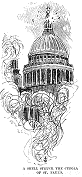 After this came the turn of the General Post Office, and soon the bombs were crashing through the roofs of the great buildings in St. Martin's-le-Grand, setting floor after floor on fire as they burst and scattered their fearful contents through the rooms and passages. Then a shell struck the cupola of St. Paul's and wrecked it at a blow. The great golden cross tottered for a moment and then crashed downwards, smashing a great hole in the dome, and shivering to fragments on the marble pavement of the cathedral.
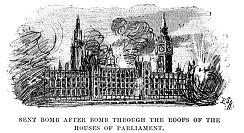
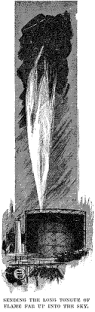 Every gas light in South London went out within a few minutes, and then the Vengeur headed away north-westward to the works of the Gas Light and Coke Company at Kensal Town. The great "Jumbo," the largest gas-holder in the world, was full, and the huge iron reservoir had been raised to the tops of the iron pillars with which it was surrounded.
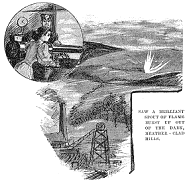 "What was that, Sir Harry?" asked Dora, with a tremor
of awe in her voice. She had come from Violet's cabin with a message, and was standing by his side watching the effects of the shot through the open slide through which the barrel of the gun projected.
"What was that, Sir Harry?" asked Dora, with a tremor
of awe in her voice. She had come from Violet's cabin with a message, and was standing by his side watching the effects of the shot through the open slide through which the barrel of the gun projected.
 "Very well," said the Mayor. "It will be better not to lose any time about it, for it will pacify the people wonderfully when they know we have got them under lock and key. And now, Sir Harry, while they're getting ready, sit down and tell me this wonderful story over again."
 THE next morning the whole country was ringing with the fame of the War-Hawk and her exploits. The reaction from the horror and panic induced by the merciless revenge which Renault had taken upon London, to the cheering certainty that, after all, the world was not to be given over unresisting to the fury of its worst enemies, and that at last the Syndicate had brought into existence a power capable of successfully disputing the empire of the air with them, sent the nation almost wild with delight.
"SIR,- Will you allow me to remind those who are apparently under the impression that the Aerial Navigation Syndicate has a special mission and obligation to protect society at large from the onslaughts of the anarchists, that this Syndicate is a private corporation, founded primarily upon a commercial basis, for the furtherance of the purposes of those who have put their work and their money into it. What those purposes are, or in what manner they will be carried out, is our business and no one's else.
"We recognise no obligations to employ the force at our disposal according to the direction of any Government or Governments. We have broken no laws and attacked no one save the enemies of society, and therefore our right to complete freedom of action cannot be impugned. We shall act when and how we think fit, and that is all that I either can or will say on the subject.
"I may add that so far, the publicity given by the newspapers with regard to events still fresh in the public memory has, in each instance, directly assisted the anarchists in their designs. Through the newspapers Renault's accomplices received the disguised message which he gave them from the dock at Bow Street; through the same medium they were informed of the precise hour at which his execution was to take place, and so were able to rescue him in the nick of time; and thus, too, the rescue of the crew of the Vengeur and the terrible tragedy at Newcastle were directly due to information derived from the minute details published in the newspapers.
"I feel sure that all sensible people will agree with me that it would be something worse than madness for us to follow the same foolish course.--
Yours truly,
"HIRAM S. MAXIM."
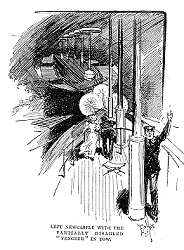 Three of her men were sent on board the captured vessel to get the engines into order as far as possible, and to keep up the supply of power to the lifting fans, so that the War-Hawk might not have any downward drag upon her, and could so tow her through the air at the highest possible speed. She was able to travel a little over seventy-five miles an hour under these conditions, and an hour or two before dawn on the following morning, she and her prize of war dropped through the darkness upon Lundy Island, and found that the Volante was still there waiting, although she was quite twelve hours late for the appointed rendezvous.
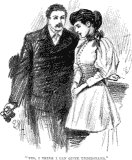 "Yes," she said, with a faint flush on her cheek and just the suspicion of a roguish twinkle in her eyes, "I think I can quite understand what you mean, and perhaps I can answer you by reminding you that we Utopians don't call each other Miss and Mr. in our conversation."
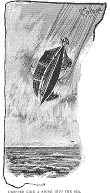 He saw her stop for an instant, and, as it were, shiver in the shaken atmosphere. Then she dropped two or three hundred feet, came to equilibrium, and swung round to fly northward again.
"BULL POINT STATION,
"News just received that Nautilus was surprised and torpedoed by unknown vessel off Scillies soon after nightfall. Wyndham in command. None saved.
He saw her stop for an instant, and, as it were, shiver in the shaken atmosphere. Then she dropped two or three hundred feet, came to equilibrium, and swung round to fly northward again.
"BULL POINT STATION,
"News just received that Nautilus was surprised and torpedoed by unknown vessel off Scillies soon after nightfall. Wyndham in command. None saved.
"July 17th, midnight."GARDNER."
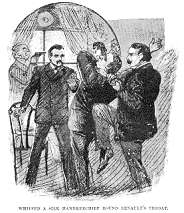 attempted mutiny in the camp. If it had not been for the very great and, indeed, indispensable services that you rendered to us at the beginning, I tell you frankly I would have shot you as I shot Berthauld - on
suspicion. As it is, you shall have the opportunity of defending yourself, and if you can clear yourself, why-"
attempted mutiny in the camp. If it had not been for the very great and, indeed, indispensable services that you rendered to us at the beginning, I tell you frankly I would have shot you as I shot Berthauld - on
suspicion. As it is, you shall have the opportunity of defending yourself, and if you can clear yourself, why-"
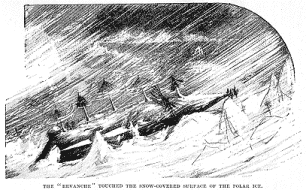
Offices of the Aerial Navigation Syndicate,
Victoria Street, Westminster S.W.
(Date )
To His Imperial Majesty,
The Emperor of the Russias.
I have the honour to subscribe myself, Your Majesty's obedient servant,
HIRAM S. MAXIM
(Chairman of the Aerial Navigation Syndicate).
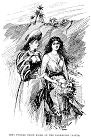 "Don't," said Violet, with a shudder, putting her arm round Dora's waist and turning her away.