Introduction to the HTML version
ONE of the problems any student of Victorian and Edwardian magazines encounters is the sheer quantity of dross that must be winnowed to find occasional gold. The late 19th century readership was insatiable for the printed word, and to meet this demand many of the stories and articles did seem to be formulaic - whether the formula was as formalised as described below is unclear, what's certain is that there was a certain repetitiveness to their contents. The present editor has repeatedly bought collected volumes of several hundred pages, only to find that there is nothing inside worth bringing to the attention of a modern audience. There are occasional exceptions, of course, but at a guess there are fifty to a hundred stories and articles for every one that's of real interest.
D'Ordel's Pantechnicon shows that the readers of the period weren't blind to their flaws - it's a brilliant parody of the style of these magazines, and some of their authors. For example, "The Missing Lynx" by "D'oothby Boyle" is very obviously derived from the Dr. Nikola stories by Guy Boothby; "For the Royal Rusks" by "Quax Blunderthud" takes its inspiration from William LeQuex. Nearly every issue had a romantic story like "Bunnie," or an informative article like "London's Goldmines," and most magazines began with an art section like "Scragford's Beauties" and ended with humour, though generally not quite as bad as "The Editor's Pig-Tub." This work also parodies the xenophobia and jingoism of some of the writing, to an extent that some modern readers may find offensive; in particular, "Bunnie" contains racial epiphets which would be considered unacceptable today.
 D'Ordel's Pantechnicon was published in 1904. The author was Sir Mark Sykes, bart. 1879-1919; a brief biography appears here. This e-text began as a photocopy of the original book, subsequently scanned by Kip Williams, who has very generously made his scans available for this release. Due to the limitations of HTML the layout is not identical - in particular, footnotes have generally been put immediately after the paragraph which leads to them, or at the end of the end of a section of text where that is more convenient. The Greek characters used for the book's motto could not be reproduced exactly as HTML coding and are displayed as a graphics file. The text includes several passages inside decorative borders - although I've tested it in several browsers, some readers may need to adjust text size to avoid text overlapping the borders.
The book as a whole did not originally have a table of contents, although there is one for the sample magazine - the contents list following has been added by the current editor. The cover is based on a monochrome image, the colour etc. from a description provided by Kip Williams.
I have corrected several minor spelling errors in the original text, and probably added many more errors from OCR etc. Please bring anything you find to my attention.
Marcus L. Rowland, January 2007
D'ORDEL'S
PANTECHNICON
An Universal DIRECTORY of the
MECHANICAL ART of MANUFACTURING
Illustrated Magazines
Intended as a Course of Learning for Future Writers
CONTAINING AN ACCOUNT OF
THE ADVANCE OF LITERATURE
In Modern Times
WITH A
PERFECT MODEL
for the Guidance of Students
AND
DIRECTIONS
Exposing the whole MANUAL ART of the Trade
BY
Prometheus D'Ordel, Gent.
As it was (lately) delivered to the Editors
MARK SYKES and EDMUND SANDARS
LONDON : Printed for Bickers and Son, at the Sign of The
Falcon in New Street Square. MCMIV
THE EDITORS' ADVERTISEMENT
A FEW weeks ago we each received a communication from the solicitor to the estate of Major-General D'Ordel, which informed us that there were certain papers, addressed to us both jointly, awaiting us at his office. We met on the following day and went down together to the City, where we found a large parcel containing a letter and a bundle of manuscript.
The letter was as follows:
"SANDWICH, April 9, 1904.
"SATURDAY at Night.
"GENTLEMEN,
"It may be that you will pardon my troubling you with this letter and the enclosed manuscript.
"I should never have approached you upon this subject had I not already had ample proof of your integrity and patience. You may be surprised to hear me run on at this rate, but your admiration will give way to acquiescence when I tell you that I well knew the original manuscript of my cousin, General D'Ordel — that same manuscript you carved and beat into some form of grammar and sense before publishing it to the world. Having by me a copy of my poor cousin's original at the time I read your edition of Tactics and Military Training, I was, as you may imagine, astounded at your pertinacity and
labour.
It is possible that you be not ignorant of my existence, since there must be among the General's papers a heap of correspondence, letters, notes, and suggestions of mine, which he invariably treated with a contempt and a disregard that would have raised the anger of one less philosophical than myself. But de mortuis N. N. B.
"After this preamble I think you will forgive me if I proceed immediately to the business of my letter. I have devoted many years of study to the best methods of attaining proficiency in a number of trades and employments, and I think I have discovered several walks in life wherein a dunce of the most profound kind can, if he do but follow certain rules, earn a livelihood. If this is a fact, who shall say that my time has been idly spent, or that I shall not prove a benefactor to mankind?
"The increased population of these islands has brought with it a corresponding increase in the number of blundering and stupid persons, who (unless provided for by the accident of birth or by Government employment) must needs earn for themselves an honest livelihood of some kind or another, as their very stupidity unfits them for successful crime.
"The interruption of my studies which would be caused by the tedious and harassing business of publishing a book has long deterred me from taking this step; but Modesty, greatly as she may enhance the beauty of a genius brilliant enough to penetrate her opaque covering, often withholds a lesser light from mankind, and I have therefore decided to place one part of my work before you for publication. Should you deem it worthy of printing, pray relieve me of the innumerable and dreaded annoyances. And perhaps you will send me a copy of the book when complete, as I should like to have it by me for reference.
"In absolute reliance upon your judgment and confidence in your capacity, I am, Gentlemen, with full respect and esteem,
"Your most obedient and humble servant, "PROMETHEUS D'ORDEL." |
We turned to the manuscript with some curiosity, and found that it consisted of a number of papers in a thin, clear hand-writing, together with a quantity of drawings and sketches—the whole evidently hastily and carelessly packed, and in the greatest confusion. Our chief difficulty lay in arranging them in order, for, once that was done, they assumed the form in which we now publish them.
The only difference between the manuscript as we received it and as published arises from our omission of one essay. This was entitled, " A Defence of Magazines in the Eighteenth Century," and consisted of a refutation of the following note by Pope and Warburton to their 1743 edition of the Dunciad:
| B.I. | Line 42 Magazines.—The common names of those monstrous collections in prose and verse; where dulness assumes all the various shapes of folly to draw in and cajole the rabble; the eruption of every miserable scribbler; the dirty scum of every stagnant newspaper; the rags of worn-out nonsense, and scandal, picked up from every dunghill, under the title of Essays, Reflections, Queries, Songs, Epigrams, Riddles, etc., equally the disgrace of wit, morality, and common sense. |
It did not seem to us that this essay had anything to do with the subject of the remaining manuscript or bore the slightest application to any periodical of the present day. Therefore, having written once or twice to Mr. D'Ordel about it, and having received no reply, we ventured to omit it entirely.
MARK SYKES.
EDMUND SANDARS.
ΠΡΟΜΗΘΕΩΣ
ΩΡΔΗΛΙΔΟΤ
ΠΑΝΤΕΧΝΙΚΟΝ
DEDICATION
TO _____________________________________*
THE EDITOR OF THE
MOST PERFECT OF EXISTING
ILLUSTRATED MAGAZINES.
SIR,
When you realise how much use I have made of your Noble Monthly in preparing this Text Book, you will not be surprised that I should dedicate my work to you.
It is acknowledged in the remotest corner of our Dominions that to your Zeal and Labour the Magazinian Art owes its present splendid Position among the Mysteries of this Age. With you rests the Honour of having instituted obedience to those Magnificent Mechanical Principles which I have only endeavoured to arrange and expound.
Perhaps some Share of your Fame, which must surely pass down to Posterity, may fall to my lot as being in some measure associated with the Founder of a Trade wherein the most Incompetent can earn an easy Livelihood without difficulty, and in spite of the Obstacle which Nature hath laid in their path; and it pleases the retiring scholar to think that his name will ever be coupled with that of the Famous Celebrity.
I have the honour to subscribe
myself, Sir,
Your faithful, devoted, and
admiring servant,
PROMETHEUS D'ORDEL.
* Unluckily, this illustrious name was totally illegible in the MS., and when we wrote to the author asking him who the person was, again we received no reply, and so we were obliged to leave a hiatus, which the reader must fill in at his discretion.
|
AN ACCOUNT OF
THE ADVANCE OF LITERATURE
In Modern Times
WITH A
PERFECT MODEL
for the Guidance of Students
I can teach with ease even the densest dunce
WHEN the first press was completed and the first book printed in Europe, the philosophers and statesmen of that day scarcely apprehended the extraordinary revolution which the new invention would effect in the affairs of the world, though to us the far-reaching changes which resulted from the mechanical practice of the discovery form a logical sequence of events as obvious as the rungs of a ladder against the wall of a house.
Yet would one no more blame them for failing to foresee these developments than he would discredit the wits of a countryman who, discerning only the steps of St. Paul's through a London fog, admitted that he had no clear idea of the shape of the cathedral, although the edifice is the only reasonable and proportioned structure which the steps could support.
From the earliest use of movable types down to our own time printing has become cheaper and cheaper. To-day the luscious fruit of the instructive tree which our first parents culled in the garden stands for sale on every hawker's barrow, and the meanest can now divert themselves with the knowledge of good and evil which it brings.
Perhaps the most noticeable advantage to mankind which has resulted from this greater cheapness has been the vastly increased production of those delicate literary fancies which aim at amusing all men, without strain to their intelligence or aggravation of the
evil of such as chance to be stricken with brains.
The Board School boy of to-day would laugh to scorn the library of light literature which was at the disposal of a nobleman in the middle of the eighteenth century. At the best it would only contain a Rabelais, Gulliver's Travels, some plays, a few odd verses, Pope's Poems, The Examiner, The Tatler, The Guardian, The Spectator, and similar stuff—works which (although in view of the dates at which they were produced they may claim to possess some merit) require a useless, unpractical, and liberal education before they can be enjoyed or understood. Joseph Miller and the writers of the Touchstone and the Chap books, the pioneers of English literature, did not find fit successors to carry on their work, and although during the first half of the nineteenth century certain authors were generally enjoyed, they were but few in number.
Dickens, Thackeray, the Brontes, Bulwer Lytton, and a couple of score more, formed
the whole popular writing body in 1860, and their works still retained a considerable tincture of the evils which marked those of their predecessors.
Their stories were long, their style tedious, studied, and hampered by accuracy of grammar and construction, and many a modern reader avoids their works and never even opens one of their books merely by reason of the number of pages they contain. The passing vogue which these men enjoyed was due, not to the brilliancy or beauty of their work, for these things have but little to do with true popularity, but to the fact that they provided the only reading material obtainable.
Latterly, however, by reason of the increased cheapness of printing and the more widely spread knowledge of the alphabet, not only has the number of readers been much augmented, but a prodigious host of authors has sprung up — no longer mere pompous, long-winded grammarians, penning interminable stories of possible events, but authors without any pretension to learning of any kind, driven only by hunger and thirst, and unfettered by wit or invention. The works of these writers found place in the various illustrated magazines, which first appeared in any considerable force about the year 1885.
The manufacture of cheap and attractive stuff was then only in its infancy — the science of writing down to the price of the periodical was not fully understood. An illustrated magazine was often worth a shilling; many of the stories were written by men of antiquated, scholarly training, and a number of the drawings were executed by persons of some taste and originality. But as time went on, by dint of diligence and experiment, it was found that, by the employment of authors properly qualified, the use of photography and tracing-paper to compose pictures, and a great increase in the part devoted to the commercial advertisements, a magazine, thicker, more fully illustrated, and containing even less merit than the shilling volume, could be so produced as not to appear cheap to anyone at sixpence. The improvement did not end here. In the last years of the century such a periodical worth only fourpence-halfpenny was ventured; and still later an even more careful selection of writers, artists, and methods enabled some bold projectors to bring forth an illustrated monthly of the literary and pictorial value of threepence.
But this will not close the matter finally; we shall see the day when a magazine will be constructed which will only be worth ______ I was thus far gone in prophecy, when it came into my mind that predictions are dangerous, and that, having once hazarded them, the easiest means of proving their accuracy was to fulfil them myself.
Therefore I instantly set to work to compile a perfect standard to be followed by the makers of future magazines. This model I have completed, and I set it before the literary world as an ideal type from which the entire craft, manual art, trade, fraud, trick, mystery, and cunning of writing may be learned.
Although I have taken particular pains to make this work complete, imitative, and stale, yet, so uncertain is every human effort of success, that I dread lest some faint trace of the blight of thought or originality may have crept in. Of this, if it be so, I beg that I may be speedily informed by the one who discovers it, so that the blemish may be removed in any later edition.
The reader of observation will immediately note that my perfect model lacks an essential to all successful and notorious magazines. I refer to the most striking and weighty section of those works — that universal directory of science, art, and manufacture, that noble monument of trade, which is built up of the advertisements. And whoever perceives that those glorious compositions are not contained in the pages of "Scragford's" will laugh at my pretensions to any knowledge of the magazinian art. The very idea of a periodical without advertisements is absurd and vain. Who could conjure up in his mind any one of our renowned monthly issues with neither the first eighty nor the last fifty pages devoted to a compendium of commercial instruction and guide to purchasers of soups, songs, wines, tobaccos, foods, books, and furniture? Who could imagine such a publication unburdened by those informing tracts interleaved within it, whose gorgeous colourings transform the sober carpet of a railway carriage into a tasteful patchwork quilt? And yet "Scragford's" contains no sign of all these things; and still the author has the presumption to bring it forward as a Model for future guidance!
So just is this objection that many a student has conceived that a magazine consisting only of advertisements, and containing no stories, would be more reasonable. But if
this were granted, then the whole theory upon which literature is based would fall to the ground, for the advertisements would be given a standing which they could never maintain. They cannot rightly be deemed literature, since it is fundamental to their existence that they should be of use. For if the goods which are therein praised be truly commendable, the buyer has benefited by the notice; and if they have no value or virtue the gain is that of the trader. Thus it will be seen that in either case the advertisement is not worthless to the entire human race; and any writing which pretends to excellence must at least satisfy that test. The articles and tales in a magazine conform exactly to this important requirement. They are without utility of any kind, and they are therefore enticing. The reason for their existence and for the exercise of their alluring power is to force the public to buy the volume, to open it and to turn over its pages. Once this is done their object is accomplished — the readers have been brought into ocular range of the advertisements; and this is to-day the whole scheme, design, intention, and purpose of skilled writing.
But still it might be argued that, as advertisements are the most important, though not the sole contents of a periodical, any model should comprise them. To this I reply that my standard type deals only with the literary part of the subject, and, further, that advertisements not only do not partake of the nature of letters, but rather tend to their ruin. No author can either compose or study trade notices without contracting certain corrupt and abominable qualities, such as terseness, originality, clearness, and knowledge; and the display of any one of these would render him incapable of obtaining admission to the writing staff of any perfect magazine.
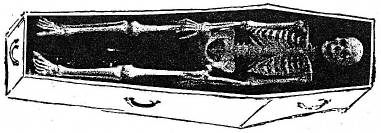
My model must therefore be compared to a grim skeleton both dried of its marrow and robbed of its fair covering the better to disclose its articulations, and, just as the bones of the body preserved in their natural situation are instructive to the surgeon, so "Scragford's" may serve those authors whose duty it is to produce the light and less intellectual part of a modern magazine.
In this work, then, I have only striven to indicate, in well-worn phrases which all will remember, the methods which lead to periodical prosperity, and even to the lowest degree of honour that is hereditary.
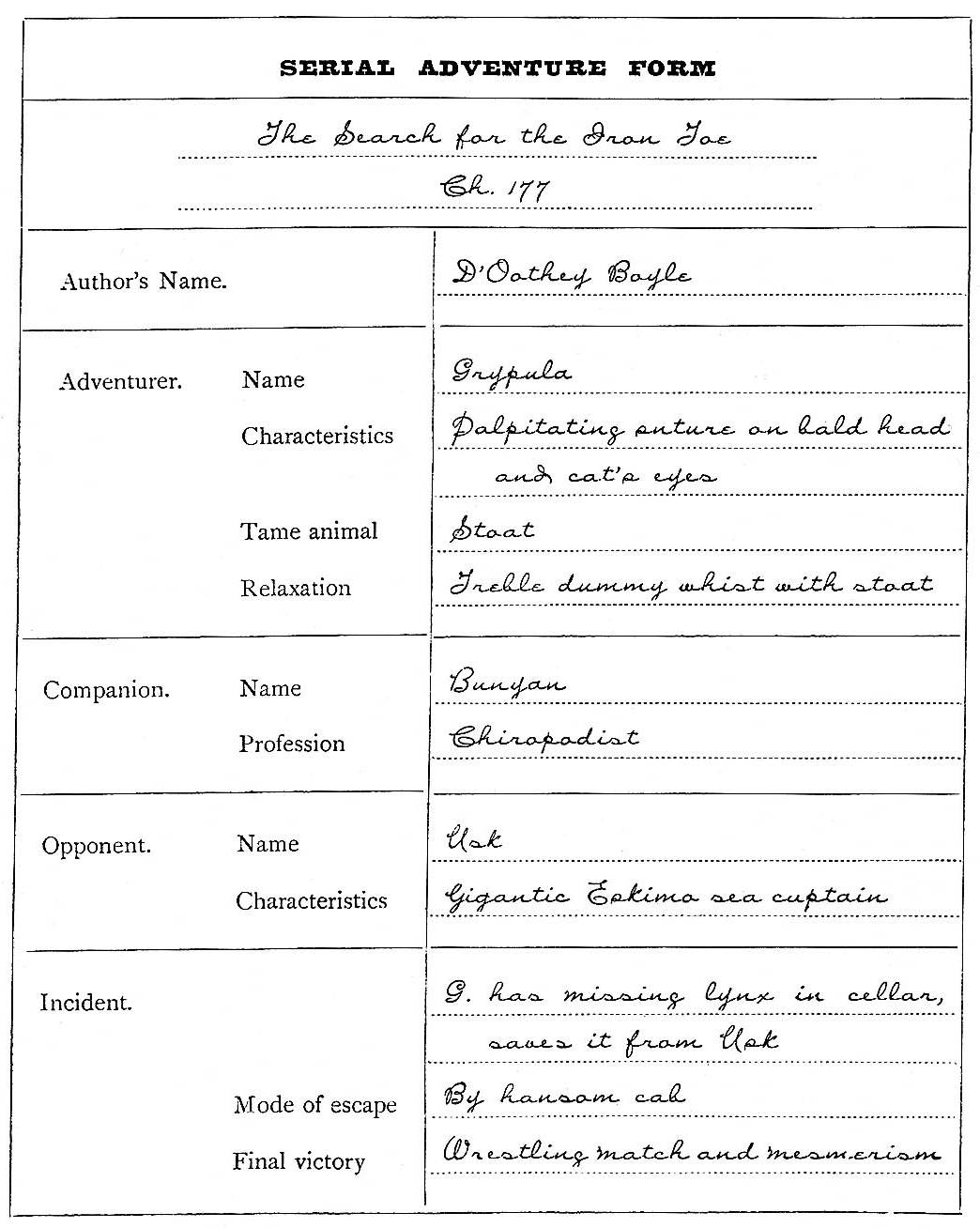
The story of "Grypula" gives the ingredients of the indispensable tale of an incident in the life of the serial adventurer, wherein are two important points to be observed.
In the first place, the character of the adventurer himself must be simple and freed from all the complexity of human nature, and his acts must be so governed by the ready rules laid down for him as inevitably to be foreseen by every reader.
This is made more easy by the fact that, no matter who be the author or what the hero's
profession, he must always be the same man. Whatever part he may play, whether as in his original manifestation, that of a drugged detective in a dressing-gown, or that of a nonconforming Spanish brigand with a beard shaped like a torpedo, a merchant captain with
the beak and plumage of a brooding vulture, an insane Croesus with a brown papier mâché hump, an animated Egyptian mummy with a curiosity concerning Chinese monasteries, or any other character which human folly can devise, his identity must never be lost.
In the second place, the recital may with advantage purport to come from the mouth of one so crassly and patently imbecile as to be unable to exercise this foresight.
The operation of these two rules taken in conjunction is that of an exquisitely subtle
flattery, than which there is no greater inducement to waste money upon worthless trash.
Thus, if, for example, the fellow be said always to consult a clinical thermometer at all moments of extreme peril, and if this manoeuvre be repeated in each tale, on the adventurer being led forth to execution by learned pigs the fatuous narrator will interject, "I was astounded to see the strange man calmly consult his tiny clinical thermometer."
Thereupon many of the readers will be rejoiced by the thought that they are more intelligent than average men, for most of them must have divined that the thermometer would be consulted.
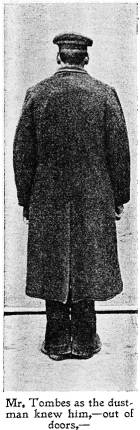
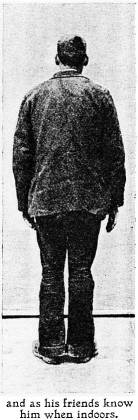
The instructive article on Dustmen is dependent for its formation upon the possession of a number of unremarkable photographs and an infinite capacity for expanding any theme, be it a bye-law of an athletic club, the habits of cheese-mites, or any other matter of sufficient insignificance and meanness. Thus, in the instance given, the article could be summarised in the words "Dustmen remove dust in carts," but in this form it would not occupy a line of print, whereas my duly inflated version fills three pages.
The narrative which bears the name of "For the Royal Rusks" appeals to the fairest
parts of the nature of all civilised communities — their extreme interest in the affairs of persons of quality, and their unbounded reverence for the bearers of titles of honour; and still more strongly to what is perhaps their noblest characteristic — a keen delight in the nicest details of bloodshed, slaughter, and destruction, so long as these events be sufficiently remote to cause no apprehension of personal danger or risk to their own property.
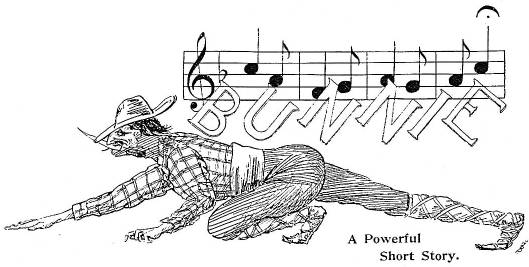
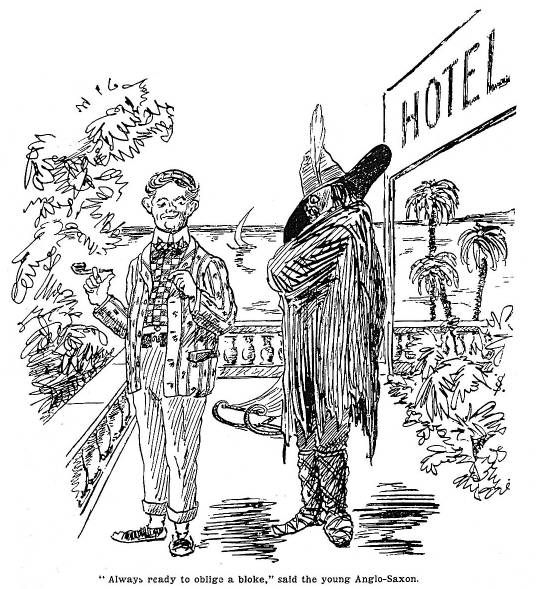
The histories entitled "Bunnie" and "The Judge's First Case" will be recognised as being the results, the one of the true island patriotism, and the other of the intimate ignorance of a profession which mark their respective types. The former may appear with the scene laid in Italy, Spain, India, China, or Kamskatka; the latter may fail to reveal the true life of Counsel, Physicians, Civil Servants, or Diplomats.
In short, I have written a model of what the skeleton of the magazine of the future should be. It contains everything that such a framework must contain. The stories are
of the liveliest and most sprightly kind; the jokes are of the most approved style the illustrations are well within the mark; the items of information of the requisite uselessness; and, upon my sacred word of honour, the whole compilation is only worth ONE FARTHING.*
WE fear that Mr. D'Ordel's meaning is liable to misconception. It is true that such a Magazine as "Scragfords" when unloaded upon the market with its complete equipment of advertisements would only be worth the sum mentioned, but as a model its value to students is incalculable. - EDITORS.
HERE FOLLOWS THE MODEL.
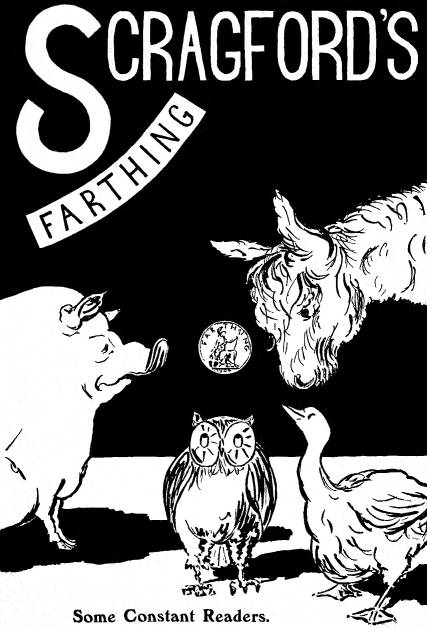
SCRAGFORD'S FARTHING

THE MODEL MONTHLY.
Rights of translation and reproduction in the Contents of this pattern are strictly reserved, but rights of imitation are gratuitously offered to all compilers of Magazines.

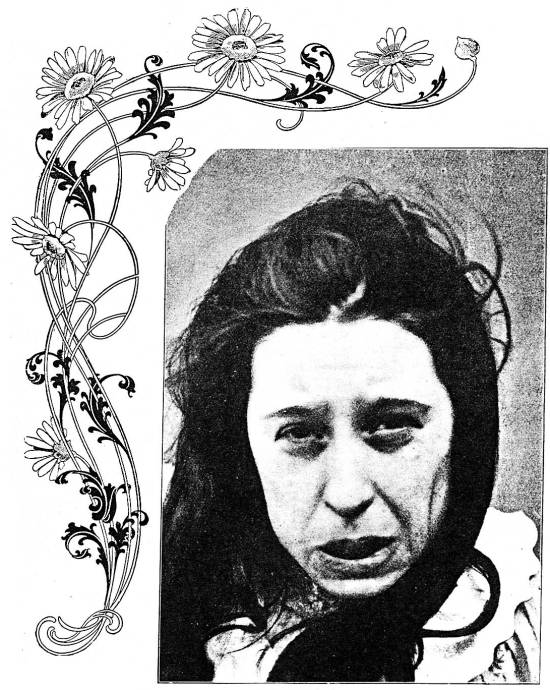
SCRAGFORD'S BEAUTIES.—No. VII.
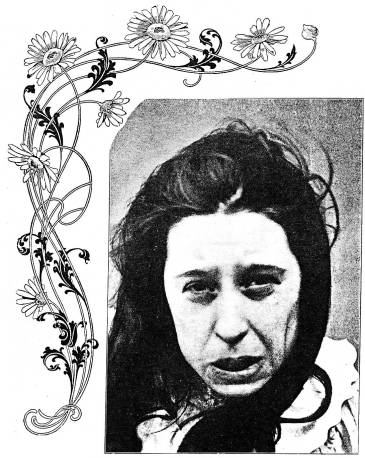
Oh! winsome, coy, demurest girl,
Thy rosebud smile and limpid eye
Make thee fit bride for any earl.
"Would," Scragford's editor remarks,
"That nobleman were I!" |
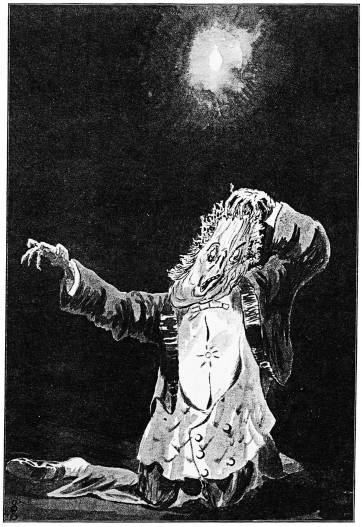
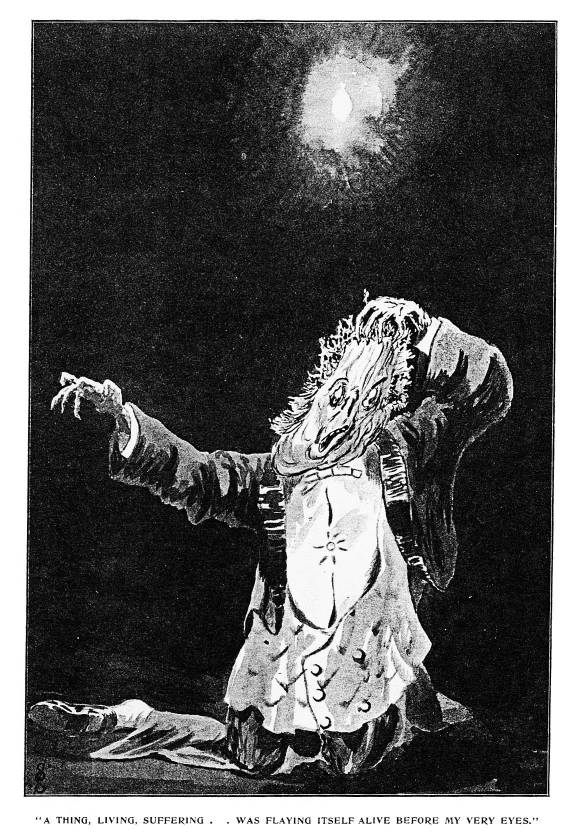
"A Thing, Living, Suffering... Was Flaying Itself Alive Before My Very Eyes"
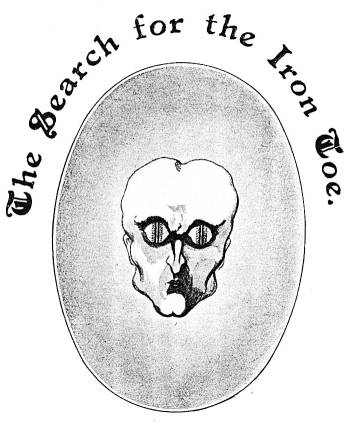 |
A Serial Novel
By
D'OOTHEY BOYLE,
Author of
IN GRYPULA'S GRIP; THE
HUNT FOR A SKUNK;
GRYPULA'S ADVENTURES;
AU REVOIR, GRYPULA;
THE STRANGE EPISODE OF THE
BRAZEN FACE; MORE GRYPULA'S
ADVENTURES.

To Readers of
"SCRAGFORD'S FARTHING."
Each chapter of this stirring serial
contains a full and complete story,
which has no reference to the main
issue of the novel.
|
Synopsis.
Grypula, cruel, stern, affectionate, repulsive, faithful, fascinating and unscrupulous man of mystery, aged 2003, accompanied by his grey stoat "Moloch," which he carries about in a diamond-studded reticule, has employed Ralf Bunyan, a struggling young Australian chiropodist, as his amanuensis. The latter met his employer in the lions' cage at Jamrach's, and has since been Commissioned by his master to record some sixteen hundred cf his unique exploits. Ethel Liffey is the niece and sole heiress of the Duke of Dublin, a millionaire noble in Grypula's pay. Ralf has been ordered by his master to keep in touch with the Duke, and contrives to obtain professional employment in the house. Ethel knows the secret of the Den. Grypula knows everything. Ralf knows nothing.
CHAPTER CLXXVII
THE ADVENTURE of the Missing Lynx.
ON returning home after a pleasant day spent at "Clubland," I found on my table in my brown study a heavily-sealed envelope, which I hastily tore open. It read as follows:
MY BOY,—Ethel and I are lonely to-night; will you partake of supper with us? Your friend—Dublin, Dux K.S.D.
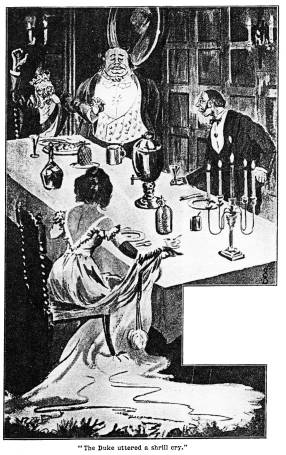 To change my tie and shirt-front and slip into my black velvet Norfolk jacket was the work of a moment, for I knew that his Grace's table, at his mansion in Harley Street,would be well spread. Besides, there was Ethel—but of her more anon. Within a quarter of an hour I applied my thumb to the electric "sonnerie" marked "Visitors," and thought to myself how strange it was that I, the erstwhile struggling young surgical operator, should, through my casual meeting with the most extraordinary of men, now be a welcome guest at one of England's noblest houses. The door opened, and emitted a flood of light on to the pavement, and I was relieved of my top-hat by Buljer the butler, who whispered to me : "His Grace and Miss Ethel await you in the supper-room." As he led me thither. I noticed that he was a huge, unwieldy man who, though still enormously stout, showed by the bloodhound-like pouches under his eyes and cheeks that he had once been much fatter. As he opened the door for me I thought, though I may have been mistaken, that I heard a deep, sepulchral laugh. My host was a tall, beetle-browed nobleman who, in spite of his almost boundless wealth, showed by the lines of care upon his face that a life of pleasure, excitement, and anxiety had left their mark upon him. Though I knew from my "Debrett" that he was not above sixty, he might have passed for seventy-five. I noticed that, in spite of the pain which I knew he had suffered, the staunch blood of the old kings of North Wall enabled him to force his feet into his tight glace pumps, while the black silk stockings which encased his courtly old legs made a brave show. "Welcome, Bunyan," he cried cheerily enough. "Ethel, here's our visitor." My eyes glanced from the heavily-laden board and fell once more under the thrall of my loadstar.
"Uncle and I are always pleased to see you here," she sighed. The words were few and simple, but to me they meant much, and I lapsed into a reverie from which I was recalled by the butler's huge shadow falling between us.
"Have a nobbler of port with your venison," said the Duke. "Buljer is waiting for you."
I drank off the wine, silently toasting the fair lady opposite me. The conversation seemed to flag, and I could not help noticing that the Duke appeared more than usually nervous, and almost as if apprehensive of some great disaster.
"Is there any news in this evening's papers?" queried Ethel, as if desirous of relieving the tension of the moment.
"Not much," I explained, fingering the agate pickle-jar. "I suppose you have heard of the disappearance of Lord Phoenix's renowned diamond links."
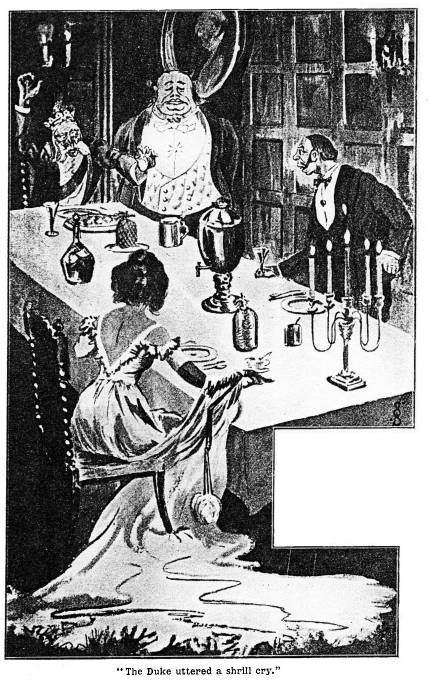
Suddenly the Duke uttered a shrill cry and fell forward on to the table, his face buried in the dish of trifle which was before him. Ethel rose to her feet and hastened to lavish tender cares upon her uncle, while Buljer, unmoved, poured him out a stiff go of old Cognac. "Only a passing qualm," groaned the Duke; "my heart is not what it was," and after a short time the conversation resumed its normal tenour. I rose early to leave, fearing to fatigue his Grace, and after having made my professional appointment for the morrow, craved permission to retire on the score of urgent business.
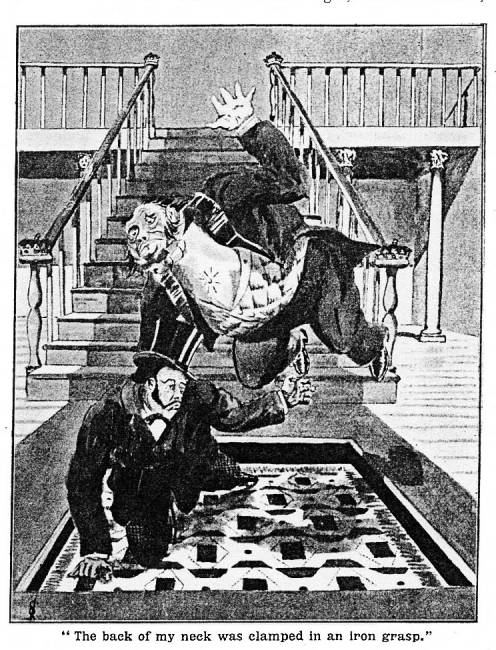
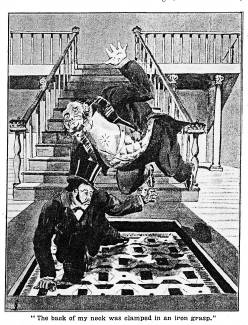 I descended the grand staircase, took my hat from Buljer, who was waiting for me in the hall, and turned towards the door. Sometimes things seem to happen with such lightning rapidity that one is unable to realise or describe them in their proper sequence. All I can remember is that the back of my neck was clamped in an iron grasp, a leathery substance was forced between my teeth, my top-hat was violently crushed down over my eyes, the rich Turkey carpet seemed to slide from under my feet, the floor quivered beneath me, and I felt that I was rapidly sinking. The smooth rumbling of well-oiled machinery mingled in my ears with the throbbing of my carotid artery and the heavy breathing of my assailant as he knelt with crushing weight upon the small of my back. The descending motion ceased with a slight click, and I found myself in complete darkness. I was lifted bodily from the ground and flung heavily off the carpet on to what appeared to be a heap of empty bottles, and I realised that I was in the cellar of Dublin House. While endeavouring to remove the hat, which had probably saved my life in my last fall, I heard the sound of the re-adjustment of the hydraulic machinery. When I succeeded in freeing myself, I was dazed by a flood of electric light, which revealed, though at first but hazily, the massive form of Buljer.
"You infernal scoundrel!" I shouted, tearing the gag from my mouth. The man merely smiled, and, motioning me to be silent with his hand, slowly began to fumble with the stud of his capacious shirt-front. I heard a slight hissing sound and then an awful change took place the memory of which even now causes me to shudder. His face seemed to shrink, and puckered into flaccid folds of empty skin, his vast bosom and shoulders heaved and sank. The knees trembled and the huge thighs seemed to vanish into air, leaving the ample garments that had covered them hanging crumpled and unfilled. The pink and dimpled hands grew withered and clawlike, and ad! that awful face! now creased into a thousand wrinkles, was shrivelling up before me. I felt the cold beads of perspiration coursing down my brow, and heard them splashing on the damp floor, but worse was yet to come. I tried to shut out the fear-some sight, but I could not. The Thing began to move, to raise its arms and writhe as if in dreadful anguish. It clutched at its face, at its chin, and at the loose dead-white skin which hung upon its breast, it fell upon its knees and tore upwards with its dangling claws (now more like tentacles of sinew), at its face. Its face? Merciful Powers! it had none! Where the frightful face had been was a still more awful blank—a blank —now seamed with twisted folds, now taut and throbbing with unutterable agony. Something living—suffering—was flaying itself before my very eyes
"If I were Dublin, I would not employ this butler," I moaned, hardly knowing what I said. *
* Upon subsequent consideration I still think so.
Then at last the tension was relaxed, the fearful blank fell back, empty, the great stiff shirt-front heaved and gaped, and skin and clothes fell to the ground, while from the gaping shirt emerged, calm, smiling, pensive, dreamy, cold, unbending, bitter, pondering — Grypula.
"I fear I startled you, Bunyan?" he murmured as one disturbed in a long reverie. "The disguise, you will admit, was effective?"
"Disguise," I quavered.
"Yes," he continued, "it is my No. 1 confidential upper servant pneumatic," and drawing from his breast-pocket Moloch's diamond reticule he opened it and put in his little finger. The strange denizen realising that its enforced seclusion had come to an end, ran up his arm and fastened its gleaming teeth securely and affectionately in the lobe of his left ear. "Oh! Moloch," he mused sadly, "we cannot have our rubber this evening, as we have a more serious game on foot, but we will play one hand while our friend Bunyan recovers with the help of some of the Duke's Imperial Tokay, which he will find in bin No. 43." So saying he carefully folded the disguise, the discarding of which had so terrified me, and using the shirt-front as a table, produced from his waistcoat-pocket the miniature pack I knew so well, and dealt out the cards for his usual game of treble dummy whist. The Stoat, with his hardly human interest in the game, took up a position on the table close to Grypula's left hand, from which he could administer the savage bites with which he marked his master's revokes.
I staggered to the bin indicated, and snacking off the neck of one of the bottles, from which the dust of ages fell, drank down a stiff nobbler of its liquid gold. I turned towards the strange pair, and noticed that Moloch's sharp canines were firmly fixed in the ball of Grypula's thumb, and that he had just added the ace of spades to the three of diamonds, which were trumps, led by one of his imaginary opponents; he held in his hand the four, seven, and ten of diamonds.
"Grypula, you have revoked," I observed.
"Moloch has already told me so," he retorted, and added, " My dear Bunyan, I see you have recovered. I was present at the treading out of that wine in 1604. The fourth Henri, had he not been a recluse, would have been a martyr."
This extraordinary man was almost always surprising me in some way or another. I sometimes could hardly believe that this calm, pensive individual who was sitting on the floor of a Duke's cellar playing treble dummy with a stoat, had but ten minutes before been masquerading as the Duke's butler, had assisted a long dead French King in the manufacture of Tokay, and had of old wielded Rome's imperial sway under the title of Heliogabalus. But his historic omniscience has often convinced me that it could not have been otherwise. An antique boot, a modern rapier, a blue Mauritius, or Saitaphernes' tiara presented no archaeological difficulties to him, while a Republican as recalled memories of his childhood.
"Bunyan," interrogated Grypula briskly, as he placed the cards in the back of his gold repeater and slipped Moloch into his reticule, "are you ready for a stiff job to-night, for I think I see a pretty little adventure forming itself in the near future?"
"Need you ask?" I replied; "but, remember, I have a professional visit to pay to the Duke to-morrow morning" — and a vision of Ethel passed before my eyes.
"Have no fear," he answered, "but that pairing will never take place." I wondered. Did he read my thoughts? Or, was he thinking of the appointment with my illustrious patient? But he proceeded, "Listen. As you well know, in my search for the Iron Toe I required the assistance afforded by the ownership of the Missing Lynx. That animal was guarded in the fastnesses of the north by the Cheoptic Eskimo whose god it is. Daily it was fed on the freshly-severed limbs of human babes. Its ferocity was such that even the chief priest could not approach it unmuzzled. Now, mark me, no matter how, I have obtained that lynx."
 "What!" I exclaimed, springing up, "are we then so near the end of our search?" He did not answer, but his eyes gleamed, and once again I noticed the extraordinary phenomena connected with these organs and with his shaven cranium. The eyes were those of a member of the feline tribe—large, green, and iridescent, the iris opening out and contracting into a thin vertical line, and the top suture of his head, always wide open, displayed, when in repose, a deep cleft which pulsated gently to the workings of his gigantic intellect. It was almost uncanny.
He resumed his story, "I have obtained that lynx, and it is now chained and muzzled in a den at the further end of this cellar."
I shuddered involuntarily. "But why here of all places in the world?" I asked.
"Really, Bunyan," he snapped, "you know little of my methods. It should be obvious even to you that my possession of the lynx would be objectionable to its late worshippers, of whom, by the way, the high priest—Usk—is a man to be reckoned with. Although born an ignorant Eskimo he holds a British master mariner's certificate. You will thus perceive that once owner of the Missing Lynx it became incumbent upon me to procure a reliable keeper. I, therefore, engaged for the purpose the premier Duke of Ireland at a salary."
"A salary! you surprise me."
"A mere matter of a million a week. Perhaps the rise in the bank rate which has so perplexed the press is now comprehensible to you. But pray do not interrupt me. The Duke
agreed to house the lynx and daily feed it with his own hands. But even I am not infallible, at least I begin to think so. Usk had been a forward hand upon the Duke's yacht, and, becoming master of a dark secret, held the Duke in his power. I did not know of this. The Duke has proved false to his trust, and to-night Usk will be here with the Eskimo crew of the whaler, of which he is mate, to receive the lynx at his hands. This may explain to you your host's 'passing qualm' in the trifle after your unwitting blunder in referring to Lord Phoenix's loss. Now we must to business—wait here."
Grypula switched off the electric light, and I heard him gliding noiselessly towards the back of the long cellar. I fell to thinking over the strange events of the night, and wondering whether the circumstances of which I had just heard would affect my chances with his Grace's niece. I was thus employed when a tap on the shoulder from a heavy chain aroused me—it was Grypula.
"The lynx can now defend itself," he announced, "only the bars of its den protect us from its teeth and claws. But, hist! we have a visitor. Down behind that bin, Bunyan, for your life!" I instantly obeyed this peremptory request. A key rattled in the lock, as if held by some uncertain hand. I instinctively felt for my Waffenfabrik No. 3.
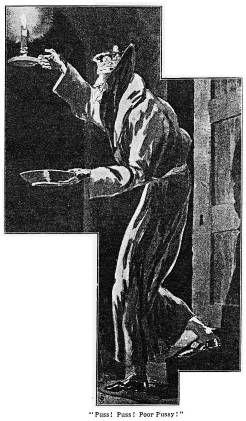
W and S Target model .4.46326 repeating pistol which I invariably carry since I lost my left leg in the adventure of the Mystic Mangle of which I have already written. Would to God that I had had it on that awful day! The heavy door creaked on its hinges and a bar of light shot across the ceiling, following the circuitous route dictated to it by the heavy gilt mouldings of the cellar. The bar widened until it embraced the whole room, and disclosed that it emanated from a bedroom candle borne by a tall figure, whose face was so far bent down into the collar of an ample dressing-gown that I could not distinguish it from my coign of vantage. The figure shuffled slowly by me, and I saw that it was none other than the owner of the Tokay which was scarce dry upon my lips. He held in his hand a deep enamelled saucer of milk, paused before me to murmur "Puss! Puss! Poor Pussy!" and then continued towards the dark end of the cellar. At that moment clear, deep, yet shrill rang out into the echoing vault a wild hoarse mew. A mew so thrilling, so intense as ne'er was mewed before — it played among the arches and reverberated among the wine bins, telling of bestial rage, ruthless ferocity, and of strange uncanny power. Obeying some irresistible impulse, I jumped to my foot—a cry of warning at my lips. A sickening blow descended upon my head, a million sparks danced before my eyes, and I sank unconscious into the bin.
* * * *
When I came to myself I found Grypula seated astride of one of the mahogany, brass-bound barrels of Beaune, gazing regretfully at a glace dress pump.
"Here," he soliloquised, "I hold all that remains of Patrick Threlgood Tippy Liffey, Duke of Dublin, Marquess of Nephin-Begg, Earl of Nephin-Begg, Viscount Croaghmoyle,
Baron Liffey, Peer of Ireland, member of the Dublin City Council, Knight of the most noble order of the Shillaghleah of Donny-brook, once keeper of the Chiltern Hundreds, Resident Magistrate and Inspector of the Irish Constabulary, millionaire, connoisseur, and villain. He has paid in his checks—I will not judge him. This shoe will figure in my collection of interesting footgear." As he spoke he placed the pump in one of his capacious pockets, and "Bunyan," he pursued, "your untimely sympathy for that most undeserving of men almost interfered with my schemes. Had you made a sound I should have been obliged to resort to strong measures."
I murmured some feeble words of apology as I bound up my injured head. Grypula switched off the light and we resumed our former place of hiding. I had just begun to ponder on Ethel, now a duchess in her own right, when the massive door once more creaked and opened, and two figures bearing torches entered. They were wearing the tall conical head-dress of the priesthood of the Lynx, and their faces were covered with the heavy robe, pierced only with two eye-holes, which hung from it, At the bottom of the steps they turned and marched slowly and majestically towards the den. I shuddered with horror at what might happen—I had seen one man take that path before! Grypula thrust me violently aside, and with his swift, stealthy, cat-like walk followed them to the end of the cellar. There I saw him stretch out his arms and grip them each by the neck where the spinal cord enters the pericranium. I saw him give a slight effort of the wrists, I heard but one short, sharp crack, and, by the dim light given by the fallen torches, I saw that what had but a moment before been two as vigorous young priests as ever trod in shoe-leather was but one shapeless bundle of clothes. From this Grypula swiftly selected the priestly robes and, having assumed one, signed to me to do the same to the other. I had so often had cause to wear a similar garment in my many marvellous adventures with Grypula that this was but the work of a moment, and picking up the torches we proceeded to the door. Grypula opened the door, and in the Cheoptic dialect of the Eskimo language called out, "All is well, the Duke is in the Lynx's den" (which was strictly true). We stood aside and a file of men entered—such men as I had never seen before. All except their leader, who came last, were stunted deformities. They wore the usual Eskimo sealskin combination suit, and their copper, blubber-covered faces lit by the torches they bore produced a wild lurid effect. Their leader, whom I instantly recognised as Usk, was much above the average height — he must have easily touched seven feet. His face was powerful and, though cruel, handsome. His broad hairless upper lip, his flat nose, and almond eyes black as sloes, were surmounted by an extraordinarily protuberant forehead which showed an intellectual development remarkable in any man and marvellous in one of his race. Grypula signalled them towards the den, and made the mystic sign of the Lynx. "Go," he commanded, still in Cheoptic, "the mighty One of Ones hungers for the worship of her followers." As they turned I noticed that the leader held a brazen vessel which emitted a savoury odour — I shuddered involuntarily, thinking what nourishment it might contain, and was grateful to the covering robe which concealed my emotion. The whole party knelt and crawled swiftly down the cellar with low beastlike cries. Grypula thrust me towards the steps. "I think, my dear Bunyan," he whispered, " that our presence is no longer necessary." As he did so a hubbub arose at the further end of the cellar, and the whole horde came pressing back. I heard the hoarse voice of the leader shouting to his men, I saw the sea of angry faces, and we jumped through the portal and slammed the heavy door to, severing a hand which clutched at my wooden leg as it lay upon the ground, crablike. Grypula locked, double, and treble locked the door; we tore off our disguises and sped down the passage at lightning speed. As we ran Grypula explained to me that Usk had seen the bodies of the priests, knew that the Missing Lynx was loose within the cage, safe from capture, and was only bent upon revenge. Behind the door the din redoubled, and thundering blows shook the foundations of the ducal mansion, and as we reached the area a crash of rending timbers announced that it had fallen. "There is no time to lose," hissed Grypula, and seizing me by the belt of my Norfolk jacket, he tossed me clear over the area railings on to the cold, hard pavement, and vaulting lightly after me, thrust me into a hansom which stood tenantless at the door. I was dazed by my falls, and was only half conscious of Grypula springing into the driver's perch and lashing the horse into a gallop. When I came to myself I saw in the looking-glass before me that I had lost my top-hat, and that my neck-wear was disarranged. But for these trifling inconveniences and for the throbbing of my wounded head I was almost uninjured. The trapdocr opened above me, and the cool, calm voice of my extraordinary companion called to me " Kindly shoot the driver of the omnibus behind us." I never hesitate to obey this wonderful man, and so breaking the small window behind my head I raised the flap with my left hand and taking careful aim at his passing shadow on a house lodged a bullet in the gentleman indicated. I was horrified to see him sway from his box and fall with a dull thud upon the roadway, where the wheels of the ponderous vehicle passed over his body.
"A clever ricochet, between the eyes," chuckled Grypula. "You would he a great shikaree, but I fear it might, if published to those blockheads at Scotland Yard, bring you within the clutches of the law." A thrill of horror crept down my spine. Why had he bidden me kill this man?
"That omnibus contains some of our mutual friends," he rejoined from above, as though penetrating my inmost thoughts through the top of my skull, "and I considered it advisable to detain them."
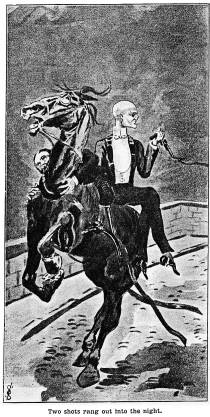 The pace was becoming terrific: our steed, striving in a wild gallop, cast back great flecks of foam which gave it the appearance of a goose in the plucking, and the whole cab became white as driven snow. As I have often remarked, in moments such as these a man notices small details, and accordingly I say that I observed that the tassel of the right-hand window-blind was slightly frayed. As we shaved the corner leading from Oxford Street into Park Lane I saw the great swaying vehicle but sixty yards behind us, and heard the exulting yells of its pursuing inmates. At Hyde Park Corner the sixty yards had shrunk to thirty, and I felt that it could not last long. But here we obtained a momentary respite from the white uplifted hand of a policeman, who checked the 'bus's wild career while he himself crossed the road. This gave us but twenty yards more, and down past Knightsbridge through the Brompton Road to Hammersmith and Putney we held our mad course. Thrice my Waffenfabrik barked, and thrice a blubbery driver reeled from his perch and bit the asphalt with despairing cry. Up the steep slope of Putney Bridge we tore, and such was the pace that at the cobbled ridge the cab left the roadway and rose full two feet into the air. It fell with a grinding crash, and I found myself clinging to the brave horse's mane, struggling to regain my balance on his neck. Unable to do so unaided, I was slipping to the ground, when my artificial limb was seized in a firm, cold grasp, and I was restored to a more stable seat upon the horse's hack. Grypula, who was riding pillion with all the grace of an accomplished horse-woman, had again saved my life. I felt a clutch at my pistol pocket, and two shots rang out into the night. He had cut the traces, and we were freed from the trailing burden behind us. The body of our late vehicle followed us for twenty yards, then swerved in its course, jumped gutter, pavement, and parapet, and fell thirty-seven feet into the eddying swirls of black water below. Strange as it may seem, all had happened so swiftly that the horse had never broken his stride, and from our reaching the top of the bridge to the disappearance of the cab cannot have occupied more than seventeen seconds.
"I had to do that," muttered Grypula dreamily, "when escaping in my chariot from
Attila. I had not yet invented gunpowder, and the hatchet was decidedly clumsier."
As we galloped up Putney Hill I could clearly see that the awful strain was telling on our brave beast, his breath came in deepstertorous gasps, his flanks heaved convulsively, and his knees quivered as they shot out beneath his outstretched neck. Grypula handed me a hypodermic syringe and calmly directed, "Under the left shoulder-blade. Unsporting but necessary — we have no time to consider the feelings of the jockey Club."
I did not protest, but pressed the tiny piston home, and we again began to distance our pursuers. Seven times I doped the poor labouring brute, seven times he pluckily responded to the call of transatlantic science, but as I inserted the needle for the eighth go at the top of Wimbledon Cornmon the exhausted animal twice staggered in its stride, and fell in rigid death. I was flung against a sharp boulder with the horse across my back, Grypula, as usual, landing upon his feet. He dragged me out by the hair and set me on my foot, and we fled through the iron-grey dawn. I leaped along in Grypula's wake, my steel-shod leg striking out, as I then thought, its last sparks from the flinty road. As we reached the summit of a slight ascent we heard a wild cheer from the oncoming 'bus, which turned into a shriek of terror from thirty throats as the huge fabric, striking the corpse of our faithful steed, stood, tottered, swayed, and, bursting like a bombshell, scattered its living contents to the earth. What had but lately been one of the best 'busses that ever travelled on tyres was but a heap of riven matchboard and shivered glass.
"That horse has been of use to us," quoth the strange man, as I stood fascinated by the dire ruin. " By the way, did you notice when he died?"
"I suppose when he fell on me," I ejaculated, surprised at the unexpected question.
"My clear Bunyan, you are no observer," sneered Grypula; "he ceased to breathe immediately after the second injection."
I shuddered involuntarily. For two miles we had ridden a dead horse!
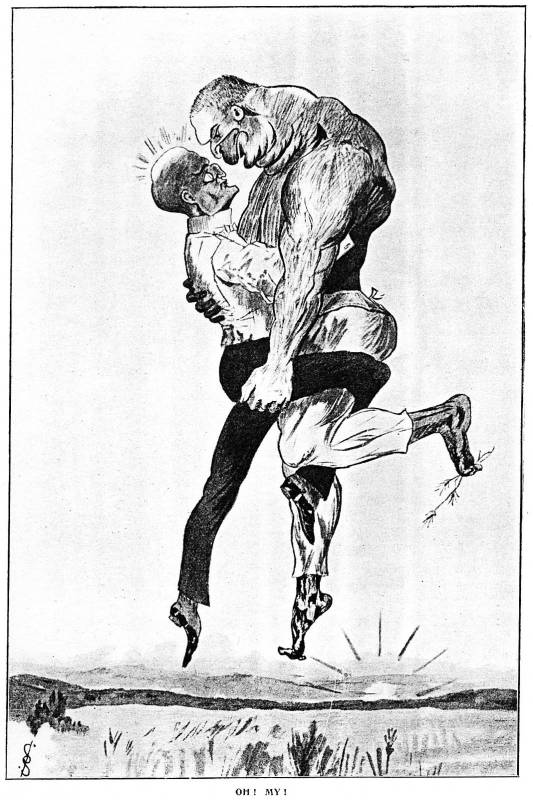
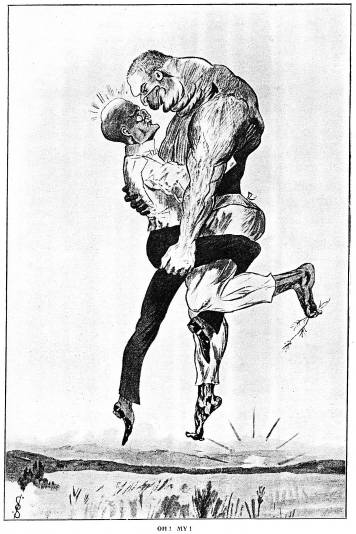 "But now," he declared, "I must deal with the man who has endeavoured to thwart me." I looked towards the debris on the road, and saw one solitary figure arise from its midst and stride towards us — it was the mighty mate. He alone survived of those fifty desperate men who started from Greenland to recover the Missing Lynx. He advanced with deliberate strides from the wreck, beneath which the shattered forms of the last of his companions lay buried. At his approach Grypula removed his evening-dress coat, and neatly folding it handed it to me, postulating: "Be careful of Moloch." I was inexpressibly surprised and astonished to find this marvellous man so cool and collected. "Kindly relieve our friend of his furs," he remarked ; "they may encumber him," and taking from his trouser-pocket the pistol which he had not restored to me, he cast it away from him to the ground. Usk, moved by some impulse of rough chivalry, sent the heavy blubber knife which he held behind him to join my Waffenfabrik, and then with one swift movement threw aside his sealskin garment and faced Grypula completely nude, save for his nether jaeger underwear. The two stood motionless for a moment in silence, and I contemplated them with awe. Grypula, though a man of somewhat above the medium height, was giving his opponent half a cubit. He stood lightly poised upon the balls of his feet, leaning slightly forward. His tense, eager legs, taut yet supple, the finely trained muscles of his trunk and thighs, showing through his beautifully fitting clothes, which were specially made for him by a West-end tailor, his well-poised neck and ivory knuckles presented a splendid picture of graceful humanity. Before him stood Usk, the high priest of the Cheoptics. Huge as he had seemed when fully clothed, he now appeared far more gigantic; although without an ounce of superfluous flesh, he would have tipped the scale at nearly thirty stone. His close-cropped hair, his beetling brow and cruel mouth surmounted a tightly knotted, sinewy neck and a pair of shoulders which would have put a regular Hercules to shame. Above these shoulders the head, though immense, appeared monstrously small. The circumference of each of his thighs exceeded that of his waist, and his calves were those of a great Assyrian bull. His great feet were flattened with pacing icy decks, and contrasted strangely with the arched and dainty insteps of Grypula. After standing thus for twelve minutes the silence was broken by a short yap of hate as Usk rushed in; the two men gripped, and the struggle began. Silently the two figures stood, each clasping the other round the body, my friend having obtained the much coveted under-grip, and I could see that each without a sound or movement was straining to raise the other, Usk with a view to loosening Grypula's hold, Grypula with a view to utilising it. The only sound which broke the stillness was the monotonous creaking of their muscles as they strove for mastery. I could see the lithe, stipple movements of Grypula's chest and shoulders under his linen shirt, and could also detect that, mighty and well proportioned as he was, the Eskimo's diet of candles and soap had told upon the structure of his muscles—they seemed to move more slowly, more stiffly, and less precisely than those of his smaller opponent. Upward they strained, their feet clawing at the soil beneath them, The mighty backs writhed and bent, the eyes clashed like two sharp swords, and the deep red weals made upon the giant's back and sides by the steel cable arms of his adversary were hidden by the arms that had made them. Then suddenly a most extraordinary thing occurred. So equal was the strength of the two men and so great, such was their determination to attain this object, that they both succeeded. Slowly, steadily, and simultaneously each raised the other from the ground. They rose inch by inch, until there were two clear feet of space between them and the earth they had trod! Then slowly the gigantic effort subsided, and they came gradually back to earth. Again they strove, again they rose, inch by inch, inch by inch. Now the strain was fearful to see; Usk was grievously distressed, and even Grypula's brow was marked by a tiny bead of sweat! Suddenly I saw a change come over his feline eyes; they burned like two live coals, and the skin over the great cleft in his head was throbbing strangely. It rose until instead of a cleft it had the appearance of a ridge, shaped like the cock's comb of a Metropolitan policeman's helmet, and it glowed as if filled with liquid fire. Oh! my! slowly I saw the giant's eyes grow stony and vacant, and his skin, which until then had rippled over his working muscles like some strange sea, grew grey and rigid as the wavelets in the sand left by its swiftly retreating tide. His mighty arms relaxed, the great supporting tension snapped, and they fell as one man to the ground. Grypula sprang to his feet, stood for a moment over his vanquished foe with a smile of triumph, and then fell himself, unconscious. Grypula had fainted! It was but for an instant, and he rose and calmly bade me give him his coat.
"Usk has had a lesson he will never forget," he stated decisively, "for the next ten years he will think himself a turnip."
I shuddered involuntarily and turned in horror to the giant, and saw that already his head, upon which he was standing, was partly concealed in the soft soil, while he endeavoured to make the indescribable noise characteristic of that esculent root.
When my eyes again fell upon Grypula, he had removed Moloch from his reticule, and was dealing out the cards for the second hand of his interrupted rubber.
Suddenly amid a rustle of silk and frou-frou, a slender figure emerged from the bushes. It was her Grace the Duchess of Dublin—nay, Ethel!
* * * *
I little thought when I paid my professional visits to Dublin House that I should one day be Duke-Consort within its walls. Her Grace, my wife, tells me that Grypula has returned to London. I wonder whether that wonderful man will again come into my life in time for next month's "Scragford's"?
[To be continued in our next.]

NEXT MONTH. Mr. D'Oothey Boyle promises us an even more awful chapter for our next number, entitled: " THE ADVENTURE OF THE SEVENTH HOWL," in which Grypula, with the aid of the Lynx, discovers the thumbless Negro in his living tomb. Grypula will be disguised as a Banshee.
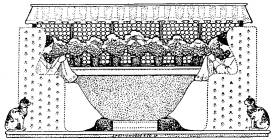
 | LONDON'S
GOLD
MINES:
A DAY AMONG THE
DUSTMEN.
Being some personal glimpses of one of Britain's great enterprises, its remarkable achievements in the gathering of dust, with a bright and interesting account in which the writer gives his impressions of a visit to a London dust-cart.
By
MORTIMER TOMBES.
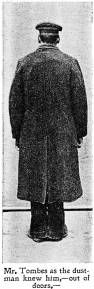
| | 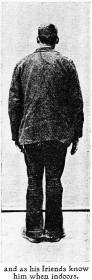 |
On the 4th of July, 1853, the seventy-seventh anniversary of the Declaration of the Independence of the United States of America, a dustman, whom we will call Robinson, was emptying his cart of dust at one of the great dust shoots of the metropolis, now long disused and probably covered by recent building. He had had a long and fatiguing day at his work, and perhaps may have been more or less anxious to get back to his wife and family— if, that is to say, he enjoyed the advantages of matrimonial life and some tender olive-branches. As the dust fell from his cart, he thought that he saw some object glittering in the evening sunlight. He got down from his cart to the ground and walked down the slope of the shoot to the spot where he thought, possibly, the object might have fallen. He groped about in the refuse with the toe of his boot, which was tipped with iron nails, and soon disclosed the bright object which he had really seen. It proved to be a spoon made of Abyssinian gold, a composition closely resembling in appearance the real article. He picked it up between his fingers and examined it with his eyes. Then he put it in his pocket and walked back to his cart. He climbed in, and taking up the reins in one hand and the whip in the other, he drove his cart away from the shoot towards his own mews, where his horse was to be stabled and where his cart was to be put away for the night. On the way he stopped at the police station, where he gave his find to a P.C., stating that he had found it among the refuse which he had brought in his cart from a particular street. The minion of the law took out his note-book from his pocket, and with the help of a pencil noted these facts, together with the name and address of the dustman Robinson. After this he told Robinson that it was all that he required of him, and the latter once more mounted his cart and drove the now empty vehicle home. He never again heard of the spoon, but the matter did not end here. On Maundy Thursday, 1854, during the second year of the Crimean War, the police traced the owner of the lost property, a respectable widow who lived in Wandsworth, and restored the spoon to her. Words fail to describe the bereaved woman's joy when she recovered the article she had so long deemed lost beyond recall.
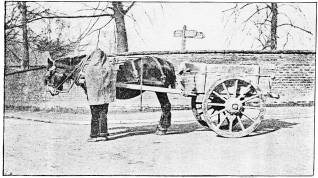
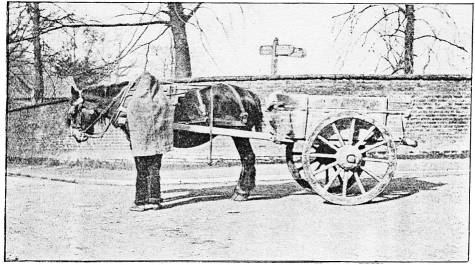
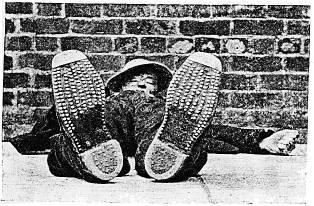
Here we see the Dustman, his horse Tiger, and the cart. Readers should note the placard which informs the wondering observer of the nature of the cart's contents. This photo was taken while the dustman was attending to some of the complicated harness on Tiger's back.
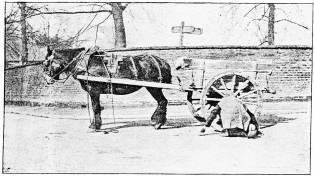
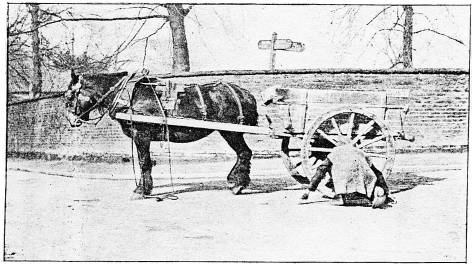
This dustman is looking at the wheel of his cart and wondering whether it wants any grease. If it does he will certainly put some on before he goes any further. Note that Tiger has moved his foot since the last photo was taken. The reins are hanging on the ground, but they will be picked up later. |
The promptitude and intelligence shown by Robinson on that memorable evening are only characteristic of the thousands of dustmen who form the cleansers of London's dust-bins. Most people who by force or inclination are the owners of dust-bins in London gain a rather odd opinion of the duties of a dustman. Based on what they see of him they form the conclusion that his only occupation is to wear a sack upon his back, and to put dust into carts and take it away. That is the dustman as the house-holder sees him. To those, however, who know the bin-cleanser a little more intimately, as I do from having gone out and spoken to one in the street, he is quite a different kind of person. Next month's "Scragford's" will contain another intensely exciting and instructive article descriptive of the multitudinous duties of a London undertaker; the present writer avers that, so far as the number and variety are concerned, Dustmen's duties are hard to beat even by so versatile an individual as the Metropolitan Funeral Purveyor.
Come to think of it, the life of a Dustman is not the bed of roses most people imagine it to he. He most be able to carry the baskets of dust from the domestic dust-bin to his cart, to drive or lead his horse which draws the often heavy vehicle to and from the refuse-heaps. He must master the elaborate mechanism by which his cart is enabled to tip backwards so as to eject its contents upon the shoot. He has to be almost constantly, as to his driving, on the look-out, and woe betide the dustman who lies down in the road and allows his cart to pass over his body.
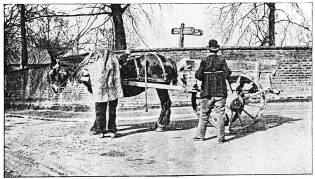
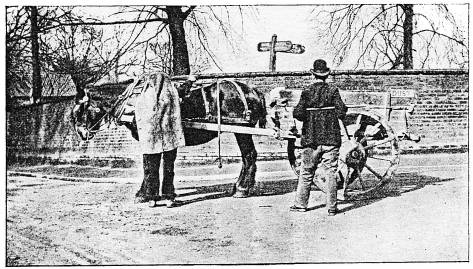
This is a photo of great interest. The wheel has been greased if it needed it. The reins have been picked up. But who is this other person? He is a passing stranger, unacquainted with the neighbourhood, who wishes to know his way. This the Dustman, who above all things is a handy man, is able to indicate to him by pointing with his finger to the sign-post. Note that Tiger has taken up his first position again, probably previous to starting. |
The wheels of his cart, again, require constant and earnest attention, and so handy a man is he that he is able not only to perform his many other duties, but in case of being asked by any passing stranger to show him the way, he is able to indicate it to him if he happens to know it. The dustmen are undoubtedly the first and most highly trained force for the purpose of emptying bins. These bins can only be kept empty by constant and continuous practice. So many a time and oft, Robinson and his mates have to turn in at the bidding of a householder, or some person qualified to give them orders to remote dust. And at unexpected intervals a great D puts in an appearance in the windows of houses and summons them to remove dust. If there be any slackness exhibited in its removal some official is sure to hear of it afterwards, and what he hears may displease him. This dust is composed of all sorts of rubbish, cigar ends, cabbage stalks, pieces of worthless paper, even "Scragford's Farthing" — in short, all the useless trash which collects in a house. Under all these conditions and circumstances it must be admitted that a dustman is a very hardworked man, executing very important and offensive duties for a wage; still, you will always find him a jovial, hearty, fair-spoken fellow, enjoying, no doubt, the knowledge that by good conduct and willing work he is sure to remove a considerable quantity of refuse. Their bonhomie is of a kind which makes you think for many a long day of those lonely men who, restless on their carts, are incessantly vigilant in preserving our homes from the ravages of bacilli, and of the admirable officials who control the Dust Department of our great metropolis.
Readers of " Scragford's Farthing."
Look out eagerly next month for Mr. Tombes's brisk and strenuous article on "Undertakers."
 BEHIND
  THE VEIL
Being a series of actual facts and experiences revealing the inner history and working of the Legal Profession in modern times. "Scragford's" readers must remember that these stories are not mere tales, but the truth—the whole truth—and nothing but the truth, attested and sworn to
By
OUR LAWYER.
No. I.—THE JUDGE'S FIRST BRIEF
A relation by a judge wherein we see that lawyers are, perhaps, not more hard-hearted than others when confronted by lovely women.
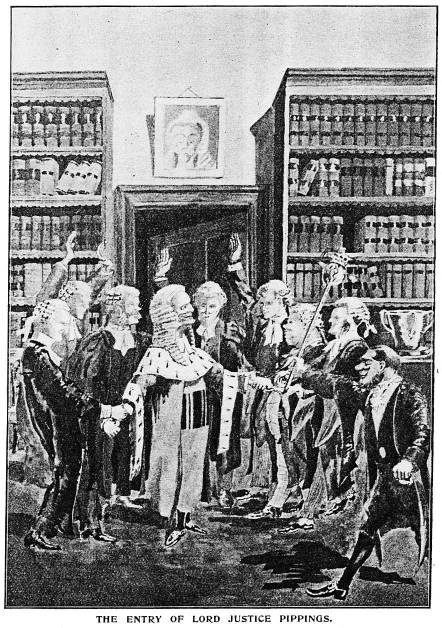
IT was a cold November evening in Stump Court, Lincoln's Inn, and there was a great collection of men of law in the chambers of young Fulford Strop, the junior K.C. of his year. The fun was fast and furious, as it was known that he was to entertain the judge whose brilliant summing up had obtained for the young counsel his verdict that day. As the usher of the court completed an interesting story, and as the old port and muffins were beginning to circulate, the door opened, and a universal cheer greeted the entry of Lord Justice Pippings. His scarlet robes and ermine tippet lent a touch of colour to the somewhat sombre gathering. They crowded round him and eagerly relieved him of his three-cornered hat and walking mace. When the old judge had been comfortably installed in the armchair usually assigned to the wealthier clients, the interrupted flow of repartee was once more resumed, and the conversation became general. A chased silver tankard, bearing the hall-mark of Richard II., which many a generation of judges and attorneys had deigned to quaff, was filled with the ruby liquid and offered to his lordship. Pippings, L. J., imbibed the fruity draught, and wiping his lips with the end of his full-bottomed wig, "A good tap that, Harry," he said, addressing the host. "It must be '48. The year in which I held my first brief." "How was that?" they all cried in unison. The judge was famous for his well-known stories and oft had he regaled the students at the famous Inns of Court dinners with instructive tales of the profession to which they were soon to belong. He lovingly mouthed his goblet and began :--
"I was then a struggling young robesman, and following upon a disastrous Northern Circuit, I had waited patiently in London for some weeks, without as much as seeing a six-and-eightpenny brief in its blue envelope. My clerk had complained bitterly of not having any pleadings to draft or settle, and I was almost at my wits' end. I hung about the purlieus of the Old Bailey vainly seeking employment among the felons and criminals who thronged its gates, and thus it was that one bright spring morning I found myself sauntering past Newgate without even the two proverbial browns in my breeches-pockets. I realised that this state of things could not continue long, and as I dared not face my clerk without bringing back work for him to do, I turned desperately towards Whitechapel in search of a client. I walked sadly on, and suddenly as I passed one of the narrow alleys which turn out of Ratcliff Highway I heard a scream, and a girl rushed towards me and flung herself at my feet, crying, 'Protect me! Sir, for mercy's sake, protect me!' I looked more closely at her, and saw that she was slight and slender, she had eyes which sought mine with the appealing moistness of a wounded fawn's, and her expensive gown showed her to be in good financial circumstances. I thrilled with joy, and instantly agreed. A burly policeman strode up to us, and touching the girl on the shoulder, said, 'In the name of the law, you are wanted': then, at the sight of my wig and gown, he saluted me, and I felt grateful for the intimate connection between the bar and the constabulary force which enabled me to protect the poor girl.
"'Officer,' I said, 'have you your subpoena duces tecum?'
He silently handed me the document, and I observed that it was strictly in order, and had the satisfaction of seeing the sensational nature of the charge against her. I got my retainer from the beautiful girl, and after agreeing to call upon her that evening at Pentonville Prison, I returned to my chambers. At about eight o'clock I visited my client in the dungeon; the poor girl was well nigh frantic, and implored me to tell her of what she was accused. I was obliged to inform her that, by the wisdom of our law, this could not be disclosed to her until she had been thrice warned by a police inspector that every word she uttered would be taken down and used as evidence against her. All I could elicit from her was the oft-repeated phrase. 'I am innocent, sir, save me.' 'I will do my best,' I said, and parted from her at the door of her cell. Being but young at the time I was unable to restrain some feeling of compassion for this girl, whom I thus left in her prison garb so freely bespattered with broad arrows, and burdened with heavy chains.
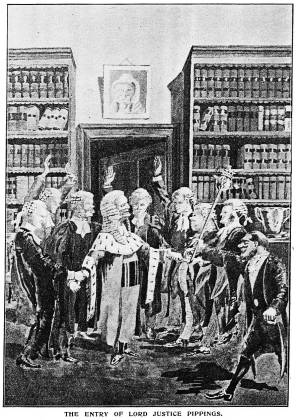 "That night in bed I revolved the matter round and round in my brain, but it always came back to the same place. I could find no solution and no rest, and such was my discomfort that I felt almost inclined to discard my wig, but I am glad to say that the love of my profession conquered. I had just fallen into a fitful doze when I was awakened by the opening of my door and the entry of a flashily dressed individual.
"'What do you mean,' he said angrily, 'by taking this ridiculous case?'
"'To which of my cases do you refer?' I queried.
"'You have only one,' he sneered; 'why did you take it?'
"'If you refer to that of the lady who to-day appealed for my protection, know, sir, that I, like every other member of the English bar, am ever ready to defend the cause of distressed and solvent beauty.' I was young and my blood was hot."
As the old judge said this his eye flashed with the fire of youth, and a low murmur of admiration and acquiescence passed round his auditory. He resumed :
"'Pshaw! I will make it worth your while to prosecute,' the intruder went on, fingering a large bundle of bank-notes.
"I subdued my anger and, great as was the sum offered, I refused it, and explained that it was contrary to the etiquette of our profession to relinquish a brief until the conviction or acquittal of the client, and that I could not with my existing pressure of business hold two opposing briefs in the same case. With an expression of disgust he dashed from the room.
"The next day was the day fixed for the trial, and the Lord Chancellor had placed the case upon his list. I was up betimes, and busied myself in drawing my brief. When I entered the Court at Westminster it was filled to overflowing with the number of people, mostly professionals, who had come to assist at my début. My old coach, John Huggins, seated among the common serjeants, shook my hand encouragingly as I followed my client into the dock. Bets were passed freely, and, so far as I could ascertain from the usher of the court, Huggins was the only taker even at four to one against me. My client wore her prison garb with an indescribable coquetry, and she leaned heavily on my arm.
"The charge was read over, and my client shuddered. `It was not a tinderbox!' she cried, `I am innocent.'
"In my opening speech I contented myself with promising the court that my witnesses would show the utter falsity of those who were to be called for the prosecution, and then the long stream of hostile evidence began. The doctor, the banker, the gun-smith, an expert in handwriting, the cabin boy, MacGregor the gillie, and the man from whom the book was bought; each, in turn, contributed his quota of damning evidence, and after the opening speech for the Crown, I saw Huggins frantically trying to hedge — things looked black indeed.
"I rose to my feet and loudly called my own name, then stepped into the box and was sworn. Returning to my place in the dock I asked,`Herbert Pippings, what do you know of this case?' I regained the box, and once more kissing the book I divulged my story. I told of how a man visited a lawyer at midnight, of how he attempted to suborn him, and of how he was foiled. Then descending once more from the box I asked myself `Who was that Iawyer? and who that man?' I stepped once more into the box amid a hush of eager expectation during which I could have heard a horse hair pin fall from the Vice-Chancellor's wig, and, striking my chest, I cried out, 'I am that lawyer, and,' pointing to the foreman of the
jury, 'Thou art the man!'
"The Lord Chancellor issued the usual peremptory mandamus, and my client left the box without a stain upon her character."
* * * *
"But, my lud," said a youthful junior, after the frenzied applause had subsided, "what was the charge against the girl?
"Ah! my boy," returned the judge, smiling. kindly, "you have still much to learn from such stories as this of the etiquette of our profession."
 | Readers of "Scragford's!" Next month OUR LAWYER will tell of "The Witness's
Revenge," a story of Damages in Chancery. | |
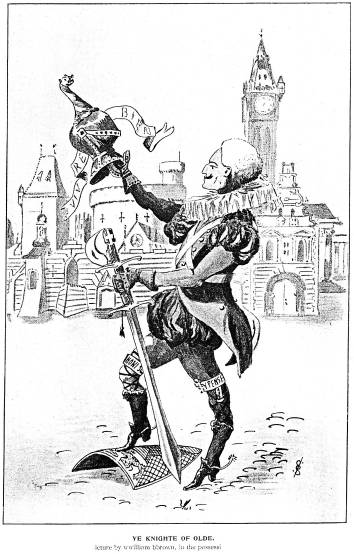
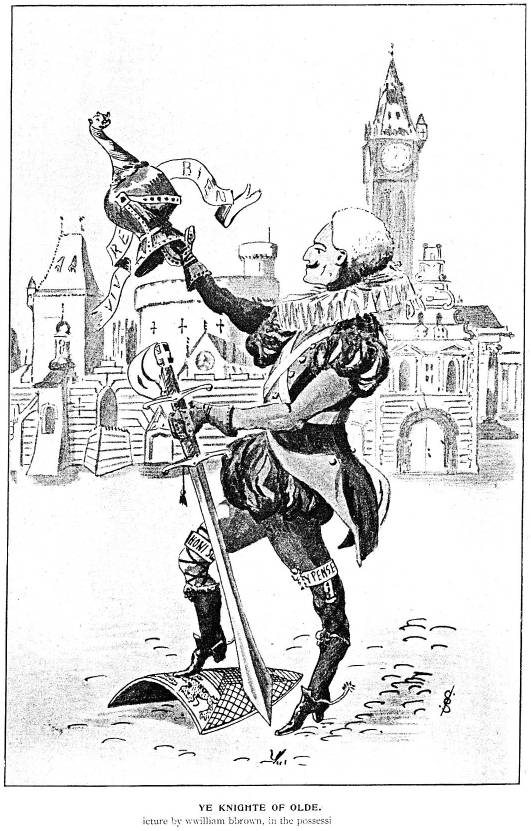
YE KNIGHTE OF OLDE.
Picture by wwilliam bbrown in the possession of Alderman Suss. | A MEDITATION
BY
CISSY HASP. | |
See! the silver Clarions bray,
Th' Lists are set, the Gages giv'n,
Champions join the Tourney's fray
(Spirits soon will wend to Heav'n).
Mowbray, Marlbro', Launcelote,
Roland, Hudibras, Morold,
Coeur de Lion, Don Quixote,
Raleigh,— and our Knighte of Olde.
Mark the Jousting's dinning sound,
Clash of steel and clang of Glaive,
Maces on the Vizors pound,
Truncheons crested helmets save
Ne'er "Ye Knighte of Olde" dismay'd,
Ever foremost, him we find;
Wearied in the tan are laid
Friend and Foeman, far behind.
High he rears his casque of steel
Decorate with fairest jew'lry;
Culverins his vict'ries peal,
None now heed the jester's fool'ry;
Smiling glances sound his praise;
Seeks he Dame of high degree?
Quiv'ring heartstrings meet that gaze;
Heav'ns ! his orb hath fix'd on me!
On me!! on me!!! on me!!!! on me!!!!!
* * * * * * *
Alas, the vision fair is gone for ever after more!
Never again shall I behold th' adored Knight of yore,
For, lo, that stalwart figure, which then so real did seem,
Was but a scrumptious vision, the Phantom of my Dream.
|
|
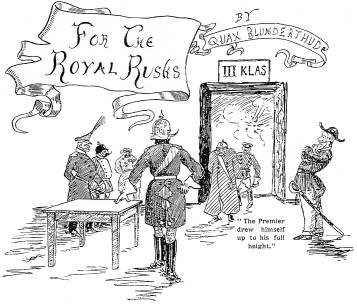
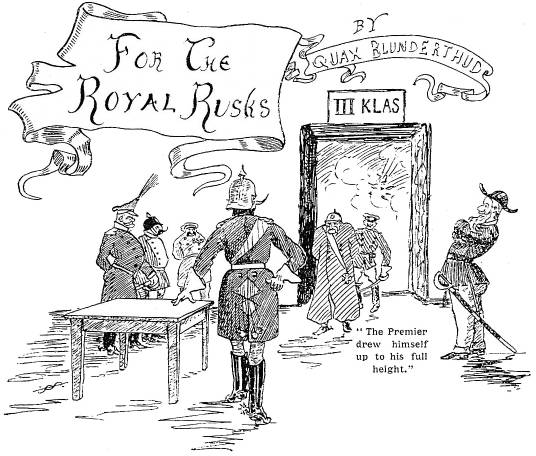
The story of a stirring episode of the Silurian Dukedom, It tells of the daring deeds of aristocrats, of the sudden death of an archbishop, of the dissolution of a cabinet, of the fearful fate of a minister, and of a veteran's valour. A young Ketzerhaupt tells the story. | For The
Royal Rusks
by
QUAX BLUNDERTHUD
author of
The Doom of Ramsgate;
The Celluloid Octopus;
The Serene Flunkey;
Under the Royal Fist;
The Imperial Buttons;
The Blue Bulgarian Band;
The Plagiarist of Hope;
and other short stories. |
IT was a stirring time during those days when Green-toothed George made his last grim dart at the archdukedom of Siluria. I was only a young Ketzerhaupt of the Black Gross-Herzoglicher Hof Guards, but I knew as much of the back workings of my master's brains as most men. I knew the story of the dead grisotte, and the reason why the old castle gate was always locked at three, but I stayed mum as a mouse and kept my mouth shut. Not that I did not have amusements too, as many a fair mädchen of Blagdensburg could have told. Heigho!
One cold evening in January, when the wind wailed down the tall beetling streets of the capital, I relieved Captain Cohenstein on guard at the palace gates, and prepared to remain in command of the royal postern for the rest of the night. The sergeant of the outlying picket had reported all secure, and the soft stertorous breathing of the troops in the guard-room showed that all was quiet. The heavy tread of the sentinel lulled me into a doze as I sipped my tankard of lager. Just as I had sunk into a profound sleep, a clatter of hoofs roused me into alertness. I heard the hoarse roar as the sentry challenged, then silence. Then the sharp bang of a musket, and a bullet clave the night like an angry hornet. A piercing shriek replied to the discharge—the bullet had gone home. Old Krakskul, the sergeant, strode in grimly. "Sir," he reported, "a horseman has been wounded."
I sprang to my feet and called him to "attention," then bade him bring in the injured man. In a moment he returned with two troopers bearing a human being clad as one of the Lithographic Hussars. I gazed astounded, for by the flickering light of the horn lantern I could see it was a woman in male attire, and that the most beautiful I had ever seen. Her wine-coloured hair was not all through the door when her slender body was already stretched in the centre of the spacious guard-room.
I rushed to her side to learn something of the mystery. " A thousand pardons, madam," I cried.
The beautiful creature raised herself to her elbow and drew a large parchment envelope from her bosom. " For him," she moaned, and the blood poured from her lips in volumes. With a thrill I noticed it was quite blue, and at once recognised the Archduchess-mother. I gazed at the heavy seal, and became aware that the fate of the infant Duke was at stake. I must deliver this missive without a moment's delay to the Minister of Agriculture. "Krakskul," I cried, "you know your duty." He threw back his head and saluted stiffly. Two minutes later I was pounding along the Blagdensburg road mounted on my old war-horse. "Halloa! comrade," I whispered to him, "these are stirring days. All Siluria hangs on your
brave pins to-night. With the responsive instinct of an animal, Megatherium pricked his flea-bitten ears and crunched the bit between his long teeth.
Far behind me I could hear that I was not a moment too soon, for evidently the alarm had been raised: Drums were rolling the assembly, bugles shrieked as though endeavouring to drown the wild clangour of the tocsin of the arsenal tower, lights flashed in the palace windows, the carillon of the cathedral played the national anthem backwards with revolutionary ardour, the spattered ripple of musketry showed that disorder was rife among the burghers, and above all the silent boom of a minute gun penetrated the din with gruesome intensity. To the south, two rockets bore their blazing tails into the sky—evidently a signal. Twenty minutes' hard riding brought me to the Ministry of Agriculture, situated as it was amid the broad expanse of the Blunkenheim moors. I clanged the bell of the Schloss with impatience. A trembling porter opened the yawning door. "Where is your master?" I queried sternly. The man gazed at me in confusion, and stammered that the Graf was in bed. "Liar and traitor!" I exclaimed, and clave him in two with my sabre; then striding over his palpitating pieces, stepped up the stairs to the metallic minister's study.
I rapped sharply at the door. A harsh voice of iron bade me enter. I obeyed, and confronted the statesman seated at his writing-desk, inflexible as graphite, his eagle nose resting upon his decorated breast. This was the man the threads of whose wire web communicated with every Court in Europe, and whose leaden thumb pressed alike on prince and peasant. His piercing steel grey eyes rested upon me as I entered, and concealed an imperceptible start.
"Pray what brings Count von Tchernivitch to see me here?"
I clashed my spurs, saluted stiffly, and proffered him the blood-stained despatch.
His reserve deserted him. He snatched it from my hand. He quickly tore it open, and keenly perused its contents.
"By heavens! I had not expected this," he growled. "Green-toothed George is now in Blagdensburg, only our swords stand between him and our master."
My ears tingled at this, and I grasped my hilt until the blood spurted from beneath my finger-nails.
"Hark," cried the minister, what is that?"
I heard soft footsteps creeping up the stairs with a thrill of excitement. I flung open the doors and poured the contents of my two revolvers into the darkness. The old minister gripped his sword and bade me follow him. We hurled ourselves into the dark passage and began slowly fighting our way along the landing. The musical clash of blades was only broken by the soft squeaking of steel passing through human flesh. Twice I felt a rapier like a red-hot needle transfix the calf of my leg, seventeen times I felt my point encounter the unresisting bosoms of various of my opponents. At last we reached the staircase already cumbered with a heap of dead. My feet slid upon the steps as I waded through the stream of gore which trickled sluggishly down them. Once a shower of sparks from my hilt showed me the metallic minister driving back a score of insurgent nobles to the further end of the marble vestibule. I rushed to his assistance, and in four and a half minutes the whole of our enemies were breathing their last. "To horse!" cried the great man, and three minutes and thirty seconds later we were galloping back to Blagdensburg, where I could see the flames of the city reddening the sky with lurid tongues.
All through that ride the minister never uttered a word. It is not for a plain blunt soldier like me to judge what is fit for a politician to think or not to think, but I have often wondered what was passing through Graf von Elecktronóff's mind during that momentous gallop. Did he foresee that the revolution would involve the land in a war which would ruin his own golden opportunity, or did he—perhaps—who knows? Twice we dashed through ambushes of our desperate foes, and twice two score of bullets whistled harmlessly over our ears. At last, with rowelled and weary horses, we gained the gate of the town, which we found deserted, and, lying in the centre of the road, we saw a figure wrapped in a rich purple robe.
We reverently raised it, and saw that our suspicions were but too true—it covered the venerable countenance of the Cardinal Arch-bishop. He had been shot through the heart in seven places and a bayonet transfixed his breast.
"Ah, I had counted on his support with the people," grunted the minister. The words were wrenched from the iron man with the sound of an old sword being dragged from a rusty scabbard.
It struck me at the time how mutable were the affairs of life—just seven chance bullets and a careless bayonet-thrust, and a great and good man had passed from our midst. Old Elecktronóff's eye brightened with a gleam of moisture, then he vaulted heavily into the saddle, but with an agility remarkable in one of his years.
We left the good prelate's corpse in the moonlight peering through the tall spires of the town. We clattered wildly through the streets as we urged our chargers over the blood-stained cobble-stones towards the Bahnhof. As we darted down the dark alleys the din retrebled, and now the thud of dynamite explosions mingled with the crackling rumble of the machine-guns and the crash and recrash of musketry. At the station we found all confusion. Wild-eyed men were hurrying to and fro; a shattered squadron of sappers were helplessly endeavouring to re-form upon their lost maxim detachment; wounded men were crying, not in vain, to be put out of their agony, commissariat officers ran hither and thither shouting counter orders to a mass of men, horses and mules who were madly striving to extricate caissons, ambulances, tumbrils, limbers, ammunition waggons, guns, and all the matériel of transport from the unutterable confusion in which they were locked. The sparkling flames from a pile of broken water-carts licked the great face of the station clock, whose hands twisted as though hastening to escape the dreadful hour. Swarms of gallopers and staff officers, black with the fumes of smokeless powder, cut their way through the seething crowd, shrieking out details of reverse and disaster. A projectile tore out the wall of a neighbouring villa, and severing a lamp-post, plunged angrily into the pavement. In the flash of its detonation it exposed the headless trunk of the late owner of the home it had wrecked. Above us the exploding shells danced a devil's tattoo among the silent stars, who often hid themselves behind the smoke of battle, as though ashamed to witness such a sight. The whole complicated machinery of war was in active operation. The great Silurian army was engaged in conflict.
A few of the Household troops were huddled round an old cabman's shelter, where a vivandière was dispensing emergency rations among a torrent of rough soldier talk and badinage. Old Elecktronóff reined in his horse.
"You see, Tchernivitch, how my mobilisation scheme works," he said grimly. Then he thundered in a voice of brass, "Where is General Bunslau?"
A wounded trooper tottered forward, clicked his heels, saluted stiffly, and clutched the minister's stirrup. "Excellency," he gasped, " where he is now I do not know—he trod upon a dynamite bomb in the market place."
To us who knew the general well there could be no doubt.
"Ugh!" grated the Minister of Agriculture, "they have planned well, it is for us to plan better.
We learned from the vivandiere that Green-toothed George had declared himself Arch-Duke, had crowned himself in the cathedral, slaughtered the Cardinal and gained over the clergy; that the army and National Guard had gone over en masse to the usurper, and that those whom we saw and one sergeant of the palace guards were the only survivors of those who had remained loyal ; that the rebels were then attacking the castle postern, and that that sergeant alone held them at bay.
"Good old Krakskul!" I murmured, thrilling with a generous esprit de Corps.
Three minutes and twenty-five seconds later we were in the third-class refreshment room, where a Cabinet Council had been hastily summoned.
The brilliant uniforms and decorations formed a strange contrast to the dingy surroundings of beer-barrels and black bread sandwiches.
The Premier, Prince von Steinberg, drew himself to his full height. "Graf von Elecktronóff," he said solemnly, "you arrive at a moment of national peril, when the destinies of Siluria tremble in the balance. A false step, a slight blunder, a trifling error, a minute mistake, an unforeseen occurrence, a misconceived order, a trivial accident may ruin all."
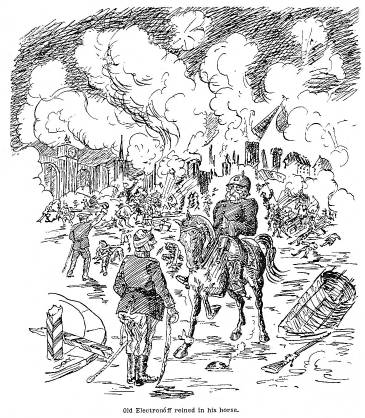 As the Premier spoke a colossal flash beggared the levin bolt. The Cabinet Council and the refreshment room vanished like a dissolving view, and I found myself plunged in darkness.
A rasping voice close by my ear whispered, "`Tchernivitch. we have been blown into the main drain—are you hurt?" It was old Elecktronóff.
"I clenched my teeth and saluted stiffly. "Excellency, I am not," I answered.
"That is well," he said. " The Steinberg Cabinet is no more." As he said this, for one instant, a mercurial smile played under his silver moustache. Then he continued briskly, "This drain leads to the postern. Follow me."
We tore down the unsavoury alley. In fourteen minutes and four-sixteenths of a second we reached the nineteenth manhole. Elecktronóff raised its lid cautiously and emerged on to the battlements. When we peeped over, the scene which met our eyes was beyond description. We saw the deep chasm which separated the Hof from the hills towards the north. It was six hundred feet in depth, and its abyss, which even the lurid flames of the burning town failed to illumine, was shrouded in darkness. Across it from beneath our feet stretched the mighty Boris Suspension Bridge, built by and named after the late Archduke. Its span was five hundred yards and its breadth sixty feet, and its girders glowed as if in red heat in the flickering glare of the doomed city. Upon it we beheld a great army of rebel soldiers, desperate revolutionaries, sleek burghers and Silurian clergy, beneath whose unaccustomed weight the mighty structure quivered and sagged. On their faces the fire-light displayed rage, hatred, and baffled fury. The palace end of the bridge was clear for the space of twenty yards, and those who stood nearest to us were half turned away, and seemed as if striving to force their way back among those who pressed forward from behind. Why were these men afraid? Why did they hang back? We craned further over the battlements and saw just beneath us, at the top of the fan-shaped staircase which leads down from the narrow postern to the bridge, a gaunt military figure leaning upon his rifle with bayonet fixed. It was old Krakskul. just then, as if on purpose, a flash of livid forked lightning illumined the abysmal chasm beneath, and we saw why it was that that great host had fear amongst them. Strewn on the granite rocks beneath were the battered corpses of an army as great as that which stood before us on the bridge. Each man of that army had tried conclusions with that single hero, each man had met his fate at the point of that bayonet, and each man had crashed down to the rocks below with the same dull thud only to make room for another to follow him!
A slight stir was apparent among the front ranks of the foe, and from amidst the hustling crew emerged the swart stunted figure of Green-toothed George. He foamed at the mouth and bit his teeth till the blood flowed profusely, not blue but only violet, because of the base origin of his morganatic mother. He turned to his followers in fierce fury.
"Curs, cravens, cringing cripples, cursed cowards," he cried, "rapscallions, hounds, and misbegotten swine, poltroons and ruffians, do you fear one man?"
They withered beneath his scorn. Thenhe faced old Krakskul, and drawing his rapier from its scabbard and wrapping his cloak around his other arm, addressed his worthy opponent.
"Well have you fought, and have obtained your prize," he shouted; "the slaughter of these weak Silurian slaves, whose very host might well have made a man of baser mettle tremble "—he pointed to the depths beneath the great bridge—" hath been yours. Your prize is yet to learn, and this then know. You have achieved the signal dignity, which on this field of battle from my hand alone you can receive—the noble honour of being dubbed what chivalry acclaims Knight Banneret — and this I dub you—thus!"
Throughout this speech the half royal miscreant had been slowly, almost imperceptibly, edging up the staircase, and at the last word he gave a traitor thrust at the sergeant's exposed side. A muffled groan and cries of shame rose up even from his own followers; however, Sir William Krakskul deftly turned aside the blow, at the same time calling out with military precision, "Parry number thirty-six." Then swiftly lunging forwards with the words "Thrust number three," he plunged his bayonet and rifle through the usurper's breast right up to the trigger. He was unable to withdraw the weapon, and so turning it round in his hand with the hideous corpse writhing in strange contortions upon it he unfixed his sword bayonet and, casting the encumbered weapon from him, faced his foes once more. The crowd uttered a deep roar of satisfaction at the sight of his partial disarmament, and I could see that long pikes were being passed forward to those in the front row. At this moment I saw what was, perhaps, the bravest deed of that day of deeds.
Elecktronóff, who had been leaning far out over the battlement, sprang from my side and leapt upon the parapet. In the glowing light his bronzed face shone out almost like burnished copper, and a tear glistened in his eye like a bead of solder on a biscuit tin. Was he thinking of his child-wife Gretchen far away among the northern mountains? Bending slowly forward he jumped towards the bridge and clutched at one of the great hawsers which bound it to the castle. At first he clung to the iron rope immovable, but gradually I saw him begin to swing first to the right then to the left. Had that radium brain given way ? The crowd beyond gazed up at him in stupefaction. My eyes followed the swinging cable back to the stones of the castle, and at last I saw what the keen eye of the great man had noticed. The hawser was frayed down to one single strand.
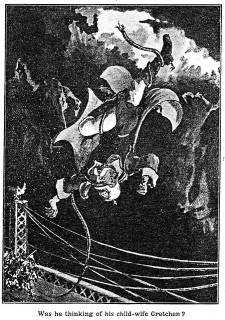 Still the metallic minister swung, backwards and forwards, and still the crowd gazed up at him in amazement, for he had been recognised. Finally a shrill piping voice from the crowd shrieked out in terror-stricken accents : "The bridge is falling! The bridge is falling!" This frenzied cry was instantly taken up by hundreds of trembling throats. Krakskul and the usurper, loyalty and rebellion were forgotten — skins, sound skins, alone were at a premium. But it was too late. Before the awful news had communicated itself to one third of the doomed host the cable parted with a report like a pistol. I saw a last vision of the iron man immeshed in the coils of the released hawser, whirled high in the air as if by an enraged python, and then hurled lifeless to his hero's grave. With a rapid fusillade the remaining cables snapped like cobweb strands, and the huge structure trembled for an instant and then thundered down into the darkness, bearing its shrieking burden to their doom.
I slid down one of the broken ends of the bridge supports on to the narrow platform before the postern, and gripped the newly created Sir William Krakskul by the hand. He was ghastly pale, but curled his moustache and saluted stiffly.
"Noble man," I said, and again clutched his reeking hand. "You have fought," I pursued, "as no man ever fought before or since!"
"Ketzerhaupt," quoth the veteran, "I have tried to obey my orders. Have I your permission to go off duty?" Needless to say this was immediately granted.
Old Krakskul slowly raised his twisted bayonet to the salute, then, in a voice which rings in my ears to-day, "Hoch! Hoch! Hoch!!!" he shouted, "it was a good fight. Long live Archduke Francis of Siluri—ah!'
The last syllable sank into a deep sigh, his knees gave a little, his head fell
forward on to his neck, his whole frame shuddered, and, before I could stretch out my hand to save him, he pitched forwards and disappeared into the chasm. As he fell I saw a deep black wound between his shoulders, from which the last drops of his life blood slowly oozed.
Even I, rough soldier, inured to war in all its phases, could not restrain the lump which rose to my throat. I entered the postern and hastened through the echoing corridors of the deserted palace to the archducal night nursery, and turned reverently to the cot which held him for and against whom so many had fought and died.
Between the damask sheets, his face turned towards the half-curtained window, and his fair golden curls clustering like an aureole around it, lay the sweet child. His tiny hands, the dimpled thumb of the one gently Iocked in the little finger of the other, lay beside him on the soft pillow. The right hand showed its rosy palm, and its thumb nestled just above his pouting Iips. The little fingers were stretched out towards the window as if welcoming the first rays of dawn. As I gazed in silent wonder the sun's rays filtered through the overhanging pall of smoke which covered the ashes of Blagdensburg and rested on my sovereign's face, which became transfigured by their kindly effulgence. It might have been a portent.
The beautiful child started from slumber with a rippling laugh, and smiling again to see me with him. "Dukie 'ants his beckie, 00 nice soldier-man."
I dropped on one knee, clanked my sabre, saluted stiffly, and then backed out of the apartment to fetch the royal rusks and milk.
|
Readers of
"Scragford's!"
Keep your eyes open for next month, when QUAX BLUNDERTHUD will relate an even more sanguinary story about an Emperor, entitled "The Purple Boots."
|
TO SPRING. By Samuel Johnson.
Readers of "Scragford's" should all be glad to read an original piece of poetry
by Dr. Johnson; he was a great writer in times gone by. This little poem was taken
from his Dictionary, where it was buried in examples.
|
| Verb, neuter, preterite "Sprung" or "Sprang"
Anciently "Sprong," with participle "Sprung"&mdash
To rise out of the ground and grow
With vegetative power.
Begin to grow or to proceed,
To come into existence as from seed;
To issue forth, arise, appear,
Incipiently exist.
To issue with effect or force;
Proceeding, as from ancestors, a town,
Or country, or as from some ground,
Or from some cause or reason.
To grow, thrive, bound, to leap or jump,
Hastily rush or suddenly appear.
To fly with pow'r elastic; start,
Or rise up from a covert.
To issue from a fountain, or
As from a source proceed; to shoot;
With speed or even violence
To issue; rousing game.
Quickly or unexpectedly
Produce or make by starting (as a leak)
If to a ship applied: Discharge,
If spoken of a mine.
All on a sudden to contrive;
Produce with haste or unexpectedly
To offer; or by leaping pass—
The last a barbarous use. |
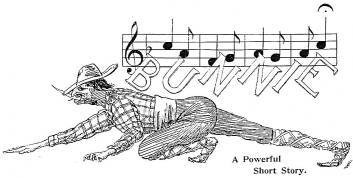 | BUNNIEA Powerful
Short Story.
|
| Being a stirring adventure which happened to a young Englishman. In which are graphically described the methods of one of Italy's many secret societies, and how it was foiled. The story contains a strong love interest. BY
Britton Maphie CHAPTER I |
"NONE of your beastly foreign smokes for me," muttered Prosper Brumyard, outside stockbroker and tourist, as he crammed some English tobacco into the serrated bowl of his briar. He gazed at the level surface of the azure Mediterranean, and thought ruefully of the day not far thence when stern business would once more call him from the silent shores of the sunny South back to the noisy alleys of the Exchange, and he thought with a smile of the tennis party that afternoon, an invitation to which from the British representative lay snugly in his blazer pocket.
Beside him stood a beautiful native girl. She was the waitress at the hotel at which he was staying, Rosina by name, and her raven locks and great deep eyes left no secret of her Italian nationality. Prosper pressed a five-lira piece into her hand, and thanked her for bringing his coffee to the garden. "Oh, signore," she said, "I take pleasure in doing anything for one of your generous race." He semi-negatived the implied compliment with a half movement of the hand, and, as the girl left, turned once more to the transparent waters and leisurely puffed at his pipe.
He was disturbed by a footstep, and half-turning from the hotel rocking-chair in which he had been sitting, confronted an Italianpeasant swathed in a dark and ragged cloak, his face invisible beneath the sable shade of a slouch hat drawn over his eyes. The man whistled slowly three or four bars of a haunting air in a peculiar cadence. Prosper coughed accidentally the intruder started, raised his hat, and beheld our young Britisher. His blue-black glossy ringlets flashed in the sun, and his regular Italian teeth showed him to be a true Neapolitan. With a gesture of infinite-grace he bowed, and excused himself in the musical tones of his mother tongue.
"Buono dopo mezzogiorno, signore, I see Queen Nicotine also claims you as her constant slave. Might I, without impertinence, crave the temporary loan of the English signor's pipe in order to re-allumine my cigaretta?"
"Always ready to oblige a bloke," said the young Anglo-Saxon bluntly, proffering his glowing bowl.
The Italian accepted it, and returned it to its owner with all the courtesy of the treacherous South. Prosper, remembering the entertainment at the Consul's, bid his companion good-day and stepped briskly up to the picturesque little old-world town of Casabianca.
Rum coves, these foreigners," he remarked, half contemptuously. He would have thought them rummer had he stayed, for no sooner was he out of sight than the peasant's face became transfixed with hatred and paled under its brown skin with hideous jealousy.
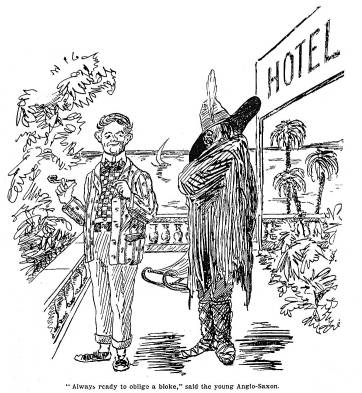 "Sono soffiato!" he hissed with a fearful Italian oath, "how handsome these English are! Were even la bella Rosina to see him I fear my suit might be imperilled. But 'By night all knives are razors,' as we Italians say."
But of this Prosper knew nothing, and still less did he know that the haunting air which his receptive ear was whistling was the secret signal of the Fratelli dei Spaghetti.
At the Consul's Prosper found all merriment and gaiety. The elite of the English families were present, most of whom he had already met at the table d'hôte, but, besides these, several of the better-to-do natives had been invited by our broad-minded representative, and had gladly availed themselves of the opportunity of cultivating the acquaintance of the beautiful Northern race.
The Consul received Prosper with real heartiness.
"Welcome, Mr. Brumyard," he said. "You will know most of us. Let me present you to a new arrival, Miss Cogginshawle, and," he added in a lower voice, "very rich."
A pair of pink eyes floated before him, and Prosper realised that he had met his fate.
* * * * * * *
Three hours later he emerged from an arbour an engaged man.
"We'll meet again to-morrow, Bunnie, my dear girl, and I'll interview your guv'nor to settle up accounts."
The beautiful albino flushed to the roots of her snowy hair, and a warm, gentle pressure of the hand was her only response.
It was with a light heart that our young hero sauntered over to the refreshment table and broke the glad news to his host.
"My dear fellow, I congratulate you," said the latter, "but I advise you to get her out of this country as soon as possible; I don't like the look of things at all."
"Why? " said Prosper, half surprised; "what's up?"
The Consul bit his cigar grimly. "There is a nasty anti-foreign spirit about," he said, "and I think matters look rather ugly. Pshaw, these Southern devils are a treacherous lot."
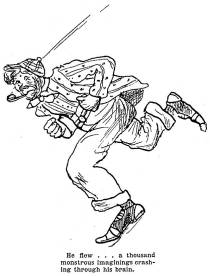 "Surely we have nothing to fear from fellows like that; after all, they are only niggers," said Prosper, pointing with his finger to a dark-skinned man in gorgeous uniform who stood close by.
"For Heaven's sake be careful," whispered his host. "You must remember you are not in London now."
At that moment a messenger handed the Consul a telegram, and as he scanned its contents a muttered imprecation escaped him: "By Gad, this is too much."
"What's the game?" interrupted Prosper.
"A dark one," returned the other. " This is the sixth English girl murdered by that infernal secret society in a week. I shall wire the F. O. to-night. Perhaps you have not heard of the Fratelli dei Spaghetti— the Paste-string Brotherhood. They are a desperate body, banded together to avenge supposed insults offered to Italian works of art by English tourists. Originally a small antiquarian society formed to preserve ancient monuments, they have developed into a formidable organisation with ramifications in every town and village in the country. It was only when the wife of an Englishman was stabbed to death in the foyer of the grand opera at Leghorn, and the local authorities refused to take any steps, that we realised how far it had gone, for it seemed that only the day before her husband had unwittingly carved his name upon the nose of the Farnese Hercules."
"But why did they go for the missis?" cried the young man, half in horror, half in indignation.
"Ahah !" replied the official, "there you lay your finger on the spot. These foreigners
are a queer set of people, and they argue on the principle of a tooth for a tooth. The Brotherhood say that the so-called art treasure monuments are their dearest possessions, and that whoever destroys them must lose his own ; therefore they invariably kill the wife, daughter, or sweetheart of the victim who has transgressed their crazy laws. In short, they act on the motto, 'Cherchez la femme.' Another point about the Brotherhood is its secret whistle known only to the members, and by which they recognise each other in the dark."
Prosper threaded his way past the tennis lawn and through the crowd of swarthy faces which gazed half contemptuously, half angrily, and half in envy of the skill and suppleness of the bull-dog breed. As he passed he overheard a young marchese say to his neighbour: " Their strength and their beauty are even as their madness — immense, prodigious."
Once in the Corso of Casabianca he instinctively drew from his pocket his red-bound guide-book and the list of sights which he had made that morning. He at once perceived that he had not yet visited the picture gallery for which the old town was famous, and decided upon doing it before the gathering darkness made it impossible. He learned from the "Baedeker" that the Daphne by Bacco, which was trebly starred, was the principal
object of interest, and he soon found himself before it. In the half light he could scarcely distinguish the portrait, and felt in his pocket for a match with which to illumine the darkness. As he was wearing indiarubber tennis shoes and flannels, he drew the lucifer rapidly across the ancient canvas. This operation he had to repeat several times before the damp vesta spluttered into a flame, when he was able to examine his guide-book. He read :
Daphne by Bacco (1610-1676) or one of the Bacchi (most probably by Corpi di-- Aq) employing the Bacchic motives of the Revell du Soulard (Drinkwater Gallery). Bongs says of this picture that it "seems painted rather by the hand than by the foot." 4 ft. by 5 hands.
He half glanced at the picture and broke into a cheery laugh, "Blest if my light hasn't given her a pair of whiskers!"
At that moment a snarling curse grated upon his ears— he turned and confronted the peasant of the morning. The man's polished courtesy had vanished, and the dilated eyes and livid face betrayed the savage, murderous nature which lies beneath every Southern breast.
"Swine of an Englishman," he raved, "you have destroyed the masterpiece! Mother of a Stiletto, but you shall pay for this. I am Giuseppe, chief of the Paste-strings—your sweetheart dies before dawn."
Prosper, with a furious lunge, endeavoured to clinch matters by a sharp counter, but the slippery Italian eluded his grasp and vanished as the match expired with a mocking laugh.
The outside broker was at first dazed by what had passed, but quickly gathering his scattered wits he hurried swiftly from the building. When he reached the ill-lit street he flew with lightning speed, a thousand monstrous imaginings crashing through his brain. One thought stood out above the rest—Bunnie was in danger! Bunnie must be saved!!
CHAPTER II
THAT night at table d'hôte, when the talk waxed gayest, and the resident Archdeacon was telling a mirth-provoking story about an interment, Prosper Brumyard was strangely silent. He seemed unable to adapt his train of thought to the conversation, and even Bunnie's quips (for she was light-hearted that day) could not provoke his usual breezy laughter. The handsome Rosina pressed him with the salade de saison for the national Italian dish of naso del Papa, but he refused it, and asked only for another Scotch and water. Her liquid eyes broke into a smile which displayed her beautiful Southern teeth, and whispering "Whatever the Signore desires of me," she swiftly departed from the room. It was clear that the girl took pleasure in serving the English stranger. Prosper started, and then, as the waitress returned with the beverage, relapsed once more into thought, in which he remained plunged. He mechanically refused the Neapolitan ice and the cavalleria angelica which followed it; nor sweet nor savoury had any attraction for him that night—all his thoughts were of Bonnie and her impending danger, of which he had been the unwitting cause.
"And the funny part of it was," concluded the Archdeacon, "that the coffin had brass handles."
A general move was made to the verandah, but Prosper did not join his fellow guests.
"Are you not coming, dear?" said Bunnie supplicatingly.
"Not just yet," he answered, half brusquely; " wait for me in the reading-room, and don't go on to the verandah."
The ultra-blonde passed from the room, but too glad to display her new-found obedience, and Prosper remained alone. He was not long so, for the beautiful Rosina soon returned, and advancing to the side of his chair with all the warm undulating grace of her Southern blood showing in her every movement :
"To-night the Signor's plates have returned to my hands all untouched. Is there nothing the poor maid can do to please the bel Inglese, as we girls of Casabianca call him?
" You're an honest girl, Rosina, and I'll tell you what—
* * * * * * *
Ten minutes later Prosper beheld a vision which long remained seared upon his brain. Standing upon the threshold of the French window, which opened into the street, was the form of the peasant beauty, Rosina. She faced him with half parted lips, clasping the casement. Her heaving bosom, which seemed as if it must burst the rude corsets that encircled it, rose and fell beneath the long fur cloak which she wore. The cloak was hooded and concealed her raven locks.
"I would do more than this for the Signore—I go." And clutching the cloak more closely round her lithe figure she stepped into the night. The cloak was Bunnie's.
Prosper reeled back, then ran to the window and peered out, but the night was black and moonless and the girl was lost to sight in the narrow streets of the little town. He thought he saw a dark creeping figure gliding on hands and knees through the beam of light which stretched out from the window, and he seemed to discern a narrow glint of light from something in the figure's mouth. Once more he heard the notes of the haunting whistle of the morning and then all was silence.
He rushed upstairs to the reading-room six steps at a time, and clutching his sweet-heart to his breast ran down wildly to the hall with the girl in his arms. Hurriedly commanding her silence, he snatched up the Archdeacon's hat, muffler, and greatcoat, and thrust them upon the trembling Bunnie.
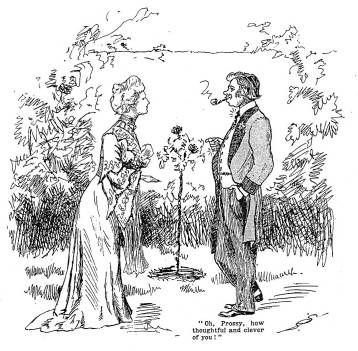 "Don't say a word, but follow me at once," he whispered. " Our lives are in danger—quick." And wrapping himself in his ulster he led her hurriedly from the building. They sped along the narrow streets, hardly pausing to consult the guide-book, and reached the market-place. There a dreadful sight assailed their eyes. A cloaked figure was walking at the opposite side of the Piazza
when suddenly a band of men stealthily surrounded it. A shrill shriek of terror rang out into the night and fifteen stilettos glanced in the dim lamp-light and rang out sharply as they clashed together in the body of their victim.
"Don't say a word, but follow me at once," he whispered. " Our lives are in danger—quick." And wrapping himself in his ulster he led her hurriedly from the building. They sped along the narrow streets, hardly pausing to consult the guide-book, and reached the market-place. There a dreadful sight assailed their eyes. A cloaked figure was walking at the opposite side of the Piazza
when suddenly a band of men stealthily surrounded it. A shrill shriek of terror rang out into the night and fifteen stilettos glanced in the dim lamp-light and rang out sharply as they clashed together in the body of their victim.
The English couple fled down a side street, and as they ran a deep wail of anguish followed them. It was the voice of Giuseppe, the leader of the Spaghetti, and it cried "Rosina, Rosina, I have slain my Rosina, whom I adored!"
Within a quarter of an hour the British Consul was reading the solemn and beautiful words of the civil marriage service.
* * * * * * *
It was after the lapse of five years, and Prosper Brumyard and his wife (née Coggshawle) were standing in their garden by the fair standard rose which she had planted in memory of the Italian peasant girl who had died for her.
"How can we ever be sufficiently mindful of her love and self-devotion, Prossy?" queried the fair beauty.
"H'em, certainly, old girl," said her husband, half musingly; "of course, yes. But I don't think I ever told you exactly how it happened. I wanted to save that poor girl a lot of pain, so, knowing she must give up her life for a hopeless love of me, I sent her out to buy some cigars, and made her put on your cloak because I said it was cold. I lay low about the picture and those Spaghetti coves."
"Oh, Prossy, how thoughtful and clever of you!"
Stormcloud and rain
On shore and plain
Fill ditch and drain—
So, when the sheet
Lies blank and neat
A poet's lines are cheap and sweet. |
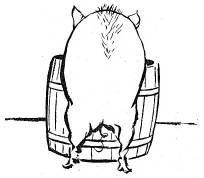

|
CHAFF!
MR. PHUNNIMAN: "Howdee, old chappie, what's the softest thing you know of—eh?
MR. STEWPIDMAN: "Your head."
MR. PHUNNIMAN: "No, yours! Ta, ta, Baffy!" (Collapse of Stewpidman.)

OFFAL (AWFUL !)
Young Mr. Soninglor received a letter from his wife's ma saying she was passing through town, and would stop with them for a week.
"Here, Maria," he groaned, "I am going to Ecuador for twelve years; perhaps I shall see your ma when I come back." Was he right?
 PEELINGS!
THE COPPER: "'Ere, guv'nor, your goin' more than twenty miles an hour."
MOWTERIST (with his horn): " Pip—Pip ! (Then he left.)
|
LEAVINGS!
Mr. B-- called upon his intended, Miss Honeysuckle. Old Mr. Honeysuckle kicked him downstairs. He left!
 GARBAGE!
Mrs. Matrimony says she has nothing to wear for Mrs. Smartset's evening party. Mr. Matrimony says she would soon waste all his Patrimony (money). Funny, isn't it—eh?
 WASH!
SCENE: Seaside, Bather and his dog. Bather takes his dip, leaving dog to guard clothes. Enter tramp. Tramp throws dog a bone. Dog runs after bone. Tramp bone's bather's bags and leaves his own. Dog returns and guards tramp's. Exit tramp. Re-enter bather. Tableau ! (On the strict Q. T.) |
|
| DREGS!
MR. DRINKALOT (returning at 3 A.M. to the wife of his bosom): "I'sh (hic) beensh (hic) t'mysh (hic) clubsh (hic)."
THE MISSUS (from upstairs): "Oh ! have you?"
Curtain (lecture).
PEARS!
MR. SELLY BATE: "Well, old chap, is it a girl or a boy?"
MR. KWIVVERFUL: "Both."
He then went to buy a sleeping draught! |
CHESTNUTS!
A mayor of Yarmouth in ancient times being by his office a Justice of the Peace, and one who was willing to dispense the laws in the wisest manner, though be could hardly rede, got hymselfe a statute booke, where, finding the law against firing a beacon, read it "frying bacon or causing it to be fried," and according went out the next night upon the scent, and being directed by his nose to the carrier's house, be found the man and his wife both frying bacon, the husband holding the pan while the wife turned it. Being thus caught in the act, and having nothing to say for themselves, his worship committed them both to prison without bail or mainprize.—Joe Miller's Jests. |

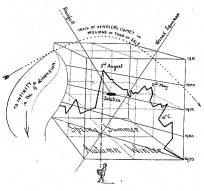 | 
THE WORLD'S WIND REAPED.
This admirably simple table in four dimensions will give all "Scragford's" readers a clear idea of how the world's wind may be reaped.
N.B.—A grain of salt placed upon the tail of Hengler's comet will add to the weight of the comet by 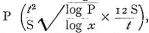 if n = Log A. This marvel was sent to us by a ploughboy. living near Sandwich. if n = Log A. This marvel was sent to us by a ploughboy. living near Sandwich.  |
 This, dear reader, is the photo of a human skeleton. You, dear reader, will be like this some day. | 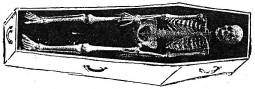 |
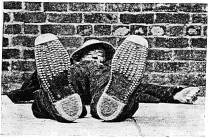 |  Monstrosity, or What?
This man's feet are really only the normal size, though you might not think so. They were nearer to the camera than his head.
|
|
 A CURIOUS HAT PEG. This hat, as you will see, is hung upon a pitchfork, on which curious peg its owner put it.
|  THE CAMERA CANNOT LIE. To the ordinary individual this appears to be a photo of a bird in a cage. But "Scragford's" readers will easily believe that this marvellous bird can speak three languages, besides being able to count and name each feather on its back.
|
 IN THE CLOUDS. This house is not hanging from the sky, as you might suppose, but was pasted in a photo album upside down by the four-year-old son of a post-master living near Chippenham ;
his father sent us the photo as it stood.
SCRATCHINGS.

I cannot leave you, dear reader, without telling you my gratification at hearing what pleasure our last Grypula story is giving. There was a grand number of the "Ragwort" last week, and, from whisperings I hear in our office, to-morrow's " Pennyroyal" cannot be far worse. "Scragford's Weekly" has a thrilling serial by Quax Blunderthud and entitled "The Strange Omissions of a Commissionaire " running now, and the popularity of "Scragford's Bell Pull," "Scragford's Winks," "Scragford's Review," and the "Evening Pail" is astonishing.
Look out for the new " Scragford " venture-
A BI-DAILY FOR GIRLS.
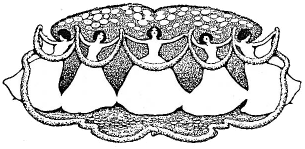
|
DIRECTIONS
Exposing to the Student the Whole
Manual Art
of the Trade.
Of the List of Contents.
THE first subject with which I am concerned is that table which enumerates the matters that are to be found within the magazine ; and this, although the smallest, is by no means the least important of its component parts. It is to this list that the readers will look for guidance as to the further contents, and there is therefore afforded to the Editor an opportunity of giving an impression that the issue contains many more stories, illustrations, jests, and other items than it actually does— such as he will not find elsewhere in the periodical. The machinery by which this is effected is two-fold.
(I) Firstly, every separate detail must be referred to at great length, while preserving an apparent conciseness of manner. Thus a story is Iabelled a complete story," a poem "an original poem " (whether it be such or not), a photograph " a reproduction of a photo" (a word which should never be printed at length, as under that guise it would confuse many of the readers), and any sketch, however trivial, should be termed "a reproduction of a photo of a design." Further, the solitary artisan who is employed to construct the pictures, borders, and other embellishments, should be mentioned under each individual heading and with a distinct name, the selection of which should of course be left to his own good taste and sense of fitness and propriety.
(2) The second means of producing the result required is the separate treatment of items which by a careless person might be deemed to be included in details already referred to or even be taken for granted. Thus, especial mention of the outside cover should always occur among the contents, also of the inside of the outside cover and of the List of Contents itself.
I had thought that perfection might be attained by including such notices as:
PAPER. A Snow-white Manufacture from a Chalk Quarry made by
TYPE. Of various Founts, set by
STITCHING. Steel Wire, drawn by
PASTE. An Original Composition by | ...
...
...
... | ...
...
...
... | _________________
_________________
_________________
_________________ |
but upon further deliberation I esteemed that this practice would be a grave breach of the rule by which the members of the staff of a magazine preserve their complete nonentity.
Of the Outside Cover.
For this part of my model I feel that some apology is due; but I hope that I may be able to disarm all criticism by saying that it is a combination of five possible covers rather than a type of a single one. Any one of the figures or the object depicted upon it could, if sufficiently enlarged, serve as a complete cover. The farthing, the ass, the owl, the goose, or the swine— any one of them— could stand alone upon the outside of such a work and fitly symbolise its nature. By grouping them as they are here grouped, it is evident that I am squandering materials which would well befit future issues; whereas it is an axiom of the trade that for this purpose the strictest economy must be observed. This rule is not derived from the scarcity of the objects represented or from any deep reverence towards them, as a broken bottle, an old umbrella, an association football, a used postage stamp, a dead kitten, or any other thing, if sufficiently
mean and indicative, will serve as an introduction to a perfect periodical. The origin of this frugal practice must be sought in that feeling of common honesty which forbids the trades-man to supply goods of greater value than their price.
Of the Serial Adventure.
"THE MISSING LYNX."
In my preliminary treatise I touched lightly upon the serial adventurer, his place in the magazine, his general characteristics, and his foolish companion. I consider Grypula an absolutely perfect specimen of his kind, and that any person, howsoever ignorant or illiterate, could— with the greatest of ease— write an adventure a month for him over a long period of years on the lines I have indicated in this chapter.
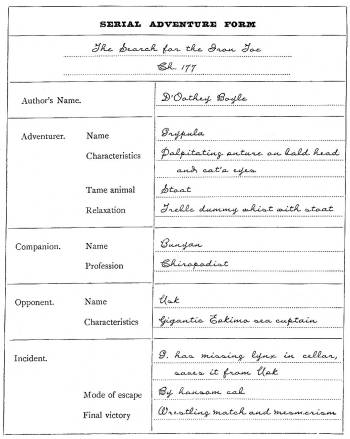 An important matter for observation in regard to Grypula, and his peers, is that they are to all intents and purposes endowed with omnipotence, so that, no matter what predicament they be in, the workman writing the story can extricate them without recourse to imagination or invention. The escape from the hansom is an instance of this fact; but, further to illustrate it, I will give an example of an unpublished accident in his career
"Grypula was bound hand and foot by mighty steel chains to the fatal block. The hideous heads-man advanced, bearing his reeking axe on high. There was a moment's pause ere the blade descended above his devoted neck— quick as a flash, by a slight effort of the wrists, the strange man freed his hands from the ligatures that bound them, seized the axe, and," etc.
Thus the mystical hero is enabled to serve as his own deus ex machina, and the constructor of the story is saved all trouble which might result from having allowed him to require escape from an impossible position.
Another element fundamental to the serial adventurer's nature is that to him alone of all men in fact or fiction is it permitted to die more than once without the interposition of any miracle. For example, if in 1895 Grypula falls shot through the heart, Bunyan reads the burial services and sacrifices his last penny for the raising of a monument,— some nine years later Grypula enters Bunyan's study and congratulates him upon the decease of his wife and his succession to the Ducal estates. Thus it will be seen that none of the difficulties usually incident to the composition of fiction attend the workman whom a magazine editor commands to set up a chapter of serial adventure. All that has to be done is for the Editor to fill in the usual printed form, which I give as prepared for this story.
This form the compositor pins up in some convenient spot and, sitting down to the Linotype or similar machine, taps off the required chapter without the slightest mental discomfort. The only rules which he must observe are these:—
| (α) | The hero must never be made to display, by word or gesture, any interest in anything other than the game which he plays as a relaxation from his arduous absence of intellectual effort. |
| (β) | No matter how ordinary an act be performed by the adventurer, the companion, having "shuddered involuntarily," must express surprise. |
| (γ) | The companion must never be allowed to say or do anything that could suggest his being capable of thought or observation. |
| (δ) | The opponent must be referred to as being endowed with immense intelligence. Of this there should be no other evidence. |
| (ε) | Supreme physical effort on the part of the adventurer should be marked by "a tiny bead of sweat." |
With the object of instructing those apprentices who are unacquainted with the phrases in use in this species of work there has been composed an invaluable book of reference, now, I rejoice to say, in common use, entitled "The Printer's Dictionary of Serial Adventure Phrases." This small volume, comprising no more than thirty pages in all, has been of the greatest use to me in making up this chapter. I will give but a few examples from its pages, all of which I have had need to use:
| (I.) | "{ | I
he | } | thought to | { | my
him | } | self how strange |
| | it was that{ | I
he | } the erstwhile |
| |  | sharper
tramp
valet
actor
burglar
adventurer
thief
dentist
chiropodist
miner
&c. |  | should now be a |
| gentleman
Duke
King
Colonel
President
guest
confidant
bishop
millionaire
K.C
&c. |
|
| (II.) | "---- poured out a stiff nobbler of ----" |
| (III.) | "Really ---- you know little of my methods ----" |
| (IV.) | "Once again I noticed the extraordinary phenomena connected with this strange man, he ----" |
| (V.) | "---- which showed a ---- remarkable in any man but marvellous in one of his ----" |
| (VI.) | "---- as ---- a man as ever trod in shoe-Ieather ----" |
| (VII.) "The |  | door
trap
curtains
shutter |  | opened and emitted a flood of light on to the |
| floor
carpet
pavement
ground | "
|
Before passing from this work I will refer to the list of "speech verbs" to be employed in rotation to avoid the too constant use of the words "said " and "asked." Among many others appear the following :—
I, he, she, you,
we or they |
cried |
I, he, she, you,
we or they |
answered |
"
"
"
"
"
"
"
"
"
"
"
"
"
"
"
" |
sighed
said
queried
explained
groaned
shouted
moaned
murmured
quavered
continued
mused
observed
retorted
added
interrogated
replied | "
"
"
"
"
"
"
"
"
"
"
"
"
"
" |
proceeded
explained
asked
snapped
announced
soliloquised
pursued
called out
commanded
whispered
hissed
chuckled
rejoined
muttered
directed |
| Quoth |
I, he, she
we, they
or the raven. |
I, he, she, you,
we, or they |
Interrupted |
I, he, she, you,
we or they | ejaculated |
"
"
"
"
"
"
"
"
"
"
"
"
"
"
"
"
"
" |
commented
predicated
raved
reiterated
remonstrated
roared
grated
grunted
screamed
screeched
shrieked
simpered
snorted
thundered
wailed
yelled
hazarded
&c., &c. |
"
"
"
"
"
"
"
"
"
"
"
"
"
"
" |
sneered
declared
postulated
remarked
stated
bawled
begged
bellowed
craved
croaked
demanded
entreated
gurgled
howled
imparted |
In addition to this Dictionary, the value of which is, I think, clear from the samples I have given, the printing establishment of a perfect magazine should be provided with an improvement to the automatic type-casting machines known in the trade as the "Word Supplier.” This appliance is framed upon the principle of those engines which distribute sweetmeats, kerchiefs, and wax matches, on the plan originally devised by Archimedes to ensure a fair distribution of wine for the ceremonial libations. It differs from these only in that it operates by the pressure of small buttons or springs, and in that it distributes, ready cast, the types for printing a series of adjectives applicable to certain nouns substantive. The springs to be pressed, which operate by electrical agency, and of which there are twenty in number, are labelled "Weird," "Magnificent," "Beautiful," "Companion," "Hero," "Opponent," and the like, according to the nature of the epithets delivered by their agency or of the person whom they befit. The use of this instrument as an adjunct to the linotype is of incalculable benefit owing to its extreme simplicity and the great saving of time effected thereby. For example, the mechanic has set up the Grypula story down to the 34th line of the 8th page. The last types he has cast read "The skin and clothes fell to the ground, while from the gaping shirt front emerged —." He desires to introduce the adventurer himself, and it is obvious that an ample supply of adjectives should precede and escort him — he therefore applies his forefinger to the cylinder marked "Hero" for the period of seven seconds, and upon his withdrawing it the small line of types falls into the tray before him bearing the seven adjectives required. In the case in point they happened to be—
"Calm, smiling, dreamy, cold, unbending, bitter, ponder'n
— "Grypula."
It will, I think, be thus seen that any person can write one of these stories with ease, and that with the aid of the above stated engine even this facility can be greatly augmented.
Of the Inflated Instructive Article.
"LONDON'S GOLD MINES."
In these Dustmen or Cheesemite articles I find that the sole distinctive process of manufacture consists in the multiplication of words. Take as a standard sentence:—
"As the dust fell, he saw some object glittering, groped about and soon disclosed a spoon of Abyssinian gold, picked it up and put it in his pocket."
This sentence is dealt with in the following manner:—
"As the dust fell from his cart, he thought that he saw some object glittering in the evening sunlight. He got down from his cart to the ground and walked down the slope of the shoot to the spot where he thought, possibly, the object might have fallen. He groped about in the refuse with the toe of his boot, which was tipped with iron nails, and soon disclosed the bright object which he had really seen. It proved to be a spoon made of Abyssinian gold, a composition closely resembling the real article. He picked it up between his fingers and examined it with his eyes. Then he put it in his pocket and walked back to his cart."
I think the above indication is sufficient to enable the student to inflate any of the following sentences to the size required of this item in a perfect magazine:—
Brick layers lay bricks.
Coast guards guard coasts.
Plumbers plumb.
Lighthouse men live in lighthouses.
Ploughmen plough.
Bees live in bee hives.
Ants build ant hills.
Scene-shifters shift scenes.
Type-setters set types.
Ocean currents flow.
Jockeys ride horses.
Asses bray.
Of Contributions by Famous Persons.
"TO SPRING."
Of this class my model contains the poem entitled "To Spring." There is much advantage to be gained from obtaining the name of some great man among the contributors to each issue. This can be done either in the method here adopted—and I may point out that the book chosen by me can be made an almost inexhaustible source of inspiration upon almost any subject—or by obtaining from living famous men some such contribution as a leaf of blotting-paper from the writing-pad, an endorsement to a dishonoured cheque, or a signed photograph. If these cannot be procured directly from the great person himself the managers of a perfect magazine would surely not be at a loss, as one of his meaner domestics may be easily persuaded to provide one of them.
Of the Inaccurate Professional Story.
"THE JUDGE'S FIRST BRIEF."
I must admit that the building up of this tale cost me great labour and a vast degree of patient inquiry. The structure of our English jurisprudence, though vastly embellished by recent legislation, still necessarily contains a large number of details and expressions which can never be fully understood by a layman. Furthermore the members of those professions that live by the practice and ex-position of the law are encompassed by a body of rules, regulations, and customs which are extremely complicated and can only be gathered by personal enquiry, as they consist almost wholly in unwritten traditions.
Now, this being so, the maker of a story who is content with an occasional breach of these laws or traditions can safely enter upon his task in complete ignorance of either, and trusting merely to their number and complexity to ensure his success. When, however, a writer strives to create a perfect standard which may be copied by any student without any danger of being misled, he undertakes a task of far greater difficulty. I was therefore obliged to devote much time to reading and no little time to converse with a dear friend of mine who has but lately resigned the active practice of the legal profession, and to whom his kindness in this matter has still further endeared me. Thanks to this preparation I think I can with safety assure students that they may copy any single incident or phrase in this tale without danger of being entrapped into an accurate or merely imitative representation of our law or of the habits of the members of our Bar.
I can confidently assert that it is unusual for Barristers, Judges, and Ushers of the Court to meet for port and muffins in the chambers of Counsel, that the Benchers of the Inns of Court do not usually relate anecdotes to the students at the qualifying dinners, that clerks do not draw pleadings, that the members of the Bar are neither superior police officers nor even connected with the detective force, and that (surprising as this may sound) the forensic robes are seldom assumed, except in court, and when they are it is usually merely for the purpose of sitting to photographers or artists.
I will not pursue this series of negative statements, which may be completed by any person who peruses this story; but I repeat that it does not contain one single statement, or one technical phrase that could ensnare an imitator into giving an accurate picture of the legal profession, and I will add that a very little ignorance of other professions will enable the student to adapt the incidents of this story to other employments.
Of the Recital of Military Slaughter, and of Events affecting the Blood Royal.
"FOR THE ROYAL RUSKS."
In regard to the story of bloodshed among persons of quality the first important ingredient is a sustained and penetrating din which should begin no later than the second page.
(i.) Such words and phrases as :— the clatter of hoofs, the hoarse roar of the sentry, the sharp bang of a musket, a piercing shriek, drums rolling, clangour of the tocsin, spattered ripple of musketry, boom of a minute gun, the musical clash of blades, the squeaking of steel, dynamite explosions, crackling rumble of machine guns, crash and recrash of musketry, detonation, bursting shells, a torrent of rough soldier talk, muffled groan, deep roar, frenzied cry and rapid fusillade, should occur with extreme frequency.
(ii.) The periods of time occupied by the action of the story should be catalogued with the greatest preciseness, and any interval which may seem to occur should be accounted for by words suggesting that it was occupied in slaughter, which is not minutely described. This scheme impresses the readers with an idea of the prodigious wealth of bloodshed at the compiler's disposal.
(iii.) There is one detail, which, however small, I think of such importance as to merit especial mention. No story of this kind is complete without some mention of the flickering light of a horn lantern, which may be used as here, may be lowered into a powder magazine, may be carried by a warder (or better by his beautiful daughter), or may be thrust into the hero's face. The main importance of this article is not apparent until the story is adapted for representation in some playhouse.
(iv.) The richness and quality of the blood-shed is enhanced by carefully setting upon the sombre surface of the massacre an occasional pathetic incident of duly hackneyed form. Of these jewels (1) the death of the archbishop, (2) the thought of the minister's child-wife, and (3) the sleep of the infant duke form examples which will serve for any story.
(v.) The character of the metallic minister, like that of the serial adventurer, is constant and uniform, and should appear in every one of the stories of this nature. Some careless and unobservant persons have been led by their common inhumanity to confuse these two types, and I therefore feel it necessary to point out the wide distinction which exists between them. The minister is mortal, at least, my extensive reading has never shown me an example of such a one who was more than once successfully assassinated. He is prone to error, and no story should omit to give an instance of this fallibility. In this model I have, I think, referred to each and every one of his metallic attributes.
His
"
"
"
"
"
"
"
"
"
"
and " | iron voice,
graphite inflexibility,
wire web,
leaden thumb,
steel grey eyes,
golden opportunity,
brazen voice,
mercurial smile,
silver moustache,
bronzed face,
solder-like tear,
radium brain |
are all mentioned, though I do not think that the copyist need employ more than three or four of these metals in each story constructed.
(vi.) The sixth point which gives the tale of aristocratic bloodshed great and considerable advantage to the compiler is its catholicity of period and place. The very model in this magazine could be used in fifteen or sixteen consecutive numbers, with but few alterations, of which the following may serve as examples:—
| (α) | Put the various characters into huge top-boots, cocked hats, and heavily skirted coats; give the whole party Spanish names; make some allusion to Lord Peterborough, and you have a stirring tale of the Spanish succession. |
| (β) | Make of the metallic Minister a metallic Cardinal, and he can with safety be called Richelieu, provided the other characters be suitably dressed and, of course, be called mousquetaires. |
| (γ) | The Minister in a turban and wearing an iron-grey beard will become the trusty Wazir of an infant Rajah or Mogul. |
| (δ) | In an ample toga, and deprived of his silver moustache, he may be fitly named Metallicus Arbiter, Praefect of Aes Alienum, in which latter case the third-class refreshment-room at the railway station becomes the Temple of Bacchus in Via Ferrate, the Bridge the Pons Asinorum, the tale is told by a young centurion of the Praetorians, and the final scene occurs in the apartment of the infant Nero on the Palatine. |
It may surprise readers ill-acquainted with the trade to find this type of story embracing so large a mass of printed fiction, but further study will show them that those stories which depend upon slaughter and emetical pathos are all of one family, no matter what be their dates or where their scenes be set. "For the Royal Rusks" is a perfect model, being the most flexible that can be made, and is capable of almost infinite adaptation.
Under such varied names as " The Death of the Pewter Praefect," "The Infant Horus, a tale of Ancient Egypt," "For the Royal Lampreys, a tale of Little Arthur," "Tinplate-afraid-of-itself, the Medicine-man of the Sioux," "A Son of Hengist," &c., &c., the story may be set up again and again by the most unskilful workman.
Such simple changes as from:—
| "The clangour of the tocsin" | to | "the howling of the priests of Baal" |
| "The crash and recrash of musketry" | } to { | "the twang and retwang of catapults" |
| "The rattle of the machine guns" | } to { | "the rattle of spear on buckler" |
| "Rough soldier talk and badinage." | } to { | "the rough badinage of the Samurai" |
| " The sharp bang of a musket and a bullet sang through the night like an angry hornet" | } to { | "The sharp whirr of a bow, and an arrow sang through the night like an angry hornet" |
| "A shattered squadron of sappers were endeavouring to re-form on their lost maxim detachment" | } to { | "A shattered mob of sans-culottes were endeavouring to re-form on their lost tumbrils." |
| " Tchernivitch, we have been blown into the main drain" | } to { | " Curius, we have fallen into the Cloaca Maxima." |
| "The wind wailed down the tall beetling streets of the capital" | } to { | "The wind wailed around the tall wigwams of the Black-feet" |
will be all that are necessary. No intelligence is required— no invention— merely faithful and diligent copying and a suitable dictionary.
Of Romantic Pictures and their Attendant Poems.
"YE KNIGHTE OF OLDE."
The student should carefully consider every detail of this picture and of the verses which accompany it. It is necessary, in producing an imaginary romantic character, to indicate all the virtues and excellences of the entire age of chivalry from its earliest birth to its revival in the architecture of the early nineteenth century. This comprehensive view of the fair character of romance is instantly destroyed by any such weight being thrown upon the dress, ornaments, names, or style of building indicative of only a single period as to confine the attention to that date alone. The effect of the coat worn by warriors of the reign of William III. should be counteracted by the heraldic helmet of uncertain date which should in turn be corrected by the trunk-hose of the eighth Henry and the circular dog-toothed archway of the Norman designers. The same effect is produced by the use of the word "Ye" (the purely orthographicaI nature of which should never be spoiled by the employment of the cognate "Yem"),* while additional beauty is given to the verse by the elision of unimportant syllables, as in the words "vict'ry," "quiv'ring," "heav'n," "jew'lry," "fool'ry," and by the accentuation of syllables usually omitted, as in "th' adored." In this way the baldest and most dissonant prose can be metamorphosed into the most marketable kind of verse.
* Though we have ourselves never come across this abbreviation, we do not feel justified in criticising Mr. D'Ordel's scholarship.
Of Patriotic Love Stories.
"BUNNIE."
These stories of tourist adventure are perhaps more rigidly bound by tradition than any other of the wares exposed in a magazine. The other types already explained must conform to certain definite laws, but their makers are allowed a latitude in the selection of many minor details, and even, as in the case of stories of men of mystery, in the appearance of the persons necessary to the action, or even in the incidents, of which there must be at least a dozen for the complete life history of a serial adventurer, which cannot be fully described in less than a hundred and fifty chapters. In these stories, however, no such discretion can be exercised by the constructor. The hero must be fair-haired, young, and aggressively insular. The heroine must be fair-haired, slender, silent, and morosely timid. The native girl must be beautiful, dark-haired, amorous, and inclined to plumpness, The male population of the country in which the adventure takes place must, however innocent their occupation, be said to display the extreme degree of fanatical and ruthless savagery, and they must always be referred to as niggers or foreigners, which words may, in these stories, be taken to have the same signification. The history and objects of the secret society must be explained by some Englishman, who may be considered to have greater knowledge of the scene of action than the hero. He may be a magistrate, an ambassador, a consul, a political resident, or a sea-captain, according to the place selected for the action.
For the phraseology I can only urge the student to study and con by rote the wording of this story, to employ the words and construction therein used, and so far as possible to avoid all others. The only point upon which I desire to lay particular stress is the method of halving the hero's actions and thoughts, which gives mechanically and without effort to the writer an impression that he has exercised restraint and is possessed of a reserve of force. Thus he will
| semi-negative,
half move,
half turn,
half glance, etc. |
| be |
| half surprised, |
| and act |
| half accidentally,
half contemptuously,
half in horror,
half in indignation,
half brusquely, |
| and | half thoughtfully. |
It should be noted that the writer is never to be restricted to the use of two halves for each whole.
Of Editorial Humour.
"THE EDITOR'S PIG-TUB."
This part of a magazine (in addition to the
curious photographs, the nature of which is, I
think, self-explanatory) should be put together
in the following manner. The few fragments
of dialogue and the scarce anecdotes which I
have recorded will each be found to contain
one of the fundamental elements of humour
which, when thus collected, form the entire
machinery of magazine wit. They might be
termed root jokes, and may be combined, set
among different surroundings, or inflated
at the caprice of the mechanic; and,
as the vulgar do extremely dislike the
effort required for the understand-
ing of any novel jest, they will
thus form a body of short
paragraphs calculated to
excite the merriment
of those who read
MAGAZINES.
—
Fin-
is.
—
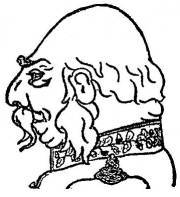 BY THE SAME AUTHORS.
——————
D'Ordel's Tactics
and
Military Training.
——————
Price ONE SHILLING net.
"An exceptionally amusing, and perhaps exceptionally instructive, skit on the 'Infantry Drill Book' of 1896. It is, in fact, a most useful piece of satire on military methods. . . . It is laughter-compelling on every page. . . . There is a good deal of truth underlying the ridicule."—SPECTATOR, February 21.
By MARK SYKES.
With 73
Illustrations and
22 Maps. |  | Thick 8vo.
Cloth Elegant,
15s. net. |
DAR-UL-ISLAM
(The Home of Islam).
A Record of a journey through the Asiatic Provinces of Turkey.
With Introduction by Prof. E. G. BROWNE.
"This most interesting volume deserves a corner in every Eastern traveller's bookshelf, and for the mere stay-at-home politician it will have its uses too, for amid all its humorous passages it contains much sound sense and no cant."—ST. JAMES'S GAZETTE.
"The best book of travels that has been published for some years. It should be read by every one who seeks an enjoyable and fascinating tale of travel."— DAILY EXPRESS.
Through Five Turkish Provinces.
With Map and Illustrations.
Demy 8vo., cloth elegant, 7S. 6d. net.
|