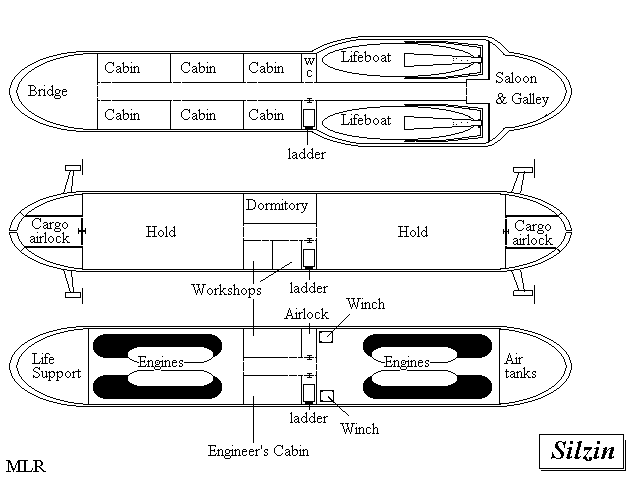
by Marcus L. Rowland
Copyright © 1994, revised 1998
Please note: All material below is for the use of referees only. If
you intend to play a character in this campaign, please STOP READING
NOW. You are strongly advised to read the six Astronef stories and the
Worldbook before running these adventures.
CONTENTS
0.0 Introduction
return to contents
This is a collection of short adventures linked by the history described in the Astronef worldbook, and by certain plot strands. Each adventure can be played in a few hours. If you do not wish to use the timeline in the worldbook, some minor modifications may be needed.
Characters are adventurers in an Edwardian world that is rapidly being transformed by the anti-gravity R. force, by an astronomical disaster, and by contact with alien worlds and civilisations. In the first adventures the R. force has just been discovered, and is only understood by a tiny handful of scientists; as the campaign progresses the adventurers will become familiar with its use, and will probably acquire their own spacecraft.
Because of the size and scope of this campaign minor NPCs are not described in great detail; they have average characteristics of 3 or 4, and skills appropriate to their jobs or ranks. Maps and charts are only provided for key locations. Where details are needed they will usually be described in the text.
For example, the first adventure is set entirely aboard an ocean liner; since the precise layout of the liner is unimportant there is no overall deck plan, but there is a simple diagram of a few cabins. Referees are strongly advised to obtain suitable maps, charts, and photographs to supplement the illustrations provided. Wherever possible sources are mentioned.
Lord Redgrave, his wife Zaide, and their faithful old retainer Murgatroyd appear as NPCs in these adventures. Their details can be found in the worldbook section 6.0, and you are strongly advised to print it out. Note that the Redgrave of these adventures is not the 'evil alternative' described in the worldbook.
When referring to adventurers the words "him" and "his" are short for "him/her" and "his/her"; unless stated otherwise the characters may be of either gender. The male pronoun is used to give a more natural flow of text.
All characters and organisations, except those modelled on historical personalities, are imaginary.
Technical Note: If you are aware of the early history of radio, you
will know that the use of Mayday messages in these adventures is
anachronistic. Early distress signals were based on complex Q-codes, which are
of limited interest to most readers. If you understand this system and
wish to use it, please feel free to modify the messages accordingly;
just be prepared to spend a long time explaining them!
0.1 Campaign Summary
return to contents
CABIN 12A is an introductory adventure set in 1901, a few months after the return of the Astronef. A small group of travellers is asked to help in the aftermath of a death, and should eventually earn the thanks of an important man.
In MOON '02 this contact bears fruit. Lord Redgrave is looking for a few good men (and women if appropriate) to help explore the Great Pyramid of the Moon. During this adventure characters should stumble across the first traces of an ancient secret, which becomes important in later scenarios. They will also encounter an old "friend" again.
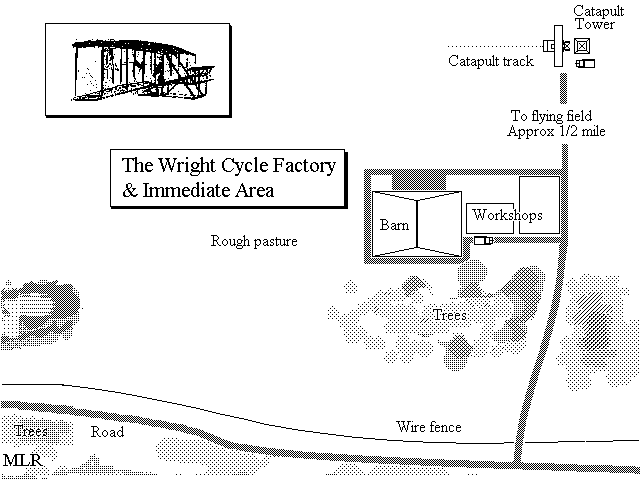
1904 brings a diversion, THE WRIGHT STUFF. Two bicycle builders have developed a so-called "heavier than air" flying machine, which is limited to atmospheric flight but ought to be much cheaper than a spacecraft. Are they impractical fools, or a lot smarter than they look? A competition will find the answer.
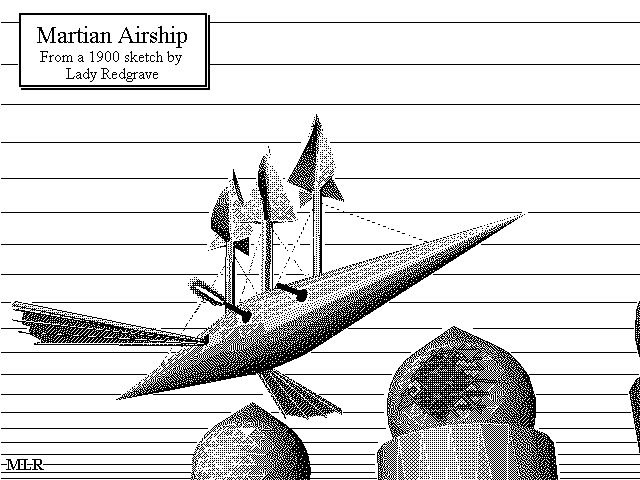
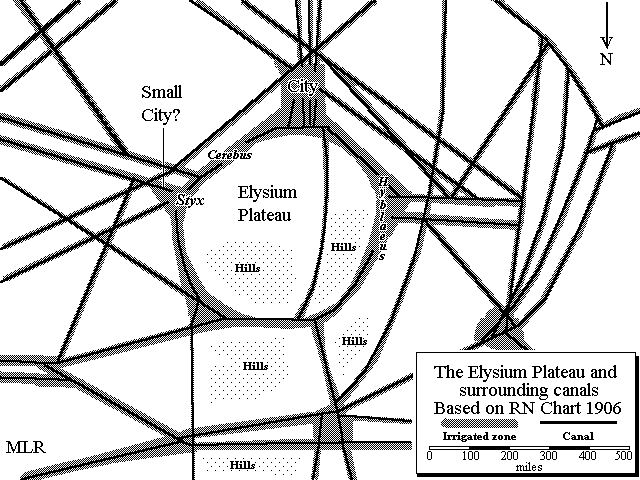
By 1908 many spaceships are already in service, and in the fourth adventure, entitled .-.. .- -.-- -.. .- -.--, one of them has run into trouble near Mars. Naturally the Royal Navy's finest spaceship is ready to answer the call.
Finally, in 1912 an unimaginably cruel plot threatens an entire world.
Can the adventurers intervene, or will THE GANYMEDAN MENACE lead to an
unimaginable disaster?
0.2 Timing and Distances
return to contents
These adventures have mostly been written to avoid the need to adhere to a strict timetable. Usually the characters will learn of a problem then have the time they need to deal with it. Occasionally their actions will precipitate events, causing a new problem that requires a rapid response, but even here it should be unnecessary to adhere to a rigid timeline.
In play-testing a freewheeling approach was used, with little attention paid to the passage of time. Regardless of their efficiency, the adventurers always managed to be at the right place at the right time, more or less equipped to deal with the situation. From then on the timing of the scenario was based on the players' actions. This melodramatic approach is strongly recommended.
If it becomes necessary to run an interplanetary chase, the PC
astronomy programs mentioned in the worldbook are extremely useful for
finding distances. There are equivalents for other machines. The
spreadsheet template TRAVTIME.WK1 can calculate travel times at any
desired acceleration.
0.3 Glossary
return to contents
This list includes short definitions of some of the words discussed in the Worldbook, and defines some extra words which are used at various points in these adventures.
A character in adventures 1 and 2 was suggested by Rudyard Kipling's "The Village That Voted The Earth Was Flat"; the hymn in adventure 2 is also taken from that story. Information on Atlantis and the Flat Earth comes from several sources, most notably John Grant's "A Directory Of Discarded Ideas" and Patrick Moore's "Can You Speak Venusian?"
Information on Edison, Tesla, and Marconi is mostly derived from Isaac Asimov's "Bibliographical Encyclopaedia of Science and Technology", from The Grolier Multimedia Encyclopaedia, from Ronald W. Clark's "Edison: The Man Who Made The Future", and John J. O'Neill's "Prodigal Genius: The Life of Nikola Tesla". For a vivid if somewhat biased fictional portrayal see Spider Robinson's "Lady Slings The Booze". Information on the Wright brothers and early aviation also comes from the Asimov and Grolier publications, plus David Wragg's "Flight With Power: The First Ten Years."
HMS Astra's motto was suggested by Roger Robinson, and translated into Latin by Kari Maughn. Thanks to both.
Adventure 5 owes much to the works of Sapper, William Le Quex, Kenneth
Robeson, and Leslie Charteris.
1.0 Adventure 1: Cabin 12A
return to contents
The year is 1901, a few months after the return of the Astronef. The Pilot skill does not yet automatically include details of spacecraft; Pilots with experience of airships, balloons, and gliders can easily learn to use the R. force, but they must be instructed by Lord Redgrave or Andrew Murgatroyd, and neither is currently in the business of giving lessons. Characters may not own spaceships; only one has flown, and it is currently being repaired. The nova Lilla-Zaidie is midway between Saturn and Jupiter, and is brighter than either of them.
Travellers on an ocean liner become involved in the affairs of a desperately ill fellow-passenger. As they do so they will learn that something is missing, and that at least one other party seems to be looking for it. If successful, they will find the missing object and prevent its theft; they will also earn the thanks of an important man, who will subsequently mention their names to Lord Redgrave.
Characters should be merchant navy officers serving aboard the liner,
or first class travellers en route from Britain to America. Their
reasons for travelling need not be the same, or connected in any way
with the events of this adventure. In most adventures at least one
character has the Doctor skill; ideally an adventurer should be the
ship's physician. If this is not the case, the ship's medical needs
are attended to by Dr. Peter Vernon, a minor NPC.
1.1 Players' Information
return to contents
You are travelling to New York aboard the steamship Princess Louise. She carries 250 first-class passengers, 280 second-class, and 800 in third class. You sailed from London yesterday. The trip will take about another six days if the weather is calm, longer if there are storms.
All of you are eating breakfast at the Doctor's table. As you tuck into your kippers and kedgeree, a steward arrives and tells you [or Dr. Vernon] that one of the second-class passengers has been taken very ill in the night. "Clutchin' 'is belly and sweatin' an' moanin' somethin' 'orrible, he is." The steward doesn't know anything about the passenger, except that he's "a Yank"; he's just delivering a message.
If Vernon is used, but an adventurer has the Doctor skill, Vernon will take his medical colleague aside and ask for help; the case sounds serious, and Vernon is only recently qualified. If more than one adventurer is medically qualified, Vernon will ask the character with the highest skill first, but won't think of asking for a woman's help if there is any alternative. Once he realises that an operation is necessary he will also be grateful for the help of a nurse, or anyone else with the First Aid skill.
If none of the characters have medical training, Vernon will tell the adventurers what happens (in sections 1.3 and 1.4 below) over supper.
Since the steward spoke just a little too loudly, everyone at the table knows that someone has been taken ill, and it naturally becomes the main topic of conversation. The adventurers may have something to say, and NPCs (see section 1.6 below) will react in ways that reflect their interests. Try to mix player and NPC dialogue in a natural manner, to introduce the NPCs without disrupting the players as they react to the news:
On this slightly confusing note breakfast ends.
1.2 Referee's Summary
return to contents
The sick "Yank" is Alfred Briggs, an employee of the Pinkerton Detective Agency. Briggs is travelling as a courier, conveying a small leather box from Lord Redgrave to Nikola Tesla. The box contains an R. lead electrode, roughly the size of a tie pin or the metal portion of a dart, which is to be used to "seed" an experimental R. graviton production plant. At current manufacturing prices the electrode has cost about £150 ($750) to synthesise, but there is a waiting list of several months for even this tiny quantity.
Briggs brought the box aboard in a briefcase handcuffed to his wrist, then locked it into the bottom drawer of his wardrobe; if he had to leave the cabin for any reason he took the case with him. He was taken ill in his cabin; when he felt the first symptoms he went to the drawer to get the briefcase, intending to have it put in the Purser's safe. He accidentally dropped it, and the box containing the electrode fell out, breaking the wax seal and the catch. The R. lead electrode "fell" upwards, and is now resting on the ceiling, in a crevice above the light fitting. Briggs collapsed before he could recover it.
Briggs is suffering from a ruptured appendix and the first stages of peritonitis. In 1901 these are extremely serious medical conditions which usually result in death. The new King's coronation has just been postponed because of appendicitis, and he nearly died despite the fact that he was treated by some of Europe's best surgeons. If Vernon is the only doctor, he won't be able to save Briggs; if one of the adventurers is a doctor Briggs may recover, but he will be seriously ill, unconscious and delirious, until long after the ship reaches New York. Unfortunately others aboard the liner will hear that he was carrying something valuable, and one of the NPCs mentioned above will make a determined attempt to uncover the secret. An unknown intruder will search Briggs' cabin, and will eventually find the electrode if the adventurers don't get there first.
Plans of similar ships can be found in numerous novels and books about the sea. Two role playing modules may also be of interest; Chaosium's "Cthulhu Casebook" details the liner Mauretania, while Steve Jackson Games' "GURPS Time Travel Adventures" includes a long section set aboard the Titanic. Both ships are larger than the liner in this adventure, but that can easily be changed.
As these events unfold, all shipboard activities are continuing normally. Meals are served and eaten, passengers flirt or quarrel, and there is a full program of entertainment. The NPCs described in section 1.6 eat at the same table as the adventurers, and should interact with them at other times; at least one will become much more deeply involved in the action, the others should be red herrings or sources of gossip and news.
Players may find it hard to explain why this matter concerns their characters if they are not involved as doctors or officers. Once it is clear that there is a mystery, detectives and others with experience of exotic events might be called in to help with the problem. Lawyers, military officers, or members of the aristocracy might be asked to act as witnesses while Briggs' luggage is searched. As a last resort, a cunning referee can probably modify the scenario to frame one or another of the characters as the thief, forcing him to fight to clear his name. There are many other possibilities.
This adventure take place in isolation; the liner has no wireless, and
won't be in signalling range of another ship until it nears the
American coast. If adventurers are going wildly wrong an engine
breakdown or a storm can be used to delay the ship's arrival; if they
fail completely no real harm will be done, since Lord Redgrave will
give Tesla another electrode and extra time to prove his theories.
1.3 Is It Safe?
return to contents
Players will probably begin with the assumption that Briggs has been poisoned, stabbed, shot, or is suffering from a horrible disease which will eventually sweep across the ship. He has been taken to the liner's sick bay, which has all the equipment of a late 19th century doctor's office. There is no X-Ray, but it does have a steriliser, supplies of bandages and ointments, a microscope and equipment for making slides, a set of surgical equipment, and reference books.
Briggs is delirious, clutching his abdomen and muttering. If anyone touches him Briggs grabs his hand and says "Is it safe?", then resumes his unintelligible muttering. During the examinaton his physician will detect all the signs of a ruptured appendix, and no evidence of foul play, but should notice that Briggs has some chafed red marks around his left wrist. They haven't been left by a wrist watch; as yet these are very rare, worn almost exclusively by women, and in any case Briggs had a silver half-hunter pocket watch in his waistcoat pocket when he collapsed.
If Vernon is working alone the operation is a failure; Briggs will die several hours later. If another physician is involved the case should be treated as a critical injury. First Aid is needed to prevent immediate death, then the Doctor skill to start his recovery. Emphasise the seriousness of the operation, but don't tell players what Difficulty numbers they are trying to beat when they roll the dice. It will be several hours before there is any sign of improvement if the treatment is successful; if it fails, he will take an equally long time to die.
Whatever the outcome, it's obvious that Briggs can't be returned to
his cabin; if dead his body must be returned to New York for burial,
if alive he must stay in the sick bay indefinitely. In either case his
property shouldn't be left unattended. Someone ought to arrange to
have his cases packed and stored, and his valuables locked in the
Purser's safe. Any adventurers who are involved may also want to check
Briggs' cabin to see if there is any explanation of the marks on his
wrist, to look for evidence of foul play, or to find out what "it" is,
and whether "it" is safe. The cabin key is in his pocket, along with
some coins and a small bunch of keys; a house key and two smaller keys
that might fit a padlock.
1.4 Unlucky For Some
return to contents
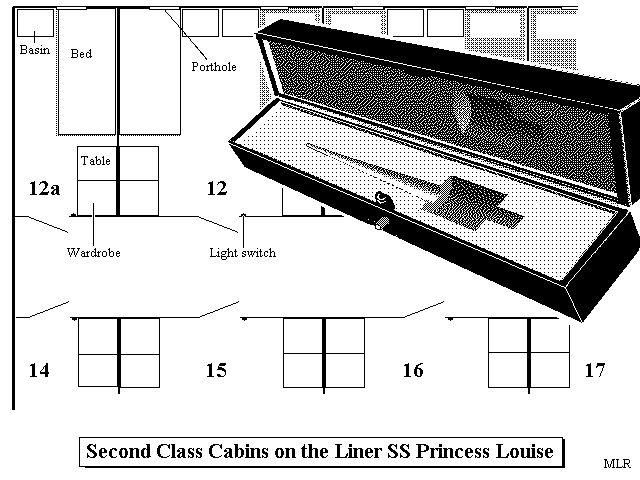
Briggs occupied cabin 12A on one of the second-class decks. It's a small single cabin at the end of a corridor; the only access is along the corridor. If not for superstition it would be cabin 13. The layout of cabins is as follows:
| 12A | 12 | 11 | 10 | 9 | 8 | 7 | 6 | 5 | 4 | 3 | 2 | 1 |
| Corridor | ||||||||||||
| 14 | 15 | 16 | 17 | 18 | 19 | WC | Bath | 20 | 21 | 22 | 23 | 24 |
12A and 14 are single cabins, the rest are doubles. Cabins 1 to 12A have portholes, 14-24 are inner cabins and do not have a view of the sea. The layout of the end of the passage is illustrated in more detail in 21_ADV2.GIF
The furnishings of 12A are a bed, a wardrobe, a wash basin, a dressing table, and a chair. The cabin also has electric light, a ventilator, plumbing, and a small porthole. The door is unlocked by a key from the outside, a knob on the inside, and there is also a small bolt on the inside. These details should only be mentioned if players ask about them.
Briggs' coat is hanging in the wardrobe. There is a .32 revolver in the right-hand pocket; the gun is loaded but not cocked, and the hammer is resting on an empty chamber. His passport is in the inner pocket; it identifies him as Alfred Briggs, born 1854, and gives his profession as Confidential Agent. Several business cards in another pocket state that he works for the Pinkerton National Detective Agency.
One of the drawers contains an open briefcase, with a chain and handcuff fixed beside the handle. One of Briggs' keys fits the cuff, another fits the lock of the case. The contents, half spilled into the drawer, are a notebook, twenty rounds of .32 ammunition, a tiny .32 Derringer, a purse containing £4 and $27 in gold and some small change, and a large manila envelope with red wax seals addressed to Mr. Nikola Tesla at a New York address.
The notebook contains a list of expenses, such as:
 2nd class ticket from Liverpool to Smeaton, Yorkshire   18s  3d
 Lunch                                                    4s 11d
 Accommodation, The Flying Yorkshireman Tavern, Smeaton  10s  6d
Summarised, the notes outline a trip from New York to Liverpool then to Smeaton in Yorkshire, a delay of four days, then a journey from Smeaton to London to join the Princess Louise.
Some newspaper clippings folded into the back of the notebook are "Wanted" advertisements, their subjects including Robert Leroy Parker (alias Butch Cassidy), Harry Longbaugh (The Sundance Kid), and other notable American criminals. None are aboard the liner, but don't tell the adventurers that if they want to look for them!
The envelope is private correspondence, and reading the contents is a serious breach of etiquette. If it does somehow fall into inquisitive hands, it contains papers related to the production of R. matter. Anyone with the Scientist skill will be fascinated, and will soon realise that the process can only be initiated with a "seed" of ready-made R. matter. Despite its apparent importance, this document contains little but the fine details of a process that has already become common knowledge. There is also a note to Tesla, reading:
Redgrave Engineering Ltd.,
Smeaton,
Yorkshire
England

My Dear Tesla,

Herewith the additional details of our current production system which
you requested. Please keep them confidential, since some minor aspects
of the process, which your refinements should render obsolete, have
yet to be patented. I have also sent the electrode with your courier,
since it was ready slightly ahead of schedule.

I trust that this finds you well, and will look forward to hearing
from you at the end of next month. Please pass on my best wishes to
Westinghouse.

        Yr obedient servant,
        [illegible]
PP Lord Redgrave |
On the table is a small leather box which looks like a jewellery case. It's empty; there are traces of a broken wax seal around the catch, and more pieces of red wax on the floor under the bed. A label on the base of the box reads "Redgrave Engineering Ltd., Smeaton, Yorkshire". An indentation in the padding once held a small cylindrical object, about 1/4" wide and 1" long, with a spike protruding from one end. Adventurers reading the letter should easily guess that the box contained the mysterious electrode.
The steward who found Briggs remembers picking up the box after Briggs was taken to the sick bay. It was lying open on the floor near the wardrobe when he found it, with bits of wax around it.
The cabin is badly lit; visitors tend to switch on the light as soon as they enter, without even thinking about it. The light bulb is covered by a globular glass shade which screws into a ceiling fixture. With the light on it is difficult to see that there is a gap of about half an inch between the metal top of the fixture (a cover resembling the lid of a jar) and the ceiling itself. The gap contains wires and the hooks that support the fixture. When Briggs dropped the box the electrode "fell" up to the ceiling, and bounced into this gap. If adventurers immediately guess that the electrode is on the ceiling, they still won't find it easily; it is small, concealed by shadow, and can only be found by someone standing on a chair or ladder, probing the gap with fingers. Optionally, it has "fallen" further, into the electrical conduit above the ceiling, and can only be retrieved by taking the fixture apart, removing a cover plate, and risking electrocution to pull it out from a narrow gap between two live terminals.
Don't focus any special attention on the ceiling. Ask players to roll whenever their characters examine anything, whether it is the floor, the wardrobe, the ceiling, or the corridor outside. Whatever the adventurers do, short of taking the light fitting apart, they should NOT find the electrode at this point. If characters do take this step they will find the electrode, of course, and it will be necessary to change subsequent events; for instance, there might be an attempt to take it from the Purser's safe.
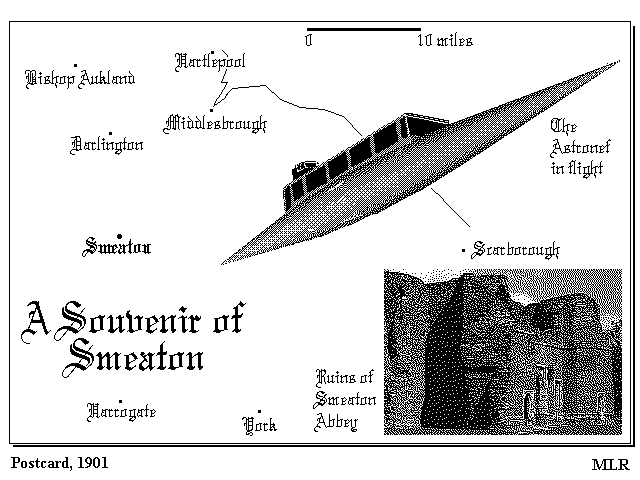
The remaining contents of the cabin are clothing, a razor, and other personal items, a copy of George Griffith's best-selling "Honeymoon In Space" (signed by Lord Redgrave), and some postcards of London and of Smeaton in Yorkshire (10_SMETN.GIF).
If none of the adventurers take part in an examination of Briggs or the cabin, all of these materials are packed for storage; the guns, papers, and money go into the Purser's safe, everything else is put into a locked storeroom. If adventurers are ship's officers or have otherwise become involved in events, they may have other ideas; provided that their proposals are reasonably legal and plausible, they should be followed.
If the Captain is questioned, he will reveal that he knew that Briggs
was armed. Normally passengers are asked to surrender all weapons on
boarding the ship, but Lord Redgrave arranged for Briggs to have a
single cabin, and requested the Captain's co-operation. Since Lord
Redgrave owns a sizeable share of the line, the Captain was happy to
oblige.
1.5 Table Talk
return to contents
At supper Briggs' condition should still be a major topic of conversation. The news is all over the ship, and the Doctor or Doctors involved will face a barrage of questions. There has been a lot of gossip, and everyone seems to know that Briggs was armed, and was carrying something valuable. Lord Redgrave's name will also be mentioned.
Anything said during the meal should be considered as a motive for one or another of the NPCs at the table to start looking for the electrode. Optionally, one or another of the NPCs was already aware of Briggs' mission, and has followed him from Yorkshire in hopes of intercepting the electrode and/or papers.
Next morning a steward bringing tea to another cabin finds the door of Briggs' cabin open, and obvious signs of a search. The bedding has been upset, the table moved, and the wardrobe drawers pulled out and up-ended on the floor. One other incident was reported to the officer of the watch, and should also come to the attention of anyone involved in investigating this matter; during the night someone unbolted a fire door between the first and second class cabins. The bolt was on the first class side, which implies that a first class passenger used the door to reach the second class deck.
Characters will probably guess that Briggs' cabin was searched by a first class passenger, and are likely to focus on those they have already met, their fellow-diners. This isn't completely logical, but (in the great tradition of the English detective novel) happens to be correct.
Depending on the identity of the intruder, there may or may not be useful evidence left behind: a damaged door or lock, an improvised lock pick, and so on. An absence of evidence might suggest (wrongly) that an officer or crewman could be to blame. Evidence for each NPC is summarised in section 1.6
Subsequent events are largely in the hands of the players. One obvious idea is to search the cabin again, much more thoroughly, hoping to find more clues to the intruder. This is likely to be the moment at which the electrode is found, especially if characters think of examining the ceiling more closely. They may also decide to set a trap for the intruder, assuming (correctly) that he or she will return to the "scene of the crime".
All of the above assumes that only one NPC is interested. There are motives below for six NPCs, and two or more might independently decide to go after the mysterious secret.
If adventurers don't find the electrode, and don't catch the intruder(s), it will be stolen. At this point the adventurers have probably lost; the electrode is small, and very easily concealed in clothing or luggage. There is a mail box aboard the ship, intended mainly for postcards. An imaginative thief might easily think of packing the electrode and posting it as a small package. Anything posted is taken ashore by the pilot's boat and posted several hours before the Princess Louise enters harbour.
One special means of finding the electrode should be mentioned; if there are supernatural powers in your campaign, Mrs. Blanche Conway is a powerful medium. If the adventurers explain what they are doing, and take her into their confidence, she will gladly try to find it. She'll request the box and the presence of everyone who has been involved in the case (including NPCs), and conduct a seance in cabin 12A. The consequences could include any of the following:
If this is tried after the electrode has been stolen, Mrs. Conway won't be able to trace it. She has a vague impression that it's "in the dark", but that simply isn't very helpful. Player character mediums should not be able to manifest anything like Mrs. Conway's degree of power; she is possibly the strongest psychic in the world, and wholly dedicated to her "gift". She would never dream of using it for profit or otherwise benefit herself.
If your campaign does not involve paranormal powers, Mrs. Conway might
still be asked to conduct a seance. It's easy to deduce that the
electrode is somewhere on the ceiling, and the light fitting is the
only cover that might hide it; Mrs. Conway is reasonably intelligent
and is subconsciously controlling the glass, so result 1 or 2 above
should occur.
1.6 The Usual Suspects
return to contents
The adventurers dined with several other passengers. Each of these NPCs is potentially interested in taking a closer look at Briggs' cabin; it's up to the referee to select a culprit. Each NPC is listed normally, and is also given a motive for breaking into cabin 12A and a means of getting inside. Almost all of the methods leave some sort of evidence, but the evidence will not be conclusive proof. If the character is not the culprit these notes should be ignored. Optionally two of the characters are involved, each using their own methods. In this case it is strongly recommended that Mrs. Blanche Conway should be one of the intruders, an interesting red herring for the adventurers.
Colonel Moutarde of the French Foreign Legion, age 55
BODY [3], MIND [3], SOUL [2], Brawling [6], Business [5], Linguist
(German, Dutch, English) [4], Melee Weapons [6], Marksman [4],
Martial Arts (Savate) [5], Military Weapons [5]
Equipment: Sabre.
Quote: "Mais non, I forget nothing!"
Notes: Colonel Moutarde has been assigned to the French Embassy in
Washington, where he will be military attache. He is pompous and
overbearing, and extremely proud of his impending status. He is
travelling on a diplomatic passport.
Motive: France needs more R. matter to rule the heavens. Since
opportunity has thrown this chance his way, he has decided to take
advantage and capture the electrode for his country.
Method: A man of action, he'll simply kick the door open.
Evidence: He won't think of cleaning his footmark off the door. But is
he the only man aboard with that type of shoe?
Miss Scarlett O'Flaherty, a beautiful Southern maiden, age 27
BODY [4], MIND [3], SOUL [1], Actor [7], Artist (forgery) [7],
Brawling [5], Business [6], Stealth [6], Thief [8]
Equipment: Gems worth £4,500, £1,200 in cash.
Quote: "Oh my! All these darling diamonds for little me?"
Notes: Miss O'Flaherty (real name Gretchen Hagen) is a confidence
trickster who has been plying her trade across Europe, and is now on
her way back to America with a tidy fortune, mostly in the form of
engagement rings and other little knick-knacks.
Motive: Greed. Anything that needs a Pinkertons courier has got to be
worth stealing.
Method: She knows how to distract a man, and how to pick pockets. The
stewards are men, and have keys to the cabins in their pockets. What
could be easier?
Evidence: A check of stewards will eventually discover that one has
lost his pass key, and is desperately trying to conceal the theft,
which could mean the loss of his job. He remembers "a beautiful Yank
lady" tripping and nearly knocking him down a few minutes before he
noticed it was gone. Scarlett won't get rid of the key; after all,
people sometimes leave valuables in their cabins. However, it will be
safely hidden in her bodice, and no gentleman could possibly dream of
looking there.
Mrs. Evadne Peacock, Widow, age 55
BODY [4], MIND [5], SOUL [3], Actor (poker face) [7], Psychology [8],
Ride [7]
Equipment: Several packs of cards, riding gear.
Quote: "Three trumps redoubled, partner."
Notes: Mrs. Peacock is a professional horse breeder and successful
gambler who takes regular transatlantic cruises to play cards with
the rich and famous. She is not a card sharp - just an extremely good
player.
Motive: Political. Mrs. Peacock is a member of the suffragist movement
(not the more militant suffragettes), and hopes to sell whatever she
finds to raise money for the cause of votes for women.
Method: There is a ventilation grille on the door. She unscrews it
with a nail file, then reaches in turn the door knob.
Evidence: She accidentally drops a hairpin with a small pearl on the
end, matching others she continues to wear. The end of her nail file
is slightly twisted, with faint brassy marks matching the screws that
held the grille in place.
Professor Ignatius Plum, wealthy scientific dilettante, age 50
BODY [3], MIND [5], SOUL [2], Scientist [7]
Equipment: Telescope, microscope, camera, and a trunk full of gadgets
and tools including vials of various chemicals.
Quote: "Now the fascinating thing about this type of storm is that the
winds blow anticlockwise..."
Notes: Professor Plum inherited a family fortune and has spent much of
it on his interests, which cover all aspects of science from
Astronomy to Zoology. Unfortunately his studies lack focus, and he
will never make any fundamental discoveries.
Motive: Scientific curiosity. It could be years before R. matter is
available for study, and he wants to get his hands on some now.
Method: His baggage includes a small supply of concentrated oil of
vitriol (sulphuric acid) which will easily destroy the lock.
Evidence: He's the only one of the suspects with access to oil of
vitriol, but there is some more aboard, used by the engineers to
clear scale from steam pipes.
The Reverend Amos Green, Vicar and Flat Earth Enthusiast, age 45
BODY [6], MIND [4], SOUL [4], Actor (preacher) [5], Athlete
(Climber) [8], Brawling [7], Science (weird) [5]
Equipment: Bible, numerous leaflets about flatness of the Earth,
climbing gear
Quote: "Of course ships do seem to disappear over the horizon; it's an
optical illusion caused by the refractive nature of damp sea air..."
Notes: Green is most kindly described as an enthusiast. He is
convinced that the Earth is flat, but appears rational in other
respects (for example, he is willing to concede that evolution may
have occurred). He believes that the flight of the Astronef was a
cunning fake perpetrated by an international conspiracy of globe
manufacturers and map makers, determined to perpetuate their lies. He
is travelling to America with other members of the Alpinists Club on
a mountaineering holiday. The Reverend Green appears again in
Adventure 2, and section 2.A contains more data on his beliefs.
Motive: Lord Redgrave is obviously an agent of the international
spherist conspiracy. Anything that might harm him, such as the loss
of the electrode, is thus God's will. As a man of the cloth the
Reverend Green must help to bring God's will about.
Method: Green has an alpenstock in his trunk, and will use its spike
to lever the door open.
Evidence: The spike has a triangular cross section, and the marks it
leaves in the door and frame are also triangular. Green won't think
of throwing it away, but all of the climbers have similar equipment.
Mrs. Blanche Conway, Medium, age 37
BODY [2], MIND [3], SOUL [7], Medium [9] (or Actor [7])
Equipment: Tarot cards, trumpet, tambourine, Ouija board.
Quote: "I feel a strong presence..."
Notes: Mrs. Conway is an extremely kind, gentle person, and a powerful
and experienced medium. She is a moderately wealthy widow, and never
charges for her services; she likes to think that she is putting her
gifts to good use by helping others.
Special note: Nothing in the Astronef stories confirms or denies any
aspect of the supernatural. If you exclude mediums from your campaign
she is a self-deluded fake with no powers. However, somnambulism and
spirit contact were popular in Victorian and Edwardian melodrama and
fiction.
Motive: None. She dreams of a voice asking her if something is safe,
and sleep-walks to cabin 12A. She searches the room without waking
then walks back. In the morning she has no memory of her actions.
If she finds the electrode she will sleep-walk to the Captain's
cabin and give it to him. While sleep-walking she moves slowly and
with a minimum of unnecessary gestures, her hands by her sides unless
she is using them. Her eyes are open, but stare straight ahead.
She breathes regularly. She doesn't respond to noise or motion, such
as a hand waved in front of her face; she will only regain
consciousness as a result of a slap or some other physical
contact.
Method: When she touches the door it is unlocked and unbolted, even
if it has previously been secured. If characters are waiting in the
cabin, expecting a more conventional intruder, this should be an
unsettling experience. If your campaign doesn't include psychic
powers, the lock is faulty.
Evidence: None, but she will return to cabin 12A every night until
the electrode is found or someone interrupts her visits.
1.7 Rewards
return to contents
If the adventurers recover the electrode they will earn Tesla's gratitude; he'll also mention their names to Lord Redgrave. If you wish to develop this relationship, Tesla is described in adventure 3. The Pinkerton agency will also owe them a favour, if the adventurers think of asking for one. Better get it in writing, since this agency isn't renowned for its trust or generosity.
If someone is caught trying to steal the electrode, the shipping line will refuse to prosecute, and do its utmost to hush up the scandal. One of the NPCs has diplomatic immunity, another is apparently innocent of any conscious motive. All are, or appear to be, wealthy and respected members of society. If characters agree to co-operate, they will gain the good will of the Captain and of the line. Even the culprit might show some gratitude for the characters' discretion! Rewards for this circumspection are left to the referee, and should be tailored to the needs of adventurers; for example, it could be very useful to have a friend in the French Embassy if a visa is needed in a hurry, while characters who frequently dabble on the shadier side of the law might have work for an experienced and completely amoral seductress.
Referees may wish to give characters bonus points for success, or for
interesting or amusing actions, but the total should be small; they
were never in any danger, and there would be no serious consequences
if they failed completely. A maximum of three points per character is
about right.
1.8 Further Adventures
return to contents
If some or all of the characters are merchant navy officers, this can be a good stepping-stone to a career in space. Lord Redgrave owns a large share-holding in the shipping line; he'll probably come recruiting when he needs officers for the Hartley Rennick and other ships his factory is building.
What will happen to surface liners when the R. force allows transatlantic flights in two hours? How will the owners fight back? Will they go under gracefully, or will they resort to dirty tricks and smear tactics?
Many merchant officers are members of the Royal Navy reserve, and occasionally need to spend time aboard Naval vessels. Once the first military spaceships enter service this could be a very interesting experience. See Adventure 4.
Any or all of the NPCs could appear in later adventures; for example,
the Reverend Green can be found in adventure 2 below. It's always nice
to run into old friends. It is not advisable to have Mrs. Conway
appear too often; if psychic phenomena exist in your world, her gifts
are extraordinarily useful, and lazy players may want to use them in
situations where normal methods and a little ingenuity would produce
more interesting results.
2.0 Adventure 2: Moon '02
return to contents
1902. Pilots still do not automatically know how to fly spacecraft; Lord Redgrave, Andrew Murgatroyd, and some employees of Lord Redgrave's company are trained, but the techniques are still his monopoly. Characters may not own spaceships; only one has flown, although another will soon enter service. The nova Lilla-Zaidie is nearer Jupiter than Saturn, and is brighter than all the planets except Venus.
Lord Redgrave is planning the second Lunar expedition; its main objective is to unravel the secrets of the Great Pyramid of the Moon. Candidates for the team must pass a series of tests to qualify, but successful applicants will earn a place in archaeological (or Lunological) history. If there is treasure to be found, they might even get rich.
Lord Redgrave will personally invite anyone who has earned his esteem
(such as a character who succeeded in Adventure 1), or has a
reputation for resourcefulness or bravery; there will also be a
discreet advertisement in The Times.
2.1 Players' Information
return to contents
All of the adventurers see this advertisement in The Times:
EXPLORERS |
While the advertisement isn't very informative about the destination of the expedition, Smeaton is known world-wide as the home of space travel. Anyone who has previously had favourable contacts with Lord Redgrave will also be sent a copy of the advertisement with a covering note:
Redgrave Engineering Ltd.,
Smeaton,
Yorkshire
England


Dear _________,

You might be interested in joining the expedition I'm
planning; sorry about the short notice, conditions will
be perfect in a few days, and we've only just got the
Astronef ready to fly again. As you've probably guessed,
we're going to take another look at the Moon.


I should warn you that I really am going to be very firm
about health and qualifications; we don't want any
accidents. I hope that you feel like participating.


        Sincerely,
        [illegible]
PP Lord Redgrave |
This is a straightforward action adventure. Lord Redgrave wants to explore the Great Pyramid of the Moon; his main objective is scientific knowledge, but some loot might also be useful. Initially he plans a quick expedition, a week or so of exploration, which will be followed up by more detailed work if the results are interesting.
The main stages are the selection process, a brief period of training, the voyage to the Moon, exploration of the pyramid, a dangerous confrontation with a stowaway, and the return to Earth. Each stage can be played reasonably quickly, or stretched out with extra incidents.
This adventure can easily result in the death of characters, and the referee should encourage players to be cautious. Having said that, don't be afraid to kill anyone who makes a stupid mistake. Forgotten Futures allows reasonably fast character generation, and no-one is irreplaceable.
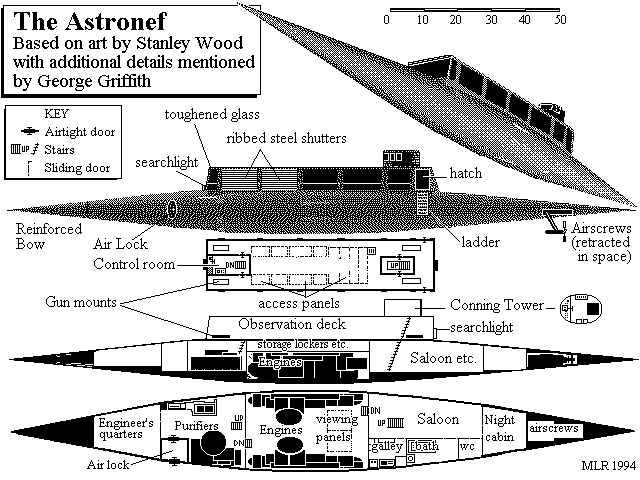
Role playing note: Sections 2.2 and 2.3 below are an introduction to 1902 space technology, but they can become a boring "Balloon factory tour" (see the Forgotten Futures rulebook) if they are taken too far. In 2.2 the pacing of the factory visit should be brisk, with the players wanting to know more as their characters are called back for assessment. Show the players the Astronef plans (08_ASPLN.GIF) but don't give them a detailed description of every compartment; the labels should suffice for now. Similarly, the training described in section 2.3 should be paced to suit the players interests; if their reaction to breathing dress is something like "It's a space suit... big ***** deal" then it's pointless wasting much time detailing the oxygen system, or trying to explain its deficiencies in plumbing and safety equipment. Just try to put one point across; while the players may think that it all looks incredibly quaint and Victorian, the characters should think of it as the cutting edge of technology, a miracle of scientific ingenuity.
Useful sources for this adventure include George MacDonald Fraser's
"Mr. American", which describes the King, and Rudyard Kipling's "The
Village That Voted The Earth Was Flat" and Arthur C. Clarke's "Prelude
To Space", which both contain vivid descriptions of a certain type of
fanatic.
2.3 Testing, Testing
return to contents
There are several hundred replies to the advertisement; most can be winnowed out by virtue of obvious insanity, illiteracy, foreignness, or combinations of the above. Eventually about thirty applicants remain, including the adventurers, and all are invited to Smeaton the following week. Since horseless carriages are still very rare, and roads are mostly poor, the only practical way to get there is by rail. There are fast direct services from London, Glasgow, and Liverpool, passengers from other areas must change trains at least once. The town's location and principal sights are shown in 10_SMETN.GIF
Most of the NPCs encountered in Smeaton have strong Yorkshire accents. For the uninitiated, eg Americans, a Lancashire accent (as heard in Coronation Street) is very similar. Omit the word "the" or pronounce it as "t'", e.g. "There's trouble at t'mill". See The Great Old Ones (Chaosium 1989) for a more detailed guide to this dialect.
A small steam charabanc meets the train and carries the candidates to the factory. As they approach the works, a harmonium playing a well-known hymn tune is just audible over the noise of the engine, but the words are unfamiliar:
Hear the truth our tongues are telling,
   Spread the light from shore to shore,
God hath given man a dwelling
   Flat and flat for evermore.

When the Primal Dark retreated,
   When the deeps were undesigned,
He with rule and level meted,
   Habitation for mankind!

Hear the truth our tongues are telling,
   Spread the light from shore to shore -
Oh, be faithful!  Oh, be truthful!
   Earth is flat for evermore.

Rudyard Kipling:
The Village That Voted The Earth Was Flat
Pickets carrying signs saying "The Earth IS Flat" politely make way for the coach as it enters the factory gates. If characters participated in adventure 1, they will recognise the Reverend Green leading the choir; if the Reverend somehow ended up in prison, he was subsequently released by a sympathetic judge and returned to his congregation. The driver says "They come and picket us once a week. The police want to stop them, but his Lordship won't have it; says they aren't doing any harm. Happen he's right."
A harassed-looking clerk welcomes the visitors and explains that Lord Redgrave is still dealing with the previous group of applicants. In the meantime he can offer tea or a tour of the works. If they take him up on the offer, an overalled workman is called in to guide the tour.
While describing the factory emphasise its sheer size; the whale-like steel frames of the gigantic spacecraft, the hammer of riveters at work, and the hum of an endless row of whirling Wimshurst machines discharging yard-long sparks into complicated electrical devices. At one side of the factory huge new machines are being erected, each a shining symphony of chrome rings and glass columns; the guide gloomily points to them and says "Them's t'new Tesla graviton converters, his Lordship says they'll double R. matter output and halve t'electricity consumption. Happen he's right, I suppose, but it sounds too much like summat for nothing for my liking, and they do say that t'alternating current can fry a man like a piece of best back bacon that's been on t'fire too long."
Near the centre of the yard the Astronef is resting in a steel cradle, her steel flanks gleaming as a workman hoses white dust from the hull. Small compared to the ships under construction, she is still an impressively large machine. "We've re-packed t'hull insulation from stem to stern, and double tarred all t'seams. Won't be any trouble with air leaks now.", the guide says reassuringly. He looks at the workman on the hull, and shouts "Jethro - you sweep away that asbestos properly, afore it dries and blows all over t'yard. His Lordship doesn't want it in his tea!"; he has no idea that the stuff might be harmful, nor should adventurers.
This may be a good opportunity to give the adventurers a QUICK guided tour of the Astronef, using the plans in 08_ASPLN.GIF; the only change is the addition of six bunk beds on the glass-walled upper deck [if there are more adventurers, change this to eight or ten beds]. "Them're for t'people that get picked for t'expedition." He also points out a new "Marconi Wireless Transmitter", a bulky machine linked to dozens of lead-acid batteries.
Soon the clerk returns to escort the adventurers to a marquee where they, and twenty or so others, are to be briefed. Lord Redgrave welcomes everyone, apologises for the delay, and explains the main objects of the expedition; to explore the Great Pyramid of the Moon, and to test wireless communication between the Earth and the Moon. "If there's time we also want to take a look at some other sites, but with so many people aboard our resources might be a bit stretched; that may have to wait for a later expedition."
Lord Redgrave explains that everyone will be tested for physical fitness and for relevant knowledge and skills. He adds "Those of you who have seen the Astronef will know that we have rigged her to accommodate extra passengers. The number of bunks has been dictated by our equipment; we have six spare sets of breathing dress [more if there are more than six adventurers]. Since there are so many eminently suitable candidates, we must narrow down the field considerably. Good luck to all of you, and may the best men win."
Lord Redgrave is as good as his word; everyone is going to be tested, and anyone who fails any test, or gets marginal results on any two tests, will be winnowed out. The first two tests are administered by doctors from the local hospital.
Health is assessed by a simple test; 100 step-ups followed by a check of pulse, blood pressure, and respiration. This is resolved by rolls of BODY versus Difficulty 2 then Difficulty 4. There is no need to make the Difficulty 2 roll if BODY is 3 or more. If the Difficulty 2 roll is a failure the character is unfit, and won't be allowed to participate in the expedition. If the Difficulty 2 roll is a success, but Difficulty 4 fails, the character is marginally fit; a second failure will eliminate him. If both rolls are successful the character has passed with flying colours.
The next test is designed to find out if the subject is mentally fit for space. WARNING: claustrophobic players may react badly to the description that follows! The subject is taken to a private room and asked to don a breathing dress (which has a slight smell of vomit). When the dress is sealed the doctor administering the test asks a few questions through the telephone, then fixes a blindfold over the portholes of the helmet, blocking them completely. Finally the doctor leads the character through a door and pushes him into a swimming pool without any warning. This test requires a roll of MIND versus Difficulty 5; any failure results in severe disorientation and nausea, and claustrophobic symptoms, such as accelerated pulse, rapid breathing, and feelings of suffocation. This is a marginal failure. If the roll above is a failure, and a roll of MIND versus BODY also fails, the character vomits into the suit. This is complete failure.
The third test is an interview, in which characters are questioned about relevant skills and knowledge. They are also given five minutes to write 25 words on why they want to take part in the expedition. While sadistic referees might like to play this out, the questions are easily answered and don't require skill rolls. Nevertheless more NPCs fail, through nervousness or stupidity. Fortunately for most characters, it is much too early in the century for more subtle forms of psychological evaluation; Freudian analysis is still in its infancy, and Rorschach is only 18 years old.
If any character fails you may optionally allow the player to generate a replacement or take over the running of an NPC. If characters seem to be passing too easily you might like to add more tests; for example, of agility (dodging thrown balls at BODY/2) or morality (a trick question of the "would you let a runaway horse run down an old lady or a small boy" variety, where the correct answer is "I'd leap for the reins and stop it, of course"); success should be determined by the appropriateness of the players answer, or by rolling SOUL versus Difficulty 6.
After these tests the surviving adventurers and (possibly) some NPCs are left; in all there should be one person for each of the six places left on the expedition. Brief details of three NPCs are provided below, on the assumption that at least three adventurers survived the selection process:
Lieutenant Victor Bates, Royal Marines, age 25
BODY [5], MIND [3], SOUL [2], Athlete (caving) [7], Brawling [7],
Linguist (Afrikaans, Latin) [4], Marksman [6], Melee Weapon [6],
Military Arms [7], Riding [4]
Quote: "Hmmmm. Better belay a rope around that stalagmite."
Notes: A soldier and amateur speleologist (cave explorer), currently
on leave after service in the Boer War.
Dr Albert Gutteridge FRCS, Surgeon and Naturalist, age 38
BODY [3], MIND [5], SOUL [2], Doctor [6], First Aid [8], Marksman [7],
Melee Weapons [5], Riding [5], Scientist (zoology) [8], Stealth [5]
Quote: "Call that a wound? It's hardly a scratch!"
Notes: An explorer, and the first doctor to remove a gallstone in
Matabeleland. He has discovered several new lizard species.
Professor George Ipps, Egyptologist, age 39
BODY [2], MIND [4], SOUL [3], Artist (restore antiquities) [6],
Marksman [6], Mechanic [6], Riding [6], Scientist (archaeology) [8]
Quote: "Yes... a definite resemblance to sixth dynasty forms...."
Notes: A veteran of numerous excavations in the Middle East. He has
various theories about the resemblance between the Egyptian and
Lunarian pyramids, and hopes that there might be evidence to support
his views.
If NPCs are needed, select characters whose skills complement those of
the adventurers, but try to avoid letting them dominate the party.
Lady Redgrave will join the expedition if there is a single female
character; Lord Redgrave wouldn't dream of having an unchaperoned
woman aboard. In this case Lady Redgrave and the female character will
share the Astronef's night cabin, and Lord Redgrave will sleep in one
of the bunks. Two or more female characters can chaperon each other;
again, they will share the night cabin while Lord Redgrave sleeps in a
bunk.
2.4 Back To School
return to contents
A few days of training follow, with the characters accommodated in the commodious guest quarters at Lord Redgrave's local residence, Smeaton Manor. The training includes instruction in the use of breathing dress and cameras, and operation of the new wireless equipment. Anyone who already has the Pilot skill will be given a chance to train on the Astronef's controls.
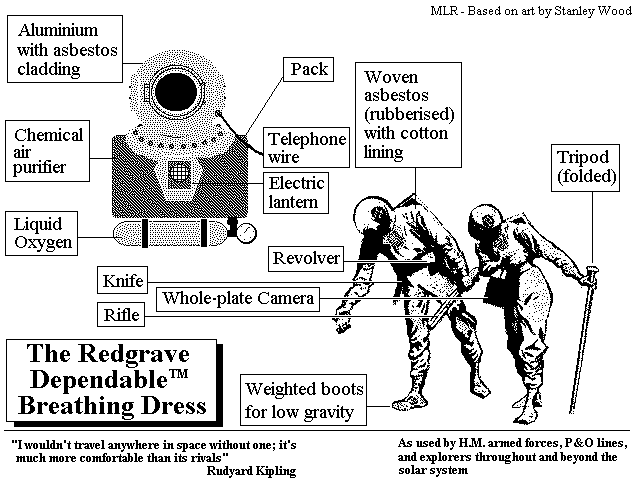
For breathing dress training Lord Redgrave uses an old rubber and canvas diving suit with a knapsack full of bricks; the real breathing dresses are still being adjusted to give a perfect fit. Most of the sessions are on the lawn outside Redgrave Mansion, with some underwater work in the factory's fire pool. The dry-land training is difficult because the suit is incredibly hot and heavy, much more so than the real thing, and each session leaves the adventurers soaked in sweat and extremely tired. The trainer is Andrew Murgatroyd, who is gloomily convinced that the adventurers will "Come to no good end" if they don't learn to use the suits safely. He lectures on the composition of the suit (see A Visit to the Moon and Worldbook section 3.10), control of the air supply, use of the light, operation of the telephone, and emergency puncture repair. Most important of all, Murgatroyd explains how to stay upright under low gravity, using the weight of the boots to counteract the heaviness of the back pack and helmet. At the end of the course he gives an examination. To simulate this, print out 09_SUITS GIF and cover the labels, then conduct a quick quiz; ask each player to identify a part, such as the air purifier, spotlight, oxygen tank, or telephone connection, and describe some aspect of the suit or its operation. For example:
Anyone failing both parts of the test receives a severe lecture from Lord Redgrave, who threatens to drop him from the expedition if there is any more "slacking". The reward for success should be a reduction in the Difficulty of actions when the adventurers are on the Moon.
Lady Redgrave teaches photography; if she isn't a member of the expedition, explain her omission by mentioning that she has an ankle in plaster following a minor riding accident. She explains how to load glass plates into wooden holders, how to set up and focus a camera, and how to time exposures (which range from a few seconds to several minutes in really poor light). The expedition will carry three cameras; the big whole-plate camera used on the first expedition, and two small quarter-plate models. All three need several minutes of setting up and adjustment before they are ready to take a picture; the quarter-plate cameras are much more compact, and a lot easier to use, but their results tend to be poor since excessive enlargement is needed. Ordinary magnesium flash powder can't be used for lighting, since it doesn't burn in a vacuum, but Lord Redgrave has prepared some self-oxygenating flares based on an incendiary compound. The course ends with a practice session in which each of the adventurers is asked to load a plate holder in the dark, set up the camera to take a photograph, and store the plate afterwards; getting this right requires three rolls:
If Lady Redgrave is coming on the expedition she will look after the big camera, otherwise it should be entrusted to the character with the best results; the other cameras should be allocated to the runners-up. This lesson is mainly important because it introduces characters to Lord Redgrave's vacuum flares, which may be significant later in the adventure:
Incendiary Flare
Lord Redgrave's design is based on Professor Rennick's incendiary
compound. The component chemicals are packed into a cardboard tube,
one of them in an inner glass vial which is in turn wrapped in a layer
of felt. When the end of the tube containing the glass vial is
crushed, the chemical soaks through the felt and ignites spontaneously
after 5-10 seconds. The mixed chemicals then burn, igniting strips of
magnesium which produce blindingly bright light for 20-30 seconds. The
flare is extremely hot, but much smaller than the normal shell:
| Flare | Effect 6, A:F B:I C:I * |
The wireless training is simple; the rudiments of radio operation and Morse code. The aerial for the equipment is a wire nearly a mile long; in flight it will be towed behind the Astronef. Some characters may already know Morse. Others can try, using MIND against Difficulty 10 after one day, 8 after two days, and so on; if successful, record it as the skill Morse Code, initially at MIND+1. Operation of the rest of the equipment is easy; Marconi has adjusted the transmitter and receiver to use the same frequencies as his equipment, and all that should be necessary is a little fine tuning once the Astronef is in space. This can be done using the Scientist or Mechanic skill; difficulty will vary during the course of the flight, and is discussed below.
Referees might like to compose a few Morse code messages for players to receive while testing the Marconi wireless receiver, on Earth or during the flight. The main elements of the code follow:
| A .- | B -... | C -.-. | D -.. | E . | F ..-. | G --. |
| H .... | I .. | J .--- | K -.- | L .-.. | M .-.. | N -. |
| O --- | P .--. | Q --.- | R .-. | S ... | T - | U ..- |
| V ...- | W .-- | X -..- | Y -.-- | Z --.. | ||
| 1 .---- | 2 ..--- | 3 ...-- | 4 ....- | 5 ..... | 6 -.... | 7 --... |
| 8 ---.. | 9 ----. | 0 ----- | ||||
| Full stop | ...... | |||||
| Beginning of transmission | -.-.- | |||||
| End of transmission | .-.-. | |||||
| Mistake | ....... | |||||
for example, -.-.- --. --- --- -.. .-.. ..- -.-. -.- .-.-. translates as "[Begin transmission] GOOD LUCK [End transmission]", while .-.. .- -.-- -.. .- -.-- is "MAYDAY", the international distress signal; the later "SOS" is not yet in use (see note on Q codes in the introduction).
For printing convenience this is also provided as a separate table.
There are several Morse code translators available as shareware or public domain software, some of them able to produce audio signals as well as printed text.
Anyone who already has the Pilot skill will be given instruction aboard the Astronef. This isn't a complete programme of flight training; since Murgatroyd can operate the engines, the instruction covers the minimum of control needed to get the Astronef home if Lord Redgrave is incapacitated. Much more expertise would be needed for a prolonged interplanetary voyage. Ask any characters concerned to make a Pilot skill roll versus Difficulty 6:
While all this is going on the Astronef is being prepared and loaded. Supplies include rations for three weeks, ammunition, spare accumulators for the wireless transmitter, electrodes for the searchlights, and extra supplies of all types. Gear loaded especially for the expedition includes the following:
Lord Redgrave has also built ten clockwork timer detonators for the pneumatic cannon shells carried aboard the Astronef, allowing them to be used as blasting explosive. He won't assemble such a bomb unless it's actually needed. Conventional explosives (such as dynamite) can't easily be set off in a vacuum; electrical detonators aren't yet available, fuses can't burn without air, and chemical timers are unreliable. He won't allow anyone to bring any other type of explosive aboard.
If the adventurers want to suggest additional items of equipment, Lord Redgrave will pay a reasonable amount of attention. The main limitation on equipment is the size of the airlock, which has hatches 3 ft wide by 5 ft 6in high; it's pointless taking anything which can't be unloaded once the Moon is reached. Larger items (such as Babbage engines or extra-powerful telescopes) can be carried if they don't need to be unloaded.
Some other activities that might take place before the flight include shopping (for unusual equipment suggested by the adventurers), a short atmospheric test flight (with a minor emergency to keep adventurers on their toes), breathing dress fittings (with the aid of a tailor who seems to want some very unusual measurements), and a visit to the nearest observatory to study the Moon through a powerful telescope.
Meanwhile the Reverend Green has somehow managed to penetrate the
factory's security. The night before the flight he sneaks aboard the
Astronef with two fellow fanatics, who help him to hide under the
grating covering a deck compartment below one of the bunks. The
compartment contains the Astronef's pneumatic cannon, which aren't
likely to be needed, and there is just enough room for Green, some
blankets, and a small amount of food and water. We shall hear more of
him later.
2.5 Fly me to the Moon...
return to contents
Soon the day for departure arrives. Even the normally imperturbable servants are excited, and one or two housemaids seem to be close to tears. Lord and Lady Redgrave join the team for breakfast, a stream of footmen bringing him telegrams and notes as the meal progresses. He reads out a few, good wishes from distinguished scientists and politicians. Eventually he stands and says "Well, ladies and gentlemen, I think that we had better be on our way. It appears that the Royal Train is arriving at Smeaton Station. His Majesty and the Queen will be seeing us off."
Lord Redgrave knew that the Royal Family would attend, but didn't want to worry the adventurers by telling them any earlier. The first flight of the Astronef was organised without a proper launching ceremony, this time things are going to be done properly.
It's a beautiful sunny day, and three open-topped carriages convey the members of the expedition to the factory. As they approach, they can hear the Redgrave Engineering brass band tuning up, while a large crowd cheers their arrival. A little boy throws a bouquet into the first coach, where it is caught by Lady Redgrave. Occupants of the second carriage will hear a loud voice saying "You daft little b*****, I told you to save that for t'King and Queen". Banners waved from the crowd bear slogans such as "Good Luck", "The Moon Is British", and "The World Is Flat - The End Is Nigh - God Save The King". Hundreds of flags wave from the crowd, some the size of handkerchiefs, others as big as a bedsheet.
As the carriages enter the grounds the brass band breaks into a medley of sprightly tunes; if you are using background music, anything by Gilbert and Sullivan or Strauss is reasonably appropriate. The Astronef is already loaded and her engines fully charged; resting on her docking cradle, draped in the Union Jack, flowers, and festive bunting, she is a colourful symbol of Mankind's ingenuity and British engineering genius. A large reviewing stand has been set up, with seats for the senior factory employees and their wives, local notables such as the Mayor of Smeaton, various of Lord Redgrave's relatives, and the Press. The remaining employees of the factory line the coach route, cheering and waving as the adventurers pass.
"Places, everyone, the King will be here very shortly!" Lord Redgrave ushers the members of the expedition to stand on a large area of red carpet around the Astronef's boarding ramp. They are barely in place when the crowds outside the factory renew their cheers, and the brass band ends its previous tune and starts on a vigorous rendition of "Rule Britannia". Escorted by a small troop of mounted policemen, an open-topped coach draws up by the carpeted area, and an equerry runs round to open the door and let down some steps for the King. As he steps down the brass band starts to play "God Save The King", and all present remove their hats and stand with their heads bowed to pay homage to the monarch. Two small girls in their best Sunday clothing present bouquets to the King and Queen.
King Edward VII is rather shorter than he looks in his photographs; he is chubby, ruddy-skinned, and talks with a slight but noticeable German accent. The Queen is taller, with an extremely quiet voice; she is very deaf. The King is greeted by Lord Redgrave, who introduces him to the members of the expedition. Men are expected to bow, women to curtsy. The King exchanges a few words with each person. Typical questions and remarks include:
He is followed by the Queen, with Lady Redgrave performing the introductions. Once again men are expected to bow, women to curtsy. She asks more general questions, but it should be apparent that she only half-hears the answers. Typical questions include:
She listens patiently, smiles vaguely, and moves on to the next in line.
Eventually the King climbs onto a low platform at the bow of the Astronef and makes a short speech: "We are here today to witness the relaunching of this fine vessel of the skies. As you all know, she has already visited several worlds and moons, and we have learned of her exploits with deep pride in the genius that designed her, and the British workmen that built her." Loud cheers from the crowd "Now she is to fly again, in a second great expedition to our sister-world the Moon. Soon we hope to see more regular commerce in space, and the incorporation of new worlds into our Empire." More cheers and flag waving "It is now my great if somewhat belated honour to name this ship the Astronef. God bless her and all who fly in her." The King swings a bottle of 1897 Krug to shatter against the needle-sharp ram at her prow, spraying the surrounding area with droplets and shards of glass, and the crowd starts to cheer again.
After the ceremony there's time for a quick glass of champagne, then Lord Redgrave shows the King and Queen (and an entourage of detectives and flunkeys) round the Astronef, while Murgatroyd makes the last preparations for flight and the explorers load their last belongings. There's room for a small amount of luggage, the equivalent of two suitcases per passenger, in lockers at the ends of the bunks; more bulky items of equipment have already been loaded with the stores for the expedition.
Eventually Lord Redgrave leads the King and Queen back to the upper deck, and they wish everyone a safe journey then leave. The gangway is withdrawn. Once he is satisfied that everyone is clear, and nothing is blocking the airscrews, Lord Redgrave moves forward to the atmospheric control room and signals to Murgatroyd for minimum engine power. Smoother than any balloon, the Astronef slowly rises into the air and turns into the wind, her screws bringing her up to sixty knots as Smeaton and the tumultuous roar of the crowd slowly sink into the distance.
Once the Astronef is airborne, Lord Redgrave leaves the controls to check that all hatches are closed and dogged tightly shut, then sets her course for a gradual rise into space. The Moon will shortly be above the horizon. It's unlikely that the adventurers have flown before; if they have, the dreamlike smoothness of the Astronef's ascent is a marked contrast to any experience of balloons or gliders. Once the Astronef is out of earshot of Smeaton the only sound is the gentle hum of her engines, and the murmur of conversation as the adventurers settle down for the flight. Gradually the sky darkens and the curve of the horizon becomes more and more apparent, until the entire globe is visible below. For a better view Lord Redgrave (or Lady Redgrave if present) can show the explorers to the lower observation panel, behind the engine room.
Soon it's time to lower the aerial and try the wireless. This close to Earth it's easy to tune in to Marconi's signal; Difficulty 4 is about right. There is very little interference, apart from some atmospherics, and the regularly repeated callsign "..." ("S") is easily audible in the operator's headphones. Messages of congratulation are soon flowing backward and forward between the Astronef and Marconi's transmitters in Cornwall and Newfoundland. As the experiment progresses, it becomes apparent that the Astronef picks up the shortest wavelengths most easily; the longest are almost useless for transmissions to the Astronef, but work very well for communications on Earth. This confirms Marconi's earlier experiments. As the trip continues, the difficulty of tuning in to Marconi's signals should rise to 6 midway between the Earth and the Moon, and 8 as the Astronef nears the Moon. The aerial must be wound in before the Astronef lands, so no messages can be sent or received until she takes off again.
Anyone with the Pilot skill can be given some more training during the flight. This has no effect over and above that mentioned in the previous section, but characters who failed their skill roll before may be allowed another attempt now.
Depending on the inclination of players, the rest of the twelve hour flight can be as boring or as eventful as you wish. Some suggestions for unexpected events:
Some other possibilities for more peaceful events include:
Referees may prefer to leave some of these incidents for the return
journey. Despite them, the flight runs more or less to schedule. About
twelve hours after the launching ceremony the Astronef touches down on
the Moon near the central mountain of Tycho, landing in the middle of
a ruined city and a hundred yards or so from the Great Pyramid of the
Moon. Outside the ship the pitiless rays of the Sun are dazzlingly
bright, and curtains must be spread to reduce their intensity. The
huge globe of the Earth hangs in the Northern sky, nearly four times
wider than the full Moon. About half of the visible hemisphere is
sunlit, the rest is dark, lit only by occasional flashes of lightning
over the South Atlantic, and diffuse lights that might be cities.
2.6 Lord Redgrave And The Pyramid Of Doom
return to contents
As soon as the Astronef lands the passengers will probably want to go outside and explore; after all, that's what they're here for. The adventurers may want to set up a watch schedule to ensure that someone is always aboard the Astronef; Murgatroyd isn't planning to go outside in any case, preferring to spend his time working on the engines and the life support equipment. Lord Redgrave is prepared to go along with such a plan, but will question the need for excessive caution on a dead world. If the adventurers do insist on leaving another guard aboard the Astronef, don't try to fight it. If there is another NPC available he will volunteer; if one of the adventurers volunteers he will have to be dealt with later.
Murgatroyd's servicing will leave the Astronef incapable of flight without the replacement of a few components that only he and Lord Redgrave understand; if anyone has been planning to hijack the Astronef while everyone else is outside, this should stop them. Murgatroyd would give his life for "the master", and certainly won't be prepared to help fly the ship back to Earth and leave him marooned on the Moon!
As soon as the adventurers are on the surface Lord Redgrave suggests a group photograph, then formally plants a flag to claim the Moon for Britain. Since there is no wind, he has thoughtfully brought two poles and suspends the Union Jack between them. Once this ceremony is out of the way, and someone takes another photograph, it's time to get down to work.
Remember the limitations of breathing dress; with no drinking water supply, and no plumbing, the wearer must return to the ship every few hours. By then (or when you are ready) the Reverend Green will be ready for action, which is described in the next section.
Lord Redgrave wants to give top priority to the pyramid, but he knows that the newcomers will want to spend some time looking around before they get down to serious work. He suggests that it would be a good idea to put on breathing dress and spend an hour or so exploring the ruined city and getting used to Lunar gravity. He has slowly been reducing the Astronef's acceleration (and internal gravity) during the voyage, and the adventurers should already be accustomed to the fact that they can jump much higher, lift heavy objects, and so forth. See the worldbook section 4.0 for details of the effects of low gravity.
Before the explorers set out, Lord Redgrave lays out a few ground rules for safety; "Don't work alone, stay in sight of your partner and linked by telephone at all times, and remember that we can't hear you call for help if both of you run into trouble. Mark your route with paint or string. Watch out for cellars, wells, and pits; I didn't see any on the first expedition, but that doesn't mean that they aren't there. Some of the ruins might be dangerously weak, so take care if they look unsafe. And be back here in two hours, or we'll have to start looking for you."
Nothing especially interesting will be found in the surrounding buildings; they are Spartan in design, single-storey structures with a minimum of furniture and no ornaments. Some contain bones and pathetic scraps of crumbling cloth and wood, others are empty. All surfaces are covered in a thick smooth layer of dust, unmarred apart from occasional pock-marks left by tiny meteors. A common feature of most of the houses is a small ceramic tub, usually located near one of the entrances; the explorers will probably guess that it might have held water. The public buildings are a little more complex, but there are no obvious clues to their nature; one is crowned with a broken dome and has rows of stone benches; it might once have been a court, a church, or a school, but there is now no indication of its use. Another is divided into dozens of small empty doorless cubicles, each about four feet square, with a few larger rooms dotted apparently at random amongst the cubicles.
During their exploration at least one adventurer should run into trouble; the buildings don't have cellars, but some have shaky roofs and walls. Under Lunar gravity damage should be minimal, but accidents might easily sever suit-to-suit telephone cables or damage a backpack, or leave explorers trapped inside a building with no easy way of summoning help.
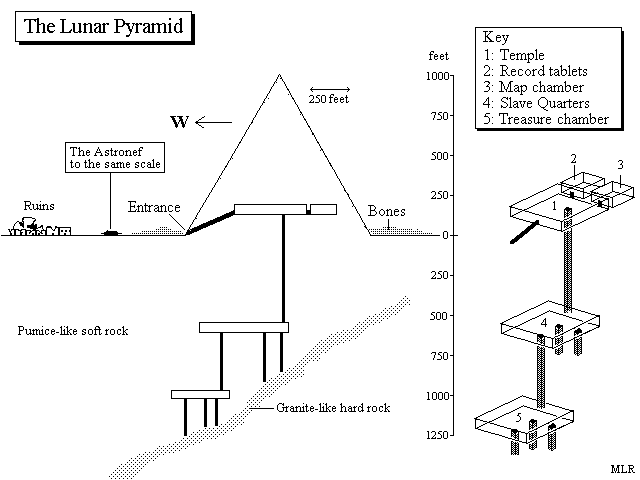
While the adventurers are exploring the town, Lord Redgrave (aided by Zaidie if present, and by anyone else who cares to help) makes a precise survey of the outside of the pyramid. It's four-sided, just over a thousand feet tall, with only one entrance in the exact middle of the base of the Western face. The entrance is about thirty feet wide and high, and is made of carefully dressed grey stone. To the limits of visibility the tunnel inside shows the same meticulous craftsmanship.
Sooner or later the party will enter the pyramid. 22_ADV2.GIF is a plan of the general structure, but the scale is too small to show many details. It is labelled with the names that Lord Redgrave will later give to its compartments. The pyramid feels bitterly cold when the adventurers leave the sunlight, but exertion and the insulation of the suits will soon compensate for the loss of heat. The tunnel slopes upwards, a 1 in 2 ramp (easy under Lunar gravity) leading to the first chamber of the pyramid.
The description of the pyramid that follows includes information that players can only determine by guesswork, deduction, and patient detective work; when describing things, leave it to the players to determine their function. For example, players might interpret the "stone tables with inset basins" described below as slaughter tables, with the basins used to collect blood. Knives and other utensils will probably be seen in the most sinister light possible. It isn't necessary for the adventurers to uncover every detail on this expedition; the pyramid will be visited again and again until all its archaeological secrets are uncovered, and will eventually become a popular tourist attraction.
The religion of this city was based on scarcity; the pyramid covers a complex of wells dug as the Moon lost its surface water. The priesthood was responsible for the supply of water to the city; in turn the city provided a workforce for the temple, and food for the priests and workers. As the Moon dried out, the quantity of water needed grew until the temple was barely supporting the population of the city. In the end the water supply failed accidentally; the chain used to haul up the workers and the water snapped, and no replacement was available - metal was also scarce. The priests had rope, but it wasn't strong enough to haul up the chain or the workers. They tried to maintain a water supply by lowering jugs on ropes, but the quantity that could be raised was tiny compared to the amount needed. Eventually the workers starved to death in the lower levels of the complex, while the priests and the city died of thirst.
All of the rooms marked on the chart are totally dark, apart from the lights the adventurers bring in. The chest lights worn by the team are directional, adequate to illuminate objects up to 30-40 ft away. They shine ahead in a cone about 60 degrees wide. This means that the nearest 10 ft or so of floor isn't illuminated, unless the wearer bends down. The design of the helmet also reduces the angle of vision considerably, while the position of the light on the chest means that adventurers who look off to one side will find that the light doesn't illuminate what they want to see, unless they twist their torso in the same direction. It's easy to trip over objects on the floor, especially since everything is covered with a layer of grey dust which softens the outline of obstacles and makes them harder to see.
All of the rooms shown on the plan have ceilings about 20 ft high, supported by dozens of stone pillars. For clarity the pillars have been omitted from the illustration.
Room 1, the "Temple", was built around and over the original well-head. It's a chamber about 350 ft square. The floor is littered with humanoid bones, many of them clad in elaborate copper and bronze regalia, inscribed with a complex pattern of wholly unintelligible markings. There are sixteen stone tables (not shown), each with a deep inset basin (carved out of the stone) and a large bronze ladle; they were formerly used for the ritual exchange of food for water, but are now, of course, completely dry, the food long since crumbled to dust. Nineteen bronze knives of various sizes and styles will be found if the floor and tables are searched; they were used to cut fruit and other foods, but players will probably suggest more sinister uses.
Directly under the apex of the pyramid is a shaft, about twenty feet square, leading down into the depths of the pyramid. A huge bronze pulley is suspended from the ceiling above the shaft, with a chain leading down into the depths and across the chamber to a massive eight-armed capstan. The capstan is stiff but can still be turned if the adventurers release a locking lever. In fact it seems to turn very easily; there is only fifty feet of chain left, ending in a broken link, and the shaft is several hundred feet deep. This can be determined by throwing a flare down the shaft. There are no obvious handholds in the rock of the shaft, but it isn't completely smooth.
Anyone trying to use climbing gear to descend the shaft will soon discover that the rock is very soft, on a par with pumice; it tends to crumble and break up as pitons take the weight of climbers. Fortunately this shouldn't be necessary; the adventurers have plenty of rope, and under Lunar gravity even several lengths tied together should be able to lift a ton or two. If anyone does try to climb and falls he is very likely to be killed.
Two archways at the back of the temple lead to smaller rooms:
Room 2, "Record Tablets", contains exactly that; thousands of slates, each marked with hundreds of cryptic symbols, stored in neat wooden racks. The slates are rationing records, lists comparing sacrifices and service to the temple, and the amount of water issued by the temple; there is a slate for each household in the city. If anything is moved the rack crumbles to dust, and the slates cascade to the floor. No other records were kept.
Room 3, "Map Chamber", is also correctly named. The North wall is decorated with an elaborate tiled mural showing the layout of the Moon as it must have been many hundreds of thousands of years ago. There are seas, rivers, and dozens of cities where now there is only airless desert. The map is centred on the pyramid, with distortion proportional to distance from the pyramid.
The South wall is an equally elaborate map of the Earth, drawn upside-down from the usual Terran maps, and is also distorted according to distance from an arbitrary starting point. The detail is no better than can be seen with the naked eye from the Moon, but there are several striking differences from modern geography; Britain is connected to the rest of Europe, and there is a small continent (or possibly a very large island) in the Atlantic between Europe and America. The land bridge suggests that the tiles were laid before the last Ice Age, the extra continent might be Atlantis. The centre of the map is a round bronze disk about four inches wide, which protrudes from the map on the coast of this continent. It's marked with engraved symbols, and is the only inscription on the map. Very patient linguistic analysis, taking several weeks, will suggest that the symbols might be vaguely similar to ancient Etruscan forms, and mean something like "Sea-gods home", more literally "Poseidonis".
Attempts to push or pull the disk won't work, but if it is turned very firmly (Difficulty 8) it will slowly unscrew. It's the top of a solid cylinder roughly 18 inches long with a triple left-hand thread. If it's unscrewed completely, and a crowbar or pickaxe handle is pushed into the hole thus revealed, a block of the wall just over 8 ft square pivots open. Behind it is a chamber containing a bronze sarcophagus, well-made but unornamented. The lid isn't locked. It holds a human skeleton; obvious differences in the size and shape of bones make it clear that they are not the remains of a Lunarian. The bones are fragile and will disintegrate if they are moved or disturbed in any way. The workmanship of the concealed door mechanism, the sarcophagus, and the screw are far superior to that seen elsewhere in the pyramid.
The East wall bears two smaller maps, one showing Mars (but with much wider oceans than exist today), the other a world which Lord Redgrave will recognise as a warmer version of Ganymede. The detail shown is extraordinary; for example, the map of Mars includes features that are only just visible with the largest Terrestrial telescope. No explanation will be found for this accuracy. Both maps have the North pole at the top, and use a mapping style similar to a Mercator projection, but differing in detail.
Players may guess some or all of the truth. This city was visited by explorers from ancient Atlantis, who were then in the process of colonising Mars and Ganymede. They befriended the natives, and created the maps of their new worlds, but realised that it was already much too late to make use of the Moon; the atmosphere and water would be exhausted in a few hundred years. While on the Moon an Atlantean died accidentally, and was buried in the temple. Many years later the Atlanteans' only graviton manufacturing plant was lost when Atlantis sank (the result of misguided experiments with concentrated G. gravitons), and the colonies subsequently lapsed into barbarism and forgot their origins.
The shaft from the temple leads down more than 600 ft to Room 4, marked as "Slave quarters" on the chart. It has been hewn through soft pumice-like rock. A crushed bronze lift cage lies below the shaft, twisted metal mingled with smashed bones and thousands of porcelain fragments, with endless yards of heavy chain on top of the wreckage, and the fragile remains of some long ropes on top of that. Apart from this wreckage the room contains thirty more skeletons, none of them wearing any regalia, and three more shafts. Two are smaller than the first, about ten feet wide and 250 ft deep, and end in a stratum of much harder rock. They are completely empty. The third is fifteen feet wide, and fitted with another windlass, pulley, and cage; this time the cage is still intact, and hangs level with the floor. The shaft is about 400 ft deep. Four or five Terrans can easily operate the windlass to lower one or two people to the depths. At these depths there is a little air, but it is much too cold to breathe, and very low in oxygen.
Room 5, the so-called "Treasure Chamber", will probably disappoint anyone who was expecting to find gems and jewels. It contains three wells, still holding a little water, each fitted with hand winches and bronze buckets. Stone tables bear neat lines of porcelain jugs, more than a thousand in all; they are empty. All are well-made and the same size (about 6.7 pints) and marked with a few symbols which correspond to those on one or another of the slates in the record chamber. Several more skeletons lie on the floor.
If you have especially mercenary players it may be necessary to remind
them that porcelain, especially of a completely unknown type, might be
valuable in its own right, and that these discoveries are an immense
advance in Lunar archaeology. If small numbers of jugs are sold on the
Terran antiques market they should raise £50-£100 (1D6+4 x £10) each.
If all of them were shipped back to Earth the sheer number would drive
the price down to a few pounds each! The bronze and copper artefacts
in the temple are also extremely valuable collectors items, worth
hundreds of pounds apiece; of course Lord Redgrave wants to give them
to the British Museum, and will be extremely annoyed if anything goes
missing.
2.7 The Spherical Heresy
return to contents
The Reverend Amos Green has waited patiently through the flight, and while the passengers have prepared to explore the Moon. He has even give the adventurers some time to get down to work. If the adventurers are enjoying their exploration of the pyramid, you may like to delay Green's intervention until they are nearly finished, and assume that Green hit his head during the flight and was deeply unconscious for two or three days.
Now Green is ready for action. He has the skill Brawling [7] and is armed with a length of lead pipe:
| Club | 1 attack, Effect BODY+1 [7], damage A:B, B:F, C:KO/K |
If an adventurer has been left aboard, in addition to Murgatroyd, take him to one side and ask him what he is doing, and where he is aboard the Astronef. Usual responses are "sitting in a deck-chair reading a book", "sleeping in my bunk", "keeping watch with binoculars", and so forth. Green's presence is initially announced by a metallic scraping noise as he slides open the hatch that covers the compartment where he is hiding. If there is an adventurer on the upper deck, Green crawls out on the other side of the bunks from him. If there is an adventurer anywhere else aboard, the noise is audible but the source isn't immediately obvious; it's loud enough to wake anyone who is asleep. Remind anyone who draws a gun that the upper deck has glass walls, and that it seems a bad idea to fire it. In fact the glass is a thick laminate of panes cemented using clear Canada balsam, a natural resin; a pistol bullet will break one or two layers, but won't shatter all the panes unless it is fired at point-blank range.
Once out of his hiding-place, Green looks for anyone left aboard. Anyone he encounters may be slightly surprised by the presence of a dishevelled maniacal pipe-wielding vicar. Green immediately attacks, using the pipe with all his strength, and will carry on fighting even if he is wounded; since there is a chance that anyone he hits will be killed, kind referees may prefer to assume that he pulls his blows just enough to cause a knock-out instead.
If Green is overcome at this stage his part in the adventure is probably over, but if he is alive there is always a chance that he will escape from wherever he is imprisoned and cause more damage. Find out exactly how the adventurers intend to keep him prisoner; the Astronef doesn't have a brig, and the only easily locked parts of the ship are the airlock, Murgatroyd's cabin (which contains tools and has a hatch which a sufficiently determined fanatic might be able to open), the lavatory and bathroom (containing some nasty photographic chemicals), and the night cabin. He might also try a little creative sabotage, such as blowing a fuse or starting a fire.
Usually Green will overpower anyone left aboard; any NPCs (such as Murgatroyd) are overcome automatically. His prisoners are pushed into the airlock (making sure that there are no breathing dresses left inside), and the inner hatch is closed and bolted shut. Once this is done Green returns to the upper deck, equips himself with a pad of paper and a soft crayon, and waits for the adventurers to return.
Green believes that the Earth is flat, and that Lord Redgrave is fully aware of "the truth" but has been faking evidence of the Earth's roundness. Certainly the Earth looks round from the Astronef, but that's because the Sun is only illuminating a small portion of the surface of a flat world. Spotlights cast round beams, why shouldn't the Sun? Green wants to make Lord Redgrave admit that he lied in front of witnesses; once that is done he will readily surrender. Since he isn't a fool, he wants the confession in writing, and he wants to make completely sure that Redgrave can't get at him first. One or more innocents trapped in the airlock should make Redgrave give in to reason.
As soon as anyone approaches the Astronef, Green uses a shaving mirror to reflect light into his eyes to attract his attention, then holds up his first sign "I have locked Murgatroyd [and anyone else he has caught] in the airlock without breathing dress. Do not try to use it. Get Lord Redgrave!"
Once Redgrave has arrived, or someone pretends that he is Lord Redgrave, Green holds up another sign. "The Earth Is Flat. Admit your part in the Great Lie, and I will let you back inside."
Negotiations can last as long as you like; Green isn't in any hurry, and isn't willing to settle for anything less than an abject confession of guilt. Lord Redgrave is carrying the pad and pencil he used to record details of the pyramid, and everyone should be carrying small blackboards, so it should be easy to reply. Green is perfectly willing to explain his ideas, and the referee may wish to quote arguments in favour of the idea that the Earth is flat. They are summarised in the appendix, section 2.A below.
There are three main possibilities for ending the "siege":
Smashing the glass won't be easy. It will take a pickaxe blow to break it, and the remains of the pane will then explode outwards with great force:
| Exploding window | Radius 4 ft, Effect 12, damage A:F, B:I, C:C/K |
Remember that any wound is made worse by vacuum.
A less dangerous way of getting inside is to put two or three of Lord Redgrave's photographic flares against the glass, break the tubes, and stand well back. The sudden heat will crack the pane; explosive decompression still occurs, but this allows a few moments to get clear of the flying glass.
If the broken glass is removed completely, and the outer shutter is closed and caulked with putty then tar, it will hold air, allowing the entire ship to be brought back up to partial pressure for the return flight. The repair won't be completely successful; air will continue to leak out, reducing endurance to 24 hours. Alternatively the upper deck can be shut off from the rest of the ship by closing two airtight doors; this leaves everyone crammed into the lower deck but endurance is better.
Any attempt to make a smaller hole (for example, by using a pickaxe to knock a hole in the steel hull) must get past armour plate and several layers of insulation, tar, and wood. The attack will be countered by Green, who will have ample time to put a putty patch over the hole.
For fairly obvious reasons Lord Redgrave will regard any of these solutions as a last resort. In the long term they make Green into a martyr, and hundreds of people will eventually flock to this irrational cause.
The disadvantage of this idea is that Lord Redgrave is very much a man of his word, and is not eager to sign such a farrago of nonsense. If he is somehow persuaded to sign it, he will keep to the exact letter of the agreement; the statement will appear in 12 newspapers, accompanied by a disclaimer stating that it was signed under duress, and explaining the exact circumstances; Lord Redgrave will publish no more atlases, but will supply free aerial photographs to any publisher who wishes to use them; and he will bring dozens of civil charges against Green and his fellow cultists, and encourage everyone else on the expedition to follow suit at his expense. Ultimately Green and his followers will be totally discredited, but it will be a long and complicated process. Anyone who suggests an alternative will earn Lord Redgrave's gratitude.
If this happens Green dictates the same confession, and the fake signs it. Once the adventurers are aboard they can capture Green and do what they like; he will submit peacefully so long as they pretend that he really has Lord Redgrave's confession, but will try to escape and sabotage the ship if he learns the truth. Once back on Earth he can be discredited completely, and treated as a criminal lunatic who was taken in by a deception that a child could spot. Lord Redgrave will be very happy with this solution, but won't think of it for himself.
It is unlikely that the adventurers can come up with an alternative plan that stands a chance of working. Green isn't a fool; he's a fanatic, and won't easily be conned in any other way. Attempts to persuade him that he is mistaken should be very difficult indeed. Appeals to reason will certainly fail, but theological arguments, or a suggestion that his attitude is unchristian, might possibly succeed. This should not be determined by a dice roll, but by sustained argument and convincing role playing.
Once Green has been dealt with the adventurers may be in a hurry to
return to Earth, especially if the Astronef is leaking like a sieve,
or may want to spend more time on the Moon. To avoid an anticlimax you
may prefer to get the adventurers back to Earth quickly; one
possibility, especially if Green has been tricked, is a suggestion
(which may even be correct) that he might have planted a bomb
somewhere aboard the Astronef.
2.8 Rewards
return to contents
The most likely reward for this adventure is scientific acclaim. Lord Redgrave is already immensely popular, and is about to be awarded the Nobel prize for Physics; he is quite happy to share the glory of this expedition with his fellow-explorers.
Award bonus points for the following achievements:
Do not award bonus points for killing Green; this is the worse possible outcome to this problem.
If any of the adventurers already work for Lord Redgrave (as suggested in the first adventure), this is possibly a good moment to start training them for a career in space.
If the expedition was successful, anyone who already has the Pilot skill and wishes to receive full flight training for space can have it for the asking; Lord Redgrave will be delighted to pay their expenses if they do not work for him. Bonus points can also be spent to improve the skill if desired, using the normal dice rolls. Anyone who does not have this skill, but has the necessary bonus points and wants to acquire it, can spend six months or so attempting to learn to fly.
If the expedition was a fiasco Lord Redgrave will not be happy. He's not going to hold unjust grudges, but anyone who has earned his displeasure may live to regret it. He can make it difficult or impossible to earn a living in space. That won't stop characters who are independently wealthy, but it can certainly slow anyone else.
Finally, their experiences on the Moon may have given the adventurers
some ideas on improvements to Lord Redgrave's breathing dress. They
might patent them, or simply tell Lord Redgrave and hope that he'll
remember the favour.
2.9 Further Adventures
return to contents
Was Green really just a lone fanatic, or was he working for powerful interests who want to see space travel discredited? Just how did he get aboard - is there a traitor somewhere in Lord Redgrave's company? It's up to you to decide.
Evidence that Atlantis existed should be the cue for a rush to explore the bed of the Atlantic. Accurate copies of the Lunar map should be worth a good deal in the right hands. And just what was Poseidonis? A city? A graviton factory? Or something completely different and alien? The exact size and location of Atlantis has purposefully been left vague; find a reasonably large map and decide where you want to put it. One hint: an extremely nice map was provided in early editions of Chaosium's Call of Cthulhu RPG, and it's worth remembering that some of the nastier monsters of that particular mythos are reputed to live in the sea...
The pyramid is huge, the volume inside it occupied by its chambers is
relatively small. One secret chamber has been found. Is there more to
it, a secret network of corridors and chambers that hasn't yet been
discovered? Is it the only significant archaeological site on the
Moon? There's plenty of scope for further investigation.
2.A Appendix: The Flat Earth
return to contents
The idea of the Flat Earth was widely held by primitive societies, but disproved reasonably conclusively by the ancient Greeks. For some reason the early Christians found the idea of a spherical earth repugnant, and for many centuries the idea was considered heretical. Early astronomers rediscovered the Greek proofs, and added more evidence. Eventually the idea became accepted scientific fact, and the Flat Earth was discarded as a mistaken theory. Naturally it soon attracted a moderately large following. The idea seems to have been at its most popular in the later Victorian years, when there were Flat Earth societies in most nations. Its popularity waned as balloons, aircraft, and rockets proved that the world was indeed a sphere, but it has never entirely died out.
Briefly, the main premises of the Flat Earth theory are as follows:
Religious
Logical
Counter-Arguments
Q: It's possible to see ships disappear over the horizon: doesn't that prove that the surface is curved?
Q: How do you explain the fact that ships have sailed around the world?
Q: Experiments on large flat bodies of water, such as long stretches of a canal, have shown that the surface curves to match the idea of a spherical world. How can your theory be correct?
Q: If you point a camera at the sky and leave the shutter open, the motion of the Earth shows each star as a line. Doesn't this prove that the Earth rotates.
Q: Space travellers aboard the Astronef have seen the Earth as a sphere; aviators and balloonists have seen the surface as curved. How do you explain that?
The summary above incorporates ideas from several different versions
of this theory, all sharing the same ideas but differing in details
such as the location of the Poles, the nature of the Sun and Moon
(usually extremely small and a few thousand miles above the Earth),
the movements of the stars, and so forth.
3.0 Adventure 3: The Wright Stuff
return to contents
September 1904. By now adventurers with the Pilot skill automatically know how to fly spacecraft. Characters may own ships, but they are very expensive (multiply construction costs by 4 for a small spacecraft, by 3 for a large design). Some equipment, such as Tesla-Westinghouse engines, is not yet available. The nova Lilla-Zaidie is nearing Jupiter, and is brighter than any planet in the sky.
On December 17th 1903 bicycle manufacturers Wilbur and Orville Wright first flew their powered aircraft Flyer I. In another world this might have attracted attention; in this one, which has already seen several flights to the Moon, their experiments have gone virtually unnoticed. Nine months later they have set up a flying competition near Dayton, Ohio, which is attracting considerably more attention.
The adventurers are people who might have some reason to be interested in the competition; journalists, cameramen (the first proper newsreels have yet to be made, but there is already great interest in footage of unusual events), sportsmen, gamblers, inventors, hired pilots, investors, hot dog vendors, security guards, or the idle rich.
Unlike the other adventures in this collection, The Wright Stuff
outlines some events that happen in and around Dayton, Ohio, during
the week of the competition, describes some NPCs, and leaves players
free to do as much, or as little, as they like. There is no plot, in
the sense of an all-encompassing scheme of events, but there are a few
running jokes and subplots.
3.1 Players' Information
return to contents
"I see, sir, that there is to be a flying competition in this area next week."
My man Jeeves is an amazing chap. Put him down on a desert island, and within hours he'd know what was going on for hundreds of miles around. There we were, riding a train through the depths of Ohio, of all places, and he was right on top of things. "How the deuce do you know that, Jeeves? Been eating fish again?"
"No, sir, it's in this newspaper." He held the thing up. It was the usual type of rag you see in these out-of-the-way places; pictures of burning haystacks and outlaws, advertisements for patent medicine, circuses, lynchings, and so on. "There, sir." He pointed at the headline, which didn't mean much to me.
"'WRIGHT BROTHERS CHALLENGE THE WORLD', is that what you mean?"
"Yes, sir. The Wright brothers have built a so-called aeroplane, a glider propelled by an internal combustion engine. I believe that it utilises Bernoulli's principle to fly."
"What, not the jolly old R. force, or those levitating magnetic carriages they use on Ganymede?"
"No, sir. It's more like the machines designed by Da Vinci, I believe."
"The artist chap?"
"The same, sir. He was also an engineer."
"A real Renaissance man."
"I believe that the phrase may have been coined to describe him, sir. To return to the Wright brothers, apparently the machine they have designed is considerably cheaper than other systems. Now they are claiming that it has other advantages, and are offering a thousand dollars to anyone whose flying machine can beat theirs around an obstacle course. The competition is apparently intended to attract investors."
"Anyone taking them up on it?"
"Lord Redgrave, also Monsieur Santos-Dumont, Professor Tesla, and Mister Edison. And others the newspaper doesn't name."
"Hmm, sounds fun. Might be a few bob in it if we back the right horse, so to speak, someone's bound to be running a book. I say... Aunt Agatha isn't expecting to see us back in New York for a couple of weeks. We'll stop off for a few days!"
"I have already taken the liberty of reserving rooms, sir."
Yes, no doubt about it; an absolutely amazing chap.
3.2 Referee's Summary
return to contents
As well as conquering space, the R. force seems to herald the true dawn of the air age. Unfortunately there are snags; while R. force craft are strong, reliable, and reasonably manoeuvrable, they are also extremely expensive, and currently the smallest ship costs about half a million pounds ($2.5 million). It might eventually be possible to build a cheap simplified flyer for use in the air, but for the moment all R. matter and R. graviton production is committed to larger projects, such as warships and the exploration of space.
Airships are the only tested rivals, but they are unlikely to succeed. They are expensive, big, dangerous, and handle poorly. Liners and freighters would cost nearly as much as R. force machines, smaller vehicles are impractical. Santos-Dumont has built a series of one-man hydrogen dirigibles, but they are very bulky; since a cubic yard of hydrogen lifts about two pounds, and the gas bag and engines add weight, even a one-man machine must be huge. His machines have a top speed of ten to fifteen miles an hour.
A few Ganymedan magnetic flyer engines were imported by Lord Redgrave's last expedition. The public expects to see flyers on sale soon, but Redgrave (and his associates Tesla and Westinghouse) have run into problems. The engines were designed for low gravity and Ganymede's strong magnetic field, and are dangerously unstable on Earth. Tesla's prototype flyer crashed during its first test flight, killing the pilot. It's impossible to think of selling them until the problems are solved. Recently Edison announced that he also intends to build flyers, but claims that he'll be able to develop the engines on Earth. He's raised nearly a million dollars on the strength of this announcement, but most experts are very sceptical.
Winged aircraft hold out the promise of cheapness; as yet their other qualities are unknown. At the moment they are still in their infancy; the Wright brothers have only flown their aircraft in straight lines and gentle curves. With the R. force available, their work has gone virtually unnoticed and is starved of investors.
In an attempt to gain publicity and attract investors, they persuaded a local newspaper to put up most of a thousand dollar prize for the fastest flight around a cunningly designed obstacle course. There have been several responses; Lord Redgrave has entered the Astronef, Nikola Tesla and Edison have entered their flyers, Santos-Dumont is bringing an airship, and more inventors are expected to sign up before the competition begins.
With just over a week to go none of the entrants feel especially confident, least of all the Wright brothers, but hotels and boarding houses in Dayton are filled to capacity and the town is bustling.
Essential sources for this adventure are the films The Right Stuff,
The Great Race, Those Magnificent Men In Their Flying Machines, and
the cartoon series Wacky Races. Unfortunately the (British) author has
not been able to obtain plans of the Wright Cycle Company's buildings
or grounds; the illustrations provided for this adventure are entirely
imaginary, and referees are advised to substitute more accurate detail
if they can find it. Similarly, the account of life in the city of
Dayton is derived from very limited information, and all newspapers,
agencies, hotels, etc. mentioned are fictional.
3.3 The Rules
return to contents
Referees may wish to print out 24_ADV2.GIF and this announcement:
In order to stimulate development of airborne travel on Earth, and to encourage construction of small craft which might be suitable for the needs of the mails, agriculture, and private transport, The Dayton Gazette and The Wright Cycle Co., builders of the first workable powered aeroplane, hereby jointly offer a prize of $1000 for any aircraft which can complete a ten-mile circuit in a better time than the Wright brothers' machine. The competition will be adjudicated by the Mayor of Dayton and the Governor of Ohio.
   Wilbur Wright                            J. Gregory
   Orville Wright                           Editor
    for The Wright Cycle Co.                 for The Dayton Gazette
The course has been laid out over rough meadow land near the Wright Cycle Company workshops (23_ADV2.GIF, 24_ADV2.GIF). A starting catapult is available, and can be used to launch aircraft that need it. It uses a heavy weight dropped from a tower and a system of pulleys to accelerate aircraft to about 30 MPH, depending on their weight; heavy aircraft will be slower, lighter ones faster. It is some way behind the starting line, to allow aircraft to build up speed. The timer is started as the nose of the aircraft crosses the starting line.
The first half of the course requires the aircraft to make a 90 degree right turn, then three 180 degree turns (left, right, left) around posts, avoiding trees, fences, and natural obstacles. After another 90 degree left turn the aircraft must fly under a rope suspended fifty feet above the field then over another rope suspended 30 ft above the field. Finally, it must make another 90 degree left turn before crossing the finishing line.
All entrants can visit the course and practise before the competition.
Equipment, such as special launching ramps or runways, can be erected
to the East of the course, provided that it is no nearer the course
than the existing launching catapult.
3.4 The Contenders
return to contents
There are six NPC entries, whose number may of course be swollen by adventurers. They are the Wright brothers, Lord Redgrave, Professor Nikola Tesla, Thomas Alva Edison, Alberto Santos-Dumont, and Dr. Ignatius Witherspoon (a showman, proprietor of Dr. Witherspoon's Amazing Electric Theatre And Medicine Show). Each is described by game statistics, the nature of the aircraft entered, and reactions to the other entrants once they have met.
The Wright brothers will use the Flyer II, a successor to the aircraft that flew at Kitty Hawk. It has BODY 10, flies at about 55 MPH, and has ample endurance for the course. Manoeuvrability is good; each 90 degree turn will be Difficulty 4, the 180 degree turns will be Difficulty 6, vertical manoeuvres are Difficulty 4. Under ideal conditions and with no failed rolls it will complete the course in 11 minutes. Any failure results in the loss of 15 seconds and a drop of 3D6 feet; if it hits the ground it crashes with Effect 2D6. A poor image of this aircraft is included in 23_ADV2.GIF; referees are strongly advised to obtain a better picture, or one of the many model kits of this aircraft.
The brothers react to Lord Redgrave and Edison with great respect, to Tesla and Santos-Dumont with some respect, and to Dr. Ignatius Witherspoon with no respect at all; they feel that his antics put the competition into disrepute, but unfortunately that isn't mentioned in the rules as a reason to disqualify him. Any additional entrants will be treated on their merits.
Wilbur Wright, Inventor & Aviator, age 37
BODY [2], MIND [6], SOUL [3], Mechanic [8], Pilot [8], Scientist [7]
Equipment: Light engineering workshops, tools, etc.
Quote: "Hmm... maybe we should tighten that stay a little"
Orville Wright, Inventor & Aviator, age 33
BODY [6], MIND [5], SOUL [4], Athlete (Cyclist) [8], Mechanic [8],
Pilot [7], Scientist [6]
Equipment: Light engineering workshops, tools, etc.
Quote: "Another quarter-inch, perhaps."
Notes: The Wright brothers are the pioneers of powered aerodynamic
flight; having spent years experimenting with gliders, developing
engines powerful enough to keep an aircraft aloft, and devising the
first wind tunnels and ailerons, they were not about to let a minor
development like anti-gravity stop them from proving the importance of
their work. They are the sons of a minister and never drink, smoke, or
swear; both are unmarried.
Lord Redgrave has entered with the Astronef. Superficially it seems obvious that he will win, but a spaceship isn't necessarily the best craft for the course laid out by the Wright brothers. In particular, its turning circle is very wide, especially at high speed. Maximum speed is in excess of 100 MPH, but at low altitude the 90 degree turns are Difficulty 5, the 180 degree turns are Difficulty 8, with Difficulty rising to 8 and 12 at speeds above 60 MPH. Any failure means that the turn is too wide, and the Astronef ends up in the trees or off course for the next flag, making the next manoeuvre +1 to +3 Difficulty. The precise height changes required are also Difficulty 8; the Astronef is much happier rising thirty miles than thirty feet! The Astronef is more than 25 ft tall from its keel to the top of its conning tower, and the airscrews protrude 4 ft below the keel when extended. This leaves only 11 ft clearance when the Astronef flies under the first rope. If all goes perfectly it will average about 70 MPH and complete the course in 9 minutes; each failure adds 30 seconds. A mistake in a vertical manoeuvre (but not a course change) will result in a drop or a rise of 2D6 feet, whichever is most inconvenient; if it hits the ground the airscrews will splinter, but the Astronef is too massive to take any other damage. Murgatroyd can repair the screws overnight.
Lord Redgrave reacts to the Wright Brothers with respect, and Tesla is, of course, an old friend and colleague. He is in a difficult situation with Edison; he respects his work, but is also sensitive to the feelings of his wife and Tesla, who both dislike Edison. He thinks that Santos-Dumont is misguided, and regards Witherspoon as a bad joke.
Tesla reacts to the Wright Brothers and Lord Redgrave with respect, although he feels that Redgrave has put him into an awkward situation by entering the Astronef. He dislikes Edison, and goes out of his way to avoid him. He stays away from Santos-Dumont's camp, since his equipment includes several spherical gas tanks and ballonets, but gets on well with him personally, since they have many friends in common in Europe. He finds Witherspoon very entertaining, especially when he produces doves and pigeons, and will eventually devise some wonderful electrical conjuring tricks for him.
Nikola Tesla, Genius, age 48
BODY [3], MIND [7], SOUL [5], Babbage Engine [8], Business [5],
Linguist [8] (Croatian, English, German, French, Italian), Mechanic
[8], Ride [5], Scientist [10]
Equipment: Slide rule, pad, technical drawing instruments, assorted
small gadgets. Accompanied by 3 mechanics, a pilot, and a wagon-load
of supplies and equipment.
Quote: "Edison? A competent inventor. Marconi? A thief who steals
ideas from his betters. Tesla? Alas, I am too modest for my own
good..."
Notes: Tesla is a genius, but he has an odd personality. Extremely
odd. He is an obsessive paranoid, terrified of dirt, afraid to shake
hands or touch human hair. He fears all spherical objects and wipes
his cutlery with eighteen linen napkins before eating, but loves
pigeons and will feed them even when he can't afford to feed himself.
His patents include most of the fundamental ideas in AC power
transmission, some of the basic ideas behind radio, and versions of
the transistor and the AND computer circuit; he will later claim to
have developed robots, death rays, and broadcast power. He can do
almost anything with electricity, creating ball lightning and twenty
foot sparks and catching them in his bare hands. He is a friend to
many notables including Mark Twain and Paderewski, and a bitter rival
of Edison; see Appendix 3.A for the reasons.
Edison's entry is a surprise; everyone has expected a magnetic flyer, but he produces a version of a Martian airship (see 16_AIRSP.GIF), modified for Terrestrial conditions. It's smaller than the Astronef and has a single broad helical propeller, not the multiple screws of the Martian machines. The engine burns an explosive mixture of kerosene and nitric acid, producing gas which is ducted up to vents around the screw, making it spin. It has a crew of 3, all trained as Pilot [4]; one steers the aircraft, the others control the engine. Again, adventurers might be hired for these positions. Unfortunately Edison hasn't thought of adding a stabilising rotor (the small airscrew seen on the tail of most helicopters). The machine has BODY [12]; left-hand turns are Difficulty 5, right-hand turns are Difficulty 8, and altitude changes are Difficulty 6. If any roll is failed, the entire aircraft starts to spin, loses 2D6 ft altitude and 30 seconds, and crashes with Effect 2D6 if it hits the ground. It flies at 25 MPH, and will complete the course in 24 minutes if all goes perfectly.
Edison reacts to the Wright Brothers and Lord Redgrave with respect, and is puzzled by Redgrave's stand-offish attitude. His agents may have resorted to industrial espionage (see the Worldbook), but it was a long time ago, and business is business. He regards Tesla as his most formidable commercial rival; the Wright Flyer and Santos-Dumont's airship don't really have much hope of succeeding as commercial transport, while the Astronef is undoubtedly a superb spaceship, but you wouldn't want to use it to fly mail or to dust crops. There is also a long history of conflict between him and Tesla (see the Worldbook and Appendix 3.A below). He is indifferent to Santos-Dumont, and dislikes Witherspoon.
Thomas Alva Edison, Inventor and Industrialist, age 57
BODY [4], MIND [6], SOUL [3], Business [8], Drive [5], Mechanic [10],
Morse Code [8] (see Adventure 2), Ride [5], Scientist [8]
Equipment: Notebook. accompanied by two secretaries with portable
phonograph dictating machine, camping equipment (including tents, bunk
beds, field kitchen, cook), telegraph equipment, and work crew of 15
mechanics.
Quote: "Yes, but is it practical...?"
Notes: Edison is the greatest practical inventor of the 19th and early
20th century. Beginning as a telegrapher, he soon invented the stock
market ticker-tape machine, waxed paper, and the mimeograph, founded
the first modern industrial research team, and went on to invent the
phonograph and improvements to the telephone, amongst many other
devices. He is best known, of course, for the development of the first
practical electric light and (more accurately, and more importantly) for designing usable
power transmission systems to go with it. Other inventions include the
first fully functional cine camera, and discovery of the "Edison
effect", later the basis of all electrical valves (vacuum tubes).
Edison is impatient with theorists, always wanting practical results.
He is almost completely deaf.
Alberto Santos-Dumont will fly his best airship, a majestic petrol-driven seventy-footer which has BODY [20] and flies at a stately 16 MPH. All manoeuvres are Difficulty 7, but since the wind across the field occasionally gusts at 15 MPH this is the least of his problems. Incidentally, this airship is 30 ft from keel to the top of the gasbag, and wobbles up and down erratically as it flies. Failed manoeuvres result in the airship flying or blowing off course in a random direction, losing 2D6 minutes, or crashing with effect 1D6 if it is close to the ground. Don't bother to work out timings for its flights; it will never get round the course in less than an hour.
Santos-Dumont respects the Wright Brothers, but feels that they are too stiff and self-righteous, and resents their ban on alcohol on the field. He likes everyone else, and loudly applauds Dr. Witherspoon's conjuring tricks. He doesn't expect to win, he's here for the sport.
Alberto Santos-Dumont, Brazilian Aviator, age 31
BODY [5], MIND [4], SOUL [6], Athlete (Break fall) [8], Drive [7],
Linguist (Spanish, French, English) [5], Mechanic [6], Pilot [6],
Ride [7], Scientist [6]
Equipment: Crew of 4, wagon of supplies including a chemical plant for
the production of hydrogen and some very large "No Smoking" signs,
which Santos-Dumont usually ignores.
Quote: "Oh, do not fret, eet ees safe - I theenk...."
Notes: Santos-Dumont is one of the oddest and most flamboyant figures
of aviation. He built the first successful powered airships, all of
them extremely small and barely airworthy, and was the first aviator
to fly one around the Eiffel Tower in 1901. He thinks nothing of
flying across Paris for lunch, leaving his craft tethered to a
lamp-post while he eats. His craft are suicidally unsafe; fortunately
they usually fly too low to do much damage when they crash. He is a
pacifist; in the real world he committed suicide to protest against
the military use of aircraft. His native language is Portuguese.
Doctor Ignatius Witherspoon doesn't have a working aircraft; his entry is a publicity stunt. He intends to "fly" three different designs, each aimed for maximum visual appeal, and described at various points below. He makes all three attempts in his conjuror's outfit, top hat and tails, and produces coins, playing cards, bunches of flowers, flags, and doves at every possible opportunity. His "ground crew" includes a few stage-hands, his assistant the lovely Penny Pretty (Mrs. Zelda Witherspoon) with performing pigeons, a mountain lion on a leash, and a small but reasonably competent brass band. If you use music to set the scene, try the "Professor Fate" theme from The Great Race whenever he appears, a dramatic roll on the snare drums whenever he is about to take off, and a dull thud when he 'lands'.
Witherspoon doesn't take the competition seriously, except as a publicity stunt, and certainly isn't up to the intellectual level of his fellow-competitors (his mail-order diploma from the University of Wagga-Wagga, Australia, describes him as a doctor of philosophy). He respects their achievements, and tries to ignore any discourtesy.
If you are using this adventure in a campaign with horror elements, Witherspoon should be a sinister figure, possibly possessed of real occult powers; the competition entries, and the performance that goes with them, should be a dark mockery of Man's dream of flight. No two characters should agree on Witherspoon's appearance. Why is the circus in Dayton, and why has he entered the competition? It's up to you to decide. His circus should be frightening; the freak show includes deliberately mutilated cripples, the animals are thin and show obvious signs of cruelty, the clowns are terrified of the ringmaster, and the fairground is large, dark, and full of pickpockets and cut-throats. The performance itself should include some element of the sinister or bizarre; for example, someone might really disappear during the magic act, the cowboy act might incorporate sadistic use of a whip, and so forth. Chase someone through the Mirror Maze or the Tunnel of Love. Recommended sources for this variant are Charles Finney's 'The Circus of Doctor Lao', Ray Bradbury's 'The October Country', and the films 'Freaks', 'Cabaret', and 'High Plains Drifter'.
Dr. Ignatius Witherspoon (Alias Doctor Midnight & Wild Bill Pecos),
Showman, age 42
BODY [5], MIND [4], SOUL [5], Actor (conjuror, juggler) [7], Athlete
(Break fall) [9], Brawling [6], First Aid [5], Marksman [7], Mechanic
[5], Melee Weapons [6], Psychology (fortune telling) [6], Riding [7]
Equipment: The resources of a small travelling circus.
Quote: "You will marvel, sir, as, before your very eyes..."
Notes: Dr. Witherspoon runs a small travelling show which tours Ohio
and the neighbouring States, and performs as ringmaster, as conjuror,
and in a cowboy riding and marksmanship act. He has entered the
competition as a publicity stunt.
Adventurers may wish to enter their own machines. If so, tell them
that they have had roughly three months warning of the competition,
and allow them to specify anything that's reasonable for the period
and circumstances described in the Worldbook. Steam, petrol, and
electrically powered flying machines, or R. force spaceships, are
possible; small R. force flyers haven't been developed, and Lord
Redgrave and his associates still have a monopoly on Ganymedan
magnetic engines. Materials technology isn't yet up to the
construction of jet engines, microlight aircraft designs, or
helicopters, except for the inefficient prototypes described above,
but don't give players this information until they try to fly them and
things start falling apart. Decide which of the above designs their
machines most resemble, and determine the Difficulty of manoeuvres
accordingly. Remember that the Wright brothers are by far the most
experienced aviators and aeronautical engineers in the world, and have
the best aero-engines; any rival winged aircraft will be no better
than the Flyer II, and probably a good deal worse.
3.5 Dayton Days
return to contents
Settled in 1796, Dayton is a city in southwestern Ohio, on the junctions of the Great Miami, Stillwater, and Mad rivers. It grew with the opening of the first section of the Miami and Erie Canal in 1829, and with the arrival of railways (railroads) in the 1850s. During the Civil War industries boomed. In 1904 it's a prosperous city, a transport nexus and a centre for light and heavy industry. The townsmen take great pride in their new electric power plants, and see the Wright brothers' experiments as further proof of Dayton's progress.
There are several hotels in the town, their quality ranging from good to awful. All are crowded with visitors eager to see the fun, and by the Friday before the competition there will be no vacancies without a reservation. Unless players have other plans, assume that they are staying in the Hotel Ohio, a luxurious new building with indoor plumbing and bathrooms, a restaurant, and electric lights in most rooms. Tesla, Redgrave, and Santos-Dumont will stay here; Edison will "camp out" in a tent (with all conveniences) near the course, the Wright Brothers have their own home, and Doctor Witherspoon stays with the circus.
Most events in the town are irrelevant to the competition, but referees should try to remember that these events are not happening in a vacuum; people are born or die, factories open or close, buildings catch fire, and so forth. Crimes are committed, some are solved while others remain mysteries. Players may optionally take the place of NPCs in some of the situations described; for example, an adventurer who is a photographer might be responsible for the fire at the Hotel Ohio and some other incidents described below, or a gambling character might start to take bets on the competition. The competition also offers some interesting business opportunities; for example, souvenirs of the event, books and photographs, and fast food sales.
           September 1904
  Sun  Mon  Tue  Wed  Thu  Fri  Sat
   -    -    -    -    1    2    3
   4    5    6    7    8    9   10
  11   12   13   14   15   16   17
  18   19   20   21   22   23   24
  25   26   27   28   29   30    -
1st-6th September
The month begins with Labor Day, already an important public holiday respected by most employers. Visitors to the town can easily participate in Labor Day picnics and other events. Although the competition isn't beginning until the 13th, and none of the visiting NPC competitors have arrived, speculation is already running high. Several well-known professional gamblers are in town, and have started to take bets; all are offering the same odds:
| Entrant | Odds | Winning $100 bet pays |
| Wright brothers | 3-2 | $150 |
| Lord Redgrave | Even | $100 |
| Edison | 2-1 on | $ 50 |
| Tesla | 2-1 | $200 |
| Santos-Dumont | 5-2 | $250 |
| Dr. Witherspoon | 4-1 | $400 |
In other words, $100 bet on the Wright brothers makes a profit of $150 if they win; since Edison is odds-on to win, a winning $100 bet would only pay back the stake plus $50.
The only bookies in the town who are prepared to take really large bets are "Gentleman Jack" Grofield of Chicago, Wallace Hoskins of New York, and Al Lipsky of Detroit. In gambling circles all are known as reasonably prosperous and 'honest' men, who are unlikely to take the money and run if they are faced with the prospect of an exceptionally large loss, or if someone bets more money than they have ever seen before. These reputations are not entirely correct; Lipsky is totally unscrupulous, and plans to 'fix' the competition. If adventurers bet heavily they will become involved in this plan.
Set odds for player entries according to the 'plausibility' of the character and machine; a well-known scientist entering an aircraft that seems to stand a chance will attract low odds, a crackpot with a 'weird science special', or whose entry is based on harnessing a large number of swans, attracts high odds.
There may also be betting on the best time for a given day, the best time for each machine, and so forth; details are left to the referee.
Out at the bicycle factory Orville Wright gives the Flyer II a test flight; it performs perfectly, easily making 90 degree and 180 degree turns at an average speed of 45 MPH, but lands badly, breaking one of its skids. Naturally there are dozens of onlookers at the field, and afterwards the odds on the Wright brothers shift to evens.
Wednesday 7th September
During the afternoon posters start to appear on every conceivable surface in the town, advertising "Dr. Witherspoon's Amazing Electric Circus And Menagerie, The Toast Of London, Paris, & New York", which will open tomorrow for two weeks with performances nightly at 6.00pm & 8.30pm (not Sunday), and a Saturday matinee at 3.00 pm. Any residents of London, Paris, or New York who might be present will fail to remember the circus. A strip of paper gummed diagonally across the main advertisement reads "See Our Entry In The Great Aviation Competition"
Attractions advertised include Miss Penny Pretty And Her Performing Pigeons, Miss Melody Chime (a singer and juggler), Professor Midnight (Witherspoon with a false moustache performing as a magician), The Amazing Rudolfo (a tightrope act), Wild Bill Pecos (Witherspoon with a fake beard dressed as a cowboy and performing a shooting and knife-throwing act), Kinematographic Motion Pictures On Screen With Phonographic Accompaniment, Magic Lantern Views Of The Moon And Planets, various animals, and clowns. Admission is 25 cents for adults, 10 cents for children, with a freak show (for men only) costing an extra 10 cents.
In the early evening Santos-Dumont arrives in town by train, his assistants unloading wagons of equipment from a cargo flatcar. A small crowd gathers to watch as the wagons navigate the streets and set off for the Wright brothers' factory. They set up camp in a neighbouring field, while Santos-Dumont returns to town and books in at the Hotel Ohio. Several journalists compete to interview him; naturally he claims to be supremely confident, sure that his airship will see off the competition; in fact he's already guessed that he won't win, but that won't stop him trying.
During the interview a photographer from the New York Times accidentally sets fire to a curtain with his flash powder; in the ensuing confusion a small lounge in the hotel is badly damaged. Several steam-pumped horse-drawn fire engines arrive to deal with the blaze, and the photographer spends the night in the local jail on arson charges. In the morning he will be acquitted of arson but found guilty of reckless endangerment, and fined $25.
Other events of the day include a band concert in the park at noon, a Shakespearean recital and lecture at the local high school in the evening, and a short thunderstorm during the night.
Thursday 8th September
At 6am everyone who isn't already awake is blasted out of bed by the arrival of Dr. Witherspoon's circus, brass band to the fore, which passes right by the hotel on its way through town, and eventually sets up camp in a convenient field on the outskirts of the city.
By mid-afternoon the tents are erected, and the circus side-shows are open for business. The circus consists of a large main tent, a smaller tent for the freak show, a dozen gambling booths, a fortune-teller (Witherspoon in a variation of his Dr. Midnight costume), a .22 shooting gallery whose prizes include plaster dogs, goldfish, and gilt-framed mirrors, and a row of cage wagons containing an assortment of reasonably healthy animals and birds.
One of the booths (admission 5 cents) houses Witherspoon's first flying machine. It's an ornithopter, a modified moto-cycle (bicycle with a low-power motorcycle engine bolted on) with flapping wings driven by a belt drive from the motor. A good look at it should convince rivals that he doesn't stand any chance of winning.
Adventurers who insist on seeing something sinister in every event will undoubtedly be delighted to notice that the rifles in the shooting gallery have deliberately twisted sights, and that most of the gambling games are rigged to pay minimal prizes. That apart, there doesn't seem to be anything too peculiar about the fairground. One of the circus roustabouts peddles "hot tips" on the flying competition; the odds he gives are essentially those above, except that Edison is at evens, and Dr. Witherspoon is at 2-1. He isn't taking bets, and charges 10 cents per crudely-printed form sheet.
The freak show contains all the usual "attractions" of the era; a fake mermaid, a "Baby Saturnian sea serpent" (actually a genuine live two-headed dice snake) in a glass tank, twin dwarves, a bearded lady, a double-jointed "rubber man", a "Venusian monkey" (an indignant lemur with fake wings carefully knotted into its back fur), and a snake charmer whose "venomous cobra" is recognisable as a small and timid python, its hood made of leather and glued on with spirit gum.
Witherspoon appears several times in the evening performance; as ringmaster, as Professor Midnight, and as Wild Bill Pecos, and as announcer for the films and magic lantern show that ends the performance. His wife also has multiple roles; a pigeon act, assistant in the magic act and (dressed as a squaw) in the cowboy act. Miss Melody Chime sings as she juggles, The Amazing Rudolfo walks the tightrope and rides across it on a bicycle, and reappears as Samson the Strong Man. The dwarves from the freak show join some of the circus roustabouts as clowns.
The 'Kinematographic Motion Pictures' are projected onto a canvas screen about four by six feet; they show the relaunching of the Astronef (see Adventure 2), a train arriving at Grand Central Station, and Melies 'A Trip To The Moon', which features painted pyramids and a canvas model of the Astronef. Most members of the audience have never seen movies before, and there are gasps of fear as the train pulls into the station with realistic (but scratchy and badly synchronised) sound effects. The magic lantern show consists of Lady Redgrave's photographs, which accompanied the publication of her diaries, copied onto projection slides and hand-tinted in luridly inaccurate colours. Use the illustrations accompanying the worldbook and stories to illustrate Dr. Witherspoon's talk, which is 20% fact and 80% imagination.
Some other events of the day include publication of the local newspaper (headline "WRIGHT BROTHERS WILL WIN!", and story to match), a rummage sale at the local Baptist church, and a runaway horse-drawn wagon in the industrial part of town. In the evening there is a cock-fight in the same part of town; it isn't advertised, but anyone who's interested in gambling will hear about it. All of the big out-of-town gamblers will be there, and it's a good opportunity to place large bets.
Friday 9th September
During the morning Edison's small army of engineers and mechanics arrive in town by train, and set up camp in the field next to Santos-Dumont's base. The Mayor greets "Our Modern Prometheus"; his speech nicely balances support for the Wright brothers with appreciation of Edison's genius and achievements. A band from the local army base escorts Edison to the field.
Tesla's equipment and support team arrive by barge a few hours later, entirely unnoticed. They also set up near Santos-Dumont, taking care to site themselves as far as possible from Edison's group. Tesla isn't with them; he has business in New York, and isn't expected until Sunday.
In the afternoon Santos-Dumont's ground crew start to inflate his airship with hydrogen. It's a laborious process, frequently threatened with disaster as gusts of wind rip at the fabric, and continues into the night.
Also in the afternoon, if any one adventurer has been betting heavily on the competition, 'invite' him to meet 'someone who wants to discuss your investments'; the invitation is delivered by a couple of extremely tough goons, who take the adventurer to a carriage and drive off, taking good care that they aren't followed. Take the player to one side before continuing. A while later the carriage arrives at a run-down boxing gymnasium in the industrial part of the town, where they search the adventurer for weapons. There's a wait of twenty minutes; one of the goons amuses himself by pounding the stuffing out of a punch bag, the other just sits flipping a coin and staring at the adventurer. Neither wants to talk. Eventually Al Lipsky arrives, accompanied by two more goons, and introduces himself.
Lipsky has a little proposition; he's noticed that the adventurer "knows his way around these flying machines", and would like to organise a deal. If Edison comes first and the Wright brothers second, regardless of the reason, he will pay the adventurer $2000; in addition, if Tesla comes third he'll raise that to $5000. He doesn't care, and doesn't want to know, how the adventurer arranges it. He also points out that he's bought up all the adventurer's bets, and that if there is any other result the character's chance of collecting will be zero. If the adventurer cooperates, Lipsky will return his stake plus a 50% bonus. If he doesn't, or if he talks to the police, Lipsky will keep the money and his thugs will break the adventurer's legs.
Al Lipsky, Psychotic gambler, age 50
BODY [5], MIND [4], SOUL [2], Actor (card sharp) [8], Brawling [8],
Business [8], Marksman [6], Melee Weapons [7], Riding [4], Thief [5]
Equipment: .32 Derringer, jack knife, cards, garotte.
Quote: "Maybe I should make things clearer. Hit him again, Joe."
Notes: Accompanied by his henchmen Joe, Dave, Peter, and Fergus (use
the 'generic thugs' in the Forgotten Futures rules), Lipsky is
basically a dishonest gambler with a sideline in extortion. He will
follow through on his threats if he is crossed.
If the adventurer is stupid enough to defy Lipsky, the thugs will beat him senseless. Lipsky reminds him of the order of winners he wants, and the thugs dump the adventurer back at his hotel.
If the adventurers haven't bet on the competition this incident will not occur, and Lipsky won't find anyone else with the necessary combination of gambling fever and technical knowledge. If they do place bets at any time, Lipsky will be in touch...
Anyone attending the circus in the evening will notice a man in a business suit talking to Witherspoon after the performance. He hands Witherspoon some papers; Witherspoon looks at them, laughs, rolls them into a thin tube, and waves his hand; they vanish, replaced by a bunch of flowers. The stranger looks baffled and leaves.
The papers are an injunction against Witherspoon's use of cinematographic equipment which breaches Edison's patents (see Appendix 3.A). Witherspoon knows that it will take several days for a court to respond to continued use of the equipment, and plans to carry on until firmer action is taken.
During the evening Santos-Dumont assaults a Press photographer from the New York Times who is preparing to use a flash too near his airship, and pours water over his supply of magnesium powder and flints. A deputy sheriff stops the fight, listens to both sides, and arrests the photographer, but he is released in the morning without charges.
Some other events of the day include a fire in a tailor's sweat-shop which kills three, the opening of a new wing in the local museum and art gallery, and a milliner's sale, clearing summer goods to make way for the latest fall fashions. Gamblers will find a big-stakes poker game and a pool tournament in the evening.
Saturday 10th September
Dozens of children flock to see the aircraft. They are mostly well-behaved, although an inevitable ruffian element starts to poke fun at Santos-Dumont's dirigible, which has developed a minor leak overnight and is drooping slightly. There isn't much to be done, apart from throwing them out if they get too close for safety.
At ten a.m. the Astronef arrives over Dayton. The sight of the massive metal spaceship attracts an immense crowd. Lord Redgrave "parks" it on a disused lot near the hotel, where it is guarded by Murgatroyd and the police. Passengers aboard the ship are Nikola Tesla, arriving a day early, reporters from Lord Redgrave's London and New York newspapers, and the Ganymedan Ambassador, Vlok Frul Rell Vorix, clad in a voluminous high-collared linen coat and wearing a broad-brimmed hat, gloves, and dark glasses.
Vlok Frul Rell Vorix, Ganymedan Ambassador, aged 55
BODY [4], MIND [5], SOUL [3], Babbage Engine [7], Business [7],
Driving [8], Linguist [6] (English, Latin, Morse Code), Martial Arts
[8] (Balxa, a judo-like wrestling art), Scientist [6]
Equipment: Notebook and pen (a peculiar Ganymedan device which
replaces the nib with a reservoir of oily ink and a rotating steel
ball), English pronunciation dictionary, suntan lotion, spare glasses.
Quote: "Speaking slower, please, and understanding will be greater".
Notes: Vorix is on Earth to set up an Embassy in London (other nations
can wait). He is naturally interested in the competition, since it
involves Ganymedan technology which will be the basis of important
trade deals. Like all pure-bred Ganymedans he has no melanin in his
skin, and must take immense care to avoid prolonged exposure to
Terrestrial sunlight. He tries to be polite, and as diplomatic as
possible. When in doubt, he falls back on his poor (but not as poor as
he pretends) English to give him time to collect his thoughts.
Lady Redgrave does not accompany them; she is in the last stages of pregnancy, although birth is not expected for another two weeks.
Once they have booked in at the Hotel Ohio, all three set out for the course in a hired cab, and spend the afternoon with Tesla's crew and the Wright brothers. After the Astronef arrives the odds shift significantly:
| Entrant | Odds | Winning $100 bet pays |
| Wright brothers | 3-2 | $150 |
| Lord Redgrave | 2-1 on | $ 50 |
| Edison | Even | $100 |
| Tesla | 2-1 | $200 |
| Santos-Dumont | 5-2 | $250 |
| Dr. Witherspoon | 5-1 | $500 |
In the early afternoon, when his airship is patched and is at its warmest and lightest, Santos-Dumont sets off for a trial run around the course. In the next hour he is blown into the trees twice, fortunately without serious damage, knocks over one of the flags, and has to make four attempts to go under the 50 ft rope. Afterwards there is a furious argument, in which the other competitors insist that Santos-Dumont must fly last on each of the three days. Although the Wright brothers are inclined to agree, they eventually decide that it would be unfair; if his position in the starting order was fixed, Santos-Dumont would have legitimate grounds to complain if the weather deteriorated while he was flying. Once word gets back to town, the odds against Santos-Dumont rise to 4-1.
While this argument is continuing, Dr. Witherspoon arrives and points out that so far there is no reason to believe that any of the other competitors will do any better. For some reason this annoys everyone else (apart from Santos-Dumont) and defuses the argument. Meanwhile Witherspoon rummages through his pockets and pulls out six doves, four bunches of flowers, and eighteen flags before finding a small stack of envelopes, one for each competitor "and party". They are invitations to the 8.30 performance at the circus. All the doves land on Tesla, who feeds them some birdseed and immediately agrees to come. Vorix is fascinated; he has never seen "magic" before, and wants to know how it works. To please him Lord Redgrave reluctantly agrees to attend the show. Santos-Dumont also wants to go. The Wright brothers decline because they must be up early for church, and Edison claims that his deafness would stop him enjoying it.
Later in the afternoon Tesla and Edison's pilots try out their respective machines. Both are reasonably impressive; Edison's for the sheer amount of noise the engines and rotor make as they come up to speed, and the heat and fury that blasts out from the exhausts like a giant Catherine wheel, Tesla's for the prettiness of the electrical discharges around its butterfly wings, and the fluttery irregularity of its flight. Both seem to be encountering problems; Edison's machine sometimes spins two or three times as it changes course, while Tesla's flyer seems to be unstable at altitudes above ten or fifteen feet.
After his flight Tesla's pilot Wiggins resigns, saying that he doesn't want to die quite yet. Tesla prepares to telegraph New York, where more pilots work for his company, but help may be nearer at hand if any of the adventurers have suitable skills and aren't already flying their own aircraft. Tesla will be reasonably generous to someone who bails him out of this mess; a few shares in his flyer company, to be signed over to the pilot after the competition, seems about the right fee. It's a chance to get in on the ground floor before the price of shares goes through the roof. If none of the adventurers want to take on the job, Wiggins will change his mind and return to work late on Monday 12th September, in time for the first round of the competition the following day.
Redgrave doesn't bring the Astronef to the field, and makes it clear, if questioned, that he is mainly present to see the other entrants. He already knows that the R. force works, and that the Astronef will probably beat the competition. The real question is whether the other machines make better sense as flyers on Earth, especially where smaller machines are needed.
Meanwhile Witherspoon has made sure that everyone knows that distinguished guests will visit the circus. By evening the grounds are packed with patrons, and all of the visitors are besieged by autograph hunters and the Press. Tesla has taken the precaution of bringing some of his crew to fend off their contact, since he has a phobia about being touched.
At first the visit goes well, although Tesla insists on spending an inordinate amount of time making friends with the birds in the menagerie, while Vorix can barely be dragged away from the gambling games; not because he wants to gamble, but because he can't believe that humans are really prepared to wager when the games are rigged to pay less than a hundredth of the correct odds, and rather tactlessly says so. A Press photographer taking a flash photo of Tesla with the animals nearly starts a stampede, and an extremely angry roustabout confiscates his camera until the end of the evening.
For the benefit of the guests, the main show includes a "tribute" to the competitors in the competition. Clowns wearing models of the principal machines as hats perform a stately waltz which gradually descends into knock-about farce and a good deal of pie throwing. It's all good-hearted fun, and the competitors have little alternative to gritting their teeth and pretending that it's highly amusing. Vorix is puzzled, especially at the waste of food; remember that Ganymede is a world with a highly balanced economy where nothing is wasted.
Miss Penny Pretty's act begins well, but as she puts her pigeons through their paces they gradually fly off and flock on Tesla. Naturally he has plenty of bird seed in his pocket, and eventually the act grinds to a disorganised halt. Afterwards he has to climb down to the ring and help her collect the birds, receiving a deafening round of applause and dodging a kiss as the last fugitives are caged.
"Professor Midnight" calls for volunteers during his act, and Vorix naturally obliges, taking notes as Witherspoon pulls coins and flags from his ears and nose, and pigeons from his hat. Later Vorix can explain exactly how each trick worked, and is annoyed because he was hoping that Terrans had discovered some genuine magic, which is as legendary on Ganymede as on Earth.
The films and magic lantern show go reasonably well, but Redgrave snorts loudly or "tuts" every time he catches Witherspoon out in a factual error. Since the show is mostly inaccurate, he spends a lot of time snorting.
As the audience leaves the tent, there's a loud crash. The stand supporting the Kinematograph projector has collapsed, and there are pieces of glass and coils of film all over the sawdust floor of the tent. A group of rowdies sitting near the machine deny that they did anything, and accuse Witherspoon of breaking it himself. A scuffle seems about to start, and blows will be traded if adventurers don't intervene; if they do intervene, the adventurers will probably be on the receiving end of some punches. Naturally Witherspoon has roustabouts and other help at hand, and the incident will end with the thugs thrown out of the circus. Use the generic thugs described in the Forgotten Futures rules, but armed with bottles and sticks, not lethal weapons.
As the mess is cleared up, an adventurer or one of the roustabouts should find a card which identifies its bearer as 'Patrick Mahoney' of the 'Pinkerton National Detective Agency, Dayton, Ohio'. Despite propaganda which portrays it as the American equivalent of Scotland Yard, in this era the Pinkerton National Detective Agency is actually a tool of Big Business, a private army (sometimes several hundred strong) used to break strikes and/or heads. Other activities include industrial espionage, repossession, a courier service, and the guarding of factories. Only the largest companies could afford to hire them as thugs. Witherspoon has no hesitation in blaming the Edison Kinematograph Company.
Naturally Edison had no direct hand in this incident, and will truthfully deny all knowledge if he is asked. The local Pinkerton agency claim that someone must have stolen one of Mahoney's cards, and no-one can positively identify him as one of the men involved. Nevertheless, Tesla and Redgrave have been given a sharp reminder of their dislike of Edison, and will start to take the competition much more seriously.
Witherspoon has no idea what to do about the damage; the projector was the star attraction of his circus, and now it is badly damaged. He could order spare parts, but it was built in France and they will probably take weeks to arrive.
If one of the adventurers suggests it, Lord Redgrave could fly the broken projector back to France, pop over to Britain to see his wife, return to France to pick up the repair, and still be back long before the competition begins. If this idea is put forward as being "one in the eye for Edison" he'll think about it for a few moments, then agree. If he sets off sufficiently early on Monday morning he'll reach Paris (in a time zone six hours ahead of Ohio) on Monday afternoon, just enough time for a rush repair. Round trip time should be about eight hours, assuming a four hour stop in Europe, getting the Astronef back to Dayton in time for a practice flight in the afternoon. If this isn't suggested by one of the adventurers, no-one else will think of it.
As these events unfold, life continues as usual. There's a midday parade by the Grand Army of the Republic (a Civil War veterans organisation), an outdoor market, and several baseball games; these aren't part of the World Series, which began in 1903 but was cancelled due to various disputes in 1904. At night there are drunken brawls in some of the seedier parts of town, but nothing unusual, and nothing the police can't handle.
Sunday 11th September
Overnight someone murders the gambler "Gentleman Jack" Grofield. A patrolling policeman finds him at 5 am, stabbed in a back alley near his hotel, which happens to be the Ohio; another officer checked the area two hours earlier, so the death occurred between 3 and 5. Anyone who has been taking bets falls under suspicion, and will be questioned by the police; interrogation methods may include the "third degree", beating and other forms of violence, if the answers aren't sufficiently helpful and respectful. Anyone who placed bets with Grofield has probably lost his money; the police don't find any money or betting records.
Characters with scientific or detective skills may wish to investigate the murder, but will need to be very persuasive to get police cooperation. Grofield was stabbed, and his wallet and notebook stolen; no-one saw anything, there are marks of a scuffle but no clear footprints, the knife is US army issue from the Civil War and thus identical to hundreds in this city alone, and Dayton has a population of many thousands. The police take a close look at the strangers in town, especially the circus, but fail to make any arrests. There are no clues in Grofield's room, just clothing and some personal belongings.
If your game includes psychic phenomena, mediums will "feel" the violence of the killing, but won't be able to track down the killer; there are just too many people around for any sort of psychic trace to stand out. A seance won't help.
On Sunday there is no reason to believe that the criminal will ever be caught, but see the events of Monday for more information on this crime; if adventurers look in the right direction and find the right clues they may be able to catch the culprit, and possibly relieve him of his ill-gotten gains. If not, the police will eventually track him down.
Any attempt to frame Al Lipsky for the murder will run into problems; he was at a boxing match all evening, then spent the night playing cards with some of the wealthier visitors to the town. Grofield was also there, but left long before Lipsky, at about 2.30am. Lipsky won nearly $5000, and there are several witnesses who can vouch for his presence until well after the body was found.
It's the day of rest, and the Wright brothers have banned all practice flights. Nevertheless the field is still busy; Edison and Tesla's men are still working on their flyers, Santos-Dumont's ground crew are tending to some leaks and refilling the gas bags, and the less religious people of the area have come to gape at the flying machines. Several deputy sheriffs try to keep them from getting underfoot, and must themselves be repeatedly rescued from dangerous proximity to vats of fuming nitric acid, high-voltage cables, and other hazards.
In the local church (attended by Redgrave and the Wright Brothers, but none of the other NPC competitors) the sermon touches on public lewdness (the circus) and the vices of drinking and gambling. The service ends with prayers for the success of "..two brave god-fearing young men of Ohio.." against "..foreigners, and those who spurn the honest air of the country for the flesh-pots of London, Paris, and New York..", but tactfully ends "..and may the best man win".
If no-one has thought of asking Redgrave to help, Witherspoon is in the Western Union telegraph office in Dayton, trying to locate someone who has the parts he needs to repair the projector. On a Sunday it's a hopeless task. If he is expecting Lord Redgrave to fly to France the next day, he writes a telegram explaining the situation, and arranges to have it sent by Transatlantic cable the following morning, so that the manufacturers will be ready for the projector.
The afternoon ends with a severe thunderstorm; fortunately there is enough warning to get the smaller aircraft under cover. Santos- Dumont's airship must take its chances. At the height of the storm Tesla can be seen standing out in the open, setting up an elaborate assembly of coils, huge Leyden jars, and glass tubes. Lightning forks down from the sky to strike the ends of the coils, somehow failing to go on to destroy the apparatus or kill Tesla, and onlookers should get the impression that his machine seems to be sucking in the lightning that would otherwise be striking the airship and other parts of the field. The jars and tubes glow blindingly bright green, and Tesla carefully retreats to the tent housing his flyer. Anyone foolish enough to go within 20 ft of the machine will be struck by lightning:
| Lightning | Effect 20, injuries A:C, B:K, C:K |
As the storm ends Tesla and his assistants emerge laying out a thick cable, which leads to a shiny metal ball on the end of a pole. Tesla cautiously touches the ball to the tip of his apparatus. There's a blinding flash and its light dies, while the tent simultaneously glows much brighter, illuminated by sparks which flicker over the flyer's wings like heat haze. Any adventurers working for Tesla should be dragged in to help, either by carrying the cable or by throwing huge knife switches at his command. Afterwards Tesla is extremely pleased; he has ample power for the flyer for several days, and won't need to run a generator to charge it.
Although Dayton is relatively quiet on a Sunday, some other activities do continue in and around the town. Some factories are open, with workmen running furnaces and other equipment that can't be shut down for a day. There's a bass fishing competition on one of the nearby lakes, a Sunday school picnic, several church services, and a small fire which guts an apartment. In the evening the police pick up more gamblers and question them about the Grofield killing, if it hasn't already been solved.
Monday 12th September
All of the competitors, with the exception of Witherspoon (and Redgrave if he has flown to Britain) are ready for more practice flights, and the weather is perfect. Orville Wright completes the course in just over thirteen minutes, and Edison's machine makes it in twenty-eight. If he is present, Redgrave takes the course gently, completing it in just over twelve minutes. If an adventurer is at the controls of Tesla's machine, use the data on it in section 3.4 to determine its progress; if no pilot has been found, it doesn't fly. Any machines entered by adventurers are also run normally. Santos-Dumont brings up the rear, at an hour and eleven minutes.
While this is going on, an enterprising burglar decides to loot a few bedrooms at the Hotel Ohio; his screams attract the hotel detective, who finds him with his hands inside Tesla's trunk, covered in a crackling electrical aura that holds him paralysed. The effect continues until Tesla can be summoned to switch it off. Anyone touching the burglar is engulfed in the same aura, and must roll BODY versus Difficulty 15 to get free. Naturally this trap will also affect any character who happens to pry into Tesla's luggage, but the first person touching the trap mechanism must overcome Difficulty 20 to get loose. To add insult to injury, there isn't anything worth stealing (other than the trap itself) in the trunk.
Lord Gordon Wellesley Redgrave is born two weeks earlier than expected in the morning (in the afternoon in Britain). If Lord Redgrave went back to Europe to get the projector repaired, he is in Smeaton for the birth. If he is in America, a boy on a bicycle delivers a telegram; Redgrave quickly flies back to Britain. In either case he spends a few hours with his family. Once assured that Zaidie and the child are well, he returns to America.
While Redgrave is in Britain, a rumour spreads that he will not return to take part in the competition. News that Tesla's pilot has quit also spreads. For the hours that the rumour lasts, the odds are changed to:
| Entrant | Odds | Winning $100 bet pays |
| Wright brothers | 2-1 ON | $ 50 |
| Edison | Even | $100 |
| Tesla | 3-1 | $300 |
| Santos-Dumont | 5-1 | $500 |
| Dr. Witherspoon | 4-1 | $400 |
The change in Witherspoon's odds reflects the fact that he hasn't flown yet, and a rumour (spread by some of his employees) that he has a much better flyer than the ornithopter displayed at the circus. Tesla's odds drop back to 2-1 if an adventurer takes the job as his pilot, or Wiggins returns to work. Anyone scouting around the circus will discover that something does seem to be going on in a tent that's off-limits to the public; in fact Witherspoon's props men are building a rocket-propelled glider, described below, but it won't be ready until Wednesday.
On Monday afternoon one of the local policemen recognises Michael Palmer, the night clerk of the Hotel Ohio, waiting on the platform of the station with two suitcases. He looks distinctly nervous, especially when the policeman approaches, and on a hunch he is taken in for questioning. When he is searched the police find $8,453, mostly in gold, and several rings and a watch that can be identified as "Gentleman Jack" Grofield's property. Palmer stole the money from the night safe after Grofield deposited it, but Grofield went back to the desk a few minutes later to order a morning call, just in time to see Palmer leaving the hotel. Grofield followed him out; they fought in the alley, and Palmer managed to snatch Grofield's knife and kill him. Afterwards he decided to return to the hotel and cover his tracks. Evidence that might be used to prove this case includes a receipt missing from the hotel's safe deposit record book, and some small cuts on Palmer's arm. The shirt he was wearing on Friday night is still in his locker in the hotel, and bears several damning blood stains; Palmer always kept a change of clothes at the hotel, in case of accidents, and changed into another shirt when he had bandaged his wounds.
Unfortunately Palmer burned Grofield's notebook and there is no way to return the money to its rightful owners. Eventually the court will find Palmer guilty of murder; since Grofield had no family, and didn't write a will, the money will go to the police widows and orphans fund.
Redgrave returns in the evening, bearing several cases of excellent 1897 champagne, some boxes of fine Havana cigars, and a hamper of delicacies from his estate's farm. If Redgrave went off with the projector, it's collected by one of Witherspoon's roustabouts, then Redgrave invites all the competitors at the field to join him in a celebration. Witherspoon is busy at the circus, but everyone else joins the party, although the Wright brothers don't drink. Ever a thoughtful host, Redgrave has laid on some root beer and sarsaparilla for them and any other non-drinkers. A Press photographer sneaks aboard and tries to take a flash photograph of the crowd; unfortunately the Astronef's air supply contains a little more oxygen than usual, and the flash creates a fireball that takes off his eyelashes and most of his hair. No-one else is hurt, and the blazing remains of the camera are soon drowned in a spray of soda water.
The party gradually breaks up as the guests realise that it's getting late and that tomorrow is going to be a very busy day.
Anyone planning to sabotage any of the machines will probably want to do it overnight. None of the competitors are expecting trouble, but that doesn't mean that things are going to be easy.
The Wright brothers are sleeping in one of the factory sheds until the competition is over. They keep their flyer in a locked wooden barn, occupied by four dogs at night. All paths around the factory (see 23_ADV2.GIF) are gravelled, and anyone walking on them makes a lot of noise. They dogs will bark if there is any intrusion, and the brothers (armed with shotguns) will come to investigate. Note: In play-testing one group decided to burn down the barn, and ended up setting fire to the factory and killing both brothers. If anyone does resort to such wholesale tactics against any of the competitors, start a full-scale criminal investigation (involving such refinements as tracker dogs, Indian scouts, large heavily-armed vigilante groups, and aerial support from anyone who hasn't been sabotaged) to teach them the error of their ways. Ohio has the death penalty in this era...
The Astronef is occupied by late guests until well after 11pm, and Lord Redgrave and Murgatroyd sleep aboard. See the Worldbook and 08_ASPLN.GIF for details of the Astronef, with special attention to the weapons in her armoury. Hatches are closed to keep out rain and insects; getting them open will make enough noise to wake the occupants. Her propellers are probably the most vulnerable external components, with several bolts and pneumatic lines accessible. Simply breaking a blade or two will only keep the Astronef out of action for a couple of hours, since Lord Redgrave will spot the fault when he checks the ship in the morning. Murgatroyd has spares aboard, and can easily fix the ship before the Astronef's turn to fly. Something more subtle, such as weakening a pneumatic line or slackening some bolts, will result in a catastrophic breakdown during the flight. While this can be fixed in a few hours, it does put the Astronef out of the running for one day.
Tesla's machine is kept in a large tent. It isn't guarded, but anyone approaching too closely should possibly be worried by the little flickers of St. Elmo's fire that illuminate the wings, and the faint tang of ozone in the air. Touching any part results in an electric shock:
| Static discharge | Effect 10, Injuries A:F, B:KO+F, C:KO+I. |
The cabin can be touched and entered relatively safely; the controls are mostly large knife switches and dials, a steering wheel, and a lever to change the angle of the wings. Since this is a prototype, not a finished machine, it has been assembled without labels on the controls or insulation on some of the more dangerous components. Any sabotage here involves cutting or loosening wires, some of which carry a charge of several thousand volts, effect and injuries as above. It's difficult to do anything that will harm this machine, short of destroying it, without risking electrocution. It seems that the safest form of sabotage would be to loosen bolts and linkages on some of the controls, which would apparently make it harder to fly than usual; in fact most of Tesla's problems are caused by over-rigid control surfaces which are preventing the flyer from responding to localised magnetic field variations correctly. Any "sabotage" will improve its performance dramatically, pushing speed up to 70 MPH and reducing the Difficulty of all manoeuvres to 4 at all altitudes.
Edison's machine is also in a tent, but his engineers are working on improvements (which unfortunately won't make any significant difference to its performance). Any saboteur must get past several men; since most of them are actually working inside the machine, it's difficult to imagine an effective way to disable it without harming them. The fuel supply is more accessible, a roped-off area containing dozens of glass carboys (huge bottles in wicker baskets) full of industrial nitric acid or kerosene. A few stones could start an explosion or a very nasty fire; since the acid releases choking fumes, this could easily result in several deaths.
Finally, Santos-Dumont's airship is very vulnerable to any sort of damage; rips, fire, and so forth. Since it's going to come last anyway, damaging it seems a little unnecessary.
Tuesday 13th September
Assuming that the night has gone quietly, everyone who was drinking faces the dawn with a mild hangover, although Redgrave's champagne is too good for severe after-effects.
At 9am the Mayor and Governor arrive in their carriages. They quickly tour the field, visiting all the machines; at this point someone should notice that Witherspoon hasn't arrived. The Wright brothers and the judges confer, then announce that he must fly last if he doesn't get there by 9.30 am.
Just before the deadline, the Wright brothers call everyone together and prepare to draw straws for flying order; this can be simulated by rolling dice, but it's more fun to draw real straws or matches. Just as the first straw is about to be drawn, Witherspoon arrives with a convoy from the circus; wagons bearing his ornithopter, his assistants, and a brass band.
The weather is perfect for flying; a warm dry day, with a light northerly breeze which gradually stiffens as the day goes on. The wind speed for the first aircraft is 1D6 MPH; add another 1D6/2 MPH for the second, for the third, and so forth. The luck of the draw and a few unlucky dice rolls may, of course, result in Santos-Dumont's airship battling against winds that exceed its maximum speed.
Use the information on these craft in section 3.4 to determine the progress of all machines. As the first set of results comes in, the odds offered by bookies will naturally start to change; a fast round should lower the odds, a slow circuit should raise them. If adventurers have somehow built an extremely fast machine, they may be tempted to restrict its performance on one or both of the first two days, to push up the odds, then bet heavily on themselves before going all-out to win on the third day.
Witherspoon's machine looks no more impressive in the daylight than it did in the tent. Launched by the Wright brothers' catapult, it skids across the field without actually taking off, occasionally bouncing a few inches into the air, while Witherspoon pedals furiously to supplement the power and tries to keep it under control. Eventually it lurches to one side, the belt and wings snapping as it crashes. Witherspoon emerges from the dust cloud, his clothing in rags, and takes a deep bow. As he does so a powerful spring makes his hat explode, showering the crowd with sweets and streamers. The applause is deafening.
Whatever the result, all the competitors (apart from Witherspoon) spend the rest of the day and evening repairing and modifying their machines. All damage is fixed (all of the NPC competitors have all the resources they need for repairs); improvements that might be obtained are as follows:
If adventurers have entered machines, any improvements made should be comparable to those described above; slightly better speed or handling, but probably not both. Several adventurers working on a single machine may get better results, but are more likely to get in each other's way.
If anyone did try sabotage, the Wright brothers will arrange to have a few sheriff's deputies patrol the grounds during the night. All of the entrants will take extra precautions:
The Wright brothers sleep in the barn with their flyer, and have shotguns handy for any intruder. Additionally, some trip wires (with noisy bells) are set up at strategic points around the grounds.
Redgrave and Murgatroyd take the Astronef up to 500 ft. and hover overnight.
Tesla has his men erect a 50 ft mast above their camp, and a few "DANGER - NO ENTRY" signs around it. As darkness falls a spherical dome of blue light appears, with a radius of 150 ft centred on the tip of the mast. The "surface" of the dome appears to be more St. Elmo's fire, and is a few inches deep.
Anyone touching it cautiously feels a mild tingling shock, which is harmless; anyone walking into the dome is zapped by a bolt of electricity:
| Artificial lightning | Effect 12, Injuries A:F, B:KO+F, C:KO+I |
This equipment works like a gigantic version of the "bug-zapper" used in 1990s butchers shops, and is only sensitive to large upright objects in contact with the ground. Someone crawling through the field will be unaffected; it is also possible to jump through without attracting the lightning, provided that the leaper is at least 2 ft up. Tesla hasn't thought of these possibilities, and the equipment is his only new defence.
Edison sends a messenger to the local branch of the Pinkerton agency, and has thirty men standing guard by nightfall. His engineers set up a couple of dozen lights around the camp, making it virtually impossible to approach without being seen.
Santos-Dumont and his men stand watch. Since he is a pacifist they aren't armed. They will call for help (and fight in self-defence) if there is any trouble.
Meanwhile, if Redgrave flew over to Paris to pick up the projector, Witherspoon uses it for the first time in the evening. He's expecting trouble, but no-one seems to have given news of the repair to the Pinkertons. Tomorrow things might be different.
In Dayton, supporters of the leading contenders are celebrating or drowning their sorrows in various bars. Fans of Tesla and Edison clash in a drunken brawl that ends in minor injuries and four arrests. A Press photographer is accused of starting the riot to get a good picture, but the police can't prove anything.
Wednesday 14th September
Another fine day, but the wind is stronger and from the East. It blows at 3D6 MPH (roll separately for each entrant) throughout the day. Use the methods described above to determine the results of each entrant's flight.
Witherspoon arrives early for a change, and has his men erect a tent behind the starting line where it won't be in anyone's way. A covered wagon backs up to the tent flaps and unloads his equipment, so that no-one can see what's happening. When it's his turn to start, his brass band plays a fanfare, and he announces "My lords, ladies, and gentlemen, Mesdames and Messieurs, allow me to present my latest contribution to the science of aviation. Before your very eyes..." He pulls a cord, and the sides of the tent fall to reveal the contents "...Phaeton's Chariot"
Witherspoon has built a gold chariot pulled by four ostriches from his menagerie; it doesn't fly, for fairly obvious reasons, but moves extremely quickly when the mountain lion breaks free (from a carefully weakened leash) and chases it. They are last seen heading off into the trees, where Witherspoon uses a steak to "capture" the tame lion, smears on some blood to make it look as though he has been clawed, and stages a miraculous reappearance at the end of the afternoon's flying. Meanwhile some of his helpers take the ostriches and chariot back to the circus.
After the day's flying all the contestants will probably want to work on their craft again, with the results described for Tuesday. If there has been any sabotage they will take the precautions described for Tuesday, with additional safeguards if someone has penetrated their initial defences. For example, if someone has succeeded in getting past Tesla's intruder-zapper, he'll make the outer triggering layer ten feet thick, and a lot more sensitive to crawling targets.
At the circus Witherspoon has put his new machine on show. It's a brightly painted biplane glider, with two big red cylindrical drums between the wings, marked with "DANGER - EXPLOSIVE" signs. Anyone familiar with gliders will realise that it's one of the Wright brothers' oldest designs, built while they were experimenting in the 1890s; close inspection shows a few badly-patched moth holes in the fabric. The pods are obviously a recent addition (and are empty; Witherspoon will fill them in the morning). To enhance the air of danger, two roustabouts make sure that no-one smokes in the tent, and beat up a Press photographer who tries to use a magnesium flash to take the flyer's picture. Witherspoon's advance agent bought the glider a few weeks ago, and it has been waiting for his arrival in a warehouse.
If Witherspoon has a repaired projector, the second performance of the evening is visited by more Pinkerton goons. This time the circus is ready for them, and roustabouts keep them away from the projector while it's taken back to his caravan and locked away. Later in the evening the goons try to sneak back into the circus and raid the caravan, but Witherspoon has left the mountain lion to guard it; they retreat with cuts and bruises.
In Dayton betting and speculation about the competition continues. There probably are other things happening in town, but no-one is paying much attention. The weekly brass band concert and Shakespearean recital attract tiny audiences.
Thursday 15th September
The morning starts wet and stays that way, a continuous shower that makes flying impossible, except for Lord Redgrave. By the early afternoon it is obvious that the competition must be held over until Friday. At the field everyone is cold and miserable, staying in their tents and workshops and working on their aircraft. No additional improvement is made, over and above the results of the previous evenings, since flight tests are needed to try out new ideas. Incidentally, Tesla's intruder-zapper doesn't work in the rain, and Edison's lights keep shorting out.
If Lord Redgrave didn't give Witherspoon a helping hand with his projector, his telegrams have produced results; a New Orleans company ships him the spare parts, which arrive today. Subsequent events are as described above, but postponed to the end of the week.
The local newspaper again headlines the competition. If the Wright brothers are in the lead, it's "A Triumph For Ohio"; if Edison or Tesla are in the lead, it's "A Triumph For America". If Lord Redgrave is in the lead it's "Sad Days for American Aviation". If Santos-Dumont or Witherspoon are in the lead it's a miracle, no headline required.
During the afternoon Vlok Frul Rell Vorix tours some of the city's factories and workshops, paying especial attention to companies specialising in precision engineering and electrical equipment. He seems a little surprised by what he finds; if questioned, he says that he was expecting the world that produced the Astronef to be slightly more advanced. Despite this opinion it's a wonderful opportunity for the Press, marred only by the accidental loss of one photographer's camera; a workman knocks it out of his hands and into a stamping machine just as he is about to take a picture.
The hold-up in the competition arouses a lot of tension in Dayton's gambling community. If anyone has previously been approached by Al Lipsky, this is a good moment for him to demand a progress report. Lipsky will not be pleased if it seems that Edison isn't going to win. If by some miracle Edison does seem about to win, sadistic referees may feel that this is a good moment for Lipsky to announce a change of plans; some more large bets are in, and he would definitely prefer Tesla to come first, the Wright brothers second, and Edison third. Accompany this reversal with the usual threats.
Hearing that the competition has been delayed, the teacher of a local school approaches Lord Redgrave, who agrees to take a party of children for a flight to improve their knowledge of geography. The teacher and a few responsible adults come along to help keep them under control; any adventurers that know Redgrave are likely to be asked to help. Redgrave takes the Astronef up 250 miles, then hovers while the children draw pictures and maps. It's possible to see the outline of the continent, major rivers, and the Grand Canyon, but most of Ohio and the surrounding States are covered in cloud. During this flight at least one child should be sick over an adventurer, another is caught trying to open one of the airtight hatches. The flight back leads to an unexpected problem; Redgrave loses his way in the cloud and has to descend and ask for directions before he finds Dayton again, eventually following railroad tracks back to the city and landing at about 7pm. Several angry parents are waiting, and make their feelings very plain.
At about the same time the head waiter of the Hotel Ohio has a mild nervous breakdown after watching Tesla wipe his cutlery with eighteen napkins, only to fumble a fork, drop it, and have to start the whole performance again. Meals are slightly disorganised for the rest of the evening, but Tesla seems to be oblivious to the disturbance he has created.
Just as the sun sets the rain stops, and it's a fine warm night. Friday promises to be an excellent day for flying.
Friday 16th September
It's a beautiful day, with virtually no wind. Once again Witherspoon arrives just in time to draw straws. His machine is the glider described above, the wing pods crammed with firework rockets. Witherspoon tells the Press that he expects to exceed 100 MPH, and poses for photographs and a motion picture photographer. One of the photographers has a problem with his flash; when he pulls the trigger which should shower the magnesium powder with sparks, nothing happens. He tries this several times, then starts to clear off the powder. As he does so there's a loud "pfoom" noise, and his hat is incinerated by the sudden fireball.
When the competitors are ready, use the methods described above to determine the results of each entrant's flight.
Witherspoon has his glider hooked on to the Wright launching catapult, and lights fuses leading to the pods. As sparks and flames start to come out of the rockets the glider is launched. For once Witherspoon is genuinely flying; the glider climbs quickly, its angle getting steeper until it is ascending almost vertically. 300 ft up the rockets explode (in patriotic colours), taking the wings of the glider with them. Witherspoon dives clear of the falling wreckage and splashes down in a handy pond, escaping with broken ribs.
Eventually all the results should be in, and it's time to present the prizes. As well as the cash prize for the winner, each entrant gets a small silver trophy depicting a Wright biplane in flight. If Lord Redgave hasn't won, he presents a magnum of champagne to the winner. The photographers crowd in to take the inevitable pictures as the Governor awards the prizes, congratulating the winner and commiserating with the gallant losers.
What are the final results? It's likely to be a reasonably close contest between Redgrave, Tesla, and the Wright brothers, with the rest coming some way behind. If players have entered their own craft, or tried to sabotage aircraft, the situation may be more complicated, but this is still the most likely outcome.
It may take a few more days for the adventurers to settle events in
Dayton; for example, Lipsky may still be a threat to one or more of
the adventurers. Witherspoon's circus will be in town for another
week, and may need help against the forces of the Pinkerton Detective
Agency. In a dark campaign all that has gone before may simply be the
build-up to Witherspoon's real reason for being in Dayton, but that's
beyond the scope of this adventure.
3.6 Rewards
return to contents
Bonus points awarded in this adventure should be based on the ingenuity and activity of your players. Encourage them to set their own goals as they play; for example:
Points should be assessed according to the difficulty and danger of the goal, and how well the characters succeed. Don't forget points for keeping the referee amused, good role playing, and anything else that seems relevant.
Characters with some money to invest might want to look into the various technologies on show during the race. Edison's device is unfortunately a dead end, at least for the moment; it doesn't work very well, and can't compete with magnetic repulsion. The R. force is already heavily over-subscribed, with too many investors chasing too few shares in the companies that make the engines. Tesla's magnetic flyers and the Wright aircraft both look more promising, and there's still room for investors. This will eventually pay huge dividends; 1905 will see the formation of Tesla-Wright-Redgrave Inc., a corporation for the development of all forms of atmospheric flight. This will give the Wright brothers the use of Ganymedan technology for future designs, and gives Redgrave and Tesla the benefit of their aerodynamic expertise. The flyers that they develop (described in the Worldbook) are faster and more manoeuvrable than their Ganymedan ancestors, but just as easy to fly.
Money invested with the Wright brothers or Tesla in 1904 pays off at 3 to 1 in 1905; if it's left invested, shares will be worth ten times their original value by 1907, and pay a steady 200-250% dividend for many years to come
If the adventurers gave Witherspoon a helping hand he'll reward them
with complimentary tickets for life. More importantly, he'll remember
them when he goes on to make his fortune (see Further Adventures,
below).
3.7 Further Adventures
return to contents
Depending on their activities the adventurers should have met some or all of the following: Redgrave, Tesla, Edison, the Wright Brothers, and the Ganymedan ambassador. Any of them can be a good lead into more adventures.
Unless you are running a dark campaign, Witherspoon goes on to build more rocket-powered gliders, and becomes a reasonably skilled pilot. The circus moves to California. By 1910 he's directing and starring in his own regular B-movie series, "The Adventures Of Clancy Conway", an all-action adventure series famous for its effects, in which a Secret Service agent who is a pilot, escapologist, crack shot, knife thrower, and master of disguise and sleight of hand battles corrupt industrialists. Adventurers with a yen for stardom might easily find roles in this series, especially if they are willing to perform their own stunts, and sooner or later he's likely to want to film a few episodes in Space.
As the adventure ends magnetic flyers still aren't perfected; while
the Wright brothers and Tesla will soon solve the remaining problems,
there might still be room for some adventures along the way.
3.A Appendix: Tesla Versus Edison
return to contents
The rivalry between Edison and Tesla has been documented extensively elsewhere. In the Astronef universe graviton technology has become a major issue in their battle, and some events related to their rivalry are discussed in the Worldbook. Real-world events are summarised briefly below.
Tesla emigrated to America in 1884 and briefly worked for Edison, who jokingly said to Tesla that "There's $50,000 in it for you" if he could make certain improvements to the dynamo; when Tesla did so, Edison declined to pay him, saying that Tesla didn't understand the American sense of humour, and Tesla resigned. This misunderstanding seems to have been the beginning of a mutual animosity that lasted their entire lives.
Soon Tesla invented the AC motor, and improved most aspects of AC power generation and transmission. With his improvements AC was greatly superior to the DC systems Edison had pioneered, and was adopted by Westinghouse and other electrical engineers. Edison refused to admit the superiority of AC, mainly for financial reasons (he would have had to rebuild existing power stations and equipment), and used smear tactics (previously used against his own system by gas companies) to discredit AC as dangerous and impractical. In 1888 Edison tried to persuade Congress to pass laws which would have crippled AC power distributors while leaving DC systems unimpaired, and tried to show that their use of high voltage AC for power distribution was "criminal recklessness". Edison's campaign also led to the first use of electrocution as a means of execution; one of his former employees bought three AC generators from Westinghouse without revealing their intended use, and sold them on to the New York State penal authorities; in 1890 they powered the first electric chairs, in Sing Sing and two other prisons. This led the public to associate high voltages with electrocution, and seriously hurt sales of AC power systems.
At the turn of the century Marconi was embroiled in a complex legal battle with other radio pioneers, including Tesla; in 1903 Edison sold Marconi an 1885 radio patent "for a song", and it greatly strengthened his case. Their dispute reached a peak in 1912, when Tesla refused a joint Nobel prize because it would have been shared with Edison.
Tesla may not have been entirely in the right in these scientific arguments; he was highly neurotic, undoubtedly paranoid, and convinced, often mistakenly, that most of the world's electrical inventors had stolen his ideas. He also had a habit of claiming major scientific advances when they were still untested theories, and before they were properly patented. He had appalling luck and poor business sense, and made then lost several fortunes between 1884 and his death in 1943.
While Edison is usually portrayed as a scientific hero, especially in
Edisonades (see the worldbook appendix B), and did genuinely make many
extremely important discoveries, he was not above some of the
activities alleged by Tesla; he always took the lions' share of credit
for work done by his research team, and was involved in a series of
bitter commercial feuds including the anti-AC campaign described
above, and the so-called motion picture patents war of 1898-1908. In
this case Edison patented cinematography in America, but failed to
protect it in the rest of the world, largely because some of the
components of his system were already covered by existing European
patents. This left the Lumiere Brothers and others free to develop and
improve on Edison's designs. Edison's "projectors" were actually
peep-show viewers, running a continuous short loop of film and lacking
such refinements as reels; when entrepreneurs tried to import European
projectors and show longer films on screen to a larger audience,
Edison sued them for violating his patents, and used hired thugs to
smash equipment owned by some of the persistent "offenders". The
dispute continued, threatening to kill the American motion picture
industry, until Edison and others were persuaded to merge their
interests into a common patent-holding trust which would allow proper
development of the technology.
4.0 Adventure 4: .-.. .- -.-- -.. .- -.--
return to contents
The year is 1908. Adventurers with the Pilot skill automatically know how to fly spacecraft. Characters may own ships, which are now built at the costs shown in the Worldbook. Some equipment is not yet available. The nova Lilla-Zaidie is past its closest approach to the Sun, and is swinging back out into deep space. It is still brighter than any planet in the sky.
This adventure assumes that the adventurers are Royal Navy Reserve
officers, aboard HMS Nova for a routine training flight, or permanent
members of her crew. If that is not the case it is necessary to make
major changes. Since the Royal Navy doesn't recruit women in this era,
all player characters must be male (or very well disguised).
4.1 Players' Information
return to contents
Join The Navy. See the Worlds. Meet new life forms and visit ancient civilisations. Sounds good, doesn't it.
In space no-one can hear you swear, apart from everyone else who's trying to cram a quart into an undersized pint pot. HMS Nova started off small; with so many extra personnel aboard, she feels even smaller and smells terrible. Every now and again you get close enough to a porthole to see the stars, and bang your head against all the other people who are also trying to see the stars. When you get down to it, stars are really pretty boring anyway.
In about ten days you can look forward to the flesh-pots of Ganymede, which rumour says is about as exciting as Aberystwyth on a rainy Thursday afternoon. Somewhere along the way you'll even see a little bit of Mars, for about twenty seconds and from about a thousand miles up. That'll be fun.
"All hands, all hands, stand by for course change. Course change in fifteen minutes. Secure all loose items, and prepare for deceleration."
That's odd, nothing's scheduled for this watch, and unless the
navigator's gone off his head, which wouldn't surprise you, there's no
reason to change course until you get much nearer Mars. Even then it
should just be a tacking manoeuvre, and there's no need to slow for
that. If they're starting to slow her now, it either means that
they're cutting the cruise short, or that Ganymede is no longer your
first port of call.
4.2 Referee's Summary
return to contents
Three hours ago the Great Western Railway Company's new liner Flying Cornishman ran into a meteor while preparing to tack near Mars. The explosion destroyed her engines, and killed two thirds of her crew. Fortunately most of the passengers were on her observation deck and survived. The survivors took to her remaining lifeboats, four pods that can each hold up to twenty passengers. The wireless operator and Captain stayed aboard; they will die when the liner burns up in the Martian atmosphere. Meanwhile they are trying to alert every ship in radio range; so far only the Nova has responded. It's possible that other ships have picked up the signal, but long-range transmitters are so new that only a few ships carry them. Fortunately the Nova was recently refitted with this equipment.
Under international law the Captain of the Nova must organise the rescue of any survivors. This won't be easy; the lifeboats could land hundreds of miles apart, and only carry short-range spark-gap radio transmitters. To make matters worse, the Martians are hostile, and will certainly try to capture the survivors if they detect them.
If many survivors are found the Captain faces another problem; the Nova is already overcrowded. Her life support can't handle more than another five or six people.
By the time the Nova reaches Mars the Martians will have found one of the lifeboats and laid a trap for any rescuers. Fortunately they expect a ship like the Astronef or the Hartley Rennick; HMS Nova will come as an extremely unpleasant surprise.
If possible, referees should obtain a copy of Lowell's map of Mars
before running this adventure. 25_ADV2.GIF is enlarged from part of
Schiaparelli's 1929 map, which is very similar. The RPG Space 1889
includes maps based on a simplified version of the same canal layout.
Note that most planetary maps have the South Pole at the top, since
they are mapped telescopically; for the purposes of this adventure
this is standard Admiralty practice.
4.3 HMS Nova
return to contents
Full details of HMS Nova, as originally built, can be found in the Worldbook; for convenience the main data is updated below:
HMS Nova: Warship, Royal Navy, completed 1905
Insignia: A bright star above the Earth, motto Ire Fortiter ("To Go Boldly")
Military control room, 1 x 2nd class (captain), 3 x 3rd class (officers), 18 x 4th class, galley for 22, air lock, supplies (10 weeks), 48 tons cargo at 1 cubic yd/ton, 2 x 8" guns, 6 x 1000lb bombs, 4 x electric Gatling guns, 2 x searchlights, 1 x long range wireless (recently installed), no lifeboats, telescope, 22 x breathing dresses, 2 pairs atmospheric engines, 4 pairs Rolls Royce developing engines.
Hull "brick-shaped", military armour plate
Volume 606.8 cubic yards, mass 598.3 tons, BODY 105
Atmospheric speed 42 MPH, difficulty modifier +1
Engine crystals £36,177 (x10), service life 24.9 months, max 4g
Engine cores 26 weeks capacity, recharge cost £27,590
Original cost £1,097,626, operating cost £16,207 per month.
HMS Nova is illustrated in 11_NAVY.GIF
Officers:
The Nova has accommodation for the Captain and three other officers. For this cruise these three officers are sharing their cabins with extra personnel. For convenience NPCs are listed for all posts. The Captain must be an NPC, all other posts may be taken by NPCs or adventurers.
Commander William Pournelle, Captain HMS Nova, age 44
BODY [4], MIND [4], SOUL [3], Athlete (Rugby Football) [8], Brawling
[7], Business [7], Marksman [6], Melee Weapon [6], Military Arms [8],
Morse Code [5], Pilot [4]
Equipment: HMS Nova & everything aboard it.
Quote: "Fire a ranging shot across his bows, Sub-Lieutenant."
Notes: Formerly a submarine officer, Pournelle transferred to the
spacegoing arm of the Navy when HMS Nova entered service. He is very
proud of the Nova, and possibly a little too concerned for the
well-being of her officers and men. That's why the reservists aboard
will be his first choice for any dangerous operation.
Lieutenant Donald Porton, Navigator, age 27
BODY [3], MIND [4], SOUL [2], Babbage Engine [5], Brawling [5], First
Aid [6], Linguist (French, German, Ganymedan) [5], Morse Code [5],
Pilot [7]
Quote: "On my mark change course to one five five magnetic... Mark"
Notes: Porton also runs the mess, and is responsible for distribution
of the daily rum ration and other luxuries. A good man to befriend.
Lieutenant Montgomery Jones, Engineer, age 32
BODY [5], MIND [3], SOUL [5], Artist (Poet) [6], Driving [6], Mechanic
[9], Pilot [5], Scientist [5]
Quote: "Oh, the engines will take it fine, look you, but if we go much
above one gravity my arches are going to collapse."
Notes: Jones is a hypochondriac, but a very good engineer. He has a
strong Welsh accent. Out of interest he has studied the science of the
R. force, as well as its practical mechanics.
Sub-Lieutenant Alan Gore, Gunnery Officer, age 27
BODY [4], MIND [4], SOUL [2], Marksman [6], Melee Weapon [6], Military
Arms [8], Riding [4]
Quote: "Hold course, range down three hundred... fire!"
Notes: Gore is the Nova's gunnery officer. He has previously seen
action in the China seas, and served briefly in submarines. He is a
martinet who feels that stern discipline is the key to efficiency, and
is disliked by most of the men.
The Nova has a crew of 18 men, all with average characteristics and skills appropriate to their station. Chief Petty Officer Collins is in overall charge of the other ranks.
| CPO Collins | Starboard Gunner |
| PO Ingle | Port Gunner |
| PO McKenna | Engineering |
| AB Barbour | Cook, Sick bay attendant |
| AB Browning | Electrician & Wireless Operator |
| AB Cohen | Engineering |
| AB Gibson | Electrician |
| AB Harrison | Cook, Machine gunner |
| AB Kapp | Artificer (mechanic) |
| AB Potter | Engineering |
| AB Thompson | Loader |
| OS Clarke | Loader |
| OS Darrington | Loader |
| OS Fabian | Loader |
| OS Jones | Magazine |
| OS Lane | Magazine |
| OS MacLaren | Machine gunner |
| OS Smith | Machine gunner |
Aboard such a small ship there is naturally considerable flexibility; depending on operational needs, any of the other ranks might be taken off his normal station and assigned to a shore party, to the magazine, or to man one of the machine guns.
For the purposes of this adventure the Nova is carrying several extra officers, with hammocks slung to supplement the normal bunks. This is cramped and uncomfortable but isn't dangerous. Extra breathing dress isn't carried for the extra personnel, but the Navy uses a standardised design in three sizes;
Something approximately right can be found for anyone that needs it. Even if the right general size group is selected, the suits are always a little too loose or too tight, chafe uncomfortably, or have the porthole a little too high or low for the eyes of the wearer. Adventurers who own vacuum dress haven't been allowed to bring it along, since it isn't standard Navy issue. Privately-owned weapons are also banned, but the Nova carries a full inventory of small arms; the following weapons are available.
The shotguns belong to the Captain, and will only be issued to
trustworthy officers. He will be extremely annoyed if they are
damaged.
4.4 To The Rescue...
return to contents
Word soon spreads that "sparks" Browning, the wireless operator, has picked up a Mayday message, and soon everyone knows all about the wreck. If adventurers happen to be on the bridge at the time they may have a hand in the exchange of messages, but this isn't essential. As soon as the first message comes in the Captain orders a change of course for Mars, with engine power raised to 1g.
Four of the messages received from the Flying Cornishman contain the details players need to know:
| MAYDAY MAYDAY MAYDAY FROM FLYING CORNISHMAN TO ALL SHIPS STOP COLLIDED WITH METEOR VICINITY OF MARS STOP ENGINES DESTROYED STOP CANNOT AVOID PLANET STOP NO POSSIBILITY SAFE LANDING STOP PREPARING TO RELEASE LIFEBOATS END |
| FROM CORNISHMAN TO NOVA STOP YOUR MESSAGE RECEIVED STOP SITUATION CRITICAL STOP SEVERE DAMAGE TO OUTER HULL AND ENGINE COMPARTMENT STOP NO POSSIBILITY OF REPAIRING ENGINES STOP ON DIRECT COURSE FOR MARS STOP SURVIVING CREW AND PASSENGERS BOARDING LIFEBOATS STOP WILL LAUNCH AS SOON AS BOARDING IS COMPLETE STOP CAPTAIN AND WIRELESS OPERATOR WILL REMAIN ABOARD AND TRY TO PINPOINT LANDING SITE AS ACCURATELY AS POSSIBLE STOP ESTIMATE 45 MINUTES TO ATMOSPHERE END |
| FROM CORNISHMAN TO NOVA STOP ESTIMATE FIFTY PLUS SURVIVORS BOARDED LIFEBOATS STOP MANY INJURED COMMA WOMEN COMMA CHILDREN STOP 4 BOATS LAUNCHED TOWARDS NORTHERN HEMISPHERE MARS STOP BOATS NOW 2 TO 3 MILES AHEAD OF SHIP ON SAME COURSE STOP ESTIMATE 20 MINUTES TO ATMOSPHERE END |
| FROM CORNISHMAN TO NOVA STOP BOATS NOW 5 TO 7 MILES AHEAD OF CORNISHMAN COMMA COURSES DIVERGING STOP ESTIMATE IMPACT IN VICINITY OF ELYSIUM PLATEAU OR FURTHER NORTH STOP LIFEBOAT ROTORS SPINNING MUST BE HITTING AIR GOD SAVE THEM AL |
The final message ends abruptly, and contact is never recovered.
Lifeboats are described in the Worldbook and illustrated in 26_ADV2.GIF. The supplies they carry include iron rations, water, and hand-cranked spark-gap wireless transmitters, designed with a punched disk and switch arrangement which sends the signal "MAYDAY" as the handle is turned. Range is very short; a few hundred miles in space, about fifty on Earth.
The time needed for the Nova to decelerate varies with the g-force used:
| g | 1.0 | 1.5 | 2.0 | 3.0 | 4.0 |
| hours | 18.0 | 15.0 | 12.0 | 10.5 | 9.0 |
If any of the adventurers have medical training, the Captain requests advice on the best way to handle deceleration, and the probable condition of any survivors on Mars; use the Doctor skill for this, or common sense. Since there aren't enough bunks for everyone aboard, and the hammocks will snap at high gravities, the fastest safe answer is to keep it down to 1.5g; at that rating no-one should suffer serious medical problems, although everyone will be extremely tired.
While speed may seem the main consideration, any survivors on Mars are either uninjured or are suffering from broken bones and ribs, skull fractures, and other impact injuries; anyone who is hurt more seriously will die without medical attention, long before the Nova reaches Mars. Anyone who can survive for the fifteen hours the Nova needs to reach Mars at 1.5g, and the extra hours it will take a tired crew to find the life boats, probably won't be any worse off if the Nova makes the trip in eighteen hours at 1g and arrives with everyone aboard in good condition.
Eventually the Captain decides on a compromise; at 1.25 g the trip will take 16 hours, and the crew shouldn't be too tired when the Nova reaches Mars. Meanwhile he wants the officers aboard to prepare search procedures and plans for every possible contingency; if the lifeboats are close together or scattered hundreds of miles apart, if there are a large number of survivors, if there are many badly wounded survivors, priorities for rescue, and so forth. Naturally there are many unknowns; for instance, no-one is entirely sure that the atmosphere of Mars is breathable for prolonged periods.
If anyone expresses doubts, make it clear that the Captain expects all officers and men to take part in the rescue. He doesn't ask for volunteers. Anyone refusing to help will be treated as a coward and will eventually be court-martialled, found guilty, and drummed out of the service.
The flight is a little uncomfortable, but not excessively unpleasant. En route the Nova signals Admiralty HQ on Earth, and receives a promise of help. As soon as the Nova reaches Mars the Captain orders surface observations and a radio watch, and anything else the adventurers might have suggested as a preliminary to landing.
The last message said that the Cornishman was headed towards Elysium, a wide plateau in the northern hemisphere of Mars. Admiralty charts (25_ADV2.GIF) show cities south of the plateau, but nothing to the north; it's on the edge of the habitable zone noted by previous expeditions, far enough North that the canals are normally frozen for most of the year. In the wake of the nova Lilla-Zaidie it's much warmer than usual; the canals are liquid, and air temperatures are about 35 Fahrenheit, 2 Centigrade. Unfortunately there is no surface water apart from the canals. As the Nova reaches Mars dawn is breaking over this area.
From space there is no obvious sign of any survivors, or of any movement on or around the Elysium Plateau. Some radio signals can be picked up, but they are in a cryptic Martian three-tone system which has never been translated. If asked, wireless operators who have been near Mars before (such as AB Browning) can say that there seems to be rather more radio traffic than usual. Maybe the Martians noticed the Flying Cornishman crash, or have detected the arrival of the Nova.
Soon the lookout (or an adventurer) should spot a small patch of smoke near the middle of the plateau, about 250 miles north of the city on its southern edge. From space the source seems to be a circle about a hundred yards wide, possibly a crater. Putting two and two together, most officers will guess that it's where the Flying Cornishman crashed.
There isn't really anything more to be learned from space, and time is
passing quickly. Unless somone has a much better idea the Captain
orders a landing.
4.5 Needles In A Haystack
return to contents
Conditions on this part of Mars are roughly comparable to the far north of Canada or Siberia. There is a continual strong northerly wind, and the ground is hard frozen. There is no ground water, but thin traces of ice can sometimes be found in the shadow of boulders. The air is breathable, but contains unusually high levels of oxygen and traces of nitrous oxide, and virtually no water vapour. The combined effect of these gases is an immediate feeling of mild intoxication, with raised pulse and respiration, and flushing of the cheeks. Reactions are speeded slightly; add 1 to BODY, Dodge, and other relevant skills for this purpose only, wearing off after 1D6 hours as the body starts to adapt to this effect. At the end of this period less favourable effects start to appear; headaches and mild nausea, and irritation of the lungs. After BODY/2 days breathing this atmosphere start to roll the days of exposure versus BODY; on any failure pneumonia sets in (treat as a Critical Injury), leading to death after BODY+1D6 days if no treatment is available. Even if the pneumonia is cured, possible results of a prolonged illness include a permanently collapsed lung (-2 BODY, to a minimum of BODY [1], with Athlete and other BODY-related skills reduced accordingly). The absence of water vapour speeds this process and can lead to throat infections.
Breathing dress will prevent these effects completely; a less effective answer is to wear a moist cloth over the nose and mouth. This adds moisture to the air and absorbs some of the nitrogen dioxide, raising the time before illness to BODY days. It isn't possible to adapt to this atmosphere; it will eventually kill Terrans, regardless of their BODY.
27_ADV2.GIF shows the location of the wreck (x) and of the four lifeboats (a-d); it should not be revealed to players.
Some of the wreckage of the Flying Cornishman did reach the ground; from low altitude the wreck is a mangled mass of half-melted girders and plates, and seems to be almost completely destroyed; certainly no-one could have survived the impact. There doesn't seem to be anything worth salvaging.
Unfortunately this impression is misleading; under several tons of wreckage lies the mangled remnants of one of her eight engines, still containing shards of an R. lead G. iodide crystal and a slightly squashed R. lead core. If they aren't recovered the Martians will eventually find them, and start to develop their own R. force technology. The material can be detected by looking at the Nova's gravitational compass; there's enough R. matter present to send the needle spinning at close range.
If someone suggests it, a bomb or a few shells from the Nova's guns will destroy the remains of the ship, shattering the crystal and releasing the trapped engine core which will "fall" off into space.
The ground around the wreck is still smouldering, and the column of smoke thus formed is now several miles high, blowing north as it rises. This is a clue to the fate of the lifeboats, which would probably drift with the wind as they fell.
Four Martian airships are in the area, searching for the wreck midway between the crash site and the city, but the search is slowly widening towards the crater. If they don't see the Nova they will eventually notice the smoke and reach the crater in three hours; if they do spot intruders, they will move in at top speed.
Martian airship
Helical-screwed helicopters with beating wings used for horizontal
propulsion; 100 MPH, maximum height eight miles, BODY 20. They have
metal hulls but these are much thinner than the skin of any spaceship,
reducing the Effect of projectiles by 5. Their weapons are four
rapid-fire cannon, almost identical to the Astronef's pneumatic
cannon. Since the Astronef showed that spacecraft are invulnerable to
poison gas, the Martians have begun to use explosive shells:
| Cannon, range 7 miles under Martian gravity, 1 shot per 2 rounds | |
| Explosive | Radius 10 ft, Effect 10, damage A:I B:C C:K |
These craft carry a pilot and 16 troops each, with all relevant skills rated [6]; the troops are armed with weapons resembling Taser pistols and packing a lethal electrical punch. Range is 45 ft (the length of the wires), and each weapon can fire nine wires before it must be reloaded.
| Martian electrical gun: | 1 shot per round, Effect 12, damage A:F/KO, B:KO/I, C:I/C |
The lifeboats have landed about forty miles apart, at the points marked a-d on the map. The passengers know that HMS Nova is on the way, and expect to be rescued within a few hours of landing. They are out of radio range of the crash site, but a spiral search starting at the site and slowly moving outwards should soon enter radio range of the lifeboats that are still transmitting. The Nova is not equipped for accurate radio direction finding, but "Sparks" can get a rough bearing by comparing signal strength with the Nova's course and position. Assume that the Nova's look-outs will spot the lifeboats if they are within 3 miles. The order in which they are found is wholly dependent on the search pattern adopted by the Nova.
Lifeboat A landed very badly; the hull tore open on rocks, and 8 of its 17 passengers were killed. The water tanks also ruptured, and spilled their contents into the desert sands. Most of the survivors are suffering from broken limbs, all from severe exposure and thirst: if it takes more than 12 hours to find, roll 1D6 for each extra hour; for each roll of 5 or 6, a passenger dies.
Lifeboat B is intact and the occupants are mostly well, but the transmitter has broken. The passengers don't know that there is a fault, and haven't tried any other type of signal.
Lifeboat C also landed hard, and the hatch hinges have buckled. No-one inside can force it far enough open to get out. Unfortunately it is poised precariously on the edge of a deep ravine, held up mainly by the rotor blades. If the passengers aren't rescued within 10 hours of the Nova's arrival it will slowly slide into the ravine, wrecking the transmitter and inflicting additional injuries (falling, Effect 6).
Lifeboat D landed on the bank of a canal. Martians in a passing boat saw it landing, and have captured the passengers and set a trap for anyone who comes to rescue them.
The Martian boat is a large military hydrofoil, speed 60 mph, BODY 12, armed with four cannon of the type described above. It isn't equipped with a radio transmitter. In addition to explosive shells, it carries a good stock of poison gas:
| Martian gas | radius 50 ft, Effect 6+2/minute, damage A:I, B:C, C:K |
Range for these shells is also several miles.
The prisoners have been taken aboard the hydrofoil and are held below decks; the boat is hiding below an overhanging cliff, and covered by a camouflage net; it isn't easily visible from the air. Spotting it is Difficulty 6, to be rolled only if the Nova checks the banks of the canal before landing. Meanwhile 31 Martian troops, as described above, are waiting in camouflaged pits around the capsule. Spotting them from the air is Difficulty 8. Eight of them, marked as mortar positions on the illustration, are also equipped with portable grenade launchers, range 250 yds. The grenades hold small amounts of the same gas, with cloud radius 10 ft.
One of the Martians is aboard the lifeboat, turning the handle of the transmitter. He is turning the handle the wrong way, which means that the signal is sent backwards, as "--.- -. ..- --.- -. ..-." or "?NU?NF", where the "?" stands for a meaningless pattern of dots and dashes. Since the signal is on the correct frequency someone should soon notice it, and spot the mistake once the Nova is in range.
The area around the lifeboat is rocky terrain, with several ancient ridges, about 6 ft high, left by erosion in an earlier era. The lifeboat is on the edge of the largest flat area, and there is room for the Nova to land about fifty yards north. Naturally this isn't coincidental; the Martians have moved the capsule here from the rocks in hopes that any rescuer will land on the clear area. They have taken care to brush away footprints and other marks left when they captured the passengers.
The Martians plan to wait for a rescuer to land and open its hatches, then bombard the site with poison gas while moving in for the kill. The troops have nose plugs which give full protection against their war gas; they are no use as protection against the effects of the Martian atmosphere. If the boat is attacked, the Martians will bring out some of their prisoners and use them as human shields. Resolving this matter should not be easy; the best means is probably to disable the boat without destroying it, then storm the boat with bayonets. This is risky, and some of the prisoners will probably be killed.
There are eighteen human prisoners:
The Martians allowed them to take food and water from the lifeboat, but haven't provided them with any protection against the cold and the Martian atmosphere. The Martians do not seem to have taken any especial interest in the Terran women, which suggests that some of the theories about Martian psychology may need further development.
During this battle any of the adventurers with knowledge of Ganymedan
should hear enough Martian to get the idea that their languages might
be very distantly related. Under the circumstances this can't easily
be confirmed.
4.6 Staying Alive
return to contents
Once the lifeboats are found the problem of rescuing their occupants remains. The Martians will soon realise that they have been invaded, and start to send large aerial fleets to investigate. Think of this as a 1950s UFO invasion movie, with HMS Nova as the UFO, her officers and men as fearsome little pink men.
One important fact dominates the rest of this adventure. The Nova doesn't have room for everyone; if it sets off for Earth, up to fifty survivors must be left behind on Mars.
What happens next depends on the ingenuity of your players; if they simply camp out near the crash site they should experience several Martian attacks, beginning with the small aerial fleet described above, followed by larger aerial fleets, and eventually by ground forces (coming overland from the nearest city, and landed by boat from the canal) with aerial support. If the Nova is at hand none of these attacks should be too great a threat, but if the Nova has set off for Earth those left behind may face real problems. The Martians seem to be fanatics, and will fight to the death; prisoners will commit suicide rather than surrender, and carry poison capsules and knives for this purpose. Without the Nova this adventure can end as a prolonged heroic battle, on the lines of Rourke's Drift, possibly leading to the death of all the humans.
Probably the best compromise is to ferry everyone to a more isolated site, and set up a fortified camp, with the Nova airborne and prepared to repel attackers. The worse of the injured can be taken aboard the Nova for medical attention, and to protect them from the toxic air. With luck the Martians won't find the camp and bring in their forces before help arrives.
85 hours after the Nova reached Mars, "Sparks" picks up a faint message from the P&O liner Orion (see Worldbook); she was about to begin her flight trials when the Nova's call came in, and loaded a medical team and supplies before setting off. She arrives four hours later; if the Nova has set off for Earth the Orion takes several extra hours to find the camp, otherwise she follows the Nova's directions.
If the Nova has set off for Earth, the Orion will be attacked as she comes in for her landing. She is a large awkward craft without armour, and there may be several casualties. Fortunately she is carrying 8 Maxim guns, which should help to turn the tide in her favour. If HMS Nova is still around, the attack should be beaten off long before the Orion is endangered.
The Orion has ample room for everyone, but isn't a finished ship; the only furnishings are camp beds and mattresses, a few trestle tables and chairs, jury-rigged medical facilities, and three working WCs for everyone aboard. If the Nova has stayed on Mars, the adventure ends with the Orion taking off, her doctors already tending to the wounded, while the Nova flies cover and sees off any more attackers. If the Nova isn't present, there will be another attack as the Orion takes off. The last passengers board under fire, and there will probably be several casualties.
After this the flight to Earth is uneventful. Depending on the final
body count, the adventurers arrive as heroes, as suspected
incompetents, or as despised cowards.
4.7 Rewards
return to contents
Since this is a military adventure, rewards must obviously be based wholly on the success or failure of the operation. Calculate a group award by adding the relevant bonuses then dividing by the number of surviving adventurers (round up), then add individual awards for each character.
| Situation | Bonus |
| Group awards: | |
| All of the passengers survived | 4 |
| Most of the passengers survived | 2 |
| Most of the passengers died | -2 |
| No naval casualties | 3 |
| 1-6 naval casualties | 1 |
| Most of HMS Nova's crew killed | -2 |
| Orion lands and departs safely | 2 |
| Orion attacked | -2 |
| Individual awards: | |
| Adventurer risked life to save a civilian | 3 |
| Adventurer risked life to save Navy personnel | 2 |
| Adventurer widely perceived as a hero | 2 |
| Adventurer widely perceived as a coward | -2 |
| Adventurer captures a Martian weapon | 2 |
| Adventurer takes a Martian prisoner | 2 |
The referee should add bonus points for all the usual reasons; for good role playing, for amusing or helpful actions, and for classic military adventure quotes such as "It's too quiet" or "My God, there must be thousands of the blighters out there".
If the total bonus for any character ends up as less than 1, consider it to be zero.
Any Martian prisoners will die en route to Earth, victims of Terrestrial bacteria. By the time either ship lands their bodies have already begun to rot, consumed by Terrestrial moulds and fungi, and there is no way to preserve them with the materials aboard the ship. If players think that this gives them a tremendous advantage over the Martians, remind them that they may be equally vulnerable to Martian bacteria. If someone subsequently develops a mystery illness they may start to get really worried...
Heroic characters should be destined for fame and decorations;
depending on the level of heroism shown, the VC may even be
appropriate. Cowards and incompetents will be ostracised in the
officers mess, and are likely to face court martial.
4.8 Further Adventures
return to contents
If the Nova didn't stay on Mars to cover the rescue, all officers involved will eventually be called to give evidence at the court-martial of Commander Pournelle. As senior officer he should have known better than to leave so many people unprotected. The adventurers evidence may help to exonerate him, or prove his incompetence. Remember that he will only leave Mars if the advice he gets is bad, or weighted too heavily towards an immediate rescue of a small number of passengers; if he takes it he bears the brunt of the blame, but the reputation of the other officers involved will also suffer.
Medical reports from this expedition should make it clear that Mars isn't really worth conquering. Some of the survivors will spend weeks in hospital with horrible lung complaints, and some will die if they haven't been given suitable help. Even so, the Admiralty may want more proof of this; for example, a scientific mission to capture Martian plants and animals, and possibly a few Martians, for prolonged examination. While running this adventure, think of some of the weirder reports of alien abductions, with the human characters as the abductors and the Martians as the abductees.
In the longer term, the Ganymedans may want to try to make contact with the Martians, on the assumption that the obvious similarities between their races may help to overcome this distrust. This probably ends up with a group of Ganymedan diplomats in need of rescue.
If the Cornishman's last engine isn't destroyed, the Martians will eventually reach space. This will permanently change the history described in the Worldbook, and referees may prefer to give players a chance to put things right before it's too late. The Worldbook mentions graviton-sensitive photographic emulsions, which might detect the Martian experiments before they perfect graviton production. The most probable response is another military operation.
Eventually someone may wish to do something more permanent to end the
"Martian Menace". While governments seem the most likely candidates
for a pre-emptive strike, there are other possibilities; for example,
an adventure entitled "The Abominable Doctor Fu Manchu Conquers The
Martians", with the characters taking the role of the sinister
doctor's assistants, mercenary employees, or unwitting dupes, was
considered for this collection...
5.0 Adventure 5: The Ganymedan Menace
return to contents
July 1912. Adventurers with the Pilot skill automatically know how to fly spacecraft. Characters may own ships, which are now built at the costs shown in the Worldbook, but some equipment is still not available. The nova Lilla-Zaidie is past its closest approach to Earth and is swinging back out into deep space; currently it has passed the orbit of Jupiter, heading outwards, and is far above the plane of the Ecliptic. From Earth it is about as bright as Venus. On Earth conditions are deteriorating, with sea levels rising as a delayed response to the warming of earlier years. London is partially flooded.
Although Britain is currently having to make immense adjustments, some things remain constant; foremost amongst them are the British love of sport, gardening, and animals. When the NSPCA, the National Society for the Prevention of Cruelty to Animals (later the RSPCA), asks the adventurers to investigate a mysterious interplanetary trade in birds, they should discover a sinister scheme and may help to prevent an appalling crime. But is the danger all that it seems?
Adventurers should have some reason to travel to Ganymede in their own ship. For example, they might be scientists investigating the ruins on Callisto, explorers preparing for an expedition to the outermost planets, or the crew of a tramp freighter. If adventurers don't have access to a ship some modification is needed. A suitable ship is described in section 5.6 below.
Note: The NSPCA was a real organisation which later became the RSPCA; all
details of its officers and practices mentioned in this adventure are entirely fictional.
5.1 Players' Information
return to contents
A sunny Friday afternoon in London.
At the request of a mutual friend you have agreed to meet Sir Evelyn Trimble. He is an aging hero of the Afghan Wars, but today you are meeting him in his role as a director of the NSPCA.
"As you know, the Society is always concerned if there seems to be an unusual trade in live animals. We recently learned that large numbers of cage birds are being shipped to Ganymede. Several different species are involved, including pigeons and doves, budgerigars, parrots, Venusian night-warblers, and canaries. They seem to disappear once they reach Ganymede. We've checked with returning visitors, and no-one has noticed them. In fact, our research suggests that the Ganymedans don't keep pets at all; the word doesn't exist in their language.
"You will be aware, of course, that the Society's funds are very limited. The unfortunate ..hrumph.. misunderstanding between Lord Redgrave and Mr. Shaw severely stretched our resources. For the moment, at least, there is no possibility of arranging our own investigations on Ganymede. However, I gather that you happen to be setting off for the place on Tuesday...?"
You nod.
"We understand that a shipment of birds will leave London next week, and will arrive on Ganymede a few hours after you dock. If you could arrange to observe what happens to them, and report your findings, we would be extremely grateful."
As you think about his request, the window behind him shatters. He
grunts and collapses forward, blood oozing from a bullet wound in the
back of his skull.
5.2 Referee's Summary
return to contents
This adventure is a melodrama. It is not set in the "real world" of the Astronef stories; it is set in that world as it is imagined by the thriller writers of the era, a world where danger lurks on every corner and glamorously sinister alien conspiracies abound. A suitable author might be Sapper, William Le Queux, or Sax Rohmer. In the "real" Astronef world Ganymedans are honourable and free of most human vices and crimes, but in thrillers they have started to replace sinister Orientals as a convenient target for xenophobia.
An essential point of this adventure is the bizarre logic-defying complexity of such alien plans, which can always be unravelled by a bold Englishman with a strong right arm. Don't be afraid to twist probability outrageously to keep the plot moving, and try not to give your players too much time to spot its gaping flaws. Above all, make things fun! Think of TV series and films like "Moonlighting" and "Last Action Hero", and the Prisoner episode "Once Upon A Time", and keep your tongue firmly in your cheek.
The plot (such as it is) makes some peculiar assumptions:
Ganymede is a dying world; resources were rapidly dwindling before the arrival of the Astronef, and hundreds of Terran tourists have only made things worse. While some food and water is imported with each liner, much more is used up by its passengers. The warming effect of Lilla-Zaidie appeared to improve the climate, but Ganymede is so small that most of the water freed by the thaw evaporated into space. Although some has been stored in cisterns below the Ganymedan cities, ice reserves that should have lasted several hundred more years will now be exhausted in a generation.
The Foremost of Ganymede, Hort Welo Ve Hinor, has ordered his scientists to investigate the possibility of colonising other worlds. Mercury is obviously useless; a few minutes of exposure to Mercurian sunlight will kill most Ganymedans. Earth also has unacceptably harsh sunlight, and natives who would probably put up severe objections. Mars may not suffer from the sunlight drawback, but Ganymedans share the Terran dislike of nitrous oxide poisoning; Mars also has hostile natives.
Ignoring the outer planets, there is only one possibility left. Venus, a world of perpetual cloud with a temperate climate and an eminently breathable atmosphere. Unfortunately Venus is inhabited by natives who enjoy Terran naval protection and might have their own opinion of massive Ganymedan colonisation.
Most of the available information on Venus consists of records from the Astronef expedition, and the subsequent missionary visit of 1909. Studying them, the Ganymedans learned that all imported Venusian life forms seem to be vulnerable to bacteria which are carried by Terran bird species. Scientists at their base on Pallas are experimenting with this idea, exposing Venusian "birds", such as night-warblers, to these bacteria, and monitoring the spread of the disease. The scientists plan to find a disease which is infectious but takes some time to affect its carrier, so that it will be spread rapidly before the first Venusians fall ill. When the plague is spreading across Venus, they will "accidentally" land a ship there and discover the Venusian's plight. The "discovery" that the disease is Terran in origin will be an excuse to bring in large numbers of Ganymedan doctors and scientists, while ruling out Terran intervention. While pretending to try to help the Venusians, the Ganymedans will take over the planet, and by the time the Venusians are extinct there will be a permanent Ganymedan colony on Venus, heavily armed against human retaliation.
Naturally none of these plot points are true; Ganymede still has plenty of water, and was greatly helped by Lilla-Zaidie. The Ganymedans have no expansion plans and have never imported any animals. Their base on Pallas is a Graviton research facility. They are more ethical than humans, and would never dream of disturbing the Venusians.
There is a further contradiction in A Honeymoon In Space, which describes birds flying around in the Ganymedan domes, and makes it obvious that the Ganymedans do keep pets. As with the other contradictions found in the novel, this is probably best ignored.
Referees who are unsympathetic to the "story within a game" approach used in this adventure can dispense with the most melodramatic elements and run the Ganymedan plot entirely seriously, assuming that it is the work of a small criminal faction. The rest of us will hopefully have much more fun...
Note: Some examples of racial stereotyping in this adventure are not
representative of the author's opinions. They are unfortunately all
too typical of the stories that this adventure emulates, and omitting
them would remove some of the "flavour" of the genre.
5.3 Hue And Cry
return to contents
As Trimble collapses, the adventurer closest to the window sees a tall figure in a black cloak dart down an alley across the road, a rifle clutched in his hand. A policeman tries to stop him and falls back, shot in the leg, but clutching the assassin's cloak as he falls. Shorn of his cloak, the assassin has the pallid skin and tunic of a Ganymedan!
It's likely that the adventurers will set off in hot pursuit. The office is conveniently only a few yards from the street door. If they stop for the policeman, he says "It's only a flesh wound, I'll be all right. You catch 'im!", and waves them on after the assassin.
Run this as a prolonged chase through back streets and alleys, with the assassin taking occasional pot-shots at the adventurers and anyone that gets in his way. The shots are almost completely silent, just a loud "pop" as the gun fires, and a thud as the slug hits its target. He should miss, or at worse cause a flesh wound, if he shoots at adventurers.
Ganymedan Assassin
BODY [3], MIND [2], SOUL [2], Brawling [6], Dodge [6], Linguist [3]
(English), Marksman [4], Melee Weapon [6]
Equipment: Cloak, dark glasses, dagger, poison capsule, air rifle;
Effect 5, No multiple attacks, damage A:F, B:I, C:C/K
Quote: "Die, humeen scim"
Notes: Cannon fodder. The gun isn't a particularly powerful weapon,
and he isn't a particularly good shot; he got lucky when he shot
Trimble. He knows nothing of the Ganymedan plot; he is simply obeying
orders.
If he isn't stopped, the assassin eventually runs out of ammunition after an implausibly large number of shots; simultaneously he takes a wrong turning and is trapped in a cul-de-sac, a cobbled alley surrounded by high walls and ending at a locked gate.
Whichever way he is caught or injured, his final act is to bite on a poison capsule, releasing a small quantity of a rare Ganymedan venom. He dies slowly, cursing the adventurers with "The thousand agonies of Sho-Zimba, Black Goddess of the Outer Darkness" before collapsing.
The murderer is a Ganymedan Helos, a member of the inferior labouring class, recognisable by his height, work-roughened hands, and coarse skin. The gun is a powerful air rifle firing slugs from a long tubular magazine. Don't comment on the fact that more shots were fired than could possibly have been held in the magazine. His tunic has no pockets, but there is the unused return half of a West London Railway ticket in his belt pouch, issued at Kensington Station earlier in the day. The other contents of the pouch are 2s 9d in small change, a dagger, and another poison capsule.
If the adventurers are wondering what to do with the body, the injured policeman limps up, an improvised bandage tied round his leg. He salutes, and says "I saw what 'appened, sir. Thank Gawd you stopped 'im."; he seems to be entirely willing to take full charge of the body, without even asking the adventurers for statements. Most players will not question their luck at this point; tell those who do that "it's all right, sir, I saw the 'ole thing. He got wot was coming to 'im!" Naturally the policeman will not think of questioning the adventurers' right to search the body and remove clues.
If the adventurers return to the NSPCA offices, they'll find that in their absence someone has broken in, emptied a filing cabinet, and set fire to a pile of papers. If someone stayed in the building to try to revive Sir Evelyn (who is dead), the fire is started elsewhere in the building, and is a raging inferno before the smell of smoke reaches the adventurer. There is no alternative but to escape. There's no clue to the identity of the arsonist. No other members of the NSPCA are in the building at the time.
At this point there are two obvious clues. The first is in Sir Evelyn's story; a ship will be setting off for Ganymede next week. The second is the ticket in the assassin's belt pouch. Adventurers may also think of checking the Ganymedan Embassy.
Lloyds Register of Shipping reports that five ships, including the adventurers', will leave for Ganymede next week; one of the others is the liner Orion, which wouldn't carry such a cargo, the other three are freighters. The manifest of the Liberty Bell, an American ship currently loading at the Port of London and due to fly on Monday, includes "livestock", the others seem to be carrying minerals. Checking back issues, the Liberty Bell lists livestock on most flights.
If investigated, the crew of the Liberty Bell seem to be completely
innocent; all that they know is that they have a regular contract with
Vlohul Trading, of Agmal-Voon, Ganymede, and that the cargo always
includes several cages of birds, loaded just before the flight. They
are delivered by wagon from the Jovian Trading Company, which is in
Whitechapel; none of the crew have noticed the exact address. All the
paperwork is handled by the shippers. If the adventurers immediately
decide to go to the Embassy, see the description in section 5.4 below.
If they start to look for the Jovian Trading Company, see section 5.5
below.
5.4 Ticket To Terror
return to contents
The adventurers may try to trace the Ganymedan at Kensington Station. If asked, the ticket clerk says that "One of them Chalkies" (a racist nickname based on Ganymedan albinism) often buys tickets. He thinks that he's something to do with the Ganymedan Embassy, which is a few hundred yards away, on the edge of Holland Park. If questioned further, he says that the stranger usually buys tickets to Whitechapel.
The Embassy is what anyone might expect in this type of adventure; a mansion standing in its own grounds, which are bordered by a high wall topped with rotating spikes and broken glass. The windows of the mansion appear to be shuttered. The barred steel gate leading onto the grounds is firmly locked; anyone approaching it notices some extremely vicious dogs, which have apparently been left free to roam the estate. A brass plate on the wall by the gate says:
Ganymedan EmbassyOffice Hours 10 am - 2 pm Tuesday - Thursday No Hawkers, No Trespassers No Admission Outside Office Hours Except By Appointment |
It's probably still Friday. There's a bell below the plate. If the adventurers ring, or create a disturbance, three Helos carrying double-barrelled shotguns eventually appear behind the gate. They won't let any human in. Use the statistics for the assassin if they are to interact with the adventurers.
One obvious way past the guards is to use a disguise; a cloak, dark glasses, and make-up to lighten the skin can be reasonably effective. Naturally at least one of the adventurers must be tall, speak Ganymedan reasonably well, and have a plausible story. Bear in mind that these are guards of the type found in most cheap thrillers; stupid and easily fooled.
If adventurers do set out to break into the Embassy, or trick their way inside, all should go well at first; the dogs can easily be drugged, the locks picked, the guards decoyed away or knocked out. The interior decoration is a luxuriously decadent maze, and should be described as "reminiscent of the worst excesses of Asia or the Middle East"; walls are covered in elaborate tapestries and mosaics, and lounging groups of Helos women wearing tunics which shamelessly reveal their bare feet and ankles "almost to their knees" (emphasise this scandalous point) giggle as the adventurers pass. There is a strange musky smell. Ask the adventurers to start rolling BODY versus Difficulty 4, slowly rising to 5, then 6, and so forth; on the first failure the adventurers collapse unconscious, overcome by the exotic fragrance. Anyone trying to escape runs into more guards (even if the first were killed), and is forced back inside, eventually collapsing.
The adventurers regain consciousness in a cellar; it's damp, cold, and thoroughly locked, with a steel door that is obviously not going to yield to any plausible attack. There is a candle in the centre of the floor. See the top half of 28_ADV2.GIF for a plan. Any weapons have been confiscated. If adventurers look around, describe the vents and steel rungs mentioned below. A sibilant voice speaks through a tiny grille, inset in the door, and asks the adventurers why they have intruded; naturally the voice will not answer questions. Whatever the adventurers' explanations, eventually the voice says "Enough. You have ventured where you do not belong, and now you must pay the price. Your world is fortunate to have a plentiful supply of water. You are not so lucky. Bwah-hah-hah-hah-hah" A metal plate slides across the grille, and the laughing voice recedes into the distance. Water starts to flood into the cellar through several barred vents; unless the adventurers grab the candle within one round it will go out.
The cellar has an 8 ft ceiling, and water rises by about 6" per round. There is a manhole in one corner of the cellar; it is covered in dirt, but can be spotted by the fact that there are some steel rungs set into the wall above it. If the manhole is opened (Difficulty 4 with up to 1 ft of water, Difficulty 6 with up to 2 ft, and so forth), the water in the cellar starts to drain away. The shaft leads down 15 ft to the main sewer below the Embassy, a noisome tunnel with a plentiful supply of rats and raw sewage. A ladder a few hundred feet away leads up to another manhole, which comes out on the pavement two streets away from the Embassy. If the adventurers try to return by this route, they'll find the manhole immovable, weighed down by several hundred tons of water.
There isn't any other escape route. If the adventurers don't find the manhole, the water stops a few inches below the ceiling. They must tread water in the inky darkness, and should start to feel cold and numb. Anyone who fails a roll of BODY versus Difficulty 7 is stiff and weakened by the cold, and acts with BODY at -2 (to a minimum of 1) for the next few hours. Eventually the water starts to drain away again, and two unarmed Helos enter the cellar to dispose of the "bodies"; this is probably a good excuse for a short fight. The passage from the cellar ends in a door leading up a few steps to the Embassy gardens; several deep pits have been dug in the flower beds, a grave for each of the adventurers. From this vantage point it is possible to see a ladder leaning against the wall around the grounds. A cloaked Helos workman has been repairing some of the spikes that top the wall, and there is a gap where some have been removed for replacement. He gapes as the adventurers come into view, then shouts for help.
Soon more Helos guards arrive; fortunately there is ample time for the adventurers to overcome the workman and escape. If they insist on staying to put up a fight, the Helos will capture them and return them to the cellar, and start to flood it again. Keep this up until the adventurers escape (or die if they are particularly stupid).
If the adventurers try to obtain police or military help, they are
told that the Embassy is Ganymedan territory; the police have no legal
right to enter it, and doing so could be treated as an act of war. Any
adventurers planning to go back to the Embassy with more weapons (such
as an armed spaceship) should find that it is heavily fortified; the
outer walls of the building conceal a concrete bunker with magnetic
ray projectors and other weaponry. Such an attack is definitely an act
of war, and the adventurers will be hunted by the Royal Navy, the
police, and other interested parties. This is far beyond the scope of
the adventure, and referees will need to improvise the remainder of
the story.
5.5 The Whitechapel Unpleasantness
return to contents
Adventurers may visit Whitechapel as a result of talking to the crew of the Liberty Bell, or the ticket clerk at Kensington station. The area still has a reputation as a wretched hive of depravity. Make it clear that no-one seems to be eager to talk to strangers, or to admit to knowing anything about Ganymedans. Fill the streets with all the cliched disreputable scum you can imagine; swarthy Lascar seamen with tattoos and knives trading small balls of opium with pigtailed Orientals, drunken French and German seamen, Russian Jews and Irish Catholics talking anarchy, and anything else that seems appropriate.
The local trade directory lists the company as "The Jovian Export Company - 111 Brick Lane, Whitechapel". As the adventurers are looking for it a wagon drives past, loaded with dozens of cages full of twittering birds and marked with the company's name and logo, JEC. The wagon driver is a swarthy gypsy named Compo, and is reluctant to talk "unless you crosses my hands with silver, of course." Given a suitable bribe, he'll admit that the trading company is owned by Ganymedans. His job is to go around London's animal dealers, and pick up all sorts of birds. The Ganymedans seem to be especially keen to obtain a wide variety; over and above his wages, they pay a 5s bonus for each new species he brings in, 10s for mated pairs.
The trading company is a typical warehouse of the area, built into an arch under a railway viaduct. Trains rattle overhead every few minutes, and there is a constant noise of shunting. The main entrance is on Brick lane; there is also a door onto a back alley, but it isn't easily found by strangers. See the lower half of 28_ADV2.GIF for a plan. Two more Helos (statistics as above) stand by the main entrance; they aren't obviously armed, but their cloaks could cover almost anything. They will do their utmost to deter intruders. They carry pickaxe handles (damage as clubs) and knives. It should be easy to get past them, by violence or by a trick (such as luring them away from the door, or hiding inside the wagon). If the adventurers do use the wagon to get inside, Compo won't agree to drive it, but will let an adventurer borrow his cap, dingy coat, and evil-smelling pipe for a suitable fee. While the adventurers are in the warehouse someone stabs him, leaving his body propped against a lamp-post. There are no usable fingerprints on the dagger.
The warehouse is simply a long dim semicircular brick tunnel, closed off at the ends by brick walls. Much of the interior is lined with bird cages. Most of them contain Terrestrial varieties, but one corner has a few glass-fronted tanks which contain specimens of the delicate Venusian species. Three more Helos (also armed with staves and knives) tend to them. Regardless of the adventurers' strategy, they will spot the intruders and sound the alarm. A fight will probably follow.
One end of the warehouse contains a small office, which holds papers related to the shipment of minerals and birds to Ganymede, but no obviously useful clues. Opposite is a room with a locked door. When the adventurers approach the door, they hear muffled sobbing from inside. Forcing the door, they will find a small cell containing a Ganymedan Dictos woman, Doonai Losh Avica:
Doonai Losh Avica, Ganymedan Femme Fatale, age 25 Terran years.
BODY [5], MIND [5], SOUL [4], Actor (dance) [8], Artist (chef) [6],
Brawling [8], Linguist (English, French, Russian, German) [7],
Marksman [6], Melee Weapon [7], Psychology [9], Stealth [6], Thief [6]
Equipment: Ring with poison capsule (large dose cyanide), strangling
wire braided into hair, lock picks (disguised as ornamental pins),
immaculate Ganymedan Dictos dress (see JUPE2.GIF), cloak (satin
lined), sunglasses (gold frames with silver filigree mesh replacing lenses).
Quote: "Oh, Admiral, I find even the shape of your military spaceships
so..." (shudders delicately) "...brutally attractive. Tell me more
about the new breech airlock system..."
Notes: Doonai is one of Ganymede's premier spies, a spectacularly
beautiful and cold-hearted killer assigned to prevent Terran discovery
of the Ganymedan plan. A useful role model is the character Servalan
in the TV series Blake's Seven.
Doonai masterminded the assassination, and set fire to the files while the adventurers were chasing the killer. She followed the adventurers to Whitechapel and killed Compo (who had met her) while they were breaking in, then went round to the alley and hid in the cell before the adventurers reached it. She plans to infiltrate the group and ensure that they don't find out the truth, or kill them if necessary. She has keys for the back door of the warehouse and the cell concealed in her clothing. She will discreetly dispose of them as soon as possible; if the adventurers don't immediately decide to search her, she has got rid of them.
Once "freed", Doonai gathers her cloak from the bed, puts on her dark glasses, and prepares to accompany the adventurers. All of the Helos were her loyal servants, but she calls them scum and kicks one (alive or dead) as she passes. If alive, they are well trained and won't betray her.
Doonai tells the adventurers that she is the recently-appointed Ganymedan junior trade attache. Two days ago she was looking through old files and found a receipt for a dozen Maxim guns, delivered to the warehouse for shipment to Ganymede, in contravention of all Ganymedan law. When she started to ask questions someone drugged her, and she has been locked in the cell since the previous evening. She suspects that someone is planning a military coup on Ganymede, probably with Terran mercenary help. She thinks that the birds are just cover for the arms shipments; they are so unusual that Ganymedan customs officials will be distracted from the other cargo aboard the ship. She doesn't dare go back to the Embassy, and implores the adventurers to help her.
A prolonged search will eventually find two crates of Winchester rifles under some of the cages. They aren't listed on the manifest for the next flight aboard the Liberty Bell, but that doesn't mean that they won't be shipped; someone might have been bribed to take them aboard. Maybe there are already arms aboard the Liberty Bell.
If the adventurers haven't yet been to the Ganymedan Embassy, Doonai will try to persuade them not to go near the place, and will refuse to have any part in an attempt to break in. If her advice is ignored, they'll walk into the trap described in 5.4 above.
If the adventurers don't break into the JEC warehouse, Doonai will eventually order the Helos to chase her outside, pretending that she's escaped from the cell, and try to gain the adventurers' confidence when they "rescue" her. If they never go anywhere near the place, she'll go to the adventurers with her story, with a few well-trained Helos prepared to try to "assassinate her" (extremely ineptly, and definitely non-fatally) while she's telling her tale.
At this point there may be no-one apart from Doonai left alive at the warehouse. If there has been a violent incident, the police should eventually arrive to take details; they will accept any reasonably plausible story, especially if it's borne out by the evidence. Doonai carries papers which confirm her diplomatic immunity and can plausibly take charge of the warehouse.
There isn't any obvious way to find more information on Earth. The crew of the Liberty Bell will firmly deny that they have carried any guns to Ganymede, and there is no evidence that they are lying. All of the cargo ships preparing to leave in the next few days have done business with JEC; if the adventurers operate a merchant ship, some of the (wholly innocent) cargo they are carrying will have also passed through the warehouse. None of the officers of this company can be found.
If no-one else suggests it, Doonai will recommend loading the birds and guns aboard the Liberty Bell, and following the guns when they reach Ganymede. She does her best to pooh-pooh any suggestion that the birds are actually more important than the guns.
In the few days remaining before the Liberty Bell is to fly, Doonai will do her best to keep the adventurers distracted. She claims that she doesn't have any money or trustworthy friends in London, and throws herself on the adventurers' mercy. Naturally she'll need help with accommodation, clothing (in large and extremely expensive quantities), and other essentials; perfume, jewels, and so forth. She feigns fear of the sinister Ganymedan assassins, who somehow fail to track her down. She assumes that the adventurers will find room for her aboard their ship; if they refuse to take her, or try to persuade her to stay with a reliable confederate while they investigate the situation on Ganymede, she'll put up the maximum possible resistance, pretend to give in, then stow away aboard their ship.
Unless your adventurers are acting wholly out of period, it is
unlikely that they will attempt to interrogate Doonai, search her, or
try to find evidence to disprove her story. Even if they do get
suspicious, she is a good liar and will do her best to allay their
doubts. If all else fails she will submit to arrest then escape at the
earliest opportunity, leaving a trail of corpses, to reappear on
Pallas. Whatever happens, she must not be killed or permanently
imprisoned; if necessary, bend probability outrageously to help her
survive. Carry on at Section 5.7 below if this occurs.
5.6 The Perils Of Doonai
return to contents
This section assumes that the adventurers are about to set off for Ganymede aboard the Pioneer, a small freighter, or some other roughly comparable craft, and have not discovered Doonai's treachery. See 5.7 below if Doonai does not accompany the group. 29_ADV2.GIF shows planetary positions at this time, and includes a portrait of Doonai.
The Pioneer
Freighter, completed 1908
British, base Smeaton, Yorkshire
Control room, 1 2nd class cabin, 6 3rd class cabins, galley, air lock, supplies (4 weeks), 200 tons cargo at 2 cubic yards per ton, 2 Pneumatic Cannon, 2 Maxim guns, Short range radio, 2 searchlights, 1 telescope, 7 breathing dress, 1 lifeboat, 2 pairs atmospheric engines, 3 pairs developing engines
Hull cylindrical-shaped, standard plate / armoured glass
Volume 616.2 cubic yards, mass 337.4 tons, BODY 80
Atmospheric speed 67 MPH, difficulty modifier +1
Engine crystals £3,753 (x7), service life 18.7 months, max 2.5g
Engine cores 25 weeks capacity, recharge cost £6,536
Cost £192,879, operating cost £2,334 per month.
The Pioneer is a typical small freighter, sold off cheaply after her previous owner was killed by a faulty breathing dress. One of the reasons for cheapness is the fact that the engine crystals will need replacement in about six months. The breathing dress used by her former owner was repaired and is still aboard the ship; no one is entirely sure which one it is!
The team have already arranged a flight plan, charts, Customs clearance, and all the other essentials of any interplanetary journey. All of these will need changing if they don't fly on Tuesday. This isn't a problem; the Pioneer is a faster ship than the Liberty Bell, and, despite her later launch, will get to Ganymede six hours before her if the flight plan is followed.
If Doonai has stowed away she waits until the ship is well past the orbit of the Moon before revealing her presence. Whichever way she comes to be aboard, she plans to stir up as much male interest as possible, using delicate perfumes and occasional glimpses of her ankles to keep the adventurers' attention. Occasionally she cooks a delicious meal for whichever of the adventurers has been most helpful and attentive, or performs erotic "sacred dances" for a select audience. She is adept at avoiding closer romantic contact, but in any case no true Englishman would ever force his attentions on a lady. If all else fails she will fight for her honour, but that is very much a last resort.
Doonai's plan is simple; keep the adventurers more interested in her than in solving the mystery, and it should be easy to lure them out of the way while the birds are transferred to another ship bound for Pallas. Meanwhile, do nothing to arouse suspicion. She is beginning to think of a contingency plan, a way to use the adventurers if they reach Pallas; see section 5.8 below for details.
Doonai tells the adventurers that her father, Veer Losh Avica, is one of the senior city representatives at the Court of the Foremost, a very influential man who should be able to help them. The Court is currently in session, so he'll be in Agmal-Voon when they dock.
Eventually Ganymede appears silhouetted against the glowing fires of Jupiter, a cloudy ball growing larger by the second. If the adventurers have ideas about landing surreptitiously, remind them that Ganymede is well defended against unauthorised landings; every city has its ray projectors, and the remainder of the planet is much too cold for comfort. Snow can conceal boulders and other obstacles, and some apparently ideal landing sites are actually frozen lakes which would slowly give way under the weight of a ship, leaving the adventurers stranded a long way from any shelter.
Navigation to Agmal-Voon is routine, and soon the Pioneer is slowly descending towards the city docks, a complex of landing pads beside the southern domes of the city. Doonai is "desperate" to get into the city and call her father, but the ship must first pass a Ganymedan Customs check.
The Customs officials are Helos, intent on searching every inch of the ship for arms, illegal publications (such as political or religious texts), and drugs. They are surprised to see Doonai aboard; she pretends to be enraged by their slow pace, and tongue-lashes them in the most aristocratic tones, mentioning that she has urgent business with "my father at the Court of the Foremost". They speed up remarkably. During the argument Doonai slips a note to the officer, instructions to fake her kidnapping as described below. She is a skilful pickpocket and won't be seen by adventurers.
As soon as the ship has clearance, Doonai insists on going into the city to see her father, and asks the adventurers to accompany her to make sure that she isn't attacked. Since the Liberty Bell isn't expected for several hours this should sound like a reasonable plan, and a majority of the adventurers will probably accompany her.
Doonai's father lives in an austere but comfortable apartment in Agmal-Voon, several domes away from the docks. He seems very surprised to see her, especially in the company of Terrans, but greets her warmly, and says "out of courtesy to your guests, perhaps we should speak English".
Doonai explains the "military coup" theory; naturally her father is aware of the truth, but pretends surprise, then anger, as her story unfolds. When she has finished he feigns deep thought then says "It is possible, but another explanation comes to mind. Some factions in the Council of the Foremost are not reconciled to our policy of friendly contact with your world, and would maintain a more isolationist stance. Perhaps they seek to create an incident which would sow distrust between our planets. As to its exact nature..."
While he is talking Doonai busies herself pouring excellent wine for the guests, but the pitcher empties before she has finished serving everyone. She steps out into the next room, pretending that she means to get more wine, moves out of sight of the open door, poises the pitcher precariously on the edge of a table, and quietly lets herself out of the apartment through a side door. Eventually the pitcher falls to the floor (slowly, since Ganymedan gravity is low), shattering loudly when it lands. Meanwhile a Helos, who has been lurking outside, throws Doonai over his shoulder and runs upstairs towards a flyer, waiting on the windswept roof, which lifts off as soon as the "kidnapper" and "victim" are aboard. Doonai screams to ensure that the adventurers notice her fate. The flyer gains altitude then circles and swoops down, forcing the adventurers to duck as they reach the landing pad, and giving them another glimpse of Doonai struggling with her "captors", then flies off westards. Naturally there isn't another flyer ready to pursue it.
The details of any pursuit are left to the adventurers. There are three main possibilities:
In cases 2 or 3 the flyer heads off on a prolonged zig-zag, carefully avoiding various Ganymedan city domes. If the adventurers catch up, the "kidnappers" threaten to kill Doonai. Eventually the flyer lands outside a cave in a distant range of hills (see 28_ADV2.GIF). The kidnappers drag Doonai inside, but the flyer remains outside as a clear indication of their hiding place if the adventurers haven't already caught up with them. The Helos are aware that they are about to be attacked by Englishmen, and fully expect to pay the penalty for their supposed crimes. Naturally they are ready to sell their lives dearly, and are armed with throwing knives and large numbers of razor-edged disks (used as shirukin, but without Martial Arts skill so only one attack per round).
The fight continues until the two Helos are injured or dead; if injured, they use poison to commit suicide. Doonai is tied up at the back of the cave, carefully positioned behind some rocks to prevent any ricochets hitting her; once freed she indulges in a prolonged attack of hysterical sobbing, wasting as much time as possible, then says that the kidnappers planned to use "My life as hostage against the honour of my father and house". Unfortunately they weren't specific about their plans.
By the time the adventurers return to Agmal-Voon the Liberty Bell has landed, gone through an amazingly quick Customs check, and has been completely unloaded. The crew are still aboard, slightly stunned by the speed with which a small army of cargo handlers has cleared the holds. Everything has been taken into the city, presumably to Vlohul Trading's warehouses, which are several domes away from the spaceport.
When the adventurers get there the building is closed, its doors shuttered. If the adventurers listen carefully, they can just hear the sound of singing birds. It should take several minutes for them to realise that they are hearing the same sounds at curiously regular intervals. The doors are very tough, BODY 12 for the shutters and BODY 8 for the doors themselves, but a determined assault should pry one open. Behind the doors is a huge echoing hangar, empty apart from a few crates and an old Edison phonograph rigged to play a cylinder recording of bird song over and over again. There is some snow by doors at the far end, leading outside the dome, where there is a patch of cleared ground, the size of a large spaceship.
At this point various methods of tracing the spaceship may be tried; one common tactic is to find the equivalent of a harbour master and bribe or threaten him until he talks. In the world of thrillers this tactic works, because by definition any foreign official is corrupt and/or a coward. For a sizeable fee, or if his arm is twisted a little, he will admit that the ship is the freighter Silzin, outbound for the asteroids. He doesn't know any more; the ship is government- owned, and never files a precise flight-plan. If Doonai is present she is genuinely shocked, apparently by the revelation of government involvement, actually by the ease with which he is persuaded to reveal confidential information. She notes his name for later punishment.
Listening to the radio will also work; only one ship in the area seems to be transmitting in the Ganymedan equivalent of Morse Code. The source is to Sunward of the Jovian system, but the transmission is too short for a more accurate bearing. It can only be understood by someone with the Morse Code skill and knowledge of Ganymedan. If someone has both skills, the message is understood automatically; it's simply "Silzin to Base. On course and schedule, will dock in 255 hours".
This is a very useful clue; Lloyd's Register of Shipping says that the Silzin is a German-built 900-ton freighter sold to Ganymede in 1909, and has cruising acceleration of 0.5g, which isn't likely to be exceeded by natives of a low-gravity planet. 255 hours at that rate is a journey of about 650 million miles; currently only Ceres and Pallas are at anything like the correct distance. Pallas is almost exactly right, Ceres is a little too near and has several Terran bases whose occupants might notice clandestine Ganymedan activity. The charts carried by the Pioneer show Pallas as a Ganymedan scientific station, which would fit in with this theory.
The British Embassy in Agmal-Voon may possibly be able to help adventurers if they request aid. Depending on what the adventurers tell them, all the diplomats will be sceptical of a Ganymedan military coup; they think that a Ganymedan intrigue directed against Britain is much more likely. None of the Embassy staff can work out how birds might fit into the picture, or why anyone would want to kidnap Doonai. The Embassy has charts, copies of Lloyds Register, and anything else the adventurers might need to solve the puzzle. It also has a wireless link to Earth, although it takes considerable time to get an answer to a message.
While in the Embassy, Doonai will pretend to be very nervous, saying "Perhaps this evil plan is directed from Earth. You have proved that you are not involved, but can we really trust these officials?"; the obvious answer is "Naturally; they're British!"
Adventurers of other nationalities must use the British Embassy; The Ganymedans would only agree to lease space for one Embassy. By treaty its diplomats represent all Terran spacefaring nations.
If the adventurers simply set off in hot pursuit, without bothering to find out anything about the ship they are pursuing or its likely destination, the chase should be difficult but not impossible. The Silzin has four engines in a 900-ton hull, which implies very large R. matter engine cores, and the Pioneer's gravitational compass is working well. It will detect the Ganymedan ship whenever it is within several million miles. The Ganymedans aren't observing radio silence, and haven't blacked out their ship. Between them these slips should give the adventurers enough clues to follow the Silzin to Pallas.
If the adventurers are suspicious of Doonai, and insist on leaving her
behind, she'll argue again and claim that her life is in danger if she
stays. Mention that there usually seem to be one or two Helos lurking
and watching her movements; this is mainly because of her beauty, but
don't tell the adventurers that! If they are adamant, Doonai tearfully
waves goodbye as the Pioneer takes off, then turns to her own plans.
Whether she accompanies the group or not, continue at section 5.8
below.
5.7 Where Are You Hiding Her?
return to contents
This brief section covers the changes needed if Doonai has been caught and does not accompany the adventurers to Ganymede.
The adventurers still set off for Ganymede in the Pioneer (described
above) or some comparable ship, but aren't subjected to Doonai's
little games. Meanwhile she escapes and returns to her Embassy, where
she is provided with a disguise, false papers, and everything else she
needs for a fast passage to Ganymede aboard the Orion. She sets off a
few hours after the adventurers, and arrives on Ganymede a day
EARLIER; the Orion is a fast ship with good navigational aids, and
averages nearly .8g on this familiar route. The early arrival gives
Doonai ample time to lay her plans.
When the Pioneer reaches Ganymede she is boarded by a strong force of
Customs officers, Ganymedan police, and officials from the British
Embassy, all intent on searching the ship for an escaped felon, Doonai
Losh Avica. All protestations of innocence are ignored; the
adventurers are known to have associated with her, and left London the
day she escaped. It should take hours to untangle the carefully-
engineered confusion and prove that the adventurers were actually
responsible for her original arrest. Meanwhile, of course, the Liberty
Bell lands and is unloaded as described above, and the Silzin sets off
for Pallas with the birds and Doonai aboard.
From this point onwards events should proceed much as described above;
the adventurers should find a way to track the Silzin and follow her
to Pallas. Doonai has worked out a way to make use of the adventurers
if they reach Pallas; they can safely be ignored if they don't.
Continue with section 5.8, omitting any mention of Doonai until the
adventurers encounter her on Pallas.
5.8 The Pallas Connection
return to contents
Silzin
Freighter, completed 1909
German built, Ganymedan owned, base Agmal-Voon
Control room, 2 2nd class cabins, 6 3rd class cabins, 16 4th class bunks, galley, 1 air lock, 2 cargo airlocks, supplies (4 weeks), 400 tons cargo at 3 cubic yards per ton, 4 Maxim guns, long range radio, 2 searchlights, 1 telescope, 4 breathing dress, 2 lifeboats, 2 pairs atmospheric engines, 2 pairs developing engines, 2 200-ton winches.
Hull cylindrical-shaped, standard plate / armoured glass
Volume 1596 cubic yards, mass 914 tons, BODY 100
Atmospheric speed 25 MPH, difficulty modifier +2
Engine crystals £251,539 (x 5), service life 76.1 months, max 2.5g
Engine cores 25 weeks capacity, recharge cost £35,669
Cost £2,213,392; operating cost £19,398 per month.
Silzin was built to Ganymedan specifications, as a general purpose cargo carrier capable of salvage work and use in a wide variety of roles. Some of her nominal cargo space has been used for two large airlocks (£1200, 15 cubic yards, 5 tons) and two winches (£1000, 3 cubic yards, 1 ton). She is ridiculously over-specified and very expensive to run; a ship this size would normally have at least four pairs of engines, reducing her costs considerably, but the Ganymedans preferred to design for maximum reliability. The holds have been built for easy conversion to low-quality passenger space, with some of the capacity taken up by extra life support and galley equipment, portable lavatories, etc.; with this conversion she could transport up to 150 passengers in conditions of extreme discomfort.
The Silzin is roughly as fast as the Pioneer, and lightly loaded, and her crew are familiar with the run to Pallas. Unless the adventurers cram on extra acceleration, the Silzin will get there several hours before the Pioneer. If the adventurers get there first, they must search for the Ganymedan base over several thousand square miles; by the time they find it the Silzin has landed. If Doonai was left behind on Ganymede, a fast military courier ship has long since transported her to Pallas.
If Doonai is aboard the Pioneer, she bides her time and prepares to betray the adventurers on Pallas, where she will have all the help she needs to eliminate them. She continues to amuse herself by flirting with the more attractive male members of the party, and tries to arouse a degree of rivalry between her conquests. Naturally she will be delighted if this results in a duel, murder (of anyone else), or suicide, but she won't risk revealing her true nature to precipitate such an incident.
Pallas is much like its bigger cousin Ceres; a tiny world with a breathable atmosphere, covered in scrubby bushes, lichens, and grasses. There is no animal life more advanced than the simplest invertebrates. Occasional pools of "heavy" water are the only source of moisture. The Ganymedan station is built near one of these pools, in a valley that makes it difficult to spot from space.
As in most thrillers, the Ganymedan station is ridiculously large for the number of occupants, built beside a cleared landing pad as a series of domes and greenhouse-like structures forming a closed environment. See 30_ADV2.GIF for a plan. The design was evolved for Ganymede's colder climate, but works well on Pallas. The main entrance is an airlock, used to keep warm air inside the dome. To the right, areas 1-6 are living quarters; there is a flyer park with three machines (similar to Ford Flyers) at the end of the wing. Areas 7-8 and 10-11 are biological laboratories, recognisable by microscopes and other instruments, including strange devices of Ganymedan design. There are dissected birds on some of the benches, all Venusian types, and there are specimens of their flesh in dozens of jars and under the microscopes. Area 12 is a kitchen and dining hall, area 13 is a storage area. Domes 13-15 each have two railed galleries 15 and 30 ft above the floor, reached by spiral staircases. Dome 13 houses the Terran birds bought in on previous flights, and Dome 14 the Venusian species from these flights. Dome 15 is currently unoccupied, but has been built with strong perches and roosts to house some Venusians. The corridors between these domes are airlocks, which spray a mist of carbolic acid (a powerful disinfectant) on their users. Domes 14 and 15 have similar airlocks leading to the landing pad. All walls, doors, etc. have BODY 12; none of the doors are locked.
The personnel of the base consists of 44 guards, 18 Helos workers (unarmed), and 8 Dictos scientists. They know that the adventurers are coming; they have been warned by Doonai or the Foremost of Ganymede, using a secure military code on frequencies the adventurers' wireless can't pick up.
Helos Guards (x 30)
BODY [4], MIND [3], SOUL [2], Brawling [7], Dodge [7], Marksman [7],
Melee Weapon [6]
Equipment: Sword, Big Rifle, Dagger/bayonet, Body armour (-2 Effect
all projectile weapons, knives, etc.), helmet (-2 Effect all attacks)
Quote: (in Ganymedan) "Die, Terran Scum!"
Dictos Guard Officers (x4)
BODY [4], MIND [5], SOUL [4], Brawling [6], Dodge [5], Linguist
(English, German, French) [6], Marksman [6], Melee Weapon [5]
Equipment: Sword, Big handgun, Body armour (-2 Effect all projectile
weapons, knives, etc.), helmet (-2 Effect all attacks)
Quote: (in Ganymedan) "Forward Rank... Fire! Rear Rank... Fire!"
Notes: These are elite Ganymedan troops, whose officers were trained by the British Army as part of a cultural exchange program, and they are conversant with Terran military tactics. Their main weakness is a lack of experience, especially of unorthodox tactics and tricks. They co-operate sensibly in combat, and should be a match for most adventurers.
When the adventurers arrive, most of the troops are spread around the base, patrolling in groups of four; there are also guards aboard each of the flyers, which are armed with Maxim guns. The Silzin has eight crewmen, all Dictos officers; its hatches are locked and they are ready to deal with any boarders.
It's best if the adventurers find the base and decide to attack it or break in, and achieve some success before the guards close in to deal with them. Make it clear that the guards are prepared to kill them if they don't surrender; it may be necessary to shoot one or two adventurers if they don't co-operate. The guards will aim for limited damage, rather than to kill, if they outnumber the adventurers.
If Doonai is with the team, she'll find a good moment to fake a slip which allows one of the guards to capture her; they are well briefed and will threaten to kill her if the adventurers don't surrender. If there's an argument, one of the guards pretends to stab her with his bayonet, passing the blade between folds of her dress; she screams in pretended agony and collapses.
If the adventurers can somehow deal with all of this, they deserve to defeat the Ganymedan plot at this point; it's more likely that they will be taken prisoner. Once they are secured (in handcuffs), Doonai is released, or makes a miraculous recovery if she has been feigning injury. If she didn't accompany the adventurers, she now makes an appearance from some obscure hiding place; it doesn't matter if the adventurers have already searched every inch of the complex, she somehow avoided discovery. The guard officers salute her, the most senior kisses her hand. Troops are sent to capture any adventurers who are missing or have stayed aboard the Pioneer.
When all the adventurers are prisoners, it's time for the big 'Aha, now you are in my power I can explain my sinister plot' scene, beloved of all thriller writers. If the adventurers haven't already guessed the reason why the scientists are studying Venusian birds, or haven't taken the time to search the place, Doonai and a strong escort of guards take them on a guided tour. Doonai explains the Ganymedan need for a more hospitable world, and their decision to colonise Venus, then shows the adventurers a Venusian bird which has been in contact with Terran species and is already seriously ill. She concludes: "Obviously we have not covered our tracks sufficiently, but I believe that I have found a solution. We know that many Venusian species are vulnerable to the diseases of your birds. If by some mischance a Terran ship with a Terran crew, fully loaded with these disgusting animals, should crash-land on Venus, and its cargo should somehow escape, it seems unlikely that the natives would survive contact with dozens of Terran species. Our problems would be solved, and you would be blamed. Meanwhile this base will be converted to a wholly innocent purpose, such as a spa or a hotel."
After several hours under guard, the adventurers are marched aboard their own ship; one of the guards (covered by several colleagues) removes their handcuffs as they board. The Silzin hovers overhead, trailing long towing cables which are looped under the Pioneer. Naturally the Pioneer's engine crystals have been smashed, and its guns have been disabled, their barrels bent to uselessness. A jagged gouge has been torn in the hull of its lifeboat, and the radio is wrecked. The hold is packed with cages, and there are more in the corridors and other compartments. Already there is a slight smell of guano, and the cheeps are deafening. Doonai uses an amazingly small electrical loudhailer to address the team from the hovering Silzin: "In five days we will reach Venus, and you will be released. If you co-operate we will make the landing gentle, and you will survive. If you are stubborn, we calculate that the birds will survive a fall of several hundred feet. Simply tend to the birds; don't be tempted to destroy them, we will release more from the Silzin after you land. Board now, and enjoy the flight. Who knows, when Venus is ours we may even decide to rescue you.. if you survive."
As the last adventurer is pushed aboard, the guards slam the airlock
shut. Moments later the Silzin takes the strain, and the Pioneer rises
into the air. Venus will be the next stop.
5.9 Tow To Terror
return to contents
This is a thriller, and thrillers usually end in a victory for the heroes. However, there is no reason to make things easy for them.
The Ganymedans have been thorough; anything that could harm the Silzin has been damaged or destroyed. Gun barrels are bent, and the firing mechanisms smashed. The engines can't be repaired with the resources aboard the Pioneer; even the spare crystal has been smashed. When they have finished assembling their resources the adventurers should have several hundred rounds of ammunition of various calibres, twenty rounds each of explosive and incendiary ammunition for the (broken) pneumatic cannon, and an assortment of knives, hammers, and tools. The breathing dresses are intact.
It shouldn't take the adventurers long to realise that the Ganymedans can't possibly allow them to survive, despite anything they might say to the contrary; the level of damage sustained by the Pioneer can only be explained by a serious crash which would leave no survivors. In any case the adventurers obviously won't be permitted to reveal the truth. This means that they have nothing to lose, and everything to gain, if they try to overcome the Ganymedans.
With the Pioneer in tow the Silzin accelerates at 0.5g, and can't easily manoeuvre. The cables linking the two ships provide an obvious route beteeen them, but this requires a climb of about 80ft; the cables end at two small openings in the hull of the Silzin, and don't seem to offer any obvious route to her interior. See 31_ADV2.GIF for plans. The Silzin carries her normal crew of eight, plus Doonai and sixteen armed troopers from Pallas.
One solution might be to cut the cables with explosives or incendiary shells; as they snap, the ends will whiplash back to hit the Silzin, tearing huge gashes in her hull and killing everyone in her engine room. Unfortunately she continues to accelerate, leaving the adventurers trapped aboard a powerless ship as the Ganymedans fly off. The Ganymedans will need several hours to fix the damage, and won't be able to find the Pioneer again; unfortunately this leaves the Pioneer drifting in space without much hope of rescue. Any scheme that involves abandoning ship suffers from the same problem. This method also allows the Ganymedans to continue with their evil plan, and drop the Silzin's birds on Venus.
A better plan is to climb a cable and fix a shell (with an improvised timer) against the Silzin's hull. When it explodes the blast will rip open the hull around the winch housing, depressurising the engine deck and killing its occupants. If the adventurers work quickly they can invade the Silzin from below and prevent the dastardly plot.
If adventurers don't seem to be thinking of any of these plans, the Silzin eventually suffers an engine breakdown (because it is towing the Pioneer) and has to cut its acceleration to make repairs. This leaves the ships floating in space about 80 ft apart, and the adventurers can easily clamber along the cables and over the hull of the Silzin to find a weak point. The airlocks are locked, but the Silzin has plenty of portholes. Naturally the occupants of the Silzin will see the adventurers coming, and prepare to repel boarders.
If any of these methods are tried, they should be allowed to succeed; the Ganymedans aren't used to space combat, and aren't as strong or as brave as Englishmen. Doonai should not be captured; even the other Ganymedans seem surprised to find that she is nowhere aboard. A breathing dress is also missing. The Silzin is worth a fortune, especially when the Ganymedans claim that she was stolen from Agmal-Voon and legitimise the adventurers' salvage claims.
If the adventurers don't try to board the Silzin, one other method that might be tried is to use the gravitational compass to locate passing ships, then use the Pioneer's searchlights as signalling lights to request help. This will work, if adventurers spend a lot of time trying it; eventually HMS Nova will arrive to investigate, as described below.
If the adventurers really can't think of any way to escape, the ships
are just about to enter the Venusian atmosphere when HMS Nova appears
around the curve of the planet and challenges the Silzin. The Silzin's
Captain has his excuses ready, of course; he claims that he found the
Pioneer adrift in space, hit by a meteor, and is towing her to Venus
because she doesn't have enough air left to reach Earth. The
adventurers ought to think of signalling the Nova for help; even if
they don't, the Nova sends over a prize crew to assess the damage and
see if it can be repaired without landing on Venus. As the Nova
approaches the Pioneer, the Silzin slips its cables, leaving the
Pioneer drifting towards re-entry, and makes its escape as the Nova
rescues the adventurers.
5.10 The Inevitable Sequel...
return to contents
Read this to your players:
In a dim cavern somewhere below Agmal-Voon, the Council of the Foremost meets in secret session. One of the lesser representatives concludes his report:
"...Fortunately the British have accepted our assurance that this insane scheme was engineered by a discredited minority, which has now been removed from power. We have even elected a new Foremost, our former Ambassador in London, who actually believes this pretence. Naturally real power remains with this council and its elected leader."
"Very well" says the figure at the head of the table "We have suffered an unexpected reversal, but we still have the support of our race. Soon we will take our revenge on the British, and on these upstart adventurers who thwarted our schemes. They shall pay... dearly." Her voice soft despite her rage, Doonai Losh Avica leans forward and picks up a pile of folders, handing them to an assistant. He passes them to the other members of the committee. "Now, my lords, if you will turn to page one of this document, we shall discuss the destruction of London and of the British King..."
This adventure is a fiction - but so are they all. Bonus points should be awarded for the following:
| Adventurers visit Embassy and escape via sewers | 5 points |
| Adventurers visit Embassy and escape later | 3 points |
| Prove that Doonai is a murderer in London | 3 points |
| Foil the plan on Pallas | 10 points |
| Board the Silzin | 8 points |
| Summon help | 5 points |
| Adventurers are rescued gratuitously | -2 points |
Additional points should be awarded for all the usual reasons, especially for use of standard thriller cliches such as "My god, the fiends!" or "Take that, you cad!", excessively stupid heroism, leading with a strong right hook, and so forth.
A salvage court will probably award the adventurers about 5% of the
Silzin's value if she is recovered; subtract a few thousand pounds if
she has been badly damaged by their actions. This will give them about
£100,000 to share. Unfortunately the Silzin is ludicrously expensive
for any commercial trader; attempts to run her on a businesslike basis
will lead to bankruptcy.
5.12 Further Adventures
return to contents
The nature of this adventure makes it unsuitable as a source for further adventures in the "real" Astronef world. However, there is nothing to stop a campaign drifting into the thriller world that appears in this story, and one hallmark of the genre is endless sequels. Naturally Doonai Losh Avica should be a recurring enemy in such a campaign; see the Fu Manchu novels for an excellent example of a serial villain. Doonai is, of course, a master of disguise, and may easily appear incognito; as the Ganymedans develop better makeup she might even be able to masquerade as a Terran. She should not appear in every adventure; develop a stable of two or three recurring villains, each with his or her own axe to grind, and some one-shot characters who can be killed especially spectacularly at the climax of adventures.
One consequence of the events above is the sudden abandonment of the Ganymedan station on Pallas. This could be an excellent base for a group of adventurers with their own spaceship, but will they really be able to cope with the problems of owning a small planet?
In a thriller campaign it's advisable to end every adventure with a "trailer" for the next instalment; the example above could lead into an assassination plot, or a scheme to divert a giant asteroid onto London. Sometimes it may be a complete red herring.
If you have decided to treat this adventure more seriously, and omitted some of the more melodramatic elements, it's a good idea to emphasise that this was a plan devised and executed by a small demented minority, and does not represent official Ganymedan policy; any other course would probably result in a war between Earth and Ganymede. Doonai should be captured and reveal her co-conspirators, bringing the scheme to a sudden halt.