by Marcus L. Rowland
Copyright © 1994, revised 1998
Due to various technical problems it was necessary to split the worldbook
into two files for the HTML version; this one is mainly "scientific", covering the R. force, spacecraft design
and operation, and the solar system. The other covers the historical and
social background of the stories, sources, etc.
contents
Return to main worldbook
Return to FF2 index
Passages in this and the next section are taken from "Practical Astronautics" by Andrew Olle (1918). They are reprinted by permission of the author and The Redgrave Technical Press.
Gravity is a natural force like lightning; harnessed, it is as controllable as electricity. It is extremely complex, but many of these complexities are irrelevant to its practical use.
If a man switches on a wireless, he may possibly be thinking of the
details of electrical generation and power distribution, radio wave
propagation, or the fundamental nature of the electron itself, but he
is much more likely to be thinking about the news, music, or the
latest football results. It doesn't make any difference to the
operation of the wireless. Similarly, it is useful to understand the
R. force and graviton technology, but it is not essential. It is
enough to know that they work, and how to use them. The companion
volume "Theoretical Astronautics" by Rowena Dell covers gravitational
theory in much greater detail; as its title implies, this volume is
more concerned with the practical use of this technology. Despite
this, a brief non-mathematical introduction to the science of
gravitation is essential.
3.1 Theoretical basis
return to contents
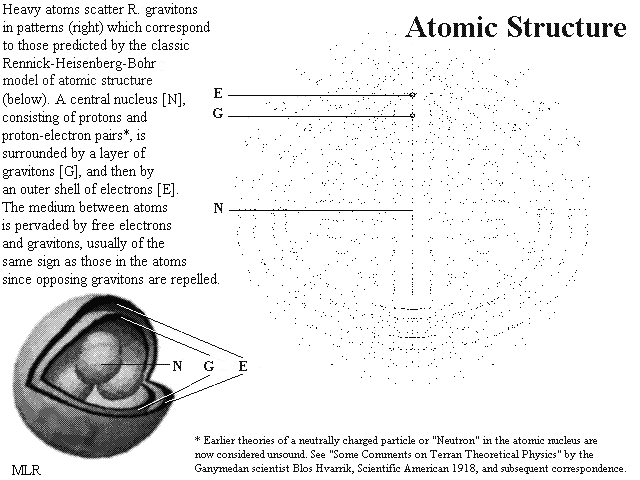
Atoms are believed to consist of a central nucleus containing protons and proton-electron pairs, an inner shell of gravitons, and an outer shell of electrons. The former theory of heavy electrically neutral particles (usually called neutrons) in atomic nuclei is now generally discounted. [See 13_ATOM.GIF].
Until the discovery of the R. force it was assumed that all gravitons exerted the normal pull of gravity; it is now known that the gravitational "charge" of any atom is a quantum state, which changes spontaneously if even one graviton of opposing sign is introduced into the graviton shell. Fortunately such an introduction requires large amounts of energy, and always releases excess gravitons of the shell's original sign, which tends to limit the spread of such reversals. If this were not the case we would live in fear of an accidental release of R. gravitons suddenly causing the whole world's gravity field to reverse! Oddly, individual gravitons have not been observed to reverse sign spontaneously.
G. matter always contains a surplus of G. gravitons which are free to migrate between atoms, acting as a kind of gravitic "fluid". Similarly, R. matter contains free R. gravitons. Both forms of graviton are continually radiated by the appropriate atoms, instantaneously replaced via quantum events which are still not fully understood. It is possible to increase G. graviton density far above normal levels, especially in materials that are naturally extremely dense, so that they become much heavier than usual. On Ceres, for example, an odd combination of geographic features and natural forces has resulted in an unusual excess of G. gravitons, which is especially notable in the "heavy water" of that worldlet. A similar effect is noticeable in the rings of Saturn. Similarly, it is possible to force more R. gravitons into R. matter, and thus make it abnormally repulsive. Matter containing concentrated gravitons is naturally unstable, and tends to release them spontaneously; the rate of loss can be controlled by mechanically vibrating the structure, while the direction in which they are radiated is to a large part determined by its geometry.
At various points in later sections it is important to understand the difference between mass and weight. Mass (more properly known as inertial mass) is a measure of the quantity of matter in an object, regardless of its gravitational sign. The force exerted by, for example, a hammer is dependent on the mass of the head, not its weight, except when weight is used to speed the hammer's blows. Weight is a product of gravitation, and is naturally completely different for R. matter and ordinary matter. It also varies according to the local pull of gravity. For instance
Finally, a note on chemical nomenclature. When describing a material
made of two or more elements with differing gravitational signs, it is
important to mention the signs. At the moment this is usually done by
prefixing the name of the element with R. or G., for "repulsive" or
"gravitic", and spelling out the name of the element in full. For
example, R. Lead (II) G. Iodide is used in developing engines. This is
satisfactory, in some respects, but does not take account of graviton
concentration; it will also be very cumbersome if more complex compounds
enter service, so there is a move to replace this convention with
one or more superscripted "R" or "G" signs beside the normal symbol for the
element, or with superscripted symbols "g+" and "g-", with extra plus or minus
signs for materials with unusual graviton concentrations. At least four
variations on these schemes have appeared in the literature; until a
firm international consensus is reached we will continue to use the
existing method.
3.2 Practical mechanics
return to contents
Rennick's original graviton conversion system was based on a modified Wimshurst machine (an electrostatic device for producing extremely high voltages) with a tiny fragment of R. matter fixed to one of two electrodes, surrounded by a powerful electromagnet. As enormous sparks cracked across the gap they dislodged R. gravitons from the R. matter; these gravitons in turn displaced G. gravitons from some of the surrounding atoms, and the electrode was gradually converted to R. matter. Most of the R. gravitons were unfortunately lost. After several weeks (and the exhaustion of the students who took turns to crank the machine) the electrode was carefully cut into pieces and welded to make the tips of a dozen new electrodes. Thereafter progress was more rapid, especially when Lord Redgrave took charge of the production process. By mid-1899 the works at Smeaton contained scores of steam-powered Wimshurst machines, each slowly producing pieces of R. lead which were amalgamated into two spheres, used as the Astronef's graviton store. These were fixed inside outer casings of normal lead, so that the R. matter was surrounded by ordinary matter; gravitons were trapped inside the sphere, unable to escape because they were repelled by the surrounding lead. More gravitons could then be forced into the cores at lower voltages, so that they added to the "soup" of R. gravitons that surrounded the R. lead without causing more normal matter to become R. matter. Meanwhile more R. lead was synthesised to make R. lead (II) G. iodide crystals (see above and below) which focus and amplify the R. graviton beam.
Tesla's improvements of 1901-4 replaced the Wimshurst machines with rectified high-voltage AC transformers, and regulated the graviton flow via strong eddy currents, allowing production of R. lead and gravitons at a greatly increased rate. These procedures increased speed and decreased power consumption by a factor of eight, and eliminated huge amounts of noise. Efficiency more than trebled as the equipment was perfected. Today output at Smeaton alone exceeds an ounce a day, and the global total is approximately four inertial pounds a week.
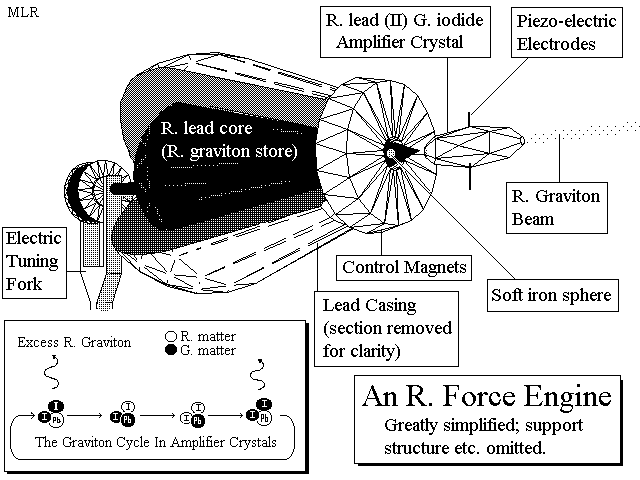
R. force engines, usually called developing engines, consist of a sharply pointed pear-shaped reservoir of "dense" R. matter (almost always R. lead, although the harder R. gold was sometimes substituted before it became a currency metal), charged to saturation with an excess of R. gravitons, while encased in a heavy lead jacket. The outer casing repels the R. gravitons back into the core. An electrical tuning fork is arranged to vibrate the core at its resonant frequency, sending regular shock waves down its conical end towards the point. This focuses the full effect of the vibration towards a very small point, releasing a burst of gravitons. The quantity released is controlled by varying the current supplied to the solenoid which keeps the fork vibrating, while a ring of electromagnets around the point is used to make minute adjustments to its position (via a soft iron sphere buried in the R. lead) to ensure maximum efficiency. See 14_ENGIN.GIF for a simplified plan of the layout of these engines.
The released gravitons are directed into the "amplifier", a precisely-faceted crystal of R. lead (II) G. iodide; this chemical has a suitable crystalline structure and contains roughly equal masses of R. lead and G. iodine. As the R. gravitons enter the crystal they trigger a "shock wave" of quantum changes, in which the G. iodine becomes R. iodine and the R. lead becomes G. lead. The result is a massive release of R. gravitons. Most are absorbed by the G. lead atoms, which in turn revert to R. matter, releasing G. gravitons which reverse the change in the R. iodine, but a significant portion are released as a narrowly focused "jet" of gravitons of enormous power. A useful by-product of this process is the production of a good deal of electrical energy from piezo-electric effects, and this can be harnessed to run the other systems of the ship.
Unfortunately the gravitic reversals in the crystals are never quite 100% efficient; sooner or later the balance between G. matter and R. matter is lost, and the core decays exponentially, until all that is left is a crystal made almost entirely of G. matter or R. matter; which way the balance tips is entirely a matter of chance. If taken out of service early enough some or all of the material can be salvaged, and most engine builders offer rebates on new crystals if an old one is handed in at the time of purchase.
Chemists may be interested in brief details of the fate of used crystals. They are ground to powder, with great care taken to avoid any loss of flying dust, then heated and electrolysed in a sealed chamber to separate the component elements. Iodine and R. iodine are released as vapour; as the gas rises both forms of iodine condense on the walls of the chamber (the R. iodine condenses because the atoms are more strongly attracted by interatomic forces than they are repelled by the R. force), with the R. iodine much higher than the iodine. Meanwhile the lead and R. lead are plated onto one of the electrodes. Once electrolysis is complete the mixed leads are detached from the electrode, weighed to determine the proportions of the two forms (and the amount of any rebate), then converted to pure R. lead via the Rennick-Tesla system. There is currently no major industrial demand for R. iodine; the only known uses are in the manufacture of Kodak's graviton-sensitive photographic emulsion, used mainly for research, and in demonstration R. force equipment for education. This consumes just a small portion of the R. iodine produced; the rest (a few pounds recovered per factory per year) is kept in the hope that some application will eventually be found. Most manufacturers are delighted to sell it at £150 an ounce.
Developing engines must be fitted in precisely matched pairs. The cost of crystals rises rapidly with the mass each engine must move, so larger ships tend to have two or more pairs of engines. Unfortunately each additional pair adds mass and considerable bulk, and increases the work of the engineers who keep them running; usually this means that the ship needs extra crew, who will need more accommodation, supplies, and lifeboats.
The R. force must always push against something, or it has no effect. Typically the earth or another planet is used, while at low altitudes mountains are preferred.
Variants of this device include the attractor (or tractor) beam, which
uses a similar system to aim precisely focused beams of G. gravitons,
and the pressor beam, which is a developing engine mounted as a
stationary projector. The attractor beam is unlikely to see service in
the near future, since a full-scale model would need a core encased in
several hundred ounces of R. lead. Both types of beam projector are
still experimental.
3.3 Spacecraft Design and Costs
return to contents
To design a ship we must first know its purpose. This determines the load that it must carry, and its performance needs. For example, a ship that will be used for routine flights on the Earth-Moon run needs the ability to take off and land on Earth, enough supplies for a few days in space, and plenty of cargo capacity. A ship flying the Earth-Ganymede run needs engines powerful enough to break free of Jovian gravity, more supplies, and will probably devote more room to passengers than to cargo.
In essence, a spacecraft consists of a box or tube made of strong steel girders surrounded by an airtight hull and fitted with developing engines. While the full design process takes months and an enormous number of calculations, it is possible to reach a first approximation extremely quickly. This consists of the following stages:
While this is sometimes a laborious process, it requires no special equipment or mathematical techniques, although a slide rule, logarithmic tables, abacus, or adding machine may be useful. Owners of Lotus 123-compatible difference engines are strongly advised to read this section and design ships with the spreadsheet template SPACESHP.WK1; see section 3.3.4 for details.
In the examples that follow, prices, weights, etc. are rounded to the nearest whole number or to a convenient number of decimal places. This rounding was carried out after calculations were completed. The spreadsheet template also presents results with some degree of rounding. For convenience, fractions of tons and fractions of cubic yards are shown as such, not converted to pounds and ounces or cubic feet. This degree of accuracy is ample for the early stages of ship design.
In all that follows prices are quoted in pounds sterling. To work in
dollars, multiply by 5.
3.3.1 Volume, mass and cost
return to contents
The table that follows lists these factors for some standard compartments and items of equipment, all of which are available from 1900 onwards unless marked otherwise:
| Useage | Volume yards3 | Mass Tons | Cost | Notes |
| Control room, civilian | 8 | 2.0 | £ 1700 | |
| Control room, military | 16 | 5.0 | £ 2500 | 1903 onwards |
| 1st class per passenger | 25 | 3.0 | £ 1000 | |
| 2nd " " " | 12 | 1.2 | £ 300 | |
| 3rd " " " | 8 | 0.6 | £ 120 | |
| 4th " " " | 6 | 0.4 | £ 90 | |
| Galley | 6 | 1.0 | £ 200 | |
| Air lock | 3 | 0.5 | £ 450 | |
| Supplies/person/week | 1 | 0.5 | £ 10 | |
| Cargo space | 3 | 1.0 | £ 30 | |
| Strong room | 16 | 3.0 | £ 1500 | |
| Maxim gun | 0.1 | 0.05 | £ 250 | |
| Powered Gatling gun | 0.2 | 0.1 | £ 525 | |
| Pneumatic Cannon | 2 | 1.0 | £ 400 | |
| 8" gun | 20 | 25.0 | £15000 | 1905 onwards |
| 1000 lb bomb | 2 | 0.6 | £ 800 | 1905 " |
| Steel Ram | 5 | 10.0 | £ 3000 | |
| Lifeboat | 16 | 2.0 | £ 1500 | 1903 onwards |
| Navigation engine Mk I | 2 | 1.0 | £ 1500 | 1905 " |
| Navigation engine Mk II | 2 | 1.0 | £ 2300 | 1909 " |
| Navigation engine Mk III | 2 | 1.0 | £ 3500 | 1910 " |
| Navigation engine Mk IV | 2 | 1.0 | £ 3500 | 1912 " |
| Navigation engine Mk V | 2 | 1.0 | £ 4500 | 1917 " |
| Radio, Earth-Moon range | 2 | 1.0 | £ 1000 | 1902 " |
| Radio, Interplanetary | 4 | 2.0 | £ 2500 | 1907 " |
| Searchlight (external) | - | 0.05 | £ 175 | |
| Telescope | 1 | 0.1 | £ 350 | |
| Breathing Dress | N/A | N/A | £ 320 | |
| Atmospheric Engines (2) | 4 | 2.0 | £ 2500 | |
| Developing Engines (2) | 24 | 2.5 | Variable |
Compartments
CONTROL ROOMS are needed in all ships. Military vessels use large control rooms with redundancy in instruments and personnel. Civilian vessels need less complexity.
ACCOMMODATION is listed with minimum space and cost requirements. On some ships, such as the Astronef, the volume devoted to first class passengers is even larger, but costs and weights should be proportional to size. Some passenger space (of all classes) is used for communal areas such as lounges, corridors, etc.
GALLEYS need more space according to the number of people aboard the ship. The galley above is adequate for up to ten passengers and crew. Add another 3 cubic yards, 0.5 tons, and £100 for 11-20, and so forth.
AIRLOCKS are needed on all ships. Some larger ships have two or more. Most also have access hatches (not airlocks) which can only be used on a world with an atmosphere. The latter need not be added to construction costs, since they are relatively inexpensive and add little mass.
SUPPLIES include oxygen, water, and recycling chemicals, as well as food and drink.
CARGO VOLUME assumes average weight cargo; metal ores and other heavy loads may take up less room, eg 1 cubic yard per ton. The cost remains constant at about £30/ton because denser cargoes need stronger compartments and more bracing.
STRONG-ROOMS are needed on any ship which will carry valuables. Almost all liners have a strong-room to secure passenger's jewellery, money, etc.
Weapons
In 1900 guns can only be used when a spaceship is in a breathable atmosphere, since they must be fired through open ports. By 1908-10 airtight seals and breech airlocks have been developed, but are unreliable and unusable with Gatling guns. Bombs can be used in a vacuum, since the bays are sealed off from the rest of the ship.
MAXIM GUNS are tripod mounted. They are usually kept in lockers which
need a small amount of space; weight is for the gun, locker, and some
ammunition.
[Use the generic Machine Gun in the rules. Civilians may find it
difficult to obtain these and other military weapons, although the
British government is usually prepared to co-operate with explorers
and others who have a legitimate need for armaments. They can be fired
in vacuum after 1910, but this requires regular maintenance of
airtight seals and breech airlocks, Difficulty 8.]
POWERED GATLING GUNS are available in pneumatic, steam-driven, or electrical versions. All are recent military innovations, so far only found in a few ships belonging to various navies. The rate of fire is greatly increased, but so is ammunition consumption. They are fixed to mounts and motors which take up some space.
[These weapons were really built, but were unsuccessful; Edwardian engineering wasn't quite up to the challenge of feeding ammunition at these speeds, and the usual result was a jam. While they work (make a luck roll, Difficulty 4, to fire each burst successfully) use the data for the Mini Gun described in the rules. Because Gatling gun barrels rotate it is not possible to use them through vacuum seals.]
PNEUMATIC CANNON are described in the second Astronef story. They fire explosive or incendiary shells, and have a range of four miles on Earth, seven miles on Mars. The incendiary shell contains a thermite compound, which will burn even in a vacuum - unfortunately it can't be fired in a vacuum without depressurising the ship!
[Cannon, range 4 miles (much further under low gravity), 1 shot per 2 rounds
| explosives burst | 10ft, effect 25, A:I B:C C:K |
| incendiary burst | 15ft, effect 15, A:I B:C C:K * |
* Burns through 1D6/2 inches of steel per round for 1D6/2 rounds.
Breech airlocks and barrel seals are available from 1909 onwards, with
maintenance problems as above.]
8" GUNS are long-barrelled naval guns, built to minimise weight and recoil. They were developed especially for military use, utilising Lord Redgrave's new explosives. They aren't fitted with any horizontal training mechanism, just a simple elevation control; they are aimed by adjusting the angle of the entire ship. This greatly simplifies their operation, and six crew can handle the demands of loading and firing. The volumes and weights include storage for 50 rounds and 50 charges of propellant, packed in cardboard canisters separate from the shell.
[8" gun, range 7 miles (much further under low gravity), 1 shot per 3 rounds
| explosives burst | 20ft, effect 40, A:I B:C C:K |
| incendiary burst | 30ft, effect 30, A:I B:C C:K * |
* Burns through 1D6 inches of steel per round for 1D6 rounds
Breech airlocks and barrel seals are available in 1908, with
maintenance problems as above.]
1000 lb BOMBS are simple gravity bombs; a little inaccurate, but devastating enough if they are on target. The weights include a bomb bay, armoured doors, etc; replacements cost £300 a bomb. Bays are often built in pairs, with the option of suspending a single naval torpedo instead of two bombs; this decision doesn't affect construction costs, but adds £1000 per torpedo for ammunition.
RAMS are simply a bow (sometimes a pointed stern) reinforced with
strong steel girders and covered in extra-strong armour plate. They
were fitted to a few early ships, but improved firepower subsequently
proved more effective.
[See later sections for the combat effects of a ram.]
Miscellaneous Equipment
LIFEBOATS are airtight hulls fitted with tanks of oxygen, chemicals for carbon dioxide absorption, a simple hand-cranked spark-gap wireless transmitter, and supplies of food and water. There are no engines. Folding rotor blades allow atmospheric landings; as the lifeboat hits air they snap open, and start to spin the craft. The autogyroscopic effect thus created buoys up the craft and brings it in for a bumpy but surviveable landing.
Endurance is 20 man-days; they will support a single occupant for 20 days, two occupants for 10 days, three for about a week, and so forth. 1904 Board of Trade regulations require all commercial vessels to have a lifeboat for every twenty passengers and crew. Those who have used them describe them as extraordinarily claustrophobic and uncomfortable.
[The designers of lifeboats, and the regulations governing them, are highly optimistic; if there are more than five occupants the lifeboat overheats, knocking out the carbon dioxide absorption system long before the nominal duration of its supplies. Since there has never been an accident with a rescue craft inside four days range this defect has not been discovered. While the craft can survive an atmospheric landing, the occupants may not be so lucky; the braking effect of the rotor blades is just enough to prevent it burning up in the atmosphere, and those aboard take 1D6 random hits each with Effect 2D6, damage A: B/KO, B:KO/I, C:C/K]
NAVIGATION ENGINES are mechanical calculating engines of great precision. Models are available from several companies, most notably Redgrave Business Machines Ltd. They are extremely useful in navigational calculations.
[Navigation engines reduce the Difficulty of navigational problems provided that a successful Babbage Machine roll is made. If the Babbage Machine roll is failed, the difficulty of the problem is raised +2.
| Model | Price | Difficulty | First available |
| Mk I | £1500 | -1 | 1905 |
| MK II | £2300 | -2 | 1909 |
| Mk III | £3500 | -2 | 1910 * |
| MK IV | £3500 | -3 | 1912 |
| MK V | £4500 | -4 | 1917 |
* The Mk III was a bug-ridden fiasco; it was supposed to be more accurate than the Mk II but wasn't, cost as much as the Mk IV, and tended to break down when confronted with complex problems. Despite this they have a small coterie of loyal users who are sure that they are better than their successors. Unscrupulous dealers with old stock still try to pass them off as better than the Mk. II]
RADIOS are fitted to almost all ships built after 1902. There are two models, distinguished by transmitter power. The earlier model is adequate for Earth-Moon communications, and for short-range ship-to-ship messages, later designs (1907 onwards) are powerful enough to transmit across interplanetary distances. Both can receive at all ranges. They have extremely long aerials (up to several miles) towed behind the ship; this means that they can only be used in space, since the aerial would soon be torn away or tangle with the air-screws in atmosphere.
SEARCHLIGHTS are widely used for landings etc. They are powerful arc lights, built into a casing on the outside of the hull and controlled by levers inside. Despite certain scientific errors in the popular account of the first journey to the Moon, searchlights can be used normally in a vacuum.
TELESCOPES are essential for interplanetary navigation, but they are not usually needed for flights between the Earth and the Moon; a good pair of binoculars suffices. Extra telescopes are often carried as backup and for the entertainment of passengers. The statistics quoted are for a high quality portable refracting telescope with storage locker and tripod.
[Raise navigation difficulty +2 if a telescope is NOT available]
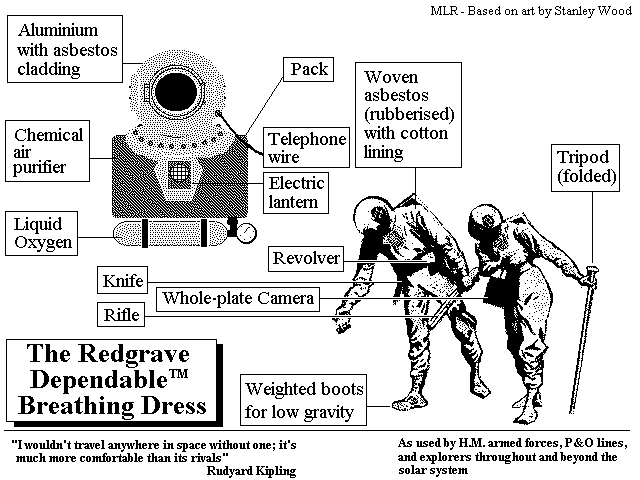
BREATHING DRESS is described in much more detail in a later section. No weight or volume is indicated because suits are portable equipment, and thus fall outside the main concerns of the designer.
Engines
The ATMOSPHERIC ENGINES are air compressors which power propellers
mounted on retractable arms. They are used for navigation in
atmosphere, but have no effect in space. A pair is needed for every
250 tons of ship mass.
[If there is less than one pair for every 250 tons, add 1 to the
difficulty of all atmospheric manoeuvres. If there is less than one
pair for every 500 tons, add 2 to the difficulty of all atmospheric
manoeuvres, and so forth. See later sections for calculation of
atmospheric speed.]
DEVELOPING ENGINES are priced according to the power output required, and to the degree of precision with which they are made, but the size and weight are constant. The physical data listed are for two complete sets of engines, the minimum needed for a spacecraft; more sets can be added at the same weight and mass per pair. The fewer the engines the smaller the crew needed, but the more the engines cost. Section 3.3.3 details engine costs and performance.
Example: The Astronef
  Item                     Volume   Mass   Cost
  Control room, civilian     8      2.0    £1,700
  Passenger space          100     12.0    £4,000 (The Redgraves)
  3rd class cabin            8      0.6    £  120 (Murgatroyd)
  Galley                     6      1.0    £  200
  Air lock                   3      0.5    £  450
  Supplies (3x26 man-weeks) 78     39.0    £  780
  Maxim guns x4              0.4    0.2    £1,000
  Pneumatic Cannon x 4       8      4.0    £1,600
  Steel Ram                  5     10.0    £3,000
  Searchlights x2          N/A      0.1    £  350
  Telescopes x 2           2.0      0.2    £  700
  Breathing dress x2       N/A      N/A    £  640
  Atmospheric engines x2     4      2.0    £2,500
  Developing engines x2     24      2.5   See later sections
  SUBTOTAL                 245.4   74.0   £17,040
                           Cubic   Tons
                           yards
Example: The Shanghai Princess
  Item                     Volume   Mass   Cost
  Control room, civilian     8      2.0    £1700
  2nd class cabin x 1       12      1.2    £ 300
  3rd  "    "     x 2       16      1.2    £ 240
  4th  "    "     x 3       18      1.2    £ 270
  Galley                     6      1.0    £ 200
  Air lock                   3      0.5    £ 450
  Supplies x 6 man/weeks     6      3.0    £  60
  Cargo space, 300 tons    300    300.0   £9,000
  Strong room               16      3.0   £1,500
  Searchlight              N/A      0.05  £  175
  Breathing dress (x6)     N/A      N/A   £1,920
  Lifeboat                  24      2.5   £1,500
  Radio                      2      1.0   £ 1000
  Atmospheric engines x2     4      2.0   £2,500
  Developing engines x4     48      5.0   See later sections
  SUBTOTAL                 455    323.15 £20,815
                           Cubic   Tons
                           yards
Hulls are built around a skeleton of steel girders. All plating is made of steel, riveted, then welded and caulked with layers of rubber, asbestos, and tar to insulate the occupants from the cold of space and prevent any air loss. An inner wooden lining adds comfort, and is also carefully sealed and varnished as a further precaution against leaks. Portholes and the windows of observation decks are made of heavy plate glass, in several laminations cemented with Canada balsam, and are fitted with steel roller shutters. Military craft naturally use much heavier armour plate, with all of the inner layers mentioned above. All of these components add weight, and cost roughly £500 per ton.
Three main hull designs are in common use. The first is the general-purpose cigar shape popularised by the Astronef. This shape is highly streamlined, and it is ideal for exploration and for ships that may face a wide variety of conditions. It has a relatively high surface area and weight for its volume.
| Structural weight | = component weight x .1 |
| Hull weight | = Structural weight x 1% per cubic yard. |
The second type is a simple cylinder with rounded ends, with width about a sixth of length, mostly used for the largest ships. Poorly streamlined, and sometimes difficult to control in atmosphere, it has the advantages of relative cheapness and lightness.
| Structural weight | = component weight x .1 |
| Hull weight | = Structural weight x 0.5% per cubic yard. |
Hull weights for the above types (but not structural weight) should be DOUBLED if the hull is covered in military-grade armoured plating.
The final type is the flat-sided prism typified by HMS Nova and other naval craft. This shape, the so-called "flying brick", has sloping armoured sides and bow to ensure that projectiles will strike glancing blows if they hit, and a heavily reinforced armoured keel to support naval ordnance. It is streamlined, though not so well as the cigar hull. As might be expected, this design is heavy and inefficient in any non-military role. It is the only hull strong enough to mount full-sized naval ordnance.
| Structural weight | = Component weight x .2 |
| Hull weight | = Structural weight x 1% per cubic yard |
At this stage it is possible to calculate atmospheric speed by comparing the mass of the ship and the number of atmospheric engines, with a modifier for the hull design.
Speed = (250/mass) x number of atmospheric engine pairs x 50 mph Add 10% for cigar-shaped hulls, subtract 10% for cylindrical hulls.
Example: The Astronef
  Structural weight = component weight x .1 = 74 x .1 = 7.4 tons
        Hull weight = Structural weight x 1% per cubic yard.
                    = 7.4 x 2.454 = 18.1596 tons
         Hull total = 7.4 + 18.16 = 25.6 tons @ £500 per ton = £12,780

  Item                     Volume   Mass   Cost
  Internal components      245.4    74     £17,040
  Hull                     N/A      25.6   £12,780
  SUBTOTAL                 245.4    99.6   £29,820
                           Cubic    Tons
                           yards

  Speed = (250/mass) x number of atmospheric engine pairs x 50 + 10%
        = 2.51 x 1 x 50 +10%
        = 125.5 + 10% = 138 MPH in atmosphere
Example: The Shanghai Princess
  Structural weight = component weight x .1 = 32.4 tons
        Hull weight = 32.4 x 231.5% = 74.9 tons
         Hull total = 107.3 tons @ £500 per ton = £53,645

  Item                     Volume   Mass   Cost
  Internal components      463      323.7  £20,815
  Hull                     N/A      107.3  £53,645
  SUBTOTAL                 463      431.0  £74,460
                           Cubic    Tons
                           yards

  Speed = (250/431) x 1 x 50 - 10%
        = .485 x 50 - 10% = 26 mph in atmosphere
Game Data
The BODY of a ship can be calculated from its mass and hull type:
| Mass | BODY | Modifiers: | BODY |
| 50-100 tons | 60 | "Cigar" hull | +10 |
| 100-200 tons | 70 | "Flying Brick" hull | +15 |
| 200-400 tons | 80 | EITHER Armoured steel plating | +5 * |
| 400-600 tons | 90 | OR steel ram fitted | +5 * |
| 600 tons and up | 100 | * Not "Flying Brick" hull |
Ordinary plating and armoured glass subtract 15 from the Effect of bullets etc.; projectiles which still have some Effect left will penetrate. Most either glance off or embed somewhere in the layers of material that make up the hull.
Military grade armour subtracts 25 from the Effect of bullets etc.; projectiles which still have some Effect left penetrate on a column "B" or "C" result, and glance off on a column "A" result.
The Difficulty modifier for atmospheric flight can be calculated by comparing mass and the number of atmospheric engines, and modifying the result for the hull style as follows:
| Cigar shaped hull | -1 |
| Cylinder hull | +1 |
| Military hull | No modifier |
The Astronef
The Shanghai Princess
From the outside there is little to distinguish the weakest developing engine from the most powerful; all consist of a complex arrangement of machinery surrounding an amplifier crystal and an R. lead core. The essential features that determine performance are the size of the amplifier crystals, and the mass of the cores; repulsive power and crystalline stability are related to the size of the crystal, endurance to the mass of the core. A final factor is the precision with which the controlling mechanism is built; this affects cost, reliability, and control accuracy.
All ships need at least two engines, because they invariably need to push against more than one object. For instance, a ship approaching the Moon needs to push against the lunar surface directly for support, and diagonally for propulsion. With just one engine it would be necessary to calculate a complex compromise between these thrusts, changing by the second with altitude and speed. The mathematics of the R. force are too complicated to make this possible. Extra engines are added in pairs to preserve symmetry and simplify adjustments.
Crystals
The mathematics of crystal design are extremely complicated (see the companion volume by Rowena Dell), but fortunately the end result is four simple equations which even an amateur can understand and use:
| Crystal width (inches) = | maximum acceleration x mass of ship / 150 |
| Crystal mass (oz) = | width cubed x 0.6 |
| Crystal cost = | £950 per oz |
| Crystal service life (months) = | Width x 25 / maximum acceleration |
It should be noted that it takes a good deal of time to grow large crystals, at least a month per ounce.
If more than one pair of engines is used, divide the ship's mass by the number of pairs of engines before making this calculation. All engines must be identical.
For example, a ship weighing 100 tons and expected to perform at 4g would need a crystal of width
100 x 4 / 150 inches = 400/150 inches = 2.66 inchesand mass
2.66 x 2.66 x 2.66 x .6 = 18.97 x .6 = 11.38 ozR. lead (II) G. iodide costs £950 an ounce. A crystal of mass 11.38 oz costs
11.38 x £950 = £10,811The other crystal of the pair naturally costs the same, for a total cost of £21,622. They must be ordered nearly a year before they are needed, to allow for growing time. Their service life will be
2.66 x 25 / 4 = 16.6 months
Crystal life estimates aren't always accurate; they can fail months earlier than expected for no apparent reason, or last months beyond their allotted span. They fail very suddenly once they start to deteriorate, with power output halving every few hours, but they can be exchanged for fresh crystals at half price if they are caught before serious deterioration begins; accordingly it is advisable to replace them at the first sign of trouble. Most ships carry spares. It is notable that crystals often fail early if they are subjected to unusual strain.
[The referee should secretly roll 2D6 as follows:
| 2: | Add 1D6 months to crystal life |
| 3-4: | Add 1D6/2 months |
| 5-9: | Crystals will fail on schedule |
| 10-11: | Subtract 1D6/2 months from crystal life |
| 12: | Subtract 1D6 months from crystal life |
Crystal replacement takes about 6 hours and a Mechanic roll, difficulty 8. The pilot must then adjust the crystal position to exactly match power output; this takes an hour and is difficulty 7]
Storage Cores
Storage cores are masses of R. lead charged with excess R. gravitons. These are "radiated" from the pointed end of the core; the power produced by the amplifier crystal is related to the rate of graviton release. Again some complex theory determines their capacity and performance; in essence, the storage capacity is related to the square of core mass. The practical consequences can be boiled down to a single simple equation:
Core mass (oz) = Sq. rt. of endurance (weeks) x crystal mass x .5Cores are made of pure R. lead, and the cost of the core is simply the current cost of R. lead, £1550 an ounce. Full recharging costs a tenth of core cost; the cost of the core includes one full charge.
Example: Taking the ship above, and assuming that the designers expect the engines to operate for a maximum of 20 weeks between charges:
crystal mass = 11.38 ozCore mass must be
Sq. rt. 20 x 11.38 x .5 = 4.47 x 11.38 x .5 = 25.5 ozCore cost is 25.5 x £1550 = £39,525; recharge cost is £3,953 Both these results are multiplied by the number of cores, for final costs of £79,050 for cores, £7,905 for recharging.
[if cores are badly abused (eg. by an attempt to exceed the rated performance of the engines) they may lose some charge. Reduce endurance by 1D6/2 weeks.]
At this point it is possible to calculate the minimum operating expenses for the ship. Divide the total cost of the crystals IN THE ENGINES by their service life in months, then add the total recharge cost, assuming continuous operation, per month. In our example above, the crystals cost £10,811 and last 16.6 months, the recharge cost is £7,905 per 20 weeks.
| Crystal cost (per month) = | £10,811 / 16.6 = £651 |
| Core charge cost (per month) = | (£7,905 / 20) x 52 /12 = £1,713 |
Engine Machinery
The remaining machinery of the engine is a complex array of mechanical and electrical components designed to control output and keep the R. graviton beam aligned on the object that is repelling the ship. The more accurately it is built, the less trouble it gives and the less attention it needs from the pilot and engineer. Precision costs money, and varies from one manufacturer to another.
| Type | Cost | [Difficulty Repair/Use] |
| Redgrave Superlative | £2500 + 30% of cost of core + crystal | [+2/-2] |
| Redgrave Standard | £1500 + 25% of cost of core + crystal | [ 0/ 0] |
| Rolls Royce | £1200 + 25% of cost of core + crystal | [-2/+1] |
| Tesla-Westinghouse | £1000 + 15% of cost of core + crystal | [-1/+2] |
[The two difficulty modifiers shown are for repairing the engine, and for precise navigation. For example, the Tesla-Westinghouse model is moderately easy to repair (-1 difficulty modifier) but very inaccurate if used for long-range navigation (+2 difficulty modifier)]
The Redgrave Superlative (1903) and Standard (1900) are usually regarded as the best engines for long-range navigation, although the Superlative has been described as "an absolute pig to repair". The Rolls-Royce (1905) is screened against the Ganymedan magnetic ray, and has a reputation for ruggedness and ease of repair which offsets its slightly reduced accuracy; it is often found in naval craft, where constant watchkeeping prevents serious navigational errors. Finally, the Tesla-Westinghouse design (1907) simplifies the aiming mechanism, and is built mainly for short-range flights; most craft on the lunar run use it.
Example: The Astronef
  Crystal width (inches) = maximum acceleration x mass of ship / 150
                         = 5 x 99.6 / 150 = 3.32"
     Crystal weight (oz) = width cubed x 0.6
                         = 35 x 0.6 = 21.93 oz
            Crystal cost = 21.93 x £950
                         = £20,833 (x2 crystals)
                         = £41,667
   Service life (months) = width x 25 / maximum power
                         = 3.32 x 25 / 5 = 16.6 months

  Core mass = Sq. rt. 52 x 21.9 x .5 = Sq. rt. 570 = 23.88 oz
  Core cost = 23.88 x £1550 = £37,012 (x 2 cores) = £74,023
  Recharge cost = £7,402

  Operating cost = (£41,667 / 16.6) + ((£7,402 / 52) x 52/12)
                 = £2,510 + £616 = £3,116 per month

  Machinery cost = (£20,833 + £37,012) x .25 + £1,500
                 = £57,845 x .25 + £1,500
                 = £14,461 + £1,500
                 = £15,961 (x 2 engines) = £31,922

  Item                     Volume   Mass   Cost
  Hull and interior        245.4    99.6   £29,820
  Amplifier crystals       N/A      N/A    £41,667 *
  Cores                    N/A      N/A    £74,023 *
  Engine machinery       Already included  £31,922
  TOTAL                    243      98    £177,432
                           Cubic    Tons
                           yards
* Volume and mass are not noted because they are already included in
  the overall data for the engines.
Example: The Shanghai Princess
  Crystal width (inches) = 1.5 x 213.5 / 150 = 2.15"
     Crystal weight (oz) = 2.15 cubed x 0.6 oz = 6.0 oz
            Crystal cost = 6.0 x £950 = £5,702 (x6 = £34,212)
   Service life (months) = 2.15 x 25 / 1.5 = 36 months

  Core mass (oz) = Sq. rt. 26 x 6 x .5 = Sq. rt. 78 = 8.83 oz
  Core cost = 8.83 x £1550 = £13,692 (x 4 engines = £54,767)
  Recharge cost = £54,767 x .1 = £5,477

  Operating costs = (£22,808/36) + ((£5,477 / 26) x 52/12)
                  = £634 + £912 = £1,548 per month

  Machinery cost = (£5,702 + £13,692) x 15% + £1,000
                 = £3,909 (x 4 engines)
                 = £15,636

  Item                     Volume   Mass   Cost
  Hull and interior        463.0    430.9   £74,460
  Amplifier crystals x 6   N/A      N/A     £34,212
  Cores x 4                N/A      N/A     £54,767
  Engine Machinery x 4    Already included  £15,636
  TOTAL                    463.0    430.9  £179,075
                           Cubic    Tons
                           yards
SPACESHP.WK1 is a template for Lotus 123 and compatible spreadsheets. Most spreadsheet programs should be able to load it or translate it. Set your spreadsheet to use British pounds as the default currency before using it. The file has been saved in protected mode; this means that only the unprotected cells (usually shown in a different colour) can be altered. You are strongly advised not to remove protection until you understand how it works; dozens of serious formula errors were eliminated at various points in testing, the last only days before release of this collection. Save edited sheets with a new name to avoid overwriting the original. Please DON'T distribute templates with modified formulae. A sample spacecraft has been recorded. While the template is moderately bulletproof, it can't prevent stupid mistakes; for example, it won't stop you choosing to have 1000 engines or -5 first class cabins. This shouldn't do any harm provided you spot the error.
The spreadsheet is organised so that everything needed for game purposes can be printed out on a single page, showing cells A1..G49; a few choices (such as hull style, engine type, etc.) are entered to the right of this range, but the choices made are summarised on the first page. A second page (A50..G90) has spaces for notes and illustrations. Both pages have been optimised for the Lotus WYSIWYG add-in, but results should be acceptable without it.
The top few lines of the main page detail the name of the ship, country of origin, and so forth; these do not affect values. Below are details of hull design and performance; endurance in weeks and maximum acceleration are entered here, the rest of the information summarises choices that are made elsewhere on the sheet.
The remainder of this page is a long list of components, prices, volumes, and weights. Simply type in the number of items needed and it will automatically calculate volume, size, and cost. Once a hull type is selected it will show the hull weight and cost (the default is a cigar-shaped hull, like the Astronef). Once the number of developing engines is selected, and the make and maximum acceleration is typed in, it automatically shows all relevant costs. Off the page to the right are sections detailing the hull and engines, and some lookup tables which are used by the spreadsheet to calculate complex items that can't easily be handled in a single equation. A nearby section holds the volume, mass, and cost of each type of accommodation; if you want to change these factors for an unusual design, these are the numbers to modify. Since this should be comparatively rare, they are initially protected.
At the bottom of the first page, just before various totals, are five "new item" entries for any extras you might wish to enter. Names, volumes, weights, and costs of these extra items can be entered into another lookup table off the main page to the right. Cells in this table are not protected. It's assumed that these items aren't limited to a particular hull style, don't affect the number of crew, and so forth. For instance, a really big gun might be entered as 11-inch gun, volume 30 cubic yards, mass 50 tons, cost £80,000; this would work correctly as far as volume, mass, and costs per gun were concerned, but the spreadsheet won't know that it could only be built into a military hull, or that it would need fifteen or twenty crew. Similarly, a new form of accommodation (such as a luxury suite much larger than the normal first class cabin) will not be reflected in the galley size or quantity of supplies aboard.
At several points you should type in numbers to make a selection from a limited range of possibilities. Any other entry will result in an error message:
| Control room | type "0" for civilian, "1" for military. |
| Navigation engine | "0" for none, "1" for mk I, "2" for mk II, etc. |
| Radio | "0" none, "1" short range, "2" long range |
| Steel Ram | "0" none, "1" bow, "2" bow and stern |
| Hull design | "0" cigar, "1" cylinder, "2" military 'brick' |
| Hull armour | "0" standard plate and glass, "1" military grade armour plating. This entry has no effect on the military chisel design if it has been selected. |
| Engine make | "0" Redgrave superlative, "1" Redgrave standard, "2" Rolls Royce, "3" Tesla-Westinghouse |
Some choices need more than one entry. For instance, when entering cargo requirements there are spaces for the mass to be carried, and the hull volume needed per ton. This permits the choice of (for example) 1 ton per cubic yard for dense metals and ores, 1 ton per 5 cubic yards for furniture, etc. Water, oil, and most other liquid cargoes average about a ton per cubic yard; liquid mercury and the "heavy water" of Ceres would theoretically ship at 16 tons per cubic yard, but in practice are more likely to be shipped in small jugs packed in straw inside wooden crates, averaging about a ton per cubic yard.
When you explore the sheet, try making a few "minor" changes and see how they snowball as they affect weight, volume (and hence hull weight), engine power (and hence cost). For example, adding a lifeboat (cost £1500) to one ship added nearly £200,000 to its eventual price. Changing the number of developing engines can have a VERY large effect on costs, and it's possible to achieve some extremely silly results, such as ships with hundreds of cheap engines. Keep an eye on operating expenses, crew, endurance, and crystal life, as well as on the actual cost of the ship, and you won't go far wrong.
The template doesn't distinguish between passengers and crew, but will
warn you if there are more pairs of engines than people aboard the
ship, or if a warship has more battle stations than occupants. The
latter assumes two crew on the bridge, a crewman per pair of
developing engines, six crew for each 8" gun, and one crewman for all
other guns. By real naval standards this is highly optimistic; most
warships would have teams of ten or fifteen for each big gun, and many
more crew aboard for other stations and as "spares". The warnings are
displayed near the engine and hull details. You will also be warned if
your design mounts naval guns in a cigar-shaped or cylindrical hull.
These warnings do not affect the operation of the sheet and can be
ignored at your discretion.
3.5 Spacecraft Design Record
return to contents
Use this form (also saved as a separate file for printing convenience, and as a separate text file shiprecd.txt) to record details of ship designs. It will probably print out at slightly more than a page, so you may prefer to edit the text version on screen, to delete lines that don't apply or add extra lines for new items of equipment. The spreadsheet SPACESHP.WK1 is much more convenient; see section 3.4, above, for details.
Forgotten Futures II - Spaceship Design Record | |||||
| Ship Name | Type | ||||
| Owner | Flag | Base | |||
| Number/ Type | Notes | Volume Yd3 | Mass Tons | Cost | |
| INTERNAL COMPONENTS | |||||
| Control room | . | . | . | . | £ |
| 1st Class Cabins | . | . | . | . | £ |
| 2nd Class Cabins | . | . | . | . | £ |
| 3rd Class Cabins | . | . | . | . | £ |
| 4th Class Cabins | . | . | . | . | £ |
| Galley for ______ persons | . | . | . | £ | |
| Air Lock | . | . | . | . | £ |
| Supplies for _____ man-weeks | . | . | . | £ | |
| Cargo space, _____ tons | . | . | . | £ | |
| Strong room | . | . | . | . | £ |
| Maxim Gun | . | . | . | . | £ |
| Powered Gatling | . | . | . | . | £ |
| Pneumatic Cannon | . | . | . | . | £ |
| 8" gun | . | . | . | . | £ |
| 1000 lb bomb | . | . | . | . | £ |
| Steel Ram | . | . | . | . | £ |
| Lifeboat | . | . | . | . | £ |
| Nav engine, Mk _____ | . | . | . | £ | |
| Radio | . | . | . | . | £ |
| Searchlight | . | . | . | . | £ |
| Telescope | . | . | . | . | £ |
| Vacuum Dress | . | . | . | . | £ |
| . | . | . | . | . | £ |
| . | . | . | . | . | £ |
| . | . | . | . | . | £ |
| . | . | . | . | . | £ |
| . | . | . | . | . | £ |
| . | . | . | . | . | £ |
| Developing engines, _____ pairs | . | . | . | £ | |
| R. Force engine, _____ pairs | . | . | . | £ | |
| Subtotals | . | . | £ | ||
| HULL | |||||
| Specification | Difficulty Modifier | ||||
| Materials | BODY | ||||
| Subtotals | . | . | £ | ||
| ENGINES | |||||
| Amplifier Crystals | . | £ | |||
| Crystal life, months | |||||
| R. Graviton Cores | . | £ | |||
| Engine mechanisms | . | Maker | £ | ||
| Engine Power, g | . | ||||
| Endurance, weeks | . | ||||
| Recharge cost | £ | ||||
| GRAND TOTALS | . | . | £ | ||
| Notes . . . . . . | |||||
3.6 Sample Spacecraft
return to contents
This is a brief listing of a few spacecraft designed using these techniques.
The Astronef
Yacht, owner Lord Redgrave, completed 1900
British, base Smeaton, Yorkshire
Control room, 100 cubic yards 1st class passenger space, 1 x 3rd class cabin, galley, air lock, supplies (26 weeks), 4 x Pneumatic Cannon, 4 x Maxim guns, forward ram, 1 pair atmospheric engines, 1 pair Redgrave Standard developing engines, 2 x searchlights, telescope, 2 x Breathing dress
Hull cigar-shaped, standard plate / armoured glass
Volume 245.4 cubic yards, mass 99.6 tons, BODY 75
Atmospheric speed 138 MPH, difficulty modifier -1
Engine crystals £20,833 (x2), service life 16.6 months, max 5g
Engine cores 1 year capacity, recharge cost £7,402
Cost £177,082, operating cost £3,116 per month.
This luxurious yacht carries supplies for three occupants for half a
year. She was built before radio or navigation engines were available,
and is not fitted with a lifeboat (since there was no-one to rescue
the occupants). The Astronef is cutting-edge technology in 1900, and
is still in many ways a typical ship in 1920 (although by then the
actual ship occupies pride of place in London's Science Museum). She
is a sleek agile craft with good handling in the air and in space. For
more details see section 3.6, below.
Illustrations 07_ASTNF.GIF, 08_ASPLN.GIF
The Hartley Rennick (and sister ship Zaidie Redgrave)
General purpose yachts, owner Lord Redgrave, completed 1903 (1904)
British, base Smeaton, Yorkshire
Control room, 4 x 1st class, 4 x 2nd class, 6 x 3rd class (crew), 6 x 4th class (servants, crew), galley for 20, air lock, supplies (10 weeks), 50 tons cargo @ 3 cubic yds/ton, strong room, 6 x pneumatic cannon, 6 x Maxim guns, forward ram, 2 x searchlights, radio (short range), telescope, 8 x breathing dress, lifeboat, 2 pairs atmospheric engines, 3 pairs Redgrave Standard developing engines.
Hull cigar-shaped, standard plate / armoured glass
Volume 742.6 cubic yards, mass 389.3 tons, BODY 95
Atmospheric speed 71 mph., difficulty modifier -1
Engine crystals £23,649 (x8), service life 21.6 months, max 4g
Engine cores 52 weeks capacity, recharge cost £23,649
Cost £649,660, Operating cost £8,525 per month.
These ships were built as the logical successors to the original Astronef; for exploration, for diplomacy, to carry passengers and cargo, and (if necessary) for limited warfare. As such they fall between a multitude of stools; they lack cargo space, and are overcrowded when they carry passengers. They are slower than the Astronef, and poorly armed compared to the naval vessels that soon entered service. Despite these shortcomings both are agile and are still in use in 1920. At various dates both were upgraded with long range radios and navigation engines; these are not included in the prices above, which are original construction cost.
HMS Nova (and others of her class)
Warship, Royal Navy, completed 1905 (8 others built 1906-1916)
British, base Plymouth, Devon
Military control room, 1 x 2nd class (captain), 3 x 3rd class (officers), 18 x 4th class, galley for 22, air lock, supplies (10 weeks), 50 tons cargo at 1 cubic yd/ton, 2 x 8" guns, 6 x 1000lb bombs, 4 x electric Gatling guns, 2 x searchlights, no lifeboats, telescope, 22 x breathing dresses, 2 pairs atmospheric engines, 4 pairs Rolls Royce developing engines.
Hull "brick-shaped", military armour plate
Volume 606.8 cubic yards, mass 598.3 tons, BODY 105
Atmospheric speed 42 MPH, difficulty modifier +1
Engine crystals £36,177 (x10), service life 24.9 months, max 4g
Engine cores 26 weeks capacity, recharge cost £27,590
Cost £1,097,626, operating cost £16,207 per month.
These are the specifications for the Nova as she was built; she was later upgraded with a long-range radio and Mk IV navigation engine which are not shown above. There are minor variations between the Nova and others of her class; most notably, the other ships have three sets of atmospheric engines, not two, and lose some cargo capacity. Her slow atmospheric speed is only a factor in sustained low-altitude manoeuvres; ships of this class are built to swoop from space, adding a good deal of momentum to engine power, and the atmospheric engines are used mainly for fine control and landing. In a strike from space she can achieve 150-200 MPH for short periods.
The Nova was designed for use on Earth and in nearby space; her primary role was defence against surface naval forces and the "flying battleships" which were then slowly emerging from the shipyards of Europe, with her spacegoing capability almost an afterthought. The design was unexpectedly successful, so much so that these craft became the core of Britain's space fleet; most are still in service in 1920.
The Rolls Royce engines in this hull were built under contract, with the cores and crystals supplied by Lord Redgrave's company; they were specially designed for immunity to the Ganymedan magnetic ray, and have since proved to be a robust design of reasonable accuracy.
All ships of this class are built to land on water as well as land, and they are mostly based in naval ports. If the hold is packed with iron rations, and strict water conservation is enforced, endurance can be stretched to 300 man-weeks, or 15 weeks in space. Supply depots on the Moon, Mercury, and Ganymede mean that it is rarely necessary to take such extreme steps. The Nova now serves primarily as a training vessel; with the exception of the Nebula, which was destroyed in an unsuccessful attempt to deflect the 1908 asteroid, the other seven ships of this class are still in regular service. The new Nebula class, which will enter service in 1921-2, has a similar configuration but is rated at 5g with better endurance and firepower.
The American Independence class (7 ships) is similar in performance, though different in detail, and variants are operated by Germany (3 ships), France (2), Norway (2), Belgium (1), Finland (1), Italy (1), Japan (1), Russia (1), and Switzerland (1).
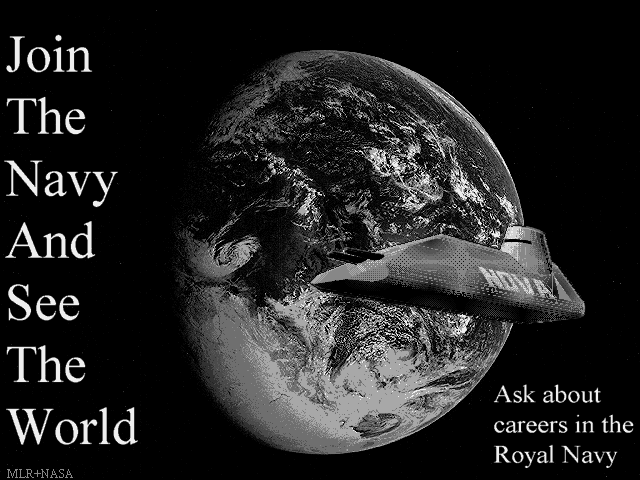
See 11_NAVY.GIF for a picture of this ship in flight. One of the adventures has a naval background.
The Orion, a typical liner
Liner, P&O lines, completed 1908
British, base Plymouth
Civilian control room, 20 x first class, 20 x 2nd, 20 x 3rd, 30 x 4th (crew), galley for 90, air lock, supplies (7 weeks), Cargo x 100 tons @ 3 cb.yds. per ton, strong room, Mk 1 navigation engine, short-range radio, 2 x searchlights, 2 x telescopes, 8 x breathing dress (engineering crew), 5 x lifeboats, 3 pairs atmospheric engines, 10 pairs Redgrave Standard Developing engines.
Hull cylindrical, standard plate / armoured glass
Volume 2444 cubic yards, mass 1341.7 tons, BODY 100
Atmospheric speed 17 mph, Difficulty modifier +3
Engine crystals £11,012 (x22), service life 22.4 months, max 3g
Engine cores 30 weeks capacity, recharge cost £40,878
Cost £1,337,076, Operating cost £15,754 per month.
This liner clearly shows the advantage of a large number of developing engines, but she only has three sets of atmospheric engines, rather than the five or more her mass would suggest were needed, and is extremely clumsy in atmospheric flight; she generally lands on water, then is towed to her dock by tugs. She must be extremely careful in her approach to Ganymede since she has barely enough engine power to break free if she ventures too close to Jupiter. Despite these failings she is a popular Earth-Ganymede service, almost always over-booked. Her Christmas flights are especially in demand. She has recently been upgraded with a Mk IV navigation engine and long-range radio, not shown in the above costs.
While the statistics for this craft do not include weapons, she has numerous mounting points for pneumatic cannon and pneumatic Gatling guns, and pipes for a compressed air supply to power them. In an emergency she can quickly be converted into an armed troop ship carrying up to 300 passengers and crew.
| Scenario Idea, 1908 onwards: Murder On The Ganymede Express This one speaks for itself, although it isn't a good idea to stick too closely to the Christie model. A few inscrutable Orientals and Ganymedans should keep players guessing, especially if the motive is moderately obscure. A Christmas setting offers some interesting possibilities for weapons disguised as presents, murderers disguised as Santa, bodies in sacks, etc... |
The Steel Baron, a typical mining ship
Mining Ship, private owner, 1912
American, base Tycho, the Moon
Civilian control room, 6 x 3rd class cabins, galley for 6, air lock, 26 weeks supplies, 150 tons cargo @ 1 cb.yd. per ton, 1 Maxim gun, 1 pneumatic cannon, Mk II navigation engine, long-range radio, 2 searchlights, telescope, 6 breathing dresses, no lifeboat, 1 pair atmospheric engines, 1 pair Redgrave Standard Developing engines.
Hull cylindrical, armoured steel
Volume 432.1 cubic yards, mass 377.6 tons, BODY 85
Atmospheric speed 30 mph, Difficulty modifier +2
Engine crystals £142,059 (x3), service life 62.9 months, max 2.5g
Engine cores 26 weeks capacity, recharge cost £13,668
Cost £758,175, Operating cost £6,793 per month.
Despite her name, this ship mainly mines rare minerals. She usually leaves Earth with her hold packed with explosives, drills, and other supplies, which are used or abandoned as she fills with ore. Recently her crew discovered a deposit of several tons of high-quality jadeite, the rarer and more valuable form of jade; her owners are cautiously selling it on the Chinese market, in quantities that won't bring the price down. The hull design is inherently clumsy, but she rarely ventures into the atmosphere anyway, being based at one of the Lunar refining plants. Her cannon and Maxim gun can be fired in space; the cannon is used mainly to break up rocks from a safe distance, the Maxim gun is for defence against claim jumpers.
The "Stella", the first interstellar spacecraft
Exploratory ship, built by public subscription, 1919
British, base Smeaton, Yorkshire
Civilian control room, 2 1st class cabins, 100 cb. yd exercise compartment, galley, air lock, supplies for 100 weeks (see below), Huxley algal food/air system (see below), 50 tons cargo @ 1 cb.yd. per ton, 2 x Maxim guns, 2 x pneumatic cannon, navigation engine mk V, long range radio, 2 x searchlights, 2 x telescopes, 2 x breathing dress, 2 pairs atmospheric engines, 1 pair Redgrave Superlative Developing engines, Rennick-Tesla Graviton plant.
Hull cylindrical, standard plate / armoured glass
Volume 369.2 cubic yards, mass 256.2 tons, BODY 85
Atmospheric speed 88 mph, Difficulty modifier +1
Engine crystals £181,829 (x10), service life 42.7 months, max 4g
Engine cores 100 weeks capacity, recharge cost £30,326 (see below)
Cost £6,895,181, Operating cost £9,830 per month (see below)
The Stella is a radical new design, utilising a variety of techniques
to extend endurance far beyond the figures above, which are emergency
reserves. Roughly half her food is carried in the form of concentrated
iron rations, the remainder is supplied by the Huxley algal system (50
cb. yds, 25 tons, £500,000) which converts sewage, carbon dioxide, and
nutrient chemicals into algae, which can then be processed to a
variety of tasty foods. A useful by-product is oxygen. The
experimental Tesla-Rennick graviton generator (100 cb. yds, 100 tons,
£4 million) recharges her cores in flight, so that in theory the only
resource that will eventually run out is the supply of engine
crystals. Note that the prices quoted for these items are estimates,
not precise figures; the algal system was constructed without charge
by a team of scientists and engineers from Imperial College, the
graviton plant was donated by R. Force Developments Inc. of America,
and Lord Redgrave provided the engines, the spare crystals, and the
work-force that constructed her.
3.7 The Astronef
return to contents
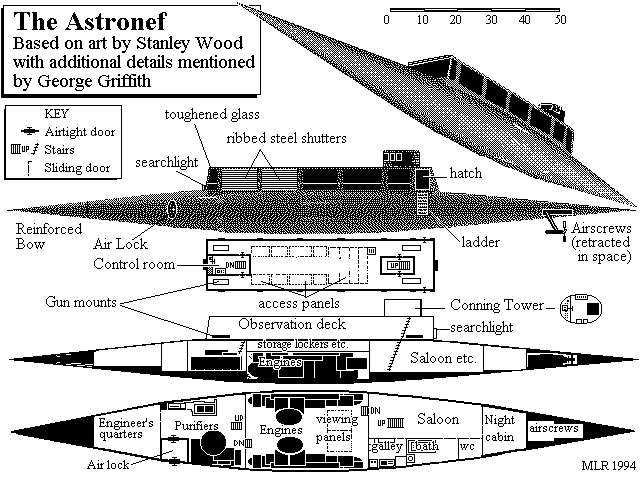
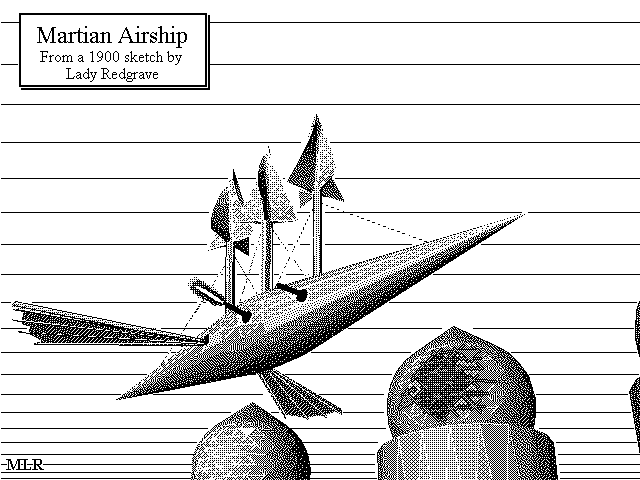
Although her main components have already been listed, the Astronef has many interesting features which bear closer examination. Study will undoubtedly reward designers who may be tempted to replicate or improve on her design. See 08_ASPLN.GIF for her layout. Various illustrations accompanying the Astronef stories show internal or external details.
The Astronef has two main decks; the glass-walled upper deck, and a lower deck inside the main cylindrical hull. There is also a small conning tower above the upper deck, which looks very like a funnel and is used mainly for navigation in deep space.
The greenhouse-like upper deck is used for recreation and observation, but is not absolutely essential to the operation of the ship; in an emergency the compartments around the stairs can be sealed, allowing air to be retained even if the glass is broken. This is unlikely, since the glass is thick and can be covered with steel shutters (raised pneumatically) in moments. Mounts for the ship's Maxim guns and pneumatic cannon are also on this deck; the weapons themselves are stored in lockers under the deck, along with many other supplies. The compartment at the forward end of the deck contains controls for the atmospheric engines and rudders, used for navigation in air. Some of the glass panels of the main compartment double as airtight hatches, and can be slid open in atmosphere; naturally this is only done after the air is thoroughly tested. For safety it is impossible to open them if there is a vacuum outside.
The layout of the upper deck makes the Astronef perfect for astronomical observations; there is even a large glass panel in the lower deck, allowing observation below the hull. Naturally it is usually protected by hatches and outer steel shutters. Later vessels often omit such refinements. Equipment customarily kept on the upper deck includes two powerful astronomical telescopes, deck chairs and tables, and Lady Redgrave's cameras.
Amidships the lower deck is largely occupied by the engines, air and water purifiers, and other machinery. There are large sliding hatches in the walls beside the engines, used mainly for servicing on Earth; like the hatches on the upper deck, they are securely fastened in space and held closed by tons of air pressure.
Forward are the engineer's cabin, which is also used as a workshop, and the airlock. This can be filled with air in less than thirty seconds, or pumped out in two to three minutes. Aft are the saloon, galley, bathroom, WC, night cabin, and the engines which operate the air screws. There is electric lighting throughout, the power being a by-product of graviton flow in the engine crystals. The electrical mains are 48v DC.
While the Astronef may seem large for the number of occupants, much of her volume is taken up by machinery, by pipes, ducts, and cables, and by stores. Most internal functions are carried out by electrical or pneumatic machinery, or by steam from a small electrically-heated boiler which is also used to distil drinking water. For example, the galley oven, hot plates, and grill are electric, with boiling water on tap for beverages. All compartments have steam radiators (which can instead be linked to an electrical refrigerator if the ship is too warm). Electrical fans circulate the air, then it is compressed and passed through various filters and chemicals to remove carbon dioxide and excess water vapour. Tanks of liquid oxygen supplement any shortage. After a few weeks the air is a little stale and insipid, but this is only noticeable by comparison with fresh air. Similarly, the water would have little or no taste if Lord Redgrave had not thought to add a supply of mineral salts to the distillation system.
An important function of the compressed air system is operation of the Astronef's cannon. These are four powerful smooth-bore pneumatic guns, firing two types of shell. The first contains a powerful explosive, equivalent to twenty pounds of dynamite. The second holds two liquids, an oxygenator and a powerful incendiary agent. When mixed they ignite spontaneously in a reaction which will continue even in a vacuum. The effect is like burning a similar weight of thermite. For obvious reasons both types of shell must be handled with great care; the incendiary is especially dangerous, since it could easily burn through the deck or hull of the Astronef if it were accidentally dropped, and shells are kept in padded cases until they are needed. The guns can throw these shells to a distance of about seven Terrestrial miles on Mars, about four miles on Earth; exact range depends on gravity and air resistance. They cannot be fired in space.
The other weapons carried aboard the Astronef include two Maxim guns, two ten-bore elephant guns firing explosive bullets, a dozen assorted rifles and shotguns, and six revolvers.
| Elephant Gun | no multiple targets, Effect 9 *, Wounds A:I B:C C:K |
| * Explosive shells raise Effect to 15 | |
If the air and water systems are the lungs and blood-stream of the Astronef, her nervous system is the complicated network of cables, rods, speaking tubes, and telephones linking her control rooms and engines. Lord Redgrave can regulate her flight without leaving the conning tower, with Murgatroyd operating the developing engines and atmospheric engines at his command; precise adjustments for interplanetary flight require Lord Redgrave's personal attention, but they are comparatively rare.
The developing engines are in the lowest part of the vessel amidships, and much of the engineer's time is devoted to their care. While the main components are very small, they are mounted in bulky rotating frames which allow them to be focused in any direction. More complexity is added by the electrical and pneumatic control equipment, and by electrical generators which convert the low-voltage output of the engines to 48v DC. When the engines are operating they are virtually silent; the only noise is the faint hum of the regulatory tuning forks, an occasional click as the frames shift to maintain precise focus, the chug of the pneumatic pumps, and the whirr of the generators. Efficient use of mineral wool and asbestos insulation ensures that mechanical noise is kept to a minimum; it is only faintly audible outside the engine compartment, and the upper deck is completely quiet.
The saloon is fitted to the finest standards, with maximum attention paid to the comfort and convenience so essential when it is sometimes occupied for weeks on end. The floor is the finest teak, while the inner lining of the walls is panelled in oak. Neatly concealed cupboards contain small arms, a wine chest, Lady Redgrave's photographic equipment, a microscope and dissecting tools, medical supplies, and other essentials. For entertainment there is a phonograph with a comprehensive selection of cylinders, a magic lantern with many slides, a range of board and card games, and a compact library containing the best of English science and literature, plus many important works by foreigners such as Lowell and Flammarion. Naturally the night cabin is fitted to a similarly high standard.
The bathroom has hot and cold water, and an extraction system which takes damp air straight to the purifiers. One unusual refinement is the ease with which it can be converted into a darkroom; a lid folding down over the bath is used as a workbench, and compartments contain Lady Redgrave's enlarger, developing dishes, and a good supply of photographic chemicals, papers, and plates.
Finally, the upper conning tower is fully equipped for navigation, with large-scale star charts, a sextant, chronometers, and sets of logarithms and other tables and instruments. In space it is the nerve centre of the ship; the forward control room only comes into its own when the Astronef is flying in an atmosphere or preparing to land. Lord Redgrave himself devised many of the instruments, and a few have no parallel in Terrestrial navigation. Naturally all skilled pilots are fully conversant with their use in later years.
By far the most important is the gravitational compass, which uses a gimbaled needle with R. matter and G. matter tips to obtain an exact bearing on the nearest strong gravitational source. It is also possible, but much more difficult, to obtain a rough bearing on strong R. graviton sources, such as the engines of spacecraft.
[The difficulty of this feat (using Pilot skill) should vary with the needs of the adventure, but it should never be easy. Maximum detection range should be low; under a million miles for a ship in deep space, a few thousand miles anywhere near a planet, and a hundred miles or less for a ship on the surface of a planet. Occasionally freak conditions extend or reduce the range dramatically.]
A Honeymoon In SpaceMany of the details of this section are contradicted by A Honeymoon In Space. Briefly:
Some of these changes have implications that would make it necessary to revise most of the worldbook and all details of the R. force and spaceship design and operation. Their cumulative effect does not make this setting more interesting or usable as a role-playing background; to avoid such extensive revisions I have decided to ignore the new data, and stay with the descriptions in the original stories. |
Spacecraft fly by means of the R. force, but otherwise obey the normal laws of gravity and inertia. The engines push against whichever massive object has been selected (generally the nearest planet), and are often capable of imparting an acceleration of three or four gravities. Unfortunately the occupants would be extremely uncomfortable under this force.
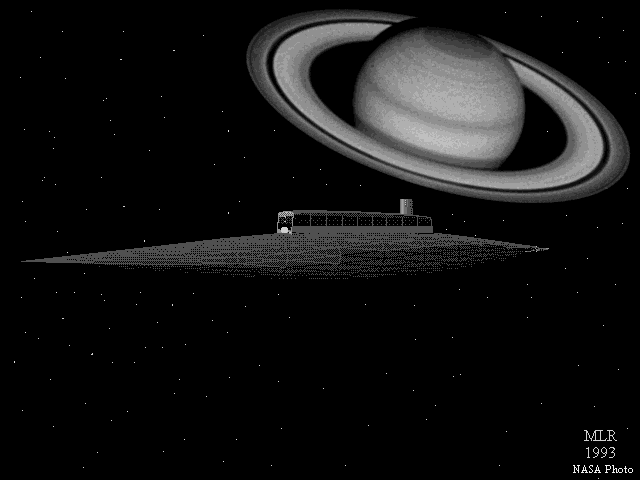
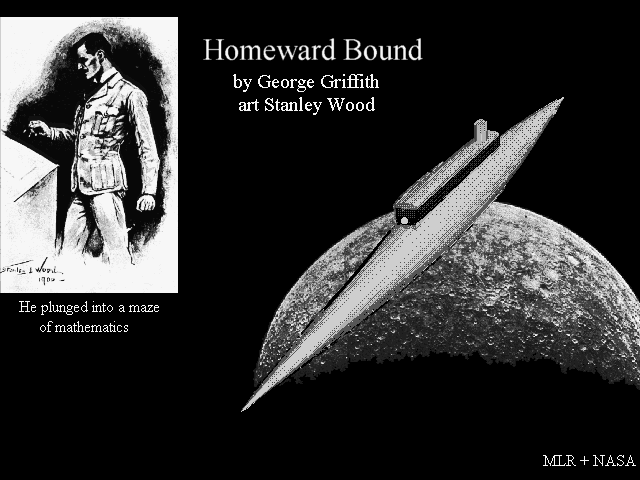
When a spacecraft accelerates, the occupants feel weight proportional to the force exerted by the engines, added to the local gravity. For this reason most craft accelerate extremely gently when they leave the Earth, so that the upward thrust of the developing engines just exceeds the downwards pull of the Earth. As the craft rises the pull of gravity slowly decreases, and the force exerted by the engines is raised; the acceleration counterfeits the normal gravitational force. For convenience this force must be exerted downwards, towards the decks. This means that spacecraft must take off vertically and fly with the developing engines pushing against objects "below" the ship. Illustrations showing ships flying in deep space, but in the atmospheric bow-first mode, are dramatically appealing but incorrect (see 06_HOME.GIF, 07_ASTNF.GIF and 11_NAVY.GIF for examples). While most spacecraft have engines capable of exerting much more than 1g, this power is a reserve used for emergencies and to overcome strong gravitational forces near the giant planets.
While one gravity may not seem much acceleration, it soon builds up to colossal speed. In practice most craft must spend a good deal of time in slow acceleration as they depart, and slow deceleration as they near their destinations. For instance, the Earth-Moon journey should theoretically take three hours at 1g, but usually needs ten because a good deal of time is spent at relatively low speeds, gaining altitude and matching speed with the Moon. Similarly, travel times may be extended by such factors as the position of the planets relative to each other and the Sun, the need to shed or gain orbital velocity, etc. Ignoring the special case of the Earth-Moon run, which is just too short for efficiency, the average acceleration after these factors are taken into account is roughly 0.5g for private and commercial vessels, and 0.75g to 1g for military craft. Engines are built to give their most economical performance in these ranges, and running at higher acceleration for prolonged periods may seriously reduce the charge stored in the core.
| Travel times (days) at opposition (Maximum distances between planets) | |||||||||
| Planet | Distance from Sun | M | V | E | M | J | S | U | N |
| Mercury | 36.3 M | - | 4.3 | 4.8 | 5.6 | 9.6 | 12.7 | 17.8 | 22.3 |
| Venus | 67.0 M | 4.3 | - | 5.3 | 6.0 | 9.8 | 12.9 | 18.0 | 22.4 |
| Earth | 93.0 M | 4.8 | 5.3 | - | 6.4 | 10.1 | 13.1 | 18.1 | 22.5 |
| Mars | 139.5 M | 5.6 | 6.0 | 6.4 | - | 10.5 | 13.4 | 18.3 | 22.7 |
| Jupiter | 483.6 M | 9.6 | 9.8 | 10.1 | 10.5 | - | 15.5 | 19.9 | 24.0 |
| Saturn | 883.5 M | 12.7 | 12.9 | 13.1 | 13.4 | 15.5 | - | 21.6 | 25.4 |
| Uranus | 1767.0 M | 17.8 | 18.0 | 18.1 | 18.3 | 19.2 | 21.6 | - | 28.3 |
| Neptune | 2790.0 M | 22.3 | 22.4 | 22.5 | 22.7 | 24.0 | 25.4 | 28.3 | - |
| Travel times (days) at conjunction (minimum distance between planets) | |||||||||
| Planet | Distance from Sun | M | V | E | M | J | S | U | N |
| Mercury | 36.3 M | - | 2.3 | 3.2 | 4.3 | 8.9 | 12.2 | 17.4 | 22.0 |
| Venus | 67.0 M | 2.3 | - | 2.1 | 3.6 | 8.6 | 12.0 | 17.3 | 21.9 |
| Earth | 93.0 M | 3.2 | 2.1 | - | 2.9 | 8.3 | 11.8 | 17.2 | 21.8 |
| Mars | 139.5 M | 4.3 | 3.6 | 2.9 | - | 7.8 | 11.4 | 16.9 | 21.6 |
| Jupiter | 483.6 M | 8.9 | 8.6 | 8.3 | 7.8 | - | 8.4 | 15.0 | 20.1 |
| Saturn | 883.5 M | 12.2 | 12.0 | 11.8 | 11.4 | 8.4 | - | 12.5 | 18.3 |
| Uranus | 1767.0 M | 17.4 | 17.3 | 17.2 | 16.9 | 15.0 | 12.5 | - | 13.4 |
| Neptune | 2790.0 M | 22.0 | 21.9 | 21.8 | 21.6 | 20.1 | 18.3 | 13.4 | - |
The spreadsheet template TRAVTIME.WK1 can be used to calculate journeys at any desired acceleration; the results are based purely on acceleration and ignore all other factors. [It includes a planet called Pluto which does not, of course, exist in this universe.]
It's interesting to note that on its first flight the Astronef took more than eleven days to fly from the Moon to Mars; no engine problems were reported, so evidently Lord and Lady Redgrave weren't in any great hurry. Of course they were on their honeymoon...
Because the R. force pushes against objects such as planets, it is
often desirable to manoeuvre close to such bodies en route to a more
distant destination. For example, a ship travelling from Earth to
Jupiter will usually use the R. force to push towards Mars if it is in
the right part of the sky, then transfer the focus of the developing
engines to Mars as it continues on towards Jupiter. It might also use
Ceres or one of the other asteroids as another "stepping stone" in its
flight. This manoeuvre is generally described as "tacking".
3.8.1 Common Problems
return to contents
Unless a ship is badly managed, any normal journey should be trouble-free. The main causes of difficulty are navigational errors, mechanical failures, and stress due to unusually powerful gravitational fields or acceleration. All should generally be entirely avoidable.
Most navigational errors are due to poor watchkeeping. Although spacecraft are extraordinarily fast, interplanetary distances are so vast that there should still be ample time to check courses and correct for any error. Especial care should be taken if one of the less accurate types of engine is in use; the Westinghouse-Tesla design was expressly designed for short-range flights, and its aiming mechanism is inherently unreliable for long-distance use. The Rolls-Royce model is also a little inaccurate, since the anti-magnetic screening around the engine has a slight but unavoidable damping effect on the control magnets around the core.
Common sense and practice require a navigational check at least three times a day, followed by careful calculation of the course, and appropriate modification of the engine settings if necessary. Factors that can affect the result include the accuracy of the developing engines, as described above, the use of a navigational engine, and so forth. Usually there is no particular difficulty about the operation, above and beyond normal use of a pilot's skill, although some tricky manoeuvres require extra care.
Mechanical failures are also likely to be due to inadequate attention. The best developing engines are extremely delicate, and without constant care they soon become temperamental. While in most ways a fine engine, the Redgrave Superlative has a reputation for minor problems, while one Rolls Royce machine continued to work after the engineer accidentally dropped a mallet onto its core control magnets. Other engines fall between these extremes. Complexity also affects ease of servicing; the Redgrave Superlative service manual runs to 128 pages with fourteen fold-out charts, the Tesla-Westinghouse equivalent is barely half the size.
Usually one engineer or mechanic should be employed for each pair of developing engines. If there are less there is a good chance that servicing will be skimped. Unfortunately it is easy to become obsessed with the engines and forget that the other machinery aboard ship requires its fair share of attention, as does the structure of the ship itself; a ship with perfect engines but faulty life support equipment or a leaking weld is a death trap.
The most common causes of problems are human error and overloading of the engines. Both can be attributed to prolonged acceleration. While engines are often designed for 3 gravities or more, the occupants are not; engineers and mechanics soon become tired at these accelerations, and errors are almost inevitable. Even if the engines aren't over-stressed, running at high gravities increases the strain on the cores and crystals, and on auxiliary equipment such as the focusing magnets and generators. Things get worse if the engines are overloaded; for example, if one or more pairs of engines is out of service the other engines will be lifting more than the mass they were designed for. Pilots sometimes try to exceed the maximum acceleration their engines were built for; while this often works for a few minutes, sometimes for hours, the inevitable result is rapid deterioration of the engine crystals and cores, and an increased chance of a breakdown.
If some of the engines of a ship are out of action, the other engines share the load, but at proportionally lower acceleration. For example, a ship with two pairs of engines might be rated at 3g; if one pair is taken out of action, the other pair could continue to move it at a maximum of 1.5g, but the chance of a breakdown is increased.
The acceleration of overloaded ships is reduced by the proportion of the overload; for instance, a 100 ton 3g ship carrying 50 tons of excess cargo can only accelerate at 2g. This also applies to ships towing or pushing other ships.
Engines must always operate in pairs; it isn't possible to take just one out of service. For instance, if one of the Astronef's engines were out of action the other would be unusable until it was fixed. This could be catastrophic if it were on the verge of landing.
In an emergency engines can be "pushed", increasing the maximum gravity rating. Usually it is impossible to predict how much extra force will be produced, and damage is almost inevitable. For example, an engine rated at 2g might give 50% extra thrust, or 3g, the first time it was abused in this way, but only 10% extra power the next time. It might also break down after a few minutes.
Game Data
If the players say that they are going to take sensible precautions
against an error (such as regular position checks, engine maintenance,
and so forth), and the ship is flying a familiar route, the referee
need never ask for the dice to be rolled. If they seem to be doing
things sloppily, or are venturing into unknown territory, more
frequent rolls might be needed.
The basic Difficulty of any navigational calculation is 6, rolled using the Pilot skill (the Scientist skill may optionally be substituted). The factors that can affect the operation, to a minimum Difficulty of 2 or maximum of 10, can include any or all of the following:
| Navigational engine Mk 1 | -1 * |
| Navigational engine MK II,III | -2 * |
| Navigational engine MK IV | -3 * |
| Navigational engine Mk V | -4 * |
| * Also requires a successful Babbage Engine roll, or | |
| Failed Babbage Machine roll | +2 |
| Not using a telescope | +2 |
| Following a familiar course | -1 |
| Earth-Moon run | -2 |
| Redgrave Superlative engine | -2 |
| Redgrave Standard engine | 0 |
| Rolls Royce engine | +1 |
| Tesla-Westinghouse engine | +2 |
| Per 12 hours without a check | +1 |
| After any failed check | +2 |
| Within 1,000,000 miles of Jupiter | +2 |
| Within Saturn's rings | +2 |
| Engines have been damaged | +2 |
| Engines are not properly serviced | +2 |
| Emergency manoeuvre | +1 to +3 |
| (depending on circumstances) | |
| Per week in flight | +2 * |
| * A "tacking" manoeuvre resets time to zero | |
If the navigation roll fails there has been a slight (or possibly catastrophic) error somewhere along the line, either in determining the position or in setting the course for the next few hours. The navigator need not necessarily know that an error has occurred; if the referee keeps the modifiers secret, the navigator can't be entirely sure that there is (or isn't) a problem. Find the effects by checking against the severity of the failure, as follows:
Despite all of the above, there is no need to pay too much attention to navigation if it is irrelevant to the needs of your campaign. For example, if the characters are busy with a complex intrigue involving the jewels (or life) of an NPC they will only be annoyed, and possibly distracted, if you pester them for regular navigation checks.
Tacking - flying close to a planet and using the R. force to push away from it - is a fruitful source of dramatic tension. Will the manoeuvre succeed, or will the spacecraft be thrown off course? Are pirates waiting in low orbit, ready to ambush any ship that passes by? Will the ship be hit by a meteor, or run into a hitherto-uncharted minor moon? It's up to the referee to decide.
Engines that are "pushed" develop 2D6-3 x 10% extra thrust. This gives a range of -10% to 90% extra thrust. -10% represents a catastrophic failure, with the engine requiring servicing before it can develop full thrust or can be "pushed" again. Kind referees won't leave adventurers in a death trap if this happens.
The difficulty of servicing developing engines is 8, with the following modifiers:
| Redgrave Superlative | +2 |
| Redgrave Standard | 0 |
| Rolls Royce | -2 |
| Tesla-Westinghouse | -1 |
| Engineer overworked | +2 |
| Acceleration 2g or more | +1 |
| Engine "pushed" above design rating | +2 per hour |
| Engine overloaded | +1 |
| Maintenance neglected | +2 |
Some other systems that need occasional attention include the following; all are difficulty 5:
As with navigational errors, maintenance should only become a problem if players persistently ignore it; if they occasionally mention that someone is taking care of it, you need never worry about rolling the dice.
The effects of low and high gravity are described in more detail in
section 4.0]
3.8.2 Hazards
return to contents
Space is virtually empty; while there are occasional meteors, they are extraordinarily rare. None were encountered during the maiden voyage of the Astronef, and most flights are without incident. The rare exceptions are usually particles no larger than a grain of rice, easily deflected by the armour of any well-built ship; those that penetrate tend to embed in the layers of tar inside the hull, which melt with the heat of impact and quickly form an airtight seal.
When the more dangerous effects of x-rays and radium were discovered, there were fears that there might be similarly dangerous radiation in space. Fortunately this is not the case; the Sun is made of burning hydrogen, not radium, and does not generate X-rays. The only dangerous radiation it produces is heat, easily minimised by suitable insulation, or by refrigeration on flights towards Mercury.
Ships on the Mercury run travel with all spare cargo space packed with ice. Melted water is allowed to evaporate into vacuum, cooling the ship even more, or sprayed into the air around the ship once it has landed on Mercury. This keeps conditions tolerable while the ship loads its ore, but means that great care must be taken to avoid running out of ice before the ship retreats from the Sun, while loading a maximum amount of cargo. Ideally just enough ice is carried to last until the ship passes the orbit of Venus on the return journey.
One of the most dangerous problems aboard ship is fire. Some of the chemicals used in air purifiers react violently with water, with electrical cables, oxygen, tar, and wooden panelling adding their own dangers. Fortunately the vast majority of fires can easily be extinguished if they are caught in time; just close a few airtight doors to contain the blaze, then vent the compartment to the surrounding void. Breathing dress is naturally fireproof, although some extreme conditions can damage the oxygen cylinder or knock out the air purification chemicals.
Professor Rennick's incendiary compound poses special problems, because it will burn in a vacuum and develops enough heat to penetrate asbestos. It is made by mixing two chemicals; if they are kept well apart, and only allowed near each other as shells are charged, the risk of a fire is minimised. Warships generally keep a few ready-charged shells for each gun, packed separately in asbestos-lined lockers, with armourers filling more shells as they are needed. Even with these precautions magazine fires are greatly to be feared, and the largest warships are built to jettison them into space in an emergency.
Game Data
Meteors should be very rare, only encountered when it serves the needs of your campaign. Unless you decide otherwise they should be rated as
| Meteor | Effect 6D6, Wounds A:I B:C C:C/K |
the hole they leave will always self-seal, or will be small enough to be plugged easily. Hollywood's depiction of all the air in a compartment instantly rushing out through a small meteor hole is a myth; the effect would be more like a powerful vacuum cleaner sucking air through the hole, causing a relatively slow pressure drop.
Any Effect which remains if a meteor penetrates the hull will be used inside, carrying on to damage more items until all its Effect has been shed. Internal partitions are BODY 10, pressure bulkheads (such as airlock walls etc.) are BODY 15, engineering components (such as engines) are also BODY 15.
Example:
A meteor with Effect 28 penetrates the Astronef's hull.
15 Effect is shed in the hull, leaving Effect 13 to damage the
interior of the ship. The referee decides that it has struck
Murgatroyd's compartment, heading towards the stern of the ship;
fortunately Murgatroyd is working on the engines at the time. The
meteor ploughs through the compartment, smashes a photograph of
Murgatroyd's mother, bangs through the door (overcoming BODY 10, but
losing effect 10), and strikes the life support equipment with Effect
3, which does not do any significant damage. An extremely hot lump of
nickel steel mashes against the casing of the equipment, leaving a
neat disk which drops to the floor. Murgatroyd checks his compartment,
finds that air is still leaking out (slowly, since the hole is small),
plugs it with a lump of putty, then coats it with tar. Once the
Astronef lands he will rivet a patch over the outer hole. Lord
Redgrave finds the remains of the meteor, and has it mounted in a
locket for Zaidie.
All bets are off if a ship is hit by a REALLY big meteor, but this is only worthwhile if you want to maroon the adventurers or involve them in an elaborate rescue mission. At top speeds a big meteor would vaporise a ship, not just make a hole.
The note on radiation assumes that your campaign minimises or ignores atomic energy, and uses the variant atomic structure described above. In the real universe the steel-hulled ships described by Griffith would convert relatively harmless forms of radiation into showers of lethal particles, and the maiden flight of the Astronef would have ended with three unpleasant deaths.
Any fire is extremely bad news; unless the air vents are quickly closed the entire ship will soon be flooded with smoke and fumes, overloading the purification system. All ships are equipped with water-based fire extinguishers, using pumps to propel the liquid, and are compartmented to minimise the spread of fire and loss of air. Big ships have fire alarm switches in every compartment; as well as sounding the alarm, they shut down the ventilators to the compartment. Smaller ships, and all early models, lack these refinements.
Only the largest warships are equipped to jettison their magazines;
the magazine is built as a box inside a bay with remotely-operated
doors. In an emergency airtight doors close, the bay doors open, and
powerful springs throw the compartment into space. Anyone inside the
compartment is naturally killed if they are not wearing breathing
dress. Magazines with this capability should be purchased as cargo
holds, volume 1 cubic yard per ton; the cost of the extra equipment is
negligible. Naturally there are interlocks to stop the bay doors
opening if the airtight doors aren't shut, and the occupants of the
magazine can over-ride the controls to prevent jettisoning.]
3.9 Combat
return to contents
Spaceships can almost always avoid a fight if the crew know that trouble is coming. They are fast, extremely manoeuvrable, and accelerate very rapidly, while weapons have short ranges and are often much slower than their targets. Projectiles don't have any homing mechanism, and can't be remotely controlled. Even if a moving spacecraft attacks a motionless target, the ballistics are extremely complex. The only way that two ships can fight for more than a fraction of a second is to match courses and speeds, close to a convenient distance (no more than 2-3 miles), and start taking pot-shots at each other. In practice very few captains are stupid enough to let this happen.
Surprise attacks are a different matter. There have been a few cases of piracy, usually against mining ships; where the details are known, the attacker has invariably used trickery to close to point-blank range and match speeds and courses, then disabled the target before it could make an escape. For instance, one pirate pretended to be a courier carrying an urgent message from the victim's owners, another pretended that there was a fire aboard and requested aid from the victim. In other cases it is believed that there was a saboteur aboard the target ship.
When combat does occur it usually lasts just a few moments before the ships break contact, usually because of radical course changes or a sudden change of acceleration.
Attacks that take place in atmosphere, or against grounded spacecraft or other targets, are different. Here speeds are comparatively low, and there is usually little room to manoeuvre. The advantage always lies with the fastest ship and the best gunners and pilots.
Some early spacecraft were equipped to ram. Although this is often the only way to ensure damage to a target that is rapidly changing its velocity, it is now generally regarded as a tactic of desperation, since the most likely result is serious damage to both ships.
Bombs and machine guns are mainly carried for use against ground targets, and are almost useless against spacecraft. It is theoretically possible for a ship to drop bombs in the path of its pursuer, but speeds are so vast that an error of a few thousandths of a second would mean a miss by hundreds of feet or even miles. Dumping a large number of small heavy objects into the path of a pursuer may be much more effective; in one incident a mining ship dropped a few spadefuls of rock chippings, which spread out into a cloud of fragments, holing the pursuer in several places.
Game Data
This game does not include a complex spaceship battle system for war-gamers; if that's what you want, you may prefer to use one of the rules systems mentioned in Appendix B of the Forgotten Futures rules.
Spaceship combat is a contest of skills, consisting of attempts to use
the ship itself, or its weapons, to damage an enemy. Gun combats etc.
can be resolved by the normal game rules. The faster ship in a combat
can run rings around its opponent. This is most easily resolved by
giving the occupants of the faster ship +1 for each .5g advantage they
have over their opponents. For example, if the Astronef (5g) attacked
a pirate freighter (3g), all relevant skills would gain a +4
advantage!
3.9.1 Ramming
return to contents
Ramming is suicidal, unless the collision takes place at extremely low speed or the victim is flimsily built. It can only occur if the craft involved are on a collision course, or the craft that is doing the ramming is faster than its opponent. Unless complete surprise is achieved the attacker must make several successful skill rolls, overcoming the skill of the opponent, to achieve a collision. This assumes, of course, that the defender wants to evade; if not, collision is automatic.
Divide the difference in speed between the two ships by 10, then add the mass of the attacker, to get the attacking Effect. The defender is the BODY of the defending ship. Both of these numbers will probably fall well off the normal attack versus defence table, so divide both (usually by 20 or 30, as explained in the rules section 1.2.1) to get onto the table. After both numbers are in the range covered by the table, apply the following modifiers:
| Head-on collision: Side-on collision: Overtaking collision: Attempting to evade: Equipped to ram: |
+2 +1 -1 -4 (see below) +4 (see construction rules) |
Example: Maybe This Wasn't A Good Id....
The Astronef (mass 99.6 tons) pursues and rams a pirate freighter,
which has BODY 80.
The speed difference is 1500 MPH. It will be an overtaking collision
and the Astronef is equipped to ram, while the target is not.
The Effect of the attack is 1500/10 + 99.6 rounded to 250
The defending BODY is 80.
Dividing both by 40 puts them back on the scale at 7 and 2, with the
attacking Effect reduced to 6 because it will be an overtaking
collision, but raised to 10 because the Astronef is equipped to ram.
Naturally the damage goes both ways; the freighter attacks the Astronef with its mass (500 tons) and the speed difference (1500/10), for a total Effect of 650 against BODY 75. Dividing both by 50 reduces them to 13 against 2, with the freighter's Effect reduced to 9 because it is attempting to evade.
Use the damage result table as follows:
Example: Maybe This Wasn't A Good Id.... (2)
On a 4 the Astronef easily slices into the freighter. On a 9 the
damage is severe enough to destroy the freighter. Unfortunately the
roll for the freighter is a 3 followed by a 2; the Astronef is also
wrecked. There are no survivors.
If both ships survive a collision, a Pilot roll is needed to separate them afterwards. If the roll fails, a sadistic referee may wish to inflict further damage on both ships.
At lower speeds, or against a much smaller target, there is a better chance of survival. For instance, the ramming described in The World of the War God took place at about 100 MPH, and the target ship probably weighed ten tons with BODY of 20. Let's see how this would work in terms of these rules:
The Astronef attacks with Effect (100/10)+99.6, rounded to 110,
against BODY 20, which is reduced to 6 against 1. Modifiers to the
attack are +4 for the ram, +1 for a side-on collision, for a final
Effect of 11 against BODY 1. While this just goes off the table, the
referee decides that a 12 will be damage A, 6-11 damage B, 2-5 damage
C. On a 4 the Astronef slices the Martian ship in two. Meanwhile the
Martian ship's Effect is only 10+10 = 20 against BODY 75, divided down
to 4 against 15, and reduced again to the minimum of 1 against 15
because the pilot is trying to evade. The referee rules that the
difference is so great that there is no chance of the Astronef being
harmed by the collision.]
3.9.2 Bombs And Torpedoes
return to contents
Bombs are carried by most military ships. Torpedoes use a similar warhead, mounted on a compressed-air motor which will propel it up to a mile; they are designed for use against surface ships, and are useless away from water.
Both classes of weapon are designed almost exclusively for use against ground (or water-borne) targets, since it is impractical to aim against a moving spacecraft with any degree of accuracy.
| 1000 lb bomb: | 20ft radius, Effect 30, A:I B:C C:K |
| Torpedo warhead: | 20ft radius, Effect 25, A:I B:C C:K |
These are less powerful than the explosives described in Forgotten Futures I: The A.B.C. Files, which were developed by more advanced technology in the face of much tougher weight problems.
See section 3.9.3 below for rules for hitting another ship with
dropped weapons, but there is an additional modifier of +6 to the
defending pilot's skill if only one bomb is used. This modifier is
reduced by 1 for each bomb dropped, to a minimum of +1
3.9.3 Throwing Rocks
return to contents
As mentioned above, dropping a large number of projectiles into the path of another spacecraft can be a relatively effective form of attack. There are two main circumstances in which it is effective;
It might also be possible to use these tactics to attack a ship on a converging or opposing course, but the odds against a hit are astronomical. Any projectiles which hit act as meteorites, as described above.
The basic chance of a hit is found by use of the pilot's skills, with the modifiers described above in section 3.8, but halve the attacking skill if the ships are not on exactly the same course. If a hit does occur, roll skill versus skill again to determine how many rocks hit:
| A: 1 | B: 1D6/2 | C: 1D6 |
This weapon is an extraordinarily powerful magnetic beam, generated by dozens of projectors, originally developed as a defence against meteors. It is based on a strongly magnetic particle analogous to the graviton, known as the "magnetron". Its effect is to immobilise all the moving parts of an R. force engine, most notably the aiming mechanism, generators, and focusing magnets. At low power the target is unable to alter course or speed; at medium power it is immobilised; at high power it would theoretically lose all control and crash. The range is five to ten miles.
The equipment is an array of dozens of projectors, each weighing several tons, and is only found defending a few of the largest Ganymedan cities. Since they draw power from the magnetic field of Jupiter there is little chance that a portable version will be developed.
The magnetic screening in Rolls Royce developing engines reduces the effect considerably, but can't stop it completely; otherwise there is little or nothing that can be done to overcome the power of these beams. Fortunately the Ganymedans are friendly, and the short range of their beams means that they would pose no threat if their attitude were to change.
Game Data
These rays are guided by dish-like wireless antennae, and are
activated whenever any object is on a collision course with one of the
protected cities. There are so many ray projectors that a spaceship
travelling at low speed will always be caught; don't bother to roll.
To attack a spaceship travelling at high speed the operator (skill
8-10) must overcome the skill of the pilot. Meteors (and other
projectiles) are automatically deflected off course, usually crashing
outside the city.
| Distance | Effect |
| 0-3 miles | 100 |
| 4-6 miles | 75 |
| 7-10 miles | 50 |
| 11-15 miles | 25 |
| 16-20 miles | 10 |
The Effect must overcome the BODY of the spaceship. This usually means dividing the Effect and BODY by 10 to get them onto the attack/defence chart. Results of a hit are as follows:
If the Ganymedans use the ray against a spaceship they will usually limit
the power to avoid damaging it, so that only an "A" or "B" result can
occur. The screening on Rolls Royce engines halves the Effect of the
ray.
3.10 Flying Dreadnoughts
return to contents
At the dawn of the Space Age many nations dreamed of invincible flying battleships, mounting a formidable array of weaponry and able to advance inexorably towards any target, no matter how well it might be defended. Unfortunately there were snags...
Anywhere near a planet the weight of such a vehicle is supported on invisible "stilts" of the R. force. Any jolt or turning force (such as the sideways blast of a big turreted gun) tends to start the ship rotating about at least one axis. The effect is minimised if the recoil is comparatively small, or is aligned along an axis of rotation, but this is difficult to achieve with big guns. The Astronef was equipped with compressed air guns which had a very light recoil; HMS Nova, and other similar craft, achieve stability by firing both guns simultaneously, with the recoil balanced to either side of the longitudinal axis of the ship. Even so they would soon lose control if they were not travelling forward with some speed. Even the largest warships (such as Germany's Hindenberg) have their main weapons arranged symmetrically around their longitudinal axis, and may even lurch backwards if they fire all guns at low speed. The severity of this problem increases with the size of guns and the distance of guns from the axis of rotation. One miscalculation or malfunction, such as firing the guns in an asymmetrical pattern, can send the ship spinning out of control.
A second problem is speed and manoeuvrability. Big ships are notoriously hard to handle, especially in atmosphere, and are usually slowed by air resistance. The largest ships bristle with propellers, but efficiency is low.
Most of these problems go away if a ship is travelling in vacuum at interplanetary speeds, but at these velocities the chances of hitting anything are negligible. Big ships are thus expensive status symbols, vulnerable to fleets of smaller and cheaper warships.
Naturally this situation will change as designs improve; 1920 military doctrine puts the most useful size of warship at about 1000 tons, in 1915 750 tons was considered excessive. Eventually it should be possible to overcome the limitations described above.
Game Data
The design rules make big ships extremely expensive, especially if the
guidelines on crew numbers are followed. Big ships bring a host of
problems for referees; everything from working out the chain of
command to keeping notes on hundreds of crewmen. They also tend to
dominate adventure plots - players sometimes forget to be subtle when
a few fourteen-inch shells can take care of most problems. While the
existence of "the fleet" is sometimes useful as background
information, or as a threat of retribution, the reality that
adventurers encounter should be smaller vessels and support craft, not
lumbering dreadnoughts. Small-ship military campaigns are more fun,
and recommended if your players are capable of the degree of
cooperation needed; for example, will players obey the orders of their
captain? Under all circumstances?
German flying dreadnoughts of the Great War were not capable of space flight, and had most of their weapons mounted in turrets. To design one use the methods described above but make the following changes:
Unless they are passengers on the largest liner, all spacefarers inevitably spend some time in breathing dress.
The Redgrave Patent Breathing Dress is the first and best design, improved by its makers but never excelled. It resembles a diving dress but is much lighter, made of asbestos-cloth lined with rubberised fabric and padded with quilted cotton or lambswool. The helmets are aluminium covered with asbestos, and contain a small telephone; a model incorporating a miniature wireless will probably be available soon. There is a lantern on the chest plate; some models also have helmet lamps. The backpack contains equipment to regulate and recycle liquefied air, released from a cylinder below the pack. Efficiency is very good, and endurance can be measured in days. The pressure of air inside the helmet regulates the supply. An airtight collar stops air circulating into the dress, to prevent the material tearing or ballooning until it is impossible to move, but the interior of the suit is not a complete vacuum; a little air is bled in to maintain partial atmospheric pressure and protect the skin and body from vacuum-related injuries such as ruptured veins. For prolonged use it is advisable to wear elasticated underclothes, which help maintain the body's pressure. While it is possible to put on a breathing dress in minutes, fittings can take several days. They must be precisely tailored to the wearer's body, and repeatedly tested before they are worn in a vacuum.
Breathing dress is illustrated in 01_MOON.GIF and 09_SUITS.GIF
Game Data
This expands and slightly modifies the description in A Visit to the Moon
Griffith anticipated several problems encountered by real space-suit designers in the 1950s and 1960s; most notably, the need to limit pressure in the main suit to keep the limbs flexible. However, there is one significant omission; these suits do not have any plumbing, or any arrangement for the supply of food or water without removing the suit. Maximum endurance is thus measured in hours, not the days claimed for the model; while the air does last that long, sooner or later the wearer will need to drink or use a lavatory.
Breathing dress acts as armour to reduce the Effect of all blunt weapons by 3, of all sharp weapons by 2. Since the helmet is isolated from the body, the wearer does not automatically suffocate if the suit is damaged, but any damage which actually rips the suit is automatically made worse if there is no air; flesh wounds become injuries, injuries become criticals, and criticals become kills. Double the difficulty of first aid if a suit is ripped. The helmet windows have BODY 3 for purposes of resisting damage.
Because breathing dress is made of asbestos fibre, it gives some limited protection against fire. Reduce the Effect of all fires by 4 for 1D6 rounds.
The backpack has BODY 4. It contains lead-acid batteries, soda lime
and other air purifying chemicals, and is linked to a supply of
liquefied air. Any damage which affects the pack is likely to have
catastrophic results, as the acid reacts with the soda lime or eats
through a pipe. Referees should try to avoid killing characters
instantly if their packs malfunction; it's more fun to describe fumes
gradually contaminating the air supply, searingly cold liquefied air
leaking down the character's back, the desperate race for the airlock
before the final catastrophe, and so forth. Then kill them...
3.12 Flyers
return to contents
The Ganymedans are masters of magnetic science, and their flyers reflect this technology, using "magnetron" particles to induce a strong magnetic field in the surface of their worldlet, riding the field by repulsion. Before the visit of the Astronef they could reach heights in excess of five hundred feet, and speeds around a hundred miles per hour. Since they are lifted by a repulsion effect, they are almost impossible to crash; the force buoying them up grows more powerful as they approach the ground!
On Earth TWR (Tesla-Wright-Redgrave) Inc combined the Ganymedan technology with advanced aerodynamic concepts such as streamlining, improving their performance considerably. Their speed and ease of operation made them the most popular form of transport by 1910, and TWR designs are manufactured by companies all over the world.
There are fundamental limits to the power of this arrangement, making it impossible to build really large vehicles. On Earth speed and maximum altitude (above the ground, not above sea level) are directly related to mass by the following simple equations:
| Speed (MPH) = | 150 / Mass (tons) |
| Altitude (ft) = | 400 / Mass (tons) |
For instance, a typical 4-seater car weighs about .75 tons; .5 tons for the body and engine, .25 tons for the passengers. It travels at 150/.75 = 200 MPH, to a maximum altitude of 400/.75 = 533 ft. On Ganymede it could reach 300 MPH and 1066 ft.
The engines cost about £150, and draw their power from local magnetic and electrical fields, using huge butterfly-like "wings" containing complex induction coils which charge internal accumulators. They need 1-3 hours to recharge per hour of flight. For faster results they can be charged from any mains power supply, or placed where their magnetic fields will attract lightning strikes; it's common to see owners moving their flyers outdoors whenever a storm threatens! If the batteries are completely run down, the craft descends gently to Earth.
Currently most magnetrons are imported from Ganymede, although Nikola Tesla has built a pilot production plant near Niagara Falls, and hopes to achieve full-scale industrial production in 1921.
Following are some typical models, with performance data for Earth (and Ganymede in brackets):
Ford Flyer
Four-seater with few frills, the typical car described above.
Mass .75 tons, £250, Speed 200 (300) MPH, Altitude 533 (1066) ft.
Battery life 4 hours
Renault Butterfly
Two-seater sports model with a high-quality finish.
Mass .5 tons, £300, Speed 300 (425) MPH, Altitude 800 (1600) ft.
Battery life 3 hours
Renault Hawk-Moth
Two-seater military version of the Butterfly armed with two Maxim guns
and a 200lb bomb, and fitted with extra batteries.
Mass .6 tons, £600, Speed 250 (375) MPH, Altitude 667 (1334) ft.
Battery life 8 hours
Reliant Robin
Small truck with 1-ton cargo capacity, driver, etc.
Mass 1.5 tons, £350, Speed 100 (150) MPH, Altitude 266 (532) ft
Battery life 4 hours
Reliant Eagle
Bomber based on the Robin carrying two 1000-lb bombs and a Maxim gun.
Mass 1.5 tons, £550, Speed 100 (150) MPH, Altitude 266 (532) ft
Battery life 5 hours
Postlethwaite V
Taxi for driver and four passengers.
Mass .8 tons, £275, Speed 144 (216) MPH, Altitude 500 (1000) ft
Battery life 5 hours
Larger flyers are based on the R. force, and are naturally much more expensive.
Game Data
Flyers are made of lightweight non-magnetic materials such as
lacquered plywood, stretched fabric, and leather. They have BODY
10-15. They are easy to fly and extremely stable, flown via the Driver
skill, not Pilot.
Game design note: These flyers are not based on graviton technology
because it seemed preferable to keep the R. force expensive and
difficult to control. If you disagree you are welcome to change
things. An early model flyer is illustrated over one of the 'Crystal
Palaces' of Ganymede in 18_FLYER.GIF.
Big flyers (usually called Aerial Liners) are R. force craft without
any spacefaring capability; use the rules for standard ship design,
but limit acceleration to 1.1g, add lots of atmospheric engines, and
reduce the supplies needed to .1 ton, .2 cubic yard, per man per week.
The Pilot skill is needed to fly them.
4.0 The Solar System
back to contents
This section examines the worlds of the solar system, first our own Moon and then our neighbours around the Sun. We know far more about our Moon and Ganymede than any other worlds; the Moon because it is so close, and has been extensively explored and exploited, Ganymede because it has intelligent cooperative natives who have helped us to understand the secrets of their planet. Although they have intelligent natives, Venus and Mars are both closed to visitors; Mars because of the warlike nature of its inhabitants, Venus because the inhabitants need to be protected from human vice. Saturn, Mercury, and the Asteroids are regularly visited for commercial purposes, but have not been systematically explored; there are undoubtedly many scientific secrets to be found on these worlds and worldlets. At the limits of the Solar System the outer planets appear to be useless and are largely unexplored, while the new star Lilla-Zaidie has been visited only once, by the starship Stella on its way out of the solar system.
Gaming Notes
Most of the following sections include astronomical data, which is
taken from the Astronef stories whenever possible. Lord and Lady
Redgrave are, of course, excellent astronomers, and don't make
mistakes; they just happen to live in a universe based on some of the
ideas of 19th century astronomy, in which some moons and the larger
Asteroids have atmospheres, and the laws of nature are a little
different. If you need data for purposes other than gaming you are
advised to check modern sources!
Some of the information in this section includes "history" as seen from a 1920 viewpoint. If you want your players to be surprised by events it may be necessary to ask them not to read past this point. Some of the data below is modified by additional information in the adventure campaign; these changes are not mentioned below, even where there is a flat contradiction with what follows.
Since gravity varies from world to world, its effects are also variable. The Astronef stories pay very little attention to this phenomenon, and referees are advised to follow suit. At most, mention that the low gravity of (for example) Mars makes the characters walk with an extra spring in their steps, or that the high acceleration needed to escape from a close encounter with Jupiter makes them feel tired and sluggish.
If you need more detail, gravity can affect falling damage, the ease of lifting things and other feats of strength, and (optionally) the amount of sleep needed by characters. The table that follows is for Terran characters:
| Gravity | BODY | Falling & Sleep | Example |
| Under 0.25 | +4 | -4 * | The Moon, Titan, Ceres, etc. |
| .25 - 0.5 | +2 | -2 | Mars, Mercury, Ganymede, etc. |
| .5 - 0.75 | +1 | -1 | Venus |
| .75 - 1.25 | Unchanged | Earth, Saturn, Uranus | |
| 1.25 - 1.5 | -1 | +1 | |
| 1.5 - 1.75 | -2 | +2 | |
| Over 1.75 | -4 | +4 | Near Jupiter |
On the above table "BODY" is a modifier for feats of strength ONLY; it doesn't effect resistance to wounds, sheer weight, etc., and minimum BODY for this purpose remains 1. "Falling" is a modifier to the Effect of any fall, but the final Effect must be at least 1; any fall can cause damage. This number is also a modifier to the number of hours of sleep needed.
Characters who fail to get enough sleep should suffer penalties on use of skills, and on rolls to recover from wounds; this should initially be a +1 Difficulty modifier, increasing if sleep is skimped for several days.
Example: Walking On The Moon
Example: Heavy Work
Natives of other planets suffer similar effects, modified for the
gravity of their world; for instance, a Martian visiting Earth
experiences more than twice his normal gravity, and is thus at -4
BODY, and at +4 for hours of sleep. Referees will probably find it
convenient to assume that these effects soon wear off with adaptation
to the new force of gravity. Damage from falls remains unchanged.
4.1 The Moon
return to contents
"Look, there's the Moon! Just fancy -- our first stopping-place! Well,
it doesn't look so very far off at present."
Lady Redgrave - Quoted in A Visit To The Moon
| Surface gravity: Distance from Earth: Day: Orbital period: |
0.17g 250,000 miles 27.3 Terran days 27.3 Terran days |
See 01_MOON.GIF, 12_SIZES.GIF
The Moon is a harsh world of stark contrasts; searing heat and intolerably bright light whenever the Sun is visible, sub-zero temperatures and inky darkness in the shade. Seen from space it is amazingly beautiful, with Sunrise especially glorious, but at lower altitudes it is a "ghastly wilderness of dead mountains and dead plains." The surface is covered in grey sand-strewn rock.
The Moon is almost airless at normal altitudes, but the lowest crevasses still have breathable air. While this air is much too cold for normal purposes, a few mining camps use electric heaters to warm it and are thus independent of supplies from Earth. Unfortunately most of the larger mineral deposits are hundreds of miles from useful air supplies.
The Astronef expedition made two important discoveries; ruined cities, including the awesome Great Pyramid of the Moon, and ape-like animals which are apparently degenerate descendants of the former intelligent race.
The Great Pyramid is now known to be the temple of an elite priesthood, possibly serving a water god or goddess. Explorers have found thousands of record slates, several detailed maps of the Moon and Earth as they must have appeared many thousands of years ago, and the remains of hundreds of slaves. The complex descends more than a thousand feet below the surface of the Moon, making exploration extremely difficult, and it is entirely possible that there are more discoveries to be made there.
At this point it is perhaps necessary to mention a scientific error that repeatedly appears in Mr. George Griffith's account of the Astronef expedition. Lady Redgrave's diary describes how lights were "swallowed by distance" as they entered the first chamber. This somehow became "darkness impenetrable". An earlier statement attributed to Lord Redgrave, implying that their lights would be useless in a vacuum, is also a fabrication or a misunderstanding which would have been corrected were it not for Mr. Griffith's untimely death. The contrast between the lights and the surrounding darkness was so great that their eyes could not distinguish the relatively small amount of light returned by the far walls of the chamber. If the lights had been more directional, or more powerful, they would have been able to see the walls. A later passage stating that the Astronef's searchlights are only visible in air is also wrong; the beam is more visible in air, since a small portion is scattered by dust particles, but the rays actually reach a little further in vacuum.
The only life on the Moon is found in some of the deepest craters and rifts; most notably Newton, which is five thousand feet deep with twenty-four thousand foot walls. Here there is a thin breathable atmosphere, and a few score pitiful ape-like creatures, now generally known as Lunarians, strive for survival at sub-zero temperatures, living on vegetation and fish scavenged from a deep swamp which is kept liquid by volcanic heat. The atmosphere also contains volcanic gases. The Lunarians are in turn prey to the horrible Lunar polyps. Lady Redgrave's description (somewhat edited) will suffice:
'It might have passed for some strange ape, but its skin was smooth and livid grey. Its lower limbs were more powerful than its upper; its chest was enormously developed, but the stomach was small. The head was big and round and smooth. In place of finger-nails it had long white feelers which it kept extended and constantly waving about. As the light flashed full on it, it turned its head. The nose was long and thick, with huge mobile nostrils, and the mouth formed an angle something like a fish's lips, and of teeth there seemed none. At either side of the upper part of the nose there were two little sunken holes, in which this thing's ancestors had possessed eyes.'
Tests have shown that these creatures can sense light, although they seem to be unable to distinguish more than its presence or absence. They appear to be on the verge of extinction, and their occasional visitors are asked to avoid doing anything which might disrupt their precarious existence. Recent German papers describing their internal anatomy are based on dissection of a frozen corpse found near the swamp; while the evidence is inconclusive, there is reason to believe that their evolutionary origin was very much like that of mankind. Despite Lady Redgrave's first impression they are warm blooded, with a thick layer of blubber to protect them from cold.
Geologists (more properly Lunologists) now understand the history of the Moon in a reasonable amount of detail. It formed at the same time as our own world, but due to its smaller size cooled more rapidly, evolving life much earlier than Earth. Unfortunately lower gravity allowed its air and water to slowly evaporate into space. As the seas shrank, silt drifted with the currents and settled into the deeper ocean rifts, filling them and thus smoothing the sea-bed to form the Lunar seas we know today. A few of the lowest rifts, those over volcanic fissures, still hold liquid water, the rest contain rocks formed by pressure on the silt over many thousands of years. In some areas there is deep permafrost underneath. A period of volcanism gave the Moon its familiar cratered appearance; since the atmosphere was largely gone, the craters have never weathered, and the Moon soon cooled until there was little volcanism. There is also inconclusive evidence suggesting that some craters were created by meteor impacts, which in turn triggered more volcanoes.
The Moon now houses between four and five thousand miners and mining engineers, some working with native lunar ores, others with material imported from Mercury and the asteroids. There is a small dockyard and graviton plant at Tycho, used mainly for mining ships. Paradoxically, the Moon's largest manufactured export is vacuum; no less than five factories assemble light bulbs and wireless valves, taking advantage of the vacuum that covers most of the surface. Several nations plan to construct greenhouses after the Ganymedan pattern (with modifications for the airless conditions) in the near future. By 1940 the Moon should be self-sufficient in food and air, which is already a useful by-product of ore refining, and could be well on its way to becoming an industrial giant to rival Britain or France.
Despite the dozen or so claims currently pending before the international courts, the Moon has no government. Since the matter seems to be completely deadlocked, the "temporary" solution has been to regard the lunar mines and factories as property of the company that builds them, governed by the laws of the nation in which that company is registered. These nations enforce the law, usually by ferrying troublemakers back to Earth for trial.
Lunarian
BODY [5], MIND [1], SOUL [1], Brawling [5]
Wounds: B[ ] F[ ] I[ ] I[ ] C[ ]
Quote: "Uaarrrggg"
Equipment: None - naked
Notes: Lunarians are grey-skinned gorilla-like humanoids, which live
only to forage for fish and other simple foods. They are virtually
blind, but notice light if it is very bright. They are only found in
the lowest lunar depths, where cliffs block out sunlight, and live at
temperatures well below zero Fahrenheit.
While the description above corresponds to Lady Redgrave's observations, it is not necessarily accurate. It should be remembered that the Lunarians have had hundreds of thousands of years to evolve into their current conditions, and may be intelligent and feel that they are living the good life:
Optional Lunarian
BODY [5], MIND [6], SOUL [7], Brawling [5]
Wounds: B[ ] F[ ] I[ ] I[ ] C[ ]
Quote: "Uaarrrggg" (but in constant telepathic contact with other
Lunarians, and aware of their surroundings via extra-sensory
perception)
Equipment: None - naked
Notes: Civilisation? It's a state of mind, not something that requires
fancy tools, clothes, and buildings. Just groove to the taste of the
nice brown leaves, or dip in the sauna for a fish if you fancy a
change of diet. If a polyp eats you, that's cool; it must be hungry,
and you'll be reincarnated eventually. Humans and other tourists are
an irrelevant nuisance, distracting you from serious business like
meditation and your karma. If you play dumb maybe they'll eventually
go away.
Lunarians of this type will ignore humans so long as they are left alone, but may give them a nasty surprise if they try to capture or kill one of the "dumb animals".
Lunar Polyp
BODY [7], MIND [0], SOUL [0], Brawling [8];
Bite, Effect 8, Damage A:F, B:I, C:C/K
Wrestle, Effect 8, Damage A:I, B:I, C:C
Wounds: B[ ] F[ ] I[ ] I[ ] I[ ] C[ ]
Quote: -
Equipment: -
Notes: This repulsive octopus-like creature is also blind. It hunts by
touch, and lives on fish, Lunarians, and other animals. It is only
found in the icy waters of the Lunar depths. Even if the Lunarians are
intelligent, polyp statistics remain unchanged.
By 1920 the Moon is political dynamite, with most of the spacefaring nations claiming sovereignty. The situation described above is a complicated mess, with mining camps a few miles apart working under completely different legal codes; for instance, some of the Russian mines use what amounts to slave labour after the Siberian model. Naturally there are occasional attempts to escape to the freedom offered by camps of more liberal nations, and attempts to re-capture such "criminals" may involve gunboat diplomacy. As yet no-one has been killed (at least, no-one is admitting it), but the situation is potentially very dangerous.
| Scenario Idea: Exodus
Historically a large portion of the Czarist Russian army consisted of Jews, press-ganged into military service. In this setting there might be other duties for such pressed men... The adventurers are the owners or crew of a freighter or mining ship, and are approached by a group of Jews from New York. One of them is a recent immigrant from Russia; he says that before he emigrated he was a miner on the Moon, and hid a small cache of high-grade diamonds on the surface. He wasn't able to recover them before he was shipped back to Earth, and they should still be there, about three miles from one of the largest Russian mining camps. The guards don't bother to patrol the area outside the main mining complex because the mine is several hundred miles from any other facility. The ex-miner is sure that he will recognise his cache if he sees it again from ground level. This may be exactly what it sounds like; a reasonably safe way to earn some money. On the other hand, it's always possible that the Russians have discovered that the diamonds are missing, and beefed up security; it's also possible that there are another 27 Jews working in the mine, that the diamonds don't exist, and that there are going to be a lot of extra passengers on the return journey.... |
| Surface gravity: Distance from Earth: Distance from Sun: Day: Year: |
0.4 57 to 129 million miles 36 million miles 87.9 days 87.9 Terran days |
See 06_HOME.GIF, 15_MERC.GIF
Their eyes were fixed on the black disc of Mercury, which, as they
approached it, expanded with magical rapidity till it completely
eclipsed the blazing orb behind it.
Homeward Bound
Mercury was not visited by the Astronef; it was used for a "tacking" manoeuvre on the return voyage, but even then was simply a dark shape silhouetted against the glare of the Sun. Today we know that Mercury is an inferno, a desert world pockmarked with volcanic craters and racked by frequent earthquakes. It has a thin but breathable atmosphere, but keeps one face permanently turned towards the Sun. The entire planet is hot; even the Poles and dark side are heated by volcanoes, by conduction through the planet, and by the circulating wind. It is moderately rich in minerals, but they are usually found locked into complex chemical compounds; for instance, Mercury has abundant supplies of gold, mostly in fluorine compounds which are very difficult to refine. The discovery of these compounds probably did more than anything else to trigger the rush into space, but this is a story that has been extensively told elsewhere.
Explorers on Mercury must take great care to guard against direct exposure to sunlight, which can sometimes lead to horrific forms of cancer. Heat stroke is also a serious problem, and no ship will venture within the orbit of Venus without plentiful supplies of ice and, all too often, beer. Lord Redgrave has designed a refrigerated oversuit, resembling breathing dress, for use on Mercury, but most explorers find it cumbersome, preferring to dress lightly and use awnings and other devices to reduce the heat and glare. A stout pair of boots is vital; the rocks are very hot, and the wildlife is mostly venomous.
For convenience experts generally divide Mercury into five zones, distinguished by their average temperature. The 120 degree zone is the coolest part of the dark side; temperatures rise to 140 degrees over most of the dark side, to 160 degrees at the terminator (the boundary between the light and dark sides), then to 180 degrees and above on the Sunward side. Areas above 200 degrees are largely unexplored, since they are almost completely volcanic. Since the planet has no surface water, the only variations are minor seasonal changes, and a slight degree of cooling when ashes from a volcano temporarily block the Sun.
Naturalists have identified roughly ninety species of Mercurian pseudo-arthropod, six of which are venomous carnivores capable of harming a man. The table that follows shows their distribution:
| Scorpions | All regions |
| Tarantulas | 140 to 200+ degrees |
| Centipedes | 140 to 180 degrees |
| Millepedes | 120 to 160 degrees |
| Fleas | 200+ degrees |
| Spring-tails | 120 to 140 degrees |
Giant scorpions (roughly the size of alligators) are found everywhere on the planet; their armour and speed protects them from variations in temperature, and can even resist hot ashes and splashes of lava. Their venom is almost instantly deadly, but they generally prefer to make a prolonged threatening display (with rattling claws and tail) before striking something as large as a man. The cat-sized tarantulas are also widely distributed, shunning only the hottest parts of the bright side. Their poison is lethal, and they give no warning before they strike. Centipedes and millepedes range from 1ft to 4ft in length, both having venomous fangs which can cause serious illness or death; millepedes are also covered in fine needle-like hairs secreting a poison which causes skin ulcers and occasionally lethal allergic reactions. The pea-sized fleas of the 200+ degree zone attack in swarms, sucking blood and injecting venom; they rarely kill, but victims are often ill for weeks. Finally, the mouse-sized spring-tails of the dark regions inject paralysing venom and a large number of eggs which soon hatch inside the victim, who is eaten from the inside.
Note that there may be variations in distribution; for example, spring-tails are generally found in the 120 and 140 degree zones, but have occasionally been sighted in the cooler parts of the 160 degree zone.
Because of these problems most explorers prefer to stay in the 160 degree zone, where it is possible to see these creatures and evade them while avoiding the worst excesses of the Sun. There are no permanent mining camps; most minerals can be found loose on the surface, and the preferred mining technique is to find a suitable site, land, secure a perimeter, erect awnings, prospect until ice and water start to run out, then leave quickly. Experienced Mercury hands soon learn to spot promising sites; usually they are areas where a recent volcano or earthquake has revealed useful materials. Accident rates are very high, and in recent years there has been a slow shift away from Mercury towards the safer pickings of the asteroids.
| Mercury Sunlight | Effect 1 per hour *, A:-, B:B (rash), C:Cancer |
* Add +1 to Effect in the 180 degree zone, +3 in the 200+ degree zone.
Reduce the cumulative time by 1d6/2 hours (to a minimum of 0) for each
day that passes without exposure to this light, and do not roll on
these days.
The B (rash) result is peeling skin, soreness, and all the
other effects of severe sunburn; this can lead to skin infections and illness.
Once contracted, skin cancers are treated as flesh wounds, then as injuries, then as critical injuries.
Each stage lasts 1D6 months. If a cure is not found the patient
eventually dies. Neither Terran nor Ganymedan science has a cure for
this form of cancer, but an attempt to find one might lead to some
interesting adventures.
The planet's heat can also cause serious problems; this is best simulated by penalising characters who run out of water. Each hour they should use BODY to overcome the number of hours since water ran out; each failure causes the loss of 1 BODY (for this purpose only). If BODY drops to zero the character collapses, and can only be revived by coolness and copious amounts of water. Make this roll every half hour in the 200+ degree zone, every two hours in the 120 degree zone.
Mercury has no surface water; the only plants are various forms of lichen, which obtain it by breaking down volcanic rock. For this reason the areas around volcanoes are also rich in small animal life, which in turn attracts the predators mentioned above:
Scorpion
BODY [6], MIND [-], SOUL [-], Brawling [7]
Pincers, Effect 8, Damage A:I, B:I, C:C
Poison, Effect 8, Damage A: I, B: C, C: K
Wounds: B[ ] F[ ] I[ ] I[ ] I[ ] I[ ] C[ ]
Armour reduces Effect of attacks by -3
Tarantula
BODY [2], MIND [-], SOUL [-], Brawling [4]
Poison, Effect 6, Damage A: B, B: F, C: F
Wounds: B[ ] F[ ] C[ ] (any Injury result is Critical)
Armour reduces Effect of attacks by -2
Centipede
BODY [2], MIND [-], SOUL [-], Brawling [4]
Poison, Effect 5, Damage A: I, B: C, C: K
Wounds: B[ ] F[ ] I[ ] C[ ]
Armour reduces Effect of attacks by -1
Millepede
BODY [3], MIND [-], SOUL [-], Brawling [4]
Poison, Effect 5, Damage A:I, B:C, C:K
Wounds: B[ ] F[ ] I[ ] C[ ]
Body is covered in spines inflicting automatic attacks if touched:
Poison, Effect 3, Damage A:F, B:F, C:C/K
Flea
BODY [1], MIND [-], SOUL [-], Brawling [2]
Bite, Effect 2, Damage A:B, B:F, C:F
Wounds: Any wound kills
Attack in swarms of 20 or more.
Spring tail
BODY [1], MIND [1], SOUL [1], Brawling [2]
Poison, Effect 8, Damage A:F, B:KO, 1-2 hours *, C:Paralysis, 2-3 days *
* eggs hatch after 2D6 hours, and young eat the victim from
within if they are not rapidly destroyed.
Wounds: B[ ] F[ ] C[ ] (Any Injury result is Critical)
Lord Redgrave's cooling suit for Mercury is a modification of standard breathing dress; the woven asbestos fabric is not rubberised, and the helmet is replaced by a burnous-like hood and dark glasses. Liquefied air is bled into an expansion chamber then into the suit to cool it, escaping through the weave of the fabric. Unfortunately the back-pack is awkward, especially for someone performing manual work, and just as vulnerable to accidental damage. Like breathing dress, the suit acts as armour to reduce the Effect of all blunt weapons by 3, of all sharp weapons by 2. Since it is not worn in a vacuum, damage that penetrates it is not made more severe.
Mercury's mineral wealth is more or less inexhaustible, since fresh
deposits are continually thrown out by volcanoes. Unfortunately it is
all in forms that are difficult to purify, such as stable fluorides
and fluorites, and is found in areas around volcanoes that attract
more than their fair share of predators.
4.3 Venus
return to contents
"I shouldn't be surprised if we found the people of the Love-World
living on nectar and ambrosia...."
Lord Redgrave, quoted in A Glimpse Of The Sinless Star.
| Surface gravity: Distance from Earth: Distance from Sun: Day: Year: |
0.7 g 26 to 160 million miles 67 million miles Rotational period 20 hours 224.7 Terran days |
See 03_VENUS.GIF, 12_SIZES.GIF
The Astronef expedition disproved earlier ideas that the axis of Venus is greatly inclined; there is almost no axial tilt, and conditions remain constant throughout the year. Thick cloud reflects much of the Sun's heat, leaving most of the planet in perpetual warm springlike conditions; the Poles are cooler, of course, and most resemble the Scottish Highlands. The Peary expedition found evidence of glaciation, suggesting that the Poles may sometimes freeze and the planet suffer a short-lived Ice Age. Geologists believe that this would be much less severe than on Earth.
Venus has no birds or mammals; their place is taken by a large six-limbed group combining the features of both types of animal. Like birds they have hollow bones, beaks, and feathers; like mammals they bring forth and suckle live young. Venusian conditions make gliding and flight easy, and winged forms have come to dominate most niches, although there is some variation in the function of limbs - while the natives have wings, arms, and legs, the creature most like a mouse is a glider and has a continuous membrane linking all six limbs. There are also numerous species resembling four-winged Terrestrial birds, with the wings overlapping so closely that it is difficult to see that there is more than one pair. Some of these species were taken back to Earth by the second expedition, and have become popular pets.
Evolutionists believe that the Venusians were originally a ground- roosting species which lost body feathers as a means of reducing body temperature. Today their wings and tails are feathered, the head has hair-like down, the remaining limbs and body are thinly covered with down, no more noticeable than the hair on most parts of the human body. During one of the rare Ice Ages the natives began to suffer from the cold, and built elaborate nests to retain warmth and block out the wind. Gradually these nests became simple buildings, small at first but becoming larger, and accommodating more families, when fire was discovered. By the time warm conditions returned the natives were used to communal life; today all prefer the comfort and convenience of their artificial "nests".
Males average 5ft. in height, females 5ft. 6in., excluding wings, and this is the only obvious difference between the sexes. The infants are born very small, covered in soft down, and spend a considerable time (the second expedition estimated nearly six Venusian years) with their mothers, using their claw-like hands and feet to cling to their bodies. The need to protect mothers during this long nursing period may have been another spur to the development of civilisation. At the end of this period the young are approximately the size of a year-old human, and develop proper feathers for their first flight. Thereafter development is rapid, and full adult height is reached after another twelve to fourteen Venusian years. Their life span is believed to be sixty to eighty Venusian years, but for obvious reasons this has not been confirmed.
Venusian crafts are roughly comparable to those of Earth's Bronze Age, but architecture is much more advanced, and some of the more impressive buildings rival any palace or cathedral of Earth. Their agriculture is based mainly on orchards, vineyards, and the collection of wild fruits, nuts, roots, and fungi. Trees are also tapped for substances resembling rubber and gutta-percha. A clear membrane, probably also derived from plant sources, is used in place of glass, and seems to be amply strong for Venusian weather conditions.
Most buildings consist of two or three stories of open-sided rooms overlooking a central courtyard, covered by a clear tentlike roof. There are numerous windows and openings, often leading onto landing platforms twenty or thirty feet above ground level. Steep ladder-like stairs connect the floors, although most Venusians prefer to fly; the stairs are presumably for the use of the young, the elderly, and the infirm, but are very convenient for visiting Terrans. At night a fire is lit on a stone hearth in the centre of the courtyard, the smoke rising into the roof and escaping through ingeniously-designed vents. This single fire is used for cooking, and for heat and light; the Venusians take extreme care in the use of fire. This is presumably because the higher air pressure and oxygen content of the atmosphere makes a fire burn fiercely and spread very easily, with potentially catastrophic results. Fires are invariably built with a wide stone surround, and with buckets of water ready for any accident. The second expedition took equal care after a crewman was badly burned; a box of matches caught fire and exploded while he was lighting a cigarette. Lord Redgrave was luckier during the first expedition, probably due to his use of wax-coated safety matches.
Although the second expedition was cut short at the request of the Church, it confirmed that the natives appear to have no concept of sin or evil, but was unable to discover if they have any form of faith. There are no obvious signs of religious activity, but devotions might be carried out in flight and are probably entirely verbal. While the Venusians have developed painting and other forms of graphic art, they gave no sign of understanding the use of writing.
Venusian musical abilities are extraordinary; the second expedition carried a wide range of instruments, and one native even learned to play a harmonium. Others soon mastered the flute, clarinet, and piccolo, but they seemed to dislike deeper instruments such as the oboe. Their flight membranes obstructed attempts to play the guitar and other stringed instruments. They were upset by phonograph music, regardless of type, but this may be due to the scratching sound of the needle. They readily joined in with hymns, and seemed to have some conception of their solemn meaning. Phonograph recordings made by this expedition have delighted audiences around the world, and are still best-sellers today.
Venus has not been visited since 1909, and it is not known how the natives fared during and after the passage of Lilla-Zaidie. Astronomical observations suggest that there were no serious effects; there have been no obvious changes in cloud cover or temperature.
Venusian "birds" have become popular pets on Earth, but they aren't very hardy; they are vulnerable to fowl pest, psittacosis, and many other diseases that affect Terrestrial birds, and usually die once infected. They are somewhat more intelligent than normal Terrestrial species, and can often be taught simple tricks. Their aviaries must be purpose-built with glass walls to exclude Terrestrial species, and with shades to prevent exposure to the direct rays of the Sun.
Average Venusian
BODY [3], MIND [4], SOUL [6], Actor (Singing) [6], Athlete (fly
gracefully) [10], Brawling [2];
Buffet with wings, Effect 2, damage A:none, B:B, C:B
Peck, Effect 3, damage A:none, B:B, C:F
Wounds: B[ ] F[ ] I[ ] I[ ] C[ ]
Quote: "Cooo cooo tweet la trill la laaaaaa!"
Equipment: None, or a simple tool or implement.
Notes: Venusians of both sexes live in perfect love and harmony. They
have no concept of evil. Anyone who tries to exploit them must deal
with the fact that they lack the concept of punishment, have no fear
of death, and will simply fly away from anyone or anything that upsets
them. To protect their young they might fly at an enemy and try to
distract it by pecking or wing buffets, but this is strictly a tactic
of desperation, and they will never use it for any other type of
attack. They enjoy music and human singing, but are distressed by
harsher male tones. They can only fly on their own world, with high
oxygen concentrations and pressure and slightly lower gravity, and
suffer distress under any other conditions. The pupils of their eyes
are slow to react to bright light, and direct sunlight can cause
discomfort or permanent damage. Unlike Ganymedans (see below) they are
not unusually vulnerable to skin cancer.
If the optional hit location rules are used, use this table for attacks against a Venusian:
| Location | Skill modification | Effect | Random hit |
| Head | -2 | +2 | 2 |
| Wings | -1 | -1 | 3 Right, 4 left |
| Arms | -1 | -1 | 5 Right, 6 left |
| Torso | No modification | 0 | 7-9 |
| Legs | -1 | -1 | 10-11 |
| Tail | -1 | -1 | 12 |
The Venusians really are everything that Lord and Lady Redgrave imagined; innocent, pure, inherently kind and gentle. Any idea of warfare (or any other type of conflict) is wholly alien to their minds. This leaves them very vulnerable to the more predatory human instincts, which is one of the reasons why the major religions of Earth have asked governments to ban further contact. So far as is known all governments are obeying these requests, but the referee should decide if anyone is secretly risking clerical and/or divine displeasure.
Note: A Honeymoon In Space elaborates slightly on the reasons why it is unwise for the Astronef to stay any longer:
"Just this," she replied, leaning a little towards him in her deck chair. "These people, half angels, and half men and women, welcomed us after we dropped through their cloud-veil, as friends: we were a little strange to them, certainly, but still they welcomed us as friends. They had no suspicions of us; they didn't try to poison us or blow us up as those wretches on Mars did. They're just like a lot of grown-up children with wings on. In fact they're about as nearly angels as anything we can think of. They've taken us into their palaces, they've given us, as one might say, the whole planet. Everything was ours that we liked to take. You know that we have two or three hundredweight of precious stones on board now, which they would make me take just because they saw my rings."
"We've been living with them ten days now, and neither you nor I, nor even Murgatroyd, who, like the old Puritan that he is, seems to see sin or wrong in everything that looks nice, has seen a single sign among them that they know anything about what we call sin or wrong on Earth. There's no jealousy, no selfishness. In short no envy, hatred, malice, and all uncharitableness; no vice, or meanness, or cheating, or any of the abominations of the planet Terra, and we come from that planet. Do you see what I mean now?"
This worldbook has not mentioned Venusian gems because it seems more
useful to keep the planet as an unspoiled Garden of Eden. If there are
gems, prospectors and thieves will certainly try to take them, and
devastate the planet as they do so. The only alternative is total
quarantine, possibly enforced by diamond companies as well as by
various navies. The value of gems is entirely a result of their
rarity, and there are powerful interests opposed to any attempt to
make them more common.
4.4 Mars
return to contents
...they may not be men at all, but just a sort of monster with a
semi-human intellect, perhaps a superhuman one...
Lord Redgrave, quoted in The World Of The War God
| Surface gravity: Distance from Earth: Distance from Sun: Day: Year: |
0.4g 48 to 234 million miles 141.4 million miles 24 hrs 37 min 687 Terran days |
| Moon: Orbital height: Surface gravity: Orbital period: |
Phobos 3,700 miles Negligible 7.5 hours |
Deimos 12,400 miles Negligible 30 hours |
See 02_MARS.GIF, 12_SIZES.GIF, 16_AIRSP.GIF
At the beginning of the century we knew more about Mars than any other planet. Today our knowledge of most of the other worlds is greatly improved, but Mars remains a hostile enigma.
Mars is undoubtedly the most controversial world of the solar system. Endless papers have discussed the little that is known about Martian society; some agree with the conclusions reached by Lord and Lady Redgrave, others argue that the events of the Astronef expedition were a hideous and unforgivable mistake, and one largely due to the actions of Lord Redgrave. Pacifist demonstrations arising from this dispute marred the Nobel Prize ceremonies in 1902, and it has since led to the writing of many vituperative books and pamphlets.
The physical facts are easily summarised; Mars is a smaller planet than our own world, and it is believed that it cooled much earlier in its history. Over millions of years erosion has worn down its highest mountains, silting up the seas. The natives apparently reacted by building canals and widening gulfs and isthmuses, to ease transportation and ensure that polar water reached the equatorial seas, where their civilisation is mainly concentrated. While this may have been done to ease navigational problems, it seems more likely that the Martians wanted to keep the air humid, or that the sea water is drinkable or usable for irrigation; unfortunately this detail has never been checked. The pink shades of clouds and seas suggest that it is not pure water. We also have no firm information on the geology of the planet.
Air samples returned by the Astronef and the Hartley Rennick show that Mars' atmosphere is similar to that of Earth, but contains about 28% oxygen, a little more carbon dioxide, and traces of nitrous oxide. The mix is not immediately dangerous, but there is enough oxygen and nitrous oxide to cause minor physiological changes; an initial feeling of mild intoxication, followed by slightly faster pulse and respiration, and flushing of the cheeks. Headaches follow prolonged exposure, and there may be long-term toxic effects; mice left in a tank of this air develop respiratory problems and eventually die.
Martian plants are predominantly reddish-yellow to brown in hue, which has led scientists to speculate that their metabolism may be based on a copper compound analogous to chlorophyll, which would undoubtedly be inedible to humans, and would almost certainly be toxic. Pink algae might also explain the colour of the Martian seas, but most experts believe that iron oxides are more likely to be responsible. If such oxides are common on land they might also explain the pink Martian clouds, which would probably contain suspended dust.
The Martians themselves seem to be very close to the human in anatomy, but they have larger heads, and are approximately nine feet tall and completely hairless. It is not certain that the Astronef expedition saw any female Martians; if any were present at the landing, it would appear that they look and behave exactly like their male counterparts and were massacred along with them. Unfortunately there has never been an opportunity to make a detailed examination. It is regrettable that Lord and Lady Redgrave failed to dissect the corpse of a Martian who was killed aboard the Astronef. It is possible that the Martians, like the Ganymedans (below), have Terrestrial ancestry, but more evidence is needed, which would require Martian cooperation.
While the Martians seem to have eliminated sexual differences amongst themselves, it appears that they still have extremely primitive reactions to "less evolved" human forms. Their behaviour towards Lady Redgrave strongly suggests that the appearance of human women is unusually attractive to these creatures. Herr Doctor Freud of Vienna has suggested that the characteristics of human females might be similar to a psycho-sexual archetype in the Martian subconscious, arousing instincts that they normally suppress. It is possible that Martian women might have shown a similar reasponse to Lord Redgrave given the opportunity.
Martian technology includes flight (in airships lifted by Archimedean screws), cannon, poison gas, horseless carriages, and wireless. Clothing consists of drab but apparently well-made fabric tunics. Only the presumed Martian leader showed any variation, and then only in wearing a coloured sash.
There are many large Martian cities, all of them apparently allied; the second Mars expedition tried to land at several places, and was rebuffed each time. The architectural style seen by the Astronef was repeated elsewhere, suggesting that there might be a single state on the planet, or at the very least regular contact between the Martian nations.
While there is every reason to believe that the Martians are implacably hostile, it must be remembered that our impressions of Martian society are based entirely on their treatment of the Astronef and Lord and Lady Redgrave, and on their hostile reception of subsequent expeditions. There is a remote possibility that the Astronef had the misfortune to encounter an aberrant group, or was mistaken for a war-craft from another Martian nation. It is also possible that the Astronef unknowingly violated some taboo. Wells has suggested that the intoxicating air of Mars might have caused Lord and Lady Redgrave to over-react to Martian behaviour, and that the Martian attacks were intended as a greeting, equivalent to the ceremonial spear-waving and ritual shield-beating of many tribes on Earth. If these arguments are correct we have seen a tragic mistake, and one that may never be remedied. It is evident that the entire planet is now prepared to repel all visitors.
Mars is potentially a threat to the peace of the Solar System, and it is to be hoped that the Martians never learn the secrets of graviton technology. Unfortunately it is impractical to prevent spacecraft approaching the planet; navigators find it useful to "tack" (changing the focus of the developing engines so that a ship is repelled from Mars) en route to Ganymede and the Asteroids, and this manoeuvre is best performed within a few hundred miles of the surface. Liners often combine this manoeuvre with sight-seeing. There have already been several near misses, and more seem likely in the future. Meanwhile regular patrols keep an eye on Mars, and are prepared to rescue any ship that is in danger of crash-landing on the Red Planet.
The planning staffs of the League's armies and navies regularly war-game invasions of Mars; the last Combined Services game pitted the fleets of Britain, Germany, America, and France against the Martians, assumed an intensive bombardment before the invasion began, and still ended with 70% casualties amongst the invading armies. The Martians would be playing on their home ground, and already know much of our capabilities; if they have spent the last twenty years arming for our attack, it seems likely that they will have some unpleasant surprises planned.
In the wake of the nova Lilla-Zaidie, astronomers observed almost complete evaporation of the Martian ice-caps, a great increase in cloud formation, and widespread darkening (probably the growth of vegetation) around the canals. There does not appear to have been any widespread flooding, such as was experienced on Earth, presumably because the seas and rivers run in deep natural or artificial channels. It is not known how this has affected the Martians, but new construction has been noted near most of their cities. Mars may subsequently revert to more normal conditions, but there is some reason to believe that the result might be a permanent loss of part of the dwindling water supply, absorbed in desert areas or evaporated into space from the upper atmosphere.
In 1910 the Royal Navy established a supply depot on Deimos; it contains stocks of food, air, and water, chemical charges for breathing dress air purifiers, and a powerful radio. It says much for the "charms" of these moons that the depot is possibly their most interesting feature.
Martian warlord
BODY [6], MIND [6], SOUL [1], Brawling [7], Business [8], Military
Arms [9], Stealth [5]
Quote: [untranslatable] and obscene gesture
Equipment: The resources of a Martian city
Notes: This Martian is an "educated savage" who has given up all ideas
of right or wrong in favour of logic and expediency. He controls an
army of fanatically loyal underlings, all prepared to die at his
command. He is aroused by Terrestrial beauty, despite the fact that
women of his race look exactly like the males. He is nearly 9ft. tall.
Average Martian
BODY [5], MIND [5], SOUL [1], Brawling [6], Any three of the
following: Marksman [7], Mechanic [7], Melee weapon, [7], Military
Arms [7], Pilot [6], Scientist [6]
Quote: [untranslatable]
Equipment: Hand weapons of various sorts, flying ships, etc.
Notes: Fanatically loyal to their lord, and have the same "educated
savage" mindset. They average 8ft. tall.
The descriptions above assume that Lord and Lady Redgrave were right in their assessment of the Martians. If they were wrong, the Martians are peace-loving and extremely intelligent, and have reluctantly turned to arms to blast the vile invaders / blasphemers / sexually dimorphic perverts out of the sky. They are obviously at least as intelligent as humans, and building an R. force engine should be well within their capabilities once they know that the R. force exists. See the section below on the Zaidie Hypothesis, which might explain some of the odder inconsistencies encountered on Mars.
Martian "airships" are helicopters with beating wings used for horizontal propulsion; top speed is about 100 MPH, maximum height about eight miles. They have metal hulls but these are much thinner than the skin of any spaceship, reducing the Effect of projectiles by 5. The craft as a whole has BODY 20, and weighs ten tons, of which perhaps five tons is available for cargo and crew. Military designs mount four rapid-fire cannon, almost identical to the Astronef's pneumatic cannon, but their shells contain poison gas:
| Cannon, range 7 miles under Martian gravity, 1 shot per 2 rounds | |
| Gas shells | burst 100 ft, Effect 5+1/round A:F B:C C:K |
| There is no Effect outside the initial burst radius. | |
Civilian craft, if they exist, lack the cannon and devote all their capacity to cargo and passengers. There may also be larger freight and passenger designs.
Martian cars travel without any obvious motive force, and may be electrical. They don't seem to be particularly fast or have any form of armour, and have BODY of 5-10.
If you accept the "conventional" view of Mars described above, then Martian society is a totally ruthless dictatorship, in which warlords control every aspect of daily life. If there has been a horrible mistake, Mars may be entirely different from how it is imagined by the misguided Terrans; for example, the Martians may indeed have had tribal customs which required a warlike display, like Maoris or American Indians. Maybe it is the height of Martian manners to make love to your host's wife, or at least to give the impression that you want to do so.
Whatever the truth, the actions of Lord Redgrave have ensured that there is little or no chance of coming to any peaceful terms, and the average "Martian in the street" will behave as described above, regardless of motivation.
The version of this story in A Honeymoon In Space
has several flaws. It is apparent that two pages were set up in the wrong
order, so that the adventurers prepare their weapons some time before deciding
that the Martians might be hostile; there has been a superficial attempt to
rectify the error, but it doesn't read well. More seriously, the novel has the
Martians speaking perfect English, and claims that the language evolved as the
most logical form of speech. This is at best silly, at worst an insult to every
other language on Earth. Referees are strongly advised not to give the Martians this
ability.
4.5 Ceres And The Asteroids
return to contents
See 17_ASTDS.GIF
...the tiny world possessed a breathable atmosphere and a fluid
resembling water but nearly as dense as mercury. A couple of flasks of
it form the greatest treasures of the British Museum and the National
Museum at Washington. The vegetable world was represented by coarse
grass, lichens, and dwarf shrubs, and the animal by different species
of worms, lizards and flies, and small burrowing animals of the rodent
type.
Homeward Bound
| Asteroid: Surface gravity: Distance from Sun: Distance from Earth: Day: Year: |
Ceres 0.2 264 354 13.2 4.6 |
Pallas 0.1 240 353 15.0 4.6 |
Juno 0.1 258 348 7.3 4.4 |
Vesta 0.05 235 201 65.1 3.6 |
Units g million miles * million miles * hours Terrestrial years* |
* On January 1st 1900
Since orbits are eccentric it is advisable to use a navigational engine to determine precise distances before a
flight.
The Asteroids, sometimes known as Asteroides, are believed to be dense fragments of the core of a planet which once orbited between Mars and Jupiter, and was destroyed by some unimaginable cataclysm. Those listed above have atmospheres, the smaller bodies are airless.
Ceres was visited by the historic first flight of the Astronef, and again by the Hartley Rennick in 1904. At a first glance it is a world of few resources, but the "heavy water", saturated with G. gravitons, is greatly prized by scientists on Earth and Ganymede. The physical properties of this odd material are fascinating:
| Density Relative Density Refractive Index Freezing point Boiling point |
7.36 15.3 5.9 10.4 246.2 |
oz/cubic inch relative to water . Fahrenheit (-12 Celsius) Fahrenheit (119 Celsius) |
A tank filled with this water to a depth of a foot appears to be about two inches deep when viewed from above, and the surface is reflective at most angles. A man trying to dive in would almost bounce, and it is possible to float coins and lead weights on the surface.
The advantages of this material are obvious; it is slightly less dense than mercury, but transparent and completely harmless, and can be used as a superior substitute for mercury in many applications. The supply would soon be exhausted if it were not for a fortuitous discovery; some bottles of beer were left to cool in one of the Cerean streams, and the last of them was found to have gained weight a few days later. Subsequent tests showed that any aqueous liquid left in contact with the surface gains G. gravitons, in a manner similar to the electrostatic charging of a Leydon jar. A French mineral water company has built a series of lakes on Ceres, and uses them to "age" Terran water until it reaches the density of the Ceres equivalent. There is also a hydro, a health spa where visitors can take the waters and relax in the quiet of this unspoilt little world.
The reason for the surplus of G. gravitons is unknown, but experts believe that the cores of most planets are similarly charged. The cores of Earth and the other major planets are too deep to "leak" extra G. gravitons to the surface in this way, but Ceres may have a relatively thin layer of crust, only a few hundred yards deep, covering the core material. The Royal Society has commissioned the construction of a drilling rig to investigate the matter, and excavations should begin in 1921-2.
Most of the animal species of Ceres incorporate this water into their bodies, and they are much more massive than their size would appear to indicate, with thicker legs than their Terran equivalents. Specimens taken back to Earth and given normal water to drink slowly lose weight, but are still denser than Terrestrial animals. They sink if they try to swim in Terran water.
Pallas, Juno, and Vesta are very similar to Ceres, but lack the larger Asteroid's diversity of life; Pallas and Juno bear nothing but vegetation and a few simple invertebrates, while Vesta has no animal life at all, and no vegetation more advanced than the simplest fungi. All three have small pools of abnormally heavy water, but it is much less dense than that of Ceres.
Generally speaking the larger Asteroids have no other interesting resources, although some seams of silver have been found on Vesta. All but Pallas have permanent residents; Ceres has the hydro and a French naval base, Vesta has a silver mine and a small population of miners, and Juno houses a Cistercian monastery. The Ganymedans claimed Pallas and maintained a scientific base there from 1910 to 1912, but this was subsequently abandoned; the claim has been allowed to lapse.
The smaller Asteroids have very low gravity, and would appear to lack the core material possessed by the four giants described above. None of them have an atmosphere. Roughly 20% are rich in minerals, the rest are simply rocky lumps. Only thirty had been observed in 1900; today, with superior instruments and the advantages of space travel we know of several hundred and have visited at least eighty, with more discovered and explored every year.
"Taking the waters" is a fashionable form of treatment for a variety of odd medical conditions, from obesity to tuberculosis. Sometimes it is helpful, sometimes it is virtually useless. The Ceres spa falls into the latter category; the waters have no unusual medicinal properties, and treatment is based mainly on complex dietary theories, homeopathy, and obscure forms of massage. There have been a number of "miracle cures", but they are mostly due to quiet, low gravity, and the placebo effect. At least one patient has returned to Earth and died because he had absorbed so much Cerean water that he was massively overweight!
At this point referees may expect to find a set of complex rules for
generating the minerals of Asteroids. They will be disappointed.
There's gold in them thar' flying hills, but ordinary gold is worth no
more than lead or steel from 1918 onwards. In campaigns set earlier,
gold-bearing Asteroids should remain elusive. Otherwise, minerals are
found (or not) at the whim of the referee, and should usually be the
cue for trouble. Some possibilities include claim jumpers, mistaken
identification of minerals (for instance, fools' gold does look
remarkably like the real thing), another Asteroid on a collision
course, and "sorry, you just flooded the market - this stuff's
worthless now!". Don't forget intrigue and theft aboard the mining
ship; see The Treasure of the Sierra Madre for an interesting example.
4.6 Jupiter and its Moons
return to contents
back to contents
...Through floating seas of misty steam they beheld what seemed to
them to be vast continents shape themselves and melt away into oceans
of flames. Whole mountain ranges of glowing lava were hurled up miles
high to take shape for an instant and then fall away again, leaving
fathomless gulfs of fiery mist in their place.
The World of the Crystal Cities
| Surface gravity: Distance from Earth: Distance from Sun: Day: Year: |
2.5 g 387 to 573 million miles 480 million miles variable according to latitude 11.86 Terran years |
| Moon: Orbital height: Surface gravity: Orbital period: |
Io 262000 0.15 42.3 |
Europa 417000 0.14 85.25 |
Ganymede 666000 0.4 171.75 |
Callisto 1170000 miles 0.3 g 400.5 hours |
See JUPE4.GIF, 04_JUPE.GIF, 12_SIZES.GIF, 18_FLYER.GIF
Jupiter is simply a huge ball of white-hot molten lava, continually wracked by gigantic eruptions, explosions, and flames. It is presumably cooling slowly, but it will be many millions of years before it can support any form of life. Most of the natural features mapped by astronomers are simply the longest-lived of these eruptions; for instance, the "red spot" is a gigantic whirlpool of unusually cool and partially solidified pumice-like lava, expanding when the surrounding material is calm, or contracting (actually breaking up and melting) if the lava around it is agitated. There may be a solid core somewhere inside the planet; the Royal Society tried to test this hypothesis by mapping G. graviton emissions in 1918-19, but the results were inconclusive.
While Jupiter itself is inaccessible, and a distinct hazard to shipping (as shown by the near-disaster that befell the Astronef on its maiden voyage), its four moons are much more interesting.
Io lacks an atmosphere and is little more than a ball of rock, heated to an average temperature of 35 degrees Fahrenheit by the fires of Jupiter. It has been surveyed extensively, and has no natural resources worth exploiting.
Europa is a frozen world, with no atmosphere and nothing to indicate that it has ever possessed life. Again, there are no useful resources.
Callisto has a frigid atmosphere, mostly composed of nitrogen with traces of other gases, but is too cold to support life. Recent excavations have uncovered coal layers and the fossilised remains of a few simple plants, suggesting that this moon was once much warmer. Mister Horatio Bottomley's new Callisto Coal Company is attempting to raise funds to finance extensive mining. This scheme has aroused a good deal of interest amongst smaller investors, but most professional speculators find it hard to imagine how it can ever be made to pay.
Note: According to A Honeymoon In Space, Callisto is made of a spongy mineral, a mixture of silver and gold ores. Lady Redgrave feels that it is fortunate that this material isn't found nearer the Earth, since it might cause economic problems. Given the importance of gold in the history described in this worldbook, and the travel speeds available to R. force ships, this has not been incorporated into this revision.
All three moons experienced a brief period of warming during the passage of the nova Lilla-Zaidie. While there was no obvious effect on Io, ice on the surface of Europa and Callisto was melted to a depth of several inches, eventually freezing as uniform smooth layers that make it difficult to determine the nature of the underlying terrain. It is possible that interesting features were obliterated by this event.
"Glorified hot houses, as I'm alive," exclaimed Redgrave. "Whole
cities under glass, fields, too, and lit by electricity or
something very like it. Zaidie, we shall find human beings down
there."
Ibid.
Ganymede is a moon about three-quarters the size of Mars. It is usually referred to as a world because of its size and because it has a breathable atmosphere, water (albeit frozen or in deep underground reservoirs), and intelligent life.
The Ganymedans have an ancient civilisation with extensive knowledge of all sciences and arts. Their discoveries include the R. force, the magnetic ray, magnetic propulsion of flying cars, and all of the technology used to keep their civilisation flourishing and warm on a world of perpetual winter.
The Ganymedans themselves are very like Terrans, but a little taller. Their skin is entirely lacking in pigmentation, even the minimal amounts found in the fair-skinned Nordic races of our own world. There have been several children born of Terran-Ganymedan marriages; this initially confused biologists, but it is now generally accepted that Ganymede was colonised by the ancient civilisation of Atlantis. Evidence for this hypothesis includes similarities between ancient Greek and Ganymedan dialects, and the absence of any fossil record of human evolution on Ganymede. The current form of their language still has remnants of this proto-Grecian origin, but its structure has diverged greatly from these roots. It is not an easy tongue for outsiders, and qualified linguists are in great demand.
Ganymedan society is based on stratification between two principal classes; "Helos", or servants (the word may be derived from, or share ancestry with, the Greek "helot"), and "Dictos", or leaders (another word with obvious links to Terrestrial languages). An average Ganymedan city houses forty to fifty thousand Helos and about a thousand Dictos. To outsiders the distinction between these classes appears to be racial, but there is actually a degree of mobility between them; outstanding Helos can be rewarded by promotion to the Dictos class, while Dictos criminals are sometimes reduced to Helos status, mainly to prevent them taking part in government. The Helos are primarily servants, craftsmen, and manual labourers, while the Dictos are inclined to more intellectual and artistic pursuits, and are responsible for medicine, science, law, and government. Lady Redgrave once suggested that the Dictos might originally have been a race which perfected the techniques used to preserve life on Ganymede; records show that this was the case, but that over many thousands of years the distinction has become so blurred as to be meaningless. The less attractive appearance of the Helos is mainly a result of their way of life.
Despite appearances, this form of government is actually beneficial for most of the natives including the Helos. The Dictos do not enjoy vast luxuries, and take on responsibilities that are appropriate to their station. It should be remembered that civilisation on Ganymede is perpetually balanced on the verge of disaster; effective planning and management of resources is essential if the race is to survive. All classes appreciate this point and co-operate for the greater good.
Each city is represented by a Dictos, elected by his peers, who is a delegate to the planetary assembly at Agmal-voon. The planetary assembly in turn elects the "Foremost" (the Ganymedan word is almost impossible to pronounce), who functions as a curious cross between a President and a King. There is no set term of office; the holder can be impeached, but otherwise holds the position until he resigns or becomes unable to serve through age or illness.
Jupiter was within ten million miles of the nova Lilla-Zaidie in 1902-3, and about twenty million miles from it in 1907-8. On both occasions Ganymede experienced several months of comparative warmth, and during the first encounter it was even possible to go outdoors without protective clothing. Unfortunately the side-effects were less satisfactory; the polar icecaps melted, causing floods which badly damaged the cities of Dejhuxa, Fnord, and Agmal-voon. There were many casualties. Fortunately the warm weather persisted while the cities were evacuated and the long work of reconstruction was begun. Agmal-voon was fit for re-occupation in 1906, Fnord and Dejhuxa in 1907. The Ganymedans were better prepared in 1907-8, and there was no significant damage to any city. In the long term these disasters benefited Ganymede, since most of the melted water was diverted to the enormous subterranean reservoirs that supply the cities, and did much to replenish their reserves.
Today Ganymede regularly hosts hundreds of Terran visitors, and enjoys strong trading links with Earth, while many Ganymedans have ventured to our planet. Unfortunately they must wear sunglasses and broad-brimmed hats, and use oils and lotions to protect themselves from the relatively fierce sunlight of Earth. Failure to observe these precautions can easily result in severe sunburn, rashes, and (in extreme cases) a rapidly-spreading form of skin cancer.
Io, Europa, and Callisto are uninhabitable without life support equipment. The scheme to mine Callisto is a scam created by Horatio Bottomley, one of the greatest con men of the early 20th century. After several years and an investment of several million pounds, much of it diverted to Bottomley's pockets, the mines will be abandoned as an expensive failure. Callisto once had intelligent natives, but the ruins of their cities weren't discovered by the Astronef expedition; the last surface traces were obliterated in the melting of 1902-3, but buried ruins might be found if someone looked in the right places.
Ganeymedan Dictos
BODY [4], MIND [5], SOUL [5], any reasonable combination of skills to
25 points.
Quote: [In Ganymedan or slightly stilted English] "So, we see that
when this equation is balanced, the efficiency of the process is
nearly doubled..."
Equipment: Personal effects, flying car, cold weather clothing.
Notes: All Ganymedans live in artificially heated "hothouses"
scattered across the icy surface of their moon. Their civilisation is
very advanced; they have flying cars and other "hi-tech" gadgetry, but
tend to prefer to live as simply as possible. Play them as Vulcans, or
as high caste Orientals, and you won't go far wrong. Both sexes are
about 6" taller than their Terrestrial equivalents. They are strongly
affected by sunlight and need protective clothing and lotions on any
of the inner planets.
Ganymedan Helos
BODY [4], MIND [4], SOUL [4], any reasonable combination of manual
skills to 15 points.
Quote: [in Ganymedan] "Yes sir, immediately sir"
Equipment: Tools of a trade
Notes: The Helos class are also residents of the Ganymedan
"hothouses", but of greatly inferior status. They are the miners,
factory workers, and farmers of this moon. Treat them as faceless
underlings; only describe them if players request more information,
then mention the lines of age on their faces, their coarse clothing,
and the calluses on their hands. The workers in the film Metropolis
are useful role models. Helos are a little shorter than the Dictos
class, but are apparently equally vulnerable to the harsh rays of the
Sun.
Terran visitors to Ganymede are treated as guests, and are usually distanced by the difficulties of the Ganymedan language. They rarely appreciate the full extent of the gulf between the Dictos and Helos. While visitors see the elegant Dictos and their slightly less attractive Helos servants, the vast majority of Helos are out of sight, busy tending to crops, labouring in factories and mines, or operating water reservoirs deep below the surface. Helos generally live 50-60 Terran years, compared to 80-100 years for a Dictos. When Agmal-voon was flooded almost all of the Dictos were evacuated unharmed, while several hundred Helos died.
Ganymedan culture is overwhelmingly driven by precedent and tradition, and by a rigid code of manners. Most Helos would never dream of attempting to become a Dictos, because it would be unthinkable to change a familiar way of life. The Dictos class is slightly more flexible, but even more reluctant to permit social changes. Promotions from Helos to Dictos are common in Helos legend, but very rare in practice. Demotions are equally rare. Marriage between the castes is almost unknown, although some Dictos take attractive Helos as mistresses or lovers. These relationships are usually short-lived.
The first Terran visitors were treated as Dictos, setting a precedent which is becoming unacceptable to the masters of this world. While their customs do not permit them to show any ill will, they find it increasingly difficult to accept hordes of tourists as their equals. The alien idea of democracy has also reached some of the more adaptable Helos, and there are faint whispers of a desire to take a hand in the decisions of their betters. Eventually this desire may explode into civil war. Meanwhile the Dictos may have their own plans for dealing with the "inferior" Terrans. They have quietly bought several ships, and their influence is not necessarily confined to the Jovian system.
Ganymedan Albinism
Terrans and Ganymedans (of both classes) are mutually fertile, and
Ganymedan albinism is based on a single recessive gene. All the
children of a mating between them would have normal pigmentation, but carry the gene
for this form of albinism. The offspring of later generations only
produce albino children if the recessive gene is inherited from both
parents. In the examples that follow, P is the normal Terran gene, p
the recessive Ganymedan gene. There are four possible combinations of
genes in each case:
| Terran | PP (Pigmented skin) |
| Ganymedan | pp (Albino) |
| All children are Pp hybrids (Pigmented skin, albino recessive) | |
| Terran | PP |
| Hybrid | Pp |
| Two out of four children PP, two Pp | |
| Ganymedan | pp |
| Hybrid | Pp |
| Two out of four children pp, two Pp | |
| Hybrid | Pp |
| Hybrid | Pp |
| One PP child, two Pp children, one pp child. | |
It should be remembered that, except in the first case, these results are only averages; in four matings between two hybrids, for example, all children could easily inherit normal coloration as PP or Pp, and there is a small chance (1:128) that all could be pp albinos.
All pp albinos are susceptible to skin cancer under Earth's sunlight.
See the data above on Mercury for details. Ganymedans visiting Venus
would not be at risk, because they would be protected by the dense
cloud layer. On Mars the danger is much less, Effect 1 per 4 hours,
because of reduced levels of sunlight.
4.7 Saturn
return to contents
...the spectacle presented by the rings became every minute more and
more marvellous - purple and silver, black and gold, dotted with
myriads of brilliant points of many-coloured lights, they stretched
upwards like vast rainbows in the Saturnian sky...
In Saturn's Realm
| Surface gravity: | 1.1 g |
| Distance from Earth: | 793 to 979 million miles |
| Distance from Sun: | 886 million miles |
| Day: | 29.5 Terran years |
| Year: | 15 Terran years |
| Moon: | Mimas | Enceladus | Tethys | Dione | |
| Orbital height: | 115000 | 148000 | 183000 | 234000 | miles |
| Surface gravity: | 0.10 | 0.12 | 0.13 | 0.12 | g |
| Orbital period: | 22.5 | 33.0 | 45.3 | 65.6 | hours |
| . | |||||
| Moon: | Rhea | Titan | Hyperion | Japetus | |
| Orbital height: | 327000 | 758000 | 919000 | 2210000 | miles |
| Surface gravity: | 0.11 | 0.23 | 0.11 | 0.18 | g |
| Orbital period: | 108.5 | 382.6 | 510.6 | 1904 | hours |
See 05_SATRN.GIF, 07_ASTNF.GIF, 19_SERP.GIF
Saturn and its moons and rings are probably the most glorious sight the solar system has to offer. Seen from a suitable vantage point they are a toy for the gods, a giant decorated spinning top of unimaginable proportions.
Saturn's moons have disappointed explorers. Only Titan has an atmosphere, but it is a frigid mix of toxic gases. Even here human ingenuity has found a source of profit, and this noxious brew is now the principal source of several valuable industrial chemicals. The rest of the moons are icy balls, airless and (so far as is known) bereft of useful resources.
The rings are vast clouds of icy dust and meteoric debris, orbiting in a flat plane. Despite the smallness of most of the particles, the total mass of the ring is immense. Inertial analysis shows that the dust particles have a gravitational weight averaging three to four times their inertial mass; see Einstein's "An Electro-Magnetic Explanation of High G. Graviton Concentrations In Saturn's Rings", Scientific American May 1913, for more details.
The region between the rings and the planet includes a zone, several thousand miles wide, in which the gravity of the planet is counteracted exactly by that exerted by the rings. This area is theoretically a hazard to shipping, because there is some loss of control as external gravity is cancelled out, but momentum usually takes care of this problem. Trouble can only occur if a ship is moving extremely slowly. Most travellers find the weightless sensation exhilarating, and liners passing through this zone stage a ceremony resembling "crossing the line" on Earth.
Saturn has an atmosphere of warm vapour that behaves like a liquid. The attraction of the rings pulls the gas outward, forming a dense discus-like shell around the main planet; at the Poles air pressure is several times that of Earth, at the equator the pressure exceeds three hundred pounds per square inch at a hundred miles altitude, probably rising to several thousand PSI at "sea-bed" level. Due to the length of the planetary day, approximately fifteen Terran years, the night side is frozen. The main components of the atmosphere are methane, water vapour, and a variety of dense inert gases. Surprisingly, life flourishes in these dim poisonous "seas".
The typical species of the Saturnian depths resemble gigantic serpents crossed with jellyfish, but their internal anatomy is more like that of worms. The main body of these creatures is made of a foamed cellular material, somewhat like sponge, with inflated cavities used to regulate depth. A network of pressurised "pipes" acts as a flexible skeleton, somewhat like that of a Terrestrial worm, backed by layers of rubbery muscle. Their most extraordinary feature is the presence of two heads, one at each end of the body, both capable of co-ordinated movement via a diffuse nervous system made up of numerous ganglia and sub-brains. Naturalists have established that these creatures can simultaneously eat with both mouths, the remains of the digested food being expelled through numerous cloaca along the length of the body. The main advantage of the two-headed arrangement is an ability to strike and move backwards or forwards without swapping ends, which can take these vast creatures three or four minutes.
The fluid in the pressure skeleton of these creatures is an organic chemical resembling ambergris, which can be used to make perfumery and cosmetics. This chemical is now universally preferred because it is comparatively cheap and available in very large quantities. Harvesting is simple; instinct compels the "serpents" to attack any light, so hunting ships attract them with spotlights. Since their bodies are partially transparent, it is possible to fire hollow harpoons directly into the pressure skeleton; these harpoons are linked by hose to the ship's storage tanks. Once the harpoons are in place a valve is opened and powerful pumps suck the fluid along the hose. External pressure collapses the corpse of the serpent, which starts to sink and must be discarded before the ship is dragged down.
Several other useful chemicals, including valuable pharmaceuticals, have been found in the ganglia and glands of these serpents, but extraction is difficult in the depths. For best results a live serpent must be hooked and pulled up until its body explodes, then the useful organs can be collected by suitably armoured divers. While this may sound unpleasant, scientists assure us that these creatures are mindless beasts whose minds are no more advanced than Earth's invertebrates, and that their diffuse nervous system is probably incapable of feeling pain.
Despite their horrific appearance they are the largest living creatures known, and toys and ornaments based on them are extremely popular. They have also appeared on cigarette cards, in dozens of books for children, and on postage stamps (19_SERP.GIF). Despite the attempts of Barnum and other entrepreneurs, it is unlikely that a specimen will ever be exhibited on Earth; they are too large for easy transportation, and need enormously high pressures to survive.
While most of Saturn is covered by the dense gaseous "ocean", the polar regions (an area several times the total surface of the Earth) are more like the surface of other planets with seas, vast swamps, and creatures resembling gigantic versions of the aquatic dinosaurs once seen on our own world. Nearer the Poles these seas and swamps give way to land which is occupied by more mammalian creatures, still of immense size. Finally, the polar mountains are home to species resembling gorillas, but again much larger than those of Earth.
It is possible to survive at the Poles in normal breathing dress, not the heavily armoured equipment needed at the equator, and several safaris have collected specimens in the region. Maxim guns and pneumatic cannon are needed to deal with the largest animals. Unfortunately skins and other trophies rapidly decay in a Terrestrial atmosphere, so interest is now mainly confined to the scientific community.
Titan is a useful source of industrial chemicals, but its hostile environment and remoteness impose a tremendous strain on the workmen and engineers who operate the refinery. Conditions are cramped, tours of duty are long, and violent brawls are frequent. See the film "Outland" for some ideas on adventures with a similar setting. The other moons really are lifeless and useless.
The rings are composed mainly of ice and rock, which over many thousands of years has absorbed a surplus of G. gravitons. The mechanism of this process is extremely complex, related to resonance and the magnetic fields of Saturn and the Sun, but the consequences are simple; they exert more gravitational force than might otherwise be expected, creating the peculiar gravitational anomalies experienced between the ring and the planet. Anyone needing large quantities of graviton-dense G. matter will find the rings useful; the only other source is Ceres, whose supply of water is also saturated with G. gravitons.
Saturn's atmosphere isn't toxic, just unbreathable. Unfortunately methane is explosive if it mixes with Terrestrial air, so explorers must be very careful to avoid leaks, which might easily be ignited by any spark or flame. Referees might be interested in the fact that methane can diffuse through some types of rubber, which includes the material used in normal breathing dresses. Suits made especially for use on Saturn don't suffer from this problem.
The armoured breathing dress used by serpent hunters is essentially a heavy-duty version of the standard Saturn breathing dress with an outer layer of steel plate. The combination of reinforced rubber-asbestos and armour reduces the Effect of melee attacks (including bites) by -5. Since it is heavy and extremely awkward it also acts as a +3 modifier on the Dodge skill, or any other skill or characteristic used to avoid an attack. The backpack has BODY 6.
Saturnian sea-serpent
BODY [15], MIND [1], SOUL [1]
Bite, effect 16, Damage A:F, B:I, C:C/K. Can attack twice per round.
Wounds: B[ ] F[ ] I[ ] I[ ] I[ ] I[ ] I[ ] C[ ]
Quote: -
Equipment: -
Notes: These two-headed serpents are mainly notable for their economic
importance and nuisance value; they'll bite propellers and other parts
of a ship if provoked. Their teeth and flesh aren't strong enough to
damage the hull of a spaceship, but they could endanger someone in a
breathing dress. Their decentralised nervous system allows them to
take an unusual number of injuries before they are incapacitated. If
you use the optional wound location system, all wounds to arms and
legs are treated as wounds to the body.
Saturnian ape
BODY [12], MIND [2], SOUL [2], Brawling [12]
Bite, Effect 10, Damage A:F, B:I, C:C/K
Quote: "Aaaarrrrhoogh"
Equipment: club
Notes: These ape-like humanoids are just starting on the long road
towards intelligence. It will be many millennia before they develop a
true civilisation. They show some loyalty to family and pack, roughly
on a par with the behaviour of gorillas or chimpanzees. Use wound
boxes for a human.
The other animals mentioned in this story have equivalents that are described in the game rules, but add 10 to BODY and the Effect of all attacks because of their giant size.
Note: The descriptions of serpent-hunting and safaris above should not
be interpreted as approval of cruelty to animals.
4.8 Uranus And Neptune
return to contents
| World: | Uranus | Neptune | |
| Surface gravity: | 1.1 | 1.1 | g |
| Distance from Earth: | 1,690 - 1,876 | 2,700 - 2,886 | million miles |
| Distance from Sun: | 1,783 | 2,793 | million miles |
| Day: | 10 | 14 | hours |
| Year: | 84 | 165 | Terran years |
| Moons of Uranus: Ariel | Umbriel | Titania | Oberon | |
| Orbital height: 147600 | 167000 | 302200 | 336400 | miles |
| Surface gravity: .1 | .1 | .1 | .1 | g |
| Orbital period: 60.5 | 98 | 209 | 323 | hours |
| . | ||||
| Moon of Neptune: | Triton | |||
| Orbital height: | 220600 | miles | ||
| Surface gravity: | .3 | g | ||
| Orbital period: | 141.6 | hours |
...if you've had enough of Saturn and would prefer a trip to Uranus-?" "No, thanks," said Zaidie quickly. "To tell you the truth, Lenox, I've had almost enough star-wandering for one honeymoon...
...far above and beyond him again hung the pale disc of Neptune, the
outer guard of the Solar System, separated from the Sun by a gulf of
more than 2,750,000,000 miles.
In Saturn's Realm
Think of Saturn, but take away the life and rings, cool it immensely, and spin it much faster on its axis. You've just described both of the outer planets. Uranus and Neptune are very similar; cold, dark, and lifeless, with no useful resources. Neither has been extensively explored, but it is already apparent that they are unlikely to produce any surprises, and that (with one exception) all of their moons are icy balls without atmospheres.
Neptune's moon Triton is the exception; a comparative giant, it is swathed in a variety of inert gases including neon and argon. Despite the immense distance from Earth it is actually profitable to transport these gases, which are purified and used to make fluorescent tubes for advertising signs. The ships on this run are bloated with layers of insulation, used to keep heat in the cabins and cold around the gas tanks, and are usually short of crew. The darkness of deep space has that effect on spacemen. For those who can take the isolation, this trip is very profitable; the refined gas sells for a pound or more per cubic yard, and crew are paid double wages for the harsh conditions.
These worlds really are the pits. Dull, boring, lifeless, and cold enough to freeze the balls off any sort of monkey. Any ship venturing into their atmospheres is asking for real trouble, and probably won't survive the experience without a lot of luck. Triton is the only exception, and the only reason why anyone ever ventures past the orbit of Saturn.
Is that all there is to say about two of the four largest planets in
the Solar System? It seems a little unlikely. Somewhere out there is
something wonderful; proof that Atlantis colonised the solar system, a
race of aliens with liquid hydrogen in their veins, or a time machine
that just needs a little fuel. Its precise nature is left entirely to
the referee. Finding it shouldn't be easy...
4.9 Lilla-Zaidie
return to contents
See 06_HOME.GIF, 20_NOVA.GIF
...A vast mantle of luminous mist spread out with inconceivable
rapidity, and in the midst of this blazed the central nucleus - the
Sun which in far-off ages to come would be the giver of light and
heat, of life and beauty to worlds unborn, to planets which were now
only little eddies of atoms whirling in that ocean of nebulous flame.
Homeward Bound
Lilla-Zaidie is a small dense star formed by the collision of two planets approximately forty million miles from Saturn. It has an extremely strong gravitational field, estimated as about 7g at its surface, and is naturally much too hot to approach closely.
Scientists believe that the two bodies were substantially different in size and speed; one was about twenty times the size of Earth, the other smaller than our world but moving extremely quickly. They were both moving too fast to be captured by our Sun's gravity, but in opposite directions. The collision slowed the combined mass, deflecting it inwards in a wide cometary orbit. At first astronomers thought that it would become a permanent part of the solar system, orbiting like a comet with a period of several hundred years, but it is now believed that the gravity of Jupiter has swung it back out again, and that it is destined to leave our solar system and depart into deep space.
Normally a star is formed when the gravitational pull of a large body attracts interplanetary dust and asteroids, gradually increasing the star's mass. The energy of the collisions raises the temperature of the material until it becomes incandescent, so hot that the rock itself becomes vapour. In the case of our Sun this occurred many millions of years ago. Novas may arise in these circumstances, or when a moving star ploughs into a cloud of interstellar dust.
Lilla-Zaidie is probably abnormal; the collision was unusually violent, and kindled the entire star when it had a tiny fraction of normal stellar mass. It is entirely possible that the reaction will consume the star extremely quickly, so that it burns out within a few hundred or thousand years.
The Stella expedition observed the star for several days, sending back data on temperatures, motion, etc. which mostly confirmed observations made from Earth, the Moon, and Ganymede. Since Lilla-Zaidie is already far above the plane of the solar system, and rapidly moving away from the Sun, further expeditions are not currently planned.
Lila-Zaidie is abnormal, but only a few scientists have realised the full extent of its abnormality. When the Astronef first encountered one of the bodies that composed the star, it was dragged off-course; the pull was much stronger than that of Jupiter. That would take an enormous concentration of matter, or at least of G. gravitons, encompassed in a body that was too small to see.
It was already apparent that matter could be made to collapse. There were hints of this in Ganymedan physics and in Einstein's work, and in 1917 Karl Schwarzschild tied all of the loose ends together and showed how a sufficiently strong gravitational force could literally close in on itself and disappear from normal space, making its presence felt only by gravity. In 1919 Sir William Crookes deduced that Lilla-Zaidie was formed when a body of this type collided with a large planet; the nova thus formed is powered by energy released as the "normal" planet is sucked into the so-called Schwarzschild body. When they collided, the gravitationally normal matter surrounding the Schwarzschild body reduced the overall gravitational field to a level that could be overcome by the Astronef's engines.
The Stella expedition confirmed that there appears to be a very strong G. graviton source inside Lilla-Zaidie, whose strength varies erratically; Crookes believes that it is the Schwarzschild body orbiting the molten core of the planet, slowly sucking in matter and releasing vast quantities of energy as it is torn apart.
As of 1920 this information is a closely-guarded secret, because Crookes has suggested that it might be possible to use gravitational collapse on a smaller scale to release vast amounts of energy, either as an industrial power source or as a bomb. Material has already been found with abnormally high levels of G. gravitons, on Ceres and in the rings of Saturn, and several G. graviton projectors have been built. With enough power it should be possible to make a sufficiently dense object collapse to test the idea. For obvious reasons the British government would prefer to keep this idea under wraps until much more is known.
This worldbook does not include detailed rules for constructing black holes, but you are advised to make the machinery so large that only one bomb can be carried on a ship (or even so large that the ship itself is the bomb), very expensive, and difficult to use safely. The resulting black holes should be world-wreckers, impossible to use anywhere on the surface of a planet without tearing it apart. Don't try this at home, kids!