by Marcus L. Rowland
Copyright © 1993-6, revised 1998
This is the fourth of a series of source packs, aimed mainly at users of table-top role playing games, but also of interest to SF and fantasy fans and scholars. It is not a computer game; I am simply using shareware distribution as an alternative to printed publication. If you have obtained it thinking that it is software, PLEASE inform the supplier of this mistake.
Before looking at the rest of this document, read at least one of the Carnacki stories. The Horse of the Invisible is an excellent introduction to the character, while The Whistling Room and The Gateway Of The Monster are possibly the most horrific of these stories. The Hog is the longest, contains the most "technical" information on Hodgson's version of the occult, and is probably best read after some of the others.
Please note that the information below and in later sections mentions some of the events of these stories and may reduce your enjoyment; the obvious answer is to read them before continuing with this worldbook.
Previous Forgotten Futures collections have tried to 'rescue' fiction that seemed to be in danger of disappearing; stories and novels that nobody was interested in reprinting, which seemed to be heading for oblivion. This is not the case with the Carnacki stories; they are rediscovered every ten or fifteen years, so copies aren't particularly hard to find, and often appear in anthologies. Despite this, most of the stories have not been published electronically; the versions included in this collection may not have been published since their original appearance in 1910-12. This collection corrects the omission, and brings some extraordinarily good stories to the attention of many readers who are unable to find them elsewhere. My main reason for using them is simple; I like these stories and think that they present a near-perfect background for a supernatural role playing game. Read them and see if you agree.
0.1 Publishing history
Return to contents
Six of these stories first appeared in British magazines in 1910-12, and were reprinted in the anthology Carnacki The Ghost Finder in 1913. All were illustrated on original publication. A 1948 American printing (edited by August Derleth) added three more stories; The Hog, The Haunted Jarvee and The Find. All subsequent editions have included these stories. The list below shows the names and file names of the stories in order of publication, a code which will be used to refer to them in the remainder of this document, and the file names of any extra illustrations that have been added for this collection:
The earlier stories are scanned from photocopies of the magazines in which they originally appeared, with the headings and art that accompanied them. The last three were scanned from the 1974 Sphere edition, the most common British version. Since some readers may prefer to use the printed book, this worldbook mentions any relevant changes, referring to the printed book (and specifically this edition) as [CGF]. Thus [CGF/WR] means "The version of The Whistling Room in Carnacki The Ghost Finder (1974 Sphere edition)". One story, The Thing Invisible, is included in both versions; there are major differences between them, and the later version is somewhat better. Character details etc. are for the later version.
The Hog is divided into numbered sections; where necessary these numbers are used to refer to the appropriate part of the text; for example, [TH:5] means "The Hog, section 5".
More details of the publishing history is in another file
0.2 Ghost Detectives
Return to contents
Previous Forgotten Futures collections have concentrated on Scientific Romances, the ancestors of Science Fiction. This collection takes a look at another genre; the world of the ghost detective story.
These stories were most popular around the end of the 19th century, when premature death was much more common than it is today; most families would experience the death of at least one child, and epidemics of typhoid and cholera were almost routine events. Not surprisingly, there was a widespread desire to believe that something compensated for these untimely deaths; somehow a period of rapid technological development also saw a huge expansion in spiritualism, and in death-related fiction including horror and ghost stories.
Ghost detective stories blend elements of science fiction, fantasy, horror, the supernatural and the detective story. Often they were presented as factual; for example, in 1898-9 Pearson's Magazine published two series of 'real ghost stories' by E & H Heron, accompanied by a biography of 'Mr. Flaxman Low - under the thin disguise of which name many are sure to recognise one of the leading scientists of the day...'; these stories included photographs of 'haunted' houses and other 'evidence' of their truth.
The Carnacki stories are perhaps the best example of the type; while there are many others, their heroes (such as the aforementioned Flaxman Low) are usually irritatingly omniscient and super-competent. Carnacki often feels fear, with good reason, and is ready to run if things are going badly wrong. He also makes a fool of himself occasionally, seeing supernatural forces where there are none.
Conventional ghost and horror stories often rely on isolation or alienation for much of their effect, tend to have a limited cast, and are often confined to one key location. In ghost detective stories the protagonist tends to be an outsider, called in to investigate some unusual event, and can call on the resources of the outside world as needed. Generally he (it is almost always a man) knows little of the other characters before the story begins, and is treated as a distinguished expert. Sometimes the detective is regarded as a crank or a charlatan, but this is rare; indeed, police and other authorities are often ready to obey his instructions, even when they seem far-fetched or ridiculous. In Dracula, for example, Van Helsing encourages the other characters to commit grave-robbery and burglary, mutilates corpses and enlists their help in several dangerous hypnotic experiments. Carnacki is less extreme in his requirements, but often enlists the help of the police and other officials.
These stories usually involve a mystery that must be solved to put an end to a haunting. Generally this requires discovery of the truth about some long-forgotten crime, the exhumation of a corpse, or some other ritual which will put an unquiet soul to rest. The Carnacki stories are no exception, but they present a blacker view of the supernatural than most of their rivals; the entities Hodgson describes are usually ravening monsters, not human spirits, and are almost always to be feared and avoided. They certainly can't be charmed or reasoned with, and probably can't be exorcised by clergy.
Another distinction between normal ghost stories and the ghost detective tale is their use of technology. Cameras, barometers, recording thermometers and elaborate traps are common, and Carnacki also makes use of recording phonographs and the famous (and often parodied) electrical pentacle.
Unlike conventional horror stories, ghost detective stories are usually reassuring; they tell us that there are explanations and remedies for supernatural evils. Hodgson breaks from this pattern; Carnacki is usually a closer of doors, but they can probably be opened again. Behind them something extremely nasty is waiting to pounce...
0.3 Language And Units
Return to contents
The author of Forgotten Futures is British, as was William Hope Hodgson. American readers will occasionally notice that there are differences in spelling and use of language between our 'common' tongues. If that worries you, you are welcome to run documents through a spell checker, but please DON'T distribute modified versions.
The stories use Imperial measurements of length and power; feet and inches, ounces and pounds, miles and horsepower. To retain their flavour these units have mostly been used in the worldbook and adventures. Readers who are unfamiliar with the British (and American) system of weights, or with pre-decimal British currency, will find the awful details in Appendix A of the rules; see TABLES.WK1 for conversion tables and CURRENCY.WK1 for a currency conversion template.
0.4 Role Playing Games
Return to contents
This collection is a source for game referees, and most sections contain notes for their use. A few sections are written mainly for the game. The Forgotten Futures rules can be found on this CD-Rom, but you are welcome to use the game of your choice and add game statistics to fit its rules. No one will complain, provided you don't distribute a modified version of these files, but if you like the game setting and adventures please register.
The recommended time frame for a campaign based on these stories is roughly 1905-1914, but there is no reason why it can't be set in the Victorian era or the 1920s. Chaosium's Call of Cthulhu and Cthulhu By Gaslight cover these eras in detail, as does Steve Jackson Games' GURPS Horror. Both these games can provide additional background details, mostly from an American viewpoint.
Several excellent games deal with horror, ghosts, spiritualism and the afterlife. Call Of Cthulhu and GURPS Horror cover the horror end of this field, while Wraith (White Wolf) and In Nomine (Steve Jackson Games) are based largely on spiritual aspects. Ghostbusters (West End Games, reprinted with some changes as Ghostbusters International) is a useful source for a more humorous approach, but is out of print. Bureau 13: Stalking The Night Fantastic (Tri-Tac Inc) is set in a world where almost any sort of supernatural or paranormal event, usually deadly, can occur. Over The Edge (Atlas Games) is set in a world of conspiracy and deadly deceptions, and has a background which can easily incorporate these topics. Please note that Wraith, In Nomine and Over The Edge are all marketed as "adult games", and tackle themes which may not be suitable for younger players, as do most horror games.
Two previous Forgotten Futures collections have overlapped the period or themes of the Carnacki stories:
Forgotten Futures II: The Log Of The Astronef is set in the same era as these stories, but in a world where Britain has already conquered space. While there is no supernatural content, it would be easy to set a Carnacki-style ghost detective campaign against the background of the Astronef stories. Ghosts on Ganymede? Vampires on Venus? The possibilities are endless. Some of the historical material from FF2, such as the list of prices and wages, has been reused (and in some cases revised) for this worldbook; if you have already printed it, you may wish to avoid doing so again.
Forgotten Futures III: George E. Challenger's Mysterious World has a background that incorporates spiritualist concepts. Doyle's version of supernatural events is much "cosier" than Hodgson's, but there is no real reason why the nastier phenomena of the Carnacki world should not also exist in Doyle's universe.
Finally, there is one published adventure based on the Carnacki stories; "The Horse Of The Invisible" by A. J. Bradbury (White Dwarf 66, June 1985) used the events of the story as a background for a Call of Cthulhu adventure, assuming that the "horse" was a creature of the Cthulhu Mythos. To the best of my knowledge it has not been reprinted. I am not aware of any others.
0.5 Writing Between The Lines
Return to contents
At various points this worldbook makes assumptions about things that aren't specifically described in the Carnacki stories, or are mentioned in an ambiguous way. Most of the notes on Carnacki's life and personality, "lost cases", and the "Ab-natural" world fall into this category. There are also numerous inconsistencies; where possible I have chosen the alternative that seems to give the best explanation of events. Since Hodgson rarely says much about the minor characters of the stories, I have sometimes speculated wildly about their prior and subsequent histories, skills, motivation, etc. Carnacki's background is also largely invented. For example, his school was chosen because it was attended by Jerome K. Jerome, the editor of The Idler (which published the first five stories), and because the author of this collection was a pupil there many years later.
One of the conventions of this series is the framing dinner party, in which Carnacki tells friends about his cases. In one sense, this is all that happens; Carnacki tells a tale and his friends then leave for their homes. "Dodgson" (one of the four friends) writes up the story for publication, but it is entirely hearsay. This format implies the possibility that the story-teller is a liar, mistaken, or insane, since the narrator, not the author, describes events. While this argument can sometimes be important in other forms of literature (most notably detective fiction), this worldbook always assumes that whatever Carnacki describes occurred as he tells it and is accurate to the limits of his observational abilities. Occasionally I have gone beyond these limits, basing ideas on Hodgson's other works.
In most ghost fiction supernatural events have no major effect on society. The Carnacki stories imply a "normal" Edwardian background, conforming in all respects to the world we know, except that supernatural events occur and have a very limited degree of scientific acceptance. Most people have no experience of the supernatural; if they are unlucky enough to need help with unnatural events, someone will eventually pass on the name of Carnacki or another savant with similar skills and knowledge. I have assumed that this fringe status continues today; most people don't believe in the Ab-natural, but stories do get around. Carnacki's biographical details are reasonably well-known; the general public remember him as an interesting eccentric, while those who are active in Ab-natural studies are aware of his importance to the field.
Although the exact date of the events in the stories is unimportant, the first six are assumed to be set in 1909-10, with the exception of [SEH], which is told as an early experience and is apparently set in the late 19th century. Presumably the other stories are also set prior to the Hodgson's death during the First World War. From the context of the stories it is apparent that Carnacki has much experience of the supernatural, implying that his career began considerably earlier. It's reasonable to guess that he began this work in 1894-5, with [SEH] taking place in 1897.
0.6 Weird Science
Return to contents
Carnacki's work (and that of the scientists and scholars he occasionally refers to) is on the fringes of orthodoxy; most respectable scientists refuse to admit that the Ab-natural exists, or prefer to have nothing to do with someone who messes around with electric pentacles, chalk, magic and vibrations. At best the uninitiated treat him as a crank or an eccentric; at worse, as little more than an outright fraud. Little of this is apparent in the stories, but they are told from Carnacki's viewpoint and usually describe cases in which someone has already taken the step of calling for his help. Anyone who is sufficiently worried about the supernatural to call in an expert is probably already predisposed to take him seriously.
Carnacki's scientific background is never explored in detail, but he obviously has some knowledge of physics, chemistry, photography and archaeology, and is familiar with ancient and occult writings. His inventions include the electric pentacle, the elaborate vibratory apparatus described in The Haunted Jarvee, and the peculiar experimental chamber and protective clothing of The Hog, which also mentions a device which is a cross between an electroencephalograph and mechanised telepathy. Relatively minor achievements include several feats of forensic science.
Despite these discoveries, Carnacki is less dogmatic about his work than most scientists of early 20th-century fiction; he is always prepared to admit that he doesn't have all the answers and might be completely mistaken.
Later sections of this worldbook try to explain the Ab-normal universe and other aspects of Carnacki's work and personal history, with some input from Hodgson's other stories, but it should be remembered that even Carnacki is rarely sure of the facts and that much remains unknown in his era. If you don't agree with my interpretation, there is plenty of scope for changes!
0.7 Magic And Religion
Return to contents
The Carnacki stories are set in a world in which magic exists, although it is implied that the spells described are simply triggers for 'natural' forces, with 'natural' taking in the unknown as well as the known. Later sections describe the use of magic, with appropriate game rules, but do not give realistic details of spell casting, beyond the relatively sparse descriptions in the Carnacki stories.
I don't believe in magic, but readers who wish to add greater authenticity can find detailed information in numerous text books on the occult and/or anthropology. Please note that realism in this area is likely to offend anyone with strong religious and/or magical beliefs and that this is, in all respects, a game based on works of fiction, not real life!
Any work related to magic or the supernatural naturally has religious implications. In the Carnacki stories it is apparent that "ghosts" are not "souls" or "spirits" in any normal religious sense, but manifestations of a hostile universe; nevertheless, the use of religious symbols (especially holy water) does sometimes seem to be effective against them. The "Astarral" entities seem to be a force for good, but are not necessarily related to any conventional version of God and/or angels; limited human perceptions may nevertheless see them in that light. Referees should make their own decisions on these matters; the author is NOT prepared to enter into any debates!
0.8 Omissions
Return to contents
I have not been able to learn anything about Florence Briscoe, who illustrated the Carnacki stories in The Idler; I am also unable to identify the artist who illustrated The Thing Invisible. Further information on these points would be appreciated.
0.9 Technical notes
Return to contents
Documents were typed using Borland's Sprint word processor, then exported to ASCII format. Sprint was also used to convert these files to HTML.
Graphics came from a variety of sources; some were created using Zing, a 3D modelling package, others are from public domain sources, most notably the Carnacki stories themselves. Diagrams and maps were mostly created using Microsoft's PC Paint, a Windows accessory. File conversion and effects were produced by Micrografyx PhotoMagic, part of Graphics Works.
The magazine art was scanned at low resolution to allow inclusion of all the stories plus game material within a reasonable total file size. As the images were scanned from photocopies, not the original magazines, there wasn't significant loss of clarity. Faces and other details are inset scanned at 300 DPI.
0.10 Acknowledgements
Return to contents
Thanks to Terry Pratchett and Bridget Wilkinson for their thoughts on Carnacki's personality, and to Roger Robinson and the Science Fiction Foundation for bibliographic information. The publication data in section 0.1 above comes from an article by Michael Ashley, in The Science Fiction Collector No. 15, also found by Roger Robinson. Some of the ideas on improvising adventures in section 7.1 were suggested by an article on improvised theatre by Mike Cule, in InterAction 1.
Thanks to Christopher Beiting for his help in finding (and copying) the first six stories and illustrations in their original form, and to Ken and Jo Walton, who generously gave me collected volumes of Harmsworth's Magazine (later the London Magazine) for 1899 to 1902, and made several valuable suggestions regarding this worldbook.
Other sources include The Encyclopaedia of Science Fiction (Clute & Nicholls), The Cassel Encyclopaedia Dictionary, The Grolier Electronic Encyclopaedia, issues of Pearson's Magazine from 1897 to 1902, Dracula, and various issues of The Skeptic and Fortean Times.
A few "quotes" from films, music and TV have been included in the text; they are parodies used to illustrate the themes of this collection and the effects of the Ab-natural on modern popular culture. There is no intention to infringe copyright. Special thanks to Phil Masters, who suggested some changes and is undoubtedly a better song-writer than I am.
Previous collections were proof-read by my mother, Jessie Rowland. Without her help and her patience in teaching me the rudiments of English grammar, it is unlikely that I would be a writer today. Very few readers will have met her; she attended one science fiction convention as a holiday, but had no real interest in gaming or SF. During her last illness, while in hospital, she insisted on checking most of the Forgotten Futures 3 adventures. She died in 1995, aged 75, and is greatly missed by her family and friends.
1.0 Glossary
Return to contents
This list defines these terms as they are used in the Carnacki stories, or in the material that follows.
"As for the rest of them, these psychic dabblers, they have no stomach for the truth and would run a mile if they saw it. The only exception is Carnacki, and he has no romance in his soul; a self-taught scientist with the plodding lack of imagination of a bank manager. He even collects pipes and, I believe, Toby jugs! By his own account he has seen the work of the Outer Monstrosities many times, yet comes back for more. This isn't courage - it's a deficiency in his personality!"
(Aleister Crowley, in a letter circa 1912)
Thomas Carnacki is perhaps the most baffling figures of the early twentieth century psychic scene; a man with no apparent reason for involvement in supernatural affairs, who scorned most aspects of psychic research, but nevertheless dedicated his life to its study, who was afraid of the Ab-natural but continued to risk his life and soul investigating it, while remaining so isolated that he was unknown to most of his contemporaries.
He seems to have had few interests outside his work, apart from some knowledge of billiards, gastronomy and bibliography; he did indeed collect pipes, but does not seem to have been interested in Toby jugs. Were it not for a few moments of fame, his friendship with the author Dodgson, and his importance in the history of the Ab-natural, it is likely that he would now be forgotten.
Thomas Carnacki was born in 1872, the only child of Ivan Carnacki, a Russian emigre, and Alice Carnacki (nee Wells), a schoolmistress. The name Carnacki was almost certainly assumed; it isn't a normal Russian name, and there is no record of Ivan prior to 1864, when he would have been in his early twenties. Their marriage licence implies that he was a Catholic, then somewhat persecuted in Russia; since Alice was a member of the Church of England, their marriage was a civil ceremony.
Ivan was euphemistically known as a "confidential agent"; in practice he acted as a translator, spy and messenger for the Foreign and Colonial Office, and was its liaison with several factions in Russia. These activities were covered by involvement in a London-based fur company, which gave him legitimate reasons to visit Russia. He also seems to have used his access to sensitive information, especially items related to currency fluctuations and trade, to make some extremely successful investments.
Ivan's business was potentially dangerous, especially when it took him abroad, but his death was entirely accidental. In 1879 he travelled to Scotland to clear up some minor complications in the delivery of a consignment of sable pelts, and was a victim of the Tay railway bridge disaster. He left Alice and Thomas a comfortable income from his investments, ironically including a large portfolio of railway shares. Alice promptly moved from the East End of London to a genteel home near Regents Park, and settled down to life as a wealthy widow.
Thomas was initially educated by tutors, then attended the nearby Philological School (later St. Marylebone Grammar School; now closed) from 1883 to 1890. The school then specialised in ancient languages and history, and Thomas easily won a scholarship to Queens College, Oxford, where he studied Greats (Greek, Latin and philosophy), eventually achieving a comfortable First. He also seems to have begun his lifetime study of the occult and supernatural; Bodleian Library records show him as a frequent reader of related incunabula (early books), such as the Sigsand Manuscript [SEH]. There is nothing to indicate why he suddenly developed this interest; there is no evidence of any contact with Ab-natural phenomena at the time, although his letters suggest that he experienced something soon after graduation.
Contemporaries rarely mention him in accounts of their college days; he achieved no sporting distinctions and only joined one society, becoming treasurer of the photographic club, 1892-3. With these exceptions, he might almost have been an invisible man.
He returned to London in 1894 and began to manage the family business interests, while developing contacts in scientific and supernatural affairs. The few letters that survive from this period give the impression of an earnest enquirer and hint at some personal (and possibly traumatic) experience of the Ab-natural, which is unfortunately never detailed.
In August 1895 the lease on the Regents Park house ended, and Carnacki's mother decided to move to Appledorn, on the South Coast. He accompanied her, and there experienced his earliest documented encounter with the supernatural [SEH] in 1897. His report of this case notes that "my experience of what I might term 'curious' things was very small at that time.", but he was being characteristically modest; the police already knew him as someone to take seriously. The case was solved in circumstances which made it desirable to leave the house, so they returned to London and a new home at 472 Cheyne Walk, Chelsea, a large Georgian house on the Thames embankment.
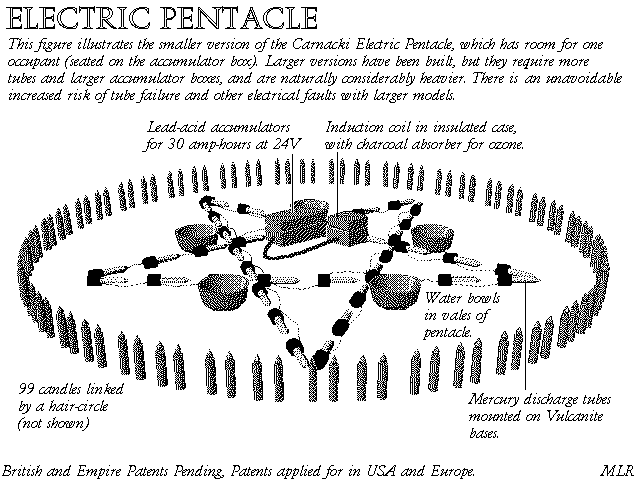
In 1902 Mrs. Carnacki met Forrest Jones, an American widower. They found that they had much in common and married in 1904, moving to New York after the wedding. Thomas stayed in London. By now he was regularly involved in psychic investigations; he used the rooms freed by his mother's departure to set up an unusual laboratory equipped for a wide range of experiments [HG], and began to design such devices as the electric pentacle [GM etc.]; see Section 5 for more details of this device, 17_PENT.GIF for an illustration.
The electric pentacle was developed after Carnacki was nearly killed in a partially completed pentacle (the "Moving Fur" case [GM]), and after the tragic "Black Veil" case [GM] of 1906-7, which saw Carnacki's first serious brush with the law. Both cases are summarised in section 3; briefly, Carnacki was protected by a pentacle and lived, his colleague Aster felt that this was superstition and was killed by a powerful Aeiirii manifestation. Naturally this lead to an inquest, and the Coroner was unable to accept the involvement of Ab-natural forces. He preferred to believe that Aster had died of heart failure, following a hysterical fit brought about by apprehension and Carnacki's suggestion; in other words, that Carnacki had literally frightened him to death. Fortunately witnesses were able to confirm that Carnacki had not spoken to Aster for more than an hour before his fit, and the final verdict was death by natural causes. Nevertheless the Coroner's criticism of Carnacki was damaging; Aster's family sued him and there was an expensive out of court settlement.
Subsequently Carnacki decided to work alone, although he did occasionally recruit outside help when he could be sure that everyone involved would follow his instructions; in at least one case [HAL] this was optimistic.
Aster's death and the resultant publicity marked the start of Carnacki's busiest period, but one that is unfortunately poorly documented. While he was an obsessive record keeper, it is certain that he destroyed many files at the start of the First World War. The best accounts now remaining are anecdotes recorded by a friend, the author William Dodgson. In addition to Dodgson's records and press accounts of the "Moving Fur" and "Black Veil" incidents, we know of the following cases between approximately 1905 and 1910:
Fortunately partial records of most of these cases are still available, and what is known of them is described in more detail in section 3.1; since Carnacki was involved in another five cases in 1909-10, an apparently typical year, there is every reason to believe that many more are missing from this list.
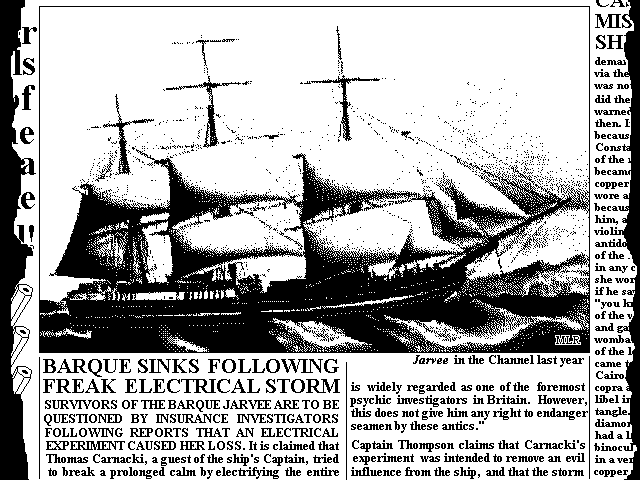
Carnacki's name was again prominent in 1911, when he was accused of partial responsibility for the wreck of the barque Jarvee [HJ]. Newspaper accounts of the period (19_JARVE.GIF) initially suggested that his vibratory machine had somehow caused the destruction of the Jarvee, possibly by shaking it apart. Lloyds of London carried the ship's insurance and brought an action against him. Luckily the court did not agree; there was ample evidence of the severity of the storm, which damaged several other ships in the area. It is perhaps fortunate that Dodgson's version of the incident, based on Carnacki's anecdote, was published well after the case had been settled. An unbiased reader might conclude that Carnacki's experiment had caused the storm!
In 1914 the First World War began. Carnacki volunteered for the army, expecting to serve in the trenches, but was instead selected for intelligence work. His eye for detail and refusal to accept the obvious led to several successes, although the slow pace of most of his investigations apparently exasperated his colleagues. For instance, it took him nearly eight months to trap a ring of German agents operating around Cork, and for much of the period Carnacki was based in an office within 50ft of the ringleader.
Carnacki's war service from March 1917 onwards is still covered by the Official Secrets Act; successive governments have declined to reduce its classification and today it is almost the only mystery remaining from the First World War. It is known that he was hospitalised in Glasgow from March to June 1918, suffering from severe burns, but their cause is unknown and most medical records are missing. Unusually, no hint of the details exist in the records of other nations, such as Germany. At the end of the war he received the Distinguished Service Cross, for "sustained services to military intelligence"; no other details were recorded.
"....While your investigation sounds fascinating, my time is fully taken up with my own work... ... I should add that in my experience the Ab-natural is less pretty than your photographs seem to indicate...."
(Letter to Sir Arthur Conan Doyle, undated)
Most of Carnacki's close friends were killed in the war; in particular, Dodgson was killed by enemy fire in April 1918. There is reason to believe that he was working on a biography of Carnacki at the time; unfortunately many irreplaceable papers related to this work seem to have been discarded by his wife while settling his affairs.
Details of Carnacki's subsequent career are mainly inferred from contemporary letters and other documents. He declined an invitation to look into the Cottingley Fairies (a ludicrous fake which took in Sir Arthur Conan Doyle and several other prominent spiritualists). He is known to have corresponded with Ernest Rutherford and Aleister Crowley; the latter even purchased an electric pentacle. For years he was a shadowy figure, almost unknown outside a small circle of correspondents. This period, and his life, ended in a blaze of publicity.
The mystery of Carnacki's last case remains unsolved. The facts are simple. In January-April 1926 four watchmen died while guarding the safe deposit vault of a minor branch of the City and Provincial Bank. All four died alone, apparently of heart failure caused by fright; there was no sign of violence, or of any intrusion. One of the directors of the bank knew Carnacki, then aged 56, and brought the case to his attention. He spent two fruitless weeks probing the vault, checking the walls and floors for secret passages, analysing the air, and otherwise ruling out human involvement. Eventually, on May 12th 1933, he was sealed into the vault and was last seen preparing to set up a pentacle. In the morning he had vanished. The vault door was still sealed, inside as well as outside, and the walls, floor, ceiling and deposit boxes were criss-crossed with unbroken threads and ribbons. There were no signs of a disturbance. There was only one clue; one of the tubes of the electric pentacle was burned out, apparently by some powerful overload.
Carnacki's disappearance caused a considerable stir, and for the first time serious scientific attention was focused on the Ab-natural. For a while it seemed that something of real consequence might emerge from their studies. These hopes were premature. For some time there had been a general decline in Ab-natural phenomena, possibly a result of the spread of electric lighting and the demolition of many older houses, which has continued to the present day. Ghosts seemed to be unusually shy, and the few events that occurred could not be verified experimentally. Gradually interest waned, and even today his work, and that of other scholars of the Ab-natural, is ignored by most mainstream scientists. Several authors suggested means for a secret escape from the vault; usually the motive discussed was a desire to cause a sensation and attract attention to the Ab-natural. The best of these works is Agatha Christie's classic novel 'Five Sides of the Question' (1930), in which Carnacki, thinly disguised as "Thomas Straki", vanishes with the aid of two clocks, three mirrors, and the collaboration of a hypnotised bank employee, having stolen diamonds worth several million pounds from a safety deposit box. The method reads well, but Christie had to change many details of vault security to make it work.
Eventually Carnacki was declared dead, and his estate divided amongst various cousins. His books and other manuscripts were donated to the Bodleian Library.
"Something decidedly Ab-natural about this cheese, Gromit..."
(The Wrong Pentacle, 1993)
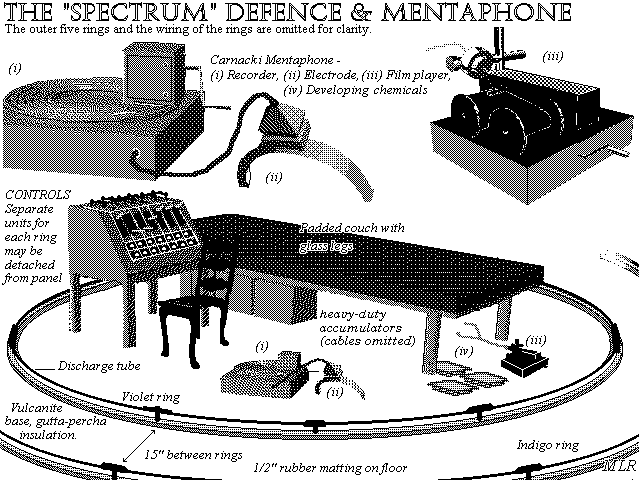
Carnacki still has an important place in the history of occult studies, but mainstream science prefers to remember him for the "Mentaphone", the opto-electrical device he used to study brain-waves [HG], which is now regarded as an important predecessor of the electroencephalograph, and for some of his other electrical inventions. To the general public he is mainly prominent as a famous character in popular legend, fantasy and historical fiction.
Like Jack the Ripper and H.G. Wells, Carnacki often appears in stories with a Victorian or Edwardian background. In historical fiction Dodgson's memoirs, and his sensational disappearance, have ensured that the otherwise dull facts of his life have acquired a thick coating of myth. In particular, it should be emphasised that there is no evidence that Carnacki ever met any member of the British royal family, Churchill, Chamberlain, Einstein, Wells, Wilde, or Hitler. His mother and step-father did not drown aboard the Titanic (both died of age-related diseases in the 1920s), and he was never a stage magician or a priest of any religion. Although Dodgson's accounts of Carnacki, and the evidence of others who had met him, describe a man who rarely made friends and had little to do with women, there is no reason whatever to believe that he was homosexual; suggestions that his apparently celibate lifestyle was an attempt to repress what was then regarded as a highly illegal perversion are baseless speculation.
He was not involved in black magic; although he corresponded with Aleister Crowley and they had acquaintances in common, they never seem to have met. To quash one of the more ludicrous theories, he was certainly not Jack the Ripper; he was sixteen at the time of the Ripper killings and was on holiday in Ireland with his mother when the first two victims were killed!
Science fiction and fantasy often hurl Carnacki through time and space (presumably from the vaults of the City and Provincial Bank) to appear as a captive of aliens, a stranger in an alternate world, or a guest aboard a star-ship or space-station. Steampunk fiction has confronted him with Holmes, Moriarty, Cavor, Cthulhu and Dracula. His ideas and inventions, as described by Dodgson, are widely plundered in popular fiction; see, for instance, the film Ghostbusters (1984), whose laser containment pentacle is an obvious parody of Carnacki's most famous invention.
While some aspects of this fictional immortality detract from the real personality, they have helped to keep non-specialist interest in Carnacki alive, and ensure that Dodgson's biographical sketches will continue to appeal to new generations of readers. Most regard them as entertaining fiction, but perhaps this is as well; there are appalling dangers on the road to Ab-natural knowledge, and any reader tempted to emulate Carnacki's experiments is playing with something much worse than fire.
2.1 Everyday Life 1900-1914
Return to contents
Queen Victoria is dead and the staid pace of the Victorian era has ended. Motor cars are becoming an everyday sight, Count Zeppelin's gigantic airships have flown over Germany, and aeroplanes have crossed the Channel. In Belgium monorail trains have exceeded ninety miles an hour and steam turbine ships promise dramatic improvements at sea. It's even rumoured that there may be another attempt to find funds for a Channel Tunnel. Eventually it might be possible for businessmen to commute from London to Paris on a daily basis! At a time when most London homes still have gas lighting and outdoor plumbing, it's hard to believe in these scientific miracles, but they are already starting to be taken for granted. Meanwhile developments on the leading edges of science continue apace; one of the growth areas, although far from the scientific mainstream, is study of the occult in general and the strange world of Ab-natural phenomena in particular.
While Britain presents a facade of military might and strong social structures, the cracks are starting to show. The Boer war revealed serious deficiencies in the army's tactics and strategy; predicted to last a few weeks, it dragged on for two years. The war highlighted one statistic that starkly exposes the ills of modern industrial society; even after the army lowered its standards for recruits, only 10% of the 12,000 men who volunteered in Manchester were medically fit. The rest suffered from a variety of illnesses related to pollution, overwork and malnutrition. The other big industrial cities are little better. In just ten years Britain's population has risen by 3.8 million; meanwhile Ireland's population has shrunk from 6.5 to 4.3 million, largely a result of emigration to America. The government is slowly moving towards granting home rule to Ireland, but the Protestant minority in the province opposes any change. This minority includes many influential land owners and most of the Irish peers and members of Parliament, and the end result will be a series of unsatisfactory compromises leading to bloodshed. It is likely that the "political club" encountered by Carnacki [CGF/HAL] is part of this Protestant backlash.
Britannia still claims to rule the waves, but much of the fleet is poorly equipped, slow and obsolete, and there are similar problems on land. The British army is reasonably well equipped for colonial warfare, but has little experience of combat against foes with modern weapons and tactics. Rearmament will bring new problems, as the major European powers start to see Britain as a threat and expand their own forces.
There is growing unrest in Britain, with the rise of the Labour movement a symptom of political dissatisfaction; 29 Labour and 34 "Lib-Lab" MPs took seats after the 1906 General Election. At first the Labour party simply represents the rights of the working man, later it becomes the voice of socialism in Britain.
A crucial key to the future is the monarchy. When Victoria reigned, the Prince of Wales was widely regarded as a "lightweight" figure, often involved in scandals and far too frivolous to rule. His first public acts as King Edward VII did much to heal this distrust, and most Britons were soon prepared to give him the benefit of the doubt. By the Coronation, in 1902, he was widely loved and respected; he spent an unprecedented portion of his time in the public eye and was soon seen by more of his subjects, especially those of the lower classes, than ever saw the reclusive Victoria. During his reign he did much to encourage the modernisation of the armed forces and improvements in social and economic conditions. Unfortunately he died in 1910 and was succeeded by George V, who tried to perpetuate the "popular monarchy" begun by Edward, but lacked his appeal to the masses.
Improved transport is one of the roads to greater democracy. Cheap bus and tram fares make commuting possible, and bicycles allow many workers a degree of mobility that was unimaginable in earlier years. By the 1920s motorcycles will also be affordable for the more prosperous members of the working classes.
Despite the new democratising influences, social class is still overwhelmingly important. There are dozens of gradations between the lowest and highest ranks, often so subtle that they are only apparent to an insider. At the bottom are the unemployed, the dross of the working classes. Their only recourse is to beg or seek the "charity" of the workhouse, where revolting food and poor accommodation must be paid for with hours of back-breaking toil. Next come the poorest industrial and agricultural workers, often living six or eight to a room, poorly fed and clothed. Above these are foremen and other manual workers whose posts involve some degree of responsibility. All are made to feel inferior to the poorest clerk. Meanwhile servants have their own hierarchy, as do the self-employed, the employers and the aristocracy. At the top, the fate of Britain and the Empire is mainly determined by a tiny minority; the most important landed aristocrats, a few key figures in the armed forces, and leading industrialists. The King knows them all, and spends much of his time at their homes or in their company. He moves with an entourage of at least eighteen servants and detectives, more if he is accompanied by the Queen, and anyone who wishes to take an active role in society must be prepared to accommodate all of them, along with dozens of other guests and a small army of servants, whenever the King makes it known that he might consider accepting an invitation.
The rigid stratification of society is felt in many subtle ways; one of the oddest aspects is the question of headgear. Regardless of class, no man in Britain will willingly be seen outdoors without a hat. Its type and quality reflect social status, occasion and wealth. You raise your hat to show deference to those you meet; without a hat you defer to everyone, regardless of status. Hats are chosen in accordance with the season and the occasion. For example, a gentleman will own two or three top hats of the latest style; the name of his hatter is an instant guide to his position, and even without a label can often be determined by such qualities as the curve of the brim or the finish of the lining (see Murder Must Advertise by Dorothy L. Sayers for a later example). The colour of the hat and its band are even more significant indicators; a subtle mismatch between the occasion and the hat are enough to brand the wearer as nouveau riche or old-fashioned. Naturally there are special hats for special occasions; straw boaters for punting, deer-stalkers for an expedition to the moors, and so forth. Even schoolboys conform to this code. At the poorest end of the spectrum every tramp or chimney sweep owns some sort of hat or cap, even if it has been stolen from a scarecrow, and often guys his betters by wearing a cast-off that is wholly inappropriate to his status. Between these extremes there is little variety; workmen and labourers always wear cloth caps, clerks always wear bowler hats, and anyone who ventures to choose something different will soon hear about it from colleagues and employers. Inventors produce dozens of devices for hat-wearers; everything from self-raising hats powered by clockwork, to hats with concealed cameras and secret compartments.
For the wealthier classes elaborate meals are the norm, often running to ten or twelve courses (although six or so are more usual). For the poor, starvation wages and malnutrition are more common.
While these social contrasts provide one easy way to think of the period, there are many other possibilities. It's the last great age of exploration; within a few years most of the world will be mapped. Technology is changing by the day, with endless wonders like electric light, X-rays, radium and, at the fringes of science, work on the Ab-natural. While most private transport is still horse-drawn, the world is criss-crossed by elaborate rail systems; they are steam-powered, but in the cities public transport is rapidly switching to electric trains and trams, and omnibuses with internal combustion engines. It's the decade of Sherlock Holmes' last cases and Fu Manchu's first crimes, of Marie Curie and Mary Stopes, of Butch Cassidy and the Sundance Kid. It sees an immense flowering of science, education, and literature, and of spiritualism and dozens of crackpot crazes and religions. Anything that you can imagine is probably happening somewhere - all that you need do is look for it.
2.1.1 Timeline 1891-1914
Return to contents
Wages
Housemaid                £12-30 per year
Cook/Housekeeper         £80 per year
Page boy                 £10 per year
Butler                   Up to £100 per year
Skilled engineer         36s 6d per week
Assistant to above       19s per week
Bricklayer               38s per week
Assistant to above       18s per week
Clerk                    £1 10s per week
Foreman                  £2 5s per week
Miner                    £1 15s per week
Craftsman in London      £2 per week
Cabinet minister         £2000 or £5000 per year
                         (£38 or £96 per week)

Housing
Hovel                    4s per week
4 room rural cottage     5s per week, £200 to buy
Small inner London house £200 per year, £1000 to buy
Small suburban house     £50 per year, £500 to buy
Boarding house room      £1 1s per week

Man's Clothing
Shirt                    3s-5s
Collars for above (12)   6s 6d
Detachable cuffs         1s
Leather gloves           3s 3d
Handkerchiefs (12)       8s
Underwear                5s
Good quality boots       11s
Light boots              7s
Walking shoes            14s
Trousers                 7s 6d
Bowler hat               12s 6d
Top hat                  25s
Soft felt hat            7s 6d
Hat box, leather         15s

Woman's Clothing
Camisole                 3s
Chemise                  7s
Combinations             5s 6d
Nightdress               6s
Skirt                    10s
Stockings                6 1/2d
Shoes                    12s-£1 8s
Blouse                   £1 5s 11d

Food & Drink
1 lb Almonds             2d
1/2 lb tea               8d
2lb sugar                5d
1 lb butter              1s
2 oz tobacco             6d
1 lb fish                1 1/2d
1 lb ham                 9 1/2d
1 lb chocolate           1s 2d
1 lb soap                3d
1 lb currants            3d
Pint beer                2d
1 lb Biscuits            2d
Loaf bread               2 1/4d
12 Bottles Cider         14s
12 Bottles Champagne     £4 18s
12 Bottles Claret        £2 10s
12 Bottles Port          £1 14s
12 Bottles Sherry        £2 2s
Bottle Whisky            7s
Bottle Brandy            9s 10d
Bottle Gin               4s 6d
Bottle Rum               7s 6d

Miscellaneous
Electricity              6d per unit (kilowatt-hour) *
* rate held artificially high to protect smaller generating companies
1 lb Candles             10d
Safety matches, box      1d
"Thermos" Vacuum flask   £1 1s pint, £1 15s quart **
** Both leather with silver fittings
Chest of drawers         17s
Simple bed               £1 15s
Luxury bed               £19
Piano, upright           £105
Piano, grand             £210
Violin                   £2 10s
False teeth              1 guinea per set
Cricket bat              12s 10d
Golf clubs               6s
Golf balls               10s per dozen
Watch, good quality      £10
Watch, for schoolboy     12s
Sewing machine           £1 10s
If a date is followed by a dash (eg 1910-) without a second figure, the office is still held after 1914.
Britain         Monarch         Prime Minister
1837-1901       Victoria        1895-1902   Marquis of Salisbury (Con.)
1901-1910       Edward VII      1902-1905   Arthur James Balfour (Con.)
1910-           George V        1905-1908   Henry Campbell-Bannerman (Lib.)
                                1908-       Herbert Henry Asquith (Lib.)
Lib. = Liberal, Con. = Conservative

Belgium         Monarch         Prime Minister
1865-1909       Leopold II      1899-1907   Paul de Smet de Nayer
                                1907-1908   Jules de Trooz
                                1908-1911   Frans Schollaert
1909-           Albert I        1911-       Charles de Broqueville

France          President
1899-1906       Emile Loubet
1906-           Armand Fallieres

Germany         Monarch
1888-           Kaiser William II

Russia          Monarch
1894-           Tsar Nicholas II

USA             President
1897-1901       William McKinley (Rep.)
1901-1909       Theodore Roosevelt (Rep.)
1909-1913       William Howard Taft (Rep.)
1913-           Woodrow Wilson (Dem.)
Rep. = Republican, Dem. = Democrat
This collection includes three long adventures set in the world of the Carnacki stories. The following are some brief ideas for adventures related to Carnacki's life, which will need a considerable amount of development. Some are incompatible with others; in particular, there are four mutually incompatible variants of the second outline.
1895: The sleepy holiday village of Appledorn is disturbed by reports of a mad dog that has been attacking sheep. Rabies is virtually wiped out in Britain, but Appledorn is on the coast; perhaps someone has smuggled a dog ashore from a foreign ship. But why hasn't anyone seen it, and why do the attacks only occur at night?
This may be a case of rabies, possibly in a nocturnal animal such as a fox, or an Ab-natural incident. All the attacks occur in a relatively small area and it should be possible to track it to its lair (or materialisation point) and confront the beast.
Carnacki is living in Appledorn at the time but should not become involved at first. If it is a rabid animal the adventurers should solve the case without his help and meet him afterwards ("Sorry, Mister Carnacki, there's nothing supernatural about this one. These gentlemen have already shot it!"). Remember that rabies is usually fatal; Pasteur has developed an antiserum, but it is only a little less dangerous than the disease.
If the beast is Ab-natural, the adventurers should realise that there is something odd about it, then enlist Carnacki's help via the police or a mutual acquaintance. Carnacki should NOT take over the case; at this stage he hasn't developed many of his techniques and he should simply give the adventurers a little advice, such as a suggestion that they look for a materialisation portal, before leaving on urgent and prolonged business.
1905: There is an abortive revolution in Russia. Photographs of some of the ringleaders are published in The Times. One of them is a bearded man, captioned as "Ivan Carnacki", who looks remarkably like old photographs of Thomas's father. Is it just a coincidence, or was another body substituted after the Tay disaster? Whoever it is, there's a price on his head and the Okhrana (Russian secret police) are closing in. Carnacki is in Britain and will take days to reach the scene, but some acquaintances (the adventurers) happen to be in Russia. For some reason the British government doesn't seem to be willing to intervene. What's going on, and can the adventurers help?
As above, but the adventurers are agents assigned to rescue Ivan, a "sleeper" for British Intelligence, and Thomas is not involved. There are complications; most notably, Ivan has a wife and children (his marriage to Alice was bigamous), and does not want anyone in Britain to know that he is still alive.
See Forgotten Futures III for more on adventures in pre-revolutionary Russia and on His Majesty's Secret Service.
1911: The adventurers are hired by Lloyds of London to find proof that Carnacki caused the wreck of the Jarvee, or colluded with Captain Thomas to fake her loss. Carnacki has told an unbelievable story about ghosts, but is the truth an accidental loss or a cunning fraud? Is Captain Thomas a liar, musguided, or insane?
1918: Following the Revolution, the Communists are purging counter-revolutionaries in Russia. One of them is a bearded elderly man, "Ivan Carnacki"...
Use the plots of either of the second or third adventure above, modified for this setting. In 1918 Russia is still in relative chaos, with a civil war following the revolution; Britain is on the side of the monarchist White Russian army, which adds extra complications, since "Ivan" is being held by the Red Army...
As (3) above, but "Ivan" is actually Thomas, who has used his father's name while infiltrating the Revolution for His Majesty's Secret Service. He intended to assassinate Lenin, but something has gone badly wrong. Can the adventurers save him?
1910-1930: As electric lighting reaches most areas and many older buildings are demolished, there must gradually be fewer "gateways" for the Ab-natural. Could this mean that those that remain are more likely to attract unwelcome phenomena? If the "civilised" world is gradually becoming less attractive, what about remote places like Africa or the Australian outback? What's really going on in these areas? Do the adventurers really want to know?
3.0 Ab-natural Phenomena
Return to contents
"Science fiction, double feature,
Meet Doctor X's Ab-natural creature..."
(The Rocky Horror Picture Show, 1975)
Most of what is known about the Ab-natural derives from the work of a few experimenters, often working against extreme prejudice and under very difficult conditions. The information they have produced is largely fragmentary, tiny pieces of a colossal jigsaw puzzle. Thomas Carnacki would be the first to agree that he rarely had all the answers when he was dealing with the Ab-natural. His exploits suggest some general principles, but that is all. It is difficult to improve on Carnacki's own descriptions [GM,WR,HG,SEH], although it should be remembered that they make certain simplifications for a non-technical audience; what follows is simply a summary of these phenomena as they affect life on Earth.
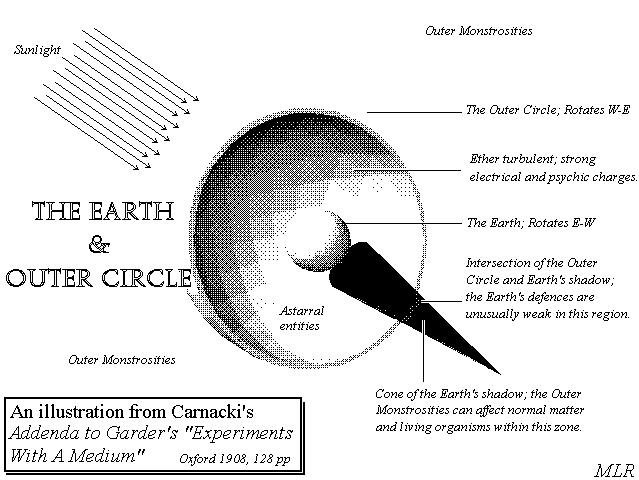
Briefly, the Ab-natural phenomena encountered on Earth are a pale shadow of the forces that exist in a "belt" of ether extending from a hundred thousand to several million miles from the Earth (see 20_WORLD.GIF). Their activities in this belt are unknown, but do not seem to involve material objects, although Forteans will later suggest that some satellite malfunctions and the death of some early cosmonauts are caused by these entities. There will also be persistent rumours of a massive government cover-up, concealing much more blatant manifestations of the Ab-natural. However, this is irrelevant to events in Carnacki's lifetime.
The Earth's upper atmosphere is electrically charged, and it is believed that this is one of the main barriers against intrusions from these entities. Occasionally this defence is weakened, perhaps by natural forces, possibly by magic, but most usually by some accidental combination of emotion and repetition whose exact nature is still unclear. When this happens the Ab-natural effects can penetrate to Earth. Unfortunately it is all too apparent that they are hostile to life and to spiritual energies, and if possible will consolidate any beach-head to ensure continual access to the Earth.
Fortunately two factors prevent the Ab-natural world totally dominating our own. One is the presence of the mysterious Astarral entities, at one time worshipped by "...the Ab-human Priests in the Incantation of the Raaee..."; the other is an apparent allergy to sunlight and (to a lesser extent) to other forms of bright light. Since space around the Earth is usually illuminated, except in the Earth's shadow, it seems certain that light simply disrupts their interaction with the physical world, rather than harming them; anyone expecting a ghost to be permanently destroyed by a few hours of sun or use of a flashgun will be disappointed.
Five main forms of Ab-natural phenomenon were known to Carnacki; one type, mediumistic contact with the dead, was only mentioned in passing while discussing Carnacki's reading of Garder's "Experiments with a Medium" [GM]. It is likely that he had more intimate contact with it in one of the "lost" cases, or one that was never mentioned in his after-dinner talks.
"...I saw nothing, until I became really frightened; then I saw, not the Woman; but a Child, running away from Something or Someone. However, I will touch on that later. In short, until a very strong degree of fear was present, no one was affected by the Force which made Itself evident, as a Woman..." [SEH]
The first, least dangerous, of the forms encountered by Carnacki is a type of psychic "leakage" from another plane, in which sounds and visions can be perceived by the psychicaly sensitive [SEH]. These visions are theoretically harmless, but they "feed" on strong emotions, especially fear and grief; if they are seen by someone that fears them, they become stronger and more vivid. Profound sorrow also intensifies them. Repetition and intensification can eventually give more power to these visions and open a "door" to the more dangerous phenomena described below. There may also be a similar form of psychic "recording", not initially involving active Ab-natural forces, but also capable of amplification by repetition [WR, HI].
"...as I stared, something began slowly to grow upon my sight - a moving shadow, a little darker than the surrounding shadows. I lost the thing amid the vagueness and for a moment or two I glanced swiftly from side to side, with a fresh, new sense of impending danger..." [GM]
The second class of phenomena are "The usual Aeiirii forms of semi-materialisation" [WR], so-called ghosts which can affect the physical world but are not themselves composed of normal matter. Aeiiriii phenomena are dangerous; they can sometimes kill and may be able to interfere with a susceptible mind. However, they have definite limits to their power; in particular, they must materialise from a focus object or in a particular place [GM], are sometimes stopped by physical walls, and are stopped by defences such as the electric pentacle and more traditional forms of magical protection. Carnacki believed that some religious symbols helped; for instance, his pentacles include bowls of "a certain water" [GM], probably holy water.
All evidence suggests that the Aeiirii manifestations (and the Saiitii phenomena described below) are often released or created by the human mind; they appear as giant hands, invisible horses, and the like, and seem to be a development of the purely sensory "ghosts" described above. It is easy to assume a malevolent alien origin [HG], but it is possible that they simply represent one aspect of a neutral force that powers such "positive" phenomena as magic, the Astarral entities, and the Saaamaaa Ritual, but is triggered in a destructive form by human malice.
The effects of Aeiirii manifestations can include physical damage [GM], mental aberrations and hallucinations [GM,HG], and damage to the soul itself [HG,WR] which may leave the victim mindless or insane. Carnacki regarded suicide as preferable to this fate [WR].
"...It was a true instance of Saiitii manifestation, which I can best explain by likening it to a living spiritual fungus, which involves the very structure of the aether-fibre itself..." [WR]
The third type, and by far the most dangerous, are Saiitii manifestations. Dead matter is infested with a grisly parody of life and moves as though it were living flesh [WR]. True Saiitii manifestations can take over the material of defences; their advance may be slowed [HG:6], but it isn't stopped. Fire is effective as a defence and the one means of destroying material that has been infested; the chaotic movement of particles and energy in flame presumably disrupts the controlling essence of the manifestation. Even so, it is difficult to imagine a fire defence that would work for extended periods; a ring of burning petrol might give some temporary protection, but it would eventually burn out, and a powerful Saiitii manifestation might be able to undermine it to drain the fluid.
Saiitii manifestations have the same harmful effects as Aeiirii phenomena, but their ability to "infest" material objects is peculiarly frightening and gives them greater mobility. While an Aeiirii manifestation is always linked to one locale, or tied to one object, Saaitii manifestations spread and may even be able to assume mobile forms. This makes them hard to confine or destroy. There is reason to believe that the classic 'elementals' of mythology were Saaitii manifestations.
There are undoubtedly intermediate phases between these different types of phenomena; for example, weak Saiitii manifestations, hallucinations with some limited physical effect, etc. In one case [HG] Carnacki encountered an apparent hallucination that eventually involved Aiirii and Saiitii effects.
"...there is some inscrutable Protective Force constantly intervening between the human-soul (not the body, mind you) and the Outer Monstrosities. Am I clear?" [GM]
"...one of those inscrutable forces which govern the spinning of the outer circle..." [HG:6]
The final class are the Astarral entities, such as the Raaee, which apparently act to protect life (and especially the soul) against Ab-natural phenomena. Their intervention usually takes the form of a mental suggestion or warning. For example, on several occasions Carnacki was saved by a mental prompting which allowed him to complete the Unknown Last Line of the Saaamaaa Ritual (see section 4 below), or by a sudden flash of intuition which gave him time to escape. There are hints of more direct forms of intervention, in old manuscripts and legend; for instance, the Raaee undoubtedly took material form on occasion, although the details have long been lost. Carnacki experienced direct intervention once [HG:6].
Why these entities should take such an interest in humanity remains unclear; altruism is one possibility, but Carnacki's addenda to Harzam's monograph speaks of a balancing of vibrations [HG:6], which implies that they are harmed if the Ab-natural world gains too much power. Why this should be so is a mystery; Carnacki's analogy of the "electrical machine" [HG:6] is presumably a reference to the Wimshurst high-voltage electrostatic generator, which implies the existence of "positive" and "negative" forces which must cancel each other. But the scant evidence available suggests that these are conscious intelligent beings, albeit on a scale that humans can't readily understand, and can presumably make choices in this matter. It remains unexplained.
One further point; Carnacki and other experts prefer to avoid loose use of the words 'ghost' and 'haunting', but they are very convenient 'shorthands' when discussing Ab-natural entities, manifestations, etc., and have been used widely in the remainder of this worldbook.
3.1 The "Lost" Cases
Return to contents
"...These files are really old, Buck, they go right back to Carnacki's Yellow Finger experiments!"
"Keep at it, Pecos, the answer has to be there somewhere..."
(Buckaroo Banzai And The World Crime Syndicate, 1988)
Dodgson's accounts of Carnacki's exploits mention several cases which are not detailed. A search of Carnacki's records has shed some light on the matter, but the brief reports that follow include conjecture and some outright guesswork. It should be added that most of these cases were less interesting than those chronicled by Dodgson, who seems to have selected stories for maximum sensationalism.
Gaming note: With a little work any of these cases can be run as an adventure. If you decide to use them in this way, it is not advisable to allow players to read this section.
"..you all remember the Black Veil case, in which I believe my life was saved by a very similar form of protection, whilst Aster, who sneered at it and would not come inside, died..." [GM]
This is the best-documented and most tragic of the "lost" cases. In November 1906 Carnacki was asked to investigate a suburban haunting, an unusual incident in which a modern mansion in the village of Chalfont St. Giles, on the outskirts of London, was haunted only months after it was built. Witnesses described a pall of darkness, moving around an unoccupied bedroom, which slowly grew larger, darker and colder as the weeks went by. When the family dog was found dead, the occupants sought help.
At the time Carnacki was working with Dr. Gerald Aster, a physicist who believed that ghosts were mobile electromagnetic fields. After several days they had found no evidence of any trickery; caged mice and canaries that were left in the room died overnight, and timed photographs showed dark patches which did not appear to be any form of smoke, vapour, or cloth. They felt that they had found a genuine case and determined to take a closer look.
Carnacki had recently reviewed some old manuscripts relating to magical protection, and proposed spending the night in the room inside a pentacle. The owner of the house and two servants decided to join him, but Aster felt that use of a pentacle was a throwback to pagan superstition and witchcraft, and refused to participate. Instead he erected a copper mesh Faraday cage, which he believed would keep out any electromagnetic entity. It was worse than useless; when the haunting eventually began, at about three in the morning, the ghost proved to be a powerful Aeiirii manifestation, an amorphous black mist which promptly moved into the cage and attacked Aster. In the dark Aster couldn't find his way out of the cage and was engulfed before the others were fully aware of his peril. In the dim light Carnacki and the others saw him clawing at his own eyes, and heard him screaming uncontrollably. They spent the rest of the night trapped in the pentacle, while the ghost made a series of attempts to break through its protection. In the morning Aster was alive and unconscious, but his eyes were bleeding empty sockets. He died a few hours later.
Later Carnacki was accused of causing Aster's death by fright, as described in section 2.0 above, but the other witnesses vouched for his innocence. The haunting continued for some weeks, then an "accidental" fire destroyed that wing of the house. It seems likely that Carnacki arranged the incident, with the blessings of the owner; he and his servants seem to have been unusually well prepared for a blaze, which led to difficulties with the subsequent insurance claim. During the subsequent rebuilding an old stone barrow (which had been buried during the foundation work) was excavated, and the remains it contained were carefully cremated. There was no repetition of the haunting.
"..always I came through safe, until that Moving Fur case. It was only a partial 'Defense' there and I nearly died in the pentacle..." [GM]
This case indirectly involved Carnacki's father, Ivan Carnacki. Until his death Ivan was senior partner in Carnacki, Jones and Kelly, a Whitechapel fur trading company. In 1907 Carnacki was contacted by Adam Kelly, now the owner of the company, and asked to look into some mysterious problems at their workshops. Furriers arriving in the morning repeatedly found that their work had been ripped apart overnight, the stitches between the individual pelts broken by enormous force and the pelts scattered around the workroom. At first theft was suspected, but nothing was missing and in any case the building was always left locked and barred, with a night-watchman on patrol outside.
Carnacki conducted his usual tests and proved that no human intruder was tampering with the furs. He used a roll-film camera set up with a clockwork timer and film winder to take photographs at hourly intervals; they showed that the furs were moved between two and three in the morning.
Once he had seen the photographs, Carnacki decided to spend a night in the room, using a chalk pentacle with hair-circle and candles for protection; he had not yet invented the electric pentacle, and did not then use holy water in the protection.
Shortly after midnight he began to hear a tearing noise, and the furs on a nearby bench started to move and bunch together, gradually forming the shape of a gigantic wolf. At first it ignored Carnacki, but suddenly it sprang at the pentacle. Although it could not cross the hair circle, it came sufficiently close to knock over some of the candles before it was repelled. Carnacki failed to notice that some of the melting wax had spattered onto the chalked pentacle, breaking one of the lines. On its next approach it was not repelled, and began to attack Carnacki. Fortunately its attack was confined to a physical assault, and the heads and claws of the pelts had already been removed. The creature's "bite" was softened by the fur; even so, it came close to crushing his throat, and broke his arm and four of his ribs. Luckily they rolled onto the candles during the fight, setting some of the furs on fire, and the apparition was momentarily distracted. Carnacki made a break for the door and managed to get outside before the ghost reached him. Fortunately it was stopped by the door.
Once his injuries had been treated, Carnacki returned to the workshop and, over the course of several nights, established that the effect was centred on one of the pelts, a large grey wolf-skin. The method he used is interesting; Carnacki had the pelts split into four piles and placed in separate rooms, then eliminated the three rooms in which the furs were not disturbed. He repeated this procedure until only one fur was left, then had it incinerated. After this the haunting ended.
Carnacki was able to trace the skin to a shipment from Siberia, but beyond that there was no evidence of origin. It seemed in all respects to be a normal wolf-skin, slightly larger and finer than usual. It had been tanned and treated like any other pelt.
Although this case involved the apparent animation of non-living objects, Carnacki recorded it as a strong Aeiirrii manifestation. The pelts were moved by the power of the ghost, but were not "infected"; their animation ceased as soon as they were removed from the room containing the wolf-skin. The force was not able to escape the confines of the work-room and would have been stopped by Carnacki's pentacle if it had been complete.
"..He had heard of me in connection with that Steeple Monster Case..." [HAL]
In February 1905 several witnesses reported seeing a strange glowing light moving around the steeple of the church of an isolated Irish village. The following morning one of the village pensioners was found dead in the snow; the cause of death was apparently cold. The same light was seen six days later, and another villager was found dead the next day. Oddly, neither villager had any apparent reason to go outdoors, and neither was dressed for the weather.
Fearing that his church was haunted, the priest conducted an exorcism; a week later there was a third death, and the priest requested Carnacki's help.
Carnacki established that the first and third victims were senile, the second was feeble-minded and "easily led". It seemed possible that whatever killed them was somehow overcoming their intelligence and controlling their minds. Accordingly, he asked the priest to identify the next likely victims on this basis. There were two strong candidates; a boy who was considered to be "touched" and another senile woman. Carnacki arranged to have both moved to a cottage with a clear view of the church, and mounted a series of overnight vigils with the priest and the district nurse in attendance.
On the fourth night the glow was seen again, and the boy began to leave the cottage, without dressing. Carnacki and the priest stopped him and quickly realised that he seemed to be in a hypnotic trance. Questioning revealed that he was being called by "a lady", and wanted to go to her. He was unable to explain who the "lady" was, or why he had to obey her. Carnacki decided that the best way to solve the case was to allow the boy to go, but keep him warm and in sight at all times. The boy was dressed then released and immediately started to walk towards the church, with Carnacki and the priest in his wake. Once inside, the boy started to climb the belfry, again followed by Carnacki and the vicar.
In the steeple they found a glowing ball of light, roughly the size of a grapefruit, which started to move towards the boy. Carnacki and the priest tried to block it, but it easily dodged them and moved into the boy's head. He immediately started to speak in tongues, then settled into a form of Gaelic; the priest listened for a while, then conducted another exorcism which (Carnacki later noted) "for sheer speed and desperation would take a lot of beating." It appears to have been successful.
Subsequently the priest refused to answer questions about his conversation with the "spirit", and Carnacki claimed that he had not understood it. The boy couldn't remember anything. The case was reported widely in the Irish press, but this anticlimactic conclusion meant that it received little publicity elsewhere.
"I was inclined to parallel the case with that of Hartford's, where the hand of the child kept materialising within the pentacle, and patting the floor. As you will remember, that was a hideous business." [HI]
Nothing is known of this case; the description has obvious parallels to the "Gateway" incident [GM], but it does seem to be a separate haunting. It is certain that it was a genuine Ab-natural incident, so it is doubly unfortunate that no records remain.
"..It is most extraordinary and different from anything that I have had to do with; though that Buzzing Case was very queer, too..." [WR]
The Buzzing Case occurred in Scotland, near the village of Foyers on the banks of Loch Ness, between 1897 and 1908. Briefly, the occupants of a farmhouse near the village frequently heard a buzzing hum which seemed to originate somewhere inside the building. There was no obvious source for the noise and no machinery that might be the culprit. The noise could sometimes be heard by day, and kept the family awake at night.
Carnacki spent days tracking the noise and eventually determined that it was coming from an unexpected source; a poker and coal scuttle in the front parlour fireplace! He found that when the poker was left propped against the coal scuttle, it vibrated. The sheet metal of the scuttle amplified the noise and it spread via the chimney to the rest of the house.
None of this explained why the poker was vibrating. Carnacki's patient experiments showed that it only happened when the poker was moved to certain angles. He then realised that the buzzing was a 60-cycle note, the frequency used for AC electricity in Britain. There was a hydroelectric power station, Britain's first, on the waterfall above Foyers. The poker happened to be exactly the right length to resonate with the magnetic field around cables linking the power station to an aluminium factory in Foyers. Replacing the iron poker with one made of brass cured the problem.
While this case was not a genuine Ab-natural manifestation, it must be remembered that it had baffled the occupants of the house for several years and caused a good deal of distress. Carnacki's intervention ended considerable unhappiness.
"..it was just such a warning that saved me in the 'Grey Dog' Case..." [WR]
This case was in many ways a classic example of a genuine haunting, by a Saiitii manifestation in the form of a monstrous hound. At irregular intervals the "Grey Dog" was seen in the courtyard of the Purfleet Lunatic Asylum, on the outskirts of London, its appearance always coinciding with the death of one of the inmates, or someone living nearby. Initially, shortly before the turn of the century, it was seen as a vague shadowy figure; later it seemed to become darker, more solid, and more menacing, and began to leave tracks.
Carnacki was called in when it mauled one of the children of the asylum's superintendent, in December 1909. Fortunately a guard heard the disturbance and rushed to the rescue; he was also bitten, but saved the child and fought off the hound while fleeing into the building. The hound was stopped by the door. The wounds were undoubtedly left by a gigantic dog's bite, but contained no traces of saliva; instead, they seemed to be full of earth. The child was too young to answer questions, but the guard claimed that the dog was larger than any hound he'd seen and that every part of it, even the teeth, was dull grey or black.
For several days Carnacki set up cameras and traps in the early evening, then retreated to watch the courtyard from an unoccupied cell. The weather was poor and it was usually dark soon after he had completed his preparations.
Eleven days after the attack one of the inmates escaped from his cell, wandered out into the courtyard, and began to break Carnacki's carefully arranged ribbons and threads. The patient was harmless, but it took some time to capture him and repair the damage. As Carnacki was putting a new plate into the last camera, he felt a strong "mental warning", dropped the plate, and sprinted for the nearest door. As it shut behind him, it shook from the impact of a gigantic form crashing into the wood. In the morning Carnacki found deep parallel scratches in the door and a gigantic dog's footprints in the courtyard.
The photograph was lost, but Carnacki's system of threads, ribbons and wafers was effective. It was apparent that the creature had somehow formed from the earth of a flower bed in a corner of the courtyard, and had returned there at the end of its attack. On this evidence it seemed likely that it was a Saiitii manifestation, which ruled out an attempt to stay in the courtyard overnight.
Despite several more days of observation, Carnacki never really saw the dog; it appeared twice and left more prints, but always avoided the light. Eventually he decided to have the bed dug up and the soil incinerated. While doing so, workmen found the bones of two cats and a number of birds, rats and mice, which were also burned. This ended the haunting.
Old records revealed that the former inmates included a murderer named Renfield, a psychopath who tortured, killed and ate animals when he could not reach human prey. He lured birds and other strays to his cell and killed them. A guard eventually remembered that they were subsequently buried in the flower bed. Renfield died in 1897, after hurling himself at the cell walls and floor so violently that his back was broken. Carnacki theorised that some psychic residue of the man's madness clung to the bones of the tortured animals and somehow opened the way for the "Grey Dog". He suspected that the man's insanity might also have been a result of an Ab-natural influence, but this could not be proved.
"..it was just such a warning that saved me... ...in the 'Yellow Finger' Experiments; as well as other times" [WR]
Nothing is known about this incident; Carnacki refers to experiments, not a case, which suggests that it is another example of his rather dangerous approach to research. Perhaps it was one of his ventures into the effects of colour, although yellow is generally considered to be neutral [HG:2]; if so, it probably occurred in his laboratory at Cheyne Walk. It is known that Carnacki experimented on several possessed patients, one of whom committed suicide. Without additional information it is impossible to say more.
"...I told you about that 'Silent Garden' business? Well, this room had just that same malevolent silence..." [WR]
This interesting haunting occurred in a monastery in Wales. The order was reclusive and the monks lived in almost complete isolation, each occupying a "cell" (actually a small stone building entered from the cloisters) with a tiny walled garden, about 16 ft square. Food was delivered to the cells through small service hatches and all communication was by notes.
In 1909 it was noticed that one of the monks had not taken his daily meal. When the prior investigated, he discovered that he was dead; while repairing a chair in the cell's workshop, he had apparently slipped and cut his wrist with a chisel, and bled to death before he could attract attention. The body was cold and death had obviously occurred many hours earlier. Oddly, nobody had noticed that he was missing from the previous night's midnight mass; any absence would usually be reported to the prior, in case the monk concerned was ill.
The coroner felt that the wound would not have caused instantaneous death and was surprised that the victim had been unable to reach help, so police were sent to investigate the exact circumstances. The constables found no sign of foul play, but noticed that there seemed to be an unusual silence in the cottage; even the sounds they made appeared to be dulled, and nothing from the outside was audible. The effect was most noticeable in the garden of the cell; a constable standing there could only be heard if he shouted or blew his whistle. At first they thought it was a natural acoustic effect, but the other cells were built to the same pattern and none showed this peculiarity. Once it was brought to his attention, the prior decided to investigate the possibility that it might be a miracle, and moved into the cell. Three days later he emerged, had the cell locked and sent for Carnacki.
In his written instructions the prior told Carnacki that the silence seemed worse at night and was accompanied by gradual muffling of the other senses. In the cell the light simply seemed dim; in the garden there was an almost complete absence of light. The prior also noticed that his other senses seemed diminished and that he felt unusually cold and tired. He had no explanation for the effect, but was sure that there was something unholy about it. Carnacki visited the cell by day and made a few tests with thermometers, a photo-electric cell and galvanometer, and a recording phonograph and microphone. According to his senses the cell and garden were darker, colder and quieter than the rest of the building, even by day. According to his instruments they were almost identical to their neighbour. It seemed likely that some Ab-natural force was at work.
The monastery's records showed that the cell (which was close to the chapel and infirmary) had customarily been allocated to elderly monks, to reduce the distance they needed to walk. The final occupant was a younger man who had happened to enter the monastery when it was the only vacant accommodation.
Carnacki reasoned that the older monks might have assumed that the effect was a result of their failing faculties, and failed to realise its Ab-natural origin. The younger monk would have felt it more strongly, and might have been stupefied by the dulling of his sensations, failing to notice the injury in time to save his life. In short, Carnacki felt that the monk had been a victim of what would now be termed sensory deprivation. His apparent presence at the midnight mass was more puzzling, but could simply be an oversight by the other monks.
Carnacki left a recording thermograph and other instruments in the cell for several nights, and made an exhaustive examination of the stonework, but found nothing unusual. It seemed certain that the Ab-natural effect was purely subjective, with no effect on instruments. Caged birds and mice left in the cell and garden overnight were unharmed.
Eventually, having exhausted the other possibilities, Carnacki decided to risk an all-night vigil in the garden. None of the monks could accompany him because their religious duties required attendance at midnight mass. He set up a full defence, with electric pentacle, in a corner of the garden, and waited for events to unfold.
As night fell Carnacki already felt that his senses were a little dull, but the glow of the electric pentacle and surrounding candles, and the faint hum of the pentacle's power supply kept up his spirits. Gradually it seemed to get darker and quieter, until the only noise he could hear was the beating of his own heart, and nothing was visible beyond the pentacle.
At about midnight the darkness became total and Carnacki experienced the strange sensory "flip" described by Dodgson elsewhere [SEH]; he saw the darkness as a violet glow and the pentacle and candles as areas of absolute blackness. In this strange light a spectral monk walked out of the cell, crossed to the centre of the garden, and began to embrace someone who could not be seen, then turned, as if startled and was seemingly dragged back, again by unseen forces. The monk's face seemed to be in shadow throughout this vision. As the monk was pulled from view towards the cloisters, the strange reversal of sight ended, and Carnacki gradually began to see the pentacle and candles again.
Carnacki tried on two more nights and saw the same vision each time. He examined the monastery's oldest records and found a possible answer in the twelfth century, when several monks were flogged and expelled from the order for immoral practices; one died from the beating and was subsequently found to be a disguised woman. She was buried in unhallowed ground. Her name was not recorded.
The monastery was destroyed by fire in the seventeenth century and subsequently rebuilt to a larger plan. It seemed possible that the cell was built over her grave. Carnacki persuaded the prior to have the garden excavated, but nothing was found and the haunting continued. The prior felt that there was nothing to be gained by further investigation; he thanked Carnacki for his work and had the cell converted for use as a store house. It is still reputedly haunted, but is rarely visited, and then only by day. There is reason to believe that this type of sensory ghost, a psychic recording, draws its power from its observers. With nobody to haunt, it may gradually fade away.
"..I was practically certain that this was no mere Aeiirii development, but one of the worse forms, as the Saiitii; like that 'Grunting Man' case - you know..." [WR]
This case is obscure; there are no records whatever concerning a separate Grunting Man case. It is tempting to believe that it is actually a reference to the experiment generally known as "The Hog"; the coincidence of grunting and Saiitii manifestations is striking. In the absence of more information, there is no way to tell.
"..I proved it in that 'Nodding Door' business. There is no protection against this particular form of monster, except possibly for a fractional period of time; for it can reproduce itself in, or take to its purposes, the very protective material which you may use and has power to 'forme wythine the pentycle,' though not immediately..." [WR]
This was one of Carnacki's most dangerous cases, and it is extraordinary that Dodgson never wrote more about it; possibly Carnacki never described it to his friends in sufficient detail. Fortunately his notes are intact, and include a phonograph cylinder recorded at its climax.
The Nodding Door is a Devon inn; the name is believed to be a reference to seventeenth century smugglers who used a secret passage and trap door (long since filled in) to reach the establishment. With the growth of tourism the inn was modernised and enlarged, adding plumbing and several guest rooms. Since gas and electricity were not yet available in the area, the bedrooms were still lit by candles, the public rooms by oil lamps. By 1900 it was the most popular inn in the district.
In 1902 the occupants heard noises in the cellar and found a barrel of beer smashed; there was no sign of any intruder. The incident was repeated a few months later. The severity and frequency of the incidents rapidly increased; three or four barrels were smashed at a time, the racks containing the barrels were also damaged, and by 1906 the interval between breakages was less than three months.
Throughout this time money was repeatedly spent on new locks and bolts, and it seemed certain that nobody was breaking in. On several occasions volunteers waited in the cellar, but nothing happened when anyone was there.
Meanwhile the landlord of the inn had been claiming compensation for the damage. His insurers suspected fraud, but it became clear that the incidents were real. An ingenious accountant decided that they could be classed as "acts of God" (which were not covered by the policy) if Ab-natural forces were involved. The company had encountered Carnacki in connection with the Black Veil case, and asked him to investigate; he naturally agreed.
Carnacki had an idea of the interval between attacks, and arranged to arrive at the inn several days early. He intended to set up his ribbons and wafers every night, study the aftermath, then make plans for the next manifestation. Unfortunately nothing happened, although everyone who visited the cellar felt an uneasy sense of someone, or something, watching and waiting.
After nearly three weeks Carnacki decided to force the issue. He arranged to have the inn emptied for a night, set up a purple light (a colour which attracts Ab-natural forces) and assembled his electric pentacle in a corner of the cellar. When the preparations were complete he began to recite the opening or "summoning" phrases of the Saaamaaa ritual, generalising them to avoid naming the being summoned.
After fifteen minutes Carnacki noticed that the cellar seemed to be becoming colder, and guessed that he had attracted the 'attention' of whatever it was that was attacking the inn. He stopped reciting the spell and prepared to make notes. At this point the phonograph cylinder begins:
"Eleven ten. Getting very cold. I can hear something creaking on the far side of the cellar, it could be a barrel. Awaiting developments...
"Eleven twenty-two. I was right, one of the barrels has just burst. Ice at the top must have expanded, the pressure split it open. About ten gallons of beer on the floor. That's odd - I would have said that the floor sloped the other way, but it seems to be flowing towards me. In any event it's freezing fast. No, it's melting at the back, flowing forward and freezing at the front. Definitely something odd there...
"Eleven twenty-five. One of the candles just went out, can't tell why. There's ice coming in through the gap. Umm... three more candles gone... don't like the look of this...
"Eleven thirty. Two more barrels have burst, more beer on the floor. The ring of candles has gone completely. The ice is all around the pentacle, but isn't quite touching it.
"Eleven thirty-five. The floor inside the pentacle is turning white with frost. Odd that the bowls haven't frozen. Maybe the salt in the water has something to do with it... [presumably a reference to bowls of holy water used in the pentacle]
"Eleven thirty-eight. Spoke too soon, the bowls are freezing now. Umm, odd, the ice is forming sharp icicles, all of them pointing in at me. Don't like the look of this at all. It's very cold; I'm shivering and I think I may have frostbite in my foot...
"Eleven forty-five. Ice is - damn...."
At this point there is a loud pop and the recording ends with a prolonged crackling noise. The ice finally touched one of the tubes of the pentacle, which shattered through thermal shock. Immediately the ice began to flow inwards towards Carnacki, but he had made his preparations with unusual care. The pentacle was set up below the hatch used to lower beer into the cellar, with a rope positioned to let him climb out. Within moments he was six feet above the ice and opening the doors. Getting out without falling was difficult, but desperation lent him strength. Although the ice quickly extended spikes towards him, it was unable to follow him outside.
The following morning Carnacki examined the cellar and retrieved what was left of his equipment. The ice had melted and no obvious traces were left.
Carnacki reasoned that he had been attacked by a powerful Saiitii manifestation, an elemental force in the true sense of the word. But there seemed no obvious reason for it to pick on an obscure inn in the middle of nowhere. The answer came to Carnacki while he was eating lunch. The menu listed several cold desserts, including ice cream and water ices, but it was a warm summer day. Where was the ice coming from?
Although commercial refrigerators were already available, they were still very rare, and there was a huge trade in ice from Norway and the other Scandinavian countries. Blocks were shipped to Britain covered in sawdust and sacking, then kept in insulated ice cellars until needed. The inn regularly topped up its ice cellar, which was next to the main cellar, and the landlord could never remember running out. This seemed odd to Carnacki; ice shipments and deliveries often ran into delays, even in towns, and in a rural area it would take remarkably good organisation to keep a constant supply. Sooner or later the last piece would be used or melt.
Although the landlord protested at the expense, Carnacki insisted on clearing out the cellar and exposing the ice to the sun. It soon began to melt, apart from one apparently normal piece which remained solid. Using tongs and an ice-pick, Carnacki pried it apart to reveal a glistening ball of super-hard ice, or icy material, which rapidly covered with frost as moisture condensed from the air. It seemed to be dormant in the daylight, but he was sure that it was the source of the attack. The ice-pick couldn't penetrate it.
Carnacki took it to the local railway station and arranged to have it blasted with superheated steam from a locomotive. It took several minutes to melt, but eventually the last traces were vaporised. For safety, Carnacki had the entire cellar treated with steam, in case traces of the infection remained. Fortunately the Plymouth coastguard had suitable portable equipment, normally used to steam-fumigate the cabins of ships held in quarantine. This ended the incident, and there has been no repetition.
The origin of the ball is unknown, but Carnacki speculated that it might be the last remnant of an icy meteor. Usually they melt long before reaching the ground, but the intervention of one of the Ab-natural powers, or some fluke of nature, could possibly keep one intact. Once it reached the ground it would be a conduit for the Saiitii manifestations Carnacki observed.
"..after telling us the short incident of the Three Straw Platters, he had lapsed into a contented silence... [SEH]
By coincidence this minor case was also set in a public house; it was a fake haunting contrived by mischievous pot-boys in 1910.
The Frog and Firkin was a typical village inn in Surrey. The "platters" (woven straw dishes used for cheese and fruit) were kept on a shelf behind the bar. The wall behind the bar was a wooden partition, with the kitchen on the other side, and there were several gaps in the boards. The boys discovered that it was possible to use a piece of stiff wire to push the platters off the shelf and, knowing that the landlord was superstitious, decided to have some fun by pretending that the inn was haunted. Carnacki was called in by the local vicar, after numerous witnesses had seen the platters "fly off the shelf". He soon realised that one or another of the boys was out of sight whenever the platters fell.
When he confronted the boys with his suspicions, he learned that they were now thoroughly bored with the pretence; the landlord had caught them in the act and was making them continue because custom at the inn had risen by a third, with many extra clients coming to see the "haunted" room. Carnacki and the vicar persuaded the landlord to give up the hoax, without revealing that it was a fake; some of the new customers eventually left when it became clear that the incidents had stopped, but enough remained to satisfy the landlord.
Carnacki's resolution of the case is reasonably well-known, since his notes were printed in "The Journal of Ab-natural Studies" for June 1912 ("An Interesting Fraud", pp 22-3), but this hasn't stopped several anthologists from using the story in "supernatural" and "unexplained" collections. It is often claimed that it is Carnacki's only unsolved case!
"..I have twice seen a somewhat similar thing; in The Dark Light Case and in that trouble of Maaetheson's, which you know about..." [SEH]
This is a reference to the "Silent Garden" case described above; Carnacki had a bad habit of using multiple nicknames for the same episode. Fortunately his notes make it clear that these are indeed the same incident.
"..that trouble of Maaetheson's, which you know about..." [SEH]
This last case was one of Carnacki's failures. Maaetheson was a detective working for the London Mendicity Institute, an organisation set up to monitor the behaviour of beggars. His work involved tracing the authors of begging letters, investigating their true circumstances, and often arranging for their arrest on fraud charges.
In 1907-8 his pursuit of James Dooley (alias James Donoghue, Jimmy Patterson, The Revd. James Douglas, etc. etc.), a particularly blatant fraudster, led to the accidental death of Dooley's eight-year-old son and the subsequent suicide of his wife.
Dooley was an Irishman who on various occasions claimed to be the victim of a bank fraud, a missionary fallen on hard times, a child with a dying mother, etc. To avoid being traced, Dooley used a series of accommodation addresses in central London and sent his son to pick up the letters. If stopped by the police, the boy claimed that "a big man with a beard" had given him a penny to collect the post and bring it back to a local public house; Dooley was short and beardless, and never went near the place. Once an accommodation address was exposed, Dooley would never use it again.
After witnessing this trick, Maaetheson decided to try following the child without intercepting him and arrest Dooley when the boy handed over the letters. Unfortunately Dooley noticed one of the plain-clothes policemen accompanying Maaetheson, and gave his son a signal to avoid making contact. The boy set off, tried to lose his pursuers by dashing across a busy road, and was run down by a cab. Dooley saw the accident, ran to help his son, and was arrested by one of the policemen. Later the child died in hospital.
Dooley was subsequently found guilty on eight counts of obtaining money by deception, his fifth conviction, and sentenced to three years hard labour. His wife, an invalid, was deeply depressed by the double loss; when her money ran out early in 1908, she was evicted and committed suicide in preference to going to the workhouse.
In June 1908 Maaetheson began to see Dooley's wife and child in his dreams, leading to chronic insomnia. A few days later he looked up from a book to find them standing in his room, staring at him and weeping. After a few minutes they disappeared.
This happened several times. Maaetheson went to his doctor, asking for a sleeping draught, and told him about the "dream". The doctor was one of Carnacki's contacts and was prepared to consider the possibility that this was some form of ghost. He spent a night at Maaetheson's home and came away convinced that he had seen the same vision, though in much less detail than Maaetheson described.
At the time Carnacki was busy with another case, and it was several weeks before he found time to visit Maaetheson. By then the latter was deeply depressed, convinced that the ghosts were trying to drive him insane. Carnacki decided to exhaust some other possibilities first. His main idea was that friends of Dooley might be faking the haunting, to get revenge on Maaetheson.
A search of the house uncovered no traces of deception; there were no secret entrances, no concealed magic lantern projectors, and nothing else that might be used to produce the vision Maaetheson described.
That evening Carnacki sat up with Maaetheson and prepared to watch for the ghosts. A little after twelve he noticed that Maaetheson was sweating profusely and seemed to have difficulty breathing. A few seconds later he noticed the curious light reversal described elsewhere [SEH], and began to see two vague figures standing to one side of the room. They stood there for what seemed to be several minutes, then faded away as the light reversal ended. Checking his watch, Carnacki found that the apparition had lasted less than a minute, although it seemed much longer.
When they compared notes, Carnacki found that Maaetheson had again seem the woman and child, in much more detail than Carnacki's vision. He took particular note of the clothes Maaetheson described. The child was wearing a sailor suit, which he had worn when he died, the woman was wearing a dark blue dress. The next day Carnacki checked and found that Mrs. Dooley was wearing a brown dress when she committed suicide; Maaetheson had described the dress she wore the last time he saw her, at her husband's trial. There were some other discrepancies; the ghost had brown hair, as Mrs. Dooley had when Maaetheson last saw her, but by the time of her death, eight months later, she was prematurely grey. It wore a brooch like Mrs. Dooley's, but she had pawned it soon after the trial.
Carnacki began to think that Maaetheson was imagining the ghosts, but his own vision was impossible to explain away. The following night it happened again; Maaetheson saw the same vision, while Carnacki felt that he saw something a little more like Maaetheson's description. By the end of a week Carnacki was seeing the vision almost as clearly as Maaetheson, and could pick out Mrs. Dooley's photograph from a dozen others, although he had never met her.
It seemed certain that this was a genuine haunting, but Carnacki still felt that something was wrong. Acting on a hunch, he visited again a few nights later and slipped a sleeping potion into Maaetheson's tea; eventually the vision appeared, but much of the detail was missing. It was only a little clearer than Carnacki's first sighting.
At this point Carnacki realised the truth; Maaetheson was an untrained medium, and his depression and feelings of guilt were gradually opening up a route for some Ab-natural power, which was manifesting in a form imposed by his subconscious. To test this idea, Carnacki persuaded Maaetheson to spend a few nights at his house. On the first evening Carnacki stayed at Maaetheson's home; the vision did appear, but was again diffuse and lacking in detail. Maaetheson was delighted; his evening had passed without any apparition. The following night it appeared at Carnacki's home, as clearly as he or Carnacki had ever seen it. Maaetheson was deeply disappointed; Carnacki had half expected something to happen.
At this point Carnacki was yet to develop the colour "focusing" method used in his later experiments [HG], but had perfected the first electric pentacle. The next night he arranged separate pentacles for himself and Maaetheson, and prepared to await events. As he had half expected, the ghosts appeared again - inside Maaetheson's pentacle. As in one of his later cases [GM], Ab-natural forces were able to enter a pentacle if there was a suitable conduit within.
After this experiment Carnacki explained his theories to Maaetheson, but was unexpectedly rebuffed; Maaetheson seemed to be unable to believe that his own mind could be betraying him in this way. He insisted that the ghosts were as "real" as any other, and nothing to do with his mind. They were materialising near him because they were haunting him, not because he was summoning them.
Carnacki felt that Maaetheson needed psychiatric help, but he adamantly refused to take this advice. When they last met, Maaetheson told him to go to Hell, and ordered his housemaid to refuse to admit Carnacki again. On a long shot, Carnacki visited Dooley, explained the situation and asked him to agree to see Maaetheson and "forgive him, if you can." Dooley refused, even when Carnacki offered to use his influence to obtain a review of his sentence. When Carnacki explained that he feared for Maaetheson's sanity if the apparitions continued, Dooley simply said "Good."
Six months later Carnacki heard that Maaetheson was dead; he had suffered a heart attack and died in his bed a week later. The nurse told Carnacki that Maaetheson had spent the last week pleading with someone only he could see, although towards the end she "...began to think that I was seeing something myself." In subsequent years the house was widely reputed to be haunted and remains so to this day. All accounts of the ghosts agree with Maaetheson's last glimpses of Mrs. Dooley and her son.
This case uniquely shows one of the mechanisms by which the Ab-natural gains a foothold in our world. While its ending was unfortunate, it led to later successes, as in the case of Bains [HG].
3.2 Game Data
Return to contents
"...They are tremendous psychic forces, bred out of its elements just as an octopus or shark is bred out of the sea, or a tiger or any other physical force is bred out of the elements of its earth-and-air surroundings..." [HG: 7]
All Ab-natural entities encountered on Earth are manifestations of (literally) higher powers; the denizens of the ether cloud surrounding our world's outer atmosphere. What we see (or hear or feel) on Earth is a psychic presence; sometimes capable of interacting with matter, though not itself part of it [GM, HI, HJ], sometimes clothed in material substance [WR] and sometimes purely sensory [SEH]. Even the most tangible forms are tiny reflections of the power of the real creatures and are inevitably filtered by the preconceptions of their observers. The most "concrete" manifestations of the Ab-natural [WR, GM] take on familiar forms, not because they are in any way comparable to life on Earth, but because these forms are "keys" which fit into psychic "locks" created by the human mind. In other words, they have human or animal shapes because we expect them to have such shapes and because assuming such forms helps them to reinforce their presence on Earth. The longer such creatures have to establish a foothold, the more powerful they become. Similarly, we might see an Astarral entity as an angel, or some comparable force for good, simply because the concept is one that the human mind can understand.
In a typical case [WR] a human mind opened the way to a minor manifestation, which was probably little more than a faint auditory illusion at first. Gradually it consolidated its power, becoming louder and gaining more ability to influence its surroundings. Every human mind that heard it strengthened its "lock" on Earth. At some point it may have had the capabilities associated with Aeiirii manifestations, but eventually it gained enough power to embody itself in normal matter, as a Saiitii manifestation. For game purposes the exact mechanics of this process are irrelevant. Carnacki deals with the end results of these creatures' manifestations, not their origins.
The remaining information in this section is for referees only; if you do not intend to run adventures in Carnacki's world, STOP READING NOW.
Ab-natural creatures are almost by definition hostile; those that are not are usually waiting, reinforcing their presence on Earth and gathering strength from human emotions. They are capable of physical and mental attacks. Section 3.2.1 is a brief summary of the creatures encountered by Carnacki; it should not be considered as a definitive listing of all Ab-natural creatures, since each case is unique.
Ab-natural creatures don't have normal physical bodies or minds, and their souls are totally alien, but the usual Forgotten Futures games statistics are useful in determining their cunning, their ability to harm adventurers and to overcome the protections offered by magic or science. Most of what follows involve characteristics, modifiers, etc., which can be used or ignored as you prefer. Referees should NOT let themselves get bogged down in number crunching or arguments; the essence of a supernatural campaign is fear and suspense, and an over-emphasis on game mechanics can only get in the way.
Ghosts do not usally have skills; instead they have various powers, as listed below. Some are derived directly from the Carnacki stories, the rest are traditionally associated with ghosts and seem appropriate to the genre, or are included to increase the playability of the game. Remember that there is no such thing as a typical ghost with typical powers; each case is unique and referees should feel free to change these powers or add to the list:
| Power | Base | Note |
| Animation1 | S/2 | Control of once-living matter |
| Audible | S | Simulates a noise or speech |
| Brawling3 | B | As the normal skill |
| Disruption1 | B/2 | Shocks or burns like electricity |
| Division3 | S | The ghost can replicate itself |
| Infection2 | S | Can control and infest normal matter |
| Light Resistant | B/2 | Can manifest in daylight |
| Materialisation | B/2 | Assumes a definite tangible form |
| Possession1 | S/2 | Can take over a victim's mind |
| Psychic Attack1 | S/2 | Attacks victim's SOUL psychically |
| Psychic Suggestion2 | S | Controls victim's MIND psychically |
| Pyrokinesis1 | S/2 | The ghost can create fire |
| Suppress Light / Sound | S | Creates darkness and silence |
| Telekinesis1 | S/2 | Moves normal matter psychically |
| Time Control | M/2 | Can repeat events |
| Visible | S | Appears as a visible object |
See below and section 4.0 for details.
See under INFECTION, below.
"As the door flew open, the sound beat out at us, with an effect impossible to explain to one who has not heard it - with a certain, horrible personal note in it..." [WR]
The ghost can produce a psychic suggestion of sound; observers believe that they are hearing it. No roll is needed for the voice to be heard; it will be audible wherever the ghost can produce it, and in the case of Saiitiii entities it may be heard through walls and doors. The ghost may also attempt to use it as an attack, Effect as the ghost's power, against a listener's SOUL. If successful the listener is paralysed with fear for one round.
In a few cases the ghost may use this ability to talk to humans, usually in an attempt to lure them to their doom. Friendly ghosts (if any exist) will find this ability especially useful.
"..From the cat there rose suddenly a hideous caterwaul, that ceased abruptly.." [GM]
The ghost can interact violently with physical objects. Possession of this ability means that the creature can make physical attacks, but does NOT automatically mean that the creature is vulnerable to physical attacks. With this exception, it is used in the same way as the usual skill. The skill level and Effect are usually based on the BODY of the creature, but may sometimes be much higher, damage is often lethal. Attacks cannot penetrate a magical defence.
"...Bains left boot had been ripped open and the leg of his trousers was charred to the knee, while all around the leg were numbers of bluish marks in the form of irregular spirals." [HG:4]
This power is a disruption of the ether which damages ordinary matter, in a way that resembles an electric shock. It is felt if the ghost is touched, or touches a victim. Fortunately the power is very rare and may only be available to Saiitii creatures; Bains was lucky to survive. The attack is made directly against the victim's BODY:
| Disruption | Effect B/2, A: F, B:I, C:C/K |
Modifiers to Difficulty are as follows:
"Outside of the barrier there were now several of the curious little clouds. Each one looked exactly like a little puff of black smoke. They increased as I watched them..." [HG: 3]
The ghost can split itself into two or more separate entities which nevertheless act with a common will. Possibly these subcomponents were originally souls which have been absorbed by the ghost. All parts have the ghost's full characteristics; anything that hurts one part hurts all of them. The Difficulty number is the ghost's BODY, +1 per entity produced. The new entities cannot materialise inside a defence if the ghost is blocked outside, or outside if the ghost is trapped inside, but a ghost which has access to the inside and outside of a defence [HG] can create new entities on both sides of the barrier.
Ghosts which materialise then divide must rejoin all their pieces before they can dematerialise again.
Some ghosts (most notably The Hog) may be able to generate a much larger swarm of lesser ghosts with reduced powers and characteristics. In this case each division DOUBLES the number of ghosts, but only adds 1 to Difficulty. For example, ten divisions would produce 1024 ghosts!
"I can best explain by likening it to a living spiritual fungus, which involves the very structure of the aether-fibre itself and, of course, in so doing, acquires an essential control over the 'material-substance' involved in it." [WR]
This power is only available to the most powerful Saiitii entities. The ghost spreads through matter, takes it over and uses it as its body, by using its SOUL versus the BODY of the material to be controlled. Once it has been infected, the material becomes a focus for the reappearance of the ghost. Modifiers to Difficulty are as follows:
Note that there may be Saiitii entities that can use "gateways" to materialise inside a defence and infect the matter inside without any modifiers to Difficulty. Saiitii entities cannot use fire as a "gateway". See Materialisation, below.
The maximum amount of matter the creature can control at any one time is equivalent to the ghost's BODY; for example, a creature with BODY 8 can control matter with BODY up to 8. More matter could be infected, but couldn't be controlled simultaneously. All infected material must be in contact. For instance, a Saiitii entity with Infection [30] could spread out from one brick to take over an entire wall, then the floors and ceiling, totalling up to BODY 30, but its personal BODY might not allow it to control more than one of these surfaces at a time. Since these entities can transfer from one infected area to another in a few seconds, this does not do much to limit their powers.
Infected materials can only be cleansed by destruction in fire and even a slight remnant may suffice to start the haunting again. If they are destroyed by other means (such as a sledge-hammer or an explosion) all the fragments will be infected and can start the process again; but not until the following night.
A variant form of this power is ANIMATION. This allows the ghost to control once-living material, provided that it comes into contact with an infected object and is reasonably fresh. The Difficulty is equivalent to the age of the corpse in days. The animated corpse has the same BODY as it had when alive, the possessing entity's MIND and SOUL. If it is "killed", the animation ends. While the most obvious target is a human corpse, it's also possible that animals, swarms of insects and even moulds or fungi may suffice. One of Hodgson's sea stories describes a ship covered in an animated carnivorous slime, somehow brought to life from the ship's cargo. There is a similar creature in The Night Land.
"...it was not until the day had fully come, that I made any attempt to leave the barrier, for I did not know but that there was some method abroad, in the sudden stopping of that wind, to entice me from the pentacles..." [GM]
The ghost can continue to use its powers by day, if this power can overcome a Difficulty number set by the referee from 1 (cloudy winter evening) to 10 (indirect sunlight on bright day). In a darkened room, a cave, or a room lit entirely artificially, it need not roll. Direct sunlight repels the ghost completely - but only until the following night.
"...It was big and indistinct and wavered curiously, as though the shadow of a vast spider hung suspended in the air, just beyond the barrier..." [GM]
The creature can appear in a definite form, and while in the form it must obey some or all of the laws applying to normal matter. The referee should decide which laws apply, and which are broken; for example, the "monster" [GM] could change its size and could open locked doors, but in other ways seemed to be bound by the normal limitations of matter and could not pass through solid walls. Success requires a roll of the power versus the ghost's BODY, with the following modifiers to Difficulty:
Materialised creatures will usually appear from a "gateway", a magical opening or object which weakens the normal "world-barrier", our psychic defences against Ab-natural intrusion [GM, WR]. If the gateway is destroyed the creature may be prevented from returning, unless it can open another gate somewhere else. There are rumoured to be a few powerful creatures which can use light itself (especially the red light of flames) as a gateway. For this reason Carnacki takes care to prevent the use of matches inside his defences. Defences are no barrier to materialisation if there is a gateway inside the defence.
Materialised entities can be attacked by normal weapons, although they are unlikely to take any damage; usually they are simply driven back for a number of rounds equivalent to the Effect of an injury. On a "C" or better result the ghost may (at the referee's discretion) temporarily vanish, but it will probably return the following night.
This power may also allow the ghost to materialise tangible matter (such as ectoplasm or a genuine version of the "blood-drip" described in [HAL]), outside of its own "body"; usually this matter will vanish at dawn or if it comes into contact with any magical defence.
See under PSYCHIC SUGGESTION, below,
"I had for a moment that feeling of spiritual sickness, as if some delicate, beautiful, inward grace had suffered, which is felt only upon the too near approach of the ab-human and is more dreadful, in a strange way, than any physical pain that can be suffered." [GM]
The creature uses its SOUL directly against the SOUL of its victim. To do so it must be in very close or in direct physical contact, without any barriers. If the victim's soul is overcome, the victim feels, at the least, a loathsome presence; at worse he or she suffers appalling mental torments, up to and including permanent loss of SOUL or insanity.
Modifiers to Difficulty are as follows:
If SOUL is lost all related skills must be reduced; for instance, an artist will suffer a loss of creativity, a huntsman will find that his mount responds poorly. Friendships will be broken, lovers decide that the character is "too cold" to continue the affair, and moral problems will seem unusually complicated. If SOUL is reduced to zero the effect is disastrous; the victim is essentially a zombie, incapable of acting without instructions. Certain magicians may be able to use a version of this attack, with additional magic or drugs to make the effect permanent or increase its range.
"Was I being influenced to unconscious voluntary actions that endangered me? The thought took hold of me and I watched my every movement. Abruptly, I stretched a tired leg and knocked over one of the jars of water." [GM]
The creature can attack the MIND of one victim. The victim, if overcome, is prompted to do something foolish or dangerous, but not instantly suicidal; for example, accidentally obliterating part of a pentacle [GM], hearing something that isn't there [WR], dropping a gun, or stumbling. Attacks seem to take some time, suggesting a slow summoning of psychic energies; S/2 attacks per night are probably enough. This form of attack can cross physical [WR] and magical [GM] barriers.
Modifiers to Difficulty are as follows:
Regardless of modifiers, the attack will succeed on a roll of 2.
POSSESSION is a similar attack. It has the same modifiers, except that defences have full Effect. It must overcome the victim's MIND and SOUL; if both are overcome, the victim is completely under the control of the ghost until something dislodges it. This is potentially so devastating a power that referees should use it with great care; for best results an NPC should be controlled, not a player character. While in control, the ghost can use all of the victim's characteristics and all skills, provided it can use its own MIND to overcome the skill, but the victim's innate SOUL is reduced by 1D6/2 (to a minimum of 0) with appropriate reduction in relevant skills. The monster's other Ab-natural abilities are usually inoperative. Dogs and other animals, and some humans, may be able to sense that there is something wrong. Circumstances leading to the removal of the ghost might include exorcism, isolation in a pentacle or some other form of protection, dawn, or the fulfilment of whatever goal led to the possession, but none of these are guaranteed to be effective.
The ghost can set flammable objects alight by using its power to overcome the BODY of the object. It can also accelerate burning, with a possibility of causing an explosion (in an oil lamp or oil fire), or making a lamp or candle burn out more rapidly. Some ghosts may be able to reverse this effect, using the power to extinguish lamps and flames [HAL].
Modifiers to Difficulty are as follows:
This power allows the ghost to overcome the victim's MIND and reduce subjective levels of light and sound. This is best run as a modifier on rolls to see or hear things, and the effect itself may not be noticed until it reaches an advanced state. Add 1 to the Difficulty of seeing and/or hearing each time the ghost makes a successful roll. Eventually characters should start to notice that their senses are impaired... preferably at a moment when something very nasty is about to happen.
Psychic control of matter. The power is used by opposing it to the BODY of the object(s) to be moved. If successful, the speed at which objects move is found by dividing the power by the BODY of the object, rounding up and multiplying by 5 MPH. For example, a ghost with Telekinesis [12] could throw:
a BODY [1] stone at 12/1 x 5 MPH = 60 MPH
a BODY [3] chair at 12/3 x 5 MPH = 20 MPH
a BODY [8] piano at 12/8 x 5 MPH = 10 MPH
Use Effect and damage results appropriate to the speed and size of the object; for example, the stone could do the same damage as the "cricket ball" in the rules, while the piano would do as much damage as being run over at 10 MPH.
Objects inside a defence cannot be moved from outside, but objects could be thrown into a defended area from outside.
"I keep getting this feeling of deja-vu..."
(M. Python)
The ghost can modify time, putting the clock (and all events) back by minutes or hours. This allows it to repeat the events of an encounter until it is satisfied, or exhausts its power. Magical defences will not block this power.
Difficulty is 1 for ten minutes, 2 for 20 minutes, 4 for 30 minutes, 8 for 40 minutes, and so on. The ghost can do this until the total Difficulty is equal to its Time Control power; for example, a ghost with Time Control [10] could achieve one jump of 20 minutes and two of 30 minutes, one of 40 minutes and one of 20 minutes, five of 20 minutes, etc.
The ghost cannot be selective; everything that originally occurred within the time frame must revert to its earlier condition. For example, if one adventurer died to save three others, a ghost could put the clock back and attempt to catch all four, but the victim would first return to life. Oddly, all concerned will remember that events are repeating, although there is no objective proof. It's traditional to herald this type of time change by repeating some event (such as a bell ringing the hour, or a clap of thunder) that the players will remember. For example:
Player 1  Well, at least you two got out safely.

Referee   There's a clap of thunder and you hear a patter of rain
          that is soon a steady downpour.

Player 2  OK, it's still raining.

Referee   No, it just started.

Player 1  But I thought it was raining all along.

Player 3  Shut up, you're dead.

Referee   No he isn't... but you seem to remember that he is.

Player 2  What about all the broken furniture and the fire?

Referee   No sign of it.

Player 1  Then the ghost hasn't appeared yet?

Referee   Odd that you should mention it...
Unusually powerful ghosts may be able to achieve much more radical time shifts, spanning hours or an entire night. For staging hints you are especially referred to several "omnibus" horror films in which the characters' experiences turn out to be a dream... which immediately starts to come true.
Note: This power has been included especially for the benefit of players who feel that they can always keep safe by waiting for the morning. It is potentially lethal and great restraint is advised!
"...speaking generally, things seen of a "ghostly" nature are not seen with the eyes; they are seen with the mental eye which has this psychic quality ... in addition to its "normal" duty of revealing to the brain what our physical eyes record." [HG:6]
"...In an extraordinary way, the Child seemed not to be distinct from the surrounding gloom; but almost as if it were a concentration of that extraordinary atmosphere; as if that gloomy colour which had changed the night, came from the child..." [SEH]
The ghost produces a psychic suggestion of visual presence; observers believe that they are seeing it. No roll is needed for success; the ghost is simply seen if it wants to be seen. The ghost may also attempt to use it as an attack, Effect as the power level, against the SOUL of those who see it. If this roll succeeds, the apparition is so terrifying that the victim must flee for 1D6 rounds.
Ghosts may also use this power for deception; to do so, the power must overcome the victim's MIND. For example, Carnacki experienced several hallucinations during his encounter with the Hog.
3.2.1 Ab-natural History
Return to contents
"OK.... so.... she's the Hog...."
(Ghostbusters, 1984)
The descriptions that follow are suggestions only, and referees should feel free to ignore them completely and to run this game without using characteristics for ghosts. If used, they should not be revealed to players. It is sometimes difficult to fear a monster if it is known that it is only a little stronger than a normal human! See section 6 for suggestions on adding impact to supernatural campaigns.
The "Monster"
"...outside of the barrier that ghastly thing went round and round, grabbing and grabbing in the air at me. Twice more was the body of the dead cat molested. The second time, I heard every bone in its body scrunch and crack." [GM]
BODY [8], MIND [3], SOUL [5], Materialise [9], Psychic Attack [6], Psychic Suggestion [7]
Brawling [9], Crush / Strangle, Effect 8, Damage A:I, B:I, C:C/K
Notes: A gigantic disembodied hand that materialises from a pentagonal ring. This Aeiiiriii manifestation is in many ways a "typical" Ab-natural entity. It materialises from a focusing object and its gate is closed when the ring is destroyed. It is implied that it changes its size to strangle its victims.
The Horse
"...then, abruptly, there came again the clumping of the great hoof, away up at the end of the corridor. And immediately afterward, the clungk, clunck-clungk, clunck, of mighty hoofs coming down the passage, towards us..." [HI]
BODY [7], MIND [2], SOUL [3], Audible [6], Visible [4]
Brawling [8], Hooves Effect 8, Damage A:I, B:I, C:C/K
Notes: An invisible horse (or something that acts like one), which is mostly "present" as a noise of hooves. It is only ever seen by one character, who is desperately afraid and sees it as it kills him.
The Child
"..coming through.... this violet-coloured gloom, came a little naked Child, running.... the Child seemed not to be distinct from the surrounding gloom; but almost as if it were a concentration of that extraordinary atmosphere..." [SEH]
BODY [1], MIND [1], SOUL [3], Visible [4]
Notes: A small child, composed of shadows, who seems to be hiding from someone. He can be seen through solid objects, confirming that this type of visual manifestation does not involve normal sight. He is only seen by Carnacki; most witnesses see the Woman, below.
The Woman
"...she kept stopping and looking about her and had even peered at the wall, close beside him, as if looking for something..." [SEH]
BODY [1], MIND [1], SOUL [5], Psychic Attack [5], Visible [6]
Notes: A ghostly woman, made of shadows like the Child above, who walks through doors without opening them. She seems to be searching for the Child and causes a feeling of dread in those that see her. She does not seem to be aware of observers. Carnacki never sees her directly, but believes that she might represent "Thee Haggs", entities which steal the souls of stillborn children; if this is true her characteristics and powers should be much higher.
Ghoul (animated corpse)
"...everywhere throughout the house, there was the taint of that disgusting odour."
"...I don't want to disgust you; but the thing was a maggot. The policeman backed suddenly out of the doorway. "'The churchyard,' he said, '...at the back of the 'ouse.'"
"...the inspector picked up one of the pitchforks... 'The best thing' he said. 'I only wish you'd got two more.'" [SEH]
BODY [5], MIND [3], SOUL [10], Animation [6]
Brawling [6] (Bite), Effect 6, A:F, B:I, C:I/C
All bites are contaminated with putrid flesh, prompt disinfection is needed to avoid blood poisoning. Infected flesh is vulnerable to animation.
Notes: This creature is included by implication; although it is never explicitly stated, it seems likely that Carnacki expected to encounter a ghoul [SEH]. The statistics are for a rotting corpse animated by an Ab-natural entity. The horrible smell and maggots associated with this creature are natural, not Ab-natural. Unlike other "ghosts", ghouls do not disappear by day; the corpse rots to uselessness if the spirit leaves it. Instead, they simply find somewhere dark to hide.
If the body is completely destroyed by fire the animating spirit departs, but the object which infected the corpse may be able to infect another, given a suitable opportunity. Anyone wounded by a ghoul is a potential source of further infection; until the wound has healed completely (or has been amputated), there is a risk that the victim will become a ghoul if killed!
A similar form of infection may cause vampirism; it should be emphasised that there is nothing "glamorous" or "sexy" about the undead in this universe!
The Lips
"The floor... was puckered upwards... into a strange, soft-looking mound, parted at the top into an ever-changing hole, that pulsated to that great, gentle hooning. ...suddenly, as I stared, dumb, it came to me that the thing was living. I was looking at two enormous, blackened lips, blistered and brutal, there in the pale moonlight.... [WR]
BODY [12], MIND [10], SOUL [12], Audible [13], Infection [30], Psychic Attack [7], Psychic Suggestion [7], Suppress Light / Sound [13]
Brawling [14] (Bite / Crush), Effect 15, A:I, B:C, C:K
Illustration: 18_LIPS.GIF
Notes: This is a Saiitii manifestation, a ghost that has accumulated fearful power over centuries. Its whistling is audible for hundreds of feet and can be heard by anyone who ventures near the castle it haunts. It can take control of any part of the stonework in the room it infects, and move from the floor to the wall in seconds. Anyone caught in its lips will die horribly. Carnacki's encounter with this creature is an important image in Edwardian horror fiction, and such an attack, if handled well, should have an immense impact on adventurers.
Weather Elemental
"...a faint, dull shadowy spot seeming suspended about a foot above the deck. This grew more visible and there was movement in it and a constant, oily-seeming whirling from the centre outwards. The thing expanded to several feet across, with the lighted planks of the deck showing vaguely through. The movement from the centre outwards was now becoming very distinct, till the whole strange shape blackened and grew more dense..." [HJ]
BODY [?], MIND [?], SOUL [?], Infection (of wind / water) [?], Light Resistant [?], Telekinesis (Wind / Water) [?]
Notes: Numbers are silly when dealing with creatures which are this powerful and which seem to be immune to all normal human attacks; fortunately they are normally indifferent to humanity. The Jarvee was unlucky, a ship built to a vibratory pattern which somehow attracted them. They may not be Ab-natural entities in the sense Carnacki usually uses, since they seem to be a manifestation of the natural forces of the sea and begin to appear before sunset. An indication of their powers is the fact that four of these creatures (or possibly one in multiple form) came close to capsizing the Jarvee, a large sailing ship, and damaged it so badly that it eventually broke up.
The Hog
"...I saw it pale and huge through the swaying, whirling funnel of cloud - a monstrous pallid snout rising out of that unknowable abyss.... It rose higher like a huge pale mound. Through a thinning of the cloud curtain I saw one small eye.... I shall never see a pig's eye again without feeling something of what I felt then. A pig's eye with a sort of hell-light of vile understanding shining at the back of it." [HG: 5]
"'In the Sigsand the thing is described something like this: "Ye Hogge which ye Almighty alone hath power upon. If in sleep or in ye hour of danger ye hear the voice of ye Hogge, cease ye to meddle. For ye Hogge doth be of ye outer Monstrous Ones, nor shall any human come nigh him nor continue meddling when ye hear his voice, for in ye earlier life upon the world did the Hogge have power and shall again in ye end. And in that ye Hogge had once a power upon ye earth, so doth he crave sore to come again. And dreadful shall be ye harm to ye soul if ye continue to meddle and to let ye beast come nigh. And I say unto all, if ye have brought this dire danger upon ye, have memory of ye cross, for of all sign hath ye Hogge a horror." [HG: 4]
BODY [30?], MIND [8?], SOUL [20?], Audible [21], Infection [25], Possession [12], Psychic Attack [12], Suppress Light / Sound [21], Visible [21]
Notes: The Hog is probably the most powerful Ab-natural entity that regularly interferes with humanity, and the data above is a very rough approximation; it's likely that it has many other powers and that Carnacki only interacted with a small facet of its attention. It seems to be accompanied by a swarm of lesser ghosts, which herd its victims towards the Hog, but these may in fact be subdivisions of The Hog itself; if so, it has the Division power at a very high level. Data for these lesser entities follows:
The Hog's Herd
"Outside of the barrier there were now several of the curious little clouds. Each one looked exactly like a little puff of black smoke. They increased as I watched them..." [HG:3]
"I could not look at the base of the strange, black, moving circle about the barrier without seeing a swinish snout peep through momentarily, in this place or that." [HG:4]
BODY [2], MIND [1], SOUL [4], Audible [5], Disruption [6], Infection [6], Psychic Attack [4], Visible [4]
Notes: These creatures appear as small puffs of blackness which rapidly multiply to form a wall of black fog, from which protrudes occasional pig snouts and feet. Anyone foolish enough to touch the cloud is immediately attacked by 1D6 of the ghosts. There is every reason to think that these creatures are part of The Hog itself, rather than separate entities, linked to it in a way we can't understand. As an analogy, an ant might imagine that each finger of someone trying to pick it up was a separate entity. Whether part of The Hog, or separate beings, they are certainly Saiitii entities; they started to infect Carnacki's defensive circles.
Astarral Entity
"...there is some inscrutable Protective Force constantly intervening between the human-soul (not the body, mind you) and the Outer Monstrosities...." [WR]
"...from floor to ceiling of the room, in awful majesty, like a living Presence, there appeared that dome of blue fire banded with three rings of green light at equal distances. There was no sound or movement, not even a flicker, nor could I see anything in the light: for looking into it was like looking into the cold blue of the skies. But I felt sure that there had come to our aid one of those inscrutable forces which govern the spinning of the outer circle, for the dome of blue light, banded with three green bands of silent fire, was the outward or visible sign of an enormous force, undoubtedly of a defensive nature." [HG: 6]
Notes: No statistics are provided; characters will never encounter such an entity "in the flesh", at most they might see a construct imbued with a tiny fraction of the creature's power. This should be generated as a ghost, but one that is completely immune to light and may be able to "pass" for human. Comparisons with angels are inevitable and their concern for the human soul, even if the body dies, suggests a similar source. More often, these entities will manifest as a disembodied voice reciting the Unknown Last Line of the Saaamaaa Ritual, or generate some other form of magical protection, without appearing in "person". The reasons for their intervention are as unknown as everything else about them; see section 3.2.2 for one possibility. A plausible alternative is the suggestion that their intervention is mainly an attempt to deny resources to their enemy; if so, the benefits to humanity are more or less incidental.
Astarral intervention in dangerous Ab-natural incidents should not be automatic, and may not always be obviously helpful, since these entities are only interested in preserving the soul and are more or less indifferent to the fate of the body. For instance, these forces might set a room on fire to destroy a Saiitii entity that was slowly engulfing an adventurer's pentacle; the adventurer's soul would be saved, even if his body died!
3.2.2 Mediums And The Afterlife
Return to contents
Everything that Carnacki and his associates say about Ab-natural phenomena implies the survival of the human soul and some form of afterlife. What isn't known is the precise details; they are never spelled out. What follows is extrapolated from very meagre hints in the stories and may not reflect Hodgson's views. Readers are also reminded of the disclaimer in section 0.7; these ideas are not those of the author.
There are two main forces contending for the Earth; one is a positive expression of life-force, the Astarral entities, the other the negative Outer Monstrosities, Ab-natural monsters from the cold interplanetary void, which feed on human souls. They meet in the Outer Circle, a few thousand to a few million miles from the Earth.
Ideally all human souls are incorporated into the Astarral on death, but some, especially those who have lived evilly, have such a strong negative polarity that they are consumed by the Outer Monstrosities. Weakly charged souls, especially those of unborn children, are vulnerable to abduction by "Thee Haggs" [SEH], also feeding the Outer Monstrosities. Carnacki's idea that these thefts are the main cause of stillbirths seem unlikely; there are obvious medical reasons for most stillbirths, and it is more probable that these creatures simply capture a proportion of stillborn souls as they leave the body.
Communication with most dead is not possible; they are out of contact as soon as they are incorporated into the Astarral or consumed by the Outer Monstrosities. The exceptions are largely the recently dead and those whose souls are unusually resistant to either power. They "live" in an unimaginable limbo, continually pulled towards one or another power and hunted by the Ab-natural entities that also exist on this plane. Generally their period of survival is brief and their end is exceptionally unpleasant. The concept of "spirit guides", benevolent entities which help mediums, has no basis in reality.
Contact with the recently dead is occasionally feasible, but is fraught with hazard. Despite this, there are many professional mediums and there is a widespread belief in routine contact with the dead, who are fondly imagined to live in some idyllic afterlife. The explanation is simple; the vast majority of mediums are fakes, deluded, or both. The exceptions run extraordinary risks.
Genuine mediums have unusual openness to spiritual contact. The skill is not needed just to detect ghosts; their appearances should be role-played, with dice rolls avoided wherever possible. Emphasise atmosphere, not game mechanics. Active use of the skill is at best dangerous, at worse extremely dangerous. The numbers that follow are a few suggestions, for use if players insist on rolling dice; ignore them if you can.
For active communication with spirits the medium must enter a trance; this requires a Medium roll, Difficulty at least 6. Modifiers to Difficulty might include some of the following:
Even if contact is made, the spirit may not know whatever it is that players want to know, or may not wish to cooperate. They are neither perfect nor all-seeing, and have no prophetic gifts whatever. Often they seem to be insane.
Each time a medium goes into a trance there is a chance (on a roll of 12) that a hostile or desperate spirit will try to take over; it is likely to be powerful and dangerous. Find the SOUL of the attacking spirit by rolling 1D6+6, then use S/2 to attempt Possession (as explained under PSYCHIC SUGGESTION in section 3.2), with the following modifiers to the defending MIND and SOUL:
This should be rolled by the referee without alerting the players. If the spirit succeeds in taking control, generate its other characteristics and a plausible motive (for instance, killing the judge who sentenced a murderer to hang), which should preferably relate to events and characters in the current adventure. Optionally the spirit is an Ab-natural entity, whose motives may be extremely strange.
If this happens, wait for an opportunity to get the player alone, explain that the character has been possessed and outline the new goals; do not inform the other players that there is a cuckoo in the nest. Make achievement of the possessing spirit's goals difficult but not impossible.
For example, if an adventure was based on The Horse of the Invisible, a character might be possessed by the spirit of one of Captain Hisgin's former Lieutenants, who was caught cheating at cards and committed suicide to avoid the disgrace of being drummed out of the regiment. The spirit wants revenge on the Captain and (being reasonably intelligent) sees the Horse story as a good excuse to get close to him and arrange a suitable "accident".
While spirits will normally depart when their goals are achieved, it might be possible to run an extended campaign in which one of the characters was permanently possessed.
If other players realise that there is something wrong, they can try various means of removing the possessing spirit; hypnotism is one possibility, others include exorcism and magic. The experiment described in The Hog shows how dangerous this situation might become.
Players whose characters have been killed may wish to attempt to return to life in this way; if so, make it as difficult as possible. The most likely "receptacles" for a possessing spirit are small children, mental defectives, animals and others with low MIND and SOUL, and those who are in a trance or coma. Remind players that they undoubtedly endanger their souls if they try to possess any unwilling victim; while it may allow them to survive temporarily (and referees are strongly advised to limit possession by players to a few days at most), an evil deed of this magnitude gives the soul such a strong negative charge that it will inevitably be consumed by the Outer Monstrosities.
Forgotten Futures 3 contains considerably more on the activities of mediums, including their legal status in Britain and the tricks of fake mediums. If your campaign will emphasise communication with the dead, you are advised to read it. Please note that the afterlife described in FF3 is considerably less "dangerous" than that in this collection.
3.3 Ab-natural Adventures
Return to contents
This section briefly outlines a few adventures related to Ab-natural phenomena. The longer adventures mostly relate to them and, as already mentioned, any of the "lost" cases can be converted into scenarios. One of the FF3 III adventures, A Nice Night For Screaming, is also relevant and can be adapted to this setting with a few changes.
A wealthy adventurer happens to live at 471 Cheyne Walk, Chelsea. For some time he or she has been worried about the activities of a next-door neighbour, one Thomas Carnacki, who seems to be conducting peculiar experiments at night. This evening things seem to have got totally out of hand; a strange grunting noise is coming through the walls and the entire house is shaking. Fortunately the other adventures are dinner guests and witnesses to the disturbance. Maybe it's time to knock on his door and complain...
This is a useful idea for introducing adventurers to Carnacki, although plunging them straight into a major Ab-natural event may be a bad move. Possibly this is a separate "Grunting Man" case, not the experiment described in The Hog.
The adventurers, who are visiting an isolated outpost in India, are asked to help prove the innocence of Captain Hubert Parkinson, who has been accused of murdering his wife. He says that he saw a ghostly figure materialise and strangle her. He doesn't know why this should happen, but he does own an old gold statue of an obscure Indian demigod that he acquired (looted) during a recent campaign. Maybe it's haunted. As a serving officer he will be court-martialled; if found guilty, he will be executed. Pending the court martial he's confined to his quarters.
Possibly he's telling the truth and something nasty is using the statue as a portal. Possibly he's a cunning liar and somehow hopes to fake a ghostly apparition to back up his unlikely defence. How does he know that the adventurers are interested in these matters? It isn't something that most people advertise. If the statue does have an Ab-natural nature, how will the adventurers prove it, and how will they dispose of it?
An excellent but slightly silly source for "cursed object" adventures is The Curse Of The Claw, an episode of the BBC series Ripping Yarns [BBC 1985, video 1990] See also the film The Mask [1993]
A church in an isolated Irish village suddenly becomes a focus for religious attention when a statue of the Madonna begins to weep. Analysis shows a mixture of water and salts similar to human tears or holy water. Two days later the priest is found dead at its feet, apparently drowned in a pool of the tears. What really happened? If Ab-natural forces are to blame, how can they have possibly struck in a consecrated church? Could there be a human motive, or was the priest less pious than he appeared? Many of the villagers don't want to see any doubts cast on their miracle, which is bringing in a lot of trade, and won't welcome meddling outsiders.
Visitors camping near an ancient monastery site report that they have seen spectral figures in the night, and found traces of ectoplasm the following morning. The local doctor says that the ectoplasm is snail slime, but there does seem to be an implausibly large amount of it. Is something strange going on, or is it just an unusually good summer for snails?
As a variant on the above idea, run the adventure with children as characters (see the final appendix of the rules for details of children and dogs as adventurers). They are camped out near the ruins as part of their summer holiday, and the idea of ghosts is just too thrilling for words. Is it really a haunted monastery, or is something even more sinister going on in the ruins? Could spies or Fenians be at work? Naturally the intrepid children intend to find out!
A small boy tells his parents that he dreamed that a fairy promised to teach him to fly and take him to fairyland. Two days later he is found dead, impaled on the railings below his bedroom window. A week later the same sequence of events occurs in a nearby house. Both cases have been reported in the press. Now the young nephew of an adventurer, who also lives in the area, is telling his parents a similar tale; is he just repeating local gossip, or has he experienced something real? If he isn't just telling tales, who or what is responsible for the deaths, and how can he be protected?
"..Some evening I want to tell you about the tremendous mystery of the Psychic Doorways..." [HG:7]
Who or what are the Psychic Doorways? They are mentioned in old manuscripts but never explained, although it is implied that they are a uniquely powerful source of Ab-natural danger. Now someone seems to be killing scholars who try to unravel the puzzle. Oddly, the murderer doesn't seem to be interested in destroying evidence about the nature of the Doorways; papers belonging to the victims add more clues with each death. Could the psychic link be a cover for some other motive?
An excellent source for this type of multiple murder scenario is The Avengers (UK TV series). Various detective novels, especially The A.B.C. Murders [Christie 1935], are also useful.
The adventurers meet and overcome the power of the Hog, but somehow find that its defeat has left them trapped in an ever-repeating loop of time, a few days long, leading up to the moment of the Hog's defeat. Is there any way that they can break out of the pattern without allowing the Hog to win?
Useful sources are the film Groundhog Day [1993] and the novel Replay [Ken Grimwood 1986].
4.0 Magic
Return to contents
"...I made the first and the eighth signs of the Saaamaaa Ritual opposite each door-post, connecting them with triple lines crossed at every seventh inch. You've dipped deeper into the science of magic than I have, Arkright and you will know what that means..." [HJ]
"...Silly sod thought the Saaamaaa ritual would protect him from the demon, but he had a stroke when he cast it. Worse of it was, he died before he finished the spell, so it got his soul anyway."
"Bloody magic! Ought to carry a bleeding health warning."
"Ah well, another one bites the dust...."
(Hellblazer, 1993)
Magic is deadly. It can really screw you up. It can wreck your brain, cripple you, and mess up your relationships; sometimes all of them at once. There is also an addictive factor; once you have felt the universe respond to your commands, you want to do it again. And again...
Most people either deny that magic exists, or have more sense than to mess around with it, but anyone who regularly deals with Ab-natural forces needs to know something about it, even if they never intend to use it.
All magic attempts to harness the positive energies of the Astarral or the negative energies of the Outer Monstrosities. Unfortunately such attempts must weaken the spell caster's "protective barrier", sometimes allowing these energies to overwhelm the magician, often with catastrophic results. There is no such thing as a safe spell, although some are reputedly less dangerous than others.
All spells depend on precise geometry and ritual; the geometry (usually in the form of drawn lines and patterns) creates a symbolic framework, analogous to an electrical circuit, which is energised by the ritual. Once energised, its effects extend into the ether and may block or redirect Ab-natural energies.
The only "safe" spells are passive defensive rituals, such as the pentacle and hair circle used by Carnacki and most of his successors, or the signs and parallel lines of the Saaamaaa Ritual. Their geometries act to "earth" or "ground" Ab-natural power, without attempting to harness it. Construction does not involve any risk, apart from the possibility of a mistake which will invalidate the defence or leave it incomplete, and a chance that the job will be botched so badly that it actually attracts Ab-natural phenomena. The electric pentacle is also a passive defence; it emits short-wavelength blue light, which is particularly effective in disrupting the interaction between the material world and the Ab-natural, and seems to be an improvement on the protection of an ordinary pentacle. The danger of this device is the fact that the defence is made of light, not any physical component, and any interruption to the power supply can suddenly disrupt it. Although the shape of the electric pentacle is in itself some protection [HG:7], it's essential to back it up with a conventional chalked pentacle. See Section 5 below for more on the electric pentacle and Carnacki's other scientific breakthroughs.
All active spells are dangerous, especially active defences, spells cast "on the fly" to deter Ab-natural creatures that are already present. Since there is no time to create the precise geometry of a normal defence, these spells are semantic keys which help the magician visualise a defence and erect it in the ether, without any physical component. Here the main dangers are the possibility of an error and the certainty that the spell won't last; without any physical component to maintain it, it will always fade within a few seconds. Mistakes in such spells can be deadly, acting as a conduit for the full power of the attacking entity, or even reinforcing it with the magician's own psychic power. The Unknown Last Line of the Saaamaaa Ritual is typical in this respect. Spells might conceivably be cast when the magician is involved in physical combat, but the danger is so extreme that no sensible magician would try. But by definition very few magicians are sensible...
All other spells are active to some degree, and share the same fundamental risks of failure and recoil; ironically, the "better" a magician is, the more spectacular the failure if something goes wrong. Spells can be designed to summon, repel, or bind Ab-natural entities. They may be able to affect living creatures, although most of the information on this aspect of magic is the work of fraudsters and the deluded. While some spells are reputedly effective against inert matter, none are in the public domain; the little that is known of them makes it clear that this goal is achieved by deliberately infecting the matter with Saiitii forces. Unless the object is subsequently destroyed by fire or otherwise purged of this "spiritual fungus", it is potentially a breach in the world-barrier and the source of a devastatingly powerful haunting.
Most "public domain" spells are derived from oral or written tradition and are often encoded or contained in cryptograms. For instance, the Saaamaaa Ritual is customarily encrypted and decodes to a "magic square" containing the operating phrases which must be recited, read across and down the grid. The so-called "Unknown Last Line" is found by reading the diagonals of the square. Unfortunately many of the standard references on magic are corrupt, with the spells garbled by copying errors or deliberately distorted, and often guide their users towards useless nonsense or the most dangerous techniques. Other spells can only be found in obscure manuscripts, or are known only at second or third hand; a manuscript might refer to an earlier work, stating that it describes a spell, but if the original manuscript is tracked down it may simply refer to a third source. Since there are many forgeries, the second or third source sometimes refers back to the original document, in an endless circle that lacks any detailed description of the spell! Manuscripts attributed to Galen, Pliny and other famous Greek philosophers are especially likely to be bogus, since there were hundreds of medieval fakes, while anything hinting at a connection to Merlin (or any other mythological magician) can usually be rejected out of hand.
In themselves individual manuscripts, even if authentic, aren't especially useful; they generally deal with one or two matters of interest to the author, but a large body of background knowledge is needed to make use of them. Even the most respected works, such as the Sigsand manuscript, make little sense on their own; in fact, much of this work reads as superstitious raving if the reader lacks an appropriate grounding in arcane lore. Its main importance lies in its consolidation of material, but everything in it can be found via alternative sources. There is no such thing as a definitive book of magic that solves all problems and reveals all secrets; belief that one exists is often a major stumbling block on the road to true knowledge. Similarly, there is no such thing as a definitive list of spells; most magicians learn to develop their own and to distrust the easy route offered by the "public domain".
4.1 Game Data
Return to contents
The Carnacki stories say little about magic, but imply that its use is potentially deadly. They suggest that magic can be learned and is not an innate ability. It seems likely that it harnesses the same forces that power Ab-natural activity. The system that follows is based on these premises. Users of other games are strongly advised to look at what follows and to make magic similarly dangerous in any campaign based on these stories.
Magic is an area of knowledge mastered by use of the skill Scholar (Magic). This skill is a grounding in the theory and history of magic, possibly allied to practical experience. It is useful for at least one character to have some knowledge of this skill, but it is extremely unusual; the referee should feel free to veto an excessive number of magic-wielding characters.
Carnacki's friend Arkright is a typical theoretical magician; he knows a good deal about the subject, but appears to have no inclination to put his knowledge to use. He runs very few risks, although copying some magical diagrams might be asking for trouble. Carnacki knows as much about the subject and is prepared to use his knowledge.
Theoretical magic is mainly the study of the history of magic and of magical beliefs, but can also be used to research spells and determine their authenticity. It's an essential preliminary to any active use of spells, but is not in itself dangerous. Without adequate study magicians may find that the "spells" they try to perform are random collections of gestures and words, lacking the power of real magic. These "duds" are usually harmless, since they don't create real disturbances in the ether, although some may be booby-traps designed especially to endanger the unwary. There are also likely to be hidden assumptions, details of ingredients and ritual that must be carefully checked; for example, there is reason to believe that the plant now called hyssop [GM] is not the same as its biblical namesake. Many other words have changed their meanings over centuries.
Most spells need considerable time for preparation and casting. It seems likely that Carnacki typically spent an hour or more constructing each pentacle; he used twine, a teacher's blackboard compass and a protractor to lay out the angles, and a tape measure or yardstick to check the length of each line. Since accuracy is vital, he would have checked the entire figure at every stage. Setting up an electric pentacle would add more time, as would the other precautions he used.
If all pitfalls are passed and the spell is genuine, the game mechanics of practical magic are essentially the same as for any other use of skills. Magicians must use the skill to overcome the Difficulty of the spell that they are trying to cast, which is set by the referee (who also decides how long it will take to cast). Modifiers to Difficulty can include any of the following; the values assigned are suggestions and should be changed to fit the circumstances:
| The magician has used the spell many times | -1 |
| The spell is a known safe ritual (such as a defence) | -1 |
| There is plenty of time to cast the spell | -1 |
| Astarral forces are helping | -2 |
| The spell is hurried | +1 |
| The spell is being cast at an unusual distance | +1 |
| The spell has never been used before | +1 to +3 |
| The magician has not slept since the last spell was cast | +2 |
| The casting of the spell is interrupted by noise etc. | +4 |
| The spell is cast during combat | +4 |
| The magician is attempting to harm a living person | +2 * |
* Harmful magic is more likely to go wrong because it is likely to attract Astarral forces acting against the magician.
For simplicity assume that a Difficulty 1 spell normally takes 30 minutes to cast, Difficulty 2 an hour, Difficulty 3 two hours, and so forth. Naturally these times are very rough and might be drastically changed by circumstances; for example, it might take days to prepare a pentacle if it was to be carved into solid rock. A rushed spell increases the likelihood of a mistake.
The Effect of the spell is equivalent to the skill of the magician, with any necessary modifiers; for example, a spell's Effect might be reduced by distance, or if it is cast through a defence, or boosted by the power of an Astarral or Ab-natural entity.
If successful, the spell works; if it is an active spell, the magician feels an exultant "rush" of power that is addictive and feels tired afterwards. If several spells are cast the magician will be exhausted. Unfortunately there is a serious problem with failure...
If an active spell is unsuccessful, the magician has created an incorrect pattern in the ether and there is a backlash that attacks the magician. A randomly-selected characteristic is attacked by the Effect of the spell; on a 12, the spell backfires so comprehensively that the magician is attacked by the Effect PLUS the Difficulty he was trying to overcome! There is no defence, the results are a temporary or permanent loss of 1D6/2 BODY, MIND, or SOUL (select the WEAKEST characteristic, or choose randomly). All related skills are reduced; if the loss is permanent the reduction is permanent, pending the normal skill improvement procedure. Describe appropriate symptoms:
Characters who remain conscious will not necessarily know how badly they are affected at first; this is best simulated by adding appropriate modifiers to the Difficulty of tasks. Duration is as follows:
Referees should make death as dramatically appropriate as possible; a stroke or a heart attack for a deadly fumble in a routine spell, something really spectacular (such as an exploding head, possession, or spontaneous human combustion) for a failure while fighting off a demon or summoning a god.
Example: Stone me!
Magic is addictive, and magicians find it difficult to do anything else with their lives. Faced with the opportunity to learn a new spell or a new language, a magician would almost always prefer to learn the spell. This addictiveness adds an extra complication to accumulation of bonus points and skill improvement:
Whenever a magician accumulates enough Bonus points to improve the Scholar (Magic) skill, but would prefer to save them for something else, he must try to use MIND to overcome the skill. The only modifier on this roll is +1 if there is an urgent need to improve another skill. If the roll succeeds, the points can be saved or used as the magician prefers; if unsuccessful, the points must be used in an attempt to improve the skill, even if it CANNOT be improved!
Optionally the addiction fades with time; if a magician gives up magic, there might be a +1 bonus per year that passes. Hypnosis or aversion therapy might also help.
Example: Get A Life!
Since magicians generally prefer to develop their own rituals, there is no such thing as a definitive list of spells. Referees should encourage players to come up with their own ideas for spells and develop appropriate numbers for Difficulty etc. If possible, try to avoid getting too specific; simply tell players that they feel that a spell will be easy or tricky. Developing a new spell, or finding an old one, is a research project like any other. No individual manuscript contains enough information to improve the skill, or to add new spells, without additional research.
Static defences should be relatively easy (Difficulty 2-3), with Difficulty rising if a large area or a large number of people are protected [HAL, HJ], or if something exceptionally nasty is expected to try to get in. Use of proven aids (such as holy water or an electric pentacle) should reduce the Difficulty, but never below 1. Active defences are Difficulty 4-8, with similar modifiers for the number of people protected and for the time the protection lasts; +1 or more per round seems about right. As already noted, a mistake in a static defence does not harm the magician; however, it leaves the defence incomplete, and the magician does not necessarily know it. All defences, if successfully built, add their Effect to the difficulty of any Ab-natural or magical attack that tries to penetrate them.
Example: Bigger And Better...
Summoning Ab-natural creatures is tricky (Difficulty 8 or more); usually they prefer to appear on their own terms. Many of the traditional spells are designed to summon creatures which no longer respond, although it is possible to rewrite them or generalise them as a non-specific summons - but what will appear? Modifiers might include factors such as the creature's willingness to be summoned, its "distance" from the mortal plane of existence, and defences around the magician or the place where the creature is summoned. Summoned creatures are NOT controlled by the magician, although careful placement of defences may sometimes protect the magician from harm. There is some evidence to suggest that summoning these creatures weakens the world's defences; the creature finds it easier to return, with or without a summons, at a later date, and other entities may also be able to take advantage of the opening. Similar spells can undoubtedly be used to drive Ab-natural creatures away, but the effect will be temporary. Note that any failure in the invocation of any of these entities, regardless of their nature, is tantamount to opening a "doorway" in the barriers that protect the world and asking whatever happens to come by to enter; if the magician is lucky something benevolent may choose to respond, but the most likely result is likely to be invasion by something extremely inimical to mankind.
While there are probably other types of spells, nothing is said about them. A few suggestions follow:
Control of another person's mood or behaviour should be riddled with uncertainty; the magician must overcome the victim's MIND and SOUL (separately) to succeed. This may be easier if the magician is trying to bring about a very minor mood change, or if the "victim" is cooperating, more difficult if the magician is trying to cause a radical personality change, if the victim is aware of the attack and resisting, and so forth. The "public domain" spells in this field are notoriously unreliable, the most common being the magical equivalents of aphrodisiacs:
Example: She Loves Me Not...
This example shows one of many potential pitfalls in magic; the need to be sure that the spell is aimed at the right target. Another is the need to be sure that the spell can be reversed if it goes wrong! A less obvious drawback in this example is the need to check the meaning of words. Amos assumed, correctly as it happened, that the word "passions" meant love, but it might equally well have meant any other strong emotion including hatred or madness.
Causing an injury by magic is also difficult; the magician must separately overcome the victim's BODY and SOUL to succeed. Naturally, this is the blackest of black magic, and there is an additional +2 to Difficulty. If successful, use the spell's Effect to determine damage:
| Magic Attack | Effect variable, A:B, B:F/KO, C:I/C |
Unless the referee rules otherwise, it should not be possible to cause instant death by magic. Referees may find it helpful to assume that any use of such spells attracts the worse Ab-natural powers, which will thereafter take a good deal of interest in the magician...
Spells to counter injury or disease involve the invocation of Astarral forces, with the difficulty mentioned above; if this can be accomplished successfully, the summoned spirit may decide to help, but is under no compulsion to do so. If it does help, it boosts the patient's natural healing processes; the patient makes a recovery roll immediately, using the entity's SOUL as Effect instead of the patient's BODY. If successful, recovery takes place automatically after half the normal period. This method cannot be used more than once per illness, cannot be used to cure a magician's own injuries, does not produce instant cures, and will not regenerate amputations and other forms of permanent damage. It can be used instead of the First Aid skill (although first aid is usually a LOT easier).
Saiitii forces must be used if a spell is to affect non-living matter. The full process requires the magician to erect a defence, somehow summon Saiitii power without getting hurt, persuade the entity to cooperate (possibly by bribing it with animal or human sacrifices), then get rid of it without getting killed or damned. The Difficulty of these steps should rise if the object to be affected is large, or some particularly complex change is needed, and the spells for every step should require research. It's possible that there are equivalents to this procedure involving the positive powers of the Outer Circle, but they are notoriously reluctant to involve themselves in the affairs of mankind.
4.2 Magical Organisations
Return to contents
This section describes a few organisations that might become important in a campaign based on the magical aspects of these stories. Information is primarily for the referee, beginning with what is publicly known, then game data and additional "facts".
RELIGIONS generally regard magic as potentially evil; while they recognise that protective magic may sometimes be necessary, they usually prefer to steer clear of it. Most mainstream faiths believe that their holy symbols and rituals offer more reliable protection; Carnacki's use of holy water and hyssop in his pentacles supports this idea. While Christian religious symbols and ritual are most often associated with this form of protection, many other religions have equivalents. Religious protection and exorcisms do not use the forces of "normal" magic and there is no risk of the magical overload that accompanies a failed spell. One theoretical problem arises; there is no obvious reason why religious techniques should work, given what is known of Ab-natural forces. It can only be assumed that they somehow harness positive Astarral energies.
Several religions have remnants of a magical tradition. European and American scholars are most likely to come across references to the CABBALA (or Kabballah), an offshoot of Orthodox Judaism. To over-simplify extremely complex doctrines, it is a form of numerology based on analysis of the Talmud, to achieve a greater understanding of God and his relationship with various "powers" that were created to help build the universe. Cabbalistic magic was practised widely in medieval Europe, but declined in later years, as most Jews felt that such an attempt to tap into the power of God was a diversion from true worship. It was also an easy weapon to use against Judaism, in false claims that Jewish magicians were murdering gentile children. By Carnacki's time there is little public knowledge of this tradition. Outside of the Cabbalistic tradition, rabbis are as capable of religious exorcism and protection as any other priest.
The FREEMASONS also have some knowledge of magical ritual, although it is usually very debased. Originally their crafts were used to protect buildings, and the "art" was knowledge of the methods used to incorporate magical patterns into the layout of rooms and into ornamental stonework and other forms of decoration; compasses and other instruments used in their rituals reflect this tradition. This has unfortunately acquired a thick coating of mysticism, and much of the original practical purpose has been lost. Nevertheless, some masons still incorporate defences into their work. It's unfortunate that others have lost so much knowledge that their work actually attracts the Ab-natural. For example, the haunting of the Jarvee [HJ] may have resulted from the inclusion of attractive vibratory patterns in her hull design.
Two important organisations are involved in the study of ghosts; the PSYCHICAL RESEARCH SOCIETY (PRS) and the SPIRITUALIST CHURCH. Both are well-intentioned, mainly interested in mediumistic contact with the afterlife, and regard most other Ab-natural phenomena as irrelevant to their goals. They do not practice magic; the Spiritualist Church, which is basically a Christian organisation, considers it evil, while the PRS does not acknowledge its existence. Nevertheless, it is likely that some members of these organisations have studied magic, and there may even be a few who practice it. They may be a useful source for contacts.
The GOLDEN DAWN, most active in the late 19th century, is mainly notorious for the membership of Alisteir Crowley towards the end of its life. It is typical of numerous fringe organisations claiming some secret knowledge of magic. Another is modern DRUIDISM, an 18th-century "rediscovery" that has no real links to the past. Generally these organisations have a (largely imaginary) secret "history" describing ties to Freemasonry, the Illuminati, and other secretive orders, stretching back hundreds of years. Usually they are conceived as a means of enhancing their leader's wealth, sex life, or political power; it's notable that Nazism's mystical element will later be very similar to the Golden Dawn's creed, as expanded by Crowley.
Since a genuinely powerful magician would find all this flummery distracting, these organisations are generally founded by fakes and joined by would-be magicians who have no aptitude for study, sensation-seekers, and the deluded. They are rarely important, although it's possible that their quest for secret "power" may lead to the discovery of real information on magic; given their lack of discipline and true knowledge, the results are likely to be unfortunate.
A religious exorcism is a battle between the SOUL of the priest (with bonuses for religious symbolism, piety and ritual; the referee should adjust the total modifier to reflect the behaviour of the priest), and the SOUL of the ghost or possessing spirit. A priest who has lost his faith or lapsed from his religion's accepted standards should not be allowed to perform exorcisms easily.
Cabbalistic magic is similar to "normal" magic and is also based on the Scholar (Magic) skill; the Linguist (Hebrew) skill is also necessary for success. It requires intense study and preparation, taking many years, but offers a safer route to magical power; assume that most spells are cast with a +2 modifier to skill, drawing their power from the positive Outer Circle, and that some unusual spells are even more powerful. However, there is always a -3 modifier on any attempt to cause harm through magic. This form of magic can rarely be studied successfully by a gentile; it requires fluency in Hebrew, strict observance of religious ritual, and background knowledge of Orthodox Jewish customs and traditions. All of the most learned Cabbalistic magicians are rabbis. Traditionally this body of knowledge does include the ability to manipulate inert matter, most notably in the creation of golems. Given the prevailing attitudes to Jews in this period, any character taking this route to magical power will suffer social problems.
Most of Freemasonry has little relevance to magic, but reasonably prolonged membership will give a +1 modifier on any attempt to construct a defence. It cannot lead to any other form of improvement and is no substitute for the Scholar (Magic) skill. There may be an inner cabal working under the cover of Freemasonry, with more extensive knowledge of magic, but it does not seek publicity. See the novel Our Lady Of Darkness [Leiber 1977], the film Ghostbusters, and several episodes of The Real Ghostbusters cartoon series for more on occult architecture.
The PRS and Spiritualist Church are riddled with cranks and charlatans, but are essentially well-meaning. Both organisations can be a useful springboard into Ab-natural adventures. See Forgotten Futures III for more about their activities in a world with a much friendlier afterlife.
Most cults are the con games described above, but a few are run (often from behind the scenes) by real magicians who find them useful as a source of funds and willing helpers. In its later years the Golden Dawn is in this class; Crowley's skills include Scholar (Magic) [8], and he is one of several magicians using the organisation as a cover for their own activities. The Druids have no magical capabilities whatever.
4.3 Magical Adventures
Return to contents
This section briefly outlines a few ideas for scenarios with a magical background.
While researching the ownership of an old house, one of the adventurers stumbles across evidence suggesting that another building has been owned by the same person, under various guises, since the sixteenth century. It isn't relevant to the current case, but it's certainly interesting. Has someone forged old documents? If so, why? If not, how can anyone live for nearly 400 years?
During some routine magical research, one of the adventurers comes across a spell which promises "to myke onne loved by all". It sounds a little unlikely, but while reading through the spell the adventurer feels an odd sensation, like a key turning in a lock. Suddenly casual acquaintances profess their undying love for the adventurer and total strangers throw themselves at his or her feet. Even the other adventurers find themselves affected. Vicious rivalries develop between would-be lovers. Things get worse, until the adventurer hardly dares venture outdoors and must fend off people who try to break in. Obviously this is going to get in the way of work, or any other activity - but there is no sign that the spell is wearing off. Is there any way to stop it working? If there is, how will everyone react when this odd compulsion ends? This is probably best run as an amusing subplot, a complication which causes problems during an otherwise serious adventure.
A new conjuror calling himself The Great Zucchini is touring London's music halls. There appears to be nothing Ab-natural about his act; his tricks are simple variants on well-known routines. What isn't routine is his dialogue, using "magic words" that sound remarkably like the summoning passages of the Saaamaaa Ritual. Is the magic act covering something more sinister? If not, where did Zucchini learn these unusual phrases? And why has he named himself after an American vegetable?
See the novel The Prestige (Christopher Priest 1995) for ideas on the personalities and activities of stage magicians.
Some ghosts seem to be able to control time. What if it is possible to do this magically? Imagine watching a race, then setting time back a few minutes to place some bets. Imagine slowing time, so that an hour passes for the magician while seconds pass in the outside world. Of course this type of spell is tampering with the fundamental fabric of the universe, and all of the laws of cause and effect, and if anything goes wrong the results are likely to be a little.... unpleasant. Imagine watching a race, then going back to place some bets, only to discover that your intervention has somehow changed the outcome of the race... Imagine slowing time so that you starve to death while seconds pass in the outside world...
Magical time travel and manipulation offers hundreds of possibilities, but there are likely to be powerful forces that don't want humans to control time. How would they react if someone stumbled across the right magical techniques?
There are many sources on time travel; especially recommended are The New Accelerator (H.G. Wells 1901), All The Time In The World (Arthur C. Clarke 1952), The Man Who Folded Himself (David Gerrold 1973) and GURPS Time Travel (Steve Jackson Games).
5.0 Weird Science
Return to contents
'As I have said, I can scarcely follow the reasoning further in a brief record such as this, neither do I think it would be of interest to you who are interested only in the startling and weird side of my investigations. [HJ]
"...electrodes on the ceiling,
pentacles made of ice,
She said "We're all Ab-natural here",
And used a strange device..."
(Hotel Transylvania, The Eagles 1976)
While much of this worldbook has concentrated on magic and the Ab-natural, it should not be forgotten that there are scientific explanations for these phenomena. It is not science that is fully understood, but it is definitely science.
Carnacki's experiments mainly concerned the effects of various frequencies of light on Ab-natural phenomena and the ether. He was following in the footsteps of earlier workers, most notably Professor Garder of Utrecht, whose experiments had revealed that a medium surrounded by a strong electrical field in vacuum tubes lost his power and was unable to contact the Immaterial [GM]. Garder's seminal paper 'Astarral Vibrations Compared with Matero-involuted Vibrations Below the Six-Billion Limit' [HAL] showed that some frequencies were unusually effective in repelling Ab-natural forces. Carnacki refined this concept, identifying the most useful frequencies, those which seemed neutral, and those which actually attracted Ab-natural forces. Blue proved to be especially effective, when combined with the geometry of a pentacle. Later he experimented with the use of combinations of light to attract and repel [HG], and with the use of high-frequency radio signals [HJ] to vibrate the ether directly. He also built one of the first predecessors of the electroencephalograph machine [HG], invented some unusual fluorescent tubes and electrical valves, and was a pioneer in the use of photographic evidence [HAL, HI, TI], microphones [WR], and many other forensic techniques.
In reading Dodgson's accounts of Carnacki's experiences, it should be remembered that he rarely went into technical minutiae; he was much more interested in relating tales of the Ab-natural and the results of his work. He may also have felt that it was unwise to be too specific in an account for a non-technical audience. For example, the spectrum defence [HG] could also focus Ab-natural energies, and could be lethally dangerous in the wrong hands. Since the story omitted important details of the circuit, it would be unlikely to work if built by an ignorant amateur. In support of this idea it is only necessary to refer to the acrimonious correspondence between Carnacki and the author Victor Appleton, and the hasty suppression of the juvenile novel "Tom Swift and his Electric Pentacle" [1919], which gave a detailed description of the construction of the spectrum defence.
Carnacki developed most of his equipment in a specially equipped laboratory in his home. He described some details to Dodgson [HG]; it was 39 ft x 37 ft, with a wooden floor covered with half-inch rubber matting to absorb sound and insulate the occupants from any electrical phenomena. The windows were "treated" glass, which gave light a bluish tinge; annoyingly, this is the only description of this material, which is not mentioned in any of his monographs. It is possible that the windows were made of glass with UV-reflective properties, although most UV reflectors would have given the light a yellow tint. It seems more likely that the glass was smoked or tinted to reduce light levels.
This description is sketchy and Carnacki's own publications add no more, but some additional information is available elsewhere. Like many houses near the Thames, 472 Cheyne Walk was damaged by bombing during the Second World War. The District Surveyor's report lists the major problems and describes the room in the following terms:
"..Floor beams embedded in layer of pebble ballast, supported by planking above false ceiling in kitchen and pantry. No obvious structural function, weight excessive for load-bearing walls. Interior walls padded with quilted material, badly damaged by fire and water. Layer of wire mesh between wall and quilting. The occupants believe these modifications were made by a former owner, in contravention of planning regulations. In view of generally sound condition of remainder of house, recommend repairs grant for removal of remainder of ballast, repair of walls, floor, etc..."
The ballast was presumably used to damp out vibrations and the padding to reduce external sounds, while the mesh was probably a Faraday cage which blocked electrical interference, a common problem with Carnacki's "Mentaphone" (below). The insulated table used for experimental subjects [HG:2] also reduced interference.
We can only speculate on the non-physical preparation of this room; there are no records of the details, apart from one annoyingly vague comment: "...in this specially constructed room it is better not to dwell on things of that kind till the barriers are up." [HG:2] While this might be a reference to the insulating effects of the rubber floor, it seems more likely that magic was used to "sensitise" the area to Ab-natural forces.
There is no record of any other fittings, although the room probably had electric lights and a radiator; records of the Gas, Light and Coke Company show that the house was electrified, and central heating installed, at the end of the 19th century. For its day it was probably one of the best-equipped centres for Ab-natural studies in the world.
"..It's an electric pentacle, Scully, and the tubes are warm!"
[The X Files, 1994]
Carnacki's most famous invention was an efficient defence against Ab-natural entities, considerably improving on the protection offered by a pentacle alone. Carnacki developed the first after some early experiments with "bare" pentacles, and always used them thereafter.
Prototypes were manufactured to his specifications by the Radium Patent Light Company (RPLC Ltd.) of London. This company sold a wide range of quack medicinal devices including electric combs for baldness and radium "healing" lamps which were highly radioactive. Illustration 17_PENT.GIF is from a monograph written by Carnacki and circulated to various interested parties. Despite its serious purpose, his 1908 patent was generally treated as a joke; in the prevailing climate of ignorance of the Ab-natural, nothing else could really be expected.
There was nothing inherently mysterious about the device; it was simply an arrangement of mercury discharge tubes wired in parallel, powered by a group of lead-acid accumulators (rechargeable batteries) with an induction coil used to boost the voltage. Induction coils were noted for their noise (a loud buzz), unreliability, and smell of ozone. Carnacki overcame the first and last of these problems by keeping the induction coil in a box surrounded by layers of asbestos wool and absorbent charcoal; the reliability problem could only be overcome by careful maintenance and adjustment.
In 1910 Carnacki licensed the patent to RPLC Ltd. and the pentacle was widely advertised in the psychic press. Orders began to trickle in, and a few dozen sets were built, but the costs of the patent were hardly justified by sales, less than thirty between 1910 and the outbreak of the Great War, a handful afterwards.
The kit sold commercially had forty tubes and holders, and was supplied with assembly instructions, four spare tubes, accumulators and an induction coil. It cost £24 19s 11d and weighed 23 lb including the cases. There was room for one man inside the pentacle, seated on the accumulator box or the floor. Larger pentacles could be assembled by plugging two or more kits together; Carnacki used as many as four on occasion [HAL].
Most of the purchasers were involved in psychic experiments; it is known that they included Aleister Crowley and the Psychical Research Society. Other customers remain obscure, although at least one set reached America; from 1955 onwards it was displayed in the window of Crystal's Cave, an occult bookshop in San Francisco, but the company ceased trading in 1982 and all stock was sold at auction. The origins and current whereabouts of this pentacle are unknown. Only one is definitely known to survive; until 1993 it was on show in the basement of the Science Museum in London, mislabelled as an advertising sign, part of an exhibit on lighting methods. It was finally identified correctly and removed to safe storage when the museum was refurbished.
Today there are several "occult supplies" sources for ready-made electric pentacles, usually of very dubious quality; one model even uses red neon tubes, although Carnacki proved that red was an extremely dangerous colour. Serious researchers generally build their own. Currently the most popular DIY design is based on the low power consumption blue/violet/UV discharge tubes sold for insect "zappers", supplied with AC power from car batteries and alternators. Mains electricity should not be used, since the mains lead breaks the defence; even if there is a socket inside the pentacle, the flow of electricity breaches the defence.
'...I wished to have the power to make a "focus" during the early part of the experiment and then, at the critical moment, to change the combination of the colours so as to have a "defense" against the results of the "focus"...' [HG:7]
Carnacki pioneered one of the riskiest forms of psychic research; the use of combinations of coloured light to "focus" Ab-natural energies. By this means it is possible to attract Ab-natural entities and study their energies but (hopefully) preserve the researcher from harm, without the blanket repulsion of other defences. The dangers of this procedure are obvious; a momentary mistake could leave the researcher open to attack and might easily summon the attacker! There is one account of an early experiment [HG], making it clear that it's literally a miracle that he survived.
The apparatus consisted of curved discharge tubes, resembling the clear tubes used in some signs, built up to rings in eight or more segments and coloured by the use of different gasses; for example, mercury vapour for the blue ring, neon for the orange. The inner violet ring was 6' 6" wide, the outer red ring an impressive 14' 10".
The tubes and their mounts were made to order (at considerable expense) by RPLC Ltd. Power came from seven large accumulators, one per ring, linked to separate induction coils. In the early experiments each ring simply had its own on/off switch; later Carnacki added selector switches to the circuit, with three brightness settings for each ring and voltage gauges for each battery. The revised control board is shown in the illustration (21_CIRCL.GIF). This was a neater design than the first prototype, but retained the flexibility of the earlier model; the controls and induction coil for each ring were built into self-contained boxes with carrying handles, and could be detached from the panel without interrupting power.
It is an understatement to say that the equipment was intrinsically dangerous, even without Ab-natural influences; it was built at a time when these lights were in their infancy, and the tubes were larger than any in commercial production. It is amazing that the system never caught fire or failed in use. As should be obvious from Carnacki's account, the tubes and their supports were extremely delicate; the Vulcanite bases often cracked as they were moved, and on several occasions the gutta-percha insulation of the wires burned through, adding a risk of electrocution to the other dubious charms of the apparatus.
It is believed that Carnacki used this equipment less than a dozen times before moving on to other lines of research. Later scientists have tried to duplicate this work with disappointing results, and it seems likely that Carnacki was only successful because he was working with Bains, a near-perfect experimental subject under attack by one of the strongest Ab-natural forces. His other subjects are not identified anywhere in his notes, or in any other source, although it is stated that one committed suicide after a session [HG:2]. It is, of course, possible that Carnacki lied to Bains to impress him with the need to obey his instructions.
"My other apparatus which I now began to arrange consisted of a specially made camera, a modified form of phonograph with ear-pieces instead of a horn and a glass disk composed of many fathoms of glass vacuum tubes arranged in a special way. It had two wires leading to an electrode constructed to fit round the head." [HG:2]
In itself, there is nothing Ab-natural or magical about the device later called the Mentaphone; it is simply a crude but extremely sensitive recording electroencephalograph, built many years before there was a coherent theory of neural activity.
Carnacki's studies of several cases of possession and "haunting" had revealed that there was often a repetitive auditory or visual sensation associated with the phenomenon. He reasoned that these sensations might have an electrical basis, a pattern of brain waves of unusual power, imposed by the Ab-natural attack on the mind.
There were three main pieces of equipment in the system, the most important being the detection apparatus. This used an "electrode" (actually an array of sensitive coils fastened to a head band) to pick up electrical waves, amplified them, and displayed the frequencies as patterns of light on "..a glass disk composed of many fathoms of glass vacuum tubes arranged in a special way.." [HG:6]. The tubes themselves were an odd multi-grid design, containing a mixture of gasses and phosphors that changed colour according to the frequency of the electrical signal, and varied brightness with voltage. Each colour thus represented a different neural frequency, its brightness the strength of signal, and its location on the disk indicated the portion of the headband which picked up the signal. Full details of the tubes and wiring arrangements can be found in Carnacki's 1913 monograph (see below), but a more accessible version is in the September 1932 issue of "Wireless World"; it is far too complicated to explain here.
There was one major problem with this apparatus; extreme sensitivity to external electrical fields. Even minor fluctuations in earth voltage could overload the amplifier and blow most of the (extremely expensive) tubes on the display. Complete electrical isolation was the best answer; rubber flooring and a glass-legged table insulated the subject, who also wore a "...thick rubber combination-overall, with rubber gloves and a helmet with ear-flaps of the same material attached..." to protect the equipment from the skin's electrical fields and the body's Kirilian aura. The experimenter had to wear similar protection. The garment had an important secondary purpose; it muffled all the external senses, forcing the subject to concentrate on internal sensations.
If everything worked perfectly the disk produced its strange patterns and colours, which Carnacki and other researchers eventually learned to associate with various moods. As an aid to interpretation, and to provide a permanent record, a special roll-film camera was placed over the disk. This used a system of lenses and prisms to combine the light from a segment of the disk, split it into its component colours, and focus the spectrum onto a narrow slit. The paper-based film (which was incidentally one of the first to be sensitive to red light) was wound past the slit, with exposure varying according to the brightness of the colours, in much the same way that the sound track is recorded onto cine film. Later it was processed like any other film, and passed through a special chemical bath which reacted with the remaining silver to produce a roughened texture.
The final stage of this laborious process was to play back the film on a specially modified phonograph, with a line of fine wire brushes instead of a normal needle. The length of the wires varied for each brush, producing a different tone for each colour. The results were usually little more than a roar of static and "white" noise, with pulse-like repetitive tones, but occasionally the strongest brain waves produced a coherent signal. In some abnormal psychological conditions, and in cases of Ab-natural intervention, this might take the form of grunting, whistling, or even something vaguely resembling speech.
Carnacki published several lengthy papers on his "Spectrum Defence" experiments; to his annoyance, most mainstream scientific interest focused on his brain wave recorder and gave little or no attention to the Ab-natural implications. He was pestered with requests for more details, but seemed to feel that they were a digression from his real work. His 1913 monograph "Experimental Recording Of Cerebral Electrical Fields" included all the information needed to build the equipment, which surprisingly was not covered by patent. Again his business acumen had failed; within months the newly-formed Mentaphone Corporation of Chicago had obtained an American patent, and began to market a version of the equipment with great success. It was sold as the "Carnacki Mentaphone" and the company's advertisements and instruction manuals included extracts from his monograph, published without permission or payment, and with the implication that the product had his approval. Hundreds were sold to universities, hospitals and psychologists.
Carnacki hired an American attorney and began a lawsuit, but he lost interest when the Great War intervened; by the time his military service ended, the case had been thrown out of court. Viewed dispassionately, this was probably the best outcome, since a victory for Carnacki would probably have slowed the development of the Mentaphone. As it was, the Mentaphone Corporation had several engineers working full-time on the device, and by 1920 many improvements were made; most importantly, the sensitivity problem was partially overcome and the cumbersome camera and phonograph could be bypassed by a neat system of photo-electric cells connected directly to headphones.
Despite many efforts the Mentaphone never progressed far beyond this level of usefulness, and was eventually superseded by the more reliable electroencephalograph. In its heyday it was at least as important a research tool, and was certainly much more spectacular!
For many years telepathic communication by Mentaphone was a staple of science fiction, but interest was gradually lost as it became clear that no normal mind could send a sufficiently clear signal. In the cinema, the machine is best remembered for its use in the German film Metropolis [1926], where it is used to steal the thoughts of the heroine Maria and program her evil android replacement; this sequence was almost completely cut in the edited version released in 1984. An early script for Indiana Jones And The Last Crusade [1989] had the Nazis using a Mentaphone to interrogate Doctor Jones, but the sequence was never filmed. In fact the Nazis were inclined to distrust all psychiatric techniques as "Jewish Science", and apparently never used it. In America the FBI made some brief tests, but soon lost interest.
A spin-off from the Mentaphone was the Carnacki Valve, a vacuum tube capable of displaying a full spectrum of colours. Naturally there was considerable interest in this device when television was developed, but there were many problems; each tube consumed several watts, the response time for a colour change was in excess of a second, and the circuitry needed to control the tubes was complex. Gradually response time was reduced; today's equivalent will change colour in .15 second, brightness in .2 seconds. Unfortunately this is still too slow for television, but they are widely used for giant scoreboard displays, especially in America. It is likely that the basic principles of this tube will eventually be used for large flat-screen TV displays; while there still many problems to overcome, they are potentially much brighter and considerably cheaper than competing technologies.
"I had resolved to make experiments to see whether I could not produce a counter or "repellent" vibration, a thing which Harzam had succeeded in producing on three occasions and in which I have had a partial success once, failing only because of the imperfectness of the apparatus I had aboard....
...I led my wires up through the skylight from the cabin and set the vibrator dial and trembler-box level, screwing them solidly down to the poop-deck... ....I set the vibrations beating out into all space and then I took my seat beside the control board..." [HJ]
Harzam and Carnacki believed that the etheric "substance" of Ab-natural entities was attracted to certain resonant frequencies and might be repelled by others, in a manner analogous to the attraction and repulsion produced by various light colours. Unfortunately their selection of frequencies was largely a matter of guesswork, and mainly depended on the limitations of their equipment.
The apparatus was essentially a simple spark-gap transmitter sending out low-power microwave radio signals. The "trembler box" was a large induction coil supplying high voltages to two Leyden storage jars (a primitive form of capacitor) which were rigged to produce the spark. For details of this system see most encyclopaedias and physics textbooks.
Frequency of the signal was mainly controlled by adjusting the distance between the electrodes, and the speed with which the vibrator buzzed; Carnacki's control board simply selected different antennae in the spider's web of wiring that covered the ship.
With hindsight the major drawbacks to this equipment were probably its lack of power and the difficulty of selecting the correct repulsive frequency. Harzam was successful, but he was working under much more controlled conditions. It also seems likely that the entities he dealt with were relatively weak. Carnacki was working with limited equipment and tried to drive off phenomena which might well be described as elemental forces of nature; by the evidence of his account, it seems likely that he merely succeeded in irritating them.
There is no record of any subsequent experiments and today it is unlikely that any successful work could be carried out in this field; in most areas the background level of microwave-frequency radiation from radar, communications and other sources is considerably higher than the best output from Carnacki's equipment. There is good reason to think that much of the Ab-natural world has gradually retreated from the Earth, and this may be one of the causes.
Carnacki's experiment is mainly commemorated in one extraordinary print, M.C. Escher's Wreck of the Jarvee [1948], drawn after the artist happened to see an old newspaper account of the wreck. There are also several references to it in The Philadelphia Experiment [1984], although the main focus of the film is elsewhere. There are many complex (and highly implausible) theories linking the Jarvee, the Philadelphia Experiment, the Marie Celeste and the so-called Bermuda Triangle mystery. None of the books promoting these theories are recommended, since they are all virtually unreadable, but The Jarvee Mystery - Explained [1987] does a good job of setting out the real facts in the case and debunking these spurious links. Unfortunately it replaces them with a similarly implausible meteorological theory!
5.1 Tools of the Trade
Return to contents
In addition to his own inventions, Carnacki made extensive use of many common tools and scientific instruments, especially photographic equipment, the microphone, and various threads, ribbons and wafers. All may have a part to play in the study of apparently Ab-natural events.
Photography is a useful research tool. Memory is fallible, sketches can be misleading. A clear photograph will usually reveal the truth, if it is there to be seen. A succession of photographs, taken from the same vantage point at different times, can reveal if something has been moved or changed its size or shape. Usually...
While the camera can't lie, it can sometimes give a false impression. Take two photographs a few hours apart, with light from different directions, and the shadows will be dissimilar. You might mistakenly think that something has moved, or miss real movement because it is hidden by the movement of the shadows. Botch development of the plate, or accidentally let a little light into the camera, and you may see patches of light or mist that look remarkably like Ab-natural manifestations [TI]. Photography isn't the simple automated process that it will later become; every stage requires direct human intervention, with endless opportunities for accidents and tampering [HI].
Carnacki preferred to use plate cameras, since it was possible to adjust the development of each plate to suit the conditions in which the photograph was taken. This was virtually impossible with a roll of film. The main disadvantages of plates were their weight and fragility, and the cumbersome technique needed to use them. See any history of photography for details, and the glossary (section 1.0) for some common terms.
The skills Carnacki developed were similar to those later used in the interpretation of reconnaissance photographs; he would compare two pictures, measuring the distances between various distinctive features and looking for any changes. This was made more complicated if the camera was moved between exposures, but it was usually possible to print all photographs to a common scale to compensate for the changes.
Carnacki used several other special techniques, of which the most important was time exposure. Ghosts rarely appear under conditions favourable to photography, but it's possible to take pictures in very dim light if the exposure is sufficiently long. Naturally anything fast-moving won't appear in the picture, or will at best be seen as a faint blur. Even a snail might not appear if the exposure lasts several hours. On the evidence of his accounts there is no reason to believe that the technique was especially successful; in one case [TI] it produced results that were actively misleading.
Carnacki undoubtedly experimented with special emulsions, sensitive to red light and unusually dim illumination; the mentaphone would have been impossible without them. His work in this field is largely undocumented. He also attempted to show Ab-natural entities on film, but the only positive result [HI] may well have been faked by another party. One technique in this case may be of interest; when photographing Miss Hisgins he used a "specially prepared background" for each shot. This was described in an article for the British Journal of Photography in 1912; it was a stretched canvas covered in a grid of lines, with 6" spacing. Carnacki hoped that any Ab-natural manifestation might disturb the air between the camera and grid, appearing as a distortion of the grid in the final image. While this is a very sensitive method which will often show heat convection patterns and other "invisible" phenomena, the results were inconclusive in this case.
Carnacki's photographic equipment was probably given away or sold by relatives after he was declared dead; a half-plate Sanderson "hand or stand" camera that once belonged to him was shown on BBC TV's Antiques Roadshow in 1987, but the owner had none of his photographs or plates. His records suggest that he took hundreds of photographs; today only a handful remain. If the remainder of his collection still exists, it would be an invaluable source of information on his cases and might possibly shed light on the Ab-natural world in general.
Several types of camera are in common use in the period, prices varying considerably with the type of lens, precision and quality of their construction and design of body. There is also a considerable snob element, with some well-known models priced much higher than comparable equipment from less famous rivals.
STAND cameras are usually full or half-plate and designed exclusively for use on a tripod. The construction is very heavy, generally of wood with leather bellows. They have small aperture lenses which require long exposures, so they lack clockwork shutters. A typical half-plate stand camera is the Victo, supplied with lenses and plate holders for £4 10s. A deluxe model is the Acme, retailing at £11 10s, with an extra £2 10s charged if aluminium fittings are used instead of brass. Carnacki used stand cameras in several cases [TI,GM]
HAND OR STAND cameras are generally quarter-plate, designed for use on a tripod or in the hand. They are again mainly made of wood, but always have shutters and often have large-aperture lenses. They are often used by press photographers. The most typical British model is the Sanderson, fitted with an f6.8 Dagor lens and selling for £10 17s 6d. For a wealthy enthusiast the Newman & Guardia Sibyl, with an f4.5 Tessar lens and aluminium body, offers lightness and high speed, but costs £19 0s 0d.
MAGAZINE PLATE cameras are sold mainly to press photographers and amateurs. They are usually quarter-plate, built as a rectangular leatherette-covered wooden box with a magazine holding 8 plates. Aperture is usually f11, shutter speed 1/60 second. There are rarely many controls, and there is little difference in quality between models. One of the common British designs is Houghton's Kilo, sold under its own name at £1 10s, under several other names at prices up to £10. Carnacki was possibly referring to one when he spoke of his "snapshot" [HI], but it is more likely that he was talking about his hand or stand Sanderson.
ROLL FILM cameras come in a wide range of film sizes and styles. The quintessential amateur camera is Kodak's Box Brownie; it has an f11 lens and no controls apart from the shutter button and film winder, and sells for around 5s. Kodak's folding camera, at £2 2s, is a slightly more advanced design, but still aimed exclusively at amateurs. The Special Kodak, with an f6.3 lens at £10, and the Newman & Guardia "New Ideal", with f4.5 lens for 20 guineas, attempt to offer the quality of a plate camera in a roll film design. Most roll film cameras take eight pictures per film. There is no record of Carnacki using this type of camera, except in the mentaphone.
MINIATURE & DISGUISED cameras include the folding Vest Pocket Kodak (1912), an extremely popular scaled-down version of Kodak's other folding cameras, selling at £1 10s, the Ticka pocket watch camera at 8s 6d, and Lancaster's watch camera at 21s. The Ticka took 25 tiny pictures on roll film, the Lancaster (first sold in the 1890s) one picture on a special plate. Another tiny plate camera was Gaumont's "block-notes" folding camera, with an f5.6 lens, selling at £9 12s. Again, Carnacki may never have used one.
All of these cameras have very slow film and need a flash for indoor photography. A typical model, sold by Thornton-Pickard, costs 12s 6d and uses explosive magnesium flash powder. A complete suite of dishes and chemicals for a darkroom, with measures and a red lantern, costs from 15s to £5 depending on plate size and the materials used. Specially built enlargers are rare, but many plate cameras can be fitted with a lamp and used to enlarge their own plates.
"I tried to get a phonographic record of the whistling; but it simply produced no impression on the wax at all... ...the microphone will not magnify the sound - will not even transmit it" [WR]
Even before the invention of amplifiers, microphones were a useful tool for the observation of acoustic phenomena. For Carnacki the main advantage was the fact that they could not be deceived by Ab-natural auditory hallucinations, a useful test to separate them from real noises [WR]. It was also possible to introduce a microphone into an inaccessible area, such as a ventilator shaft or a cavity wall, to check for the sounds that might be made by hoaxers or concealed machinery.
Carnacki's equipment included two microphones; a small carbon granule model of the type used in telephones, and an early magnetic coil design, which was large but extremely sensitive. Both were linked to twenty or thirty yards of cable, a battery and a telephone earpiece.
It is also possible to use an ordinary medical stethoscope for much the same purposes, although it is obviously necessary to avoid situations in which Ab-natural entities might be able to use the tube of the stethoscope as a conduit; for instance, it would be inadvisable to leave one end of a stethoscope inside a haunted room, but it would probably be safe to listen to events inside the room by putting the stethoscope against a door or wall. Note that stethoscope tubes are too short to allow the listener to evade auditory hallucinations.
Unlike the disk models of later years, any cylinder phonograph can be used as a recorder if the correct grade of wax cylinder is fitted. Naturally the best results come from machines built for the job. Each cylinder stores a few minutes of sound. They are usually hand-cranked, but some clockwork models are available. Sound quality tends to be poor on home recordings and deteriorates each time a soft wax cylinder is played. It should be mentioned that there are several incompatible cylinder formats in use, as companies attempt to break patents and freeze out competitors; there is little standardisation before the 1920s.
Electrical listening equipment is not available commercially; it must be built by the user. Stethoscopes cost from a few shillings for a medical student's model to several pounds for a sensitive high-quality instrument. Prices range from 30s upwards for an ordinary phonograph, several pounds for a high-quality machine with the accessories for recording.
Carnacki made occasional use of a wide range of instruments. It would be tedious to list every possible item; the following are simply some of those most likely to be useful. Prices are for the 1920s (see source below) and should be reduced by approximately 25% for a campaign set before the Great War.
Thermograph (chart recorder thermometer)             £ 7. 0.0 *
Soil temperature thermograph with 2 probes           £24.17.6 *
Barograph (chart recorder barometer)                 £ 9. 7.6 *
 * chart recorders are clockwork
Anemometer, for measuring air flow                   £ 8. 8.0
Chemical balance, accurate to .5 milligram           £ 7.15.0
Set of weights for above                             £ 1. 1.0

Magnifying glass, 2"                                 £ 0. 3.6
Magnifying glass, 5"                                 £ 0.18.6
Watson's "H" Edinburgh student's microscope          £36.12.6 *
Watson's Royal research microscope                   £107.15.0 *
 * Prices include lenses, cases, eyepieces, etc.

Mortar & pestle (priced by size 3" to 14")           £ 0. 2.0 to £ 1.15.0
Test tubes, priced by size, per 144                  £ 0. 6.0 to £ 0.12.0
Test tube rack, 24 tubes                             £ 0.19.0
Glass measuring cylinder, 100 ml                     £ 0. 2.9
Glass measuring cylinder, 1 litre                    £ 0.10.6
Beaker, 600ml, 12                                    £ 0.16.3
Bunsen burner                                        £ 0. 4.6

Apparatus for air analysis                           £ 9. 0.0

Specimen jars (per dozen), priced by size            £ 0.12.0 to £ 3.15.0
Sample tubes, 144, priced by size                    £ 0. 6.0 to £ 2. 4.0
Corks for above, 144, priced by size                 £ 0. 1.6 to £ 0. 4.0
Soil sample borer, 1 metre length                    £ 1.15.0
Soil sieves, set 30,60,90,100 mesh, 9" wide          £ 1. 7.9
Source: the Baird & Tatlock Standard Catalogue Of Scientific Apparatus for 1927 (Volume III, Biological Sciences). See Forgotten Futures III for a more extensive list of scientific equipment.
5.2 Game Data
Return to contents
All of the information in this section is for referees only.
PSYCHIC LABORATORIES vary in usefulness; factors beyond the control of the researcher, such as the general level of Ab-natural activity in the area, may be far more important than the care with which a room is prepared. They are mainly useful as stage setting, to impress the clients of an occultist or as an aid to the concentration of a medium. They are also useful in ruling out certain types of fakery; someone who produces "psychic tapping" by pressing on creaking floorboards won't have much luck in a room with a rubber floor!
The ELECTRIC PENTACLE adds +4 to the Effect of any defence when switched on, +1 (simply by the presence of an object in this shape) when switched off. It cannot be combined with a Spectrum defence.
The SPECTRUM DEFENCE is tricky to operate; add +2 to the Difficulty of creating a defence. If successfully used it adds +3 to the Effect of the defence. If used to attract Ab-natural entities it adds +4 to the Effect of any spell, without modifying Difficulty. Skill rolls must be made whenever its mode of use is changed.
The MENTAPHONE works - just. It's a weird science special; it only responds to very abnormal brain waves and may occasionally trigger violent epileptic fits. In the case of Bains [HG] it induced a psychic state which allowed the Hog to enter Carnacki's laboratory. Its use in psychiatry is on a par with the use of electric shock machines; occasionally beneficial, but more often extremely dangerous.
Carnacki's TREMBLER BOX and vibratory defence are imperfect but might be made to work by trial and error. [HJ] shows the consequences of any mistake! If operational, they will repel any Ab-natural forces in the immediate area. Carnacki's idea of using this technique to permanently change the vibratory character of a ship (or any other object) is mistaken, but other techniques, such as degaussing, might do the job.
The equipment described in section 5.1 will work as designed, if properly operated and maintained, but cameras, phonographs and other instruments are unlikely to obtain any record of Ab-natural phenomena, which are perceived directly by the brain without any real audible or visual presence. It might be possible to record the effects of these phenomena, especially Saiitii manifestations, but the manifestations themselves will not be captured by these means.
For much more on weird science see the worldbook for Forgotten Futures III, which is primarily a weird science sourcebook. The topics covered include the ether, dinosaur survivals, flat, hollow and living versions of the Earth, disintegration, Counter-Earth, the World-Ice theory, the cool Sun, Panspermia (did life originate in space?), mystery airships, Atlantis and Mu, Omphalos (did God create the world recently, complete with geological evidence of an extended past?), phrenology and physiognomy, Lamarckism and Weismannism, Piltdown man, focal sepsis, N-rays and wave-particle duality (which is weird science in a universe where the ether exists!). FF III includes many adventures based on odd ideas of science and a simple system for generating random plots on this theme.
GURPS Atomic Horror (Steve Jackson Games) includes extensive notes on careers and opportunities in Weird Science, and has many more examples of peculiar scientific disciplines, skills and concepts. See also GURPS IOU for an EXTREMELY silly school for weird scientists. Lurid Tales Of Doom [West End Games, for Ghostbusters] and Tabloid [TSR, for The Amazing Engine] both include ideas for weird science adventures based on the tabloid press.
5.3 Weird Science Adventures
Return to contents
Carnacki's experiments suggest some interesting ideas for future research, which may or may not be survivable...
There is evidence that some Ab-natural phenomena are especially sensitive to coloured light. Is this an objective or subjective effect; in other words, does the light repel the entity directly, or does it somehow stimulate the human brain to create some repulsive force? Would a blindfolded experimenter, or one who happened to be colour blind, gain the same benefits? Who's going to risk finding out?
In the late 19th century the scientist Nikola Tesla proposed a broadcast power scheme involving balloons carrying long antennae into the upper atmosphere. It never seemed practical, but someone has finally found the funds to try out the idea. Unexpectedly the receiving antenna seems to be pulling power from nowhere; it generates several hundred watts even when the transmitter is switched off. But workers on the project have begun to experience strange dreams and are beginning to suggest that their laboratory might be haunted. Is this just imagination, or is something decidedly Ab-natural coming down the wire? See Forgotten Futures II and III for much more on Tesla.
The mentaphone may possibly allow the recording of thoughts. Is there any way to play them back? If so, are there any commercial possibilities? Are there any risks? A rich entrepreneur wants to find out, and hires some experts (the adventurers) to look into it. How will they tackle the problem?
6.0 Ghost Detective Campaigns
Return to contents
Frightened peasant: "I am a pious man and if there is any justice the Devil cannot harm me!"
Voice from the darkness: "There is no justice..."
(Irish ghost story, told by Dave Allen)
This section is written entirely for referees of role-playing games. If you don't intend to run adventures in the world of the Carnacki stories, you will probably find little to interest you.
Most RPGs are built around the idea of a team of adventurers, working together to defeat a common foe. Unfortunately the most important ingredients of horror stories are fear, loneliness and impotence in the face of evil, none of which fit the idea of a team of adventurers. As a simple example, the long vigils described in the Carnacki tales, especially [TI] & [GM], would lose much of their impact if several characters were waiting together and could offer moral and physical support to each other. Nevertheless, it's undeniable that RPGs are usually more fun with several players. This creates problems, not least the need to explain their common interest in the Ab-natural.
Why should anyone in his right mind want to take on these creatures? It isn't very sensible, and probably doesn't pay very well. While players are usually happy to take on the challenge without any prior motive, finding one can help to give direction to the campaign.
For example, one of the players might decide that his character has been obsessed with the afterlife ever since his sister died; he would like proof of life after death, but isn't sure that the Ab-natural is that proof. More study is needed. This immediately suggests the idea of adventures involving mediums (real or fake), and the ultimate mysteries of the soul. It also suggests some interesting weaknesses; how would the character react to evidence that his sister's soul existed but was suffering, or wished to contact him with some vital message?
Another player might be motivated by an abstract desire to help the human race; if the Ab-natural really exists, and is hostile, it must be fought. While this isn't a reasonable goal for every character, it suggests a plausible motive for a member of a group, and a reason to cooperate with others fighting this evil. It also suggests personalities that see everything in black and white, have real problems dealing with spiritual or moral ambiguity, and are sufficiently arrogant to believe that they can really make a difference in the struggle between good and evil.
Scientific interest is always plausible; adventurers intent on proving (or debunking) the supernatural might find it advantageous to join forces with others with similar interests, even if their goals are not identical. This might also apply to characters with an interest in magic. As indicated above, knowledge of the Ab-natural and magic is often extremely dangerous.
Players often choose to take on the role of priests, feeling that this is likely to give them an advantage when dealing with ghosts. While this may be true if your campaign is based on some version of Christian theology, priests have certain duties and responsibilities that players sometimes forget. One easily-used disadvantage is the need to carry out weddings and other ceremonies, which are often booked months in advance. Another, which is especially applicable to Catholics and some 'High' Anglican variants, is the obligation to take confessions and respect the sanctity of the confessional. This can be an extremely effective way for NPCs to obstruct an inquisitive priest; confess everything, take whatever penitence the priest prescribes, but refuse to talk to the secular authorities. Any evidence the priest gives to the authorities cannot be accepted in a court of law, and the priest breaks an extremely important vow if he talks to anyone, including the other adventurers, or does anything else that leads them to suspect the NPC! The spiritual repercussions of any slip should also be interesting... Obviously this only works if players are prepared to take the role seriously, but it can give them some interesting moral dilemmas.
There are many other possibilities; characters could be members of the same regiment or club, asked to look into a mystery that is threatening the reputation of their organisation, or could have attended the same university. Motives need not be identical; an effective team might include someone who believes in the Ab-natural, a sceptic who wishes to discredit such nonsense, an inquisitive reporter or detective, even a "gentleman cracksman" feigning an interest in psychic detection to case old mansions before burgling them. Characters can be involved by association; for instance, as the wife or servant of another adventurer. Look at some of the teams encountered in fiction, from The Saint's original group of friends to the heroes of Scooby Doo, for more ideas.
One important point must be decided; are the adventurers working for money? If so, they will be treated as employees; at worse on a par with rat catchers, at best as hired professionals, on a par with doctors or solicitors. Even in the latter case, they will rarely be received into "polite" society, even if they were initially of that class. It's permissible for a gentleman to earn money by shrewd investment, but not by hiring out his services.
Amateurs won't get rich, but should find that there are other compensations; invitations to spend a week shooting with Lord ---, dine with Lady ---, or join exclusive clubs, and discreet commissions from royalty. Even lowly employees of amateur ghost detectives may find that their stock rises with their peers:
"... and then 'is Lordship cast the Saaamaaaa Ritual. Hmm, talking about all this is making me right thirsty..."
"'ere, 'ave one on me. Wot 'appened then, mate?..."
Once adventurers have decided to work together, it's essential to find a way to let them interact without losing too much dramatic tension. Granted that some horrific potential is lost as soon as a group of characters forms, a cunning referee can do a lot to put things right.
It's possible to handle this problem by a kitchen-sink approach, emphasising an escalation of horrors, the "if we've run into THIS, what's going to hit us next?" effect seen in many horror scenarios; the most dangerous monsters are preceded by hordes of lesser creatures, mad cultists and anything else that can possibly fit into the horror genre. While there is nothing wrong with this approach in the right circumstances, many players will experience each new menace as a tactical problem, not something to fear.
A better answer is to keep the players off-balance and emphasise atmosphere, paranoia and the anticipation of horror; the belief that something very nasty might materialise at any moment. For example, a group of villagers who immediately attack the adventurers will be treated as a simple combat exercise; a group of villagers who offer to help the adventurers can often be much more worrying and a good deal more confusing [HAL]. Why are they being so helpful? Is there an ulterior motive? Will they panic and wreck everything?
To build up the right sensation of fear, mention all relevant senses; sight [SEH,GM], sound [WR,HI], smell [SEH], taste, feelings of heat and cold [HAL, GM], a "pringling" of hairs on the back of the neck [GM], the prickle of static electricity, etc. The cause of these feelings may be entirely innocent, but players don't need to know that. For instance, a cold chill might be a simple draft from a badly-fitting door, the precursor of an Ab-natural attack [GM], or come from a cunningly concealed secret panel [HAL, SEH]. Characters with scientific skills might notice an abnormal instrument reading, or realise that something apparently real doesn't register on their instruments [WR]. As an extreme example, the adventurers might start to worry if they noticed that a friendly NPC didn't appear in photographs and had no reflection or shadow.
An approach that is sometimes useful is the creation of false crises; give players the impression that something horrible seems to be immanent, then let them discover the entirely harmless cause. A strange tapping noise might be a wind-blown branch rattling against a window, air in radiator pipes, or a rat running through an air duct.... but even with these explanations, can the adventurers be sure that the next odd noise won't be something much, much worse...?
It isn't a coincidence that most of these stories are set in the country and that much of their effect lies in darkness. In 1910 most British houses don't have electric lighting, although it is coming into use in the larger towns and a few modernised mansions. Even gas lighting is only available in urban areas, and it's only in the last twenty years that "modern" gas mantles, giving a clear white light, have been fitted; many homes still have old "bats wing" gas burners, with a smoky yellow flame. In rural areas the only light sources are likely to be oil lamps and candles. Both are vulnerable to "accidents", wind, water and other problems, and can start fires if handled carelessly. Lamps tend to smoke and dim if the wicks aren't regularly adjusted, and can run out of oil without warning, preferably at the most dramatic moment. If you do want to set an adventure in a location with modern lighting, someone might always pull a few fuses or switch off the gas at the main...
Separate characters whenever possible; few players will be stupid enough to fall for the traditional "I heard a noise - let's split up and investigate", but there are other possibilities; for instance, encounters that take place while people are in bed or taking a bath. Impatient players will often send characters in separate directions without prompting, if they think that it will give their characters more action; be ready for them. In the first play-test of The Cutting (see the adventures) one adventurer was left in alone in a pentacle, and in extreme danger, while the others went off to track down a useless clue at a nearby pub!
Remember that some Aeiirii and Saiitii manifestations can control sound; screaming for help won't always work. Once they are separated, characters are vulnerable to their own actions as well as Ab-natural forces. Accidents are likely, especially if they are armed. Carnacki's ghost-hunting methods included the placement of grids of wire, ribbon, or tape, a potential minefield for anyone running around in the dark.
Don't overlook the possibilities offered by outdoor locations; they are difficult to light, full of strange night noises, and have a vast repertoire of sinister dark silhouettes (is it a tree or a monster?) and booby traps, including carelessly dropped rakes, rabbit holes, rocks just the right size to catch a careless foot, branches to catch a running man in the throat, ditches, and quicksand. In the dark, especially on an overcast night with no moon, it's easy to get lost or turned around.
Putting these factors together, an ideal encounter with the Ab-natural takes place in darkness and under conditions that are confusing as possible. For example, this sequence of events occurred in a real game:
The adventurers are outdoors, waiting for a nasty supernatural manifestation to appear near an ancient standing stone. They don't have magical protection, but all are armed with double-barrelled shotguns or revolvers, and one has fixed a bomb to the stone and intends to detonate it once the monster is destroyed. They think that they have the situation under control.
The creature appears behind one of the adventurers and immediately grabs him. Another adventurer fires both barrels at the creature, but misses badly. Under the circumstances the referee decides that there is a chance that the shot will hit the monster's victim, and has the player roll again; the buckshot hits the victim and kills him instantly! The monster tosses the corpse at another adventurer, knocking him to the ground, and moves after a third. By now it has been shot several times, but seems to be taking little damage. The surviving adventurers run, one pausing to light the fuse of the bomb before fleeing. In the dark another gets lost and runs in a circle, emerging near the standing stone just as the bomb explodes. He is also killed. The others head back towards the nearest town; one hears a crashing noise behind him and turns and fires. His shot wounds the adventurer who set the fuse! The monster goes quietly about its business, then vanishes again. The following morning the surviving adventurers are arrested and charged with manslaughter...
In this incident the monster did no real harm; all of the damage came from "friendly" fire. The referee didn't deliberately set up the situation to maximise confusion; the players thought of the bomb by themselves and placed themselves to "cover" and "protect" each other. Once things started to happen the referee kept events moving rapidly, didn't warn the players when they were about to do something stupid, and let them destroy themselves.
Players will undoubtedly try to find ways to overcome the darkness. One common idea is the use of photographic flashes and flares; in 1910 both are vulnerable to damp and potentially explosive. Flares must be lit by matches (which are also vulnerable to damp) or unreliable friction fuses, photographic flashes must be fired by a flintlock mechanism, and the flash powder is easily spilled. In any case, both of these forms of illumination are only good momentarily; a photographic flash for a couple of seconds, a flare for about thirty seconds. They also destroy the user's night vision. Waiting for daylight is another popular option; usually the referee can best respond by making it clear that characters are unlikely to survive to see the dawn. The time control powers described above may also deter this type of behaviour.
Ghost detective stories, as originally written, are a cliche-ridden genre. It's very easy to fall into a formulaic and ultimately boring style of play. If every case consists of an invitation to visit a rambling old mansion and investigate a haunted room, and the adventurers are always manoeuvred into spending a night in an electric pentacle, waiting for ab-natural manifestations, the genre begins to lose much of its charm. It's much better if there is a wide variety of settings and plots, and if characters frequently stumble across situations that have little or nothing to do with ghosts. Although they have a superficial similarity, there is actually considerable variety in the Carnacki stories; two involve faked supernatural events [TI,HAL], in two more the genuine supernatural involvement is almost incidental to faked phenomena [HI,SEH], and one has no supernatural content whatever [TF]. The settings range from a cottage [SEH] via several mansions [WR,HAL,TI,GM,HI] to Carnacki's own home [HG], a museum [TF] and a ship at sea [HJ].
Hopefully the ideas at the end of each section and above will suggest some useful alternatives. You may also find ideas in section 6.1, which explains the use of the Carnacki Cards as plot generators. Several other settings are described in the accompanying adventures.
Old magazines and reference books often include ideas that are useful plot generators; for instance, my account of the Maetheson Case in section 3.1 was largely suggested by an article on the London Mendicity Institute in an 1899 issue of Harmsworth's Magazine. The monastery setting for the Silent Garden case came from the same source, but might equally well have been inspired by any other book about monastic life. Most of the Sherlock Holmes stories could be modified to add an Ab-natural explanation for events. If all else fails, it's always possible to fall back on traditional themes and ask the adventurers to investigate a haunted country house...
6.1 The Carnacki Cards
Return to contents
This collection includes a simple story-telling card game based on the Carnacki stories, and explains how to make the cards. They may also be used as random plot generators, and as a means of running an improvisational game with players taking turns to referee.
Use as a plot generator is easily explained; make the cards, shuffle them, and draw cards until something emerges that looks like the outline of an adventure. For example, the first cards drawn might be:
Putting the first two together, the referee thinks of an extraordinarily pretty girl in extreme danger. Theoretically the next card would suggest that the girl should be very young, but the referee doesn't like adventures involving children and discards it. Garlic and a cold wind suggest vampirism. He thinks for a moment, and decides to bring the child back in; a vampire is menacing a beautiful young widow and her daughter.
Next, a few cards are drawn to find settings or important plot elements in the adventure:
These aren't especially promising, but the referee decides that one of the clues will be a door banging inside a locked house, that the vampire's appearance is unusually horrific (hence the screaming), and that it can only be killed by cutting off its head with an axe; stakes don't work. 'Something was there' isn't helpful, and is ignored. 'A monster' could be interpreted as some additional creature, but the referee doesn't like the idea and discards it.
Continue the process until the outline of a coherent adventure emerges, or until something suggests a better idea.
Improvisational play is a technique that can sometimes be useful in this genre; the cards aren't essential, but may help to keep things focussed. Rather than running under a single referee, the players take turns to control the game. Everyone has a character. NPCs are usually run by the player who first introduced them. Once a character or event is established, players taking over as referee may not make changes, but can of course add extra layers of motivation and secrets.
This style of play may not suit everyone; it usually works best with cooperative players who are not obsessed with advancing characters or "winning" the game. They must, of course, be familiar with the background.
If cards are used, each player draws five. One is laid face-up on the table immediately to suggest a major theme in the adventure. For example, a group of four players might lay out:
| Fred: | Simply beastly |
| Eric: | Thud! Thud! Thud! |
| Norman: | Carnacki |
| Mary: | Death |
Each player suggests an interpretation of the card; for example, Fred decides that there will be an unusually repulsive monster. Eric says that it is the ghost of someone who was buried alive; the thuds are a noise generated in its attempts to escape. Norman (rather obviously) says that Carnacki will appear as an NPC in the adventure; he is also holding the "electric pentacle" card. Mary warns the other players that things may get lethal; take her card literally. One of the other cards she is holding is "The mask", and she has a mental image of a masked ball with Death as an uninvited guest.
They hold their other cards in reserve for later play. When the ghost appears the player running the game will give it whatever powers seem appropriate, remembering that it is likely to be used against their own character if another player takes charge. Naturally all of the players are free to add to its capabilities if they wish.
One of the players then starts to run the adventure as a Carnacki story, improvising a setting and describing a couple of NPCs. This continues until the player voluntarily stops, or another player chooses to interrupt. For example:
Fred    ...Igor the hunchback turns to Carnacki and says "The master
        never drinks [pauses] wine, sir." Anyone else want to take
        over?

Norman  [Puts "The bell" on the table, and takes another card]
        OK. A deep bell starts to chime the hour, six o'clock. Igor
        pulls out his pocket watch, frowns, and puts it away
        again without explanation. It's getting dark. He says "In
        fact the master prefers [pauses] brandy. Would you [pauses]
        care for some?"

        [Play continues for several minutes, but Norman isn't doing
        much to advance the plot. Eventually Mary intervenes.]

Mary    [Puts "The mask" on the table, takes another card]
        A strange figure in a black hooded cloak enters the hall.
        A gilded mask, a face with the sun's rays around it, is held
        on a stick in front of his face, and he has a glass of
        brandy in his other hand. A slightly muffled voice says
        "Welcome to my humble home. If you hurry, there is still
        time to dress for the masquerade"....
Play continues until the scenario reaches its resolution: Mary gets her way, and the final scenes are a cross between the film versions of The Premature Burial and Masque of the Red Death. The ghost, now revealed to be a zombie animated as an anthropomorphic personification of Death, stalks the castle and destroys everyone who inadvertently buried it, as the building slowly collapses. Eventually Carnacki lures it into an electric pentacle, but dies horribly as it is forced off the material plane.
As already mentioned, this style of cooperative improvisational play will not appeal to everyone, but it can occasionally be interesting, and is a good way to give everyone a chance to act as referee.
7.0 Characters
Return to contents
This section lists major characters who appear in the stories, usually in order of appearance; some minor personalities are omitted, as are a number of people who are mentioned by Carnacki but do not appear in person.
Thomas Carnacki, Gentleman adventurer [All stories]
BODY [3], MIND [5], SOUL [6], Artist (photographer) [7], Brawling [4], Linguist (Latin, Greek, Aramaic, German, Irish) [6], Marksman [6], Medium [5], Psychology [7], Scholar (Magic, Occult lore, the Ab-natural, Antique books and manuscripts) [9], Psychology [7], Scientist [8]
Quote: "We are but speculating on the coasts of a strange country of mystery.." [HJ]
Equipment: Trunks containing an electric pentacle, reels of thread, baby ribbon and piano wire, sealing wax, adhesive wafers, a plate camera with plates and flash, developing chemicals, candles, holy water, various herbs, chalk, assorted tools, a magnifying glass, a recording phonograph, overalls and a dark lantern. Some of these items are carried in his pockets as needed, some are occasionally omitted. He is sometimes armed, but not routinely; weapons include a revolver (type unspecified) and a knuckle-duster.
Notes: Carnacki has an odd personality; he feels a fatal attraction to the Ab-natural, while simultaneously fearing it. Paradoxically, his courage is at its highest when he overcomes this fear and he would be a much less interesting character if he were immune to it. He has a university accent, but tends to speak quickly and with slightly "foreign" phrasing when stressed. See section 2.0 onwards for more details.
Gaming note: Carnacki should not appear frequently; it's best if the adventurers regard him as a rival, or an occasional source of information. Remember that he frequently spends extended periods away from home. If he continually helps adventurers out of trouble, they won't develop their own resources properly.
Arkright, a friend of Carnacki [All]
BODY [3], MIND [4], SOUL [3], Business [5], Linguist (Latin, Greek, German) [5], Riding [5], Scholar (history, myths and legends, magic and the Ab-natural) [6]
Quote: "And the well? .... How did the Captain get in from the other side?" [SEH]
Equipment: None relevant
Notes: Arkright is one of Carnacki's college friends, now a curator at the British museum. He has dipped into the "science of magic", but is not stated to be a practising magician. He listens but says little. Perhaps he knows more and is uncomfortable when speaking of his knowledge.
Dodgson, Carnacki's biographer [All]
BODY [5], MIND [5], SOUL [3], Artist (author) [8], Athlete [9], Brawling [7], Marksman [7], Melee Weapon [6], Thief (escapology & knots etc.) [4]
Quote: "Well?... Did that stop the haunting?" [GM]
Equipment: Notebook, pencil, etc.
Notes: Dodgson is a former sailor who later became a journalist and author. He is also an enthusiastic photographer and athlete, and instructs various police forces on physical fitness and unarmed combat. He was introduced to Carnacki by Inspector Johnstone, formerly of the Appledorn police force [SEH], several years after the "End House" case. Dodgson has written several books and is a frequent contributor to The Idler and other magazines. Carnacki has given him permission to write about his adventures and they are his most successful stories, although most readers believe that they are fiction. He will die heroically during the Great War.
[This version of Dodgson is modelled on William Hope Hodgson; see the biography in Appendix A for more details]
Jessop, a friend of Carnacki [All]
BODY [5], MIND [4], SOUL [3], Athlete (Rugby, pentathalon) [9], Brawling [8]
Quote: "Hmmmm...."
Equipment: None relevant
Notes: Jessop is one of Carnacki's college friends, an amateur sportsman who has played Rugby and boxed for Britain. He likes to stay in touch with his friends and enjoys their dinner parties, but doesn't believe in ghosts and thinks that Carnacki is making it all up. He is always impressed by Carnacki's skill as a story-teller. His total silence (he never says anything in any of the stories!) is thus attributable to his aesthetic appreciation of Carnacki's "art"!
Taylor, a friend of Carnacki [All]
BODY [2], MIND [3], SOUL [4], Babbage Engine (mathematics) [7], Driving [5], Scientist (physics) [6]
Quote: "Why didn't you use the Electric Pentacle as well as your new spectrum circles?" [HG]
Equipment: None relevant
Notes: Taylor is a physics lecturer at Imperial College in London. He is especially interested in the scientific technicalities of Carnacki's work, less so in magic. He was at Oxford with Carnacki.
Peter, an elderly butler [GM; "Peters" in CGF/GM]
BODY [2], MIND [3], SOUL [4], Business [4], Medium [2]
Quote: "Oh! sir, do be told! Do be told!"
Equipment: None relevant
Notes: Peter(s) has spent his whole adult life as a servant, and has reached the apex of his career as a butler to nobility; he feels that his life has been a great success, and asks nothing more than to serve. He is frightened by the haunting and sees it as a disruption of smooth household life, but is slightly disappointed when it ends.
Wentworth, a friend of Carnacki [HAL]
BODY [3], MIND [4], SOUL [4], Marksman [5], Medium [3] (untrained), Riding [6]
Quote: "Whoever is there, come out or I shall fire"
Equipment: small double-barrelled shotgun.
Notes: Wentworth is an Englishman who has inherited extensive property from distant relatives in Ireland. He feels himself to be an outsider, and knows that the locals will take advantage if they can. He goes out of his way to establish himself as firm and resolute, even when he is greatly afraid. He will be killed by Fenians during the Easter rising.
Dennis, an Irish peasant [HAL]
BODY [5], MIND [4], SOUL [4], Brawling [6],
Quote: "...kape the big dhoor open whide, an' watch for the bhlood-dhrip..."
Equipment: Pony trap, small bore shotgun, .45 automatic pistol (not carried)
Notes: Dennis is superficially a dumb superstitious peasant. He also happens to be one of the leaders of the local Fenian cell, one of those responsible for the "haunting"! The hysteria and chaos that accompany Wentworth's and Carnacki's visits to Gannington Manor are largely his work. In later years he becomes Mayor of Korunton under the Republican government.
Mr. Sid K. Tassoc, American resident in Ireland [WR]
BODY [3], MIND [3], SOUL [3], Brawling [6], Marksman [5], Riding [6]
Quote: "We've got a room in this shanty... ...which has got a most infernal whistling in it; sort of haunting it."
Equipment: .38 revolver
Notes: Sid made his fortune on the New York stock exchange. Unfortunately he forgot one or two formalities along the way, not least his obligation to pay taxes. The American Government would like to see him parted from much of his fortune; his stay in Ireland was originally an attempt to evade the U.S. Internal Revenue Service, but he has now decided to settle down. As an American he doesn't encounter much of the hostility directed against English landlords, and he will stay on in Ireland after independence.
Mr. Tom Tassoc, younger brother of Sid [WR]
BODY [3], MIND [4], SOUL [2], Marksman [8], Riding [5]
Quote: "We're all carrying guns"
Equipment: .32 4-shot Derringer
Notes: Tom has only recently come to live with Sid, following the death of their parents. He has no real idea of his brother's business activities and is somewhat puzzled by the sudden move to Britain. He will return to America before the Great War.
Mrs. Carnacki, Thomas's mother [SEH]
BODY [2], MIND [4], SOUL [5], Artist (needlepoint) [6], Linguist (French, German, Portuguese) [5]
Quote: "What a disagreeable smell!... ...you feel that there's something wrong?"
Equipment: None relevant
Notes: An agreeable attractive middle-aged woman. See Section 2.0 for more details of this character.
"The Landlord"; owner of the End House [SEH]
BODY [3], MIND [3], SOUL [2], Business [5], Marksman [4]
Quote: "Did you see her? Did you see her?"
Equipment: 20-bore single-barrel shotgun
Notes: Vernon Fosdyke is a nervous excitable character, widely known as a "warm man" to do business with. He owns most of the rented accommodation in Appledorn and two neighbouring villages. He is aware of the cottage's unusual history, but doesn't tell his tenants.
Inspector Johnstone [SEH]
BODY [4], MIND [4], SOUL [3], Brawling [6], Detective [6], Melee weapon [5], Riding [6]
Quote: (sarcastically) "I hope you held the door open politely for the lady."
Equipment: Handcuffs
Notes: Johnstone is a brave intelligent officer and would never usually dream of bullying his constables. Once he grasps the existence of the Ab-natural he is readily able to understand the implications of the situation and is prepared to deal with whatever may appear.
"The Constable" [SEH]
BODY [4], MIND [2], SOUL [3], Brawling [6], Melee weapon [6]
Quote: "The door weren't opened, Sir..."
Equipment: Truncheon, handcuffs, hooded lantern
Notes: Constable Albert Plummer's lot isn't a happy one. He doesn't like night duty and definitely hates encounters with the Ab-natural. To add insult to injury, his superior throws him downstairs! Many years later he becomes a sergeant and bores countless constables with his account of "the good old days when Inspectors were REAL men..."
"The Detective" [SEH]
BODY [4], MIND [4], SOUL [2], Brawling [7], Detective [6], Melee weapon [5]
Quote: "It's Captain Tobias!" (laughs)
Equipment: Handcuffs
Notes: Detective-Sergeant Finlay is Johnstone's right-hand man, and will eventually inherit his job when Johnstone is promoted.
Captain Tobias [SEH]
BODY [6], MIND [5], SOUL [3], Brawling [7], Marksman [6], Melee weapon [7], Thief [6]
Quote: "Lift thig dam trap, quig!"
Equipment: Leg of mutton (rotten), several thousand pounds worth of contraband concealed in the house.
Notes: Frederick Tobias is a smuggler, a likeable rogue who tries to scare Carnacki and his mother from their home but is prepared to come to a business arrangement when things go wrong. He is not a medium, but is sensitive enough to feel immaterial Ab-natural presences when he is frightened.
Captain Hisgins [HI]
BODY [4], MIND [4], SOUL [5], Brawling [5], Marksman [6], Melee weapon [7], Military Arms [8], Riding [7]
Quote: "Stop this damned fooling at once. Haven't you done enough!"
Equipment: Cavalry sabre, various firearms.
Notes: Captain John Hisgins VC served with distinction in India and Africa, retiring shortly after the Boer war. He is brave, out of his depth when dealing with the Ab-natural but refusing to flinch from it.
Beaumont, fiancee of Miss Hisgins [HI]
BODY [4], MIND [3], SOUL [3], Brawling [5], Marksman [6], Military Arms (naval gunnery) [7], Morse Code [5], Pilot (marine navigation) [7]
Quote: "There it is... ...Perhaps you'll believe now."
Equipment: .38 revolver
Notes: Ambrose Beaumont is a rising young naval officer who expects to be promoted to Commander in the near future. He is brave, even in the face of deadly danger and the Ab-natural. While he genuinely loves Mary Hisgins, marriage to the daughter of a famous and wealthy soldier will also boost his career. He will command a destroyer during the Great War.
Miss Mary Hisgins, haunted heiress [HI]
BODY [2], MIND [4], SOUL [5], Artist (water colours) [7], Medium (untrained) [4], Riding [6]
Quote: "ohhhh....." (faints)
Equipment: None relevant
Notes: Mary Hisgins is a bright, vivacious and extremely beautiful woman who is unfortunately seen at her worse in this case. She is in love and under immense stress, with genuine reasons to believe that she or her fiance might be killed at any moment. She also senses the rising Ab-natural forces in her home. The strain is occasionally too much for her.
Harry Parsket, cousin of Mary Hisgins [HI]
BODY [5], MIND [5], SOUL [5], Actor (ventriloquism) [6], Athlete (running, climbing) [7], Brawling [8], Marksman [6], Melee Weapon [7], Military Arms [6], Riding [7], Stealth [5]
Quote: "Did you notice that the bell never rang?"
Equipment: .32 revolver, horse mask, clubs with hooves, coconut shells, horse, various ventriloquist's devices (used to produce horse noises etc.)
Notes: Carnacki described Parsket as "A chap with a tremendous amount of pluck, and the particular kind of man I like to have with me, in a bad case like the one I was on." He was right in his estimate of Parsket's courage, but misjudged his character in other respects. Parsket is (literally) madly in love with Mary; his hatred of Beaumont is so intense that it leads to attempted murder and opens a path for an Ab-natural entity. Love apart, he has always been lucky; he takes extraordinary chances and should have been exposed long before the denouement of the case. In the end he dies trying to protect Mary.
Mr George Jarnock [CGF/TI]
BODY [4], MIND [3], SOUL [3], Riding [7]
Quote: "Good God! it's the dagger! The thing's been stabbed, same as Bellett!"
Notes: The younger Jarnock is a rural gentleman, a landowner and farmer with few outside interests. He attends to most routine matters on his father's estate.
Sir Alfred Jarnock [TI]
BODY [2], MIND [2], SOUL [3], Riding [4]
Quote: "Stay out of the chapel..."
Notes: Carnacki describes Jarnock as "..a little weasened nervous man.."; he is also senile and eccentric, forgetting that he has set a lethal trap for the unwary. He is never quoted directly in the story.
Captain Thompson, Master of the Jarvee [HJ]
BODY [5], MIND [3], SOUL [4], Athlete (climbing ropes etc.) [6], Business [5], Medium [4], Pilot (sailing craft, navigation) [7]
Quote: "Wind's droppin', mister. There'll be trouble tonight..."
Notes: Thompson is Master and owner of the Jarvee, a ship with an increasingly bad reputation. He is unusually sensitive to the presence of Ab-natural entities, but seems to regard them as a normal hazard of maritime life. His last crew refused to sail on her again, so he takes on fresh hands for her final voyage. Fortunately the ship is well-insured...
Van Dyll, Dutch bibliophile [FD]
BODY [3], MIND [4], SOUL [3], Scholar (Bibliology, book-binding, typography, rare manuscripts)
Quote: "I know all there is to know which is very little."
Equipment: Hand lens, pocket ruler
Notes: Professor Hans Van Dyll is one of the great bibliologists of the period, a world authority on books, manuscripts and forgeries. He teaches at Keble College, Oxford, but frequently visits the British Museum and book shops in London.
Ralph Ludwig (alias Charles, Noble, Waterfield) [FD]
BODY [3], MIND [4], SOUL [3], Actor (disguise) [6], Artist (printing, photography) [7], Scholar (history, bibliology, music) [5], Thief [5]
Quote: (turns pale and says nothing)
Equipment: Access to professional printing and photogravure equipment.
Notes: Ludwig is a professional forger who has produced dozens of spurious books and manuscripts. He buys old books and papers from various dealers to supply the raw materials he needs. His attempt to duplicate Dumpley's Acrostics and sell the real book on the open market is his most ingenious and ambitious crime, but fails because he underestimates the intelligence of the authorities and Carnacki. He is never quoted directly.
APPENDIX A - William Hope Hodgson
Return to contents
Hodgson was one of the twelve children of a clergyman, and ran away to sea in 1891, aged 14. At the end of eight years in the merchant service he had achieved the rank of Third. He also received the Royal Humane Society's award for bravery, after rescuing a drowning sailor in shark-infested waters.
Returning to Britain, he became a teacher of physical culture (gymnastics etc.), most of his students being Lancashire policemen; he supplemented his income through photography and writing. He was soon well-known as a daring eccentric. Although he had left the sea behind him, his skills, especially with ropes and knots, were not forgotten: in October 1902 he attended one of Houdini's performances, answered a call for volunteers from the audience, and bound him so well that it took him two hours to escape! This record was never broken. It seems likely that Carnacki was based, at least in part, on Houdini.
At the start of the First World War Hodgson volunteered for the forces, rejected a Naval commission and became a Lieutenant in the Royal Field Artillery. He was medically discharged in 1916, but recovered and returned to the war a year later. He was killed by enemy fire on 19th April 1918.
Hodgson was largely forgotten in Britain after his death, but continued to be published occasionally in America; this eventually led to his "rediscovery" by H.P. Lovecraft and the re-release of his major works, edited by August Derleth.
Hodgson's work is dominated by his fascination with the horrors of the sea, but there are several other recurring themes. One is a hatred of pigs (possibly related to a British maritime superstition that they are unlucky), another the idea that non-living matter can somehow be animated in a semblance of life. All of these themes can be found in the Carnacki stories.
Sources:
Some of Hodgson's short fiction, including two Carnacki stories and three sea stories, is on the CD-Rom "Tales of Mystery" (1992), published by Conglobal Media Production Group Inc., 263 Laurier Avenue West, Suite B-2, Ottawa, Ontario K1P 5J9. This disk holds 501 copyright-expired horror stories and is an excellent source for any late 19th or early 20th century campaign. From experience I advise using the Windows version of the search software, since the Dos version is extremely slow.
APPENDIX B - Recommended Reading And Viewing
Return to contents
Film & TV