
FORGOTTEN FUTURES
THE SCIENTIFIC ROMANCE ROLE PLAYING GAME
RULES
By Marcus L. Rowland
Copyright © 2005, portions Copyright © 1993-2002
Back to game index - Back to main index
By Marcus L. Rowland
Copyright © 2005, portions Copyright © 1993-2002
The first release of these rules was originally converted to HTML by Stefan Matthias Aust, to whom many thanks.
This document is a very large single file; a version split into several smaller files is also provided. Both should be accompanied by several files including larger versions of the game tables and a brief summary of the main rules for the use of players.
What will the future be like? Every generation has its own set of ideas and predictions. At the turn of this century most pundits thought that the mighty power of steam and electricity would usher in a new age of peace and prosperity. In the fifties the future was mostly seen as doom, gloom, and nuclear destruction. In the nineties we are obsessed with computers, and convinced that the future will revolve around information technology. Each of the earlier views was valid for its era; each was at least partially wrong. By looking at earlier guesses we may be able to discover what is wrong with our own vision of the future - and make even worse mistakes when we try to correct it! Forgotten Futures is a role playing game based on these discarded possibilities; the futures that could never have been, and the pasts that might have led to them, as they were imagined by the authors of the late nineteenth and early twentieth century.
Role playing games (usually shortened to RPGs) are story-telling games. One player is the referee who runs the game, and has an idea of what is to happen in the story, while the other players run characters in the story. Characters are defined by a name, a description, and a list of characteristics (such as 'MIND') and skills (such as 'Marksman'). Players describe the actions of their characters, while the referee describes everyone and everything they encounter. This may sound like an impossible job for the referee, but it's easy if players are prepared to co-operate.
The Forgotten Futures rules work well when dealing with the activities of normal people, but don't easily stretch to deal with magic, superhuman powers, and the like. Some of the appendices deal with magic, exceptional characters, melodrama, and other matters that the core rules don't cover; mostly this is material that was originally written for one or another of the Forgotten Futures settings, but seems to have more general application.
One aspect of the Forgotten Futures rules may annoy players who prefer high levels of violence; it is easy to get hurt or killed in all forms of weapon-based combat, it takes a long time to recover if you are wounded, and most wounds require medical treatment. This seems more realistic than the systems offered by some other RPGs, in which a character can be shot three or four times and still come back for more. If you dislike this approach please feel free to amend the injury system, but please DO NOT distribute modified rules.Introduction
 I like the dreams of the future better than the history of the past.
Thomas Jefferson
Draw the blinds on yesterday and it's all so much scarier....
David Bowie
| About This Release
Since the game was originally published as shareware in 1993 there have been ten on-line releases, printed versions from two publishers, and conversions to pdf and html format. In all this the actual rules have stayed much the same. This release isn't going to change that; it's mainly tidying things up a little, adding in material originally written for one or another of the game settings which seems more generally useful, fixing some errors, improving layout, and generally making things more user-friendly. Most of the new material is in the appendices, but a few changes appear elsewhere. Where it's important the change is pointed out, one way or another. But you can still use any version of the rules to run anything written for the game. An important change is an acknowledgement of something that many referees will already know. In Forgotten Futures actions are resolved on a table which opposes "attacking" and "defending" skills, characteristics, or difficulty. Most referees find that they don't need to refer to the table after a game or two, since the rule behind it is extremely simple, and that it can even slow things down. This time around the text explains the rule, and a few references to the table have been changed so that they are applicable to both methods. The actual game mechanics - the values of skills etc., and the way that they interact - are unchanged. All of the material previously released or published for the game can be used without modification. All of the illustrations used come from the Forgotten Futures CD-ROM or one or another of the game releases, or were created for use with this release of the rules. Most have been cropped, reduced in size, or modified in other ways. |
 The easiest way to understand an RPG is to see it played. In this example Bert is the referee; he's using these rules and a game background which assumes that the American Civil War ended in the formation of separate Confederate and Union nations. Eric is playing Captain Kirk T. James of the Confederate Zeppelin Squadron, Judy is Ella Mae Hickey, apparently a resourceful Southern belle but actually a resourceful Yankee spy, and Aaron is reporter Horace Mandeville of the Times (that's the London Times for American readers). They are heading towards a mysterious South American plateau, on the trail of the missing British explorer Professor Challenger (see Forgotten Futures III), but there have been problems:
Bert The airship is starting to rock from side to side, and pitching up and down in the cross winds from the hurricane. Eric I'll try to steer towards the eye of the storm. We'll drift with it until it ends. Bert How do you know where the eye is? Eric In this hemisphere storms spin anticlockwise. If I veer to the left, sorry, I mean port, while moving with the wind, I should go towards the eye. (Eric isn't sure, but it sounds plausible and is the sort of thing a real pilot would know. Bert isn't sure either, but knows that 'Kirk' should understand these things.) Bert Make your 'Pilot' roll, difficulty six. Eric (Rolls dice and consults table) No problemo. Gritting my teeth, I wrestle with the wheel and force the dirigible to its new heading. Aaron I pick up my pocket phono-recorder, slip in a new wax cylinder, and describe the captain's desperate duel with the elements. Bert Good idea, except you're still feeling airsick in the aft cabin and don't know what he's doing. Aaron I'll dictate a mood piece about airsickness instead. Let's see, how many different synonyms for the word "vomit" can I use... (starts to write list) Judy Ugh. Don't read it out loud. Bert Definitely not. Judy Once we're moving with the wind there should be less turbulence. Bert Yes, after a few minutes things seem to be getting quieter. Judy Kirk cut his head when the windscreen broke, didn't he? Bert You weren't in the control room, but yes he did. Judy Then I'll go forward and bandage Kirk's wounds. Bert I suppose he calls for your help through the speaking tube? Otherwise you wouldn't know. (Bert suggests this to keep the game moving. Players usually do better if their characters are together.) Eric Yes, as soon as things calm down enough to let go of the wheel for a few seconds. Aaron In that case I should feel better, so I'll tag along. Bert Roll for luck, to be there at the right time ..um... difficulty three. (Aaron rolls a 2, a success) OK, you get up and stagger forward in time to meet her. Judy I bat my eyelashes and ask him to carry my first aid kit. Aaron (speaking as Horace) Delighted to help, Miss Hickey. Bert You reach the bridge. Kirk is still at the wheel, and his forehead and arm are obviously badly gashed. Judy (as Ella Mae) Mah hero, you've saved us all! Eric (as Kirk) Shucks, it was nothing ma'am. Aaron (mimes speaking to recorder) Headline, Heroic But Modest Captain Defies Wounds In Hurricane Drama. Subhead, Southern Belle Angel Of Mercy. First paragraph: Captain Kirk T. James of the Confederate Zeppelin squadron today denied.. blah, blah, for a few paragraphs. Judy While he dictates I'll bandage the wounds. Bert Make a First Aid roll, difficulty four as he's lost a lot of blood. Eric Hey, I thought you said it was just cuts and bruises. Bert You didn't get her help straight away, and you've been bleeding for quite a while. It's now a flesh wound. (In this game prompt First Aid stops wounds getting worse, untreated wounds sometimes lead to additional damage. Some recovery time, and optionally the help of a doctor, is needed to restore health.) Judy Oh mah hero, let me tend to these awful cuts. (Rolls dice successfully) Eric Shucks, Ma'am, it's only a flesh wound. Ah feel better already. Bert Apart from bandages around your head and your left arm in a sling. You'll be walking wounded for at least a week. Eric Ouch. Judy When I pack my first aid kit afterwards I'll use my spy camera to take a picture of the maps on the bridge. Bert The camera concealed in your hat? It's the first chance you've had to use it, isn't it? Judy Uh-oh. Yes, it is. I have a bad feeling about this... Bert There's a loud whirring click, and the artificial flower at the front flaps out of the way, like the door of a cuckoo clock. The lens pops out on a concertina bellows and clicks, then retracts again. It takes two seconds. Eric Wow, really subtle. Do I notice this? (Eric - the player - knows that Judy's character is a spy, but Kirk - his character - is unaware of Ella Mae's real identity. A little schizophrenia is sometimes needed in an RPG) Bert Roll to notice. You too, Aaron. Difficulty six, I think, since her back is turned. Eric (Rolls dice) Rats - missed it. Bert Drowned out by the noise of the wind, perhaps. Aaron (rolls dice) Using my Detective skill I spot it, I think. (Horace is a reporter, so this skill - improved observational abilities - is naturally very useful) Bert Yes. What are you going to do about it? Aaron Nothing for now. It confirms what I thought when I saw her near the Marconi transmitter yesterday. I'll wait until we land, then try to get her to talk. An interview with a beautiful Yankee spy should sell a lot of papers! Bert Good thinking. Now, you seem to be in fairly clear air, and something big has just flown past the windscreen. Judy Another Zeppelin? Bert You're not too sure, but it looked like a pterodactyl....
 In this example male players took male roles, and the female player took a female role. This is advisable if they feel uncomfortable playing a character of the opposite sex, but there is no other reason why players shouldn't run characters of different sexes, races, nationalities, or even species. The referee needs to take on a wide variety of roles, which will probably take in all of the above as a campaign progresses. At a few points in these rules it has been convenient to use the term "him" or "her" when describing something that is equally applicable to either sex. This is not meant to imply that either sex should be excluded from any activity. However, in historically accurate settings women may find themselved disadvantaged to some extent.
| 1D6 | Roll one dice (one die if you feel pedantic) |
| 2D6 | Roll two dice and add the numbers |
| BODY | A characteristic, often abbreviated as B. |
| MIND | A characteristic, often abbreviated as M. |
| SOUL | A characteristic, often abbreviated as S. |
| Effect | Numerical rating used to calculate the damage caused by weapons and other forms of attack. |
| Average of.. | Add two numbers (eg characteristics) and divide by two. Round UP if the result is a fraction. Usually abbreviated as Av, e.g.AvB&S |
| Half of.. | Divide a number (usually a characteristic) by two and round UP. Usually shown as /2, e.g.B/2, 1D6/2 |
| Some skills are based on half the average of two characteristics. Add the characteristics, then divide by 4, then round up. e.g.AvB&S/2 | |
| +1 | Add 1 to a dice roll or other number. |
| +2 | Add 2 to a dice roll or other number. |
| -1 | Subtract 1 from a dice roll or other number. |
| -2 | Subtract 2 from a dice roll or other number. |
| 2+, 3+, etc. | 2 or more, 3 or more, etc. |
| Round | A flexible period of time during which all PCs and NPCs can perform actions. In combat a round is a few seconds, in other situations it might be a few minutes or hours. |
| Optional Rule | This means exactly what it sounds like; something that can be tacked onto the game if you want to use it, but isn't essential for play. Usually optional rules add extra realism, but make life harder for players or the referee, or involve complexities which you may wish to avoid. Most of the appendices are optional rules. |
| FF | Forgotten Futures (what else?) |
| Forgotten Futures I, II, etc. |
Numerous playtesters helped to develop the system or commented on its flaws. There are too many to name, my thanks to all.
Finally, literally dozens of people were helpful, supportive, and/or sympathetic to the ideas of this game, or encouraged its development. Again there are too many to name.
| |||||||||||||||||||||||||||||
Each player will need at least one character, whose details should be recorded. You can use the HTML record form provided, one of the rather pretty .pdf record forms that were originally part of the printed version of the game, a spreadsheet template, or just write everything down on scrap paper. The example to the right shows the format that's generally used.
Players should record their names and the name (including any title or rank), sex, and age of the character. They may wish to give their characters aristocratic or military names and rank, academic honours, and the like; the referee must decide if this will cause problems.
Sex (Male or Female, and [optionally] sexual orientation) may be important in some game settings. Most scientific romances are based on ideas current in the early 20th century, and there are very few prominent female characters, apart from swooning maidens and an occasional competent scientist's daughter. It is rare to see a woman attain any influential business or academic status. In this setting a male adventurer is probably most useful. In a civilisation derived from a successful suffragette revolt women might have all the power, with men down-trodden or enslaved. In most scientific romance settings homosexual characters will encounter severe social problems.
Age is usually unimportant for adult characters; exceptionally young or old characters may be at a social disadvantage, otherwise there is no effect in game terms.
For "profession", write in something appropriate to the game setting; the referee should tell players if they have made an unsuitable choice. Since this game is based on a wide range of backgrounds almost anything might be useful.
Try to avoid professional ranks that will give players too much power, or restrict them too badly. A member of the Royal family is an example of both; someone accompanied by three or four detectives and a small army of servants can't personally be very adventurous. Wealthy characters are perfectly acceptable, but should not be able to buy their way out of every problem. Avoid occupations that restrict character freedom and mobility; an obvious example is a slave or a serf, but a clerk with no money, a businessman with a full work schedule, or a mother tied down by young children aren't much better off.
Example: Lady Janet Smedley-Smythe-Smythe
In a world whose science is based on H.G. Wells' "The First Men In The Moon", Lady Janet (shown, left, with her maid) is an eccentric explorer who defies the normal limits of her sex. She has participated in a series of daring interplanetary expeditions, using the latest model of Cavorite sphere-ship. She is single, 25 years old, and extremely rich. Her profession is recorded as "Immensely Wealthy Eccentric". The referee has no problem with this, because he wants the campaign to move between worlds, and sphere-ships are very expensive. Lady Janet and her adventures are used to illustrate many of the rules.
The next sections of the record are completed using character points.
| ||||||||||||||||||||||||
| Example: Lady Janet Smedley-Smythe-Smythe (2) The player running Lady Janet buys BODY [3] = 3 points MIND [4] = 5 points SOUL [4] = 5 points Total 13 points. 8 points are left. | ||||||||||||||||||||||||
BODY (B) covers physical strength, toughness, speed, and dexterity.
MIND (M) covers all intellectual capabilities, reasoning, and observation.
SOUL (S) covers emotions, charisma, and psychic ability.
See below for full details of the effect of characteristics.
|
Skills are based on one or more characteristics, to which at least one point must be added. For instance, Actor is based on the average of MIND and SOUL, plus at least one point. A character with MIND [3] and SOUL [3] would get Actor [4] for one point, Actor [5] for 2 points, or Actor [6] for 3 points.
Brawling and Stealth are available at the values shown without spending points on them. Naturally they can be improved if points are spent.
See later sections for full details of the purchasing system and use of skills, and a more detailed explanation of each skill.
Example: Lady Janet Smedley-Smythe-Smythe (3)
Lady Janet doesn't bother to learn to fly her sphere-ship; that's what servants are for. Her hired pilot will be another player-character. She owns factories and other businesses which will need occasional attention, but her main interest is "collecting" (shooting) any alien animals she encounters. Obviously useful skills for this include Scientist and Marksman; she spends two points on each. For awkward situations First Aid, Athlete, Brawling and Stealth are useful; she has Brawling [3] and Stealth [2] for nothing, and spends a point each on First Aid and Athlete. Finally, any lady must be able to ride; how else does one fit into society? Ten points buy the following skills:No points are left.
Athlete [4] - 1 point
Brawling [3] - 0 points
Business [5] - 1 point
First Aid [5] - 1 pointMarksman [6] - 2 points
Riding [5] - 1 point
Scientist [6] - 2 points
Stealth [2] - 0 points
- Save for use in play.
Points can be used to improve skills at a later date, or optionally to improve the odds in emergencies. If points are saved for this purpose, double them and record them as bonus points.
Example: Lady Janet Smedley-Smythe-Smythe (4)
Lady Janet has no points left, so gains no bonus points.At the end of an adventure the referee should give players bonus points for successes, for unusually good ideas, for unusually good role playing, and anything else that seems appropriate. Try to give each player 3-6 points per successful adventure, less if they blow things completely. Bonus points should be noted in the Bonus box on the character sheet, and deleted as they are used.
For example, here is a genuine sample of dialogue that earned a player a bonus point:
1st player: "I say, isn't breaking and entering illegal?"Special thanks to Nathan Gribble for this gem.
2nd player: "Don't be silly, we're gentlemen!"
| Immensely Rich, Own Spaceship, Royalty Rich, Own Airship, Aristocrat Well off, Own car, Minor Title |
3 points each 2 points each 1 point each |
Under this system Lady Janet would need to spend eight points to get her special advantages. Use it if players seem to want to take unfair advantage of the referee. Referees who can take care of themselves are advised to omit it! One of the appendices covers more options for character background and traits.
| ||||||||||||||||||||||||||||||||
Example: Lady Janet Smedley-Smythe-Smythe (5)
In addition to the sphere-ship, Lady Janet owns factories (the source of her wealth), an ocean-going yacht, a stately home, jewels, furs, several houses and apartments, and numerous cars and horses. Most of this stuff stays in the background, or is mentioned as it is needed. For example, when she wants to go to Rome she says she'll stay in a villa she owns; since this won't affect the game the referee has no objection. The referee does ask for a list of items she regularly carries on her person; these include a Derringer pistol, gold and jewellery (enough to make her a high priority target for any thief, although the referee doesn't mention that), and small flasks of laudanum (a powerful opium-based anaesthetic) and smelling salts. She wants to add a powerful rifle and shotgun; the referee rules that they might be kept in her sphere-ship, or carried when she's in the wild, but aren't routinely carried in more civilised areas. He also accepts that she has her own laboratories (mainly used for dissection) aboard the sphere-ship and in her mansion.
The weapons section is used to record weapons that the character routinely carries. The columns list the weapon's name, whether it is capable of multiple attacks, the Effect number which determines how much damage it can cause, and the results of any damage caused. For now it isn't necessary to worry about the use of this system; it's explained in the section on combat below. Weapons are also listed below.
Example: Lady Janet Smedley-Smythe-Smythe (6)
Lady Janet has several weapons; her hands and feet, and the guns she owns. These need to be recorded on the character sheet. The only hard part of this process is calculation of the Effect number for some weapons, which may be dependent on BODY or one or another skill. Lady Janet uses the Brawling skill to fight with her hands and feet. For these attacks the Effect number is equivalent to her BODY, 3. She has several firearms; all of them have fixed effect numbers determined by the size and speed of the bullet.
The section marked "Wounds" is left blank for use during play. Note that this is the wound chart for humans and animals of roughly human size and toughness; some animals use different charts.
BODY represents general physique, well-being, stamina, and speed. If characters expect to spend a lot of time in combat, or performing manual labour, BODY should be high. Inanimate objects also have BODY. BODY is NOT necessarily indicative of size or weight; it's possible for something to be physically small or light and still have high BODY (e.g. a bantam weight boxer, a steel key), or big and have low BODY (e.g. a fat invalid, a greenhouse).
MIND covers all mental skills and traits including intelligence, reasoning ability, common sense, and the like. Anyone in a skilled job probably needs high MIND. MIND is also important in the use of most weapons.
SOUL covers artistic abilities, empathy, luck, and spiritual well-being. If SOUL is low the character should be played as aloof, insensitive, and unlikeable (as in the phrase "This man has no soul"); if high, the character does well in these areas. It is also used for other forms of human interaction, such as fast-talking, acting ("A very soulful performance"), and other arts (including martial arts). If your SOUL is low better not try to con anyone, and forget about learning baritsu or karate.
Normal human characteristics are in the range 1-6, with 1 exceptionally poor, 3 or 4 average, and 6 very good, the top percentile of normal human performance. Player characters may have characteristics of 7 at the discretion of the referee ONLY; this is freakishly good, far better than normal human performance. For example, a gold-medal Olympic athlete might have BODY [7], a Nobel Prize winner MIND [7].
Characteristics cannot normally be improved; under really exceptional circumstances changes might be allowed, but this is a once in a lifetime event. For example, someone discovering the fountain of eternal youth might gain extra BODY, but there should be a price to pay; reduced MIND or SOUL, hideous deformity, and the like. In the unlikely event of an increase in any characteristic, any skills already derived from it (see below) should be recalculated and (if necessary) improved.
Characteristics may sometimes be reduced. For instance, someone crippled after a fall might lose BODY, someone suffering a severe head injury might lose MIND. SOUL might be damaged by insanity or drug abuse. If any characteristic is reduced, recalculate the values of all skills derived from it.
Depending on circumstances, characteristics may be used against other characteristics, against skills, or against an arbitrary "Difficulty". Skills give an edge in most of these situations, as explained in later sections, but it's occasionally necessary to use them directly. For this, and for all other use of characteristics and skills, roll 2D6 on the table below:
If the result is below 12 and less than or equal to the number indicated on the table, the attempt succeeds. A dash (-) indicates that there is NO chance of success, otherwise 2 is ALWAYS a success and 12 is ALWAYS a failure.
If you prefer to do without the table a little mental arithmetic can be used as follows:
Optional Rule: For both methods, to improve the odds very slightly assume that any roll of 2 is a success, regardless of Difficulty. This means that there will always be at least a 1 in 36 chance of success.
Whether the table or mental arithmetic is used, the referee may prefer to keep the target value a secret, and simply tell the player if the result is a success or failure.
For both methods, if the result is EXACTLY the number needed to succeed, the attempt has come very close to failure; referees may want to dramatise this appropriately. If the number rolled is much lower than the number needed to succeed, the referee should emphasise the ease with which success was achieved. Similarly, a roll just one above the number needed for success should be dramatised as a very near thing that came within an ace of succeeding, a very high roll as an abject failure. These dramatics aside, any success is a success, any failure a failure.
Example: Breaking down a door
Example: Arm Wrestling
This system isn't perfect. For example, a man with BODY [3] theoretically has a 1 in 36 chance of lifting a BODY [10] elephant; in practice the referee should make this task much harder. Referees should be firm if players want to do something that's physically impossible, or make them tackle the job in smaller chunks. "Pass the saw, I need to cut up this elephant..."
Example: It's Up His Sleeve!
Example: I Can Take It...
At the discretion of the referee ONLY players may spend bonus points to temporarily modify an attacking or defending value as appropriate. Players must declare that they are doing this, and mark off the point(s) used, before the dice are rolled.
This rule does NOT mean that you can spend points to perform the physically impossible. No matter how many points are spent, a BODY [1] weakling will not lift an elephant single-handed. Regardless of points spent, a 12 is still a failure.
Using Characteristics
Attacking
Characteristic,
Skill, Effect, etc.Defending Characteristic, Skill, or Difficulty 1 2 3 4 5 6 7 8 9 10 11 12 13 14 15 16 17 18 1 7 6 5 4 3 2 2 2 - - - - - - - - - - 2 8 7 6 5 4 3 2 2 2 - - - - - - - - - 3 9 8 7 6 5 4 3 2 2 2 - - - - - - - - 4 10 9 8 7 6 5 4 3 2 2 2 - - - - - - - 5 11 10 9 8 7 6 5 4 3 2 2 2 - - - - - - 6 11 11 10 9 8 7 6 5 4 3 2 2 2 - - - - - 7 11 11 11 10 9 8 7 6 5 4 3 2 2 2 - - - - 8 11 11 11 11 10 9 8 7 6 5 4 3 2 2 2 - - - 9 11 11 11 11 11 10 9 8 7 6 5 4 3 2 2 2 - - 10 11 11 11 11 11 11 10 9 8 7 6 5 4 3 2 2 2 - To do anything roll 2D6:
All other feats of strength should use BODY to attack BODY. If several characters want to co-operate in a feat of strength, take the character with the highest BODY and add the BODY/2 of each additional person aiding.
Fred (BODY [4]) wants to break a household door (BODY [6]). The first attempt is a roll of 7.
7 (the roll) + 6 (the door's BODY) - 4 (Fred's BODY) = 9
The kick's a failure, and the door rattles but stays shut.
After a brief rest Fred kicks the door again. On a 2 the lock breaks. The referee dramatises this by describing the wood splintering and the knob flying across the room and shattering a priceless Ming vase.
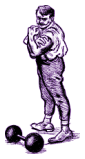 Fred (BODY [4]) and Nigel (BODY [2]) are arm wrestling. In each round each should roll BODY as attacker with the other character's BODY as defender.
Round 1: Fred and Nigel both roll 10, much too high to succeed. Nothing happens, apart from a slight flabby quivering of opposed muscles.
Round 2: Fred and Nigel both roll 3, and succeed. Again, nothing happens. Since both succeeded this is described in terms of bulging muscles, a clash of titans.
Round 3: Fred rolls 10 and fails, Nigel rolls 2 and succeeds. Nigel smashes Fred's arm to the table and wins the match.Example: Excuse Me, Where Is The British Consul?
Lady Janet has been captured by Venusian savages who have decided that she is their long-awaited god (her gender isn't obvious to Venusians). They have no common language. The referee decides that her SOUL [4] must be used against the native chief's SOUL [5] to make her manner sufficiently forceful, and ensure her release. On a 2 the natives build a sedan chair to carry her back to the sphere-ship.
Note: Sadistic referees might prefer to make players act out scenes like this...
On their way back to the ship the native witch doctor decides that Lady Janet's charismatic presence undermines his authority. He challenges her to a duel of magic (actually conjuring), using his skill Acting [6]. She must use her MIND [4] to spot his tricks. He begins by making a fruit "disappear"; on a 3 she notices that he's tucked it into a fold of his loincloth, and points out the bulge to the audience. This causes so much lewd merriment that the duel ends in his abject defeat.
The wily witch doctor has persuaded the chief that Lady Janet must be tested again. This time it's a test of endurance; she must put her hand into a jar of stinging insects. Their stings are extremely painful but do no permanent damage. Lady Janet must use her MIND [4] to attack an arbitrary difficulty of 8.
This is a tough test; on a 6 she fails, pulling her hand out before the test ends. Fortunately she has the sense to grab a handful of insects and throw them at the witch doctor; he also fails, and starts to scream as they sting him. The chief decides that nothing has been proved.
Incidentally, the referee might instead have asked for a roll of AvB&M, rather than just MIND, to check if the character has the will-power and endurance to overcome the pain, or SOUL to check if the character has the courage to endure it.BIG Numbers
If attacking and defending values are both above twelve, divide both by a number which reduces them both below 12. For really large numbers (Godzilla versus New York, an H-Bomb versus the Rock of Gibraltar) division by 50 or 100 may be needed, but in most cases dividing by a smaller number (such as 2,3,4,5, or 10) should do the job. Round numbers up if the result is a fraction. In any campaign with ships, spacecraft, land ironclads, or dirigibles this system may become important in combat.Example: Tom Sloth And His Pneumatic Coveralls (1)
Tom Sloth, the brilliant but somewhat misguided engineer, has developed a mechanical exoskeleton which can be worn over normal clothing. It looks like a pair of silver coveralls, and will theoretically let him lift things as though his BODY (normally 5) is 30. He decides to test it by lifting an elephant at the zoo. The exoskeleton attacks with BODY [30], and the referee has decided that lifting an elephant will be difficulty 20. Neither number is under 12, so he divides both by 3 to make them fit. Now the attacking force is 10 and the defending BODY rounds up to 7.
On a 3 Tom lifts the elephant; unfortunately its weight is now attacking his ankles and wrists, which aren't boosted by the power of the coveralls... BODY 10 is attacking Tom's unmodified BODY 5; the weight will cause him serious harm on an 11 or less!Improving The Odds
Example: She's Buying A Stairway To Heaven...
Lady Janet and the Venusians are being chased by a huge predator, and want to take to the trees to avoid it. The Venusians are natural climbers, and sprint up the trees without any trouble, leaving Lady Janet stranded four feet below the lowest branch. She tries to jump (Athlete [4] attacking difficulty 5) and fails on an 8. The predator roars and pads toward her. Before trying again she spends two bonus points to temporarily boost her Athlete skill to 6. Propelled by a sudden surge of adrenalin she zooms up the tree, passing the Venusians before they're half-way up.Common Characteristic Rolls
|
 All of the above situations have something in common; they should not occur frequently, and must not be an essential stage in an adventure. There must always be an alternative which does not rely on the luck of the dice. Sometimes players get unlucky in situations where their characters should succeed; in one play-test five adventurers failed to hear something at difficulty 3, and an extra clue was needed to put them back on the right track.
Example: It's Behind You...
A Venusian predator has chameleon-like camouflage abilities. One is about to pounce on the witch doctor's son, and Lady Janet is the only person with a chance to spot it. She must roll MIND against difficulty 6 to notice. On a 3 she succeeds and yells just in time to save his life, finally earning the witch-doctor's friendship. The referee might instead have had her roll against the creature's Stealth skill.
Skills are initially calculated from one or more characteristics, with the number of points spent added to the result. For instance, Marksman (the use of all forms of hand-held firearm and other hand-held projectile weapons such as crossbows) is based on MIND. Acting is based on an average of MIND and SOUL. Skills may be raised to a maximum value of 10.
Example: Buying SkillsCharacters automatically have two skills at their basic values without spending points: Brawling and Stealth. Naturally points can be spent to improve them. Optionally additional skills may be made available at their basic values; see Free Skills, below.
While generating Fred (MIND [4], SOUL [2]) a player adds two points each to the skills Acting and Marksman, and one to Linguist.
Marksman will be rated at MIND +2.
Acting will be rated at the average of MIND and SOUL +2.
Linguist will be rated at MIND +1, with his native English and Linguist/2 other languages known.
This is recorded on his character record as Marksman [6], Acting [5], Linguist (Modern Greek, German, French) [5]
Example: It's All Greek... (1)Dice rolls should be made if the character is working under unusual or difficult conditions, under stress, or in immediate danger. They are always used in combat. Usually a skill is used against one of the following:
Fred has the skill Linguist [5] and knows Greek. He is buying a box of matches in a shop in Athens. No dice roll is required.Example: ...If Gills Are Green Go To Section 6b...
Lady Janet wants to identify Venusian foods that are safe to eat. Her backpack contains a copy of the Oxford Guide To Extra-Terrestrial Vegetables, and she is using its key to identify a curious warty fungus. This is routine easy use of her Scientist [6] skill and no roll is needed.
Example: Trouble At T'millBonus points can usually be spent to improve skill rolls, exactly as they are used to improve characteristic rolls.
On her return to Earth, Lady Janet finds that one of her factories is on the verge of bankruptcy. She travels to Lancashire to investigate, using a series of Business skill rolls to overcome the Business skill of a crooked manager who has been bleeding the company dry.
Once the villain is unmasked she should theoretically use her Business skill to unravel years of tortuously complicated accounts and restore the factory to prosperity. In practice, she uses the skill to weigh up the merits of several candidates and hires another manager.Example: It's All Greek... (2)
Fred is still in Athens, and wants to buy a box of silver bullets, ten crucifixes, a certified genuine saint's relict, and a Mk 4 Carnacki Electric Pentacle. When the police arrest him as a suspected lunatic he will need to make several Linguist rolls against Difficulty 6 to explain his need for these items, and at least one Acting roll at Difficulty 8 to persuade them to let him go.
Example: What If I Press This Button?
Lady Janet's sphere-ship is hit by a meteor. Her pilot is knocked out, and the ship is veering wildly off-course. No-one else aboard has the pilot skill; the referee decides that Lady Janet has been in the control room often enough to have a sketchy idea of piloting techniques. She will use the skill at AvB&M/2, or Pilot [2]. Normally the roll to restore the ship to its correct course would be against difficulty 4; because she isn't properly trained, the referee changes that to difficulty 8. On a 2, she just succeeds.
Bonus points may not be used to help in this situation.
Some projects simply require routine use of a skill for a prolonged period, with any failure extending the time. For example, the creation of an average quality monolithic sculpture might need five Difficulty 6 Artist rolls at intervals of a month; any failure leads to major revision of the work, extending the time needed by two months. The project is completed when the fifth successful skill roll is made.
Sometimes practice is all that is needed. This is especially true when learning languages.
Example: Que..?
Fred doesn't understand Spanish. During an adventure in Spain he tries to learn the language; since he already knows some related languages the referee rates this as difficulty 8 after a week, Difficulty 7 after two weeks, and so forth. A lucky roll of 2 allows Fred to learn the language in a week, and it's added to the list on his character record.
 NOTE: This considerably underestimates the difficulty of learning a new language. Linguistic problems are not usually much fun to role-play, unless you particularly want to inflict an unreliable translator on characters, and most scientific romances either ignore them completely or assume that their heroes will easily teach the natives English! The Astronef stories, in FF II, are a little more honest; after weeks of contact with the cultures of Venus and Ganymede, the hero and heroine remain completely ignorant of the native languages. In The Lost World (FF III) the heroes spend weeks with an Indian tribe without learning much of their language.
Research projects, such as the development of a new invention, are resolved a little differently. The referee should decide how difficult the work will be, and how long it will take, then require a series of skill rolls of gradually increasing difficulty, repeated until the final difficulty level is reached. The same procedure might also be used for creation of an artistic masterpiece.
Example: What Goes Up...
Lady Janet's colleague Professor Polkington wants to develop a new antigravity paint and smash the Cavorite monopoly. The referee decides that this project will start at Difficulty 5, but will eventually be Difficulty 10, and each stage of the project will take 1D6 months; initially 4 months.
At the end of 4 months the skill roll fails. Polkington has achieved nothing, apart from shutting off a few dead ends. The referee rolls 1D6 again, and determines that the project will stay at Difficulty 5 for another 3 months. This cycle is repeated until there is a success, then the difficulty is raised to 6 for the next round of attempts. Difficulty continues to escalate until Polkington eventually overcomes difficulty 10 to complete the synthesis. Most of this occurs off-stage between adventures, but occasionally it impinges on the game; for instance, the referee might tell players that Polkington must spend the next 48 hours in his laboratory to finish the current round of experiments, depriving them of his skills at a vital moment, or that he will need a rare chemical or manuscript for the next step. Finding the missing ingredient might be an adventure in itself.
The referee need not say that characters are attempting the impossible, but it's advisable to drop a few hints if serious amounts of time are being wasted on a completely fallacious idea.
 | Under the rule above, additional skills based on high characteristics cost more than skills based on low characteristics. Optionally the referee may allow adventurers to add skills at less than base value with an appropriately reduced bonus point cost. By the time the skill reaches base value it will cost much more than the usual method, but this allows players to spread the cost over several adventures. For instance, a character with MIND [5] might add Marksmanship at a low level; just enough to shoot for the pot, not to shoot for the British Olympic team. In this example the player might choose to take Marksmanship [3] for 6 points, not Marksmanship [6] for 12 points. Once acquired such skills can only be improved by the normal process, and one point at a time. Referees are also advised to limit the number of below-base skills acquired to MIND/2; once skills are up to the usual base value they don't count towards this limit. The "difficult skills" described above may not be acquired this way. |
Example: Everyone's Jumping...
In a world based on a revival of ancient Greek customs, it's customary for every citizen to participate in the Olympics or face ostracism. All characters should have the Athlete skill automatically at BODY; extra points push it to BODY+1 etc.
Skills are listed in the following format: Name, basic value (to which the points spent should be added), and explanation. The following abbreviations are used:
Skill List
This list does not represent every possibility; it is just a selection of the most useful skills. Please feel free to add more, to change values and costs, or otherwise mess things up, but DON'T distribute modified versions of this file!
B = BODY, M = MIND, S = SOUL, Av = Average, / = Divided by
For example:
Skills marked with an asterisk are automatically acquired at their basic values.
AvM&S = average of MIND and SOUL (round up) M/2 = MIND divided by 2 (round UP) AvB&S/2 = average of BODY and SOUL divided by 2 (round UP)
Actor — Basic Value: AvM&S
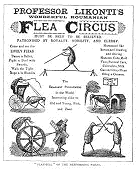 Any form of stage performance. If more than one point is spent you are good enough to earn money from one specialised type of performance, such as Operatic Tenor, Conjuror, Ballerina. This skill is also useful for confidence tricks. E.g. Actor (Juggler)
Artist — Basic Value: AvM&S
Athlete — Basic Value: B
Babbage Engine — Basic Value: M
Brawling — Basic Value: B *
Business — Basic Value: M
Detective — Basic Value: AvM&S
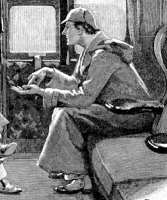 Trained in the art of observation; good at spotting small details, noticing faint scents, little clues, unusual behaviour, etc. Can be used as an improvement over normal observation rolls, and sometimes in place of an Idea roll, or in place of the Psychology skill. Specialities might include forensics, interrogation, etc. E.g. Detective (Bertillon identification system)
Doctor — Basic Value: M/2
Driving — Basic Value: AvB&M
Car chases and other vehicle pursuits should be resolved by using the skill of the chasing driver to attack the skill of the fleeing driver. Attempts to follow cars should be resolved by use of the tailing driver's skill to attack the observational ability (or Detective skill) of the lead driver. The performance of the vehicles may also be a factor, of course. First Aid — Basic Value: M
Linguist — Basic Value: M
Marksman — Basic Value: M
Martial Arts — Basic Value: AvB&S/2
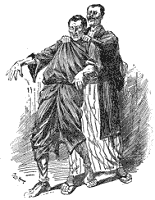 This is by far the most powerful unarmed combat skill in this game, and is not necessarily appropriate to the scientific romance genre (although Sherlock Holmes was a master of Baritsu, an obscure Oriental martial art; see the article The New Art of Self-Defense on the FF CD-ROM). Players should only be allowed to take the more obscure martial arts at the referee's discretion, and only if they can devise a background to explain acquisition of this skill. Referees can make it a little less useful by adopting one or both of the following optional rules:
Mechanic — Basic Value: M
Medium — Basic Value: S/2
Melee Weapon — Basic Value: AvB&M
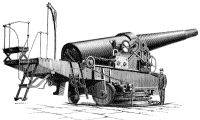
Military Arms — Basic Value: M
Morse Code — Basic Value: M
Pilot — Basic Value: AvB&M/2
Psychology — Basic Value: AvM&S
Riding — Basic Value: AvB&S
Scholar — Basic Value: M
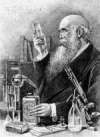
Scientist — Basic Value: M
Stealth — Basic Value: B/2 *
Thief — Basic Value: AvB&M/2
Wounds
Each character and NPC has a Wounds record, which indicates the general severity of wounds taken. It is possible (and sometimes easy) to go from "uninjured" to "dead" as the result of a single wound.
Wounds B[ ] F[ ] I[ ] I[ ] C[ ] |
|
The table shows the effects of wounds. Temporarily reduce the value of BODY and BODY-related skills by the value shown, but not below a minimum of 1.
Example: It's Only A Flesh Wound...(1)
During a visit to a German Duke's estate, Lady Janet takes part in a boar hunt. During a sudden storm she is separated from the rest of the hunters, and loses her gun in a thicket.
As she trudges home she disturbs a boar and is badly cut by one of its tusks. In the next round she tries to fend it off by beating it with a fallen branch. Normally she would use her Brawling [4] skill for the attack; because she has a flesh wound this is reduced to Brawling [3].
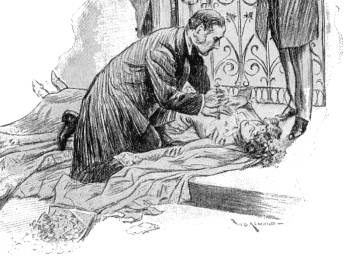 First Aid stabilises wounds and prevent them getting worse. On a successful roll against the recovery Difficulty of the wound, there is no possibility of deterioration. For example, this might involve splinting a broken leg, disinfecting and bandaging a wound, or putting cold tea (a common Victorian remedy) or ice onto a burn. Multiple wounds must be treated separately; for instance, someone with a Flesh Wound and an Injury, or with two Injuries, would need each treated separately.
Without first aid the wound may eventually deteriorate; roll the recovery Difficulty against the patient's BODY, if the result is a success the wound will get worse. Flesh wounds become Injuries and Injuries become Critical (usually as fevers and illnesses such as gangrene) if they get worse.
The Doctor skill acts like First Aid, and also speeds healing. If a successful roll is made recovery time is halved. Since the Doctor skill usually begins at a lower level than First Aid, devoted healers may wish to take both skills.
To recover from wounds without medical help, roll BODY against the recovery difficulty - AFTER the minimum recovery period. If the result is a success, the wound is healed. If the result is a failure, the illness drags on for another period before the roll can be made again.
Example: It's Only A Flesh Wound...(2)
Lady Janet has a flesh wound. She bandages it herself, using First Aid [5] against recovery Difficulty [4]. On a 9 she doesn't do a good enough job of cleaning the wound and applying pressure to prevent further bleeding.
She rolls BODY [3] against Difficulty [4]. On a result of 10 the wound gets worse; by the time she reaches help Lady Janet is bleeding severely, and must spend some time in bed. Her doctor fails to help, so her first roll for natural recovery is made after a month. Fortunately she succeeds and finally heals.
Death is death, and is usually permanent. In some settings there may be some rationale for reanimation or resurrection, but in most games there is no recovery. The referee should explain if this applies.
Some examples of common forms of injury follow the combat rules below; they are clearer if you understand some details that are introduced in the combat rules.
 The combat rules take up a large chunk of this file; this does NOT mean that they are the most important aspect of the game - it just means that they are a little more complicated than other sections. DON'T make the mistake of thinking that every adventure must involve several fire-fights!
These rules borrow an idea that is found in some war games. All the events in a combat round occur simultaneously. If ten people are firing guns, all of them fire BEFORE the results are assessed. You can shoot a gun out of someone's hand, but he will have a chance to shoot you before he loses it. Attacks are usually a use of skill against a defence; if the attack penetrates the defence, the damage is determined by use of the attack's Effect against the BODY of the target. All of these concepts are explained in more detail below.
The following things can be done in a combat round
Anyone taken completely by surprise CANNOT fight, move, or dodge in the first round of combat, but CAN perform a simple action. For example, intruders would have a round to attack someone who was standing a few feet from an alarm button; he would not have time to
get to it first. They could not stop him pressing the button if he already had his hand on it. By definition, someone with a weapon in his hand pointed at an attacker is NOT taken by surprise!
Combat Rounds
A combat round is a period of approximately five seconds in which combat occurs. In this time punches might be exchanged, shots fired, and so forth.
If you don't want to move or perform any action apart from the attack itself there is a bonus on the attack, but you do NOT fire first.
A normal human can walk about ten feet, or run twenty. On a Difficulty 6 BODY or Athlete roll, or on expenditure of a bonus point, this can be pushed to thirty feet.
OR
Referees may OPTIONALLY allow two actions, or an action and a movement, in a round; for instance, opening a door and diving through.
THEN
THEN
Resolving Attacks
Attacks are resolved in the following stages:
Rolling To Attack
|
One modifier may need explaining, since it is frequently misunderstood; machine guns are a little less accurate than other firearms, but more than make up for it by firing LOTS of bullets, increasing the chance of a hit over that for a normal gun. This is the main reason why automatic weapons are used. The idea that machine guns rarely hit and do less damage than other firearms is a myth. Even when used for single shots they are no less accurate than other weapons of similar size.
Example: Collecting A Specimen (1)
Lady Janet (Marksman [6]) wants to "collect" a Ganymedan lion. The lion isn't defending itself, so she must fire the shot against a basic difficulty of 6. The lion is immobile (+1) and large (+1), so her skill would normally be modified to 8; unfortunately it's a long way off (-1), and has skin coloration that makes it harder to see (-1), so the skill stays as Marksman [6]. On an 8 the shot misses; the lion is startled and runs away.
In the second round the lion is moving (-1), but Lady Janet didn't move (+1). The lion is still big (+1) and isn't trying to dodge or hide, and is no longer camouflaged, but it's still a long way off (-1), so Lady Janet uses an effective Marksman [5] for her next shot. On a 4 it's an easy hit.
Example: Take That You Cad! (1)
Bobby and George have decided to settle their differences in a boxing match. Both have BODY [4] and the Brawling [5] skill.
In the first combat round Bobby dodges and weaves (-1) then tries to punch the immobile (+1) George; George stays still (+1) and tries to hit the dodging (-2) Bobby when he gets close.
In this round Bobby has an effective skill of Brawling [5], George an effective skill of Brawling [4]. On a 3 Bobby easily breaks past George's guard, but on a 2 George also hits Bobby.
Some attacks can be used via two or more skills; for example, a longbow might be used via the Marksman or Martial Arts skill, a club via the Brawling or Melee Weapons skill. Use whichever skill is best. If all else fails weapons may be used via characteristic rolls; these are usually poorer than skills.
Defences may also be based on skills or characteristics; for example, someone might try to avoid an arrow by ducking (BODY versus the attacking skill), by hiding (Stealth skill), or by use of the Martial Arts skill to catch it! If no better skill is available, the basic defending value is 6.
If the result of any attack is a success, some damage occurs. Roll for damage as described below.
|
All attacks have an Effect number. For hand-to-hand weapons, martial arts, and other unarmed combat skills it is either the skill level or the user's BODY plus a bonus; for example, a club gains most of its power from the user's strength, and has an Effect equal to the user's BODY +1. A fencing foil, like all swords and daggers, has an Effect equal to Melee Weapon skill. For firearms the Effect number is usually intrinsic to the weapon, and thus independent of the user's skill or BODY.
Damage is determined by using the Effect number to attack the target's BODY. The result of this roll will sometimes be a failure; this is interpreted as minimal damage for the weapon, from column A of the weapons table. While this is always preferable (for the victim!), many weapons have a flesh wound or worse as their minimal damage.
If the result is a success, but more than half of the result needed for a success, check column B of the weapon table.
If the result is a success, and the dice roll is less than or equal to half the result needed for a success (round DOWN), check column C of the weapon table. If in doubt, use the table to the right to calculate which damage column is used.
Example: Collecting A Specimen (2)
Lady Janet's hunting rifle is recorded as follows:This means that it does the following damage:
Weapon Multiple Effect Damage Targets A B C Big Rifle No 8 F I C/K
A: Flesh wound
B: Injury
C: Roll the Effect against BODY again; if the result is a failure the injury is critical, otherwise it's a kill.
Effect [8] attacking BODY [8] succeeds on a 7 or less.
If the result is an 8 or more the lion suffers a flesh wound.
If the result is 5-7 the lion is injured.
If the result is 2-4 the lion is critically injured or killed.
On 4, then 6, the lion is killed.Example: Take That You Cad! (2)
Both combatants are using fists, which are rated as follows:There is no reason to modify these results, so both must use BODY [4] against BODY [4].
Weapon Multiple Effect Damage Targets A B C Fists No BODY B B KO
On a 9, George just grazes Bobby. On a 2, Bobby catches George with a perfect right hook and knocks him out.
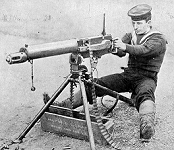 Machine guns use a special rule for Effect. If they are used on more than one target, the Effect is reduced by 2. The attacker must roll separately to hit each target, and to damage the victim if the attack is successful. It's easy to abuse machine guns; players often say that they are trying to shoot at victims in two or three different areas, which should not be allowed. Shooting at several targets in one direction (such as a group of men running along a corridor) is acceptable, but the targets in front will conceal those behind, or at least reduce the Effect. They are powerful weapons, but not all-powerful.
Example: Budda Budda Budda.... oops
Arnie, with Marksman [6] and a submachine gun, stumbles into a German trench during the First World War. Despite Arnie's cry of "Eat hot lead, you scummy krauts!", the referee accepts that they are surprised; Arnie will get one free attack before they can shoot back. There are five Germans, and he tries to shoot them all. His Marksman skill is raised to 7, because he is using a machine gun, but reduced to 5 because he is shooting at multiple targets, and the Effect is reduced from 9 to 7. Arnie succeeds in hitting and injuring three of the Germans, but there are no critical injuries or kills. All five will be able to shoot back in the next round!
It isn't possible to limit damage with shotguns, machine guns, or area effect weapons such as explosives or flame throwers, or with ANY attack on multiple targets.
|
If it is used, someone who rolls to hit a target without trying to hit a specific area should roll 2D6 for a random hit location as indicated above, and modify the Effect accordingly.
It is not possible to attack a specific hit location with machine guns or area effect weapons such as grenades, or while performing any form of multiple attack. Damage from these weapons should attack random hit locations.
Armour
| Armour | Effect | Notes |
| Bulletproof vest | -4 | projectile and blade attacks |
| Kevlar Body Armour | -6 | projectile and blade attacks |
| Bullet Proof Glass | -4 | projectile attacks |
| Medieval Plate Mail | -4 | melee weapon attacks |
| Medieval Chain Mail | -2 | melee weapon attacks |
| Motorbike Leathers | -2 | impact weapons (eg clubs) |
| WW1 Steel Helmet | -3 | attacks to head ONLY |
| Crash Helmet | -2 | impact damage to head ONLY |
The list to the right includes some modern armour as well as equipment that might be available in the late 19th century. The level of protection depends on the type of armour. Naturally only the area covered by the armour is protected; for example, motorbike leathers cover the torso, arms, and legs, but don't protect the head. A full-face crash helmet protects the head only. Similarly, body armour doesn't protect limbs or the head.
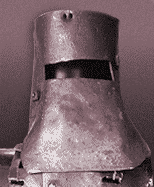 It's possible to imagine heavier armour, possibly as part of a powered suit, but generally speaking if it gives much more protection than this it should be treated as a building or a vehicle, not as personal armour. A good example of heavier armour is the steel plate legend ascribes to the outlaw Ned Kelly, which could allegedly resist rifle fire, but must have restricted visibility and mobility and restricted skills. The photograph of Ned Kelly's real armour, to the left, makes the legend seem somewhat suspect; a more realistic assessment would give it a -2 or -3 Effect modifier.
Remember also that armour is usually heavy and conspicuous, especially in a modern city. It will soon attract attention, both from the public and from the authorities.
Example: Tom Sloth And His Pneumatic Coveralls (2)
Tom Sloth's mechanical exoskeleton lets him lift things as though his BODY (normally 5) is 30. He decides to add some armour and use it to fight crime. The referee decides that plate mail will have a point of BODY for each point of Effect it stops, double that if it is going to be effective against bullets as well as simple impact forces. Tom wants to stop all bullets; the referee decides that this must mean it must reduce Effect by at least 10. The rebuilt suit will have 20 BODY in armour plate, reducing Tom's effective BODY (for lifting things etc.) to 10.
It's good armour and performs as specified. However, it hampers Tom considerably - he won't be very good at wrestling, dodging, etc., and has his vision severely restricted by its bullet-proof glass eye-slits. And he can forget any idea of using Stealth or disguises, swimming, or walking on any surface that won't support several hundred pounds of weight...
| ||||||||||||||
Some of the weapons shown have very high effect numbers, which go well off the "attack versus defence" table. This usually indicates an attack which will do maximum damage unless a 12 is rolled, or the effect number is somehow reduced; for example by distance (e.g. explosives), by the damage being spread to cover several targets (mini gun), or by armour.
Note that most unarmed attacks and some weapon attacks don't show death as a possible outcome; it simply isn't very likely in the course of a fast-moving fight. Referees should feel free to ignore the suggested result in unusual conditions; for example, if someone is attacked by a mob, while unable to resist, or is completely outmatched by his attacker.
While this game tries not to over-emphasise combat, this period produced some extremely odd weapons, as might the circumstances of a campaign. More detail is sometimes useful. Here are examples from FF VI and FF IX, the first historical and the second fictional:
Melee Weapons
Effect is based on BODY or skill.Weapon Multiple
TargetsEffect Damage Notes A B C Fist No [1] BODY [2] B B KO See above Kick No [1] BODY [2] B B F See above Wrestling No BODY [2] B KO KO / I See above Animal Bite No BODY+2 F I C See above Animal Claw No BODY+1 F I C See above Animal Horns No BODY+2 F I C/K See above [1] Using the Martial Arts skill it is possible to perform one fist and one kick attack in a single round against one target, or against two targets that are close together. Against two targets the attacks are at -2 Effect. [2] Users of the Martial Arts skill can use BODY or Martial Arts for Effect in these attacks, whichever is better.
Club Max 2 [3] BODY+1 F F KO/K Eg. Cricket Bat Spear No Melee F I C/K e.g. bayonet on rifle. Axe No BODY+2 F I C/K Sword Max 2 [3] Melee+1 F I C/K Dagger No Melee+1 F I I/K Eg. flick knife Whip No Melee/2 B B F Chair No Brawling B F I/KO Broken bottle No Brawling+1 F F I Nunchuks Max 2 [3] M. Arts B F KO/K Martial arts skill ONLY Staff Max 3 [3] Melee+2 F I KO/C [3] Targets must be within 5ft. Multiple attacks are at -2 Effect. Multiple attacks are available with the Martial Artist skill ONLY. Range For all melee weapons, targets are TOO CLOSE if they block effective use of the weapon; within a couple of feet for swords and axes, within 6 ft for whips (a lousy weapon, despite Indiana Jones), and so forth. If unsure, give players the benefit of the doubt.
Projectile Weapons
Effect is usually based on skill (for thrown weapons), on BODY (for longbows and thrown axes), or on the weapon rather than the user for firearms etc.Weapon Multiple
TargetsEffect Damage Notes A B C Spear No Melee F I C/K Thrown Axe No BODY+1 F I C/K Thrown Dagger No BODY+1 F I C/K Thrown Shuriken Max 3 M.Arts ONLY B F F Thrown Boomerang No Marksman B F KO/I Thrown Cricket Ball No Marksman B F KO/I Thrown Longbow No [4] BODY+1 F I C/K Hunting bow Crossbow No 7 F I C/K Military bow [4] Maximum 2 targets if attacking with Martial Arts skill. Small handgun Max 2 [5] 6 F I C/K e.g. .22 revolver Big handgun Max 2 [5] 6 I I C/K e.g. .38 revolver Huge handgun Max 2 [5] 8 I I C/K e.g. .45 revolver Small rifle No 5 F I C/K e.g. .22 rifle Big rifle No 7 F I C/K e.g. Winchester Huge rifle No 9 I C K e.g. Elephant gun. Small Shotgun Max 2 [5] 4 F I I One barrel Small Shotgun No [5] 8* / 4
* short range ONLYI I C Both barrels Large Shotgun Max 2 [5] 7 F I C/K One barrel Large Shotgun No [5] 14* / 7
* Short range ONLYI C K Both barrels Machine pistol Yes [6] 7 F I C/K e.g. Schmeisser Submachine gun Yes [6] 9 F I C/K e.g. Tommy Gun Machine gun Yes [6] 11 F I C/K e.g. Gatling / Maxim Gun Harpoon No 15 I C C/K Non-explosive whaling Harpoon No 25 C C K Explosive whaling [5] Hand guns can be used to fire at two targets, or twice at one target. If firing at two separate targets each attack is at -2 to hit. If firing two shots at one target there is no modifier. Each attack is resolved separately. Shotguns can fire twice at one target (no modifier to hit, small effect), fire at two different targets (modifier -2 to hit, small effect), or fire both barrels at once (+1 modifier to hit, big effect at SHORT range ONLY). In all but the last case the two shots are resolved separately. The doubled Effect of firing two barrels simultaneously is felt at short range ONLY! [6] Reduce Effect by 2 if fired at additional targets Ammunition Players will undoubtedly have their own ideas about the number of rounds in their weapons, and usually keep track without prompting. If you don't want to bother with bookkeeping it's perfectly acceptable to ignore the matter. As a rule of thumb six shots for all rifles and handguns, and three bursts or twenty single shots for machine guns, should satisfy most players. Gatling guns (including chain guns, rotary cannon, and mini-guns) cannot fire single shots, but the referee may wish to allow many more bursts to be fired. Range Normal range for all hand-thrown weapons, handguns, machine pistols, and submachine guns is 10-20 ft; normal range for bows, rifles, machine guns, and mini guns is 50-100 ft. Anything closer is at short range, anything further away at long range. Targets are too close if they are closer than the end of the weapon!
Area Effect Weapons
All explosives damage everything at full effect inside the radius shown, at effect -1D6 to double that radius, at effect -2D6 to three times the radius, and so forth. The effect of these weapons is not reduced if there are multiple targets.Weapon Damage
RadiusEffect Damage Notes A B C Stun Grenade 6 ft 8 B KO I+KO Hand Grenade 10ft 10 F I C/K Dynamite 10ft 10 F I C/K +2 Effect per additional stick. Mortar Shell 10ft 12 I C K Howitzer Shell 10ft 15 I C K Anti-tank mine 10ft 20 I C K Car Bomb 20ft 15 I C K Truck Bomb 20ft 20 I C K Flame Thrower 10ft 10 I C K No damage outside 20ft radius.
Exotic Weapons
Things that might conceivably come into play in a campaign, in no specific order.Weapon Multiple
TargetsEffect Damage Notes A B C Radium gun No 8 F I C/K Burrough's Mars Disintegrator Yes [6] 15 I C K Most SF Mini gun Yes [6] 8 I C K Terminator II Weapon Damage
RadiusEffect Damage Notes A B C Stun Gun 3ft 8 B KO KO Most SF Heat Ray 75ft 30 C K K War of the Worlds Black Smoke 500yd 10 C K K War of the Worlds Hydrogen Bomb 1 mile 40 C K K Not recommended!
| |||||||||||||||||||||||||
| ||||||||||||||||||||||||
| ||||||||||||||||||||||||||||||||||||||||||||||||||||||||||||||||||||||||||||||||||||||||||||||||||||||||||||||||||||||||||||||||||||||||||||||||||||||||||||
What's the BODY of a door? Of a bottle? Of the Queen Elizabeth? How much damage can a rabbit take (or dish out); a rhino; a blue whale? This section contains data on a range of common and uncommon objects, plants, and animals, which characters may conceivably encounter in the course of play.
Animals | |||||
| Rat BODY [1], MIND [1], SOUL [1] Brawling [1]; Bite, Effect 1, Damage A:B, B:B, C:F Wounds: Any wound kills | Rabbit BODY [1], MIND [1], SOUL [1] Brawling [1]; Kick, Effect 1, Damage A:-, B:B, C:B Wounds: B[ ] F[ ] C[ ] (Any Injury result is Critical) | ||||
| Domestic Cat BODY [1], MIND [1], SOUL [1] Brawling [4]; Claw, Effect 2, Damage A:B, B:F, C:F Wounds: B[ ] F[ ] C[ ] (any Injury result is Critical) | Small Dog BODY [2], MIND [1], SOUL [1] Brawling [3]; Bite, Effect 4, Damage A:B, B:F, C:F Wounds: B[ ] F[ ] I[ ] C[ ] | ||||
| Big Dog BODY [3], MIND [1], SOUL [1] Brawling [5]; Bite, Effect 5, Damage A:B, B:F, C:I Wounds: B[ ] F[ ] I[ ] I[ ] C[ ] | Rottweiler BODY [4], MIND [1], SOUL [1] Brawling [7]; Bite, Effect 6, Damage A:F, B:I, C:C Wounds: B[ ] F[ ] I[ ] I[ ] C[ ] | ||||
| Note that the stealth of animals (especially small animals) is often considerably higher than BODY/2. Customised dogs and canine adventurers are discussed in an appendix below. | |||||
| Cobra BODY [2], MIND [1], SOUL [1] Brawling [6]; Poison, Effect 8, Damage A:I, B:C, C:K Wounds: B[ ] F[ ] I[ ] C[ ] | Anaconda BODY [6], MIND [1], SOUL [1] Brawling [7]; Wrestle, Effect 8, Damage A:I, B:I, C:C Wounds: B[ ] F[ ] I[ ] I[ ] C[ ] | ||||
| Lion or Tiger BODY [7], MIND [1], SOUL [1] Brawling [9]; Bite, Effect 9, Damage A:F, B:I, C:C/K Wounds: B[ ] F[ ] I[ ] I[ ] C[ ] | Horse BODY [7], MIND [1], SOUL [1] Brawling [4]; Kick, Effect 7, Damage A:B, B:F, C:I/C Wounds: B[ ] F[ ] I[ ] I[ ] C[ ] | ||||
| Bull BODY [8], MIND [1], SOUL [1] Brawling [10]; Horns Effect 10, Damage A:F, B:I, C:C/K Wounds: B[ ] F[ ] I[ ] I[ ] C[ ] | Bear BODY [8], MIND [2], SOUL [2] Brawling [10]; Claws/Bite, Effect 10, Damage A:F, B:I, C:C/K Wounds: B[ ] F[ ] I[ ] I[ ] C[ ] Armour thick fur -1 Effect | ||||
| Rhino BODY [9], MIND [1], SOUL [1] Brawling [10]; Horn, Effect 10, Damage A:F, B:I, C:C/K Wounds: B[ ] F[ ] I[ ] I[ ] I[ ] C[ ] Armour thick skin, -2 Effect all attacks | Elephant BODY [10], MIND [2], SOUL [2] Brawling [6]; Tusks, Effect 10, Damage A:F, B:I, C:C/K Wounds: B[ ] F[ ] I[ ] I[ ] I[ ] C[ ] Armour thick skin, -2 Effect all attacks | ||||
| Alligator or Crocodile BODY [8], MIND [1], SOUL [1] Brawling [8]; Bite, effect 8, Damage A:F, B:I, C:C/K Wounds: B[ ] F[ ] I[ ] I[ ] C[ ] Armour thick skin, -3 Effect all attacks | Dolphin or Porpoise BODY [8], MIND [3], SOUL [2] * Brawling [8]; Butt, Effect [8], Damage A:B, B:I, C:C/K Wounds: B[ ] F[ ] I[ ] I[ ] C[ ] | ||||
| Killer Whale BODY [15], MIND [3], SOUL [2] * Brawling [12]; Bite, Effect 15, Damage A:I, B:I, C:C/K Wounds: B[ ] F[ ] I[ ] I[ ] I[ ] C[ ] Armour thick blubber, -2 Effect all attacks | Blue Whale BODY [25], MIND [3], SOUL [2] * Brawling [10]; Butt, Effect 20, Damage A:I, B:C, C:K Wounds: B[ ] F[ ] I[ ] I[ ] I[ ] I[ ] C[ ] Armour thick blubber, -3 Effect all attacks | ||||
| * If dolphins and whales are intelligent in your campaign, you may wish to change MIND and SOUL ratings and add more skills, such as Linguist or Actor (singer). | |||||
| Tyrannosaur BODY [15], MIND [1], SOUL [1] Brawling [15]; Bite, Effect 16, Damage A:I, B:C, C:K Wounds: B[ ] F[ ] I[ ] I[ ] I[ ] C[ ] | Diplodocus BODY [20], MIND [1], SOUL [1] Brawling [15]; Butt, Effect 16, Damage A:B, B:I, C:C/K Wounds: B[ ] F[ ] I[ ] I[ ] I[ ] C[ ] | ||||
| Dinosaurs are discussed in considerably more detail in the worldbook for FF III. | |||||
Plants | |||||
| Cabbage BODY [1] | Sapling BODY [3] ** | Young tree BODY [8] ** | |||
| Large tree BODY [10-20] ** | Giant redwood BODY [30-50] ** | Giant flytrap BODY [8], Bite Effect 6, Damage A:B, B:F, C:I | |||
| ** Axes attack a portion of the BODY of a tree equivalent to the Effect of the weapon. For example, an axe with Effect 6 attacks 6 BODY of the tree, succeeding on a 7 or less. If successful, that much of the BODY of the tree is destroyed. Some trees have thick bark which may act as armour, or other defences. | |||||
Everything Else | |||||
| Internal Door BODY [6], lock Difficulty [4] | Street Door BODY [8], lock Difficulty [5] |
Church Door BODY [12] Lock Difficulty [8] | |||
| Piggy Bank BODY [1], Lock Difficulty [2] | Household Safe BODY [10], Lock Difficulty [10] | Bank vault BODY [20] Lock Difficulty [15] | |||
| House BODY [20] | Warehouse BODY [75] | Skyscraper BODY [200] | Household Table BODY [6] (wood) | Household Chair BODY [3] (wood) | Armchair BODY [4] |
| Garden table BODY [8] (iron) | Garden chair BODY [8] (iron) | Park bench BODY [8] (wood & iron) | |||
| Bottle BODY [1] | Motorbike BODY [4] (1900s) | Car BODY [10] | |||
| Truck BODY [15] | Bulldozer BODY [20] | Tank BODY [25] Armour reduces Effect all attacks -8 | |||
| Liner BODY [100] | Airship BODY [50] | Spaceship BODY [100] | |||
| Many of the Forgotten Futures collections describe vehicles including dirigibles (FF I, FF VII), various types of spacecraft (FF II, FF IX) and flying machines (FF II, FF III, FF VII, FF IX), and time machines (FF IX). Usually these descriptions add considerably more detail! | |||||
SO far these rules have said a lot about rolling dice, but little about the real meat of a role playing game; the opportunity to take on a completely different personality in a world of the imagination. Since most scientific romances were written by Victorians and Edwardians, characters have a tendency to fall into stereotyped behaviour which isn't necessarily changed if they are set in the future. Here are a few of the principal elements of this behaviour:
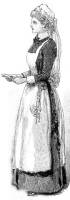
People in inferior positions accept that they are underlings. They are happy to be employed; the idea of bettering their position, over and above promotion within their workplace, is somehow abhorrent. This attitude is especially prevalent amongst servants and others in intimate contact with their social "superiors". For examples see the roles played by Eric Sykes in "Monte Carlo Or Bust", Peter Falk in "The Great Race", and Gordon Jackson in "Upstairs, Downstairs".
In contradiction to the above, the Protestant Work Ethic is also very popular. This says that if you work hard, study, and save money you'll eventually reach the top. This is primarily an American ideal, but also very popular with the British middle classes and anyone else who wants to better himself. Unfortunately middle-class Britons know that however successful they may be, they will never be gentlemen...
Aristocrats are the cream of society; stern but caring, almost always wealthy and learned, always polite (especially to women and other inferiors), they are genuinely superior men, and even savages know them as such. Even if an aristocrat goes bad he remains a gentleman; if his crimes are discovered he will commit suicide rather than dishonour his family by standing trial.
Women unfortunately tend to be treated as inferiors, second class citizens who must be protected from physical and moral danger. An adventurous woman is VERY unusual, a cause for sensation and scandal. A woman exerting real authority is almost unheard of, despite the example of Queen Victoria, and suffragettes and other campaigners for women's rights are treated with great suspicion.
Chauvinism, in its original meaning, is rampant. People don't necessarily hate foreigners, but they do treat them as mental and moral inferiors. To quote a satirical treatment of this attitude, from H.M.S. Pinafore: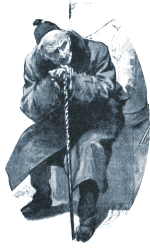
This disrespect for foreigners was true of most nations, especially Britain, while harsh treatment and exploitation of "savages" was typical wherever "civilised" nations were expanding into "primitive" lands; in India and Africa, the Middle East, North and South America, Australia, and the Pacific.
- For he might have been a Roosian,
- A French, or Turk, or Proosian,
Or perhaps Itali-an,- But in spite of all temptations,
- To belong to other nations,
He remains an Englishman!- Hurrah!
- For the true born Englishman!
Some things just aren't done. Chief amongst these is any detailed discussion of sex. Courtship is almost invariably chaperoned, any more intimate contact takes place as in this example:
* * * * *
The next morning there were kippers for breakfast....
Speech is usually fairly formal, and is of course always polite. Accents are stereotyped; in Britain members of the working classes always have lovable Cockney accents, or impenetrable country dialects, while the upper classes all have Oxford accents. Scotsmen say "Och aye", "The noo", and "Hoots mon", Welshmen "Look you" and "Boyo", Irish "Begorrah" and "Saints preserve us". America has its own stereotypes; Harvard accents for the upper classes, Brooklyn for the dregs. Only criminals and drunkards swear.
Finally, here are three examples of good and bad roleplaying in the context of these rules. Can you tell them apart?
"I say, old chap, can you direct me to the station?"
"Yo dude, where do I catch the iron horse?""Excuse me, my Lord, a gentleman from the police is at the door."
"Hey boss, it's the pigs.""I'm afraid we're in a bit of a hurry. May we get by, please?"
"Out of the way, you ***ing scumbags, we're on a mission from God!"
BY now you should understand the rules. Take another look at the example of game play in the introduction, and try to imagine how you would handle things if you were a player or the referee.
This section is mainly intended for referees. It goes into more details on the running of games, backgrounds and NPCs, plotting, and the use of handouts and other aids. If you are already an experienced referee some of the concepts in this section will be old news; even so, you may find some new ideas.
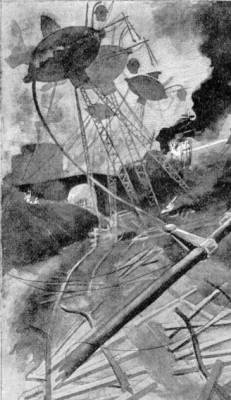 Before play begins the referee needs to make a few decisions. The first is the choice of background. While each of the Forgotten Futures collections includes source material, there is no reason to feel compelled to use it. Maybe you have a better idea. For instance, several authors have set stories in worlds where the Confederacy won the American Civil War, or the war ended in a stalemate; the example of play in the introduction was set in such a world. Equally valid settings include the New York of the future, as described in 1920s pulp SF, London under the rule of Dracula and Queen Victoria (See Kim Newman's "Anno Dracula"), or Africa in a world conquered by H.G. Wells' Martians.
Players should understand the basic details of the game world: the nature of society (or at least how it appears to the characters), the way in which people are expected to behave, and important things that everyone would be aware of. How do people get to work? Do they NEED to work? If not, why not? Is money used? If not, what has replaced it? What gadgets do people use? What would they like to use? What do they like, hate, or fear?
While there's nothing to stop you giving players a long briefing, or copies of the source material, this can sometimes lead to information overload; players have too many facts to digest, and don't know where to begin. This type of briefing is reminiscent of the "balloon factory" sequence found in some of the less impressive scientific romances - if the world the book described revolved around balloon travel, there would be interminable descriptions of their construction, and of the nature of society as transformed by readily available balloons. Here's an example, set in a generic Communist Utopia:
'Ah, Comrade Reporter Langford, welcome to People's Synthetic Food Processing Plant 12B. Here we take sawdust and convert it to the finest synthetic protein...' [several pages of explanation omitted]It's more fun to establish these details in play. Tell the players about the world as they develop characters, then let characters loose in a non-threatening situation that shows them some more. Here Judy is the referee for a game set in Kipling's A.B.C. world (see FF1). The adventurers are on their way to stay at a country house:'This is wonderful, Comrade Food Synthesis Manager Bell. Now, how does the operation of this plant fit into Comrade Glorious Leader Illingworth's five year socio-economic plan?' [several more pages of explanation omitted]
Judy The lane ahead is blocked by a surfacer, melting the road and rolling it smooth. You can see the white glare of heat under its safety covers, and smell the usual ozone. A workman with a red flag signals for you to stop. Bert I say, old chap, going to be long? Judy The workman spits towards the surfacer; the saliva sizzles into steam as it hits the road, then he says [uses appalling rural accent] "Arr, that be what I would loike to know. The trouble with these danged cheap country roads is that your molten rock turns to glass, and glass cracks as it cools. If he doesn't take it slow we'll have the whole danged job to do again in six months." He spits again, and looks gloomy. "Thing is, if he doesn't speed up a bit I'll be late for my tea." Bert But I've an important appointment, old chap. Can't you let me by? Judy [in rural voice] Well, I could, but your tyres would melt afore ye got onto the cool part of the road....
In this scene Judy wants to establish that the surfacer produces immense heat; it will be important later. She doesn't want to let the players know that the information is important. By presenting it in this way she gives the players the impression that this encounter has been used mainly to slow them. She's also mentioned the way that this setting feels to the characters; the noise and smell of the surfacer, and the light it produces, are more evidence of its vast controlled power.
If every scene appeals to two or three senses you'll find that players visualise events more clearly. This is usually good, but don't spend so long on scene setting that the players become impatient. Here's another example:
"A sombre plume of grey smoke rises sluggishly from the red brick chimney of the cottage, twisting and billowing over the slates as the breeze blows it towards you. The smoke has a strong aroma of firewood, probably cedar, but something else is added; the sickly miasma of burning flesh."As descriptions go this isn't bad, but it might be more appropriate in a Gothic novel. Paring it to its essential elements, we get something a little shorter:
"Grey smoke blows towards you from the cottage chimney; it smells of wood, but there's also the sweet aroma of burning meat."
Victorians, and to a lesser extent Edwardians, lived in an era when gadgetry was everywhere. No home was complete without knife grinders, elaborate folding tongs, magic lantern projectors, and other useful(?) devices. Although many important inventions date from this era, attics and old patent archives are full of "labour-saving" devices that can't readily be called useful; see FF IX for an article on the subject. Some were practical in their day, some virtually insane. Victorian gadgets are usually over-ornamented, bulky, and heavy. They are often designed with two or three extra functions over and above their main use. Power sources include compressed air (from bellows or pumps), hydraulic pressure, clockwork, coal gas, steam, electrostatic forces, batteries, and muscles. Components are usually made of brass, cast iron, leather, rubber, gutta-percha, whalebone, ivory, glass, or teak. This misplaced ingenuity sometimes found its way into scientific romances, and mentioning or describing these gadgets is often a good way to set the scene. For example:
"Grice-Charlesworth pumps the bellows, and the flywheel mounted above it begins to spin. A brass drive shaft with a couple of flexible joints runs up to an ivory handle which supports a rotating steel blade, a little like a miniature apple corer, mounted below a concave mirror. You can hear a thin hiss of air sucking back to the bellows through the blade. He squeezes the rubber bulb of the ether spray, and a thin jet of flame momentarily plays over the glittering surface of the steel. He smiles, and says 'At last, after all my work, the Little Wonder Nose Hair Cutter and Singer mark II (with razor grinder and anti-explosion device) is ready for testing! Which of you gentlemen would care to be the first to try it...?'"
One last point; a picture is sometimes worth a thousand words - when it's relevant. If you're an artist, consider sketching some of the scenes the players are likely to encounter, or use newspaper and magazine photographs. Maps and other plans are also very helpful. A word of warning; if you only prepare pictures of vital scenes, players will soon start to assume that nothing important is happening if they don't see a picture. A few extra pictures, produced to set the scene at less vital moments, can keep them guessing.
You'll find more examples of scene-setting in the Forgotten Futures adventures and worldbooks, and more on illustrations and handouts below.
 Most people get up in the morning with a fair idea of likely events during the day ahead, and very rarely run into invading Martians, marauding dinosaurs, or deranged serial killers. It seems unlikely that anyone reading this has fought a gun battle on the wings of a biplane, or unravelled a sinister web of deceit to unmask the machinations of an ancient cult and a nameless evil from beyond the stars.
Life is different in a role playing game, and characters don't lead routine lives. They are adventurers, encountering excitement wherever they go. Sinister cultists kill victims on their doorsteps, or decide that an adventurer is the reincarnation of their god. Their airliner is the one that is hijacked, their spaceship the one that picks up a strange alien parasite. They suspect weirdness in the most mundane events, and are usually right. The snag is that the referee has to prepare all this for the players.
Sometimes plot elements are implicit in the game background. Let's take an example set in 1911, a decade after the War Of The Worlds was won by the wrong side. The Martians control the world, and are using their machines to exterminate humans, apart from a few survivors kept as food animals. There are still human enclaves, hiding places where a resistance organisation is gradually acquiring the tools needed to destroy the Martians. Think of a steam-powered version of the resistance organisation in the "Terminator" films. Here the staple plot will be commando-style raids on Martian bases, and attempts to destroy Martian war machines. The aliens aren't invulnerable; cunning booby traps might literally bring a machine to its knees. Long-term goals would be capture of Martian heat rays and other weapons, and discovery of a way to use them safely.
This is fine for one or two sessions, but it won't sustain a long campaign. You can only destroy so many tripods before the novelty wears off. Let's add another plot element; the Martians have implanted electrodes and transmitters in the brains of a few of their prisoners, and brainwashed them to wipe out knowledge of the implants. These spies have been allowed to "escape" to the resistance organisation, where they unconsciously report to the Martians. The Martians use the information to catch raiding parties; they prefer fresh-caught food, not the unhealthy blood of their ageing "cattle". The resistance base is allowed to exist, because the occupants are accomplishing little. The Martians know its exact location, but don't move in because it would cut off their most succulent food supply. Now raids will start to go wrong, and the adventurers may start to suspect a spy in their midst. Throw in more complications; a resistance commander who thinks that one of the adventurers is a spy - possibly correctly. An escapee who is behaving very strangely, but for a completely different reason. Sooner or later someone will realise that escapees knew something about every failed raid. Proving anything will be VERY difficult; the spies don't know that they are spies, and aren't doing anything unusual.
This simple example could be good for several evenings of play. By the time the spies have been dealt with another Martian ploy will be under way, or maybe the resistance leaders will have developed a new plan to destroy the invaders.
Campaigns without these implicit adventure backgrounds pose more difficulties. In an Utopia there is nothing obvious to drive the plot. This may mean that the setting is unsuitable, but a little twisted ingenuity will usually find some cause of conflict. No Utopia can possibly please everyone all the time, and there may be hidden serpents in the Garden of Eden. A good example here is the life of the Eloi in H.G.Wells' "The Time Machine"; apparently living a life of pastoral tranquillity, they were actually preyed on by the subterranean Morlocks. Look at the workers in the film "Metropolis", and contrast their life with that of the managers.
An interesting idea is the Utopia that goes wrong, where everyone is genuinely happy and contented until a flaw in the system starts to generate horrendous problems. The most common example is the revolt plot typified by R.U.R. (Rossum's Universal Robots, by Carel Capek) and the film Westworld; a civilisation where robots do all the work until they decide to run things for themselves. Capek's War With The Newts shows another example of the revolt of an artificially created servant race. An interesting variant is the world where everything is run by machines - trains, planes, ships and cars drive themselves, factories are entirely automated, and every home has cleaning machines and other labour saving devices. Naturally everything is designed so that nothing can go wrong.. go wrong.. go wrong.. - when it does, the adventurers will have to deal with road building machines which don't notice that they are squashing cars, factories that insist on spray-enamelling all intruders, and bed-making machines that fold the occupants as well as the sheets. This example comes from numerous sources; most notably E.M. Forster's The Machine Stops, a gloomy account of the collapse of an over-mechanised civilisation.
For one-off adventures these relatively simple plots will probably satisfy your players. In long campaigns it's better to keep several plot threads on the boil, and bring one to the fore as another ends. These can be entirely separate, or different strands of a very complex design. Here's a breakdown of part of a campaign:
Plots of this complexity need a lot of preparation, but breaking them down into their component streams helps to keep things on track. Some referees also like to run adventures to a timetable, where NPCs will act at a given time unless the adventurers counter their plans; this can be fun if the adventurers are fighting a deadline (such as a bomb that will explode if it isn't found first), but the bookkeeping needed to time journeys and other activities tends to be a little more trouble than it's worth. Timed activities work best over very short periods, where combat rounds can be used; for example, if the adventurers are trying to fight their way out of a burning house before the gas mains explode.
Some groups of players run multi-referee campaigns; they take turns to run the game, but continue to use the same characters throughout - the current referee's character is sent off to the sidelines, or run as an NPC, as best fits the needs of the plot. These games do need to run to strict timetables, so that schemes involving NPCs will come to fruition when the appropriate referee is running the campaign. A simple variant is the use of several separate plot lines, set against a common game background, but with a set of characters for each referee. This method is most often used for superhero games, with each referee essentially running a separate "comic" set in a common world.
Finally, no discussion of plot would be complete without mentioning comedy. Humorous plots are occasionally fun, but a joke that falls flat is worse than no joke at all. Characters with peculiar names and behaviour aren't enough to sustain comedic interest, although the author is aware of one Mafia-based adventure that featured an NPC stool pigeon called Mr. Cream, inserted purely to allow the characters to "ice" Cream.... It's usually better if the humour is an intrinsic part of the situation you're describing. Pratfalls should be avoidable if the characters take a little care. For example, if the referee sets up a situation which should result in three or four characters getting covered with mud, players who think things through should be able to get away unblemished.
Many scientific romances are set around the year 2000, so one possible form of humour is satire of the real world and its public figures, transformed by the game setting. For example, a certain Herr Shwartzenegger appears in an unaccustomed role in the adventure accompanying the first Forgotten Futures sourcebook.
 NPCs are the backbone of every game; if they aren't played well, characters move through a landscape populated by formless blobs, faceless entities that are usually treated as cannon fodder. Despite the need to keep things simple, NPCs should be described and played as though they are characters. Here's a poor referee telling players that they've walked into trouble:
'Two men step out, with guns drawn, and tell you to throw down your weapons.'The players probably respond by shooting everything in sight. Now let's see the same scene with a better referee:
'Two men step out into the road ahead of you, holding revolvers. They're wearing oilskins - odd, on a hot day like this. The older one looks very scarred; the other one looks too young to be allowed out with a gun. He's got a nasty grin and says "Kin I plug them, pa?". Dad shrugs; "Not yet, Leroy [raises voice] Maybe you boys oughta know that there are four shotguns covering you. Now drop them weapons, or Junior and ma friends will shoot your balls off."'The situation is essentially unchanged (those friends and shotguns are a bluff), but players may think a little longer before going for their own guns.
Ignore points when preparing NPCs; if you need someone with all three characteristics at 6 and a dozen high-powered skills, just assume that the character is exceptional. If you want a wimp, set characteristics and skills low. It really doesn't matter, so long as the character makes sense in the context of the adventure, and gives the adventurers a fair chance of survival.
If player characters are the stars of an RPG, NPCs are the supporting cast and extras; some are crucial to the plot, others are cannon fodder. If all are acted to the best of the referee's ability, players shouldn't automatically know who's who - someone who seems unimportant might really be the villain of the piece, while "important" NPCs can be set up as victims or red herrings.
Important NPCs should be prepared as thoroughly as player characters; extras need much less attention, but it's advisable to keep a list of their names, and have an idea of the way that they talk and act. Experienced referees often have a small "repertory company" of prepared NPCs, who can be used as they are needed; here are some examples.
First, some useful stock characters:
Mrs. Jenkins, The Little Old Lady, is always useful as an unreliable witness to unusual events. She's unhelpful, inclined to call the police at the first sign of trouble, and always complaining. Quote: "He's the one!" (points at a completely innocent character)
BODY [1], MIND [3], SOUL [2], Detective [8]
This character is also useful as a telephone operator, receptionist, or librarian.
Stross, the Evil Retainer, knows at least three damning secrets about his master or mistress, and blackmails guests. An expert at oiliness, materialising just before he is called, skulking in shadows, eavesdropping, and general skulduggery. Quote: "Will that be all..." [pauses and sneers] "...sir?"
BODY [3], MIND [5], SOUL [3], Detective [7], Stealth [9], Thief [8]
With minor modifications this character is easily run as a secret policeman, sinister ventriloquist, or telephone timeshare salesman. Female variants should be based on Mrs. Danvers, from Rebecca, or Frau Blucher from Young Frankenstein. A "nicer" alternative should be based on Jeeves.
Next a group of generic bruisers, suitable for brawls, for robbery with violence, and as bouncers at rock concerts. Easily used as secret policemen (add leather coats, handguns, strange accents, and Marksman [6]), or as rampaging mercenaries or soldiers (add uniforms, rifles, grenades, and Marksman [7]):
CURLY is bald, 6ft 6in tall, and armed with a crowbar. Quote: "I want a word with you, shorty"
BODY [6], MIND [2], SOUL [2], Brawling [8], Melee Weapons [8]ERIC is an ex-jockey with a switch-blade knife. Quote: "I reckon it's time I taught you some manners..."
BODY [3], MIND [4], SOUL [1], Brawling [5], Melee Weapons [6], Riding [6]BIG CECIL is fat, bearded, and a former wrestler. Quote: "When you get out of hospital pay your bills."
BODY [7], MIND [3], SOUL [4], Brawling [10], Martial Arts [8], Thief [5]LENNY has a deep scar across his throat, and can only talk in a rasping whisper. He uses a knife, and is a sadist. Quote: "Oh, was that your kitten... naughty me."
BODY [4], MIND [3], SOUL [1], Brawling [7], Melee Weapons [7], Thief [4]DAVE is an unlovable Cockney, heavily tattooed, with a shotgun. Quote: "Puke on my shoes and I'll 'it you again."
BODY [2], MIND [2], SOUL [2], Marksman [6], Brawling [3], Thief [8]
The Police: Depending on the nature of your campaign, these may be corrupt Gestapo-style thugs (as above), Scotland Yard bunglers, or skilled professionals.
CONSTABLE DICKINSON is fat, near to retirement, and has never solved a serious crime in his life. He loves beer, and is armed with a truncheon, bicycle pump, and the majesty of the law. Quote: "'Ello, 'ello, wot's orl this then?"
BODY [4], MIND [3], SOUL [4], Brawling [5], Melee weapons [5], Acting [6] (comic songs)DETECTIVE SERGEANT MONDALE is in his mid-thirties, a ruthlessly efficient professional. He doesn't take bribes or frame anyone who doesn't really deserve it. Quote: "They don't like me to hurt prisoners, it messes up the cells..."
BODY [5], MIND [4], SOUL [3], Detective [6], Brawling [8], Melee weapons [7], Marksman [6], Thief [8]INSPECTOR CAVENDISH is in his early forties, fighting fit, and a connoisseur of the arts. He is scrupulously honest and fair. Quote: "Hmmm... I'd say that this ash was originally Turkish tobacco mixed with a small amount of Peruvian cocaine."
BODY [5], MIND [6], SOUL [4], Artist [7], Detective [8], Scientist [7], Brawling [6], Melee weapons [6], Linguist (German, French, Italian, Welsh, Flemish) [7]
Most NPCs are secondary characters or cannon fodder. Adventures also need a few NPC stars; powerful characters who are the driving force behind the plot. These characters fall into three main groups:
AUTHORITIES: NPCs with rank and some degree of power over the characters. Usually they need not be prepared in immense detail, since they need not become involved in the action. For example, Queen Victoria appears in several of George MacDonald Fraser's "Flashman" novels, and sometimes motivates the plot, but she is never in danger, or in a situation that makes much use of her undoubted skills. Authorities are most common in adventurers with a service background.
Another type of authority is the information source; a scientist or scholar. They are usually erudite, but rarely get involved in the action. Q, in the James Bond films, is a typical information source. Again, there is usually no need to develop characters far beyond a name and a brief description. Here are examples of both types of authority:
HEROES: PCs are the heroes of most adventures, but occasionally you'll want to confront them with an NPC hero or heroine. This can be surprisingly difficult; heroes are often resented by players, or treated as crutches to rescue them from their mistakes. For example, Sherlock Holmes sometimes appears as an NPC in Victorian campaigns, but players always expect him to do all the work, or at least to throw off his disguise and rescue them at the last minute. It's more fun to use a flawed hero; someone who has fortuitously acquired a formidable reputation but doesn't really live up to it, has fallen on hard times, or is living a lie can be a lot of fun. See the "Flashman" novels for a splendid example. None of this is to say that NPC heroes should always be avoided; sometimes they have their uses, but it's usually advisable to keep their appearances and effect minimal. More examples:H.R.H. QUEEN VICTORIA (Hip, Hip, Hurrah!) is an important figure in any Victorian campaign. Characters might meet her at an official function, or save her from some dastardly plot. Always regal, she is the Empress of half the world and an inspiration to all normal men and women. She has a will of iron and is totally lacking in fear (she survived at least twenty assassination attempts, some at point-blank range), absolutely convinced that God protects the monarchy and Britain. Quote: "We are most impressed"
BODY [2], MIND [4], SOUL [5], Business [7], Linguist [5] (French, German, Hindi)X3 is a senior figure in the British Secret Service, once an active agent but now frail and confined to a wheelchair. Almost omniscient in his grasp of the "great game", he controls a vast network of spies and counter-spies. He is highly intuitive, often sensing trouble before there is evidence. Quote: "I can't order you to accept this mission..."
BODY [1], MIND [6], SOUL [7], Artist (miniatures) [9], Business [9], Detective [8], Medium [4], Linguist (German, French, Russian, Hindi) [7], Thief [6]PROFESSOR FINCH is a leading expert on tropical diseases and toxins. He is preparing a definitive study of snake and insect venoms. There are usually a few jars with nasty-looking live specimens on his desk; sometimes the lids are a little loose. Quote: "Stay quite still while I get a net, it's more frightened than you are."
BODY [4], MIND [6], SOUL [5], Scientist [9], Doctor [5], First Aid [9]
VILLAINS: Not all worlds need villains, and the enormity of their crimes may vary according to the nature of the world; in an Utopian setting unhappiness or ugliness may be the worst offence, in a survivalist environment the main enemies may be disease or famine. Victorian settings give villains their greatest scope; the widespread inequalities and crime of the era bred fictional criminals like Bill Sykes and Moriarty, while xenophobia led to the creation of foreign masterminds like Fu Manchu and Carl Peterson. Then there are misunderstood villains and monsters, and the looming spectre of Jack The Ripper.
BODY [6], MIND [7], SOUL [5], Acting (Disguise) [10], Detective [10], Marksman [8], Martial Arts (Bartitsu) [9], Scientist (Forensics) [8], Stealth [10], Melee Weapons [8], Thief [9]JACK ROBINSON is an adventurer who subsidises his career by publishing lurid fiction based loosely on his exploits. He is NEVER around when the adventurers need him - when danger rears its ugly head in Mexico, he's believed to be somewhere in China; if evil strikes at sea, he was last seen in the desert. He's a good drinking companion, a mesmerising raconteur, and an excellent listener; several of the team's adventures have somehow found their way into his pulp novels, without acknowledgement. Quote: "There I was, with the anaconda coiled around my legs..."
BODY [7], MIND [4], SOUL [4], Actor [7] (disguise), Brawling [8], Detective [8], Marksman [7], Melee weapons [8], Scientist [6], Stealth [8], Thief [7]
If necessary use the thugs (above) as a team of assistants, substituting more socially acceptable behaviour and weapons.
One referee's lovable rogue is another's homicidal maniac. Usually players are reasonably relaxed about the threat of wholesale violence, such as a cunning plan to destroy London, but upset by more personal forms of assault. Here are two simple examples; you are STRONGLY advised to put some work into developing characters of your own!
Don't use these stereotypes too frequently; if every group of thugs contains a fat former wrestler, and every crowd a little old lady, players will soon start to recognise them. Above all, remember that NPCs are expendable. There's nothing worse than a referee who stubbornly refuses to admit that the players have killed his favourite character. Nearly as bad is the referee who insists that the players MUST meet a particular NPC, even if they have no intention of going near him. Plots should always be flexible enough to give the adventurers some leeway, and there should always be a way to get a scenario back on course if something goes drastically wrong.PROFESSOR VOLKOFF is a misguided genius of crime. He uses mechanical juggernauts to break into banks, then tries to loot them before the police arrive. He doesn't realise that he would earn far more by selling his inventions. He is always caught, but always escapes from captivity. Quote: "They all laughed at me at Heidelberg..."
BODY [4], MIND [6], SOUL [2], Scientist [10], Linguist [10] (All European and Scandinavian languages, Russian, and Polish), Mechanic [9]
Volkoff will give up without a fight if he is personally confronted by the adventurers. As an interesting twist on this character, consider having him reform after his second or third brush with the adventurers, and start to "help" with his strange inventions.THE DEATH DOCTOR is the Press's nickname for a homicidal maniac. Bodies have been found partially dissected, their adrenal glands removed with great skill. The attacks occurred in the disreputable neighbourhood of your choice. The doctor has found out how to extract adrenal fluid and transform it into a potion which imbues enormous strength, at the cost of all human feelings. The potion is addictive, effects lasting a few hours. Only glands from a certain race, sex, age group, or blood group will work; one of the adventurers falls into the affected group. These crimes should take place in the background for some time (mention them as newspaper stories appearing while the adventurers are involved in other matters), gradually getting closer and closer to home. Eventually incidents occur which make it certain that someone is stalking the affected character. Catching the doctor should be very difficult; although all human emotions and sympathy are gone when he is under the influence of the drug, his MIND remains clear and he will make sure that there is always an escape route. Quote: (On a note pinned to a corpse) "Nice trap. Better luck next time."
BODY [8/4], MIND [5], SOUL [0/1], Brawling [9/5], Doctor [7], Scientist [8], Melee weapons [7/5], Stealth [8]
Numbers before and after / signs are characteristics and skills with and without the potion. When SOUL is reduced to zero this character has no sympathy or human feelings, and is immune to all forms of emotional control.
If one of the player characters is a doctor, frame her for the murders!
For considerably more on Heroes, Villains, and melodramatic plots see the appendices below and Forgotten Futures VI.
 Some referees love them, others hate them. Props, which can include everything from maps to inflatable models of Godzilla, are very much a matter of personal taste. While there are obviously endless possibilities, the most useful props tend to be maps and plans, newspaper cuttings and other written clues, pictures, and figures and other models.
Home made maps have the advantage of being cheap and showing exactly what you want them to show. This is also their disadvantage; if a map only shows a limited number of locations, players will expect at least one of them to be significant. A map that shows an area in a reasonable amount of (mostly irrelevant) detail is usually better. Wherever possible use real maps, modifying them for the history of your game world as needed. For example, if a campaign is set in London a few years after the War Of The Worlds (the one that mankind won), it's easy to obtain a copy of a real Victorian map and add the Martian excavations on Primrose Hill, the charred remains of Imperial College, and other details. Some commercially published RPGs have included maps of Victorian London; in general the scale is too small to be useful. See below for suppliers of large-scale maps.
With a little research work it's possible to find maps and pictures of "Future cities", showing grandiose plans for architectural projects and city management that never came to pass. These are most often found in old magazines, but collections have been published.
Building plans are easily obtained; just look at a few architectural magazines or textbooks to find plenty of examples. Estate agents (realtors) also sometimes offer plans of the buildings they are selling. Plans are the most common type of handout in commercially published games - if you are involved in this hobby for any length of time, you'll soon accumulate dozens! Naturally some modification may be needed for the circumstances of your game. Needless to say there are numerous maps and plans accompanying the Forgotten Futures adventures
|
This cutting actually contains two important clues; the fact that the Prince Of Wales unveiled the statue suggests that the Queen might be busy elsewhere, and the last paragraph makes it clear that international rivalries have spurred intense study of Martian technology. The money raised by the Thunder Child trust isn't important in the current scenario, but might be prominent in a later adventure. The advertisement is a red herring. Some other possibilities for text handouts include extracts from books, pages from diaries, letters, business cards and other identity papers (most shopping centres now have useful card-making machines), and official reports.
As already said, pictures are an extremely useful adjunct to any adventure. One obvious source is SF illustrations of the twenties and thirties, when much of the tradition of the Scientific Romance still survived in pulp magazine SF. Work from this period can be found in numerous collections. Films of the era are also visually appealing, and stills are often available; Metropolis, Things To Come, and Just Imagine are particularly good in this respect, but there are many other excellent examples. Some referees like to show players photographs of NPCs; any pictorial magazine should contain all you need. Each of the Forgotten Futures collections is accompanied by numerous illustrations, and there are many more on the FF CD-ROM. Pictures of gadgets are also useful; the author has made good use of a collection of 19th century scientific illustrations and a 1920s scientific instrument catalogue. Material of this type is often surprisingly cheap, especially if you can find a public library selling off old books.
Figures and other models are useful but aren't essential. For most purposes a few men and women in civilian clothing should be ample. Figures made for the games Space 1889 and Call Of Cthulhu tend to be particularly good for Victorian and Edwardian settings, SF figures may be more appropriate in games with futuristic settings. RPG shops mainly sell lead or alloy figures in 25mm scale, but there are plenty of alternatives; plastic figures made for model railways can be quite useful, as can larger scale plastic soldiers and animals, or the smaller figures sold for war games. Toys are almost always cheaper and less fragile than gaming miniatures. Dinosaurs and other large animals are best purchased as plastic models; in Britain the Natural History Museum sells an especially realistic range. Cars and other vehicles are best obtained as toys, not as gaming models, since toys are generally a LOT cheaper. One word of warning; once you start buying these things, it's very hard to stop. The author has several hundred lead figures, dozens of vehicles, and a whole herd of dinosaurs, but generally uses less than a dozen figures for any game! If all of this sounds hideously expensive, there's nothing to stop you using paper cutouts instead of figures; just glue a picture or photograph to a piece of card, and add a bit of wood or a coin as the base. Commercial cardboard figures are rare but do exist, usually supplied as part of game modules; the Cardboard Heroes range formerly manufactured by Steve Jackson Games is still occasionally available, and is highly recommended. Some of the later Forgotten Futures collections include illustrations that are made to be printed and used in this way; again, there are many more on the FF CD-ROM
More exotic props can occasionally be useful, but they are often more trouble than they are worth. Full sized replica daggers and guns look good, but carrying them around most modern cities is asking for trouble. Model airships or spaceships tend to be too large for easy transportation, and you'll get some very strange looks from people who notice what you are carrying...
Some referees like to enhance the mood of a game by playing music that matches its theme. For instance, the music from Jeff Wayne's War Of The Worlds album might be quite effective in a post-invasion game. Ragtime might suit a campaign set in the twenties or thirties, with Gilbert and Sullivan or Souza more appropriate for Victorian adventures. Some players like this idea, others hate it; provided the music doesn't stop people hearing what's going on, it probably doesn't matter.
Finally, one last word of warning; if you need an eerie atmosphere, DON'T try to establish it by drawing the curtains and running the game by the light of a single candle. Extensive tests have revealed that three out of five referees can't read their own notes under these conditions, while one player in eight falls asleep in the dimness, and one in fifty sets fire to something...
 THESE rules are just a small part of Forgotten Futures. Material already available for the game includes detailed game worlds, each with its own history, the fiction they are based on, adventures, etc. Currently Forgotten Futures collections cover the following themes:
FF I: The A.B.C. Files
A complete role playing game set in Kipling's 21st century airship utopia. Contains the complete text of With The Night Mail and As Easy As A.B.C., a worldbook, an adventure (with an operatic theme), a spreadsheet of data on historical airships, and illustrations.
FF II: The Log Of The Astronef
The exploration of the Solar System in 1900 AD. Based on George Griffith's Stories Of Other Worlds (better known as Honeymoon in Space), it contains six complete stories, all the illustrations from their original publication, a worldbook taking the story forward to 1920, a spaceship design spreadsheet, five adventures, and much more.
FF III: George E. Challenger's Mysterious World
Adventures with Sir Arthur Conan Doyle's scientific hero, including the full text of The Lost World, The Poison Belt, When The World Screamed, The Land Of Mist, The Horror Of The Heights, and The Disintegration Machine, a worldbook, four adventures, a wargames scenario, etc.
FF IV: The Carnacki Cylinders
All nine stories of Carnacki the Ghost Finder, with illustrations and game material, magic rules, three long adventures and two large adventure outlines, and a story-telling card game.
FF V: Goodbye Piccadilly
A collection of game worlds based on the destruction or transformation of London as described by various authors of the late 19th and early 20th centuries. Includes maps, period fiction, articles, and illustrations, and all the usual game material.
FF VI: Victorian Villainy
A collection of stories and adventures showing various Victorian villains in action, with rules for melodramatic roleplaying, crime and punishment, fate, villainy, etc. Includes a novel, nine short stories, three plays, and three adventures plus several in outline form. Also includes cardboard cutout figures for the major characters in the adventures.
FF VII: Tsar Wars
A complete future history spanning 130 years, based on two epic novels by George Griffith. The birth of a Socialist Utopia in blood and war, the destruction of the Russian Empire, and its eventual resurgance form the tragic background to a story of future war and catastrophe, and the annihilation of most of the human race. Includes several adventures and adventure outlines, rules for Æronef flying machines, and much more.
FF VIII: Fables and Frolics
The world of Victorian fantasy, as described by E. Nesbit. Includes extended rules for playing Victorian children, magic, and much more. With three long adventures and numerous adventure outlines, as well as dozens of stories and three novels.
FF IX: It's My Own Invention...
The theme of this collection is weird technology, source material includes two novels by George Griffith, plus short stories and articles by a variety of authors. Four detailed game worlds describe flying hussars with a mission to fight the supernatural, a world of Babbage engines and automata, time travel by ocean liner, and a space race with big rewards for the winner. With rules for constructing automata, flying machines, etc.
All of this material, and much more, is on the FF CD-ROM; with a few exceptions all of the game material can be downloaded via either of the author's sites:
www.forgottenfutures.co.uk
www.forgottenfutures.com
The following are only available on the FF CD-ROM
 Flatland, The Role Playing Game: Action and adventure in a world where characters are supposed to be two dimensional. Uses a modified and simplified version of the Forgotten Futures rules. An additional short adventure, Flatlander: The Thickening, will be published (in a generic form) for charity in 2005 and added to the FF CD-ROM in 2006.
Printed versions of the Forgotten Futures rules and of some of the adventure and source material have been published by Heliograph Inc., but they are currently out of print.
WHILE most of the Forgotten Futures settings are based in fiction, the fiction is often based, or at least originates, in the real world. This section summarises some useful information about the period; of course things may be wildly different in a game world, but it's useful to know where the authors of the original stories were coming from.
 Adventurers will often want to buy things, and may even want to work for a living if they can't find alternatives. Most of the Forgotten Futures worldbooks include prices for items that might come up the course of play, and construction rules for items such as flying machines, spacecraft, and automata which suggest purchase prices. This section (expanded from material in FF II) explains the complexities of British currency, and gives real-world wages and prices for everyday items from around 1900, a period of relative stability and little inflation; they should be adjusted up for later periods, down for earlier settings. For simplicity add 5% in 1906-10, 10% in 1911-15, 15% in 1916-20, and so forth.
British currency is based on a gold standard until 1914, and from 1925 to 1931. Until metrication in 1972 the Pound Sterling (£ or occasionally L) is divided into 20 shillings (s), each worth 12 pence (d). This form of currency is used in most British scientific romances. Occasional references to "LSD" in period fiction refer to money, not drugs!
Confusingly the Guinea (gn, g OR gs), worth 21 shillings, is used for legal and other professional fees, and by the most expensive shops. There were no coins or notes for this amount after 1813, but prices are often given in Guineas, and cheques can be written for Guineas. A half Guinea (worth 10s 6d) is also occasionally used for smaller fees.
The Sainsbury Museum web-site has a large illustration of Victorian coins to scale (1.2mb) which may be useful.
|
| ||||||||||||||||||||||||||||||||||||||||||||||||||||||||||||||||||||||||||||||||||||||||||||||||||||||||||||||||||||||||||||||||||||||||||||||||||||||||||||||||||||||||||||||||||||||||||||||||||||||||||||||||||||||||||||||||||||||||||||||||||||||||||||||||||||||||||||||||||||||||||||||||||||||||||||||||||||||||||||||||||||||||||||
| |||||||||||||||||||||||||||||||||||||||||||||||||||||||||||||||||||||||||||||||||||||||||||||||||||||||||||||||||||||||||||||||||||||||||||||||||||||||||||||||||||||||||||||||||||||||||||||||||||||||||||||||||||||||||||||||||||||||||||||||||||||||||||||||||||||||||||||||||||||||||||||||||||||||||||||||||||||||||||||||||||||||||||||
A very brief summary of a few interesting events from 1890 to 1914, most of which has previously appeared in some of the Forgotten Futures worldbooks.
1890 Forth Railway Bridge, the first major steel bridge, opened. Van Gogh commits suicide. Wounded Knee massacre. 1891 American Express introduces traveler's cheques. Homo erectus remains found on Java. Wilde publishes The Picture of Dorian Gray. Free primary school education in Britain. 1892 Mary Baker Eddy reforms Christian Science movement. Le Libre Parole (French anti-Semitic newspaper) founded. Depression in Australia. Mechanical voting in USA. Borden family murdered in USA. 1893 Gladstone's second Irish Home Rule Bill is vetoed by the House of Lords. Art Nouveau movement. 1894 Arrest of Dreyfus. Percival Lowell builds an observatory to study Martian canals (see FF II). Aubrey Beardsley illustrates Oscar Wilde's Salome. The Jungle Book published. Marconi demonstrates wireless telegraphy. 1895 Lenin exiled to Siberia. X rays. Motion pictures. Wilde writes The Importance of Being Ernest. 1896 First modern Olympics. Becquerel discovers radioactivity. 1897 Stanislavsky founds method acting technique. Chekhov writes Uncle Vanya. Pearson's Magazine serialises Kipling's Captains Courageous and Wells' The War Of The Worlds. 1898 Spanish-American War. Britain leases Hong Kong from the Chinese. Boxer Uprising in China. 1899 Second Boer war (the first was 1882). Siege of Mafeking. Elgar writes The Enigma Variations. Boxer uprising (to 1901), Siege of Peking. 1900 Boer war becomes guerilla war. Electrocardiograph. Quantum theory. Freud publishes The Interpretation of Dreams. Britain's Labour Party formed. 1901 Queen Victoria dies, succeeded by Edward VII. Marconi tests transatlantic radio transmission (see FF II). Frozen mammoth found in Russia (see FF III adventures). Picasso's Blue Period. Beatrix Potter publishes The Tale of Peter Rabbit. 1902 Coronation of Edward VII. Boer war ends. Caruso makes his first phonographic recording. Conrad publishes Heart of Darkness. Melies produces A Trip to the Moon. Doyle publishes The Hound of the Baskervilles. 1903 Lenin organizes the Bolshevik revolutionary group. Britain invades Tibet (see FF III adventures). Emmeline Pankhurst founds the Women's Social and Political Union. Rolls-Royce founded. Wright brothers fly (see FF II adventures). Curies win the Nobel Prize for work on radioactivity. Jack London publishes The Call of the Wild. Russo-Japanese War (see FF III adventures). Pavlov wins Nobel Prize. 1904 Madame Butterfly. Peter Pan. The Cherry Orchard. First intelligence tests. 1905 Russian fleet destroyed by the Japanese. General strike and failed revolution in Russia (see FF III adventures). Sinn Fein (Irish nationalist movement) founded. Thermionic valve. Special Theory of Relativity. 1906 Dreyfus pardoned. H.M.S. Dreadnought launched. San Francisco earthquake kills 700. The Forsyte Saga. 1907 Rasputin gains influence at the court of Nicholas II. Triode valve. Tungsten light bulbs. 1908 Earthquake kills 80,000 in Italy. Tunguska fireball. Model T Ford. Boy Scout movement. First newsreel. The Wind in the Willows. 1909 Peary reaches the North Pole. Bleriot flies the Channel. 1910 Cure for syphilis. Rodin casts The Thinker. Edward VII dies, George V crowned. Most of the Carnacki stories (FF II) published. Anarchist crimes in London (FFV). 1911 Siege of Sidney Street (FFV). Tibet declares its independence from China. Admundsen reaches the South Pole ahead of Robert Scott. Rutherford formulates theory of atomic structure. Geiger counter. Gyrocompass. Seaplane. Chinese revolution. Mona Lisa stolen. 1912 Scott reaches the South Pole. Titanic sinks. Continental drift. Piltdown man discovered. Tarzan of the Apes. 1913 Bohr publishes his atomic theory. Lawrence publishes Sons and Lovers. 1914 Archduke Franz Ferdinand assassinated in Sarajevo; First World War (Known as the Great War until WW2) begins.
|
|
|
|
There are numerous conversion programs available for most computers.
 SOMETIMES it's fun to take on a role outside the normal run of adult player characters. Forgotten Futures III included an adventure written especially for children; this was so popular that the rules it introduced are reproduced below, with some minor corrections. There is a greatly expanded version of this section in Forgotten Futures VIII, which is based on Victorian children's fantasy.
Since the physical size of these characters is small, the Stealth skill should usually begin at a higher value than BODY/2. For children, this is best related to age. For a child aged 8 or less, the base value of Stealth should be BODY. For a child aged 9-12 the base value of Stealth should be BODY -1, minimum 1. After this age assume that puberty cuts in, with a spurt in BODY size, and Stealth drops to normal levels.
The Doctor skill is not available, and referees are strongly advised to prohibit the Driving, Martial Arts, Military Arms, and Pilot skills, or at least demand an extremely good rationale for their acquisition (cadet corps training is one possibility for older children). Unusually destructive use of skills should be discouraged; while real children with (for example) an extensive knowledge of chemistry may occasionally dream of blowing up their schools, very few actually do it.
Personal possessions and wealth should be limited to what is plausible and realistic for a child in the era under consideration; for instance, in the 1920s a pair of roller skates or a cricket ball is a plausible possession, but a car or a Game-Boy is not. In Britain children should find it almost impossible to obtain firearms; farm children and the aristocracy might occasionally be allowed to use shotguns or small-calibre rifles, under strict supervision, but they certainly won't be permitted to carry them in public. Air rifles are more plausible, but still illegal near any public area; the nineteenth century saw several air-rifle killings, and they are regarded as a potentially lethal weapon. While there are a very few illicit handguns in circulation, guns of all types are much less common in reality than they are in detective fiction of the period, and it is extraordinarily rare for them to fall into the hands of children. Whatever arguments players may use, the referee should ALWAYS refuse to allow access to firearms, explosives, alcohol, or anything else that isn't usually available to children.
The most useful piece of equipment that's readily available to most children is a bicycle; use BODY, or the Athlete or Riding skills, whichever is best, to ride one. Other useful possessions might include penknives, camping equipment, watches, and electric torches. A maximum of two or three pounds of saved pocket money is a good starting point for personal wealth; even if a child is the heir to a fortune, sensible parents won't dole out vast amounts of money. Children may optionally be accompanied by dogs; see below.
Optional Rule: Staying Awake
Children need plenty of sleep. If the time (pm) exceeds a character's age, start to roll age versus time every hour; after midnight add 12 to the time (am) for this roll. If the roll is failed, the character falls asleep. If the roll is exactly what is needed for success, the character stays awake but starts to yawn frequently and loudly, and makes all subsequent rolls at -1 to age; because yawning is infectious, everyone else trying to stay awake should also roll at -1!
Optional Rule: Attention Span
Children have short attention spans; if they are waiting for something to happen, they may lose interest. One way to simulate this is to ask for an occasional roll of the child's MIND versus the number of hours that pass. If this is combined with the Staying Awake roll, above, it can be almost impossible to accomplish anything at night; referees are advised to use one or the other, but not both.
Small dogs (BODY 1-2) take the following Wounds: B[ ] F[ ] I[ ] C[ ] Large dogs (BODY 3) use these wounds: B[ ] F[ ] I[ ] I[ ] C[ ] Huge dogs (BODY 4 or more) use these wounds: B[ ] F[ ] I[ ] I[ ] C[ ]
Example: Towser The Wonder-Dog
Example: Wolff (German shepherd)
Dogs don't automatically know everything that a human character might. For instance, a dog might recognise a person as "someone Master met recently", but not as "Mr. Jones, the barman at the pub". They certainly can't explain exactly what they have seen to humans. Without experience of weapons, they might mistake a gun for a stick, or a thrown hand grenade for a thrown ball.
These rules are easily extended to cover other animals, "intelligent" toys, talkative steam engines, etc.
See Free Nessie in FF III and all of FF VIII for examples of adventures for children and their pets. FF VIII also includes rules for nine-lived cats (possibly with magical powers) as player characters.
Forgotten Futures VI introduced ideas for adventures and campaigns run in the style of Victorian melodrama. The concepts discussed include the classic stereotypes of Hero, Anti-Hero, Villain, and Romantic Lead, all run as player characters, various traits that can be used to make an interestingly melodramatic character, and staging hints.
What follows is a summary of the ideas in FF VI, which may be useful for a more flamboyant campaign. Some ideas from the article Accidents of Birth (on the FF CD-ROM) are also included. Many examples of dialogue and source material and adventure ideas have been cut for brevity.
Melodrama can be used in many ways in a role-playing campaign. Any adventure may have melodramatic elements added; this usually works, although there is a danger of taking them to the point of self-parody. The Ganymedan Menace (FF II) is in this genre.
A more fundamental shift is to run an adventure as a melodrama, using all the conventions of the genre; elaborate death traps, characters speaking in "asides" to an imaginary audience, mesmerism, sudden bursts of song and music, and so forth. Much of this section relates to this style of play. It should be mentioned that there may be problems with a long-term campaign in this genre; unless you favour a serial "Perils of Pauline" style, with new villainy threatening the Hero and Romantic Lead each adventure, any problem that initially confronts them will eventually be defeated. One way to handle this is a campaign in which characters go from one role to another, as actors go from one role to another; even if they are killed in one adventure, they will return in the next.
Another useful ideas is "doubling"; each player runs two or more characters, not one, who are never "on stage" simultaneously, and all actions must take place on stage. For example, one player might run the Villain and the Kindly Doctor, another the Romantic Lead and the Villain's ally, the Sinister Housekeeper. The referee should organise the plot so that they are never quite in the same room at the same time in a given scene. There are several ramifications to this idea; for example, the Villain might notice a resemblence to the Kindly Doctor and use a disguise to take his place. It sounds, and is, a little complicated, but it works very well if done right. See FF VI for an adventure using this idea.
If none of these approaches appeal, characters in an otherwise "normal" campaign might be given reasons to act on stage; perhaps to unmask a spy or a murderer amongst the cast, or for some other purpose. In this case one or another of the theatrical scripts in FF VI could be an excellent resource for the adventure.
Heroes
Heroes and Heroines (Hurrah!) are designed on 25 points, with BODY at least 4 (3 for Heroines), but give the character 10 extra Bonus Points after generation is complete. These points may NOT be used to purchase skills - they must be used in play, to improve skill rolls and/or luck. Heroes are always competent, and may improve rolls even if they are attempting to use a skill they do not actually possess. They have several limitations and advantages; if Heroines differ, the modified data is bracketed.
In any melodramatic campaign the Hero should be the focus of the adventuring
group. This does not mean that the other characters are unimportant; it simply
means that NPCs and the focus of the plot will always tend to concentrate upon
the Hero, often to a ridiculous extent. For example, a villain may order
eighteen thugs to attack the Hero, while trying to cover four other
adventurers with a single-shot pistol. The adventurers may possibly find ways
to take advantage of the situation.
Under exceptional circumstances there may be more than one Hero in an
adventure; if so, they will almost always be rivals in love. This should not
stop them cooperating to defeat the Villain, but they should always try to
out-perform each other when the Romantic Lead is around.
Optionally, referees might prepare a theme tune for Heroes, to be played
whenever they go into action. Try especially various Gilbert & Sullivan themes,
and Sousa marches such as Liberty Bell (the Monty Python theme) and Hail To
The Spirit of Liberty (the Doc Savage theme).
Anti-Heroes
Anti-Heroes are less common than Heroes or Villains, but may be an interesting alternative to both. They commit crimes but do it in the style of a Hero. The most heroic Anti-Heroes would never build a death trap, or plot the destruction of Britain, but might target those who do such things, even if it means going well outside the law. Less scrupulous Anti-Heroes are more interested in profit, or set up as judge, jury and executioner of those they regard as undesirables, which may include cabinet ministers (The Four Just Men - Edgar Wallace), plutocrats (The Assassination Bureau Ltd. - Jack London), or royalty (The Angel of the Revolution - George Griffith).
Where a hero might see a feud developing and try to defuse the situation, an Anti-Hero would try to make things worst and take advantage of the situation (A Fistful of Dollars) to earn more money or eliminate its participants.
Anti-Heroes are generated as Heroes. They have the same advantages but chivalrous conduct is less common; Anti-Heroes MAY strike the first blow, fire the first shot, etc., sometimes harm women (albeit reluctantly), and often choose to use extremely powerful weapons. They can lie to their heart's content, and won't hesitate to cheat or steal, or even murder to further their schemes. They are often cads; female Anti-Heroes also tend to have interesting love lives. While British Anti-Heroes may share the usual prejudices about foreigners, it is NOT mandatory. Some may instead have wily foreign accomplices.
On the face of it there is no down-side, but Anti-Heroes are rarely trusted, and are usually disliked by both sides of the law. They should encounter violence at least as often as Heroes, and can't call on the police and other authorities for help.
Anti-Heroes are a poor choice for players if there will be several other characters in a game, but work well if there are only one or two other players. Remember that Anti-Heroes often work alone, or at cross purposes to other players, and that it may be necessary to develop separate plot strands for them. They use the same Traits as Heroes, but three others may be especially useful:
Romantic Leads
Romantic Leads (Ahhh!) are built on 18 points with no special requirements. They are often best run as NPCs, since players may find the role somewhat limiting. Male NPCs may take a similar role in adventures with a Heroine; naturally comments related to attractiveness etc. are reversed. Most Romantic Leads some special attributes: A few Romantic Leads are more competent, which may be preferred if they are run as player characters, but they should never be anywhere near as competent as a Hero. They should be built on 21 points.
Romantic Leads should also have a theme tune; regardless of the instrument,
it must be played romantically. Violin and piano pieces are appropriate; there
should be sad overtones.
Villains
"...Presently, when all is complete I shall press the lever, the machinery will be set in motion, and you will find yourself being slowly and surely ground into powder. Then you will hand over what I want, and be sorry you ever thought to baulk Dr. Nikola!"
Villains (Boo! Hiss!) are almost always the Masters of Villainy found in the most far-fetched melodrama. Petty Villains may suffer pangs of conscience, or have incompetent hirelings; they may kill someone with their fists, or break into a shop to steal a few pounds. Masters of Villainy rarely have a conscience, and since their henchmen can make mincemeat of most opponents, seldom need to get their own hands dirty. If they need cash, they'll break into the Bank of England and steal a few million. Everything that follows relates to male and female Villains alike.
Villains are usually run by the referee, since it's rarely possible to run the same Villain for more than one adventure. If generated by players, start off with 28 points, but no Bonus Points may be kept back, and MIND must be at least 4. Up to 4 points may be added to skills, not the usual 3. Players running Villains should remember that in most melodramatic plots they are probably fated to lose.
Most Villains need henchmen. Player-run Villains must find and recruit their own underlings, always running the risk that they may inadvertently take on a disguised Hero, an incompetent, an informer, or someone who aspires to Villainhood over the adventurer's dead body. See FF VI for examples of the complications that can arise, hiring methods, etc., and some sample organisations. They are not compulsory; it can be more expedient to hire help as needed rather than setting up an elaborate organisation.
Obviously the needs of a particular adventure may change things considerably; a Villain might act alone, or have the resources of an army or a nation under his control.
Villains have several special limitations:
Everybody Else
Most of the other characters in a melodrama are there in a supporting role, or as comic relief. Adventurers taking any of these roles are generated normally. With the exception of henchmen and dogs, any of the following may be required to sing or dance if it will enhance the "atmosphere" of the melodrama. Acting the Part
An Aside is a small speech reflecting the character's thoughts - the other "actors" are not supposed to know what is said. In practice the other players will hear Asides, so it's important to establish rules for their use before play begins. Players may use Asides as often as they like, but they must be (a) in character, (b) true, and (c) relevant to the current events of the adventure. If an Aside is a lie or irrelevant, the referee should consider reducing bonus points at the end of the adventure. Asides are most typical of Villains, but may be used by anyone.
No other character or NPC can hear what is said in an Aside or act on it directly. However, there is nothing to stop characters taking steps that arise from the situation and "happen" to relate to what is said less directly. It happens all the time in melodrama. Optionally the referee may also choose to let the characters have "feelings" or "hunches" about what they've heard, on a roll of SOUL (or any appropriate skill, e.g. Medium or Psychology) versus the speaker's MIND, Actor skill, or whatever else seems appropriate.
Players and the referee should agree a signal which makes it clear that a remark
is an Aside; the easiest is probably to hold a hand in front of the mouth and look
to one side, and begin with a phrase such as "Pah! Little do they know that..."
or "How can I tell her...". Combining this with standing and bending slightly,
as though performing a bad Richard III imitation, will also put the idea across but may lead to gales of laughter. Optionally, give each player a card saying "Aside", to be held up while speaking.
While it might seem that there is nothing to be gained by using an Aside, they are powerful tools for manipulating players; it's almost impossible to avoid being influenced by something that you know is true, even if you suspect that it is not the whole truth. For example, a Villain's Aside might be entirely truthful but worded to suggest actions that will lead the Hero into a trap.
Two other forms of dialogue can be important in a melodrama; Soliloquy and Song. Both represent a statement of a character's viewpoint or aspirations, preferably in a form that has some artistic merit. For example, the opening speech of Richard III ("Now is the winter of our discontent made glorious summer by this son of York...") and Rorschach's analysis of the meaning of life (The Watchmen part VI) are excellent Soliloquies. "I'm gonna kill everyone who stands between me and a Dukedom...", sung to a rap beat, might be a somewhat less edifying Song. Gilbert and Sullivan offer dozens of useful tunes, more can be found in the folk music of most nations. Both Soliloquy and Song can be combined with an Aside. For example:
If a Song or Soliloquy isn't an Aside everyone who is present naturally hears it, but should treat it as normal speech unless the character is supposed to be singing. Unless combat or some other life-or-death situation is in progress, time and the action stop until it's over. Songs and Soliloquies are used mainly to add atmosphere and drama, and to distinguish this genre from normal role playing.
To encourage their use referees should consider awarding bonus points for best Soliloquy, Song and Aside at the end of the adventure. Optionally this can be decided by vote.
Finally, a word about overacting. While it could be argued that it is
impossible to overact in this genre, excessive ranting and displays of extreme
emotion can eventually become a little wearing, and may slow the game
considerably. Players will have ample opportunities to display the gamut of
their acting skills in asides and soliloquies, and in the climactic scenes of
adventures. At other times it's advisable to be a little more restrained.
For non-magical campaigns continue to use the standard BODY, MIND and SOUL. If characters are subsequently used in a magical setting they are recorded as having MAGIC [0]; this would apparently imply that they are very vulnerable to magical attacks, but in practice the other characteristics can be used to resist them.
Character Generation
Characters in magical settings spend points to buy characteristics normally, but there are four characterics to buy, not three, and no extra points are available (unless you are using the melodramatic rules in the previous appendix). Spend points to buy MAGIC and Wizardry: If you are using the traits described in the previous appendix all magicians, wizards, witches etc. must have at least one that relates to their magical ability.
Depending on the circumstances of the campaign magic may be a neutral force, good, or evil. In most of what follows it's assumed to be neutral, a tool responsive to the will of its user. Reliability is another matter; most Victorian and Edwardian sources seem to show magic as devastatingly powerful while simultaneously whimsical in its effects. Spells never work exactly as planned, although they may come close. The examples below hopefully reflect this.
Magical Basics
The basic process of magic is simple; each spell attacks its target using the magician's Wizardry, with Effect equivalent to the magician's MAGIC. The target might be BODY (especially if the magician wants to harm or transform something), MIND (to create an illusion), SOUL (for hypnosis etc., or to convert something alive to an inanimate object) or MAGIC (to overcome another spell or magical power, or to cast a spell on another magician). Often two or more characteristics are attacked, if so they should be added together. Sometimes more characteristics can be added to the attack; for example, for telepathy SOUL might be added to MAGIC. MAGIC can also be used to boost another characteristic or a skill.
Optionally, if the roll to attack is a 12 something bad happens; the spell backfires in some way, hits the wrong target, or otherwise malfunctions.
Dogs As Adventurers
Usually dogs are run by the referee, but players may choose to run them as player characters. For either purpose they start out with 8 points, which can be used for characteristics or skills. No more than 2 points can be spent on any skill. The following skills are available; note that base values and descriptions are changed from human norms:
Skill Base Notes Actor AvM&S Useful for playing dead, begging, etc. Athlete B * Swimming, running, catching sticks, etc. Brawling B * Biting, clawing, and tripping only. Detective AvM&S Via scent, keen eyesight, etc. Linguist M/2 * Understand human commands, bark to warn of danger, howl to attract help, etc. High skill levels do NOT add extra languages. Regardless of skill level, it is NOT possible to talk to humans! Medium S * Uncanny ability to sense danger, ghosts, etc. All dogs have it to some extent. Riding AvB&S Used to control other animals, e.g. sheep, but not to ride them unless the dog is circus trained. Stealth See
notesHiding, camouflage, sneaking, etc.
The base value of Stealth is BODY for puppies, BODY-1 (minimum 1) for adults.Thief Steal bones, keys, sticks, etc. * Available free at base values.
and bite with Effect Brawling+1, Damage A:B, B:F, C:F
and bite with Effect Brawling+1, Damage A:B, B:F, C:I
and bite with Effect Brawling+1, Damage A:F, B:I, C:C
Example: Nippy the Yorkshire Terrier
You are strongly advised NOT to allow players to take on the role of huge dogs, unless a particularly high body count is required. BODY [1], MIND [3], SOUL [2], Athlete [1], Brawling [1], Detective [5], Linguist [3], Medium [2], Stealth [1]
Wounds: B[ ] F[ ] I[ ] C[ ]
Attack: Bite, Effect 2, Damage A:B, B:F, C:F
Quote: "Snuffle, snuffle, snuffle, yap, yap!"
Notes: Nippy has been designed as a very intelligent pet who can aid his owners by getting help, sniffing out clues, etc. He is useless in combat; his most effective attack is probably to yap excitedly, widdle on someone's foot, or entangle his lead around legs. BODY [3], MIND [1], SOUL [2], Actor [3], Athlete [3], Brawling [3], Detective [3], Linguist [1], Medium [3], Stealth [2]
Wounds: B[ ] F[ ] I[ ] I[ ] C[ ]
Attack: Bite, Effect 4, Damage A:B, B:F, C:I
Quote: "Arff, arff, arff, whine!"
Notes: Towser is a big strong mongrel, but a little lazy; no points have been spent to improve Athlete or Brawling over the norms for his BODY. One point each has been spent on the Detective and Medium skills; he is a good tracker, often senses danger before his master, and is large enough to knock someone down if he perceives a threat to his owner. BODY [4], MIND [1], SOUL [1], Athlete [5], Brawling [6], Linguist [1], Medium [1], Stealth [2]
Wounds: B[ ] F[ ] I[ ] I[ ] C[ ]
Attack: Bite, Effect 7, Damage A:F, B:I, C:C
Quote: "Grrrrrrrr....."
Notes: Wolff is an efficient killing machine. He is not a suitable pet for a child, unless the child's name happens to be Damien.
APPENDIX - Adding Melodrama
He came down the gangway... ...with a light step in the summer sunlight, with a soft grey hat canted rakishly over one eye, and a raincoat slung carelessly over his shoulder. There was death in his pocket, and peril of an even deadlier kind under his arm...
Leslie Charteris: The Simon Templar Foundation
Sense of Duty - The character has some obligation, such as military duty, that is put ahead of personal safety. Romantic illegitimacy - the Hero is descended from the nobility or royalty,
but cannot be acknowledged for political or marital reasons. This is an open
secret; everyone knows the truth, although it can never be spoken openly. Long Lost Heir - The Hero is the missing or unknown heir to a title, vast estate, or other inheritance. Usually nobody is aware of this until it becomes important for the inheritance to be claimed. Disguised nobility - the Hero pretends a humble origin, but is actually a noble, minor royalty, etc. The truth can only be revealed after the Hero has
won the heart of the Romantic Lead. Disguised - the Hero wears a mask when performing deeds of valour, CANNOT be recognised by anyone while masked, and appears to be unremarkable at other times. This works irrespective of the size of the mask. The sole exception is the Romantic Lead, who will eventually recognise the Heroes' touch, kiss, smile, voice, etc. See The Dread Pirate Roberts, Zorro, Batman, etc. Transvestism - Women taking the Heroic role may disguise themselves as men (or as boys) to perform deeds of valour. For unknown reasons the disguise is completely impenetrable. Male Heroes can't reverse this; although they can temporarily assume the disguise of an aged crone, beggar woman, etc., they must shed it before going into action. Any suggestion that they try a more glamorous costume or enjoy this is right out! Extraordinary wealth - The Hero is rich, and has a life-style that reflects it. Private yachts, airships, railway carriages, etc. are par for the course; in extreme cases the Hero may own a country, or at least control its wealth. Swashbuckling - The hero prefers flamboyant dress and behaviour, and really will swing across a room (on the chandeliers, a whip, or a convenient curtain) if it suits the needs of the plot. Cloaks, broad-brimmed hats, sword sticks and capes are almost mandatory. A fast horse or car is a vital accessory. [Swashbuckling Heroines must wear apparel which prevents any loss of modesty, or adopt a male disguise.] Doomed - The Hero suffers from a long lingering illness (tuberculosis is VERY appropriate for a Victorian campaign), war wound, curse, etc. This will eventually cause death but otherwise has no adverse effects, apart from an occasional discreet cough or momentary incapacitating pain (usually at a point where it helps the plot). The Hero is kept alive by the need to protect the Romantic Lead, and will probably die (after a deeply moving farewell speech) as soon as she or he is saved. [Heroines are very rarely Doomed, but it has been known to occur; this is often revealed as a plot twist at the end of the
story, so it is not possible to quote examples here.] An Impostor - The Hero appears to have all the trappings of a well-known Hero, but is actually someone completely different (but even more heroic). Usually the real personality will arrive to confront the impostor at a dramatically appropriate moment, and the encounter will reveal that the real "hero" has feet of clay. The circumstances may be a deliberate trick, mistaken identity, a coincidence, or a combination of all of these factors. [Very rare for Heroines; due to a biased press, there are too few publicly acclaimed women to make the idea viable] Travelling incognito - The Hero uses a false name to avoid an adoring public. Anyone actually knowing the Hero won't be fooled, but casual strangers may take the Hero's name in vain, claim non-existent friendship, and so forth, with amusing consequences. Amnesiac - Another difficult one to bring off, but fun if you can manage it. The Hero has forgotten who he is, and may even play the part of the Villain before remembering the truth. Naturally an amnesiac Hero still remains true to the Hero's code; henchmen may find it hard to understand why "the Boss" will never harm a lady or strike the first blow! Usually memory returns when the Hero kisses the Romantic Lead. Reborn - The Hero is the reincarnation of an historic or mythical character, and all relationships in the current life are reflections of that
earlier life. Often the Hero is doomed to relive the same romantic tragedies again and again, unless he can somehow triumph over recurring fate. The Hero may know ths history from the start, or becomes aware of it via mesmerism or magical means.
Separated / Swapped At Birth - The hero was either swapped with another child at birth, or separated from a sibling, or possibly both in a comedic adventure. Typically one child grows up to be the Hero, the other the Villain. Secret - The hero has a secret which will cause embarrassment or worse, possibly imprisonment and lasting shame. Usually this relates to something which the Hero is not directly responsible for, such as a brother who is a hopeless opium addict. 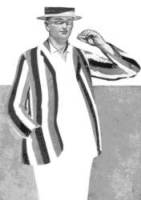 My blood froze. My heart sickened. My brain whirled. How I
had liked this villain! How I had admired him! How my liking and
admiration must turn to loathing and disgust. I waited for the
change. I longed to feel it in my heart. But -- I longed and I waited
in vain!
My blood froze. My heart sickened. My brain whirled. How I
had liked this villain! How I had admired him! How my liking and
admiration must turn to loathing and disgust. I waited for the
change. I longed to feel it in my heart. But -- I longed and I waited
in vain!
The Ides of March - E.W. Hornung
Notorious - everyone has heard of the Anti-Hero, making disguises, pseudonyms, etc. essential. Wanted - by the police, other criminals, government agencies, etc. This
usually goes with notoriety. Loner - many Anti-Heroes prefer to work alone, distrusting accomplices and friends, or limit themselves to one useful companion. They rarely recruit
large gangs. 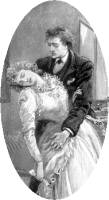 "Oh, no! my father; the enthusiasm of knowledge, the applauses of the powerful, may for a time, have weaned him from us but my own kind, gentle, Frankenstein, can never be inhuman."
Frankenstein (1826 play)
A Mortgage - The family home is mortgaged to the hilt, and the Villain has somehow got hold of the deeds. If the Romantic Lead does not give in to his
wicked wiles (twirls moustache and smiles evilly), her parents will be thrown
out into the snow. If it happens to be summer, he will import some... A Secret Admirer - This may be the Hero, but is just as likely to be the
Villain, a third party, or a case of mistaken identity. If the admirer is not
the Hero, this starts out as an occasional anonymous gift of flowers, but soon
escalates to threats to murder any other suitor, kidnapping attempts, etc. A
good example occurs in most variants of The Phantom of the Opera. A Dying/Crippled Parent/Brother/Sister - Often combined with a mortgage (see above) or poverty (below), as a means of compelling the Romantic Lead to obey the Villain. Religion - The Romantic Lead is contemplating a religious life, or has
even become a novice, but both the Hero and Villain have other ideas; or
perhaps the Villain is encouraging it, because he wants the Romantic Lead out
of the way. Poverty - The Romantic Lead is too poor to buy pretty clothing, luxuries, or (in extreme cases) food. Despite this the Villain has recognised her beauty, and has plans for her... Heiress - One day the Romantic Lead will inherit a fortune, but it is
currently controlled by her parents or a guardian, who might use the threat of
disinheritance to manipulate her. Or perhaps nobody knows her destiny, except
a Villain who happens to be next in line for the inheritance. A Thwarted Ambition - The Romantic Lead wants to be an actress, singer, artist, etc. but there are obstacles in the way; usually obstacles placed by the Villain. Doomed - The Romantic Lead is sinking fast, dying of some strange disease
(or could it be an exotic poison administered by the Villain?). Symptoms
include swooning, a need to spend long periods lying prettily on a couch, and
flushed cheeks which the uninitiated might mistake for the bloom of perfect
health. Villainesses pretending to be Romantic Leads are often good at faking
these symptoms. Disabled - Following a mysterious fall, riding accident, or illness the Romantic Lead is confined to a bath chair (the predecessor of the wheel chair) or is blind, and is at the mercy of sinister housekeepers, husbands, guardians, etc. In this setting the Hero might be a doctor, faith healer, etc. who can cure her if given a free hand, or a detective investigating the real reason for her disability. Unhappily Married - The Romantic Lead has been forced into an unhappy marriage; there may well be something odd about the arrangement, such as the husband's refusal to talk about his previous (deceased) wives, irregularities in the service, bigamy, etc. There might even be some suggestion that the husband has strange designs on the life or sanity of the Romantic Lead; but naturally the Romantic Lead respects the sanctity of marriage and would never dream of complaining... Widowed - The Romantic Lead is a grieving widow, mourning her late husband. But is he as late as she believes? Young children may be an additional
complication, as might a mortgage, poverty, etc. Mesmerised - The Romantic Lead is mind-controlled by the Villain. But True
Love might break the conditioning. Parental Control - The Romantic Lead's parents effectively control her life; they can arrange or forbid marriages, and exert enormous moral pressure. Not What She Seems - The Romantic Lead is living a lie; possibly she is
being forced to do so. For example, she might pretend that her husband / brother /
father is abroad when he is actually in prison, or assume the identity of
someone of higher status. Reborn - The Romantic Lead is the reborn spouse or lover of the Villain, who may be an immortal magician (The Mummy, She, etc.) or may also be reincarnated. Alternatively, there may be a repeated tragic link between the Romantic Lead and Hero. Usually the Romantic Lead is unaware of this relationship, especially if the Villain is the former spouse, but mesmerism or magic may restore ancestral memories. Separated / Swapped at Birth - As above Romantic Illegitimacy - As above Secret - As above. "...He has had reason to know that I am pitting my wits against his, and he flatters himself that so far he has got the better of me. That is because I am drawing him on. I am maturing a plan that will make him a poor and a very miserable man at one and the same time..."
A Bid for Fortune [Guy Boothby 1895]
ibid; later in the same speech
Q: How does a Villain change a light-bulb?
A: Kidnap the Romantic Lead's father and persuade her to sign over the deeds to his light-bulb factory, fake scientific evidence to prove that all other makes of light bulb emit dangerous N-Rays, corner the market with a "new, improved, N-Ray free filament", and use the profits to fund a South American revolution. Use the power base in South America to acquire the resources needed to build a citadel in the Antarctic, and put a new light-bulb in the citadel. Kill the father, plant a penguin feather in the cuff of his trousers, and dump his body where the Hero will find it. Tie the Romantic Lead to a chair under the light-bulb in the citadel, surround her with cunning booby-traps, and wait for the Hero to arrive. When the Hero has been destroyed by the booby-traps twirl your moustache, take the Romantic Lead and light-bulb home, force the former into marriage (she'll thank you for it in the end) and the latter into its holder. It's an old trick, but it might just work...
Romantic illegitimacy - The Villain is the bastard or disowned son of a noble or royal house, and seeks revenge by scheming to bring his family down. Often found associated with revolutionary organisations, especially in small Baltic states. Villains with this trait run a risk of becoming Anti-Heroes, or even Heroes, as their plans develop, but real Villains will always fail to rise to such occasions. The most notorious example is Michael Elphberg, half brother of the ruler of Ruritania (The Prisoner of Zenda etc.). Inadvisable for petty Villains. Insane - The Villain develops fiendishly complex but irrational plots, such
as a scheme to murder several hundred thousand people in order to be sure of
killing one of them. They cackle as they explain their schemes. They kill
their underlings for no readily apparent reason. Insanity is a good motive for
petty Villains, although greed is better.
Note: Insanity may, very rarely, be usable as a motive for heroes. See especially Rorschach (The Watchmen) and some analyses of Batman's behaviour.Vengeful - The Villain has a good reason for his actions; revenge. Unfortunately the quest for retribution is taken to ridiculous extremes. For example, a vengeful Villain might design a plan to simultaneously blow up every car in London after a hit-and-run driver kills his cat. He might set fire to his school because he was bullied as a child. Vengeful Villains often feel an urge to make the punishment fit the crime; a rapist might be impaled on a stake, a drug dealer forced to consume a massive
overdose.
Note: Revenge may also be a useful motive for Heroes
(Batman, Death Wish, Darkman), but tends to add dark overtones to a plot.Greedy - Villains are often greedy. Usually they want money, but the means of acquiring it may also be useful. Most petty Villains fall into this camp; they murder wives to take their inheritance (The "Brides In The Bath" murders, Gaslight), force the Romantic Lead into marriage to gain control of her factory, or throw widows and orphans out into the snow (the Conservative Party). Large-scale Villains develop elaborate schemes to hold the world to ransom or steal immense amounts of money. Often these are simply stepping-stones en route to a larger design, but most Villains seem to have sticky fingers, raking off some of the money before it's spent on the next phase of their master plan, and live accordingly. Doomed - The Villain will die horribly unless some circumstance intervenes; usually a cure requires the death of the Romantic Lead or some other sinister ritual. For instance, an immortal evil genius might gain his immortality by
sucking life-force from virgins, magically or by some strange technology. Needless to say there will always be a Hero close at hand when it is time for another dose... This motive is rarely suitable for a petty Villain. Good Intentions - The Villain hopes that his appalling crimes will
accomplish some greater good. Usually he is wrong. Often combined with
insanity. THRUSH (The Man From Uncle) often claimed altruistic motives for
conquering the world, as do some of the cinematic James Bond villains.
This is usually more suitable for Anti-heroes. Foreign - Need any more be said? Foreign Villains usually appeal to the most xenophobic of audiences, who perceive all Orientals as "wily" or
"sinister", all Jews as misers or millionaires, all Americans as rich magnates or cowboys, and so forth. Foreign Villains are always regarded as especially sinister, for no readily apparent reason. Most royal Villains (below) are foreign, but the British love of the Monarchy initially protects them from suspicion. Royal - The Villain is a reigning monarch, or in line of succession,
usually of a small state with Imperial ambitions. He (this trait is usually
reserved for male characters, since female Royalty are mostly Romantic Leads)
often pretends to be on a "good will" mission to Britain, but this is actually
a cover for espionage or some sinister long-term scheme to destroy the Empire.
He usually has diplomatic immunity. After an initial encounter Villains of
this hue often return to their native lands, where they enjoy all the
resources and advantages of their positions. Compulsive behaviour - The Villain feels compelled to carry out his or her plans to some fiendish schedule, usually based on the Bible, Shakespeare, or some other famous work. This is generally combined with insanity, revenge, or both, but may in fact be a cover for a scheme which is aimed at only one of its victims. Master of Disguise - Many Villains can disguise themselves as anyone, of either sex, if they are of roughly comparable shape and size. This enhances the Acting skill, adding quick change, make-up, transvestism, and an uncanny knack of imitating movement and behaviour. Even those who know the person imitated will be fooled. Masters of Disguise should only be uncovered if there is some reason for suspicion and the Detective skill is used against high Difficulty, or some extraordinary mischance (such as the arrival of the person imitated) betrays them. Often the disguise hides horrible disfigurement. This ability should not be made available to player Villains. Sadistic - Nearly all Villains are sadists; it goes with the territory, and is especially common amongst petty Villains. This is one of the reasons why victims are rarely killed outright; it's more fun to let them suffer pain or the agonies of anticipation first.
"Aahhahahahhahahahah! In just ten minutes the London to Edinburgh express will pass over these very lines. And over you, my dear, unless you sign this document..."Evil Genius - MIND of 6 or even 7 and appropriate MIND-related skills are prerequisites for this status; scientific genius is most common, but financial and military genius are also possibilities. Evil geniuses develop lethal rays and potions, elaborate plans to corner the stock market, perfect forgeries, infernal devices, etc. Villains who aren't evil geniuses often have scientists and other specialists as henchmen, so that they won't be left out. Petty Villains are rarely evil geniuses. Doctors Nikola (FF VI), Fu Manchu, and No are obvious examples. Uncanny Powers - Mesmerism is by far the most common; weak-minded victims (most notably Romantic Leads) are immediately affected, only Heroes have a chance to resist. This is a bonus added to the Villain's SOUL, used to attack the victim's MIND, succeeding automatically against NPCs.
Immortality is another popular choice; the Villain can apparently be killed, but always comes back to seek revenge. Even the destruction of his body may not be enough to prevent this.
Magic seems an obvious possibility; see the next appendix for more on this.
Rare NPC Villains may be in league with the Devil, or may actually be the Devil incarnate, and control extraordinary magical abilities. If this occurs there must always be a loophole, a way to turn these powers against the forces of darkness, which should be telegraphed to the adventurers well in advance of the final conflict. The trick may be as simple as using a mirror to reflect the evil forces back at their source, or as difficult as stealing and destroying an amulet containing the Villain's soul. These
powers can largely be seen as special effects affecting NPCs or the scenery, or as attacks on one or another characteristic, as described above.
Petty villains very rarely have uncanny powers.Extraordinary wealth - Most Villains are men of means; even a crooked lawyer
or murdering husband can probably run to a couple of hirelings and bribe a few witnesses. Extraordinary wealth implies a good deal more. Basically, the character can afford anything that is dramatically appropriate to the situation, and emphasises his or her Villainy; an airship or a private train, a steam yacht or several hundred fake uncut diamonds. An aura of Evil - The Villain exudes some strange taint which repels the good, but inspires fear in underlings and anyone he threatens. All Brawling attacks made against a Villain with this aura have the Difficulty number raised by 2, because of a natural reluctance to touch him. This is best limited to NPC villains. It is possible to have this taint but still be a Master of Disguise; in that case the evil aura is masked by the disguise, but may still be detected on a roll of SOUL versus the Villain's Master of Disguise skill. Often this is combined with a reputation for villainy, usually of epic proportions.
"..Ask the Chinese mothers nursing their almond-eyed spawn in Peking who he is; ask the Japanese, ask the Malays, the Hindoos, the Burmese, the coal porters in Port Said, the Buddhist priests of Ceylon; ask the King of Corea, the men up in Thibet, the Spanish priests in Manilla, or the Sultan of Borneo, the ministers of Siam, or the French in Saigon — they'll all know Dr Nikola and his cat, and, take my word for it, they fear him."
A Bid for FortuneFemme Fatale - Rare, the world of Villainy is largely dominated by men,
but a few notable Villains are women. They are especially likely to use proxies
for their evil deeds, although most will try their hands at seducing the Hero.
While male Villains generally dress in black, their female equivalents tend to
prefer lighter colours (although pastels are a sure sign of a loser - see Addams
Family Values). Notorious - Everyone has heard of the Villain, making disguises, pseudonyms, etc. essential. Very common, mandatory once a Villain is unmasked. Wanted - by the police, other criminals, government agencies, etc. This
usually goes with notoriety. Reborn - The Villain is in touch with his or her previous lives, and can draw on past experience to recognise reincarnated rivals (usually the Hero) or former lovers (the Romantic Lead). This time the Villain is determined to overcome previous mistakes, and get things right, no matter the cost to the world. See e.g. Pharos the Egyptian by Guy Boothby for an excellent example. This is often accompanied by Uncanny Powers. Separated / Swapped At Birth - The Villain was either swapped with another child at birth, or separated from a sibling, and either seeks revenge for the abandonment, or plans to usurp the place of the other. Secret - Usually the mere fact of being a Villain, but there may be a particular fact that will make everyone loathe the character above and beyond the fact of Villainy. For example, the character might have sold his own mother into slavery.
Strange pets - They range from everyday (but somehow unusually sinister) cats to attack dogs, snakes, gorillas, scorpions, rats, sharks, and slave girls. Generally they have been trained to attack any stranger; for some reason this training often goes wrong if the stranger is a Hero, and they attack the Villain or a henchman instead. Blofeld and Dr. Nikola owned cats, Dr. No had spiders and carnivorous crabs, Cruella De Ville liked dogs, Dracula rats and wolves, Dr. Phibes locusts, and Dr. Fu Manchu used most of the animal kingdom at one time or another. Sharks are used by several James Bond Villains.
Optionally Villains may use their Uncanny Powers to control or monitor their pets. Usually their pets resent this, and turn on them given the slightest opportunity.
Petty Villains usually settle for fierce dogs; rural examples usually have at least one, generally a vicious lurcher.A headquarters - Most Villains have some sort of base, if only a heavily
locked room where they can plan or meditate, a mansion where they can install a few floodable cellars and death traps (Bulldog Drummond, The Saint), a laboratory, or a sawmill where they can threaten to cut the Romantic Lead in two. Many Villains do things on a much larger scale, using ancient castles (Dracula), caves (Lord Ruthven), volcanic craters (Blofeld), or hidden cities as their headquarters. Some useful accessories for a headquarters include
The card game Before I Kill You, Mr. Bond... (Cheapass Games) is an excellent source for further ideas, as is the Evil Overlord web site.A long moustache - preferably beautifully waxed, to be twirled while explaining a Fiendish Plan, and/or a top hat (Dr. Nikola). Many villains have both. Most also wear black clothing. Femme Fatales rarely have moustaches! A guilty conscience - Rare, but occasionally present, especially in lesser
Villains. The Villain knows that he is guilty of many sins, and agonises about
them. It doesn't stop him from committing more crimes; it just means
that he will feel a little remorse afterwards. Sometimes guilt is a character's
main motivation, more often it is an inconvenient distraction, worthy of a few asides to the audience but otherwise ignored. A concealed weapon - Sword sticks are nice, so are Derringers up sleeves or in top hats, but true aficionados of evil prefer tiny infernal devices; vials of nitro-glycerine, vitriol (sulphuric acid), or bacteria unknown to modern science (there was a vogue for stories of murder by lethal bacillus at the end of the 19th century), pistols or dart guns disguised as cigar lighters, cigars containing poison capsules that kill the smoker, matchboxes containing deadly spiders, and other esoterica. Petty Villains rarely venture into this territory, preferring to beat their enemies to death. A beautiful but wilful daughter - Daughters are rarely Romantic Leads; usually they feel unrequited love for the Hero, rescue him from certain death, realise that he Loves Another, and throw themselves sobbing into the crocodile pit or a lesser Hero's arms. Often they are reluctantly loyal to their parents, and appear briefly to save the Hero then disappear from the plot until the next adventure.
Unfortunately for Heroes, there is no guarantee that a Villain's daughter
will help them. Sometimes they are Villainesses, even more menacing than their
fathers because they have a quality singularly lacking in Villains - common
sense! These dangerous women often find simple direct solutions to their
father's problems.
"Arr, it be warm weather for the toime of year"
"No, sorr, I can't say that oi have seen a monster today, sorr."
"You're not from these parts, are ye, sorr."
It is impossible to overdo this accent; the more grotesque it is, the more 'authentic'! Typical possessions might include a pitchfork, a flaming torch, or both, some sort of firearm (very rarely used), or a shepherd's crook. In the most lavish productions peasants appear accompanied by flocks of sheep, horse-drawn ploughs, and other evidence of their rural activities. Foreign peasants speak with appropriate accents:
"Si, it be warm weather for the toime of year, Signore"
and wear traditional native costume, but are otherwise identical to their British cousins.
NPC peasants should appear to have no useful skills whatever; this may not
be completely true (for example, they may know of old legends), but for the most part they are present simply to stand around in the background, drink large quantities of beer, die horribly, accidentally let the Villain escape, besiege a ruined castle with flaming torches and pitchforks, or join in an occasional country song or dance.
Sinister peasants are rare, if used the referee should try to avoid the temptation to emulate sources such as The Wicker Man. Unless they are in the pay of the Villain, peasants tend to be friendly or at worst suspicious, not actively hostile. Bandits are sometimes disguised as peasants; generally they are an independent nuisance, not pawns of the Villain.
 are usually presented as a romantic musical subspecies of peasant, and behave as such, but there is always a chance that they are in the pay of a Villain (see Dracula etc.), especially in Transylvania and other foreign parts. If so, they will generally skulk in the undergrowth, communicate by cunning whistles and bird calls, and help to beat up unwary friends of the Hero. They usually have the Thief skill, often applied to poaching, Brawling, Melee Weapon, etc.
Gypsy mystics and fortune tellers abound, usually making eerily predictive
but unfortunately cryptic pronouncements:
"Soon your life... will be in... great danger."
"The fat man is looking for the bird..."
If there seems to be any chance that a prediction will be useful, someone
will generally murder the gypsy before it is complete. If possible the Villain
will frame the Hero for the death.
Beautiful gypsy maidens will generally attempt to seduce the Hero, in an effort to enrage their gypsy lovers, and use flamenco dancing, eerie gypsy songs, and other wiles to lure the Hero (or a friend) into danger. They (and their boyfriends) are often armed with knives, and adventurers wishing to avoid trouble would do well to stay out of their way. Some beautiful gypsies are also fortune tellers or mystics.
Bumbling and comic policemen are usually portrayed as having a fairly relaxed attitude to the law; poaching and other minor offences are often ignored, and they can usually be distracted by the offer of a drink or a smoke. In a modern piece they will usually appear riding or wheeling a bicycle. Often they will contribute a comic monologue or song. They can usually be tricked. Gamekeepers are also often found in a police-like role.
Typical dialogue for a comic policeman (usually in a pronounced Mummerset
accent):
"Hello, hello, what's all this then?"
"No licence sir? Oh, that type of licence!" (pockets coin)
"Locked in me own handcuffs. There's a predicament!"
Efficient policemen are the law personified. They are usually portrayed as
young, efficient, and keen, and may be the Hero of a story. They are almost always from
Scotland Yard, and speak with an upper-class accent. For instance:
"So at 11.15 p.m. you were all gathered in the library..."
"This gun has fired several shots."
"One of the people in this room is the murderer..."
Excellent examples of this type of policeman can be found in most novels by
Agatha Christie and Dorothy L. Sayers, or in the play The Mousetrap by Christie.
As well as the obvious Detective and combat skills, both classes of policeman spend a lot of time out of doors, especially in rural areas, and it's entirely
reasonable to include Science (Astronomy) and Scholar (British Flora and Fauna)
amongst their skills. It's amazing how often characters will try to fob off the
law with excuses involving star gazing or bird watching...
"Squad... Atten-shun!"
"Resistance is useless!" (always good for a cheap laugh)
"Halt! Who goes there? Friend or foe?"
"Fix bayonets!"
Officers have upper-class accents, NCOs and other ranks are typically of
Cockney or peasant stock, with appropriate accents.
almost always appear en masse, often singing sea shanties as they perform some nautical task. Their use is generally confined to shipboard dramas, in which the Hero and possibly the Villain are serving Naval officers. Apart from their dialogue, sailors are almost identical to soldiers in behaviour, accents, etc.:
"Sail on the starboard bow!"
"Signal him to heave to or we open fire."
"Haul anchor!"
Sailors may also appear as pirates, in which case their most noticeable traits are usually seething resentment of their officers, lecherousness, drunkenness, and casual brutality. Sailors employed by a true Villain (eg. Captain Nemo) will be as smart and efficient as any naval crew, and devoted to their work. Presumably the pay and working
conditions are better...
"Oh, the master never drinks wine, sir, says it gives him gout."
"Did you ring, Sir?"
"Sorry, the master's not in, he's gone down to the village."
But a sinister servant would say:
"The master never drinks... wine."
"You rang... Sir?"
"The master is not... available... at present."
More examples of Sinister Servant dialogue can be found above, numerous examples of the comic style are in the plays accompanying FF VI
Useful dialogue for these friends obviously depends on the situation; for
instance:
"I say, I'm sure there's someone hiding in those bushes!"
"This Matabeleland business looks dashed odd."
"Don't worry about me, old boy, it's only a flesh wound."
"Don't pull which lever? This one?" [pulls it]
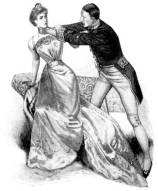 are generally present to reflect her beauty, kindness, good nature, etc., to inadvertently betray some secret to the Villain, and to giggle whenever the Hero is mentioned. On rare occasions they have good advice to offer. Occasionally they are murdered or suffer some other horrible fate in the Romantic Lead's place. Usually they have no relevant skills and are totally expendable. They say things like:
"That dress is lovely!"
"Oh, I do envy you so!"
"But have you told your mama?"
"No... no... let go... urgh!"
"I'm only a burden to you now...."
"Far be it from me to complain, but..."
"Unless you marry him the papers will go to the police!"
"Give me some money, I need a drop of gin."
"We're ruined!"
While other characters presumably have relatives (see, especially, Villains
and their daughters, above), they are generally less likely to become involved
in the plot.
"These papers are conclusive proof that you are the rightful heir to his
late Lordship's estate."
"Sir, I write to inform you that another will has been found..."
"These tests prove you are not related; you are free to wed."
"The crisis has passed, and she will soon recover..."
Villainous Doctors and Lawyers often pretend to be friendly while weaving elaborate snares for the Hero and Romantic Lead. Doctors Nikola and Fu Manchu aside, they are usually minor Villains, or henchmen of some major Villain, and their plans will seldom range far beyond various forms of blackmail and embezzlement or the odd murder or two. For example:
"I'm sorry, sir, there is no cure. Perhaps we might discuss the endowment of a charity to study your condition..."
"I fear that your father's debts must be repaid, my dear; unless, of course, we can come to some sort of - ahem [twirls moustache] - arrangement..."
"One step closer, sir, and the will shall be in the fire - and of course the earlier document leaves everything to your cousin..."
"So I'm afraid your little brother will die unless he has the operation - a shame that you have no money to pay for his treatment. But there are alternatives to money..."
 might seem to have no place in an adventurer's life, except as a nuisance, but they are often useful as a source of motivation. They can be kidnapped, lost, left to die in the snow, trapped in burning buildings, slaughtered by a horrible monster, fall ill, or innocently betray the Hero's hiding place or interrupt a tender romantic moment. They give the Romantic Lead a chance to show her tenderness, maternal instinct, etc. Villains may find them useful as innocent pawns or bait in their evil schemes.
Note: If a player runs a child in a game where the other players are running adult characters, it is advisable to set up a few ground rules; for example, an agreement that the child will not be so obnoxious as to provoke homicidal rage in any sentient life form, while the adult adventurers (except perhaps the Villain) will behave like responsible adults and try to keep the little darling alive. Some suitable dialogue for NPC children:
"Wow - that was a long kiss!"
"Gosh - that's a long way doooooow" [splat]
"Please, will I be well soon? [tubercular cough]"
"Help - let me go! Let me go!"
Villains are often associated with cats, but rarely have dogs, other than guard dogs and Petty Villains' lurchers. Some rules for nine-lived cats as player characters appear in FF VIII; use the rules in the previous appendix for dogs. Unusually intelligent horses and ponies are sometimes useful, mandatory for any adventure with a Wild West or Royal Canadian Mounted Police background; generate them with BODY of 5 (pony) to 8 (stallion), with 12-BODY points available for the other characteristics and skills; for example, a BODY 8 stallion gets 4 points to spend on MIND, SOUL, and skills; a BODY 5 pony gets 7 points. All skills available to dogs can be taken, apart from Riding (except possibly for VERY small circus ponies) and Detective (sense of smell and eyesight aren't good enough).
A pet's function in a melodrama is to get help (usually by barking, sometimes by carrying a message slipped into the collar), trip up the villain in a crucial fight scene, chew through ropes and other bonds, etc. Trained animals may be able to do more if it is dramatically appropriate; for example, bark or tap with their hooves to indicate the direction taken by the Villain, the number of people who have passed, etc. Unless you are running a very strange campaign these animals should not be able to talk.
If players seem to be placing too much reliance on animals, it may be advisable to require a MIND roll for the pet to carry out its instructions. For example "Get help" (any human) might be Difficulty 3; "Get Uncle George" (a specific person known to the animal) Difficulty 5, "Get the Police" (a concept that is unlikely to be understood) Difficulty 7. Anything else, e.g. "Bite through the rope", "Fetch the keys from that hook" should be rated according to the likelihood of the animal understanding the instruction, and any training it may have been given. In an adventure where this rule was used the dog concerned returned with a stick and a dead pigeon before fetching help.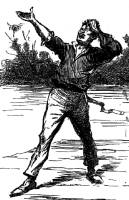 To establish the mood of melodramatic adventures, characters (especially Villains) should use Asides to the "audience" to convey information about the plot and their nature, and Soliloquies and Songs to establish their personalities.
Villain [Aside] "Aha - little do they know that...
[Sings] "A cunning villain I,
A man of lethal habits,
I'll slay my foes like rabbits,
Without any pity or shame.
Before the night is out
I'll bump off all my cousins,
kill sundry other persons,
And pass to the Hero the blame,
Oh, and pass to the Hero the blame..."Hero "Should I feel uneasy?" Referee "Roll your SOUL versus Difficulty 5, if you succeed you distrust him, but have no idea why." Villain "Feeling all right, old chap?" Hero (fails roll) "Felt dashed odd for a moment. Uneasy." Villain "Well, we all get odd feelings now and again.
Probably something you ate. Have I introduced you to my cousin Helen...?"
[Enter Romantic Lead]APPENDIX - It's a Kind of MAGIC...
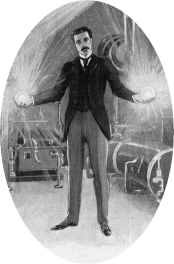 Forgotten Futures VIII introduced rules for magic, a new MAGIC characteristic, and a new Wizardry skill, plus rules for generating characters as children with magical powers. They work well in their original context, but poorly for designing adult characters. This appendix contains a more general and somewhat abridged version of this material.
 FF IV: The Carnacki Cylinders also dealt with magic, in the context of supernatural detectives. To use these rules with FF IV characters simply convert their Scholar (Magic) skill to Wizardry, and give them MAGIC at Wizardry/2 (round UP). Anyone who doesn't have Scholar (Magic) should be given MAGIC [0]. Note that most spells simply won't work in the Carnacki universe, where magic is used almost entirely for defensive purposes and summoning and communicating with supernatural entities.
Example: Tom Byzantine [1]
Tom Byzantine is to be a stage magician with a secret; genuine magical powers. It's a melodramatic campaign, and the player wants him to be an Anti-Hero. The player has 25 points and buys
BODY [2] (2 pt), MIND [3] (3 pt), SOUL [3] (3 pt), MAGIC [5] (7 pt) = 15 points
and spends the rest of 25 points on
Actor (conjuror) [6] (3 pt), Brawling [2] (free), Linguist (French, German) [4] (1 pt), Marksman (pistol) [4] (1 pt) Medium [4] (1 pt), Melee Weapon (rapier) [3] (1 pt), Psychology [4] (1 pt), Wizardry [7] (2 pt)Example: Tom Byzantine [2]
As mentioned above, Byzantine is to be an anti-hero. The player selects the traits Notorious (as a conjuror who has been mysteriously present when various notable criminals met their well-deserved ends), Secret (he's really a wizard; if word gets out he'll be treated as a freak) and Wanted (by the police, for questioning in connection with the above well-deserved ends.
|
| Normal Duration | Required Duration | Difficulty |
| Minutes | Hours | +1 |
| Hours | Days | +1 |
| Days | Years | +1 |
| Years | Centuries | +1 |
| Centuries | Permanent | +1 |
For example, the conversion of a prince to a frog might normally last a few days. With +3 Difficulty the spell will be permanent. In this context "permanent" always has some sort of loophole; the spell's antidote may be as simple as being touched by cold iron or kissed by a princess, or require some elaborate quest for the ingredients, but there is always a way out.
In campaigns where spells almost always ends at the same time (e.g., after exactly 24 hours, at sunset, at dawn) this table should be ignored. Instead, increase Difficulty considerably to get past this limitation.
Difficulty may also increase if the magician wants to cast the spell at a distance, if the spell is complex or will be unusually difficult to break, if the target is moving or hidden, or if it is to affect several people or a large area.
Difficulty can be reduced if a spell is cast on someone who wants it to work, if several magicians pool their MAGIC (see side text), if the duration of the spell is reduced, or if it is broken down into sections. This last may need some explanation; for example, to turn a prince into a frog, then turn the frog into a silver frog statue, then make the spell permanent might use three separate spells; there is less chance of any given stage going wrong, but the total effort requires three spells, any one of which still has a chance of failure, and is likely to be exhausting and time-consuming.
Optionally there should be a limit on the number of spells cast in a day. Magicians can cast MAGIC spells at normal Difficulty, any more add +1 Difficulty per spell cast. This is reset by a good night's sleep.
The time taken to cast a spell can vary from seconds to hours. Use whatever seems most dramatically appropriate: from a few seconds for the sudden appearance of an evil fairy, a curse, and her vanishing, to a few hours for an elaborate magical ceremony to create rain. There isn't necessarily any relationship between the time to cast a spell and its power or complexity; one wizard may spend a week creating a single perfect rose, another ten seconds creating a slightly slipshod magical palace or an equally slipshod curse. Optionally extra-long rituals can reduce the Difficulty of a spell or increase the quality of the result at the referee's discretion.
Optionally any spell can have dramatic special effects added; they don't add to Difficulty, unless they change the actual outcome, but when the spell is used the player must describe the effect. Suitable special effects include sparkling lights, thunder, smoke, pungent smells, and crackles of electricity.
Beyond these guidelines each magician, and each work of magic, is unique.
Magical Techniques
Spell books and training schools apart, there is no such thing as a "standard" spell or magician; everyone has their own path to power, and often it may be very different to the magician next door. One magician might turn a prince into a frog by an elaborate ritual, another by clicking his heels. What follow is very much a do-it-yourself system, and referees should be ready to make up most of the details as they go along; some examples of the most common spells follow, with some modifiers that might be useful. Everything in this section is optional. Add to the Difficulty if communication would normally be prevented or takes place at a distance. For example, if the magician is bound and gagged but wants to use telepathy to contact a friend and ask for rescue, the referee might make the Difficulty 3 for communication under impossible circumstances plus 2 for distance (use the distance modifiers listed for clairvoyance below), total Difficulty 5. Optionally SOUL can be added to MAGIC for attempts at telepathy, to a maximum of 10.
Many non-human intelligent creatures can communicate without the use of magic, by the normal Linguist skill or by having a human language as their native tongue; for example, any magical creature resident in Britain probably speaks some variation of English (or Scots, Welsh, Cornish, Old English, etc.)
Difficulty rises if the power is being opposed by another magician's MAGIC, falls if the target wants to be observed and adds MAGIC to the spell.
Materialisation can be worked in reverse, to destroy something - the Difficulty is again the total of all characteristics - and especially gifted magicians can cast a short-duration destructive spell on themselves (or anyone or anything else) to vanish in one place and reappear in another. The Difficulty is the total of all characteristics plus modifiers for duration and distance as above. Obviously the results of a fumble are likely to be fairly horrible - think "transporter accident" plus The Fly...
Optionally, magicians who transform themselves into animal forms must beware of a subtle danger; the risk that they will come to believe that they are the creature whose form has been assumed, and prolong the spell until it becomes permanent and gradually erases the magician's personality. Roll MIND plus SOUL against the number of days since the spell was cast: If there is a failure 1 MIND or 1 SOUL is lost, on a roll of twelve 1D6/2 MIND or SOUL is lost. Repeat until there is nothing left that isn't natural to the animal. The only thing that reveals the truth is the trace of MAGIC that keeps the spell working. If the spell is reversed MIND and SOUL slowly return; roll every day, on a 2 one point is recovered. A full cure may take months. Note that this doesn't apply to people who have been changed into animal form by someone else's spell; the duration and effects of the spell are set when it is cast.
If any characteristic is changed to zero it is usually a temporary effect, and will be revert when the spell is undone. Exactly what happens to MIND and SOUL during this process isn't clear; since they are usually restored they presumably exist in some form, but no thought or feelings should be experienced until the transformation ends.
Optionally people or creatures turned into inanimate objects might retain their MIND, SOUL, and even MAGIC, which can be detected by someone with the Medium skill or MAGIC. If this option is used the Difficulty of the transformation should be unchanged because it will still be necessary to bind these characteristics to the will of the magician. This could be one of the ways that evil magicians create some of the magical objects described in the next section. If the object is destroyed before the spell can be reversed the SOUL is released and the victim dies.
To fly the magician must overcome BODY to hover, with Difficulty +1 per 10 MPH. The spell normally lasts a few minutes, with difficulty rising for longer durations as above. To make an unwilling victim fly overcome that person's BODY and MAGIC, if any. If a willing subject wanted to fly their MAGIC would be subtracted from the Difficulty, not added. Possible results for a success are: Another way to fly is to be transformed to a winged human form then fly naturally. Even with wings some magical help is needed - human bodies simply aren't built for flight - but the Difficulty of flying can be halved. See also Transformation into animals, above.
Many other spells can be imagined or have appeared in fiction. Hopefully these examples will help referees to develop more of their own as the need arises.
External Magic
External sources of magical power are common in fantasy, and have advantages for the referee. Since their powers are defined by the referee players can rarely be sure of their capabilities or limitations, and if necessary the referee can "bend" them to meet the needs of the scenario. It's rarely necessary to use special rules to describe their effects.
They generally fall into one or more of four broad categories; wishing machines, a term borrowed from an "article" by the late John Brunner, Galactic Consumer Reports: Twin Tube Wishing Machines, transport systems such as magic carpets, which may also have some "wishing machine" functions, "gadgets" such as enchanted swords that have limited functions, and magical beings which can either use magic or are innately magical. The first three terms often include creatures that can use these powers, such as genies. For example, in Nesbit's Five Children and It (FF VIII) the Psammead is a living wishing machine whose main limitations are a limit of one spell per day (two if one of them is very small), a high limit on complexity and/or bulk, a time limit (spells always end at sunset), and its own bloody-mindedness. An early wish adds a permanent qualifier - that a family's servants will never notice the effects of wishes.
It's difficult to avoid saying "I wish" accidentally; to simulate this with players who may be trying to avoid the phrase, the referee should encourage them to talk in character, listen for anything that's said which might be construed as a wish then ask the player to roll MIND versus Difficulty 6 - if the result is a failure the words "I wish" were used. Of course it's best if the words "I wish" are actually used by players, and sooner or later someone will probably slip.
Referees should be alert for any use of the word "wish", even out of context, including phrases along the lines of "what if I wish for..." or "Suppose we wish..." - optionally assume that the wishing machine uses the word "wish..." as an activation phrase and will then start to 'parse' the words that follow!
Players may try to beat the system by setting up elaborate logic traps and conditions for wishes. Discourage this by making the results worst than a straightforward wish, or by wilful stupidity on the behalf of the wishing machine. For example:
A hundred gallons of ice cream cascaded down onto his head. "Was that all right?," asked the Psammead "I think I lost track somewhere in the second subclause." If you want to put numbers to this (the author prefers vindictiveness and abuse of power by the referee) assume that the wishing machine must use its MIND to overcome a Difficulty number of the referee's choosing - 4+2 for each clause, "however", or other qualifier in the wish seems about right.
Similarly, the referee may wish to limit the maximum size or complexity of the item wished for; use the materialisation rules above, or your own discretion. NEVER let the players know what factors are used to decide the results!
When granting wishes referees should always be alert for the implications of the wish, as well as the actual request, and its potential for chaos and disaster. For example, wishing for unseasonable rain might achieve the desired end (rain stops play at Lords, Britain wins the Test Match) but have some undesirable side effects (flash floods wipe out half of Norfolk).
Normally there is no way to resist the power of a wish; if for any reason the referee wants to allow this - for example, if the wish is being made by an enemy and will cause physical or mental harm - the referee should roll the MAGIC behind the spell versus the MAGIC of each character. On a failure the wish doesn't work on that particular character. Wishes that affect the world as a whole can't be resisted in this way.
"Wish" travel is inflexible but requires little skill. All of the limitations
indicated for wishing machines above can apply, the most important being that there may be limits on the system's ability to understand complex or vague orders. The users are passengers, not drivers, and may be at the mercy of their transport. "Steered" travel is more flexible, but may require the Riding or Driving skill and some knowledge of geography for navigation. Sometimes these skills may be part of the mode of travel, such as an instinctive ability to fly as part of magical transformation to bird form.
There's no guarantee that all magical transport will be as easy to use, of course; it may require special skills (e.g. a broomstick rider might need Riding and Athlete to control the broom and stay on) or status (e.g. some obvious qualifications are needed to ride a unicorn).
The main types of travel that appear in fantasy are teleportation and portals through space and/or time, flight, and fast land travel.
Teleportation is usually an instantaneous transition from one place to another, almost always achieved by a wish or command which could potentially go wrong (as described under materialisation, in the previous section). There generally seems to be some form of protection to ensure that travellers have room to materialise, and aren't in deadly danger the second they arrive. To keep teleportation from becoming too powerful a tool, referees may want to impose some moderately obvious limits. Some or all of the following should suffice: A common variant on teleportation is a portal through space, time, or to other worlds and dimensions; the wardrobe of the Narnia stories and the openings of Philip Pullman's His Dark Materials trilogy are good examples. All of the limitations above can be applied; additionally, some of the following may be useful The "model" for time travel used in stories of this period varies considerably, but a good compromise version appears in Nesbit's The Story of the Amulet (FF VIII) and can best be summed up as "fixed past, potential future". You can't make major changes to the past, and in many cases what you do causes history as you know it. There are no time paradoxes, and you can't affect your personal past. Minor changes can be made, such as saving the life of someone relatively obscure who is supposed to have died (the change might manifest as a previously-unnoticed page of errata in a local history, a changed or missing gravestone in a cemetary, or a pained letter to The Times from the grandson of someone who allegedly died in infancy), but it is impossible to change the broad sweep of past history. Any changes you make will have "always" been that way, so far as the rest of the world is concerned. An excellent modern example of this style of time travel can be found in the film Twelve Monkeys.
There's an important exception; some magic includes a "reset" button, the ability to wish that it had never happened (as in Anstey's The Brass Bottle). Here there seems to be a "branch" in history at the moment the spell was cast, with two possible futures depending on whether or not the spell is cancelled. Usually the duration of the split seems to be from a few hours to a few days, but there seems no reason why this situation should be resolved so quickly. Generally only the person who cancels the spell can remember the previous state of affairs. An oddly relevant SF story is the novel Replay by Ken Grimwood.
The future is full of potential; anything is possible, and the right choices may improve things. You are creating the future as you live, a fraction of a second at a time, and anything you bring back to the present is simply a prophetic vision, not a certainty or anything like it. It's a startling intuitive anticipation of the uncertainty we take for granted today.
Again, there is an exception; while knowledge bought back by time travel can be as inaccurate as any other vision, there are occasional prophecies and curses that seem to be inescapable. Generally speaking these seem to take place only in highly magical "fairy-tale" worlds. It's a much earlier version of time and predestination, as seen in stories from the Arabian Nights to the Brothers Grimm. While it can be fun to involve adventurers in resolving these situations, it isn't usually a good idea to make them the subjects of the prediction, players tend to be much better than fairy-tale characters at resolving them!
For a VERY different version of time travel see the Past Out, Future Home campaign described in FF IX.
Any of the means of flight discussed in the previous section can be granted by magical devices, wishes, etc.; if so, the performance is usually derived from the devices' characteristics, or those of the source of the spell, not the user. Top speed for most magical flying devices should be their Wizardry x 10 MPH, the maximum extra load carried is their MAGIC minus the rider's BODY (or BODY 1 if the rider's BODY is the same or greater than the device's MAGIC). There are many other forms of travel, of course, on land and water, underground, and everywhere else that can readily be imagined. Often the form of transport functions both as a means of transport and (in stories beginning in the "real" world) as a means of getting to magic kingdoms and other strange places, and may be able to go into the past or future: For much more on magic (including a large bestiary of magical creatures and detailed examples of spells and magic use) see FF VIII.
MOST of the source material for this game has its roots in Scientific Romances, the predecessors of science fiction. It's a genre that tends to emphasise weird science and technology, so most of the worldbooks and adventures have included examples. Here are a few; rules for designing them, and many more useful(?) gadgets, can be found in the rest of the material published for the game.
If used at all these numbers should only be guidelines, and may be modified if (for example) the creature or object is making an effort to talk to the magician. All sources seem to agree that practice improves this ability, to the point at which your enjoyment of a nice scone may be spoiled by involuntarily hearing the death-agonies of the yeast organisms as they cook. See e.g. Diane Duane's So You Want To Be A Wizard and sequels.
Language Difficulty Any other human language regardless of origin, most supernatural creatures, pets 2 Any domesticated animal (cows, horses, chickens etc.) 3 Wild animals including birds, fish, etc., toys and other favourite objects. 4 Insects and other invertebrates, plants, railway engines and other man-made objects 5 Rocks, clouds, the wind, the sea, bacteria, etc. 6
Distance Difficulty Time Difficulty 10 miles 1 A day in the future * 2 100 miles 2 Two days in the future * 4 1000 miles 3 Three days in the future * 8 etc. Anywhere in the world 4 A year in the past 1 The moon 5 Ten years in the past 2 Anywhere in the solar system 8 A century in the past 3 etc. Another universe 10 Dark / underwater / underground +2 * Seeing the future is much more difficult than seeing the past, since there is an observer effect which means that viewing the future often changes it; see the notes on time travel below.
To create a ton or so of gold (BODY [20], no MIND, SOUL, or MAGIC) would be Difficulty 20 if it is visualised as a huge heap of gold. If it was visualised as separate coins the Difficulty would be 1 per coin, totalling several hundred for the whole stack! To create a kitten A gateway to another world (BODY [6], MAGIC [8]) would be Difficulty 14 if the world is already known, considerably more if it required a feat of imagination.
To change a BODY [4] prince into a BODY [1] frog will be at least Difficulty 7 (10 if the spell is to last centuries); a change of form affecting To change yourself (BODY [2], MIND [2], SOUL [2], MAGIC [4] into a BODY [1] fish with other characteristics unchanged would be Difficulty 3; since it is a willing transformation your MAGIC does not oppose the spell. Reduce the Difficulty to 2 if the spell will only last a couple of hours, to 1 if it's just for a couple of minutes. To change a frog into a gold statuette of a frog would require a change of form affecting To set a log on fire is a transformation which will destroy BODY, so the Difficulty is the BODY of the log plus the eventual loss of BODY; in other words, double the BODY. To change lead into gold is a change in form, but not a change in BODY or any other characteristic, so the difficulty is just the BODY of the lead. Referees may choose to halve the Difficulty of such "easy" transformations.
Attack type A B C Notes Lightning B/F F+KO I+KO Injuries are burns, Difficulty +3 Fire B F I Injuries are burns, Difficulty +2 Ice * / cold B F F/I Injuries are frostbite Stones * B F Injuries are bruises and/or cuts - B B Victim suffers embarassment or discomfort, Difficulty -1 * These attacks involve the momentary materialisation and destruction of physical objects, but leave no physical evidence apart from cold, dampness, slime, a smell of fish, etc.
With appropriate Difficulty modifiers (and more time) this spell can be used at a distance, by telepathy, and across species barriers. The magician can make things easier by aiming to trigger an emotion, such as greed or anger, rather than precisely controlling behaviour.
The wish can only be activated by a complex ritual, prolonged flattery, or persuasion. An upper physical limit on the size or complexity of the wish. In the example above the "million billion ice creams" might be microscopic ones, or even individual molecules, and the great ice cream flood suddenly becomes a quart or two of raspberry ripple. The rules for materialisation spells in the previous section may be useful, if only as a guideline. No wish will cause immediate harm to anyone - however, the consequences of a wish may be very dangerous. For instance, in the ice-cream example above the child would be safely on top of the ice-cream mountain rather than underneath it - but would soon start to sink... There are a finite number of wishes per day or wishes in total, as in The Monkey's Paw and most other "three wishes" stories. Referees are strongly advised to make this limitation apply to the whole group of adventurers, rather than giving each person three wishes! At a certain time, or after a certain number of hours, the spell will come undone (the Psammead, Cinderella's fairy Godmother, etc.) A condition or command that will undo the spell; a good example appears in the original version of the film Bedazzled. Usually undoing a wish erases all of its effects, and removes it from the memory of everyone except those who made the wish. A limitation imposed by a previous wish. Wishes can only be granted if they will further a specific goal (e.g. vengeance, the course of true love, etc.) Wishes can only be granted if what is wished for could conceivably happen, however unlikely it might be. This rules out some of the more extreme examples of magic, such as wings - unless you want to acquire them by some extraordinary non-magical means, such as being bitten by a radioactive sparrow - but makes it more likely that magic will have permanent effects. For example, the only way to give someone "...wealth beyond the dreams of avarice" might be for them to find a hitherto-unknown gold mine, or inherit untold millions from a long-lost relative. Wishes will only be granted if the person making the wish understands what they are wishing for. They may not understand the consequences, of course... An element of whimsy and/or wilful stupidity and literal-mindedness.
Unlimited Wishes
For a very different "feel" to wishes, and assuming that the referee is prepared to live with the consequences, try the following "limits" instead of those in the main text:
Usually the world and/or the human race lasts about two days if these conditions are used; see e.g. Jerome Bixby's It's a Good Life and Ursula K. LeGuin's The Lathe of Heaven"...and that the aforesaid children will not be harmed in any way by receiving this wish, subject to the terms and conditions previously mentioned, and that the wish will commence upon my saying `I so wish'. I so wish!" Cedric concluded triumphantly.
You can only teleport somewhere you (or the teleporting device) has already been, or somewhere you can see. You can't teleport into or from a fast moving vehicle (such as a train). Slow vehicles (such as ships) may be allowed. Optionally, it's necessary to match speed
with the target vehicle before teleporting. You can't teleport into any private area, such as a home or a bank vault, unless you have permission to enter (or it is dramatically appropriate). This usually doesn't apply if one of the adventurers is being held prisoner and the others want to rescue him; the presence of the captive is an implied invitation to enter. Some minimum time must elapse before you can teleport again. This can be very specific (e.g. "At least twenty minutes"), or extremely vague ("When I'm feeling a little better"). An upper limit on the size or weight of the object that can be teleported. You can only teleport to or from special places, such as intersections of Ley Lines (note that this is not authentic for period fantasy) or fairy rings. An activating ritual is needed before teleportation is possible, or some rare substance must be found first (see e.g. the need for mercury to repair the "fluid links" in early Dr. Who stories) After teleporting you must return to your starting point before you can go anywhere else. Optionally there is a base station (see especially portals, below) which doesn't travel. Loosely worded orders will be interpreted reasonably well; really precise orders tend to go wrong.
Only one portal at a time may be open, or only one in a given area. You have to go back the way you came before you can go anywhere else. While a portal is open it is a "weakness" which allows strange phenomena to enter the world, or may slowly damage the world in some way. Portals are "natural" events; they appear and vanish spontaneously, the "magic" is in finding and using them. E.g. Time Bandits, Sliders.
Wings let their users fly like a bird. Optionally assume that to fly at all needs a roll of BODY (or Athlete) versus Difficulty 4 to get airborne, with multiple attempts allowed if necessary. Once airborne the rest is easy... Usually the skills needed to control flight come free with the wings. If not, use BODY or Athlete rolls to avoid obstructions etc., and any other skills that seem appropriate. Top speed is as for levitation above. Wings large enough to carry a human should be at least as bulky as those of a hang glider, so they are somewhat conspicuous on the ground. Optionally they have other disadvantages ("...don't fly too close to the sun!") which should be determined by the referee. Carpets may be limited as to size, capacity, ability to teleport, etc. If they are steered the Drive or Ride skill is appropriate, otherwise a period of trial and error with the carpet performing acrobatics while the rider holds on for dear life... Referees can have fun with activation words and rituals (see especially Diana Wynne Jones' Castle in the Air), number of uses per day, and anything else that seems appropriate. Magic carpets can be rolled up and carried when they aren't in use, and seem to be implausibly small and light when rolled; presumably they use their power to neutralise some of their weight. Broomsticks are mainly the province of witches; despite the Harry Potter books they aren't "canonical" for anyone else in this genre. They generally fly extremely fast, but lack other powers. Unlike the other devices discussed here, they are in part fuelled by the user's MAGIC, giving them a top speed of the user's MAGIC x 20 MPH. Pegasi, Dragons, Rocs, etc. tend to be extremely shy; unless they can be tamed they tend to try to escape and/or harm their riders. They fly by a combination of muscle and MAGIC, but riders can never be sure how much of each is involved; for example, without magic does a Pegasus fly slowly, glide, or plummet like a stone? All should be controlled by the Riding skill, or may be intelligent enough to make
their own decisions. Flying Ships are generally only found in worlds where magic is a powerful part of everyday life. They can carry as much cargo as any sailing ship, and fly at the speed of the wind; about 30-60 MPH at altitude, less near the ground. They can only land on water. Creating such ships is usually the work of a powerful magician, but once built almost anyone can steer them. Winged ships have BODY 10-30 depending on size. They can be armed with catapults and other weapons, including cannon if they are available. See FF VII for rules for mechanical winged ships, aerial combat, etc., which can be adapted to magical ships. If the magic that holds them up is interrupted for any reason they must glide for a crash landing; for this reason they usually fly over water and try to avoid mountains, the fortresses of evil wizards, and other hazards. Optionally clouds may be the equivalent of magical islands or rocks in the sky, and a real hazard to aerial navigation.
Living Ships - In some magical worlds winged ships might be living beings, bred for qualities such as speed or cargo capacity. Their eggs hatch as small winged boats then slowly grow to full size. They have swan- or dragon-like wings and heads on long necks at the prow, and are reasonably affectionate to an owner who treats them well. Such small boats, with the right pedigree, might grow up to be very valuable. What they eat is left up to the referee; pond weed seems a reasonably simple option, but possibly war ships eat meat.
An interesting adventure might revolve around catching and training a wild ship; see e.g. The Black Stallion for ideas.
For non-magical equivalents see the TV series Lexx and Farscape, both of which have living starships.Flying carriages are usually built by powerful wizards or witches; they must be pulled by something which would normally travel through the air, such as swans or a dragon. Flying houses, cauldrons, etc. have a certain unnaturalness that tends to brand them as the work of evil witches and wizards. A cautious adventurer will usually try to hide if he sees them coming. They fly by their innate magical power, the spells used to create them, but are controlled by the magic of their owners. If either fails they plummet downwards or fly off out of control.
Seven-league boots are the traditional way to get around quickly on land. How they actually work is uncertain; the most likely explanation is that taking a step starts teleportation to a point seven leagues away (about 21 miles). The main problem with them, as with many other magical transport devices, is stopping without overshooting the destination. It ought to be possible to reach any place within seven leagues in two steps with the aid of a compass, map, and dividers, using simple geometric methods. Even if this can be done, stopping without taking another step could be difficult. See Diana Wynne Jones' Howl's Moving Castle for an excellent example of the problems that might arise. Boots appear to have their own magical power, and can move one person and anything that person carries. Sleighs show an odd dichotomy; they seem to be used as transport by evil queens and witches (The Snow Queen, the Narnia stories) and Father Christmas, but rarely by anyone in between these extremes of goodness and badness. Usually they are supernaturally fast, pulled by reindeer or immensely strong horses, and move in an eerie silence interrupted only by the soft jingling of bells, the crack of a whip and an occasional stamping hoof. They can carry several occupants and tons of cargo; they can often fly. Ships are often the best way of getting around in primitive societies; usually they have sails, since steam is a little too high-tech for most period fantasy. Ships seem to have a habit of being stopped by sea serpents and other monsters, getting wrecked on tropical isles that happen to be the hiding place of immense pirate treasures, and otherwise forcing adventure upon their passengers. Magical ships often come with their own source of wind (or a magician who can control it); see e.g. Le Guin's A Wizard of Earthsea). Other features can improve animated figure-heads (as for the flying ships above), golem or undead rowers (especially for evil captains), etc. Ships with black sails are almost always owned by evil magicians and/or slave traders. Ships with silk sails are generally owned by magical beings of one sort or another.
As with the spells in the previous section, these are simply examples showing a relatively small range of possibilities. Referees are strongly advised to develop alternatives, preferably ones that won't be familiar from endless fantasy novels or other RPGs. Magic should contain infinite variety, not the same gizmos over and over again.
Wands and Staffs usually add to the user's MAGIC, sometimes to Wizardry. They may be limited to a particular type of spell (such as lightning bolts, transformation, etc.) or to a particular purpose (they will only aid spells cast against dragons, cast for an evil purpose, etc.), or have no limitations at all. Sometimes they are unreliable or treacherous, waiting until the user comes to rely on their power then turning against them. Books typically contain spells on a single topic such as the summoning of demons or protection against them. There may also be stored magical power which allows someone without the MAGIC characteristic to cast them. Sometimes they are written in obscure dialects of ancient languages; just as often they are all too eager to be read, and any chance glimpse is enough to release the magic within, with optional brain damage and other side effects to anyone looking at the text. Magic Weapons have unusually high Effect (typically +1 to +3 above the normal weapon), and may have additional properties similar to those of any of the gadgets in this section. For example:
APPENDIX - A Gallery of Gadgets
 Postal Packet 162 Postal Packet 162
A fast metal-hulled lighter-than-air airship from the world of Kipling's Aerial Board of Control, Postal Packet 162 is owned by the Post Office and used to transport the transatlantic mail. It is essentially a featureless cigar-shape with a detachable carriage holding mail and several sorting clerks who organise the mail in flight. See FF I for the background, details of the propulsion system, etc.
|
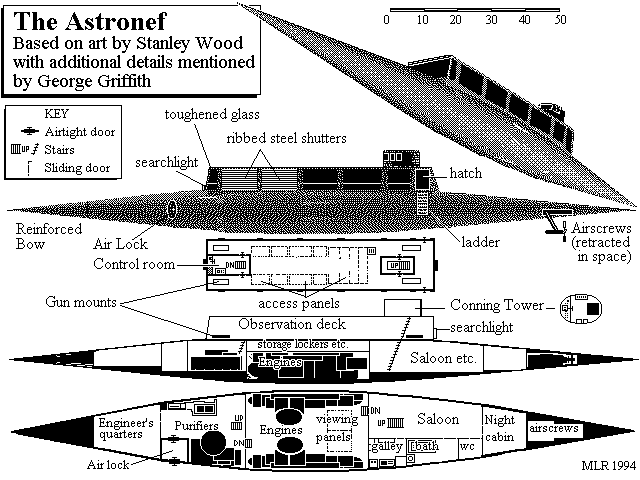 The Astronef The Astronef
The Astronef is a spacegoing yacht built to accommodate two (or possibly more) passengers in luxury. It has three decks, the upper of which is glass-domed. It flies by the "R" or "Repulsive" force, one of the components of gravity; essentially it presses against the nearest planets, and uses the push to accelerate. See FF II for background, engine design, and other rules.
|
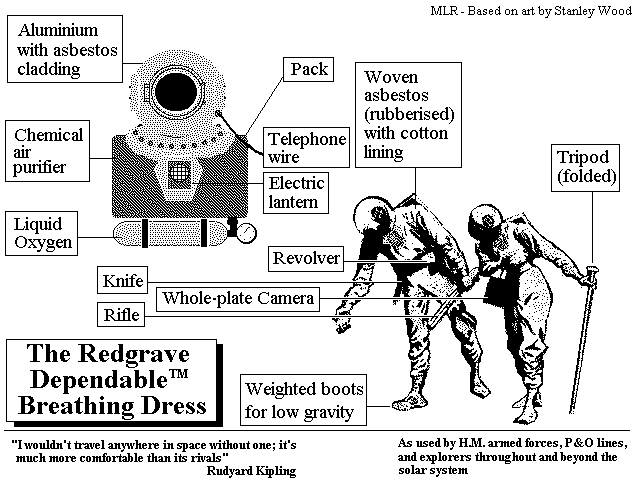 The Redgrave Patent Breathing Dress The Redgrave Patent Breathing DressUnless they are passengers on the largest liner, all spacefarers inevitably spend some time in breathing dress, or space suits. The design that follows was described in the source material for FF II, and has since also been used in Mummies, The Next Generation and FF IX. The Redgrave Patent Breathing Dress resembles a diving dress but is much lighter, made of asbestos-cloth lined with rubberised fabric and padded with quilted cotton or lambswool. The helmets are aluminium covered with asbestos, and contain a small telephone. There is a lantern on the chest plate; some models also have helmet lamps. The backpack contains equipment to regulate and recycle liquefied air, released from a cylinder below the pack. Efficiency is very good, with endurance measurable in days. The pressure of air inside the helmet regulates the supply. An airtight collar stops air circulating into the dress, to prevent the material tearing or ballooning until it is impossible to move, but the interior of the suit is not a complete vacuum; a little air is bled in to maintain partial atmospheric pressure and protect the skin and body from vacuum-related injuries such as ruptured veins.
|
| The Carnacki™ Electric Pentacle
An efficient defence against Ab-natural entities (see FF IV), considerably improving on the protection offered by a pentacle alone, developed after disappointing experiments with "bare" pentacles and manufactured under license by the Radium Patent Light Company (RPLC Ltd.) of London. Purchasers included Aleister Crowley and the Psychical Research Society. The pentacle is an arrangement of mercury discharge tubes wired in parallel, powered by a group of lead-acid accumulators (rechargeable batteries) with an induction coil used to boost the voltage. Induction coils were noted for their noise (a loud buzz), unreliability, and smell of ozone. Carnacki overcame the first and last of these problems by keeping the induction coil in a box surrounded by layers of asbestos wool and absorbent charcoal; the reliability problem could only be overcome by careful maintenance and adjustment.
|
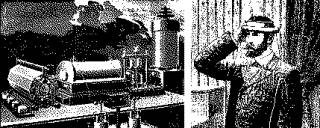 The Psychic Idealiser The Psychic Idealiser
Designed as a means of making thoughts visible, the Psychic Idealiser is in fact a means of travel to parallel worlds, invented accidentally by the eccentric philosopher, phrenologist and scientist Dr. Pyotr Plokta (of Utrecht, the Sorbonne, and Imperial College, London) in 1898, as part of an abortive search for the Platonic Ideal. The main components are a helmet bearing hundreds of fine wire coils arranged around the appropriate "faculties" of the head, mapped by careful phrenological probing. The coils connect to antennae arranged around a circular glass cylinder with a flexible diaphragm at its base, containing a quantity of fine powdered magnesium, an extremely light metal, electrified by a Wimshurst machine. The volunteer is instructed to meditate upon some common object, such as a chair, and try to visualise it in its Ideal form. As he does so a clockwork mechanism vibrates under the diaphragm, throwing the dust into the air of the cylinder. Plokta hoped that the dust would be controlled by the amplified brain waves of the subject, momentarily adhering to form a crude replica of the Ideal object. Eventually he obtained a fuzzy image of Wren's original design for St. Paul's Cathedral, which differed in many details from the version built. During the next experiment, with more power, he and his assistant suddenly found themselves standing in the plaza in front of the revised cathedral, wearing strangely old-fashioned clothing and with blurry double memories of two lives; their lives in the world where Plokta invented the machine, and in this new world, in which Britain was at war with France and medicine was still waiting for the discovery of germ theory. It was obvious that their personalities had somehow transferred to the bodies of their equivalents in the new world. Plokta built another machine, hoping that they might return to their original world. In the next St. Paul's Cathedral was much as they remembered, but London was criss-crossed with elevated railways and everyone spoke an Americanised form of English. Neither could stand the pace of this new society, so they built another machine and tried again. And again... Now, a score of worlds later, Plokta has established the basic principles of dimensional travel:
|
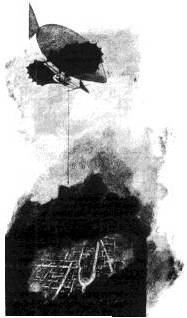 The Aerophane The AerophaneA semi-rigid airship consisting of a large fish-shaped canvas "envelope" filled with several ballonets of hydrogen. A skeletal metal "car" or gondola below the gas bag carries three passengers, a small petrol engine, and up to a ton of cargo. It literally swims through the air, using two rippling wings of canvas and metal struts for forward (or backward) motion, several steerable sails, and a fishlike tail to steer. It is designed to carry special bombs to precipitate rain and disperse smog. See FF V for more on the circumstances that led to its use.
|
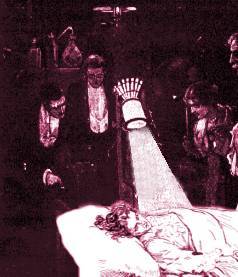 Radium Healing Rays Radium Healing Rays
Healing rays are used to speed the body's own repair processes. The treatment time (in hours) is their Effect, attacking the recovery Difficulty of the injury, any success halves the recovery time. For more on this and other rays see FF VI.
|
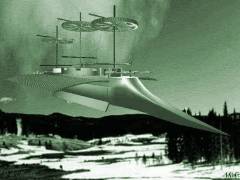 Ariel-Class Æronefs Ariel-Class Æronefs
The Ariel and her sister-ships are æronefs, heavier-than-air flying machines built in 1900 by The Terror, an anarchist group dedicated to the overflow of the Tsar and creation of a socialist Utopia. They are built largely of aluminium, with some wood and other metals used where necessary, and designed primarily for war against ground forces, balloons, and other greatly inferior foes. Their primary advantage is Arnold's fuel, an incredibly powerful binary chemical which powers the engines and can give astonishing power-weight and fuel-distance ratios, and is also usable as a powerful explosive. For more about The Terror and its technology, use in combat, etc., see FF VII.
|
 The Amulet, Magical Time Machine The Amulet, Magical Time Machine
The Amulet is primarily a transport device, but can only take travellers to a place or time where they might be able to find its missing half. Since its existence spans several thousand years this allows plenty of scope, but once complete it loses this ability. When activated (by holding it in the direction of the rising sun and reciting the name inscribed on it, "Ur Hekau Setcheh") the Amulet grows to archway size, allowing travellers to walk to the past or future. For more on this and other magical devices see FF VIII
|
| Krupp Stahlwächter
The Krupp Stahlwächter (steel guard) is a Prussian automaton used to protect the Imperial Calculating Engines and other important facilities. For this important job the Prussians have takem the unusual step of adapting the "terrain" to the automata. Sites on which they are used are levelled and surfaced to a high standard, and in buildings ramps replace stairs. This allows the use of a wheeled design with very little ground clearance, the wheels being covered by armour plating. An aluminium chassis minimises weight and electric motors reduce noise. Generally considered successful, although they are slow to react and vulnerable to attacks which damage the "terrain" or push them over; they cannot right themselves. An unusual feature is the telescopic eye, which is moved in and out on bellows and improves the accuracy of marksmanship. The down-side is that the eye has a restricted field of view, so that the automaton is easily attacked from the side, although sites where this model is used are generally designed to limit opportunities for such attacks. For more on these machines and other automata see FF IX.
|
 American Eagle (projectile spacecraft) American Eagle (projectile spacecraft)
The American Eagle is a two-seater spacecraft designed to be launched to the Moon by the combination of a train-borne steam catapult and a rocket engine in a three-stage process; it's accelerated to the astonishing speed of 300 MPH by a special steam turbine train, then a steam catapult fires and boosts it to nearly 1000 MPH. As it leaves the catapult a supplementary or "booster" rocket ignites and delivers the remainder of the velocity needed to take it to the Moon. This is basically a "proof of concept" craft, which will be scaled up if it is successful, and if the first flight finds resources valuable enough to make another flight worthwhile. Of course this depends on the resources; if diamonds were found, for example, the craft is large enough for a considerable fortune. See FF IX for more on this and other projectile craft.
|
Replica and reprinted maps are wonderful props for any game, and a useful starting point for "future cities" as they were imagined around the turn of the century. It should be possible to obtain them for most areas; the examples that follow are useful for a British campaign.
These games are, or were, available from most specialist shops.
Historical note: With the exception of various cowboy RPGs, such as TSR's Boot Hill, the first commercial RPG to cover the 19th century in any detail was probably Victorian Adventure by Stephen Smith, published by SKS Distribution. It was intended as a purely historical game, and appeared in Britain around 1982-3, with at least two editions. It was not a success, possibly because readers were put off by unusual typography and layout, possibly because there wasn't much of a market for a purely historical game. Many thanks to Patrick Brady for these details.
Marcus L. Rowland is a London-based technician. In his spare time he has been writing for games magazines and publishers since 1979. Notable works include the following game supplements and adventures:
The first printed version of Forgotten Futures was published as a free booklet with Future Publishing's Arcane magazine in 1997. This booklet is now very rare. It consists of the summary rules and introductory adventure, both of which are on line and on the Forgotten Futures CD-ROM.
From Heliograph Inc. for Forgotten Futures
Forgotten Futures (expanded rules and introductory adventure)
(ed.) Stories of Other Worlds and A Honeymoon In Space by George Griffith
The Log of the Astronef - Space travel worldbook
(ed.) Tsar Wars: The Angel of the Revolution by George Griffith
(ed.) Tsar Wars: The Syren of the Skies by George Griffith
Masters of the Graviton, the space travel adventures book, long on hold, has now been cancelled, and there are currently no plans for continued print publication of Forgotten Futures.
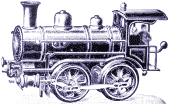 Gordon (MIND [4], BODY [3]) has decided that he wants to be an engine driver. This skill (actually Driving) begins with a rating of 5, so it costs ten bonus points. To gain the skill he must use the average of MIND and BODY (4) against Difficulty 5. Unfortunately he rolls a 7, a failure. After his next adventure he pays another ten points, representing more training, succeeds on a 3, and adds Driving [5] to his skill list.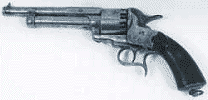
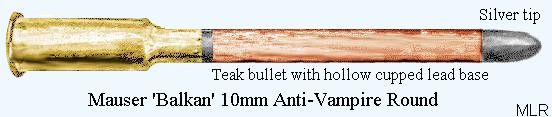
 Wands and magical talismans add to MAGIC and may reduce the time needed to cast spells, but sometimes have an agenda of their own, or just exist to cause trouble. They may be usable as often as the magician wants to cast a spell, or have some limitation such as a maximum number of uses, or an unwelcome side effect. This is one way that a magician with