- With The Night Raid
by Marcus L. Rowland
Copyright © 2004, portions Copyright © 2000-2003
| Worldbook | Main Index |
| Air-Ships
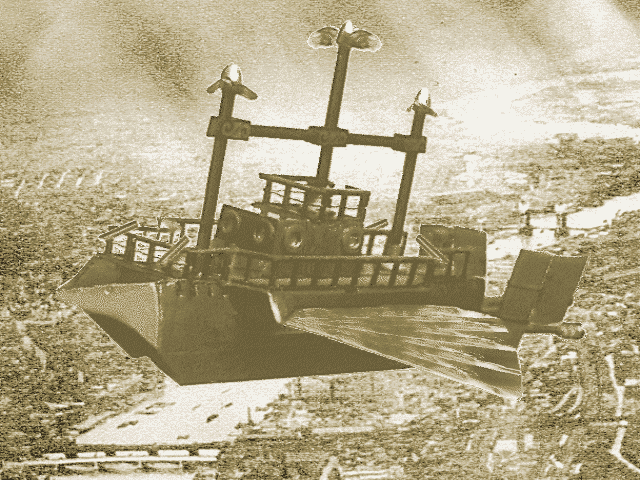
Air-ships (or æronefs) are heavier-than-air flying ships. They take off and lands vertically, supported by rotating air-screws, with wings extending to support the ship in horizontal flight. Æronefs are fast but expensive to build and run, uneconomic for civilian use and too noisy to appeal to the luxury market. Typically they carry just enough armour to protect them against small arms fire, their guns pneumatic cannon using compressed air to fire explosive shells. Hulls are generally water-tight, so that the craft can operate from land or water. The largest air-ships can only operate from water. Current designs range in size from small gunboats, as used by the Aerial Hussars, to naval cruisers with a crew of several hundred. The USA, European powers and Britain are currently in a race to develop faster, heavier, and more heavily armored air-ships; so far Britain is narrowly in the lead, but the USA (with the advantage of cheap oil) is rapidly catching up. British and European air-ships are coal fuelled. The names of British military air-ships have the prefix HMAS (His or Her Majesty's Air-Ship) for Naval vessels, AAS (Army Air-Ship) for army craft. |
I reached their base near Coventry a little early, and expected to spend a comfortable hour chatting with my old friend Captain T___, commander of the Fifth Squadron - I should explain here that there is a policy that serving members of the regiment should not be named, to protect their families and homes from unwelcome attention - before dressing for dinner. When I arrived I found that things were not to go as planned. The base was bustling with activity and the gates were closed; I was nearly turned away by the guard, but fortunately his sergeant recognised my name and was prepared to admit me. As I parked my steamer near the landing field wagons laden with shells and powdered coal rattled past, and I could see dozens of men working on the field. It was obvious that several air-ships were being prepared for flight. From the grim attitudes of some of the soldiers I passed, it was more than a drill...
FOLLOWING the development of the first practical æronef air-ships in the 1880s, the Royal Navy began to develop fleets of aerial destroyers and light cruisers; at that time larger air-ships could not be built, but the enormous tactical advantage of height, and the development of powerful explosive bombs and shells, made a flying cruiser the match of any battleship afloat.
Not to be outdone, the Army soon began to field its own air-ship units, concentrating on smaller vessels designed to support ground forces with aerial bombardment and machine-gun fire. Technically these might be considered dragoons, since they convey foot-soldiers and artillery to battle, but since the soldiers aboard them occasionally fight from the air it was decided to treat them as cavalry or hussars. This made them a little more prestigious, which had a good effect on recruitment and morale.
...and so it was that thirty-one men boarded the Broadsword-class air-ship AAS Balaclava that evening; ten crew, twenty officers and men, and one supernumary journalist wearing a borrowed uniform. The commander of our gallant craft was Lieutenant P____, a keen youngster who made an alarmingly accurate guess of my weight, yelled at the ground crew to unload the requisite ballast, and rang "Full power" less than two minutes after I'd boarded. Overhead the three twin-bladed air-screws began to turn, slowly at first then gaining momentum. Scraps of litter and coal dust blew from the hastily-cleared decks, and I distinctly saw someone's forgotten cap fly overboard. With a slight wobble we rose into the air; Lieutenant P____ immediately rang for full power on the aft screws, and we began to gain speed. It was a far cry from the stately rise of a fifty-screw Navy cruiser, where every manoeuvre seems part of an elephantine ballet. In less than a minute we were above the clouds and moving forward at a brisk pace, and Lieutenant P____ ordered the wings extended."This is where we have to be careful" he said "Swing the wings out without slowing the lift screws and they'll tear off from the downdraught. Slow too much, before the wings are extended or we reach cruising speed, and we'll drop like a stone. Let either wing open much more than the other and we lose our balance. That's what happened to D'Urban last month, the port wing jammed half-open at five hundred feet and they couldn't get the balance right before she hit the ground. Lucky they weren't all killed." As he spoke he deftly juggled the telegraphs for wing position, lift screws, and rear screws, barking orders to the helmsman as needed, without a wasted motion. Through the side portholes I could see the wings sweep forward, each opening fan-like to curve forward through a semi-circular arc like those of a gliding hawk. Ahead the twin guns glinted dimly in the moonlight, their metal deliberately dulled to reduce reflections. A hundred yards to port another air-ship, the Alexander, was going through the same manoeuvres, with Flashman and Cromwell II on our starboard bow. We rocked slightly as a small Rapier-class, the Edgehill, completed the evolution and surged ahead to take up a position leading the squadron. "Show-off," said Lieutenant P____, "but it's probably the most excitement he'll get tonight, the lads down below will probably be doing most of the work, with our guns to help them if needs be. The small fry just cover us with their Maxims, or maybe drop a few five-pounder bombs if we need it, but they're generally more dangerous to us than to anything we'll be fighting."
"A couple of hours to wait now" said Captain T____, leading me aft from the bridge (if a compartment the size of a small larder can really be called that) and down to the saloon. "By the way, you don't want to believe all he says about the Rapiers, they're actually very useful. Faster than us, and nippy enough to suppress threats to our troops before we run into trouble on the ground. But they're still a little temperamental, and some good men were hurt when D'Urban crashed."
These small air-ships are cramped, and twenty men and their equipment were crammed into a space little larger than a third-class railway compartment, lit by dim red lights to ensure good night vision. A hatch aft led to the engine room, and I thought of going to take a closer look at her turbines, but one glance through the opening convinced me that there was no room for sightseers. Two stokers were manhandling sacks of powdered coal to the feed hoppers, while the engineers tended to valves, dials, and a complicated network of pipes and ducts, some glowing red-hot, all the while deftly avoiding the rotating shafts and gears that make any engine room a death-trap for the unwary, in temperatures that would fry an egg if anyone dropped one on the deck-plates.
Kipling, ibid.
Formed in 1894, The Queens Own Aerial Hussars is a regiment modelled on ideas borrowed from the Confederate army of the US Civil War. Originally its wartime mission was intended to be raiding operations behind enemy lines. In peacetime the regiment was to have acted as a flying rapid-response force for riots and other civil emergencies. However, circumstances have changed, and the regiment now has an unusual specialisation; it is Britain's main military defence against supernatural attacks.
In the late 1880s Count Dracula of Transylvania attempted to spread the curse of vampirism to the flower of English womanhood. Although he was defeated by a foreigner, a Doctor Van Helsing, his attack resulted in several deaths and the creation (but fortunately rapid destruction) of more vampires. There was a half-hearted attempt to keep the story secret, but more incidents occurred in the following months, and it became apparent that the curse of vampirism, formerly considered to be little more than a myth, had come to the British isles. Questions were asked in Parliament, and it was clear that something had to be done.
It was obvious that these incidents were potentially the prelude to an uncontrollable epidemic of vampirism. Fortunately Van Helsing had been aided in his fight by Lord Godalming, a nobleman of enormous influence who came to realise the importance of creating a permanent defence against the undead. Soon after the Aerial Hussars became operational they were assigned to this unusual mission, and have since become celebrated as the first line of defence against the monsters that threaten Britain. To date the regiment has defeated eighteen vampires - to everyone's surprise they have also had to deal with five werewolves, the Loch Ness monster (at least one other monster is believed to exist in the Loch, but hasn't yet become a threat), and a haunted mansion. Needless to say, they have also had to handle numerous false alarms.
Sergeant R____ and Corporal K____ made room for me on one of the benches, and the latter passed me a tin mug of tea from an urn at the rear of the cabin. His skin seemed a little grey, and I wondered if he was quite well, then noticed the scars on his neck. He saw my poorly-concealed stare, and said "Vampire bite. Ten seconds to get bit, then a month feeling like death while the quacks pumped silver muck into me blood every few days. If they cremate me when I die they'll get enough silver back to pay for the funeral."I asked "How did it happen?" He shrugged and said "We was clearing out a castle on one of the Scottish islands, belonged to a blood-sucker called Ruthven. Not one of your Balkan mob, although I suppose he could have been bit out there. Been around for centuries, married women and killed them, pretended to die then posed as his own son to take over the estate. Had the locals so mesmerised that they never noticed what was going on, but someone visiting the island for a holiday looked at the parish records, spotted it and raised the alarm. That was a real b_____ - he was so old that he could look more or less human, even in a mirror, and it turned out he could go outdoors in daylight if he had to. Sneaked around behind us while we were closing in on his tomb, killed two of us before he got me. I saw him out of the corner of my eye, just got a shot off before he had me, and that brought in the rest of the lads to chase him back inside. We got the servants and their families out but ended up having to shell the castle, left him buried under a few hundred tons of rubble. Mind you, that one's supposed to have come back from the dead at least twice, so we may have it all to do again one of these years." I laughed, then realised he was deadly serious. "Aged me five years, they reckon, the bite and the medicine, and my skin will always be grey now. Better than being a bloodsucker, I suppose."
Kipling, ibid.
Anti-vampire operations are generally a cross between counter-terrorism and hostage rescue; vampires can mesmerise dozens of victims, all of whom will do anything to protect their masters. The vampire must usually be winkled out of a highly fortified lair, separated from its followers, and killed. It may also infect some of its victims with vampirism, creating more of its kind, but since they can only feed on the living they nearly always have victims who are uninfected, or in the earliest stages of the disease, who must be rescued. After the vampires have been killed these victims must be quarantined and if necessary treated for vampiric infection; the disease can be stopped if treated with silver and mercury compounds early enough, although a proportion of those treated die despite (and in some cases because of) the treatment. If they die with these chemicals in their bodies they are not reborn as vampires. A common side-effect of the anti-vampire treatment is a condition known as agyria, in which skin (especially thicker folds) is permanently stained blue-grey by the photoreactive silver compounds. Medical doses of the drugs are ineffective on true vampires, although a large enough dose will kill them - or anyone else - in minutes.
Werewolf hunts are very different; they are marauding monsters, fast and deadly, killing indiscriminately and almost invulnerable to small arms fire. Their bite carries the infection, and survivors often succumb to it. Usually the best way to deal with them is to force them out into the open then strike from the air.
...showed me a razor-sharp claw, about two inches long, that he kept as a souvenir. "This came from the Bodmin Moor werewolf. We caught up with it after it had killed a little girl - wasn't even hungry, she just disturbed it when it was sleeping. We've got the head over the fire in the mess." He looked distant for a moment, then added "You can't think of a monster like that as human, or give it a Christian burial, it's better to think of them as animals. In a way they are, of course, they have no idea of good or evil, just mindless hunger. No way of finding out who it was originally, of course, once they're dead they never change back. I don't know what we'd do if we ever caught one alive, or when it wasn't changed."Kipling, ibid.
Other missions vary; the Loch Ness operation ended up with several air-ships firing their guns at a huge and virtually unstoppable monster, and the eventual use of a Navy cruiser to finish it off. The regiment's one encounter with a haunted house was a much quieter affair, bought to a satisfactory conclusion without casualties or significant property damage thanks to the help of a civilian "ghost detective" who identified the cause of the disturbance.
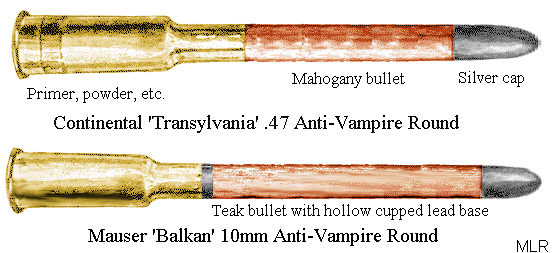
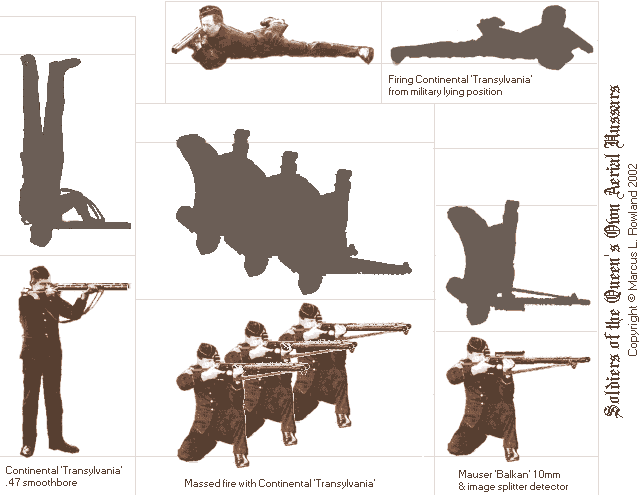
Sergeant R____ is an American soldier who is spending a year with the Hussars before returning home to train his countrymen in this style of fighting. He told me "We have to face facts. There have already been vampires in America, we've been lucky so far but sooner or later they'll become a real threat. There's already rumours of colonies in some isolated places - there's towns in California and along the Massechussets coast that're scheduled for a flying visit as soon as we're ready." He's not the only outsider in the company - there are Russian and German observers aboard Edgehill, and two Royal Marines aboard Alexander.After a few questions he handed me a Continental 'Transylvania' .47 smoothbore, much like a cut-down elephant rifle, with short thick double barrels and a bandolier of long cartridges fitted with 4" silver-tipped hardwood rods as bullets. "You've hunted big game? Then try this. Short range, and it'll kick like a mule if you have to use it, but it'll take a vampire down if you get him in the heart or head. The silver cap breaks off and stays inside if the shaft is pulled out, and that'll eventually poison him. Just don't shoot any of us! Oh, and don't waste them, they cost three shillings a round." Most of the other soldiers carried the same weapons, with larger stakes in loops on their belts, and silver-plated cavalry sabres. Some of the bigger men were loading 10mm long-barrel Mauser 'Balkan' rifles, taking longer but slightly narrower cartridges and fitted with bulky telescopic night sights. Here the base of the teak bullet is a hollow lead cup, which expands and grips the rifling like a Minie ball when fired. Range is greatly improved, but they are awkward weapons and weigh nearly eighteen pounds. It takes a strong man to fire them! A huge Scots corporal was sharpening a two-handed sword. The sergeant noticed my interest, and explained "Corporal Mc____ comes from a highland clan that has a tradition of swordsmanship. He's as fast with that as I'd be with a sabre, and he can do a heck of a lot more damage if it connects. I've seen a vampire run from him - didn't do it much good, there were two of us waiting with rifles."
Kipling, ibid.
 |
 |
Spears, bows and crossbows have been tried but are too unwieldy for use in confined spaces. There have also been experiments with grenades with wood or silver casings, but they seem to be no more effective than conventional explosives - in the long term they might do more harm to a vampire, but the fragments of shrapnel seem to be too small for any immediate effect. There are also problems with the reliability of fuses for all grenades.
Larger quantities of explosives, such as artillery shells, will destroy them; the snag is that vampires move so fast that it is difficult to pin them down long enough to take aim. At least one man in each squad carries some dynamite and fuses, but they are rarely used.
All of these weapons work against werewolves, and shotguns firing silver buckshot have also been very effective - but do little immediate damage to vampires. Each air-ship also carries a sealed ammunition chest containing belts of silver Maxim-gun ammunition. They cost thirty-five pounds per belt, and an officer must give orders to break the seal before they can be used.
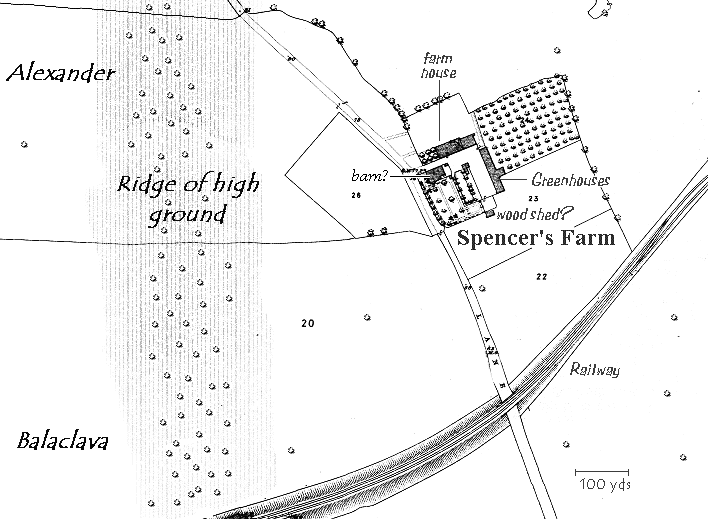
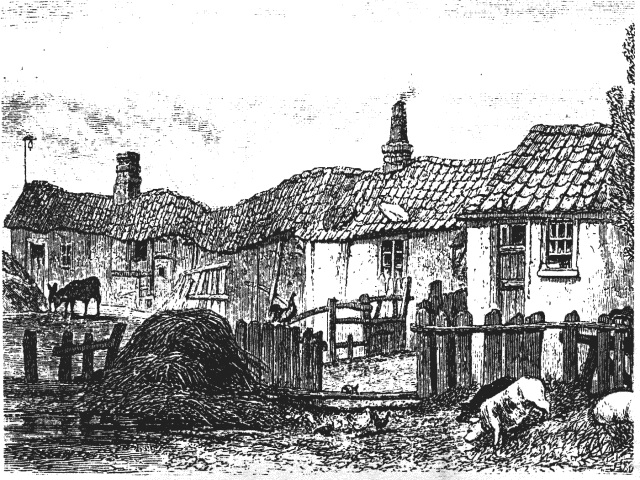
One of the corporals handed round a box of silver crucifixes, but most of the men declined them so I followed suit. Corporal K____ told me "They reckon they work if you believe in them, and the vampire believes in them, but I've never seen it. Besides, things usually go too fast to mess around. We tried taking a priest with us once, but the poor bleeder got too close to the first vampire he saw. Thought he could save its soul or something, but it had him before he'd got his bible open. I could have told him, vampires ain't got no souls. Vampires with souls, you might as well believe in angels. Still, I suppose he died a martyr."Captain T____ gave us a final briefing. A day earlier a visiting vet had noticed odd bite marks on some cattle he was treating, and realised that everyone in the farm seemed to be a little dazed. The child of the family had mentioned seeing something horrible in the woodshed. He ended "Could be a false alarm, wouldn't be the first, but some vampires can feed on animals as well as humans. Might be sleeping in the shed by day, and coming out to feed at night. One thing to remember - there's at least one child there, and we need to make sure that she doesn't come to any harm. Assuming she isn't another vampire, of course."
The soldiers began to smear burnt cork and grease on their faces and hands. A few strapped odd periscopic devices over their left eyes, which can sometimes reveal the presence of vampires.
Kipling, ibid.
Most vampires are deterred by religious symbols, provided that the person using them is confident and has some faith in them. Herr Freud has a theory that the effect is largely psychological, and in part an effect of the vampire's own psychic powers - the user believes that the vampire will be harmed, and the vampire senses that belief so takes psychosomatic damage if the symbol comes too close. The snag is firstly that few men have sufficient faith and confidence to pull off this trick, secondly that the vampire must be able to see the symbol, must know what it is, and must have time to react to it. None of these factors are likely to occur in combat. Magnesium flares are more useful in driving vampires off, since their eyes seem to be unusually sensitive to bright light, but they must be lit with a match or fired from a flare gun and burn out in thirty seconds or so.
 The "vampire detector" is a simple device which takes advantage of the illusion which vampires use to disguise their nature. It consists of two mirrors, one of them "half silvered", a process which produces a mirror which reflects some light, but also allows some to pass through. The mirrors are adjusted so that any normal object is seen as two overlapping images. Since the vampire illusion affects the brain, not the eye, the doubled reflection isn't seen. Most soldiers can't take advantage of this device; some get headaches with prolonged use, others find that their marksmanship suffers if they use it.
In other respects mirrors are less useful against vampires than is commonly supposed; all but the youngest can produce the illusion of a normal human reflection, although it sometimes breaks down if the vampire is trying to fool several observers viewing it from different angles.
Werewolves don't use illusions so mirrors don't help to find them, and are not affected by religious symbols since they are incapable of rational thought.
Vampires and werewolves have much keener senses than humans; camouflage can buy a little time, but is only effective if the presence of a soldier isn't suspected. Even then a werewolf will eventually smell the soldier, a vampire will see or hear some subtle clue and become alert for more.
Our arrival was timed to coincide with the passing of a goods train on a nearby line, its driver briefed to make as much noise as possible to mask the sound of our engines. Balaclava and Alexander glided down in eerie near-silence, with a brief burst of power to kill our speed a few feet above the ground, and landed on the far side of a ridge from our target. The other Broadswords were disembarking more troops on the other side of woods a mile or so beyond the house, while Edgehill circled the area at height, ready to move in if needed. The silence seemed total to my ears, numbed by the noise of the flight, but in fact the engines were still turning quietly, ready to go to full power in moments if need be. Now the guns were manned and starshells loaded, ready to illuminate our attack.Captain T____ shivered and whispered "After a while you get an instinct, and this place... it feels like the real thing. Stay close, and for God's sake make sure you know what you're shooting at."
Kipling, ibid.
Vampires and werewolves radiate a psychic "miasma" which can often be detected by the sensitive. This is percieved as a sense of "wrongness", and is to some degree directional. Unfortunately the sensation is also associated with their lair, and isn't necessarily a certain sign that a vampire is present - he may be in the lair, but may instead have gone out for a bite...
We climbed the hill, and the men scattered into the undergrowth. For several minutes Captain T____ scanned the farm-house with field-glasses. "Nothing obvious... wait a second... there you are." He passed me another pair, and I looked at the buildings. "He's loading boxes onto the cart to the left of the house - could be coffins, or crates of earth." I could see a stooped figure, handling a man-sized wooden box as though it were made of cardboard. "No doubt about that one. When he stands upright take a look at his face, he isn't even hiding what he is. Doesn't know anyone is looking, I suppose." A moment later he obligingly stood, and I barely repressed a gasp as I saw the gruesome visage thus revealed - elongated jaws with fang-like teeth, and a feral ugliness to the rest of the face. There was something odd about the ears and cheeks, and Captain T____ whispered "Soft tissue. Must have rotted in the grave. Not as bad as some I've seen." He looked again and swore softly. "Not much cover, and I've a feeling he isn't planning to stay put. Must have guessed trouble was brewing. We'll have to do this the hard way." He fired a red flare - the evening's signal for an attack - high into the air. A few seconds later something whizzed overhead, and a star-shell burst high above the farm, bathing the buildings in a fierce actinic glare.Kipling, ibid.
Like all military forces in this era, the Hussars make very little use of electrical signalling devices. Instead they use signal lamps and heliographs, flags, whistles, and flares. Field telephones take too long to set up to be useful to such a fast-moving force. Wireless is in its infancy, and although the Navy has equipment on its largest air-ships, it still weighs several tons and won't be available for small craft for years to come. Personal radios are only found in the wildest scientific romances.
As the flare fell soldiers rose from cover nearer the house and began to open fire, and the vampire lept towards the horse. I could see spurts of brick dust and splintering wood as our bullets hit the wall, but the vampire seemed to be unharmed - he ducked behind the horse, then leapt onto its back and tried to ride away from the farm. For a moment the horse bucked, and I thought that he would be thrown clear, but something drew blood from the horse's rump, and it suddenly bolted."Good - I wanted him clear of the house," said Captain T____, "now we can really get to work." He blew three sharp blasts on a whistle, then fired a blue flare after the fleeing horse. The fields, which had previously seemed empty, suddenly filled with soldiers, rising from cover to fire at the fleeing vampire. There was a sudden roar from above, and Edgehill swooped after horse and rider. As she passed overhead I could see the gunners manning the rear Maxims, secured by strong canvas straps to stop them being blown overboard. Suddenly Captain T____ swore: "He's heading for the railway, and another train's coming!" He fired another flare, this one yellow, then urged me to my feet to follow the fleeing vampire. Behind the hill I could hear the Balaclava's engines roar back to life - a minute later she grounded in front of us, her propellers still spinning, and Captain T____, his men, and I scrambled back aboard, lining the ship's rails with our guns ready to fire. Forward the gunners fired more star-shells, illuminating the fleeing vampire and the other soldiers. Somehow he had passed the gauntlet unscathed, and was making for the approaching train.
Kipling, ibid.
Before an operation begins a code of signals is agreed. For example, five colours of flare are available, and by firing multiple flares many instructions are possible. For example:
| Red: | Air-ships fire star-shell, soldiers to open fire if the target is visible. |
| Blue: | Enemy is fleeing in direction of flare, all units attack. |
| Yellow: | Regroup and board air-ships |
"Is he using an illusion to make himself harder to hit?" I asked. Captain T____ shook his head: "We've hit him at least twice, but it takes a heart or head shot to put them down, anything else just annoys them. If there's silver in the wound he'll die eventually, but that could take hours." Behind us the soldiers on the ground were moving to surround the farm and make sure that no other vampires remained, while Edgehill and Balaclava pursued horse and rider. We'd lost time boarding, but Edgehill's gunners were busy spraying rider, horse, and the ground around them with silver bullets at thirty-five pounds the belt. "I can't believe he isn't hit!" I said, and at that moment the horse went down, its rider scrambling clear and continuing to run for the train. "Vampires are tough, and it takes a lot of silver to kill them instantly. He's dead, but he doesn't know it yet."The vampire reached the train, which must have been making thirty miles an hour, but seemed to have no trouble catching up and climbing aboard. It leapt aboard the guards van, and moments later we saw the horribly mutilated body of the guard thrown out and the vampire working its way forward atop the wagons. "Get down there!" shouted Captain T____, and the Balaclava swooped low above the train, while the vampire ripped its way into one of the covered wagons and vanished. At Captain T____'s urging she matched speed with the train, a few feet behind the cab of the engine, and Captain T____ and Sergeant R____ jumped nimbly to the roof of a goods van, followed by four others. We dropped back to the rear of the train, lest our wings or the wash of our propellers knock someone off the train, then dropped more men just forward of the guard's van, with Corporal Mc____ leading the party. This time one of the soldiers went over the side, plunging to the track, his leg at an awkward angle and almost certainly broken. Moved by a stupid impulse to help I moved to jump after them, but a burly private stopped me. Within seconds Balaclava was well off to one side, and both Balaclava and Edgehill were using searchlights to illuminate the roof of the train and the wagon where the vampire had gone to ground. Grimly the soldiers began to converge on it. "Tunnel in five miles," Lieutenant P____ shouted, "Eight minutes at this speed."
As the soldiers approached the wagon from opposite directions, Captain T____ began to make a series of hand signals whose meaning I could only guess at. Everyone stopped, and one of the privates in his party crouched, rummaged in a canvas bag, and somehow lit a fuse. He hurled the bag into the wagon, then everyone crouched, waiting. Seconds later there was a powerful explosion, and Balaclava rocked sickeningly and plummeted ten or fifteen feet before levelling off and climbing. There was a loud tearing noise, and fragments of leaves and twigs swirled around the stern. "Hit the top of a tree, hope the wings are all right!" shouted Corporal K____. The wagon was burning furiously, and I was certain that nothing could survive such an inferno. I was wrong.
An awful form erupted from the blazing canvas, its clothing ablaze, and was instantly caught in the cross-fire of the waiting soldiers. In the pitiless glare its skin was bubbling and peeling, revealing the rotting flesh and bone underneath. I saw it hit three or four times, but still struggle towards the rear of the train. Corporal Mc____ was there to meet it, and despite the rocking of the train somehow swung his huge sword as any normal man would swing a golf club. It struck true, and the creature collapsed, its head completely severed from its body. Corporal Mc____ almost fell from the train, but half a dozen hands pulled him back. Balaclava flew forward and ahead of the train, signalling for the driver to stop.
With a squeal of brakes the train slowly shuddered to a halt, and we landed beside it. Fortunately there was a stream near the track, and it didn't take long for all hands to put out the fire. Soldiers wearing heavy gauntlets and surgical masks gathered the remains of the vampire in an oilskin sack - there is reason to believe that their flesh can carry the infection even after they have been killed - and transferred it to a steel locker for the return journey. Edgehill flew back down the track to recover Balaclava's sole casualty, finding him limping towards us with his rifle for a crutch.
At the farm it took several hours to search everywhere and determine that there were no other vampires, although everyone that lived there had been bitten, and was to some extent under the vampire's spell. All, including the child, would have to be treated with silver; I later heard that the grandmother of the family eventually died. The herds were to be slaughtered and burned; it seemed likely that the vampire had used them to supplement its diet, and might have infected them. Eventually the barn, a coffin, and four crates of earth would also be incinerated. Three soldiers from other craft were injured; two, clawed by the vampire as it escaped, would also need treatment but thankfully made a full recovery, the last was accidentally grazed by splinters from a bullet. By the time we were ready to leave half the county was there, along with the press. Fortunately we were airborne before the mayor and other local dignitaries arrived, or we might have had to sit through half a dozen speeches.
We returned to Coventry at noon the following day, the regimental band greeting us with a stirring march as our air-ships landed and the tired soldiers unloaded their equipment and wearily went to their barracks. "Well, that went reasonably well," said Captain T____, "apart from forgetting to stop the trains on that line. Have to write that one up, make sure it doesn't happen again. Never mind, wish they were all that easy," and went off whistling to make his report. I laughed, but as I went to my borrowed bed in the officer's mess I knew that he wasn't joking.
Kipling, ibid.
Organisation
The Aerial Hussars are based near Coventry, with subsidiary bases near Aberdeen, London, Ulster and in Cornwall. These subsidiary bases have landing and coaling facilities, workshops, and barracks blocks, but are normally only occupied by a skeleton staff of guards and maintainance personnel. If another base is to be used personnel are transferred by air-ship and train; all essential services can be made fully operational in six to twelve hours on the mainland, eighteen hours in Ulster. There are also landing facilities at most army and navy bases, in an emergency any cleared area of ground or sheltered body of water can be used, although safety regulations say it must be at least three times as long and wide as the air-ship itself.
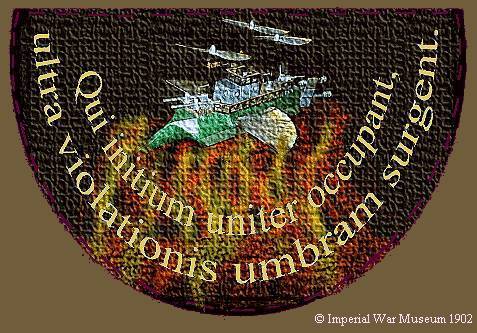 The regimental uniform is dark khaki, with matt brown webbing and dark puttees to reduce visibility at night. The cap-badge shows an air-ship rising phoenix-like from flames and billowing black smoke, with the Latin motto "Qui initium uniter occupant, ultra violationis umbram surgent.", which translated means "Those who seize the initiative together, rise above the shadow of desecration." Nobody is entirely sure who came up with the motto. It's generally considered to be a little too verbose and obscure, but it is already enshrined in tradition and military records so unlikely to be changed.
Although carried on the Army's books as a regiment, the Hussars are an elite organisation requiring an unusual balance of soldiers and noncombatant personnel; roughly two thirds of the regiment supports the combat element. There are six squadrons:
Air-Ships
Air-ships are æronef designs with turbine engines. To conserve weight steam turbines can't be used; instead they use liquid or powdered fuels, mixed with air and burning at extremely high temperatures. The turbine blades are hit by the expanding combustion gases, not steam. The technology is still a little unreliable; damaged blades are common, and engines must be stripped down at least once a week for inspection and any blade replacement that is needed.
While liquid fuels such as petroleum and paraffin (which the Americans call kerosene) are obviously preferable for this system, powdered solids will also work. The main problem is pitting of the turbine blades by unburned residues, but with sufficiently fine powder no solid survives to reach them. Coal dust works if properly ground and mixed with air before it is burnt.
The USA uses petroleum fuels for its engines, most other powers use coal. Britain must import petroleum but has extensive coal reserves, and has standardised on coal. There have also been British experiments with whale oil and flour as fuels.
Flour shows particular promise since it is milled in huge quantities, contains nearly as much energy as coal, and is only a little more expensive than coal in bulk. Unfortunately most wheat is imported, and the supply might be affected if there was a war. Flour is also more explosive than coal - it is naturally a finely divided powder, whereas coal tends to clump as larger particles. This means that a given weight of flour in air may have three or four times the surface area as the same weight of coal dust in air, and combustion speed is directly proportional to surface area. There has been one case of a flour-fed turbine flashing back and detonating the flour in the fuel hopper, killing everyone in the engine room and making the air-ship crash. It was probably caused by carelessness, but nobody wants to take unnecessary chances. Currently flour is approved as an emergency fuel - in most places it's more readily available than powdered coal - but its use is strongly discouraged, only allowed if lack of fuel endangers a combat mission. If fuel runs out during training missions or manoeuvres orders are to land and wait for a coal delivery.
Whale oil is about as good as petroleum derivatives, but rather smelly. It is being pushed hard by the whaling industry, which is starting to feel the pinch as gas and electric lighting spread across Britain. Royal Navy air-ships assigned to the Falklands patrol are equipped to burn liquid fuels, including whale oil, as well as coal, but the smaller air-ships used by the army don't have room for the extra complexities of two fuel systems.
Three designs of air-ship are used by the regiment (and currently by the army as a whole); all are designed to operate from land or water, and painted in dark colours to reduce visibility at night. Even the guns and brass-work are dulled to prevent reflections. The only exceptions are the folding wings and propellers, which for aerodynamic and mechanical reasons can't easily be painted.
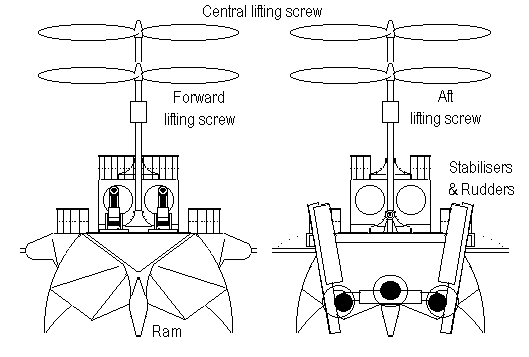
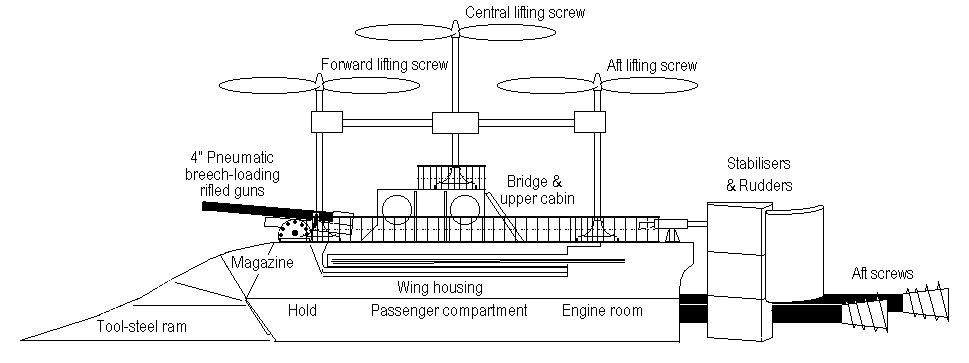
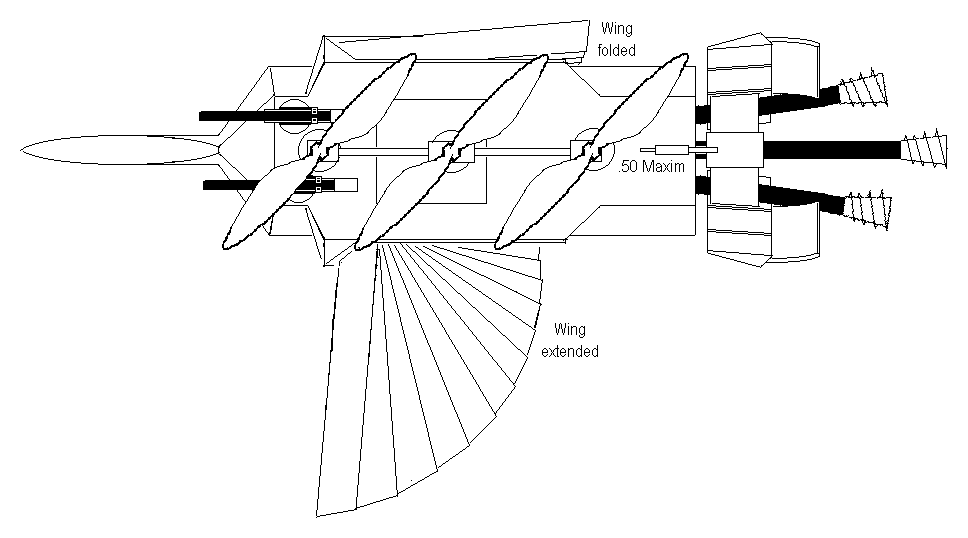
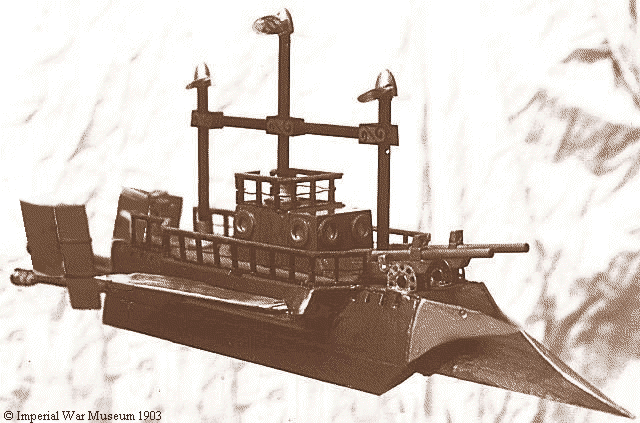 The Broadsword class was originally a naval design, the Hardy class, intended as the flying equivalent of a torpedo boat. They have a crew of ten, two guns, one Maxim gun, and passenger capacity of twenty soldiers with equipment or four tons of cargo. They have three vertical screws and three aft for propulsion, cruise at 66 MPH with a top speed of 86 MPH, maximum altitude 8,000 ft, and have a range of 660 miles in normal use. The hull has a spiked central keel for ramming other air-ships; they were originally capable of doing serious damage to capital ships, but the rapid increase in capital ship size and armour has made them obsolete in this role, although they can still take on small air-ships, balloons, etc. The Broadsword conversion removes some upper armour and adds more under the troop accommodation, needed in its ground attack role. Purpose-built Broadwords are largely identical to modified Hardys, except for the position of some hatches and the use of steel in hull fittings where the Hardy class used bronze. This reflects the fact that the navy operates from salt water, the army rarely does so and doesn't need the same level of corrosion resistance. A Broadsword appears on the regiment's cap badge. They are considered to be a good all-round air-ship for Army purposes, a reliable work-horse which rarely gives problems. Detailed plans and specifications for the Broadsword class appear below.
Rapier air-ships are a new design, equipped with four Maxim guns and racks for 5 lb. bombs. They have a crew of seven and can carry ten soldiers (some acting as gunners) or two tons of cargo plus a half ton of ordnance. They fly at 100 MPH cruise speed, 120 MPH top speed, maximum altitude 8,000 ft., with a range of 700 miles. They were designed from the outset for skirmishing and close support of troops. Currently there are concerns over their safety record; they are less stable than larger air-ships, seem to be more vulnerable to wind effects, and have been known to ice up in cloud. None of these differences are extreme - they passed all acceptance trials and are within specification - but it is obvious that Rapiers are pushing the envelope of safety. For the moment orders restrict them to 3,000 ft. and fair weather, but would probably be ignored in an operational emergency. They are generally considered to be "fun" to fly, especially at low altitude, compared to the other air-ships of the regiment. Superficially they look much like a smaller version of the Broadsword, except that the centre keel, ram and main guns are omitted to reduce weight.
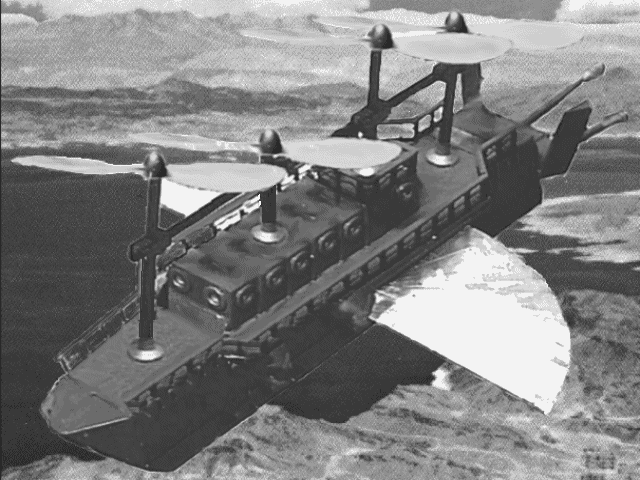 The Claymore class are support vessels, with a crew of twelve and carrying forty passengers or ten tons of cargo, with two Maxim guns for defence. They cruise at 50 MPH, top speed 75 MPH, maximum altitude 6,000 ft, range 1000 miles fully loaded. Typical cargoes might include fuel, ground troops, light field guns and other equipment, even horses and mules for ground operations. They can be equipped to drop bombs but the racks are not standard equipment. They have four vertical screws and three aft for propulsion. There are plans to equip a Claymore with wireless equipment, to allow Coventry to communicate with squadrons during operations, but its comparative slowness may limit its usefulness in fast-moving operations.
Fifth squadron, currently the most experienced, can deploy five air-ships, all of them having the designating initials AAS (Army Air-Ship) followed by the name of a battle or famous soldier: AAS Alexander, Balaclava, Cromwell II (the first Cromwell was lost in the Loch Ness campaign), Edgehill, and Flashman. A sixth, the AAS D'urban, was badly damaged in a training accident and is undergoing extensive repairs. A replacement hasn't been assigned, but one could be borrowed from another squadron if needed. Edgehill and D'urban are Rapiers, the others are Broadswords. For extended operations in the field at least one Claymore would probably accompany the squadron, loaded with sacks of coal and extra stores and ammunition.
If more firepower is needed the squadrons can combine; if really big guns are needed the Navy is generally called in, although the use of such large air-ships is usually more trouble than it's worth in this type of operation.
Air-ship design is discussed in more detail below.
Personnel and Personal Equipment
|
Characters
The Aerial Hussars are an elite unit, and characters will naturally be highly skilled. Generate them on 25 points, with BODY at least 3. For ground forces at least 7 points must go to combat-related skills, including three points devoted to a single combat-related skill (such as Military Arms or Marksman). For air-ship crew at least 7 points must go to combat-related skills, Pilot, or Mechanic. |
All soldiers are expected to be proficient with firearms (conventional rifles and the special weapons used against vampires), and are trained with sabres, stakes, and other melee weapons. Personal weapons are allowed in combat (but not on parade) if they are likely to be effective against vampires and won't get in the way too much - most officers and several of the men have swords of higher quality than the standard sabre, and a few officers carry pepper-pot multi-barrel revolvers firing 3" wooden bullets; these aren't standard issue, due to reliability problems.
Equipment for the entire regiment is of unusually high quality; rifles and other weapons are purpose-built or adjusted to match standards, ammunition is regularly replaced with fresh stock, and the air-ships and other equipment are serviced by some of the best mechanics in the army. If special equipment is needed it can usually be built in the regiment's workshops, or commissioned from one or another factory in Coventry or nearby Birmingham, both centres of engineering excellence.
A complete detailed list of equipment carried by combat soldiers in this regiment runs to several pages; the main items are as follows:
| Weapon | Mult? | Effect | A | B | C | Notes |
| No | 7 | F | I | C/K | Clip of 5 rounds | |
| 0.50 rifle | No | 9 | I | C | K | E.g. elephant gun, custom magazine guns. [1] |
| Mauser 'Balkan' | No | 8 | I | C | K | -2 Effect at Long range. 2 shots. [1] |
| [1] Minimum BODY 4 to handle recoil. Marksmen with BODY 3 or less must use their BODY to overcome the Effect of the gun to be able to fire again in the next round. | ||||||
| No | 9 | I | C | K | -2 Effect at Medium range, -3 at Long range. 2 shots. | |
| .45 revolver | Max 2 | 8 | I | I | C/K | |
| Pepperpot gun | Max 2 | 7 | I | I | C/K | Fires 3" silver-tipped stake - Point-blank range, -1 Effect at Short range, -2 Medium range, -4 Long range, jams on 11+ |
| Machine gun | Yes | 11 | F | I | C/K | Reduce Effect to 9 when firing single shots. |
| Stake | No [2] | Melee | F | I | C/K | Effect Melee+2 if hammered in. [3] |
| [2] A stake attack can be combined with a Martial Arts attack (but not Brawling) as e.g. using the stake (Effect as Melee skill) then kicking it in (Effect as Martial Arts skill +2 if successful). This can't be combined with use of a hammer.
[3] Stakes can only be hammered in if the vampire is immobile e.g. critically injured. | ||||||
| Axe | No | BODY+2 | F | I | C/K | |
| Cavalry sabre | Max 2 | Melee+1 | F | I | C/K | |
| Long sword | No | Melee+2 | F | I | C/K | |
| Bayonet | No | Melee | F | I | C/K | |
| Radius | ||||||
| Hand grenade | 10ft | 10 | F | I | C/K | |
| Dynamite | 10ft | 10 | F | I | C/K | +2 effect/stick |
| Naptha (pint) | 3 ft | 6+2/round | F | I | I/C | |
| Magnesium (1 lb) | 1 ft | 10+2/round | F | I | I/C | Burns out in 4 rounds |
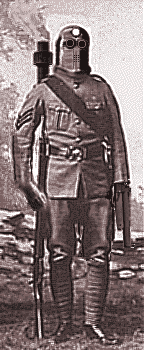 Experimental equipment is often issued to the Hussars. In the past this has included repeating anti-vampire guns (which have so far proved unreliable) and an air-ship mounted electrically-illuminated cross (effective in driving vampires to cover, but too awkward for use in most operations). In a campaign with advanced automata (such as a crossover with Swiss Movement) this includes "Automaton Atkins", a prototype steam-driven mechanical soldier, which works provided that it is given absolutely clear instructions, doesn't trip on uneven ground, and doesn't encounter any surprises. None of these conditions are likely to apply in combat, but the inventors claim to be making improvements; "Atkins" is currently being rebuilt for the sixth time, and it is rumoured that the latest changes will increase its intelligence. Most soldiers believe that this will make it more dangerous to themselves, not the vampires, although it has to be admitted that it is totally immune to most of a vampire's powers. Unfortunately it is also totally literal-minded; if told to guard a door, it would make sure that the door wasn't removed or harmed but would totally ignore anyone using the door. Atkins is actually the most recognisable figure in the regiment; its photograph often appears in illustrated papers, and it has its own strip in Comic Cuts. It is named after "Tommy Atkins", the name used as an example of how to fill in the details of an army pay book. For obvious reasons it isn't deployed until the enemy has been engaged - it can't move quietly and is very conspicuous, so is kept aboard whichever air-ship carries it until needed. Details of "Atkins" are in Swiss Movement, and in the character records below. On operations it usually carries an oversized rifle firing a clip of five .50 silver bullets, 1 shot/round, and has a prototype grenade launcher built into one arm.
As well as soldiers, civilian experts such as priests, psychics, scientists, ghost detectives, and students of the occult are sometimes brought in to help with operations. Typically they are attached one or two to a squad; the squad is generally instructed to keep them safe, and try to stop them making a nuisance of themeselves until they are needed.
Missions
Missions usually begin with the discovery of evidence of a vampire or other supernatural attack. The evidence generally comes from the police and other civilian authorities, but occasionally derives from reports by members of the public (as in the raid described in Kipling's account) or military intelligence. These reports are forwarded to the War Office, which evaluates them and issues orders accordingly. Eventually they end up with the commander of the Hussars, Lieutenant-Colonel K____.
If possible the report should be confirmed or found to be erroneous before a raid begins. If there is time there is usually some reconnaisance, but in cases where there is an immediate threat to children, there are signs of a rapid spread of vampirism, or some other reason to hurry this step is omitted. For example, if there had been more time before the farmhouse raid a party of soldiers would have probably gone in on foot a night earlier and observed the farm from cover for the next 24 hours; if that wasn't possible some men might have visited the farm in the guise of surveyors, picknickers, or whatever else seemed appropriate.
During the reconnaisance period copies of the large-scale ordnance survey maps for the area are procured, if possible; these can be as large as 1:2500 and even 1:1056 (5 ft to the mile) scale in some urban areas. Maps for the main British cities are already on file at Coventry, with a standing order for all updates as they are produced. Coventry also has 1:10,000 scale maps for the rest of the United Kingdom including Ireland. Enlarged plans of the key areas (such as the farm) are drawn from the map, and the terrain and buildings are modelled in a sand-box if time permits.
Once Lieutenant-Colonel K____ has a rough idea of the mission he decides on squadron assignments; for most operations one or two squadrons are used. Typically Second or Fifth squadron conducts the main assault, with First squadron flying cover if needed. While every effort is made to ensure that Second and Fifth take part in an equal number of operations, a certain proportion of operations turn out to be false alarms. For some reason Fifth squadron seems to get more than its fair share of real action. First and Fourth squadrons see a little less action than either, since most operations don't need extra cover or transport. Troops and crew are frequently transferred between squadrons to ensure that everyone has combat experience.
Mission planning begins while the maps and models are being prepared. Any information that's available is checked, if this can be done without alerting the target of the mission; sources consulted might include parish and school records, medical and police reports, etc. The resources committed to the mission may be changed as plans are developed; for example, if it becomes apparent that an escape route must be plugged the First squadron might be added, or the Fourth squadron sent to land troops to close off the route. The first results from reconnaisance may arrive during the planning stage; if there is obvious evidence of supernatural activity, or it is clear that a mistake has been made, the reconnaisance party will if necessary get clear of the area and report in. If this isn't possible, or they still aren't sure of the true nature of the situation, they will wait for the main raid to arrive. So far no reconnaisance party has been lost, although there have been near misses.
Once the plan is clear the squadron commanders (who mostly have the rank of Captain) brief the air-ship commanders (mostly Lieutenants, although there are two Sergeants) and the officers and NCOs commanding the ground troops. In the raid described above Captain T____ commanded the operation and Fifth squadron as a whole, Sergeant R____ commanded the troops aboard Balaclava, Lieutenant P____ commanded the crew of the Balaclava. Theoretically Captain T____ should probably not have boarded the train, since if he had been lost there was nobody left to command the operation; in practice the squadron commander is expected to lead from the front - that's part of being a Hussar - and everyone knew roughly what to do if he was hurt or killed.
If necessary the squadrons involved in the operation transfer to one of the Hussars' auxiliary bases, or to another secure site if that isn't desirable, before the mission begins. Other ranks are issued ammunition and any special equipment that is needed, and briefed on the operation two to three hours before boarding the air-ships for the raid. Typical subjects of a briefing include the nature of the threat, the layout of the area, signals to be used in the operation, etc.
Most operations are run at night, to stop word of the Hussars' movements reaching their target. This is when supernatural creatures are at their most active, but this isn't necessarily a disadvantage; an active vampire or werewolf is much easier to find than one resting peacefully in a well-concealed coffin or lair.
In all operations the main aim is to contain and eliminate the threat, and make sure that it will not recur. For example, if a vampire is found it must be destroyed, its coffin and earth must be incinerated, and anyone infected by it must be treated. Protecting the innocent is important, but if the only choices are to allow an innocent to be hurt or let the vampire escape, the innocent will unfortunately have to take their chances. Several operations have resulted in collateral damage, up to and including the death of civilians; this invariably leads to a formal enquiry, and if necessary to a court martial, but so far no soldier has received worse than a reprimand and transfer to another regiment.
It should be mentioned that not all operations involve supernatural activity; there have been false alarms, hoaxes, etc., and operations against Fenians and other terrorists. Essentially the Hussars are an expensive and extremely mobile force; it makes sense to use them for other duties when things are quiet on the supernatural front. There are also frequent training deployments and exercises with other regiments. Most important, the Hussars are supposed to be as visible as possible when they aren't actually involved in operations, to reassure the public - the pilot who flew a Rapier through Tower Bridge in London a few months after it opened was promoted, not court-martialed.
Air-Ship Construction
The most important technology of this campaign is the air-ship, which is of the æronef design popularised by George Griffith [OA] and other authors.
Note: This section describes the technology of small æronef flying machines only. It would have to be scaled up considerably for the larger Naval designs. The design process is a simplified version of a system originally used in FF VII, but there have been several changes. If you would prefer to use the FF VII air-ships there is nothing to stop you doing so, but the following changes should be made:
FF VII is available on CD-ROM or can be downloaded from www.forgottenfutures.com.
Stripped to their essentials, all air-ships need the following components:
In the stages that follow:
| Weapon | Radius | Effect | A | B | C |
| Shell (Dynamite) | 5ft | 10 | I | C | K |
| Bomb (Dynamite) | 10ft | 15 | I | C | K |
| Incendiaries | 20ft | 6 + 2 / rd. | F | I | K |
The weight and cost of guns includes the pipes etc. that supply them with compressed air, stabilisation equipment, aiming devices, and other accessories. The components that determine a gun's range are a comparatively small proportion of its weight and cost, and are ignored for these calculations.
Guns can only be fired if the engines are powering an air compressor; it takes a full round to get up to pressure, thereafter shots can be fired on alternate rounds. Optionally referees can allow guns to be kept ready to fire, with enough compressed air stored for one shot without starting the compressor - however, the compressed air leaks out after a few hours.
Example: AAS Balaclava
Subtotals: 4.4 tons, 18 PR, £2060 |
Air-ship versus air-ship combat probably isn't going to play much part in an Aerial Hussars campaign; full details can be found in FF VII. Ground combat, and the use of air-ship weapons against ground targets, uses the normal rules; all air-ship weapons are used via the Military Arms skill, for main guns no other skill may be substituted. If more information is required the links below jump to the FF VII air-ship combat rules:
Miscellaneous equipment generally includes searchlights, winches, and sirens; eventually it will also include wireless equipment. There are more specialised possibilities, but these are found in most vessels.
Example: Balaclava
Subtotals: 4.55 tons, 19 PR, £2210 |
Accommodation is of course essential. For naval ships most construction assumes a reasonable level of comfort for the crew, slightly better conditions for the officers and any passengers, and possibly some luxury accommodation for important dignitaries. The weight given for this accommodation below includes an occupant. Additional facilities usually include a galley, mess, wardroom, etc., possibly a saloon, and the bridge; the weights of occupants are not included in these components, since it is assumed that they have accommodation elsewhere. For small air-ships, especially those used by the army, most of these comforts are omitted. Finally, cargo (including ammunition and food for the crew) must usually be carried. Unless noted otherwise, energy costs are negligible.
Example: Balaclava
Subtotals: 10.35 tons, 19 PR, £2430 |
The Hull encloses or supports the components described above plus the engines, propulsion equipment etc.; with the hull itself these components add at least a third of the weight, often more. For example, an air-ship with 15 tons devoted to weapons, accommodation, etc. may need to devote another 8 tons to hull and machinery. For small air-ships (including most army designs) this proportion may rise to half the total design weight. This figure can be varied with experience, but it is a useful first approximation for design purposes. For simplicity this design weight is often rounded up or down to a whole number of tons.
The hull is at least 10% of the final design weight, with various modifiers. Round tonnage up to the next 0.1 tons, MD up to the next full number in each stage that follows; changes are cumulative:
|
Hull Strength
Air-ships have relatively lightweight hulls, and BODY is similarly low. For game purposes the BODY of a vessel's hull is found by the following means (rounding up at each stage): The base BODY is (designed tonnage / 3) plus 5
Normal hulls reduce the Effect of small arms projectiles by 3. Armoured hulls stop small arms projectiles and reduce the Effect of explosives etc. by 6. This is generally not enough to protect a vessel from direct hits. |
| Example: Balaclava
Balaclava has two guns and a seaworthy hull and ram. She does not have a streamlined fairing but is armoured. She initially weighs 10.35 tons, this is rounded down and doubled to a design weight of 20 tons. The unmodified hull adds 20.0 x 10% = 2 tons, £400. Two gun positions add 4% more weight to the hull and 10% more cost = 0.1 tons, £40, taking the hull to 2.1 tons, £440. The ram adds 25% more hull weight and 25% cost = 0.6 tons, £110, taking the hull to 2.7 tons, £550. The seaworthy hull adds 10% weight and 20% cost = 0.3 tons, £110, taking the hull to 3.0 tons, £660 Armour adds 10% weight and 20% cost = 0.3 tons, £125, taking the hull to 3.3 tons, £785 The hull costs are added to the original costs of the ship, 10.35 tons and £2430. Subtotals: 13.45 tons, 19 PR, £3215 The Balaclava's nominal design weight is 20.0 tons, so the base BODY is 7 + 5 = 12 BODY. Two guns add 2 BODY = 14 BODY. The ram adds 10% BODY = 16 BODY. The boat hull adds 10% BODY = 18 BODY. The armour adds 30% BODY = 24 BODY. |
Next engines and wings are added, and the final performance can then be calculated. Air-Ships use two systems to stay aloft; vertical air-screws and wings. Aft air-screws (more commonly known as propellers) are also needed to propel the air-ship horizontally.
| Example: Balaclava
Balaclava needs to lift only 20 tons in total; for this reason three small air-screws are built, each capable of lifting 10 tons (the excess capacity is normal engineering prudence). These air-screws weigh .25 tons each, but still cost £700 to build, for a total of .75 tons, £2100. They will need 60 PR to support 20 tons. Subtotals: 14.2 tons, 79 PR, £5315 |
| Example: Balaclava
Balaclava needs wings to lift 20 tons in horizontal flight; they will cost £400, weigh 0.4 tons, and consume 20 PR when used. Subtotals: 14.6 tons, 99 PR, £5715 |
| Example: Balaclava
Balaclava will need 60 PR for vertical flight, at least 20 PR for horizontal flight, plus power for guns etc. The designer prudently selects a power output of 100 PR, which means that engines weigh two tons and cost £3600. Subtotals: 16.6 tons, 99 PR, £9315 |
| Example: Balaclava
Balaclava carries two tons of fuel, for 1000 PR hrs. Total: 18.6 tons, 99 PR, £9355 |
It is unlikely that maximum power will be needed for all systems simultaneously; vertical screws shut down at high speed, so do not need power, guns can't be manned at high speed. Nevertheless engines are usually designed for this worst-case load, but where margins are tight the maximum likely load (usually power consumption at top speed or the power needed to hover at maximum altitude, whichever is greater, plus the power needed for the guns) is used instead. This usually leads to reliability issues, and is one of the reasons for the problems with the Rapier-class air-ships described above.
Once these components have been selected, and their weight is added to the ship, performance is calculated using the following formulae:
| Example: Balaclava
Balaclava needs 20 PR to stay aloft in horizontal flight and 19 PR for other systems, total 39 PR. This leaves 61 excess PR; dividing by the final weight of the ship (18.6 tons) and multiplying by 20 gives a final speed of 66 MPH. At emergency full speed with everything else shut down there is 80 excess power, for a final speed of |
| Example: Balaclava
Balaclava uses 100 PR per hour at top, and carries 1000 PR hours of fuel, enough for 10 hours at 66 MPH. This gives a maximum range of 660 miles. In practice range is considerably more than this, since the guns rarely need power for more than a few minutes, but it's the most conservative estimate and is used in mission planning. At lower speeds fuel consumption is a little less, but under 30 MPH or so the vertical air-screws must be used, and it starts to rise again. Note that this range can be doubled if the cargo space is used for fuel. |
| Example: Balaclava
Balaclava needs 39 PR for horizontal flight, and her engines produce 100 PR. The excess is 156%, giving a theoretical maximum altitude of 15,600 ft, but in practice is limited to 8,000 ft by the need for oxygen for crew, passengers, and the engines. She can go higher in an emergency, but this isn't safe. When hovering she consumes 79 PR, giving 25% excess power or a maximum altitude of 2500 ft.; this is the maximum altitude at which gunnery is possible. With all other systems off-line she has 66% excess power and can hover at 6,600 ft. |
| Example: Balaclava
Balaclava needs 79 PR for vertical flight, and her engines produce 100 PR. She weighs 18.6 tons. 100/79 = 1.26, .26 x 18.6 = 4.8 tons. She can lift just under five tons (e.g. a field gun supported on cables) but naturally her performance suffers according to the extra weight. |
|
Broadsword class (1895-present - also built as RN Hardy class 1892-97)
This class was intended as the flying equivalent of a torpedo boat, but is now considered too small for naval combat and has become best known as an army vessel. They have a crew of ten, two guns, one Maxim gun, and passenger capacity of twenty soldiers with equipment or four tons of cargo. They have three vertical screws and three aft for propulsion, cruise at 66 MPH with a top speed of 86 MPH, maximum safe altitude 8,000 ft, and have a range of 660 miles in normal use. The armoured hull has a spiked keel for ramming and is 114 ft. long, with the main hull 66 ft. and 27 ft. wide. They are 48 ft. high from the base of the triple keel to the top of the highest vertical screw. At least fifty ships of this design have been built in Britain, and the design has also been sold abroad. A typical example is AAS Balaclava:

|
Creating similar records for the other air-ships mentioned is left as an exercise for the reader. Modelling air-ships of this type isn't difficult, and some brief notes describe the construction of the Balaclava.
| Summary of Air-ship Components | |||||
| Weight tons | Cost Pounds | Power | Crew | Notes | |
| Weapons | |||||
| Gun | 1.5 | 100 | Variable * | 1 | * Square of range |
| 1 | £30 | - | - | 200 10lb. shells. | |
| Bombs (rack 10) | 1 | £100 | - | 1 | Includes release and aiming gear |
| Bombs (pallet 10) | 0.75 | £30 | - | - | 150 lb bombs. |
| Magazine | 0.3 | 30 | - | - | Weight does not include cargo |
| Heavy MG | 0.1 | £10 | - | 1 | Belt-fed Maxim |
| Miscellaneous Equipment | |||||
| Searchlight | 0.1 | £100 | 1 | 1 | Includes signalling gear |
| Winch | 0.1 | £50 | 1 | 2 | Per ton lifted |
| Siren | 0.05 | £50 | - | - | - |
| Wireless | 2.5 | £800 | 4 | 1 | Includes antenna etc. |
| Accommodation etc. | |||||
| Spartan | 0.1-0.15 | £4 | - | - | Compartment with hammocks |
| Crew | 0.2 | £10 | - | - | Cabins for 4 or more |
| Officer | 0.3 | £20 | - | - | Cabins for 1 or 2 |
| Luxury | 0.5 | £40 | - | 1 | Steward required |
| Galley | 0.5 | £100 | 2 | 1 | Per cook, feeding up to 50 |
| Tea Urn | Negligible | £5 | - | - | Heated by exhaust gases. |
| Mess | 0.05 | £2 | - | - | Per crewman accommodated |
| Wardroom | 0.1 | £5 | - | 1 | Per officer/guest accommodated |
| Saloon | 0.25 | £5 | - | 1 | Per person accommodated |
| Bridge | 0.6 | £120 | - | 3 | Add £40 and 0.2 tons per person. |
| Hold | 1.1 | £10 | - | - | Weight includes cargo, hatches, etc. |
| Hull | |||||
| Basic hull | Add 10% | £200 / Ton | - | - | Based on design weight |
| Per gun | Add 2% | Add 5% | - | - | Added to hull |
| Ram | Add 25% | Add 25% | - | - | Added to hull |
| Boat hull | Add 10% | Add 20% | - | - | Added to hull |
| Fairing | Add 5% | Add 10% | - | - | Added to hull |
| Armoured | Add 10% | Add 20% | - | - | Added to hull |
| Power Plant Etc. | |||||
| Vertical screws | 0.5 | £700 | 3 PR/Ton | - | PR is per ton supported |
| Wings | 0.05 | £20 | 1 PR/Ton | - | Weight, MD, and PR per ton supported |
| Turbine engines | Variable | £1800/Ton | 150 PR/Ton | 1 | Power output |
| Fuel for above | Variable | £20/Ton | 500 PR/Ton | - | Stored power |
Referee's Information
Some of this information should be readily available to characters if they conduct a little research; most is game data that should only become apparent in play.
The World of the Supernatural
Vampires
| Magic and MAGIC
FF VIII introduced rules for magic and a new MAGIC characteristic. Optionally this characteristic is the basis for a vampire's powers, and it should be used instead of SOUL. Give vampires (and anything else that needs it) MAGIC equivalent to the SOUL listed below, and record SOUL as zero. Vampire powers should still oppose SOUL, not MAGIC, unless they are fighting someone with magical powers of their own. This optionally allows the use of human magicians, either as vampire fighters or yet another source of supernatural terror. Note that in FF VIII the most powerful magicians are young children. |
In the initial stages of the disease victims are alive but seemingly mesmerized; they may behave relatively normally, but they are suggestible and will always obey the will of the vampire, even if it means certain death. Some vampires seem to maintain psychic control of these victims, and can give them instructions telepathically and see and hear what the victim hears, even at great distance. Almost all vampires maintain several servants in this state; they can still feed on them, if they are given time to recover, and they will defend their master to the death.
At this stage the disease can be treated with silver and mercury compounds similar to those used for syphilis. Roughly 80% of patients recover, about 5% suffer permanent injury such as partial paralysis caused by the infection and its cure. The rest die (but do not arise as vampires). These chemicals are also used to treat more recent victims of vampire bites; about 95% recover, about 1% are crippled to some degree, the rest die.
Eventually, if untreated, the disease takes a firmer hold and enters the next phase, a prolonged death-like coma leading (usually) to death, but occasionally to rebirth as a fledgling vampire. Many vampires are buried while in this state, breaking out of their coffins days or weeks later. In this state the victim is virtually an animal, driven mainly by its desire to feed, and is already much stronger than a normal human. Mature vampires will generally kill or enslave these fledglings, since they are competition for food and attract unwanted attention. fledglings are harmed by any bright light (it harms their eyes and causes skin cancers which can eventually lead to the creature's final death) and generally become nocturnal. They are still very suggestible; for example, they often believe that they should be repelled by crosses, harmed by holy water, etc., and suffer psychosomatic damage if these "weapons" are used. Other weapons are far less effective; vampires may or may not be dead (the point is still debated) but they are extraordinarily tough, and injuries that would kill a normal human regenerate almost instantly. They die if the spine is severed or the heart is permanently stopped (as by a dagger or stake left in the wound; gunshots rarely do enough damage, and the wound quickly regenerates). Certain chemicals (including silver nitrate, mercury and cyanide compounds) are also lethal, but a large dose is needed. Garlic is useless. Two other myths about vampires are also untrue; they can enter a dwelling without being invited, and cross running water.
Vampires seem to heal more rapidly if they burrow into the earth in which they were originally buried, and generally try to keep some for emergencies; there is reason to believe that this earth contains spores which can cause the vampiric disease.
If the fledgling is allowed to mature for several years it gradually becomes less suggestible, and loses much of its vulnerability to light and "holy" objects. It also gains a level of self-control and becomes much stronger - a mature vampire is stronger and faster than a tiger. Although it will never be comfortable in daylight, dark glasses, normal clothing, and a hat are enough to prevent immediate harm. It also gains mesmeric and psychic powers, although they are weaker than those of an old vampire. Part of their mesmeric power is the ability to look like a healthy person, not a rotting quasi-corpse; since this is an illusion affecting the mind of the observer, it works even in a reflection, though it may break down if the vampire is trying to look human to dozens of observers.
Truly old vampires have all of these powers, and can mesmerize others without infecting them. There are also largely-unconfirmed rumours of other powers, such as changes of form, mesmeric control of animals such as wolves, bats, and rats, and extraordinary climbing abilities; vampires are described as hanging from walls and ceilings by their fingers, and Dracula was seen to climb down a sheer wall head first.
Typically a long-established vampire lair will consist of an old vampire, at least one or two mature vampires which act as its lieutenants (but are still to some extent under its control), several fledglings, and a good supply of enslaved victims, used as servants and for food. Often this is set up so that one of the lieutenants seems to be the master.
While the course of infection described above is relatively slow, a vampire could deliberately speed things up to recruit an army; for example, it could infect more people than it needs to feed on, just to gain control of an area, or create several fledgling vampires, infect them, and use them to spread the epidemic more rapidly.
This isn't necessarily the only way vampirism can develop; there are rumours of vampires that are psychic parasites, become invisible, or have other strange powers. All the vampires encountered in Britain derive from the same strain, shown at its most powerful in Count Dracula.
Game Data
All vampires, regardless of their age, have certain immunities and vulnerabilities:
| Wound | Body | Recovery Period | Recovery DIFFICULTY |
| Bruised | - | 1 round | 1 |
| Flesh Wound | -1 | 1 minute | 2 |
| Injury | -2 | 1D6 minutes | 3 |
| 2+ Injuries | -3 | 2D6 minutes | 4 per injury |
| Critical | -3 | 3D6 minutes | 4 |
| Knocked out | - | 1D6/2 minutes | 2 |
| Effect | A | B | C | |
| Cut from silver weapon | 1+1/2 rounds * | F/I | I | C/K |
| Silver bullet | 3+1/2 rounds * | F/I | I | C/K |
| Silver nitrate injection | 6+1/round ** | F/I | I | C/K |
| * Per cut or per bullet
** Per medical dose of silver nitrate Multiple wounds or doses have cumulative Effect | ||||
These are various stages of the infection, from a newly-reborn hatchling vampire to The Count himself.
| Wounds | B | F | I | I | C |
| Effect | A | B | C | |
| Direct sunlight | 3+3/round | F/I | I | C/K |
| Thick cloud/window | 2+2/round | F/I | I | C/K |
| Wounds | B | F | F | I | I | I | C |
| Effect | A | B | C | |
| Direct sunlight | 2+2/round | F/I | I | C/K |
| Thick cloud/window | 1+1/round | F/I | I | C/K |
| Wounds | B | F | F | F | I | I | I | I | I | C | C |
| Effect | A | B | C | |
| Direct sunlight | 2+1/round | F | F/I | I/C |
| Thick cloud/window | 1+1/2 rounds | F | F/I | I/C |
| Wounds | B | F | F | F | F | I | I | I | I | I | I | C | C | C |
Dracula is an extremely powerful vampire, with three unusual abilities:
| Effect | A | B | C | |
| Direct sunlight * | 1+1/2 rounds | F | F/I | F/I |
| Thick cloud/window | 1+1/3 rounds | F | F/I | F/I |
While the vampires above are typical of the main "species", there are numerous variants - psychic vampires which drain life-force and age their victims but don't drink blood (see e.g. The Vampire in FF VI), vampires and ghouls which eat human flesh as well as drinking blood, and anything else that appeals. The main European line has the general features described above because all vampires were infected by Count Dracula or other vampires of the same type, but there may be other strains of the disease elsewhere in the world.
Werewolves
As the disease progresses the time spent in bestial form increases until the change is permanent and irreversible. In its early stages the disease can be treated with mercury or silver compounds, but these become ineffective in medicinal quantities as the infection progresses. Werewolves have the same vulnerabilities as vampires, with two exceptions; they are not harmed by sunlight (although they are primarily nocturnal in animal form) and show no reaction to holy objects since they have no conscious intelligence and are unable to recognise their significance.
The Loch Ness Monster
Ghosts
The "psychic infections" described in FF IV could also be an explanation for vampirism; rather than a true disease, it is a form of Saiitii manifestation which infects living and once-living matter. See FF IV and William Hope Hodgson's Carnacki The Ghost Finder for more details.
The Awful Truth
He takes very little harm from daylight:
The sudden upsurge in werewolf activity has also been caused by Dracula. His powers can affect animals and the feeble-minded, and in their animal phase werewolves are easy prey. Although he doesn't think of it in such scientific terms, he is able to plant post-hypnotic suggestions which make their human forms find reasons to travel to Britain. Again the fiercest of these creatures have yet to arrive in Britain; compared to what is to come, the werewolves seen so far will seem like fluffy bunnies.
A side-effect of Dracula's power is the weakening of certain psychic barriers which protect our world from the supernatural. The upsurge in ghostly activity is the result. Dracula has no control over this, it's simply one of the things that happens when there are powerful vampires around.
Finally, Dracula has no power over the Loch Ness monsters; it's just an odd coincidence that one should become aggressive at this time. The remaining monsters aren't a threat to anyone unless disturbed - unfortunately the Zoological Society is planning to do exactly that...
Campaign Development
An Aerial Hussars campaign should begin with a bang, and emphasise action, adventure, and occasional tragedy. Nobody (including the adventurers) is safe, and carelessness usually ends in death. Long-term goals for the adventurers may be as simple as surviving, finding a way out of this nightmare and into another regiment without appearing to be a coward, or (if all else fails) dying as heroically as possible. Victory should not be assured; even one overlooked vampire can eventually create an army.
One route through such a campaign is a "crescendo of doom" approach; things seem to be manageable at first, then gradually the situations spins out of control. At first vampires are eliminated relatively easily and casualties are light, but things gradually get darker, with the death toll rising, more civilian casualties, and angry questions asked in Parliament and The Times. The vampires learn from their mistakes, and start to set traps for their erstwhile hunters.
Encourage the players to respond by developing new weapons and tactics, possibly by introducing new characters who will look for scientific or magical solutions to the problem. Mix in occasional missions that have nothing to do with the main vampire threat, and false trails that lead to more mundane enemies of the state.
Finally the climactic fight of the campaign; if the adventurers foul up this may end with Dracula victorious and free to conquer Britain (see Kim Newman's Anno Dracula), but ideally Dracula should be killed, at immense cost, and a large part of London (or some other major city) should be trashed in the process, with vast loss of life. The Hussars are severely mauled, with at least 50% casualties. Make this as cinematic and spectacular as possible; Dracula is a monster, and his hideous form will finally be revealed during the battle. Eventually he is dead, and supernatural activity quickly slackens off then seems to end completely. The remnants of the Hussars are praised, decorated - then quietly pensioned off or shipped overseas to join obscure regiments in remote corners of the Empire, an embarassment to the War Office and Government now that the crisis seems to be over.
As an epilogue, the Hussars may eventually be reunited in the Great War, fought from the outset with air-ships, where they can experience real horror, made worst by the fact that it is entirely the work of humanity...
Adventures
This disease seems to be a variant of vampirism, but werewolves lack the psychic abilities of the vampire. Instead the disease causes uncontrollable rage and blood-lust, great strength, and a reversible transformation to a bestial form. It appears to be highly infectious, carried by saliva entering the blood. The symptoms recur at roughly monthly intervals which appear to be linked to phases of the moon. The idea that werewolves are wolf by night and man by day is a myth; the werewolf remains in animal form for at least two to three days, sleeping in a lair by day. Incidentally, a werewolf doesn't look much like a real wolf; it's a fast, semi-humanoid thing, fearsome in appearance, and an anatomist given the opportunity to examine a corpse would say that it was a hitherto-unknown hominid, not any form of canine animal.
All werewolves have certain immunities and vulnerabilities:
Older werewolves gain in body and the lethality of their attacks, and in their resistance to injury, with the length of time they stay in wolf form increasing as they gain power. Eventually they are permanently monsters. Just as there are variant vampires, there may be variant werewolves; some possibilities include retention of intelligence, a more perfect transformation into wolf (or another animal form), and extremes of size and ferocity.
Wound Body Recovery
PeriodRecovery
DIFFICULTYBruised - instantaneous 1 Flesh Wound -1 1 round 2 Injury -2 1D6 rounds 3 2+ Injuries -3 2D6 rounds 4 per injury Critical -3 3D6 rounds 4 Knocked out - 1D6 rounds 2
If a werewolf is killed by silver the wounds smoulder and it will eventually burst into flames.
Effect A B C Cut from silver weapon 1+1/2 rounds * I I/C C/K Silver bullet 3+1/2 rounds * I I/C C/K Silver nitrate injection 6+1/round ** I/C C K * Per cut or per bullet
** Per medical dose of silver nitrate
Multiple wounds or doses have cumulative Effect
BODY [6], MIND [1], SOUL [1],
Athlete [6], Brawling [8]
Fangs, Effect [8] A:F, B:F/I, C:C/K *
Claws, Effect [7] A:F, B:F/I, C:F/I **
* All bite wounds contain the lycanthropic infection, which must be treated as a disease.
** Claw wounds are infected on an I result.
Equipment: -
Wounds B F F I I I C
Quote: "Arrrurrr!"
Notes: This is a new werewolf, but is already a savage and vicious animal. It is active on the night of the full moon and for one night before and afterwards, sleeping (in wolf form) by day. Note that statistics may be very different in its human form.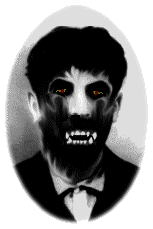 10 year old werewolf
BODY [8], MIND [1], SOUL [1],
Athlete [6], Brawling [10]
Fangs, Effect [10] A:F, B:I, C:C/K *
Claws, Effect [9] A:F, B:F/I, C:F/I **
* All bite wounds contain the lycanthropic infection, which must be treated as a disease.
** Claw wounds are infected on an F or I result.
Equipment: -
Wounds B F F F I I I I C
Quote: "Arroooogh!"
Notes: This werewolf is experienced and possibly more cunning, but still an enraged animal in wolf form. It is active for 1D6 nights either side of the full moon, sleeping (in wolf form) by day.
A gigantic reptile nearly a hundred feet long, it appears to have no "supernatural" origin; it's just a big animal. There have been rumours of similar creatures in South America. So far only one has been killed, after it sank a paddle-steamer and knocked one of squadron Five's air-ships out of the sky as it hovered over the Loch. There have been several sightings since the creature was destroyed, but the monsters reported are much smaller and their behaviour seems to be shy rather than aggressive. Dissection of the monster that was killed showed that it had a brain tumour which may have made it unusually vicious. Currently the Hussars have no plans to resume operations against the smaller monsters, but the Zoological Society is planning to trawl for one.
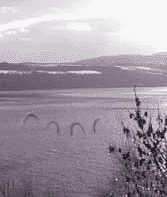 Loch Ness Monster
BODY [30], MIND [1], SOUL [1],
Athlete (swim) [22], Athlete (crawl) [5], Brawling [20]
Fangs, Effect [22] A:I, B:C, C:K
Head bash, Effect [30], A:C, B:C/K, C:K
Tail bash, Effect [25], A:C/K, B:K, C:K
Extremely thick scaly skin, -4 to all attacks
Equipment: -
Wounds B F F F F F I I I I C C
Quote: "Roooogghhyhh" (VERY deep)
Notes: A giant sea serpent in a freshwater variant. Extremely tough - it has thick scaly skin, and optionally heals as fast as a werewolf. While it normally prefers to live underwater, it can move on land (like a snake) if it has to but is slow. It can rear nearly fifty feet into the air, and raise its tail nearly as high. It can leap even higher, but must spend a round underwater first.
Ghosts exist, and in a few rare cases are hostile. There seems to be no obvious connection to other forms of the supernatural, and following some unsuccessful attempts to use military force against them it is generally accepted that they are a specialised problem, best left to "ghost detectives", exorcists, and other specialists. See FF III and FF IV for more on ghosts.
The reason for the sudden increase in supernatural activity is simple; Dracula isn't dead, although Van Helsing, Godalming, and their friends caught up with him in Transylvania and believe that they killed him. In fact he was paralysed by his wounds, and buried alive near his castle. He will take years to recover, but meanwhile he retains his psychic powers. Over hundreds of years he has created many lieutenants throughout the world, and now he is starting to organise them for a concerted assault on Britain. Most are unaware of his control; they believe that moving to Britain, or becoming more active if they are already in Britain, is their own idea. In turn they have infected their own lieutenants with the same idea. So far only relatively small fry have come to the attention of the authorities; most can't even walk by day, and are easily revealed by mirrors or psychics. Eventually much more formidable opponents will arrive. Ultimately Dracula himself will return, transformed by his prolonged regeneration into the next (and so far unseen) phase of the disease; a gigantic and virtually unkillable monster with immense psychic powers and an enormous appetite for human life-force.
BODY [14], MIND [5], SOUL [10],
Athlete (climb/run) [12], Brawling [17], Business [6], Linguist (English, Russian, French, Polish, German) [8]
Fangs, Effect [16] A:F, B:F/I, C:C/K *
Claws, Effect [16] A:F, B:F/I, C:F/I *
* All bite and claw wounds contain the vampiric infection, which must be treated as a disease.
Equipment: Good clothing, coffin or grave, at least twenty alternative burial sites, £5000 hidden in various locations, carriage or automobile.
Wounds B F F F F F I I I I I I I C C C C
Quote: "Children of the night, what music they make! Ah hah hah hah!"
Notes: Use the notes above, with the following changes:
This version of Dracula is telepathic, and can hypnotise anyone at a distance by overcoming their SOUL. The only requisite is that he must have met the person he is hypnotising at least once. He is using his powers to control or influence dozens of vampires and werewolves across Europe, and once he returns will usually be accompanied by swarms of mentally-controlled rats, wolves or dogs, and a few human slaves. His illusory appearance is usually that of a handsome young European nobleman, and can be varied at will. His real appearance is so vile that anyone seeing him must use SOUL to overcome DIFFICULTY 6 to avoid vomiting; in a melodramatic campaign ladies will always swoon.
* Treat as Thick cloud/window if he is wearing dark glasses.Effect A B C Direct sunlight * 1/2 rounds F F/I F/I Thick cloud/window 1/3 rounds F F/I F/I
 Eventually it should become apparent that the vampires are paying especial attention to Van Helsing and the other survivors of Dracula's visit to Britain, and someone should guess that he is not as dead as was believed, but is somehow influencing events from afar. This should lead to an attempt to destroy him in his grave, if he is still there, or track him down and destroy him if he has already emerged. Needless to say there will be plenty of opposition, from Transylvanian officials who really don't want soldiers of a foreign power rampaging through their country to the hordes of the undead controlled by Dracula. And by the time the grave is unearthed Dracula is gone, heading across Europe towards England. The map shows Europe (including Transylvania) and may be useful, although it should be noted that for the purposes of one of the adventures elsewhere in this collection Romania (due South of Transylvania) has been replaced with Ruritania!
| Red: | Begin attack: air-ships fire star-shell, soldiers to open fire if the target is visible. |
| Blue: | Enemy is moving in direction of flare, all units attack. |
| Yellow: | Regroup and board air-ships. |
| Green: | Cancel attack, all units stand down. |
| White: | Cease firing, remain alert. |
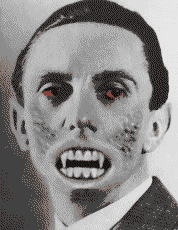 Things go as planned at first, but there are minor snags - the ridge is fairly steep and dry leaves are everywhere, scrambling up it without lights and without making a noise is rather difficult, and the train doesn't delay as long as was planned; by the time the soldiers reach the top of the ridge it's already chugging off to the North-East, and an eerie silence rapidly descends on the scene. More seriously, the half moon shows that the layout of the farm has changed since the map was drawn; the building indicated as "barn?" no longer exists, and the "wood shed?" has obviously been enlarged; there is now a rutted track linking it to the lane. The buildings are almost completely dark, the only exeception is a light in an upper window of the farm house. Someone will probably want to use binoculars to get a better look, but the angle and thick net curtains make it impossible to see anything.
Suddenly the door of the "wood shed" swings open, and a dark figure leads a horse and wagon out onto the track, holding a lantern in his hands as he tends to the horse. As he steps into the light his face is revealed - and Kipling cries out in shock, alerting the vampire to their presence before they are ready to attack! Needless to say, this will not go into his account of the raid. Although someone shoud soon fire a red flare, the element of surprise is gone and the vampire is on the move by the time the first shots are fired.
| Troubleshooting: If the adventurers have taken the precaution of stopping traffic on the railway line the vampire won't try to escape this way, but will instead try to get to the trees, climb a tree as rapidly and silently as it can, and ambush its pursuers. This is likely to lead to a shorter fight, and may be a little less entertaining than the suggested course of events, but players should be rewarded for thinking of blocking this escape route. |
The layout of the train is as follows:

| Fireworks (Crate) | Radius | Effect | A | B | C |
| Burning | 5 ft | Effect 5 | F | I | I/C |
| Exploding | 5 ft | 8 | F | I | C/K |
| Oil (Barrel)) | |||||
| Burning | 10 ft | Effect 6+2/Rd | F | I | I/C |
Try to keep the situation in and on the train as tense as possible, especially when in tunnels - Spencer will move if he senses humans coming close, attack if he can get someone alone, and fight to the death. The "Kipling" article gives one example of how to deal with him; in play-testing soldiers went through the wagons, as well as on top of them, to make sure that he could not escape, and their officer narrowly escaped having his throat torn open when he lifted the canvas on one of the wagons a little too carelessly.
Eventually Spencer should be killed and the train stopped; after a quick clean-up the officer in charge should order a return to the farm and completion of the mission there.
There are some discoveries waiting back at the farm: these can be made by the player characters, or by other soldiers, as you prefer. The train fight should have taken no more than fifteen or twenty minutes, although playing it out will probably take longer, so it isn't entirely unreasonable for the other soldiers to wait for their commanding officer before searching the farm. More evidence of vampirism will be found:
Mopping up should include an abortive hunt for the source of the infection - it was a passing gypsy, one of Dracula's brood, although the adventurers will never know that.
 Douglas Spencer
| Wounds | B | F | F | I | I | I | C |
| Effect | A | B | C | |
| Direct sunlight | 2+2/round | F/I | I | C/K |
| Thick cloud/window | 1+1/round | F/I | I | C/K |
 Tramp
Tramp
| Wounds | B | F | F | I | I | C |
| Effect | A | B | C | |
| Direct sunlight | 3+3/round | F/I | I | C/K |
| Thick cloud/window | 2+2/round | F/I | I | C/K |
 Esther Ellis
| Wounds | B | F | F | I | I | I | C |
| Effect | A | B | C | |
| Direct sunlight | 3+2/round | F/I | I | C/K |
| Thick cloud/window | 2+1/round | F/I | I | C/K |
 Lavinia Spencer
| Wounds | B | F | I | I | C |
The Guinea-Pig
The eminent scientist Louis Pasteur of France believes that he can create an innoculation against vampirism, similar to the procedure used to treat rabies. To prepare it he needs an infected victim of the disease, someone who is still alive and in the early stages. This patient won't be cured - he needs someone who is going to go through all of the stages of the disease, without silver being used to prevent it. This would be considered unethical if it became public knowledge, but the situation is desperate enough that the French are prepared to try it.
The French don't have a suitable patient, but Britain does; the child Lavinia Spencer (above) who is rapidly succumbing to the disease. Just as she's about to be injected with silver the procedure is stopped, and the Hussars are given orders to take her to Pasteur in France. She's already delirious and highly infectious, so civilian transport can't be used; she's to be flown to his clinic aboard Balaclava. The adventurers must work out how to keep her isolated and under control during the flight. Once they reach France their problems should be over, but Pasteur's clinic isn't quite ready for this "guest"; it will take him another day to prepare a secure room for her. Of course things could go faster if the Hussars help.
Somewhere along the way the adventurers should learn exactly what is planned for Lavinia; Pasteur intends to keep her alive as long as possible and use her blood (injected into guinea pigs) to create the vaccine. Throughout the procedure, which will last months, she'll probably be in pain since drugs might affect the vaccine. Are the adventurers prepared to go along with this, and how will the British Government (or the public) react if the news comes out?
Broadsword Down
Winter: Returning from a navigation exercise over the Yorkshire Moors, AAS Balaclava suffers a catastrophic turbine failure which sends blades ripping through the engine room and hull, killing or wounding all the engine room crew. The pilot manages an emergency landing but the impact takes out the other turbine, screws, and power plant (which means that the guns and electrical equipment won't work) and rips the hull open. As the survivors assess the situation it starts to snow, gently at first but gradually becoming a blizzard as the sun sets. The adventurers and a few expendable NPCs are the only ones fit enough to travel under these conditions, and people are probably going to start dying if they don't get medical help and warmth. It's unlikely that the air-ship will be seen from the air while the storm lasts, The navigator has a rough idea of their location, about twenty miles from the nearest village, ten from the nearest farm, and it should be obvious that someone should set out to get help.
Let the adventurers get about five miles before a wolf starts howling... If none of the adventurers go off for help, the NPCs that do will soon be wolf fodder.
The werewolf isn't unusually cunning - but there are two of them, working together as a "pack" to catch their prey. Use the statistics for an average new werewolf, above. If the hold has been left unguarded at least one of the wolves will enter it to eat the bodies.
Remember that they will leave tracks in the snow. However, the blizzard seems to be lasting a long time, and tracks only last an hour or two before they are obliterated. They will also cross each other's tracks occasionally, making them much more confusing.
Whatever the adventurers do, there won't be any rescue until mid-morning two days after the crash, unless someone gets out to the village and gets help. The farm is a burned-out ruin - nothing to do with werewolves, the last tenant just got careless with an oil lamp. There are still a few useful tools such as a rusty scythe in the ruins. Other than that the place is useless, and further from the village than the original crash site.
Ladies Night
After a long absence Professor Van Helsing has returned to Britain, bringing with him a young woman whom he claims is the latest of a long line of mystically-selected vampire hunters. The girl seems to be confused, extraordinarily strong, and speaks a strange American variant of English which seems almost unintelligible to British ears. But can she kill vampires? There's only one way to find out...
Of course the girl could be exactly who Van Helsing thinks she is, but it's more fun if he's completely mistaken: Recommended reading and viewing:
In play-tests one of the Hussars was young "Bob", who was a mystically-selected female vampire hunter (masquerading as a somewhat youthful-looking corporal with the aid of the regiment's medical officer and a false moustache), who had some interesting reactions to the "imposter".
| Bram Stoker | Dracula |
| Bram Stoker | Dracula or The Un-Dead (play) ed. Sylvia Starshine |
| Garth Ennis (& others) | Preacher (Vertigo comics) |
| George Griffith | The Outlaws of the Air, The Angel of the Revolution, Olga Romanoff, The World Peril of 1910 |
| Kim Newman | Anno Dracula, The Bloody Red Baron, etc. |
| Brian Stableford | The Empire of Fear |
| Channel 4 TV | Ultraviolet |
| Mutant Enemy | Buffy The Vampire Slayer (especially season 4) |
| Hammer Films | Captain Kronos: Vampire Hunter and numerous Dracula films |
Acknowledgements:
Steve Flanagan wrote the motto. He and other members of the Society of Science Fiction and Fantasy Wargamers, and users of the Cix and Steve Jackson Games RPG conferences, made numerous helpful comments and suggestions. Douglas Spencer gave a very generous donation to charity to appear here as a vampire. Some pictures in this article are edited from copyright-expired sources, other sources include a model built by the author, edited photographs of various murderers and deceased murderous politicians, and various other images found on line.
The march at the end of "With the Night Raid" is actually Sousa's "The Rifle Regiment" (1886). Extracts from this and many other Sousa marches can be found online in MPEG and MIDI format.
Alternative Campaign - A Flight of Monsters
You don't really need air-ships to fight vampires, since they are either incapable of flight or next to impossible to intercept when flying; air-ships are convenient for quick deployment, but you could fight this battle without them. If you would prefer a more challenging foe that needs to be fought in the air, one interesting possibility is dragons.
FF VIII included several varieties of dragon, ranging from wise magical creatures to unthinking killers. Of these the most suitable opponent for an airborne campaign is probably the green dragon, ranging in size from microscopic to larger than a house. For convenience their statistics are reproduced below, but some changes have been made to the description of their habits and life-cycle to support a longer campaign:
Green Dragon
| Stage 1: BODY [-], MIND [-], SOUL [-] | Wounds: All wounds kill - no armour |
| Stage 2: BODY [1], MIND [1], SOUL [-] | Wounds: B [ ] I [ ] C [ ] All wounds injure - armour -1 |
| Stage 3: BODY [2], MIND [1], SOUL [1] | Wounds: B [ ] F [ ] I [ ] C [ ] Armour -2 |
| Stage 4: BODY [4], MIND [1], SOUL [1] | Wounds: B [ ] F [ ] F [ ] I [ ] C [ ] Armour -2 |
| Stage 5: BODY [6], MIND [1], SOUL [1] | Wounds: B [ ] F [ ] F [ ] I [ ] I [ ] C [ ] Armour -3 |
| Stage 6: BODY [10], MIND [1], SOUL [1] | Wounds: B [ ] F [ ] F [ ] I [ ] I [ ] I [ ] C [ ] Armour -4 |
From Nature, February 1900:
The exact life-cycle of the green dragon is unknown, but it is clear that it is a voracious omnivore, with the later stages preferring meat to vegetable food, rapidly increasing in size from a microscopic organism if food is available.
The first stage is almost microscopic, the second about the size of a newt, the third like a large lizard, the final stage about the same size as a small air-ship. The larger stages have been seen eating their smaller brethren, which may help to explain why the largest sizes are comparatively uncommon. Similar self-predation has been seen in animals such as the Xenopus toad, in which the tadpoles eat algae and the majority are in turn consumed by the adults.
Typically dragon infestations begin in a freshwater pond, with the smallest young consuming algae, microscopic worms, and other organisms. Even at this stage they are capable of flight, and they soon begin to leave the water for short periods to attack midges and other small flying insects, rapidly moving on to flies and the larger flying beetles. At this stage spraying their ponds with oil sometimes eliminates the problem, but typically they aren't noticed so early.
Eventually they reach a size which allows them to eat larger worms, slugs, and the biggest insects, moving rapidly on to small vertebrates such as birds and mice. The ability to breathe flame gives them a crucial advantage; they can breath fire into the prey's face, searing its lungs and eyes, follow it until it dies, then eat it at their leisure. It's at this size that they are typically first noticed by the public, but it is already too late to spray water sources (except, possibly, to stop later generations); all but the smallest dragons are terrestrial.
At the fourth and subsequent stages they are willing to attack larger animals such as cats, dogs, sheep, and children, while the largest will attack adult humans and animals up to their own size; in India they have even been seen attacking elephants, though the usual result is a trampled dragon. Fortunately dragons this large are comparatively rare. Most are killed by larger dragons earlier in their lives, and the smaller stages are also hunted by flying predators such as sparrow-hawks and eagles; their fire gives them no advantage if they are taken in a surprise attack. The largest stages are only vulnerable to man and to other dragons.
Although dragons have been an occasional threat throughout recorded history, the species declined and was thought to be on the verge of extinction in the early middle ages. It is only in recent years that they have recovered and become a serious problem. Professor Clatterhorn believes that some byproduct of modern life, possibly effluent released by industry, stimulates their reproductive processes and encourages the spread of the species; it's notable that dragons are still comparatively rare in remote areas without industry. What is certain is that their attacks are now so common as to constitute a threat to modern society...
Previously very rare, dragons have been seen as a serious menace since the 1880s; the small ones are as common as wasps, the larger stages attack often enough that children are never allowed out alone, and almost all adults carry shotguns, rifles, or pistols when they venture outdoors. In Britain this is not considered a desirable state of affairs; outdoor activities such as farming are severely affected, while firearm-related crimes and accidents are becoming a daily event. Sheep and cattle must now be kept in sheds with asbestos or slate roofs and armed guards, and due to the danger this adds to outdoor activities all food costs have soared. Several trains have been derailed after running into dragons - for some reason they seem to like to land on the tracks - and numerous wild species are on the verge of extinction.
The Aerial Hussars were formed as a response to this threat; their mission is to track down and exterminate the largest dragons, help scientists who are researching the problem, and (possibly most important) improve morale by showing that something is being done.
For this campaign the special weapons described above are replaced by conventional machine guns and rifles. Other weapons that might be used include harpoons (killing a dragon and allowing its body to drop into a city is generally considered undesirable, so they are towed to safe dumping grounds for disposal), nets, lassoos, etc. The Hussars are supported by a network of fire-proof signal posts on the ground, with coded lights or flares directing them towards dragons as they are spotted. Most battles are fought in the air, with the guns and machine-guns the primary weapons in the attack. Soldiers are still needed to defend the decks of air-ships and to take out dragon nests, typically found in caves, ruins, and other inaccessible locations, but the most useful player characters are probably pilots, gunners, etc. Useful equipment might includes asbestos oversuits (Reduces Effect of all fire -3, reduces Athlete, Brawling, and other BODY-related skills -1), armour and other protective clothing, and heavy-duty fire extinguishers and fire pumps.
For an interesting complication, there is something about dragons that makes them useful; for example, something that big shouldn't be able to fly, maybe a natural anti-gravity chemical is secreted in their bodies and is vital for Britain's defences. Only the largest dragons contain enough to be worth extracting. The Hussars work to keep the dragons under control and maximise production, not to exterminate them completely. Sometimes they must fend off foreign poachers, especially the French. In this variant the Hussars will be accompanied by factory air-ships, possibly crewed by civilians, equipped to process the carcasses and extract the glands containing the precious chemical. Think of the grandeur, the spectacle, the smell...
Useful sources for such a campaign include FF VIII, the film Reign of Fire (though the ecology of dragons shown in this film seems somewhat dubious), and the RPG supplement GURPS Dragons (Phil Masters, Steve Jackson Games 2004).
Appendix: Sample Characters
The following characters were used in play-tests:
Referee note: Having survived (and forgotten) a vampire attack when he was a small child, Sergeant McClean suffers from a rare form of vampirism, which has been in remission for centuries; he has gained vampiric healing without (so far) any of the other symptoms of the disease. However, he is still a carrier, and his blood will spread the disease. If he is seriously injured or exposed to vampiric infection again the disease may set in properly; if he is treated with silver or mercury he will be poisoned